Rashi Sood et al, International Journal of Computer Science and Mobile Applications, Vol.5 Issue. 9, September- 2017, pg. 15-22 ISSN: 2321-8363 Impact Factor: 4.123
ENHANCED HOMOMORPHISM
ENCRYPTION TECHNIQUE
FOR CLOUD COMPUTING
Rashi Sood
1, Munish Katoch
2 1Research Scholar, [email protected] 2Assistant Professor, [email protected]
Abstract: To emphasize FHE encryption device for key management and key sharing. For cloud data security the improvement evidence is based on Diffie-Hellman, SHA-128 and OTP method. The OTP will generate through Email. In this we will undertake to formatting new modal for key sharing and key management in fully Homomorphic Encryption scheme. In this paper, we are using the symmetric key conveying algorithm named Diffie Hellman, it is kind of key replacement algorithm with create session key who endue to communicate with each other between two parties and here, SHA-128 is used for the intelligence uprightness OTP(One Time Password) is created which helps to give much security.
Keywords: Homomorphic, Encryption, Cryptographic, Authentication, Integrity.
1. Introduction
Rashi Sood et al, International Journal of Computer Science and Mobile Applications, Vol.5 Issue. 9, September- 2017, pg. 15-22 ISSN: 2321-8363 Impact Factor: 4.123
The cloud controller handles the mobile client demands for giving relating cloud administrations. It can be finished up from the investigation of come past reports that the security and privacy change in cloud administrations may build the cloud's subscribers [8]. The essential parameters that should be considered while designing a security plan for mobile cloud processing environment are computational complexity of security plan and resource confinement of the mobile gadget. On the other hand, few security plans are concentrating on the decrease of the computational complexity of the cryptographic algorithms. Be that as it may, the decrease of the computational complexity of cryptographic algorithms may influence the privacy of the transferred information[9]. For offloading of information access operations, the majority of the current plans depend on proxy re-encryption. Despite the fact that the proxy re-encryption plans give backing to offloading of computationally concentrated re-encryption operations, the mobile client needs to play out the encryption and decryption that include huge augmentation and exponential operations of expansive numbers.
2. Cloud -Manager-Based Encryption Scheme (CMRES)
By joining the qualities of the manager based re-encryption and cloud-based re-encryption collaborate, the scheme proposed a cloud-manager-based re-encryption sketch for offloading the complex calculation ownership on the trustworthy-entity and cloud. . Moreover, from the exploratory results presented in next areas, this can be inferred that the energy consumption amid cipher and decipher is directly equivalent to the extent of the record. Increase in document size likewise increases the aggregate number of encryption and decryption operations with constant re-encryption operations. Therefore, there is a need of security plan that can offload the ciphering and deciphering venture on the cloud/outsider in a trusted mode. In the proposed CMReS, the encryption, decryption, an offload the ciphering and decryption venture on the cloud/outsider in a trusted mode. In the proposed CMReS, the ciphering, deciphering, an re-encryption assignments are appropriated between the trusted entity and cloud. There are four fundamental modules in this system, to be specific
(a) Cloud client application facilitated on the mobile users.
(b) Encryption/Decryption Service Provider (EDSP) module facilitated on private cloud inside the client association.
(c) Re-encryption Service Provider (RSP) module facilitated on public cloud. (d) Cloud repository applications obtainable on public cloud.
Rashi Sood et al, International Journal of Computer Science and Mobile Applications, Vol.5 Issue. 9, September- 2017, pg. 15-22 ISSN: 2321-8363 Impact Factor: 4.123
authorized mobile user. The RSP module just holds the re-encryption keys of the cloud users having a place with the same virtual association for giving re-encryption services. The exceptional feature of the plan is that the RSP is hosted on the cloud and gives re-encryption services without knowing the private keys of the mobile of this document is located in users.
3. Literature Review
“Cloud Computing Security Using Encryption Technique” (Geethu Thomas, 2010). In this paper they presented that the cloud computing is very efficient technology or important field used for data storage due to its efficiency and flexibility. The cloud provides different types of services to the user and the architecture is also based upon those services. The data is stored on to data centers having a large size of data storage. The data as well as processing is somewhere on servers
.
“Cloud Computing Security” (Sean Carlin, 2011). In this paper, cloud computing is the distributed architecture that centralizes the resources of server on a scalable platform which provides services on demand. Various cloud deployment models are discussed i.e. public, private and hybrid. The main security issues and risks are discussed; sharing of resources is one of them. Customers are not satisfied with the data security on cloud. Cloud service providers must tell the customers about the deployment models. They need to use the third party auditor so that they can gain the trust of customers. For this, new techniques need to be developed and older should be removed for easy work in cloud architecture.
“Ensuring Data Storage Through A Novel Third Party Auditor Scheme in Cloud Computing” (Shui
Han, 2011). In this paper, trustful third party is introduced in which the user can operate and store their data securely in cloud. There is a problem of data storage security in cloud computing. For more security of the cloud new scheme is introduced i.e. novel third party auditor. The advantage of this scheme is that the cloud service provider can offer the functions which were provided by the traditional third party auditor and make it trustful. So it indeed reduces the constitution’s complexity in Cloud Computing. The third party auditor provides techniques like RSA and Bilinear Diffie-Hellman. By using RSA algorithm encrypted data is flow from sender to the receiver and by using Bilinear Diffie-Hellman keys are exchanged for security purposes. With the exchanging of keys, data is always sent to the valid and authorized users only.
Rashi Sood et al, International Journal of Computer Science and Mobile Applications, Vol.5 Issue. 9, September- 2017, pg. 15-22 ISSN: 2321-8363 Impact Factor: 4.123
like computing architecture, portability and interoperability, traditional security, business continuity, disaster recovery, data centre operations, Encryption and key management, identity and access management must be considered. The best way to minimize the unauthorized access is using Digital ID’s for the employee; this also addresses the issue of non-repudiation.
“Cloud Computing Security Case Studies and Research” (Chimere Barron, 2013).In this paper they discussed different issues related to cloud computing security. To protect cloud computing system and to prevent various attacks many security mechanisms have been developed. To improve the security of cloud computing new technologies has been developed by the researchers. Different types of attacks like SYN flood, malware injection, account hijacking are discussed in this paper. The main focus of this paper is on detecting and preventing SYN flood in cloud computing. The author developed two algorithm one detecting algorithm and one preventing algorithm. They will implement and test these algorithms on cloud computing.
“Enhanced Data Security in Cloud Computing with Third Party Auditor” (Bhavna Makhija, 2013) In this paper they proposed different techniques and their merits and demerits like Message Authentication Code(MAC) which protect the data from integrity. The owner of any information verified the data integrity by recalculating the message authentication code of data received by others but recalculation is possible if the amount of data is very large. A hash tree is used for large files. Third party auditor is used to relieve the large data into small parts of maintenance and security. The proposed algorithm describes data integrity and dynamic data operations. They use encryption to ensuring the data integrity. Public key is also defined which is based on homomorphic authenticator. A hash function is used for proof of irretrievability. The proposed algorithm has a main drawback that it require implementation of the higher resources cost.
“Secured Hash Algorithm-1” ( Chaitya B. Shah , Drashti R. Panchal,2014) The SHA i.e. Secure Hash Algorithm is basically based on the concept of hash function. The basic idea of a hash function is that it takes a variable length message as input and produces a fixed length message as output which can also be called as hash or message-digest. The trick behind building a good, secured cryptographic hash function is to devise a good compression function in which each input bit affects as many output bits as possible [2]. It is used with the Digital Signature Standard (DSA) for digital signature so it has a particular importance. SHA-1 has a set of cryptographic hash functions very similar to the MD family of hash functions. But MD family uses more bits in hash function. That is the main difference between MD and SHA-1.
“Secure and Efficient Integrity Algorithm based on Existing SHA Algorithms”( Snigdha Soni Sandeep
Rashi Sood et al, International Journal of Computer Science and Mobile Applications, Vol.5 Issue. 9, September- 2017, pg. 15-22 ISSN: 2321-8363 Impact Factor: 4.123
shows its implementation results and also proved that proposed algorithm is the efficient and better option to be used in places where data integrity is considered essential. Authors have tested the above results on number of sample files and proposed there results.
“Multilevel Security for Cloud Computing using Cryptography”( K.Satyanarayana,2016) Cloud Computing is a set of Information Technology Services, like network, software system, storage, hardware, software, and resources and these services are provided to a customer over a internet. These services of Cloud Computing are delivered by third party provider who owns the infrastructure. The advantages of cloud storage are easy access means access to your knowledge anywhere, anytime, scalability, resilience, cost efficiency, and high reliability of the data. Because of these advantages each and every organization is moving its data to the cloud, means it uses the storage service provided by the cloud provider. So it is required to protect that data against unauthorized access, modification or denial of services etc. Hence security of cloud means securing the operations and storage of the cloud providers.
4. Results and Discussions
Figure1: Comparison Graph of Delay
Rashi Sood et al, International Journal of Computer Science and Mobile Applications, Vol.5 Issue. 9, September- 2017, pg. 15-22 ISSN: 2321-8363 Impact Factor: 4.123
Figure 2: Comparison graph of CPU Utilization
Comparison Graph of CPU Utilization: The CPU utilization is compared in figure 2 in terms CPU utilization. It is analyzed that CPU utilization of proposed technique is less than existing technique.
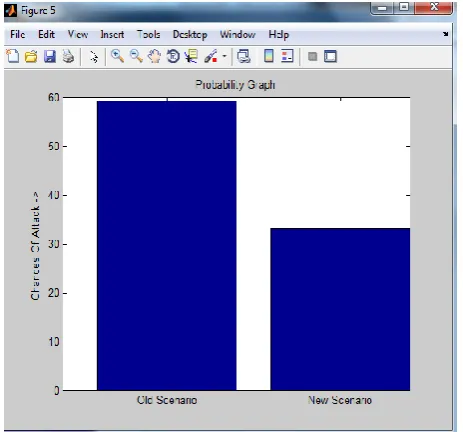
Figure3: Comparison Graph of Attack
Comparison Graph of Attack: The comparison is made between probability of existing and proposed algorithm. It is analyzed that probability of proposed technique is less than existing algorithm.
5.Conclusion
Rashi Sood et al, International Journal of Computer Science and Mobile Applications, Vol.5 Issue. 9, September- 2017, pg. 15-22 ISSN: 2321-8363 Impact Factor: 4.123
reviewed two most popular techniques for cloud information encryption. These techniques are full disk encryption and fully homomorphic encryption. In this work, we find that fully homomorphic ciphering way is more efficient than full discus encryption. But the main problem exists in fully homomorphic encryption is of key management and key sharing which reduces the reliability of the scheme. Improvement has been proposed in the ciphering devices and improvement is based on Diffie-Hellman algorithm and SHA-128 and OTP is generated on the foundation of secret key generated from Diffie-Hellman algorithm for key management and key sharing. OTP will generate through email which will provide more security among the communication between sender and receiver. Session key between exploiter and cloud is created by this algorithm. Every time between two before communication new key is generated. Secure channel is established between both i.e. exploiter and the cloud service provider which reduces the time takes place in regulation and sharing of keys. The counterfeit shows that proposed enhancement is more efficient and reliable than the existing one.
6. Acknowledgement
I sincerely express my deep gratitude Er. Munish Katoch (Assistant Professor, CSE Department, Sri Sai University Palampur (H.P), India for his constant encouragement, motivation and supervision throughout my work. His endless support helped me in channelling my efforts and ideas in proper direction.
References
[1] Geethu Thomas, 2010 “Cloud computing security using encryption Technique” researchgate.net/publication. [2] Sean Carlin, Kevin Curran, 2011 “Cloud Computing Security” International Journal of Ambient Computing and Intelligence, pp 14-19.
[3] Shui Han, Jianchuan Xing, 2011 “Ensuring Data Storage Through A Novel Third Party Auditor Scheme in Cloud Computing” IEEE computer science & Technology, pp 264-268.
[4] Dr Nashaat el-Khameesy,Hossam Abdel Rahman, 2012 “A Proposed Model for Enhancing Data Storage Security in Cloud Computing Systems”, IEEE computer science & Technology vol-3.
[5] Dian-Yuan Han, Feng-qing Zhang, 2012 “Applying Agents to the Data Security in Cloud Computing” International Conference on Computer Science and Information Processing(CSIP), pp 1126-1128.
[6] Simarjeet Kaur, 2012 “VSRD-IJCSIT, Vol. 2 (3), 2012, 242-249. Cryptography and Encryption In Cloud Computing, pp 242-249 IOSR Journal of Engineering (IOSRJEN).
[7] Young-Gi Min, Hyo-Jin Shin and Young-Hwan Bang, 2012 “Cloud Computing Security Issues and Access Control Solutions” Journal of Security Engineering, pp 135-140
[8] Deyan Chen, Hong Zhao, 2012 “Data Security and Privacy Protection Issues in Cloud Computing” International Conference on Computer Science and Electronics Engineering, pp 647-651.
[9] Dawn Song, Elaine Shi, 2012 “Cloud Data Protection for the Masses” IEEE Computer Society, pp 39-45. [10] Barron, C., Yu, H., & Zhan, J., 2013 “Cloud Computing Security Case Studies and Research”. Proceedings of
the World Congress on Engineering 2013 Vol II.
[11] Punithasurya K, Esther Daniel, Dr. N. A. Vasanthi, 2013 “A Novel Role Based Cross Domain Access Control Scheme for Cloud Storage” International Journal of Advanced Research in Computer Engineering & Technology (IJARCET) Volume 2, Issue 3, March 2013, pp 942-946.
[12] Ankur Mishra, Ruchita Mathur, Shishir Jain, Jitendra Singh Rathore, 2013 “Cloud Computing Security” International Journal on Recent and Innovation Trends in Computing and Computation, pp 36-39.
[13] Sanjoli Singla, Jasmeet Singh, 2013 “Cloud Data Security using Authentication and Encryption Technique” International Journal of Advanced Research in Computer Engineering & Technology (IJARCET) Volume 2, Issue 7, July 2013, pp 2232-2235.
[14] Vimmi Pandey, 2013 “Securing the Cloud Environment Using OTP” International Journal of Scientific Research in Computer Science and Engineering vol-1, Issue-4.
Rashi Sood et al, International Journal of Computer Science and Mobile Applications, Vol.5 Issue. 9, September- 2017, pg. 15-22 ISSN: 2321-8363 Impact Factor: 4.123
[17] Manreet Kaur, Monika Bharti,2014 “Securing user data on cloud using Fog computing and Decoy technique” International Journal of Advance Research in Computer Science and Management Studies.
[18] Snigdha Soni Sandeep Pratap Singh,2015 “Secure and Efficient Integrity Algorithm based on Existing SHA Algorithms” International Journal of Computer Applications (0975 – 8887.
[19] K.Satyanarayana,2016 “Multilevel Security for Cloud Computing using Cryptography” International Journal of Advanced Research in Computer Engineering & Technology (IJARCET).