The Thirty-Third AAAI Conference on Artificial Intelligence (AAAI-19)
Learning Resolution-Invariant Deep
Representations for Person Re-Identification
Yun-Chun Chen,
1∗Yu-Jhe Li,
1,2∗Xiaofei Du,
3Yu-Chiang Frank Wang
1,2 1Department of Electrical Engineering, National Taiwan University2MOST Joint Research Center for AI Technology and All Vista Healthcare 3Umbo Computer Vision
Email:{b03901148, r06942074, ycwang}@ntu.edu.tw, [email protected]
Abstract
Person re-identification (re-ID) solves the task of match-ing images across cameras and is among the research top-ics in vision community. Since query images in real-world scenarios might suffer from resolution loss, how to solve the resolution mismatch problem during person re-ID be-comes a practical problem. Instead of applying separate im-age super-resolution models, we propose a novel network ar-chitecture of Resolution Adaptation and re-Identification Net-work (RAIN) to solve cross-resolution person re-ID. Advanc-ing the strategy of adversarial learnAdvanc-ing, we aim at extractAdvanc-ing resolution-invariant representations for re-ID, while the pro-posed model is learned in an end-to-end training fashion. Our experiments confirm that the use of our model can recognize low-resolution query images, even if the resolution is not seen during training. Moreover, the extension of our model for semi-supervised re-ID further confirms the scalability of our proposed method for real-world scenarios and applications.
Introduction
Aiming at matching images of the same person across differ-ent camera views, person re-iddiffer-entification (re-ID) (Zheng, Yang, and Hauptmann 2016) is among the active research topics in computer vision and machine learning. With a wide range of applications ranging from video surveillance to computational forensics, person re-ID has received substan-tial attention of communities from both academia and indus-try. Nevertheless, with the presence of background clutters, viewpoint and pose changes, and even occlusion, person re-ID remains a very challenging task.
While a number of methods (Lin et al. 2017; Hermans, Beyer, and Leibe 2017; Zhong et al. 2018; Si et al. 2018) have been proposed to address the aforementioned issues in person re-ID, these methods typically assume that the im-ages (both gallery and query) are of similar or sufficient resolution. However, this assumption may not hold in real-world scenarios, since image resolution may vary drastically due to the distance between the camera and the person of interest. For instance, images captured by surveillance cam-eras (i.e., the queries to be recognized) are often of low res-olution (LR) whereas the gallery ones typically have high
∗indicates equal contributions.
Copyright c2019, Association for the Advancement of Artificial Intelligence (www.aaai.org). All rights reserved.
Feature Space
LR HR
HR
HR Different Cameras
Different Identities
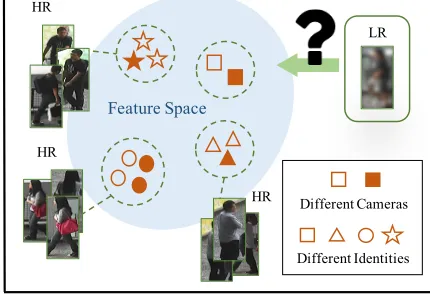
Figure 1: Illustration and challenges of cross-resolution per-son re-identification (re-ID). In addition to recognizing im-ages across different camera views, one also needs to match cross-resolution images.
resolution (HR). However, directly matching an LR query image against the HR gallery ones would entail a non-trivial
resolution mismatchproblem, as illustrated in Figure 1.
To address cross-resolution person re-ID, one can sim-ply up-sample the LR images by leveraging super-resolution (SR) approaches like (Jiao et al. 2018; Wang et al. 2018b) to synthesize HR images. However, since these two tasks are addressed separately, there is no guarantee that synthesized HR outputs would result in satisfactory re-ID performances. Moreover, if the input image resolution is not seen by the SR model, then one cannot properly recover the HR outputs. Later in the experiments, we will verify the above issues.
In this paper, we propose a novelResolution Adaptation
and re-Identification Network (RAIN) for cross-resolution
person re-ID. Based on the generative adversarial network (GAN) (Goodfellow et al. 2014) with anend-to-end learning
strategy, our RAIN is trained to extractresolution-invariant
with64×64pixels as well (prior re-ID methods requiring
SR models may not properly handle LR images with un-seen resolution). Finally, as image labeling is of high labor cost in real-world applications, we conduct a series of
semi-supervisedexperiments, which supports the use and
exten-sion of our RAIN for cross-resolution person re-ID in such practical yet challenging settings.
The contributions of this paper are highlighted below:
• We present an end-to-end trainable network that learns resolution-invariant deep representations for cross-resolution person re-ID.
• Our advance multi-level adversarial network components in our proposed architecture effectively aligns and ex-tracts feature representations across resolutions.
• We demonstrate the robustness of our model in handling a range of (and even unseen) resolutions for LR query inputs, while standard SR models are required to train on images with particular resolutions.
• Extensive experiments are performed to verify the effec-tiveness of our model, and confirm its use for re-ID in semi-supervised settings.
Related Work
Person re-ID has been widely studied in the literature. Most of the existing methods (Cheng et al. 2016; Lin et al. 2017; Kalayeh et al. 2018; Si et al. 2018; Chang, Hospedales, and Xiang 2018; Li, Zhu, and Gong 2018; Liu et al. 2018; Wei et al. 2018; Song et al. 2018; Chen et al. 2018; Shen et al. 2018) focus on tackling the challenges of match-ing images with viewpoint and pose variations, or those with background clutter or occlusion presented. For exam-ple, Liuet al. (Liu et al. 2018) develop a pose-transferable GAN-based (Goodfellow et al. 2014) framework to address image pose variations. Chen et al. (Chen et al. 2018) in-tegrate the conditional random field (CRF) with deep neu-ral networks to learn more consistent multi-scale similarity metrics. The DaRe (Wang et al. 2018a) combines the fea-ture embeddings extracted from different convolutional lay-ers into a single embedding to train the model in a supervised fashion. Several attention-based methods (Si et al. 2018; Li, Zhu, and Gong 2018; Song et al. 2018) are further pro-posed to focus on learning the discriminative parts to mit-igate the effect of background clutter. While promising re-sults have been presented, the above approaches typically assume that all images (both query and gallery) are of the same (or similar) resolution, which might not be practical in real-world re-ID applications.
To address the challenging resolution mismatch prob-lem, a couple of methods (Li et al. 2015; Jing et al. 2015; Wang et al. 2016; Jiao et al. 2018; Wang et al. 2018b) have been recently proposed. Li et al. (Li et al. 2015) present a joint learning framework that simultaneously op-timizes cross-scale image domain alignment and discrim-inant distance metric modeling. The SLD2L (Jing et al.
2015) learns a pair of HR and LR dictionaries and the map-ping between the feature representations of HR and LR im-ages. Wang et al. (Wang et al. 2016) explore the
scale-distance function space by varying the image scale of LR im-ages when matching with HR ones. Nevertheless, the above methods employ hand-crafted descriptors, which might limit the generalization of their re-ID capability.
Driven by the recent success of convolutional neural net-works (CNNs), a few CNN-based re-ID methods (Jiao et al. 2018; Wang et al. 2018b) are proposed. For example, the SING (Jiao et al. 2018) comprises an SR network and a person re-ID model to address the LR re-ID problem.
Wang et al. (Wang et al. 2018b) propose the CSR-GAN
which cascades multiple SR-GANs (Ledig et al. 2017) in se-ries to alleviate the resolution mismatch problem. Although remarkable improvements have been presented, the afore-mentioned methods require the learning of a separate SR model. Treating SR and re-ID as independent tasks, there is no guarantee that solving one task well would be prefer-able for addressing the other. Moreover, if the resolution of the LR query input is not seen during training, the CSR-GAN (Wang et al. 2018b) cannot directly apply the learned SR models for synthesizing the HR images whereas the SING (Jiao et al. 2018) requires to fuse the results produced by multiple learned models, each of which is specifically designed for a particular resolution. Namely, such models cannot be easily extended to cross-resolution person re-ID.
To overcome the above limitations, our method advances the architecture of the GAN and the autoencoder, which learns cross-resolution deep image representations for re-ID purposes. Our method not only allows LR queries with unseen resolution, but can be extended for solving cross-resolution re-ID in semi-supervised settings. The details of our proposed model will be discussed in the next section.
Proposed Method
Notations and Algorithmic Overview
For the sake of completeness, we first define the notations to be used in this paper. We assume that we have access to a set ofNHR imagesXH={xHi }Ni=1with the associated
la-bel setYH={yHi }Ni=1, wherexHi ∈RH×W×3andyiH∈R
represent theithHR image and its corresponding identity
la-bel, respectively. To synthesize LR images for training pur-poses, we generate a synthetic image setXL = {xLi}Ni=1
by down-sampling each image in XH, followed by
resiz-ing them back to the original image size via bilinear up-sampling (i.e.,xL
i ∈RH×W×3), wherexLi is the synthetic
LR image associated withxH
i (with same label). Thus, the
label setYLforXLis identical toYH.
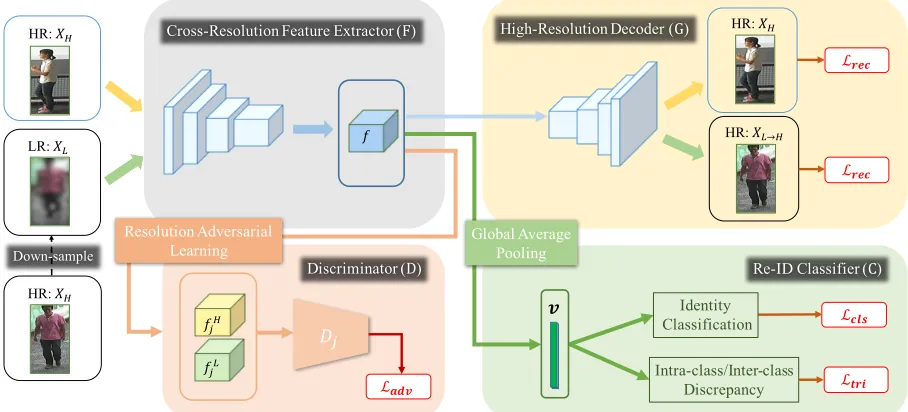
To achieve cross-resolution person re-ID, we present an end-to-end trainable network,Resolution Adaptation and
re-Identification Network (RAIN). As presented in Figure 2, our
RAIN learns resolution-invariant deep representations from training HR and LR images (note that we only need to down-sample the HR training images to produce the LR ones).
train-HR: 𝑋#
LR: 𝑋$
Cross-Resolution Feature Extractor (F)
HR: 𝑋#
High-Resolution Decoder (G) HR: 𝑋#
HR: 𝑋$→#
Global Average Pooling
ℒ𝒄𝒍𝒔 ℒ𝒓𝒆𝒄
Intra-class/Inter-class
Discrepancy ℒ𝒕𝒓𝒊 ℒ𝒓𝒆𝒄
𝑓1#
𝑓1$
𝒗
ℒ𝒂𝒅𝒗 𝐷1
Down-sample
Resolution Adversarial Learning
𝑓
Discriminator (D) Re-ID Classifier (C)
Identity Classification
Figure 2: Overview of the proposed Resolution Adaptation and re-Identification Network (RAIN). The RAIN consists of a cross-resolution feature extractorF(in gray), a high-resolution decoderG(in yellow), a resolution discriminatorD(in orange), and a re-ID classifierC (in green). The associated loss functions (in white) are the high-resolution reconstruction lossLrec,
adversarial lossLadv, classification lossLcls, and the triplet lossLtri. Note thatjdenotes the index of feature level.
ing). In the following subsections, we will detail the network components of RAIN.
Architecture of RAIN
Our proposed network, Resolution Adaptation and re-Identification Network (RAIN), includes a number of net-work components. The cross-resolution feature extractorF
encodes input images across different resolutions and pro-duces image features for both image recovery and person re-ID. The high-resolution decoderGreconstructs the encoded cross-resolution features to the HR outputs. The discrimi-natorDaligns image features across resolutions via adver-sarial learning, and thus enforces the learning of resolution-invariant features. Finally, the re-ID classifierC is learned via classification and triplet losses.
Cross-resolution feature extractorF.Given an HR image xH ∈ XH and an LR imagexL ∈ XL 1, we first forward xHandxLto the cross-resolution feature extractorFto
ob-tain their feature maps. In this paper, we adopt the
ResNet-50(He et al. 2016) as the cross-resolution feature extractor F, which has five residual blocks{R1, R2, R3, R4, R5}. We
denote the feature maps extracted from the last activation layer of each residual block as {f1, f2, f3, f4, f5}, where
fj ∈Rh×w×danddis the number of channels.
Since our goal is to perform cross-resolution person re-ID, we encourage the cross-resolution feature extractorFto generate similar feature distributions when observing both
XLandXH. To accomplish this, we advance the strategy of
adversarial learning, and introduce a discriminatorDj. This
1For simplicity, we would omit the subscripti, denote HR and LR images asxHandxL, and represent their corresponding labels
asyHandyLin this paper.
discriminator takes in the feature mapsfH
j andfjLas inputs
to distinguish whether the input feature map is fromXH or XL. Note thatj ∈ {1,2,3,4,5}represents the index of the
feature level andfH
j andfjLdenote the feature maps ofxH
andxL, respectively.
To train the cross-resolution feature extractorF and the discriminatorDjwith cross-resolution input imagesxHand xL, we define the adversarial loss as
LDj
adv(XH, XL;F,Dj) =ExH∼XH[log(Dj(f
H
j ))]
+ExL∼XL[log(1−Dj(f
L j ))].
(1)
High-resolution decoderG.To reduce the information loss in the above feature extraction stage, we introduce a high-resolution decoder G that takes in the feature map f5
ex-tracted from the cross-resolution feature extractorF as the input. In contrast to existing autoencoder-based methods that encourage the decoder to recover the original images given the observed latent features (i.e., self reconstruction), we ex-plicitly enforce our HR decoderGto reconstruct the HR im-ages using features derived from the cross-resolution feature extractor F. This would further allow F to extract cross-resolution image features, while havingGfocus on synthe-sizing the HR outputs.
To achieve the above goal, we impose an HR reconstruc-tion lossLrecbetween the outputs of the HR decoderGand
the corresponding HR ground truth images. Specifically, the HR reconstruction lossLrecis defined as
Lrec(XH, XL;F,G) =ExH∼XH[kG(f
H
5 )−xHk1]
+ExL∼XL[kG(f
L
5)−xL→Hk1].
(2)
Note thatxL→H is the HR image corresponding to xL.
to calculate the HR reconstruction lossLrec, since it would
preserve image sharpness.
Re-ID classifierC.To utilize labeled information of train-ing data for cross-resolution person re-ID, we finally intro-duce a classifier C in our RAIN. The input of this classi-fier is the feature vectorvfrom the global average pooling (GAP) layer on the feature mapf5, i.e.,v=GAP(f5), where
v ∈ Rd. With person identity as ground truth information,
we can compute the negative log-likelihood between the pre-dicted labely˜= C(v) ∈RK and the ground truth one-hot
vectoryˆ∈RK, and define the classification lossLclsas Lcls(XH, XL;F,C)
= −E(xH,yH)∼(XH,YH)
K
X
k=1
ˆ yH
k log(˜y H
k )
−E(xL,yL)∼(XL,YL)
K
X
k=1
ˆ yL
k log(˜y L k),
(3)
whereKis the number of identities (classes).
To further enhance the discriminative property, we impose a triplet lossLtrion the feature vectorv, which would
max-imize the inter-class discrepancy while minimizing intra-class distinctness. To be more specific, for each input image
x, we sample a positive imagexposwith the same identity
label and a negative imagexneg with different identity
la-bels to form a triplet tuple. Then, the following equations compute the distances betweenxandxpos/xneg:
dpos=kvx−vxposk2, (4)
dneg=kvx−vxnegk2, (5)
wherevx,vxpos, andvxneg represent the feature vectors of
imagesx,xpos, andxneg, respectively.
With the above definitions, we have the triplet lossLtri
defined as
Ltri(XH, XL;F,C)
=E(xH,yH)∼(XH,YH)max(0, m+d
H
pos−d
H
neg)
+E(xL,yL)∼(XL,YL)max(0, m+d
L
pos−d
L
neg),
(6)
wherem >0is the margin used to define the distance
dif-ference between the distance of positive image pairdposand
the distance of negative image pairdneg.
We note that minimizing the triplet loss in (6) is equiv-alent to minimizing the intra-class distinctness in (4) while maximizing the inter-class discrepancy in (5).
Total loss.Finally, the total loss functionLfor training the proposed RAIN is summarized as follows:
L(XH, XL;F,G,Dj,C) =LDj
adv(XH, XL;F,Dj) +Lrec(XH, XL;F,G) +Lcls(XH, XL;F,C) +Ltri(XH, XL;F,C).
(7)
With the above total loss, we aim to solve the min-max criterion:
min F,G,CmaxDj L
(XH, XL;F,G,Dj.C). (8)
In other words, to train our RAIN using training HR im-ages (and the down-sampled LR ones), we suppress the clas-sification lossLcls, the triplet lossLtri, and the HR
recon-struction loss Lrec while matching feature representations
across resolutions.
Experiments
We describe the datasets and settings for evaluation.
Datasets
We perform evaluations on three benchmark datasets, in-cluding two synthetic and one real-world person re-ID datasets. We will explain how we synthesize the LR images for each dataset to perform multiple low-resolution (MLR) person re-ID.
MLR-CUHK03.The MLR-CUHK03 dataset is a synthetic dataset built from CUHK03 (Li et al. 2014) which consists of 5 different camera views with more than 14,000
im-ages of 1,467 person identities. For each camera pair, we down-sample images of one camera by randomly selecting a down-sampling rater∈ {2,3,4}(i.e., the size of the down-sampled image will be H
r ×
W
r ×3), while the image
reso-lution of the other camera view remains the same.
MLR-VIPeR. The MLR-VIPeR dataset is a synthetic dataset built from VIPeR (Gray and Tao 2008) which con-tains632person-image pairs captured by two cameras.
Sim-ilarly, we down-sample all the images captured by one cam-era view using the randomly selected down-sampling rate
r ∈ {2,3,4}, while the image resolution of the other
cam-era is fixed.
CAVIAR. The more challenging CAVIAR dataset (Cheng et al. 2011) is a genuine LR person re-ID dataset which con-tains1,220images of72person identities captured from two camera views. Since the images captured by the more distant camera have much lower resolution than those captured by the closer camera, this dataset is suitable for evaluating the cross-resolution person re-ID. Following (Jiao et al. 2018), we discard22people who only appear in the closer camera. In contrast to other synthetic datasets, this dataset inherently contains multiple realistic resolutions.
Experimental Settings and Protocols
We consider cross-resolution person re-ID where the query set contains LR images while the gallery set is composed of HR images only. We adopt the standard single-shot per-son re-ID setting in all of our experiments. Following (Wang et al. 2016), we randomly divide the MLR-VIPeR and the CAVIAR datasets into halves for training and test set, with
1,367/100training/test identity split for the MLR-CUHK03 dataset. The test (query) set is constructed with all LR im-ages for each person identity while the gallery image set contains one randomly selected HR image for each person.
For performance evaluation, we adopt the average cumu-lative match characteristic and report the results recorded at ranks1,5,10, and20. We adopt the multi-level
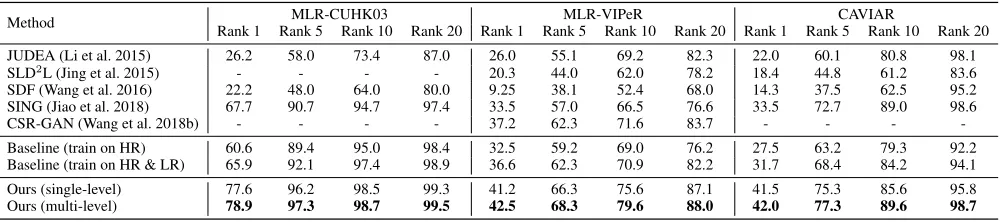
Table 1: Experimental results of cross-resolution person re-ID (%). Note that the numbers in bold denote the best results.
Method Rank 1 Rank 5 Rank 10 Rank 20 Rank 1 Rank 5 Rank 10 Rank 20 Rank 1 Rank 5 Rank 10 Rank 20MLR-CUHK03 MLR-VIPeR CAVIAR
JUDEA (Li et al. 2015) 26.2 58.0 73.4 87.0 26.0 55.1 69.2 82.3 22.0 60.1 80.8 98.1 SLD2L (Jing et al. 2015) - - - - 20.3 44.0 62.0 78.2 18.4 44.8 61.2 83.6
SDF (Wang et al. 2016) 22.2 48.0 64.0 80.0 9.25 38.1 52.4 68.0 14.3 37.5 62.5 95.2 SING (Jiao et al. 2018) 67.7 90.7 94.7 97.4 33.5 57.0 66.5 76.6 33.5 72.7 89.0 98.6
CSR-GAN (Wang et al. 2018b) - - - - 37.2 62.3 71.6 83.7 - - -
-Baseline (train on HR) 60.6 89.4 95.0 98.4 32.5 59.2 69.0 76.2 27.5 63.2 79.3 92.2 Baseline (train on HR & LR) 65.9 92.1 97.4 98.9 36.6 62.3 70.9 82.2 31.7 68.4 84.2 94.1 Ours (single-level) 77.6 96.2 98.5 99.3 41.2 66.3 75.6 87.1 41.5 75.3 85.6 95.8 Ours (multi-level) 78.9 97.3 98.7 99.5 42.5 68.3 79.6 88.0 42.0 77.3 89.6 98.7
we select the index of feature level withj ∈ {4,5}and de-note our method as “Ours (multi-level)” and the variant of our method with single-level discriminator (j= 5) as “Ours (single-level)”.
Evaluation and Comparisons
We compare our approach with the JUDEA (Li et al. 2015), the SLD2L (Jing et al. 2015), the SDF (Wang et al. 2016),
the SING (Jiao et al. 2018), and the CSR-GAN (Wang et al. 2018b). We note that our cross-resolution feature extractor is only pre-trained on the ImageNet (He et al. 2016). However, SING (Jiao et al. 2018) and CSR-GAN (Wang et al. 2018b) require their re-ID networks to be pre-trained on large-scale re-ID datasets like Market1501 (Zheng et al. 2015) (which contains32,668images of1,501person identities).
Table 1 lists the quantitative results on the three datasets. We note that our results can be further improved by applying pre-processing or post-processing method, attention mech-anisms, or re-ranking. For fair comparisons, no such tech-niques are applied.
MLR-CUHK03. Our method achieves 77.6% for single-level discriminator and78.9% for multi-level discriminator
at rank1. The proposed method performs favorably against
the state-of-the-art methods and outperforms the previous best competitor (Jiao et al. 2018) by a large margin9.9%
for single-level discriminator and11.2% for multi-level dis-criminator at rank1. Our performance gains can be ascribed
to the following two factors. First, unlike most existing re-ID methods, our model performs cross-resolution person re-ID and is trained in an end-to-end learning fashion. Second, the proposed approach would not suffer from the visual artifacts as our model does not leverage SR models.
Furthermore, the advantage of training on both HR and LR images, and introducing the discriminator can be ob-served by comparing the method “Ours (single-level)” with two baseline methods “Baseline (train on HR)” and “Base-line (train on HR & LR)”, respectively. Note that the method “Baseline (train on HR)” is considered as a naive method that only trains on HR images. A17.0% performance drop
can be observed from the method “Baseline (train on HR)”. This indicates that the resolution mismatch problem signifi-cantly alters the performance if the model is trained on HR images only. On the other hand, the method “Baseline (train on HR & LR)” trained on both HR and LR images
with-Table 2: Experimental results of cross-resolution person re-ID with seen and unseen resolutions on the MLR-VIPeR dataset evaluated at rank 1 (%).
Train Test SING CSR-GAN OursMLR-VIPeR
r∈ {1,2,3,4} r∈ {2,3,4} 33.5 37.2 42.5
r∈ {1,2,3,4} r= 8 7 7 37.5
out applying the adversarial loss still suffers a 11.7%
per-formance drop. The result suggests that even if the model is trained with images of multiple resolutions, without the adversarial loss which aligns image features across resolu-tions, the resolution mismatch problem still implicitly alters the performance.
MLR-VIPeR.Our method achieves the state-of-the-art per-formance on all four ranks. The perper-formance gains over the best competitor (Wang et al. 2018b) at rank1are4.0% for
single-level discriminator and5.3% for multi-level discrim-inator.
In addition to performance comparisons, our method can reliably perform cross-resolution person re-ID and general-ize well on unseen image resolutions. However, most exist-ing methods (Jiao et al. 2018; Wang et al. 2018b) may not properly handle image resolutions that are not seen by their SR models or require to fuse the results produced by mul-tiple learned models, each of which is specifically designed for a particular resolution.
We present and compare such results in Table 2. Suppose that the training set contains images with different down-sampling rates r ∈ {1,2,3,4} (r = 1indicates that
ages remain their original sizes), if the test set contains im-ages with down-sampling ratesr∈ {2,3,4}which have ap-peared in the training set, both existing methods (Jiao et al. 2018; Wang et al. 2018b) and our approach perform cross-resolution person re-ID properly. However, if we consider another scenario where the training set contains images with down-sampling rates r ∈ {1,2,3,4}, whereas the test set contains images with down-sampling rater= 8which are
(a) Colorization with respect toidentity. (b) Colorization with respect toresolution.
Figure 3: Visualization of cross-resolution feature vectorsvon MLR-CUHK03 via t-SNE. (a)35different identities, each of
which is shown in a unique color. (b) With four different down-sampling rates (r ∈ {1,2,4,8}) are considered and shown, images with the same resolution are shown in the same color. Note that images withr= 8are not seen during training.
Table 3: Ablation studies on the MLR-CUHK03 dataset (%).
Method Rank 1 Rank 5 Rank 10 Rank 20 mAPMLR-CUHK03
Ours 78.9 97.3 98.7 99.5 74.5
Ours w/oLcls 70.8 95.1 97.7 98.9 68.0
Ours w/oLtri 69.1 92.2 96.6 98.7 64.1
Ours w/oLrec 67.3 89.5 94.5 97.7 64.2
Ours w/oLadv 65.9 92.1 97.4 98.9 62.3
For CSR-GAN (Wang et al. 2018b), their SR models are resolution-dependent and cannot directly apply to LR im-ages of unseen resolutions for synthesizing HR imim-ages. For SING (Jiao et al. 2018), even though they can still apply their SR models on the images of unseen resolutions via fusing the results produced by several models, their SR models are specifically designed for some particular image resolutions, which will not reliably address cross-resolution person re-ID with images of unseen resolutions.
CAVIAR. For the CAVIAR dataset, our method achieves
41.5% for single-level discriminator and42.0% for
multi-level discriminator at rank 1 score achieving the state-of-the-art performance on all four evaluated ranks. The perfor-mance gains over the best competitor (Jiao et al. 2018) mea-sured at rank1are8.0% for single-level discriminator and 8.5% for multi-level discriminator.
Ablation Studies
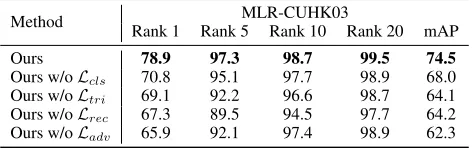
Loss functions. To analyze the importance of each loss function, we conduct an ablation study on the MLR-CUHK03 dataset using the multi-level discriminator method abbreviated as “Ours”. Table 3 presents the quantitative re-sults of the ablation experiments evaluated at ranks1,5,10,
and20, and the mAP. The results show that without the clas-sification lossLcls or the triplet loss Ltri, our model still
Table 4: Effect of training images of multiple low resolu-tions. The bold numbers indicate the best results (%).
Train MLR-CUHK03 MLR-VIPeR CAVIAR HR LR Rank 1 mAP Rank 1 mAP Rank 1 mAP
r= 1 r= 2 70.9 67.7 38.9 42.6 36.3 52.9
r= 1 r= 3 72.3 68.8 40.3 43.2 37.9 53.1
r= 1 r= 4 77.2 74.8 41.5 45.4 40.1 54.6
r= 1 r∈ {2,3,4} 78.9 75.9 42.5 47.0 42.0 56.3
achieves favorable performances compared with the state-of-the-art method (Jiao et al. 2018). This is because both the classification loss and the triplet loss are introduced to con-trol the intra-class and inter-class distances. Without either one of them, our model still has the ability to establish a well separated feature space for each person identity. How-ever, our model suffers a11.6% performance drop without the HR reconstruction loss Lrecat rank1. The result
indi-cates that introducing the HR decoder and imposing the HR reconstruction loss greatly reduce the information loss. In addition, without the adversarial lossLadv, our model does
not learn resolution-invariant representations and a 13.0%
performance drop at rank 1 can be observed, which indi-cates that our model suffers from the severe impact induced by the resolution mismatch problem. The ablation experi-ments show that all loss terms play crucial roles in achieving state-of-the-art performance.
Baseline (T rain on HR) Baseline (T rain on HR & LR) Ours
Query Top 1 Top 2 Top 3 Top 4 Top 5 Top 6 Top 7
Figure 4: Example of the top-ranked HR gallery images of the MLR-CUHK03 dataset which are matched by the LR query input. Images bounded in green and red rectangles de-note correct and incorrect matches, respectively.
other hand, for Figure 3b, we colorize each image resolution with a color in each identity cluster (four different down-sampling ratesr2 {1,2,4,8}). It can be observed that the projected feature vectors of the same identity but different down-sampling rates are all well clustered. We note that im-ages with down-sampling rater= 8are not presented in the training set.
The above visualizations demonstrate that our model learns resolution-invariant representations, and is able to generalize well to unseen image resolution (e.g.,r= 8) for cross-resolution person re-ID.
Top ranked gallery images.Given an LR query image with down-sampling rater= 8(the leftmost column), we present the first7 top-ranked HR gallery images in Figure 4. We
compare our method (bottom row) with two baseline meth-ods “Baseline (Train on HR)” (top row) and “Baseline (Train on HR and LR)” (middle row). The green and red boundaries indicate correct and incorrect matches, respectively. From the results in the top row of this figure, we observe that the method “Baseline (Train on HR)” only achieves3out of7
correct matches. When trained with images of various res-olutions, the method “Baseline (Train on HR and LR)” im-proves the matching results to5out of7correct matches.
Fi-nally, our method achieves7out of7correct matches, which
again verify the effectiveness and robustness of our model. Note that the resolution (r = 8) of the query image is not
seen during training.
Semi-Supervised Cross-Resolution Re-ID
To show that, even only a portion of the dataset are with labels (i.e., computing the classification loss and the triplet loss is only applicable for such data), the unique design of our RAIN would still exhibit sufficient ability in learning cross-resolution person re-ID image features, we conduct a series of semi-supervised experiments.
We increase the amount of labeled data by20% each time (i.e.,0%,20%, 40%,60%,80%, and100% labeled data) and record the performance at rank1as presented in
Fig-Figure 5: Semi-supervised cross-resolution person re-ID on the MLR-CUHK03 dataset.
ure 5. Note that the unlabeled data can still compute the HR reconstruction loss and the adversarial loss. We com-pare our method with two baseline methods “Baseline (train on HR)” and “Baseline (train on HR & LR)”. From Fig-ure 5, we observe that without any labeled information, our method achieves3.3% at rank1. When the amount of
la-beled data is increased to20%, our model results in66.3% at rank1, which is only slightly worse than the performance of SING (Jiao et al. 2018) (67.7%) recorded with100% la-beled data. When we further increase the amount of lala-beled data to40%, our model achieves76.1% at rank1, which
out-performs the result of SING (Jiao et al. 2018) recorded with fully labeled data by8.4%.
With the experiments, we confirm that the unique de-sign and the integration of cross-resolution feature extractor (with resolution adversarial learning), HR decoder, and clas-sification components, would allow one to learn resolution-invariant representations for cross-resolution person re-ID, even if only a portion of the image data are labeled. Thus, the use of our RAIN for real-world re-ID problems can be supported.
Conclusions
We have presented an end-to-end trainablenetwork, Res-olution Adaptation and re-Identification Network (RAIN), which is able to learn resolution-invariant representations for cross-resolution person re-ID. The novelty of this network lies in the use of adversarial learning for deriving latent image features across image resolutions, with an autoencoder-like architecture which preserves the image representation ability. Utilizing image labels, the classifica-tion components further exploit the discriminative property for re-ID purposes. From our experiments, we confirm that our model performs favorably against state-of-the-art cross-resolution person re-ID methods. We also verify that our model is able to handle LR query inputs with varying image resolutions, even if such resolutions are not seen during training. Finally, the extension to semi-supervised re-ID further supports the use of our proposed model for solving practical cross-resolution re-ID tasks.
Figure 4: Example of the top-ranked HR gallery images of the MLR-CUHK03 dataset which are matched by the LR query input. Images bounded in green and red rectangles de-note correct and incorrect matches, respectively.
hand, from the third variant method (the third row), the re-sult demonstrates that our method reliably handles unseen but intermediate resolutions (r∈ {2,3}).
Visualization of cross-resolution feature vector v. We now visualize the feature vectors v on the test set of the MLR-CUHK03 dataset in Figures 3a and 3b via t-SNE.
In Figure 3a, we select35different person identities, each
of which is indicated by a color. We observe that the pro-jected feature vectors are well separated, which suggests that sufficient re-ID ability can be exhibited by our model. On the other hand, for Figure 3b, we colorize each image resolution with a color in each identity cluster (four different down-sampling ratesr∈ {1,2,4,8}). It can be observed that the projected feature vectors of the same identity but different down-sampling rates are all well clustered. We note that im-ages with down-sampling rater= 8are not presented in the
training set.
The above visualizations demonstrate that our model learns resolution-invariant representations, and is able to generalize well to unseen image resolution (e.g.,r= 8) for
cross-resolution person re-ID.
Top ranked gallery images.Given an LR query image with down-sampling rater= 8(the leftmost column), we present
the first 7 top-ranked HR gallery images in Figure 4. We
compare our method (bottom row) with two baseline meth-ods “Baseline (Train on HR)” (top row) and “Baseline (Train on HR and LR)” (middle row). The green and red boundaries indicate correct and incorrect matches, respectively. From the results in the top row of this figure, we observe that the method “Baseline (Train on HR)” only achieves3out of7
correct matches. When trained with images of various res-olutions, the method “Baseline (Train on HR and LR)” im-proves the matching results to5out of7correct matches.
Fi-nally, our method achieves7out of7correct matches, which again verify the effectiveness and robustness of our model. Note that the resolution (r = 8) of the query image is not seen during training.
0 20 40 60 80 100
Ratio of the used labels to total labels (%)
0 10 20 30 40 50 60 70 80 90Rank-1 Score
66.476.1 76.5 78.5 78.9
51.0
60.9 64.9 65.8 65.9
47.2
58.3 60.5 60.7 61.2
Semi-supervised Analysis
Ours
Baseline (Train on HR & LR)
Baseline (Train on HR)
Figure 5: Semi-supervised cross-resolution person re-ID on the MLR-CUHK03 dataset (%).
Semi-Supervised Cross-Resolution Re-ID
To show that, even only a portion of the dataset are with labels (i.e., computing the classification loss and the triplet loss is only applicable for such data), the unique design of our RAIN would still exhibit sufficient ability in learning cross-resolution person re-ID image features, we conduct a series of semi-supervised experiments.
We increase the amount of labeled data by20% each time
(i.e., 0%, 20%, 40%, 60%, 80%, and100% labeled data)
and record the performance at rank 1 as presented in
Fig-ure 5. Note that the unlabeled data can still compute the HR reconstruction loss and the adversarial loss. We com-pare our method with two baseline methods “Baseline (train on HR)” and “Baseline (train on HR & LR)”. From Fig-ure 5, we observe that without any labeled information, our method achieves 3.3% at rank1. When the amount of
la-beled data is increased to20%, our model results in66.3%
at rank1, which is only slightly worse than the performance of SING (Jiao et al. 2018) (67.7%) recorded with100%
la-beled data. When we further increase the amount of lala-beled data to40%, our model achieves76.1% at rank1, which
out-performs the result of SING (Jiao et al. 2018) recorded with fully labeled data by8.4%.
With the experiments, we confirm that the unique de-sign and the integration of cross-resolution feature extractor (with resolution adversarial learning), HR decoder, and clas-sification components, would allow one to learn resolution-invariant representations for cross-resolution person re-ID, even if only a portion of the image data are labeled. Thus, the use of our RAIN for real-world re-ID problems can be supported.
Conclusions
autoencoder-like architecture which preserves the image representation ability. Utilizing image labels, the classifica-tion components further exploit the discriminative property for re-ID purposes. From our experiments, we confirm that our model performs favorably against state-of-the-art cross-resolution person re-ID methods. We also verify that our model is able to handle LR query inputs with varying image resolutions, even if such resolutions are not seen during training. Finally, the extension to semi-supervised re-ID further supports the use of our proposed model for solving practical cross-resolution re-ID tasks.
Acknowledgements. This work is supported in part by Umbo Computer Vision and the Ministry of Science and Technology of Taiwan under grant MOST 107-2634-F-002-010.
References
Chang, X.; Hospedales, T. M.; and Xiang, T. 2018. Multi-level factorisation net for person re-identification. InCVPR. Chen, D.; Xu, D.; Li, H.; Sebe, N.; and Wang, X. 2018. Group consistent similarity learning via deep crf for person re-identification. InCVPR.
Cheng, D. S.; Cristani, M.; Stoppa, M.; Bazzani, L.; and Murino, V. 2011. Custom pictorial structures for re-identification. InBMVC.
Cheng, D.; Gong, Y.; Zhou, S.; Wang, J.; and Zheng, N. 2016. Person re-identification by multi-channel parts-based cnn with improved triplet loss function. InCVPR.
Goodfellow, I.; Pouget-Abadie, J.; Mirza, M.; Xu, B.; Warde-Farley, D.; Ozair, S.; Courville, A.; and Bengio, Y. 2014. Generative adversarial nets. InNIPS.
Gray, D., and Tao, H. 2008. Viewpoint invariant pedes-trian recognition with an ensemble of localized features. In
ECCV.
He, K.; Zhang, X.; Ren, S.; and Sun, J. 2016. Deep residual learning for image recognition. InCVPR.
Hermans, A.; Beyer, L.; and Leibe, B. 2017. In defense of the triplet loss for person re-identification. arXiv.
Huang, X.; Liu, M.-Y.; Belongie, S.; and Kautz, J. 2018. Multimodal unsupervised image-to-image translation. In
ECCV.
Jiao, J.; Zheng, W.-S.; Wu, A.; Zhu, X.; and Gong, S. 2018. Deep low-resolution person re-identification. InAAAI. Jing, X.-Y.; Zhu, X.; Wu, F.; You, X.; Liu, Q.; Yue, D.; Hu, R.; and Xu, B. 2015. Super-resolution person re-identification with semi-coupled low-rank discriminant dic-tionary learning. InCVPR.
Kalayeh, M. M.; Basaran, E.; G¨okmen, M.; Kamasak, M. E.; and Shah, M. 2018. Human semantic parsing for person re-identification. InCVPR.
Ledig, C.; Theis, L.; Husz´ar, F.; Caballero, J.; Cunningham, A.; Acosta, A.; Aitken, A. P.; Tejani, A.; Totz, J.; Wang, Z.; et al. 2017. Photo-realistic single image super-resolution using a generative adversarial network. InCVPR.
Li, W.; Zhao, R.; Xiao, T.; and Wang, X. 2014. Deep-reid: Deep filter pairing neural network for person re-identification. InCVPR.
Li, X.; Zheng, W.-S.; Wang, X.; Xiang, T.; and Gong, S. 2015. Multi-scale learning for low-resolution person re-identification. InICCV.
Li, W.; Zhu, X.; and Gong, S. 2018. Harmonious attention network for person re-identification. InCVPR.
Lin, Y.; Zheng, L.; Zheng, Z.; Wu, Y.; and Yang, Y. 2017. Improving person re-identification by attribute and identity learning.arXiv.
Liu, J.; Ni, B.; Yan, Y.; Zhou, P.; Cheng, S.; and Hu, J. 2018. Pose transferrable person re-identification. InCVPR. Shen, Y.; Li, H.; Xiao, T.; Yi, S.; Chen, D.; and Wang, X. 2018. Deep group-shuffling random walk for person re-identification. InCVPR.
Si, J.; Zhang, H.; Li, C.-G.; Kuen, J.; Kong, X.; Kot, A. C.; and Wang, G. 2018. Dual attention matching net-work for context-aware feature sequence based person re-identification. InCVPR.
Song, C.; Huang, Y.; Ouyang, W.; and Wang, L. 2018. Mask-guided contrastive attention model for person re-identification. InCVPR.
Wang, Z.; Hu, R.; Yu, Y.; Jiang, J.; Liang, C.; and Wang, J. 2016. Scale-adaptive low-resolution person re-identification via learning a discriminating surface. InIJCAI.
Wang, Y.; Wang, L.; You, Y.; Zou, X.; Chen, V.; Li, S.; Huang, G.; Hariharan, B.; and Weinberger, K. Q. 2018a. Resource aware person re-identification across multiple res-olutions. InCVPR.
Wang, Z.; Ye, M.; Yang, F.; Bai, X.; and Satoh, S. 2018b. Cascaded sr-gan for scale-adaptive low resolution person re-identification. InIJCAI.
Wei, L.; Zhang, S.; Gao, W.; and Tian, Q. 2018. Per-son transfer gan to bridge domain gap for perPer-son re-identification. InCVPR.
Zheng, L.; Shen, L.; Tian, L.; Wang, S.; Wang, J.; and Tian, Q. 2015. Scalable person re-identification: A benchmark. In
ICCV.
Zheng, L.; Yang, Y.; and Hauptmann, A. G. 2016. Person re-identification: Past, present and future. arXiv.
Zhong, Z.; Zheng, L.; Zheng, Z.; Li, S.; and Yang, Y. 2018. Camera style adaptation for person re-identification. In