Analysing and Comparing the Final Grade in
Mathematics by Linear Regression Using
Excel and SPSS
Elena Karamazova #1, Teuta Jusufi Zenku*2, Zoran Trifunov #3 1
Faculty of Computer Sciences Department of Mathematics and Statistics University "Goce Delcev" – Stip Republic of Macedonia
2
Faculty of Technical Sciences University "Mother Teresa" – Skopje 1000 Skopje, Republic of Macedonia 3
Faculty of Technical Sciences University "Mother Teresa" – Skopje 1000 Skopje, Republic of Macedonia
Abstract: In this paper simple and multiple linear regression model is developed to analyze and compare the final grades of students from two Universities, University "Goce Delcev" - Stip, more specifically a group of students who studied in Kavadarci and students from "Mother Teresa" University in Skopje, for the subject of Mathematics. The models were based on the data of students' scores in three tests, 1st periodical exam, 2nd periodical exam and final examination. Statistical significance of the relationship between the variables has been provided. For obtaining our results some solvers like Excel and SPSS were used.
Keywords: simple linear regression, multiple linear regression, 1st periodical exam, 2nd periodical exam, final examination.
I. INTRODUCTION
Simple linear regression is a statistical method that allows us to summarize and study relationships between two continuous variables: one variable, denoted x, is regarded as the predictor, explanatory, or independent variable. The other variable, denoted y, is regarded as the response, outcome, or dependent variable.
Multiple linear regression can be used to analyze data from causal-comparative, correlational, or experimental research. In addition, it provides estimates both of the magnitude and statistical significance of relationships between variables.
Multiple linear regression is one of the most widely used statistical techniques in educational research. Multiple linear regression is defined as a multivariate technique for determining the correlation between a response variable y and some combination of two or more predictor variables, X.
In [11], such a model is developed to predict anomalies of westward-moving intraseasonal precipitable water by utilizing the first through fourth powers of a time series of outgoing longwave radiation that is filtered for eastward propagation and for the temporal and spatial scales of the tropical intraseasonal oscillations. An independent and simpler compositing method is applied to show that the results of this multiple linear regression model provide better description of the actual relationships between eastward and westward moving intraseasonal modes than a regression model that includes only the linear predictor .
In [2] the application of regression models in macroeconomic analyses is emphasized. The particular situation approached is the influence of final consumption and gross investments on the evolution of Romania’s Gross Domestic Product.
II. SIMPLE AND MULTIPLE LINEAR REGRESSION MODEL
A simple linear regression is carried out to estimate the relationship between a dependent variable, y, and a single explanatory variable, x, given a set of data that includes observations for both of these variables for a particular population.
Model form is:
(1)
0
1
y
x
where β’s denote the population regression coefficients, and ε is a random error.
A multiple linear regression analysis is carried out to predict the values of a dependent variable, y, given a set of k explanatory variables (x1, x2,….,xk).
Model form is:
(2) 0 1 1 2 2
y x x x
k k
where β’s denote the population regression coefficients, and ε is a random error.
III. PROBLEM AND OBJECT OF STUDY
The purpose of this study was to contribute to knowledge relating to the use of simple and multiple linear regression in educational research by establishing an appropriate linear regression model to analyze the relationship between variables as a final grade in the student exam in Mathematics (considered as a dependent or variable Y) depending on the 1st periodical exam and 2nd periodical exam (considered as independent or predictive X variables).
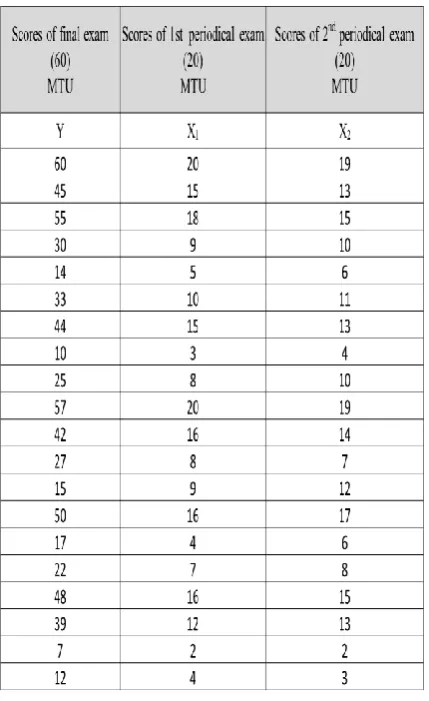
The data was collected by a sample of 40 students, 20 of University “Goce Delcev”- Stip (UGD) and 20 from students of “Mother Teresa” University - Skopje (MTU). In order to determine the regression coefficients and to analyze the data, math applicative software was used.
IV.EXCEL ANALYSIS OF DATA FROM MTU
The equation of the multiple regression model is:
1 2
2.284 3.230 0.436 .
Y X X
Regression Statistics for the multiple regression model is given in figure1. The equation of the simple regression model for the X1 variable is:
. 1.538 2.863
1
Y X
Regression Statistics for the simple regression model for the X1 variable is given in figure2. The equation of the simple regression model for X2 variable is:
2.
1.375 3.131
Y X
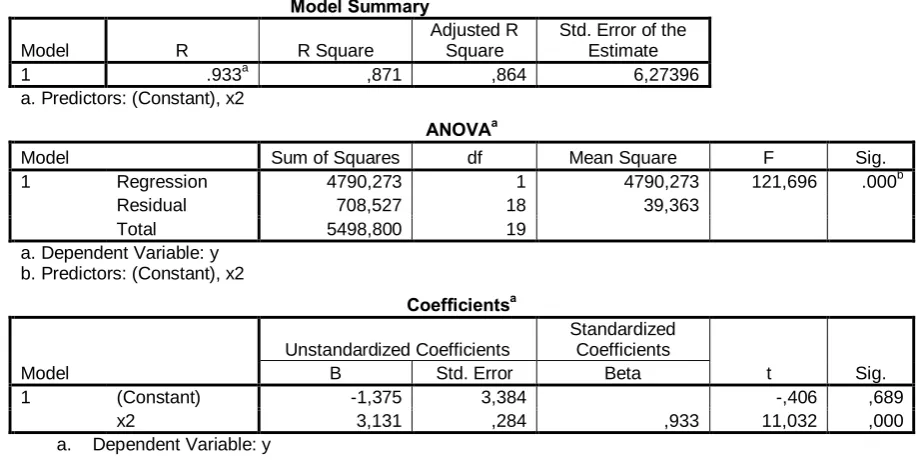
Regression Statistics for the simple regression model for the X2 variable is given in figure3.
V. SPSS ANALYSIS OF DATA FROM MTU
In figure 4, 5 and 6 are given model summary for the simple regression model for the X1 variable, for simple
regression model for the
X
2variable and for multiple regression model respectively with SPSS for MTU.VI.INTERPRETING THE RESULTS FROM MTU
From the analysis made using two application softwares we see the same results in the tables obtained. Some individual parameters are interpreted as follows:
The multiple correlation coefficient
R represents the extent of the relation between the dependent variables and two or more independent variables. The closer to one is, the greater is the connectivity.In our results we see that R> 0.93 in all cases, which means that the correlation between the Y variable and the X1 and X2variables is relatively strong.
The coefficient of determination
2R represents the variance of the variables interpreted by the model.
The coefficient of determination serves as a measure of representation of the model. ValueR2 0.87, therefore it can be said that found linear regression models are representative. Where, as we can see from tables the most representative is the multiple linear regression model.
The statistical significance of the regression model is determined based on the value of the empirical ratio F, i.e. of the corresponding value p (so-called group test of the importance of the regression model). Where for our case of multiple model is 0.000000000003, i.e. with the level of risk p <0.01, we claim that at least one of the regression variables has a statistically significant impact on the final grade in Mathematics, respectively, the multiple linear regression model is statistically significant.
Fig.1 Regression Statistic for the multiple regression model
Fig.2 Regression Statistic for the simple regression model for the X1 variable SUMMARY
OUTPUT
Regression Statistics Multiple R 0,9777 R Square 0,9559 Adjusted R
Square 0,9507
Standard
Error 3,7763
Observations 20,0000
ANOVA
Df SS MS F Significance F Regression 2 5256,37 2628,19 184,30 0,000000000003
Residual 17 242,43 14,26
Total 19 5498,80
Coefficients
Standard
Error t Stat P-value Lower 95%
Upper 95%
Lower 95,0%
Upper 95,0% Intercept 2,2837 2,1351 1,0696 0,2998 -2,2210 6,7884 -2,2210 6,7884 X Variable 1 3,2300 0,5650 5,7170 0,0000 2,0380 4,4220 2,0380 4,4220 X Variable 2 -0,4359 0,6469 -0,6738 0,5095 -1,8007 0,9290 -1,8007 0,9290
SUMMARY OUTPUT
Regression Statistics Multiple R 0,9771 R Square 0,9547 Adjusted R
Square 0,9522
Standard
Error 3,7186
Observations 20,0000
ANOVA
Df SS MS F Significance F Regression 1 5249,8984 5249,8984 379,6608 0,0000000000002 Residual 18 248,9016 13,8279
Total 19 5498,8000
Coefficients
Standard
Error t Stat P-value
Lower 95%
Upper 95%
Lower 95,0%
Upper 95,0%
Intercept 1,5381 1,7980 0,8554 0,4036 -2,2394 5,3155
Fig.3 Regression Statistic for the simple regression model for the X2 variable
Model Summary
Model R R Square
Adjusted R Square
Std. Error of the Estimate
1 .977a ,955 ,952 3,71858
a. Predictors: (Constant), x1
ANOVAa
Model
Sum of
Squares Df Mean Square F Sig. 1 Regression 5249,898 1 5249,898 379,661 .000b
Residual 248,902 18 13,828
Total 5498,800 19
a. Dependent Variable: y b. Predictors: (Constant), x1
Coefficientsa
Model
Unstandardized Coefficients
Standardized Coefficients
t Sig. B Std. Error Beta
1 (Constant) 1,538 1,798 ,855 ,404
x1 2,863 ,147 ,977 19,485 ,000
a. Dependent Variable: y
Fig. 4 Model Summary with SPSS for the simple regression model for the X1 variable for MTU SUMMARY
OUTPUT
Regression Statistics Multiple R 0,9334 R Square 0,8711 Adjusted R
Square 0,8640
Standard
Error 6,2740
Observations 20,0000
ANOVA
df SS MS F Significance F Regression 1 4790,2733 4790,2733 121,6961 0,000000001931 Residual 18 708,5267 39,3626
Total 19 5498,8000
Coefficients
Standard
Error t Stat P-value
Lower 95%
Upper 95%
Lower 95,0%
Upper 95,0%
Intercept -1,3747 3,3842 -0,4062 0,6894 -8,4847 5,7353
Model Summary
Model R R Square
Adjusted R Square
Std. Error of the Estimate
1 .933a ,871 ,864 6,27396
a. Predictors: (Constant), x2
ANOVAa
Model Sum of Squares df Mean Square F Sig. 1 Regression 4790,273 1 4790,273 121,696 .000b
Residual 708,527 18 39,363
Total 5498,800 19
a. Dependent Variable: y b. Predictors: (Constant), x2
Coefficientsa
Model
Unstandardized Coefficients
Standardized Coefficients
t Sig. B Std. Error Beta
1 (Constant) -1,375 3,384 -,406 ,689
x2 3,131 ,284 ,933 11,032 ,000
a. Dependent Variable: y
Fig. 5 Model Summary with SPSS for the simple regression model for the X2 variable for MTU
Model R R Square
Adjusted R Square
Std. Error of the Estimate
1 .978a ,956 ,951 3,77630
a. Predictors: (Constant), x2, x1
ANOVAa
Model
Sum of
Squares df Mean Square F Sig. 1 Regression 5256,372 2 2628,186 184,299 .000b
Residual 242,428 17 14,260
Total 5498,800 19
a. Dependent Variable: y b. Predictors: (Constant), x2, x1
Model
Unstandardized Coefficients
Standardized Coefficients
t Sig. B Std. Error Beta
1 (Constant) 2,284 2,135 1,070 ,300
x1 3,230 ,565 1,102 5,717 ,000
x2 -,436 ,647 -,130 -,674 ,510
a. Dependent Variable: y
Fig. 6 Model Summary for the multiple regression model with SPSS for MTU
VII. EXCEL ANALYSIS OF DATA FROM UGD
The equation of the multiple regression model is
2 243 . 1 1 754 . 1 961 .
2 X X
Y .
The equation of the simple regression model for the X1 variable is
. 6.547 2.673
1
Y X
Regression Statistics for the simple regression model for the X1 variable is given in figure 8.
The equation of the simple regression model for theX2 variable is
2.
0.947 3.167
Y X
Regression Statistics for the simple regression model for the X2 variable is given in figure 9.
VIII. SPSS ANALYSIS OF DATA FROM UGD
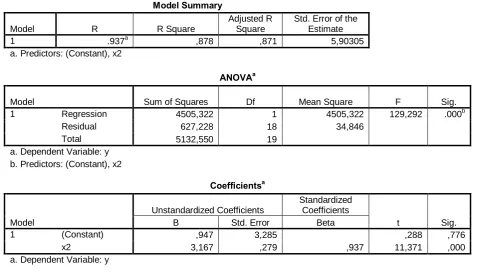
In figure 10, 11 and 12 are given model summary for the simple regression model for the X1 variable, for
simple regression model for the
X
2variable and for the multiple regression model respectively with SPSS for U.IX.INTERPRETING THE RESULTS FROM UGD
From the analysis made using two application softwares we see the same results in the tables obtained. Individual parameters are interpreted as follows:
The multiple correlation coefficient
R represents the extent of the relation between the dependent variables and two or more independent variables. The closer to one is, the greater is the connectivity.In our results we see that R> 0.94 in all cases, which means that the correlation between the Y variable and the X1 and X2 variables is relatively strong.
The coefficient of determination
2R represents the variance of the variables interpreted by the model. The
coefficient of determination serves as a measure of representation of the model. ValueR20.87, therefore it can be said that found linear regression models are representative. Where, as we can see from tables the most representative is the multiple linear regression model.
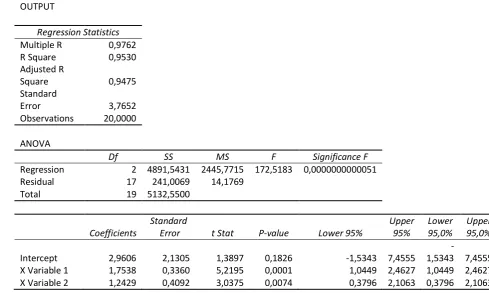
The statistical significance of the regression model is determined based on the value of the empirical ratio F, i.e. of the corresponding value p (so-called group test of the importance of the regression model). Where for our case of multiple model is 0.0000000000051, i.e. with the level of risk p <0.01, we claim that at least one of the regression variables has a statistically significant impact on the final grade in Mathematics, respectively, the multiple linear regression model is statistically significant.
In the previous case, the statistical significance of the overall regression model was assessed. The data found in the regression output tables gives us information on the statistical significance of the respective regression coefficients (so-called relevant regression model significance test). The statistical significance of the regression coefficients is determined on the basis of t-test i.e., of the corresponding values P. For our cases this value is less than 0.05 so we conclude that in the linear regression models both two variables have an impact of statistical significance on the "final grade in Mathematics" variable.
X. CONCLUSIONS
From the analysis above, our multiple regression model as well as simple linear regression models for predicting and analyzing the final grade in Mathematics, Y, from both Universities are useful and adequate.
SUMMARY OUTPUT
Regression Statistics Multiple R 0,9762 R Square 0,9530 Adjusted R
Square 0,9475
Standard
Error 3,7652
Observations 20,0000
ANOVA
Df SS MS F Significance F Regression 2 4891,5431 2445,7715 172,5183 0,0000000000051
Residual 17 241,0069 14,1769
Total 19 5132,5500
Coefficients
Standard
Error t Stat P-value Lower 95%
Upper 95%
Lower 95,0%
Upper 95,0%
Intercept 2,9606 2,1305 1,3897 0,1826 -1,5343 7,4555
-1,5343 7,4555 X Variable 1 1,7538 0,3360 5,2195 0,0001 1,0449 2,4627 1,0449 2,4627 X Variable 2 1,2429 0,4092 3,0375 0,0074 0,3796 2,1063 0,3796 2,1063
Fig. 7 Regression Statistics for the multiple regression model
SUMMARY OUTPUT
Regression Statistics Multiple R 0,9631 R Square 0,9276 Adjusted R
Square 0,9235
Standard
Error 4,5449
Observations 20,0000
ANOVA
Df SS MS F Significance F Regression 1 4760,7397 4760,7397 230,4759 0,000000000011 Residual 18 371,8103 20,6561
Total 19 5132,5500
Coefficients
Standard
Error t Stat P-value
Lower 95%
Upper 95%
Lower 95,0%
Upper 95,0% Intercept 6,5465 2,1407 3,0581 0,0068 2,0491 11,0440 2,0491 11,0440 X Variable 1 2,6732 0,1761 15,1814 0,0000 2,3033 3,0432 2,3033 3,0432
SUMMARY OUTPUT
Regression Statistics Multiple R 0,9369 R Square 0,8778 Adjusted R
Square 0,8710
Standard
Error 5,9030
Observations 20,0000
ANOVA
Df SS MS F Significance F Regression 1 4505,3223 4505,3223 129,2924 0,000000001195 Residual 18 627,2277 34,8460
Total 19 5132,5500
Coefficients
Standard
Error t Stat P-value
Lower 95%
Upper 95%
Lower 95,0%
Upper 95,0%
Intercept 0,9468 3,2849 0,2882 0,7765 -5,9545 7,8481
-5,9545 7,8481 X Variable 2 3,1670 0,2785 11,3707 0,0000 2,5818 3,7521 2,5818 3,7521
Fig. 9 Regression Statistics for the simple regression model for the X2 variable
Model Summary
Model R R Square
Adjusted R Square
Std. Error of the Estimate
1 .963a
,928 ,924 4,54490 a. Predictors: (Constant), x1
ANOVAa
Model Sum of Squares df Mean Square F Sig. 1 Regression 4760,740 1 4760,740 230,476 .000b
Residual 371,810 18 20,656
Total 5132,550 19
a. Dependent Variable: y b. Predictors: (Constant), x1
Coefficientsa
Model
Unstandardized Coefficients
Standardized Coefficients
t Sig. B Std. Error Beta
1 (Constant) 6,547 2,141 3,058 ,007
x1 2,673 ,176 ,963 15,181 ,000
Fig. 11 Model Summary with SPSS for the simple regression model for the X2 variable for UGD
Model Summary
Model R R Square
Adjusted R Square
Std. Error of the Estimate
1 .976a ,953 ,948 3,76522
a. Predictors: (Constant), x2, x1
ANOVAa
Model Sum of Squares df Mean Square F Sig. 1 Regression 4891,543 2 2445,772 172,518 .000b
Residual 241,007 17 14,177
Total 5132,550 19
a. Dependent Variable: y b. Predictors: (Constant), x2, x1
Coefficientsa
Model
Unstandardized Coefficients
Standardized Coefficients
t Sig. B Std. Error Beta
1 (Constant) 2,961 2,130 1,390 ,183
x1 1,754 ,336 ,632 5,219 ,000
x2 1,243 ,409 ,368 3,038 ,007
a. Dependent Variable: y
Fig. 12 Model Summary with SPSS for for the multiple regression model for UGD
Model Summary
Model R R Square
Adjusted R Square
Std. Error of the Estimate
1 .937a ,878 ,871 5,90305
a. Predictors: (Constant), x2
ANOVAa
Model Sum of Squares Df Mean Square F Sig. 1 Regression 4505,322 1 4505,322 129,292 .000b
Residual 627,228 18 34,846
Total 5132,550 19
a. Dependent Variable: y b. Predictors: (Constant), x2
Coefficientsa
Model
Unstandardized Coefficients
Standardized Coefficients
t Sig. B Std. Error Beta
1 (Constant) ,947 3,285 ,288 ,776
x2 3,167 ,279 ,937 11,371 ,000
REFERENCES
[1] C. Anghelache, M.G. Anghel, L. Prodan, C. Sacală and M. Popovici, Multiple Linear Regression Model Used in Economic Analyses, Romanian Statistical Review Supplement, Vol. 62. Issue 10, pp. 120-127, (October), 2014
[2] C. Anghelache, A. Manole and M. G. Anghel, Analysis of final consumption and gross investment influence on GDP – multiple linear regression model, Theoretical and Applied Economics, Volume XXII No. 3(604), pp. 137-142, 2015
[3] A.C Cameron, and P.K Trivedi, Regression Analysis of Cout Data, Cambridge, 1998. [4] F. Hoxha, Metoda tё analizёs numerike, Tiranё, 2008.
[5] D. Jaksimovic, Zbirka Zadataka iz poslovne statistike, Beograd, 2004. [6] Sh. Leka, Teoria e probabiliteteve dhe statistika matematike, Tiranë, 2004.
[7] J. T. McClove, P. George Benson, Terry Sincich, Statistics for Business and Economics, USA, 1998. [8] M. Papiq, Statistika e aplikuar në MS EXEL, Prishtinë, 2007.
[9] L. Puka, Probabliliteti dhe Statistika e zbatuar, Tiranё, 2010. [10] J. M. Rojo, Regresion lineal multiple, Madrid, 2007.
[11] P. E. Roundy and W. M. Frank, Applications of a Multiple Linear Regression Model to the Analysis of Relationships between Eastward and Westward Moving Intraseasonal Modes, Journal of the atmospheric sciences, pp. 3041-3048, 2004
[12] M. Shakil, A multiple Linear regression Model to Predict the Student’s Final Grade in a Mathematics Class, [13] A. F. Siegel, Pratical Statistics, USA, 1996.
[14] D. S. Wilks, Statistical Methods in the Atmospheric Sciences: An Introduction, International Geophysical Series, Vol. 59, Academic Press, pp. 467, 1995
Appendix