!∀#
∃%&
∋( )) ∗)+∃,)
ADAPTIVE INTELLIGENCE - ESSENTIAL ASPECTS
Kalin Penev
Southampton Solent University, East Park Terrace, Southampton, UK, e-mail: [email protected]
Abstract: The article discusses essential aspects of Adaptive Intelligence. Experimental results on optimisation of global test functions
by Free Search, Differential Evolution, and Particle Swarm Optimisation clarify how these methods can adapt to multi-modal landscape and space dominated by sub-optimal regions, without supervisors’ control. The achieved results are compared and analysed.
Key words: Adaptive Intelligence, Free Search, Differential Evolution, Swarm Intelligence, heuristics, No Free Lunch Theorem
INTRODUCTION
The comparison between different evolutionary methods and the attempts to assess their potential for adaptation and to cope with variety of problems are widely discussed in the literature [2][7][14][15][16][23]. A previous study [17] compares Free Search (FS) [18] Particle Swarm Optimisation (PSO) [8], and Differential Evolution (DE) [22] on several heterogeneous numerical problems. This article presents another investigation, which can be used for assessment of adaptation of these methods. The first part of the article presents specific properties, which enhance adaptation of intelligent systems. Free Search, relatively novel method, models behaviour of animals in nature, where they day by day explore surrounding environment in order to achieve their targets. FS model negotiates continuous space with discrete steps.
During the event exploration the algorithm generates values of the variables and presents these values to the problem ‘box’. The problem ‘box’ reacts and returns a value of the objective function, which corresponds to the variables values. By use of the value of the objective function, only, FS generates new variables and continues the optimisation process. The search space borders and existing constraints can be taken into account for generation of the new variables, as well.
Implementation of black box concept allows Free Search to adapt to any problem. It avoids preliminary settings of the optimisation parameters according to the particular optimisation problem.
INDEPENDENCE FROM INITIAL POPULATION FS modifies all current solutions, which is similar to
Evolutionary Programming (EP) [9], PSO and DE. The peculiarities, which differentiate FS from genetic [11][13], ant [6] and swarm algorithms, from Evolutionary Strategies (ES) [20][21], EP, DE, and from other methods, are black box search, independence form initial population, ability to diverge from one location across entire search space and capability to guide purposefully divergence and convergence during the process of global search avoiding stagnation in local sub-optima.
Another advanced property, implemented in Free Search, is the idea for independence of optimisation process from initial populations. Free Search can operate on any initial population. This is a conceptual improvement in comparison to other real-value methods for optimisation of non-discrete problems. Analysis of Genetic Algorithm, Particle Swarm Optimisation and Differential Evolution suggests that these methods cannot operate when optimisation starts from one location. GA starts effective work after the first mutation and DE and PSO cannot start at all [18].
BLACK BOX CONCEPT
START FROM STOCHASTIC INITIAL LOCATIONS Free Search fully implements the concept for Black box
exploration. From FS point of view any task is a black box. The algorithm does not require prior knowledge about the explored problems.
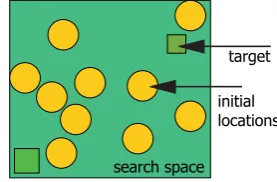
Figure 2. Stochastic initial population
Free Search can start from stochastically selected set of initial solutions where all the initial locations x0ji are random values
(Figure 2):
x0ji = Xmini + (Xmaxi – Xmini)*randomji(0,1)
Where Xmini and Xmaxi are the search space borders, i = 1,..,n,
n is the number of dimensions, j = 1,..,m, m is the population
size. random(0,1) is a random value between 0 and 1. A start from random locations guarantees non-zero probability for Figure 1. Black box optimisation
access to any location from the search space. It guarantees, also, probabilistic transaction rules for initialisation. [11]
START FROM CERTAIN INITIAL LOCATIONS
Free Search can start from certain initial population where all the initial locations x0ji are prior-defined values aji (Figure 3):
x0ji = aji , aji∈ [Xmini, Xmaxi]
Where Xmini and Xmaxi are the search space borders, i = 1,..,n,
n is the number of dimensions, j = 1,..,m, m is the population
size and aji are constants, which belong to the search space.
Figure 3. Certain initial population
A start from certain locations is a valuable ability for multi-start optimisation. It is useful from a practical point of view, as well. A start from certain locations can be used when some values are already achieved and the algorithm can continue from these values instead of repeating starts from random locations.
START FROM ONE LOCATION
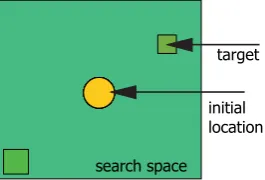
Free Search can start from an initial population where all the initial solutions x0ji are in one location ci:
x0ji = ci , ci∈ [Xmini ,Xmaxi]
Where Xmini and Xmaxi are the search space borders, i = 1,..,n,
n is the number of dimensions, j = 1,..,m, m is the population
size ci is constant. A start for one location is a difference from
Genetic Algorithm, Differential Evolution and Particle Swarm Optimisation. It is similar to Ant Colony Optimisation modified for non-discrete search space [4].
Figure 4. Initial population in one location
The ability to start from one location supports escaping from trapping in local sub-optima.
The abilities to start from one location, from certain or from random initial locations support the independence of Free Search from the initial population. It illustrates that Free Search does not determinate or discriminate the search space at the initial stage of the search process. This is an example of successful harmonisation of different concepts from genetic, swarm and ant algorithms, which benefits exploration abilities and contribute to the better performance of the search process.
FREE MOVEMENT WITHIN THE SEARCH SPACE
The individuals in Free Search have the ability for movement within the search space. They take exploration walks. During the walk they make exploration steps around the current start location. Generation of an exploration step in two-dimensional search space is illustrated in Figure 5.
Figure 5. Exploration step generation
The exploration walk generates a step xtji:
xtji = x0ji - Δxtji + 2*Δxtji*randomtji(0,1)
Where x0ji is the initial or previous location marked with pheromone. randomtji(0,1) is a random value between 0 and 1. t is the current step t = 1,..,T, T is the step limit.
Δxtji is the step.Modification strategy for step generation is:
Δxtji = Rji * ( Xmaxi – Xmini ) * randomtji(0,1)
Where Rji is a variable value of the neighbour space radius Rji = [Rmin, Rmax]. Xmini and Xmaxi are the search space
borders. randomtji(0,1) is a random value between 0 and 1. The search space borders restrict the probability for access to any location within the search space, only. Variation of Rji higher than one exceeds the search space borders and guarantees non-zero probability for access to any location within the search space. It guarantees, also, a probabilistic transaction rule for exploration of the whole space.
For a uni-dimensional step i = l, for a multi-dimensional step i = 1,..,n, n is the number of dimensions. The animals’ number is j, j = 1,..,m, m is the population size.
This modification strategy avoids contradictions of modification strategies in GA, PSO and DE: (1) good convergence but trapping and (2) good divergence but inability to locate the optimum within an acceptable period. It is independent from a current or the best achievements. The strategy allows nonzero probability for access to any location of the search space and highly encourages escaping from trapping in local maxima. It can maintain a balance between convergence and divergence within the search process and supports adaptation to different problems without any settings of the optimisation parameters for control or regulation of the divergence, convergence or convergence speed. Experimental results fully confirm these capabilities. [18]
TEST PROBLEMS
For all experiments the aim is to find the maximum therefore the test functions are transformed for in relevant manner. Ackley test function [1]. (Figure 7)
) 1 exp( )
cos( 1 exp 1
exp ) (
1 2
/ 1
1
2 ⎟− −
⎠ ⎞ ⎜
⎝ ⎛ + ⎥ ⎦ ⎤ ⎢
⎣ ⎡
⎟ ⎠ ⎞ ⎜ ⎝ ⎛ −
=
∑
∑
= =
a cx n x
n b a x f
n
i i n
i i
Figure 7. Ackley function Figure 8. Rastrigin function
Rastrigin test function [22] (Figure 8).
)) 2 cos( ( ) ( 1 2
∑
= − + = n i ii A x
x nA x
f π
where A=10 and –5.12<xi<5.12. The maximum is f(0) = 0.
Norwegian test function [5][10]. (Figure 9)
∏
= ⎟⎟⎠ ⎞ ⎜⎜ ⎝ ⎛ ⎟ ⎠ ⎞ ⎜ ⎝ ⎛ + n i i i x x 1 3 100 99 ) cos(πwhere search space borders are defined by –1.1< xi <1.1. The
maximum is f(1.0)=1.0.
Himmelblau test function [12].( (Figure 10) 2 2 2 2 ) 7 ( ) 11 ( 200 0 ,
(x y = − x +y− − x+y − f
It has four maxima equal height (200) at (3.584, -1.848), (3.0, 2.0), (2.805, 3.1313) and (-3.779, -3.283). The search space is restricted to –10 < x, y < 10.
Figure 9. Norwegian function Figure 10. Himmelblau function
EXPERIMENTAL RESULTS
FS, PSO and DE are applied to the above-mentioned functions as follows – Each algorithm is evaluated four times per test function – (1) start from stochastic initial population with limit 100 iterations, (2) start from stochastic initial population with limit 2000 iterations, (3) start from one initial location with limit 100 iterations, (4) start from one initial location with limit 2000 iterations. The single initial location is defined as: x0 = xmin + 0.9(xmax - xmin).
Each evaluation is 320 experiments. Population size is 10 (ten) individuals for all algorithms for all experiments. For DE differential factor F varies from 0.5 to 1.5. For PSO inertia W varies from 0.5 to 1.5. For FS neighbour space R varies from 0.5 to 1.5. As successful are accepted results: for Ackley test function higher than –0.1; for Himmelblau test function higher than 199.9; for Rastrigin test function higher than -0.1; for Norwegian test function higher than 0.99. The number of the successful results from all experiments is presented in Table 1.
F1 F2 F3 F4 Overall FS R*-100 281 187 34 320 822 FS R-2000 313 267 253 320 1153 FS OL*-100 201 158 26 288 673 FS OL-2000 232 257 262 314 1065 DE R-100 283 202 4 294 783 DE R-2000 299 225 6 315 845 DE OL-100 0 0 0 0 0 DE OL-2000 0 0 0 0 0 PSO R-100 175 153 10 268 606 PSO R-2000 191 235 15 313 754 PSO OL-100 0 0 0 0 0 PSO OL-2000 0 0 0 0 0
Table 1. Experimental results
F1-Ackley, F2- Rastrigin, F3- Norwegian, F4- Himmelblau; * R indicates stochastic initial population; OL indicates start from one location. All the algorithms have found all four maxima of the Himmelblau test function for 100 iterations. In Figures 11, 12, 13, and 14 are presented the achieved results per each test function.
0 50 100 150 200 250 300 350 Exper iment s 100 2000 Iterations PSO DE FS 0 50 100 150 200 250 300 350 Ex p e rim e n ts 100 2000 Iterations PSO DE FS
Figure 11. Ackley results Figure 12. Rastrigin results
0 50 100 150 200 250 300 350 E x per im ent s 100 2000 Iterations PSO DE FS 0 50 100 150 200 250 300 350 E x per im ent s 100 2000 Iterations PSO DE FS
Figure 13. Norwegian results Figure 14. Himmelblau results
0 200 400 600 800 1000 1200 1400 E x per im ent s 100 2000 Iterations
Stoc has tic
One Location 0 200 400 600 800 1000 1200 1400 Ex p e rim e n ts 100 2000 Iterations PSO DE FS
Figure 15. Overall results Figure 16. Dependence on initialisation
Figure 16 illustrates the extent in which Free Search overcomes the dependence on the initial population. According to the achieved results the condition for a start from one location can be considered as hard. However an ability to find the optimum starting from one arbitrary location, which does not favourites any area of the search space, indicates how reliable could be a search algorithm on unknown problems. For 100 iterations from 1280 experiment on all tests for stochastic initial population FS produces 822 successful results (66%) versus 673 successful results (52%) for a start from one location.
DISCUSSION
The results from the experiments with a start from stochastic initial population demonstrate that all the algorithms can adapt to the explored tests without external adjustments for any concrete test. FS outperforms DE and PSO on Norwegian test problem, which confirms that DE and PSO have some difficulties in search near to the search space borders, published earlier [18]. For the experiments with start from one location DE and PSO have some difficulties to reach the optimum in accepted limited number of iterations. It is a consequence from the requirements for non-equal individuals for adaptive settings of the optimisation parameters from DE and PSO. Prior adjustment of the optimisation parameters for each particular problem does not seem to be an acceptable approach for adaptive algorithms. An improvement of the adaptivity of these algorithms can be a subject of further research.
it). Why this is considered to be a benefit? For successful exploration of unknown problems FS not need prior settings and adjustments of the search parameters to the explored problem. The decision-making policy in FS is explicitly implemented in an idealised space by a relation between the frames of sensibility and pheromone independently from the problem [18]. Then during the process of search any particular problem is normalised to the frame of pheromone. So that FS can adjust the problem to itself or FS can adjust itself to the problem. It means FS has a potential to perform well across heterogeneous problems. Whether this is in contradiction to the statement “no algorithm can perform the best across all possible problems” [23] [14]? FS is not in contradiction with this statement and those theorems. FS is not preliminary set to any task and good overall performance requires time. This time is a slight delay, which FS needs for an adjustment to the explored problem. It is confirmed form published experimental results that some algorithms on some problems, for some appropriate initial populations can perform faster [18]. The approach, which FS uses, suggests that: The algorithm, which performs the best across all possible problems, will be the algorithm, which takes less time to adjust it self to the explored problem. This conclusion is inline with the “No Free Lunch Theorems for Optimisation”, which clearly declare that “measures of performance based on factors other than (e.g., wall clock time) are outside the scope of our results” [23, page 5], and leaves behind the assumptions on which they are proven. The inductive proof assumes for example: “The new y value, (m+1), will depend on the new x value, f and nothing else. So we expand over these possible x values” [23 page 23] .
The measurement of the performance, which respects “wall clock time”, besides the dependence of the new y value on the
x value and f, establish dependence of the new y value on time
(mT+1). Where T is a finite period of time and mT is a time dependent number of iterations.
A proof or a disproof of this conclusion can be a subject of further research. Presented experiments are made with respect and according to the defined time constraints, namely the criterion for termination is expiration of an iterations limit.
CONCLUSION
The article presents Free Search properties, which enhance adaptivity. Investigation of the global landscape of multi-modal test functions illustrates achieved level of intelligence and self-organisation. Explored algorithms demonstrate good capabilities for adaptation to different problems without supervisor’s control and without additional adjustment to the concrete problem.
FS, which harmonises valuable ideas from other evolutionary algorithms, such as probabilistic transaction rules, learning from experience, probabilistic access to whole search space with the concepts for uncertain individual behaviour and creative interpretation of the achieved current results has higher overall performance on explored test. FS overcomes common disadvantages of existing evolutionary population-based algorithms such as dependence from the initial population and inability for orientation within the search space, which is supported with the experimental results. Free Search can advance a wide range of disciplines in the efforts to cope with complex, uncertain problems, such as engineering, physics, chemistry, economics, business, finance, and operations research.
Further investigations can focus on enhancement of convergence speed, evaluation with dynamic and time dependent search space, including implementation in autonomous systems. A pragmatic area for further research is application to industrial and scientific tasks.
REFERENCES
1. Ackley D.H., 1987, A connectionist Machine for Genetic Hillclimbing, Boston, MA, Kluwer.
2. Angeline P., 1998, Evolutionary Optimisation versus Particle Swarm Optimisation: Philosophy and Performance Difference, The 7-th Annual Conference on Evolutionary Programming, San Diego, USA.
3. Banzhaf W., P. Nordin, R.E. Keller, F.D. Francone, 1998, Genetic Programming – An Introduction, ISBN 1-55860-510-X, Morgan Kaufman Publishers Inc., USA.
4. Bilchev G., Parmee I., 1995, The Ant Colony Metaphor for Searching Continuous Design Space, Proceedings of the AISB Workshop on Evolutionary Computation, University of Sheffield, UK, April 3-4.
5. Brekke E. F., 2005, Complex Behaviour in Dynamical Systems, The Norwegian University of Science and Technology,
http://www.stud.ntnu.no/~edmundfo/tma4700report.pdf pp 37-38, last visited on 15.11.2006.
6. Colorni A., Dorigo M., Maniezzo V., 1991, Distributed Optimization by Ant Colonies, Proceedings of First European Conference of Artificial Life, Varela F., and Bourgine P. editors, Paris, Elsevier, pages (134-142).
7. Deb K., 2001, Multi-objective Optimisation using Evolutionary Algorithms, Wiley, Chichester, UK.
8. Eberhart R. and J. Kennedy, 1995, Particle Swarm Optimisation, Proceedings of the 1995 IEEE International Conference on Neural Networks., vol. 4, 1942-1948.
9. Eiben A.E., J.E. Smith, 2003, Introduction to Evolutionary Computing, Springer-Verlag, ISBN 3-540-40184-9.
10.Federici D., 2005, Norwegian University of Science and Technology, last visited on 15.11.2006. http://www.idi.ntnu.no/~federici/subai/index1.html
11.Goldberg D.E., 1989, Genetic Algorithms in Search, Optimisation, and Machine Learning, Addison Wesley Longman Inc. ISBN 0-201-15767-5.
12.Himmelblau D., 1972, Applied Non-linear Programming, McGraw-Hill, New York, 1972.
13.Holland J., 1975, Adaptation In Natural and Artificial Systems, University of Michigan Press.
14.Igel C., Toussaint M., 2004, A No-Free-Lunch Theorem for Non-Uniform Distribution of Target Functions, Journal of Mathematical Modelling and Algorithms, 3: pp 313–322, 2004.© 2004 Kluwer Academic Publishers.
15.Keane A. J., 1996, A Brief Comparison of Some Evolutionary Optimization Methods, In V.Rayward-Smith, I. Osman, C. Reeves and G.D. Smith, J. Wiley (Editors), Modern Heuristic Search Methods, pp 255-272.
16.Michalewicz, Z. and Fogel, D., 2002, How to Solve It: Modern Heuristics, ISBN 3-540-66061-5 Springer-Verlag, Berlin, Heidelberg, New York.
17.Penev K., and Littlefair G., 2005, Free Search – A Comparative Analysis, Information Sciences Journal, Elsevier, Volume 172, Issues 1-2, pp 173-193.
18.Penev K., 2008, Free Search of Real Value or How to Make Computers Think, Alexander Gegov (Editor), St. Qu publisher, April 2008, ISBN 978-0955894800, UK.
19.Price K., and R. Storn, 1997, "Differential Evolution", Dr, Dobb's Journal 22 (4), 18-24 (April 1997).
20.Rechenberg I., 1973, Evolutionarytrategie: Optimierung Technisher Systeme nach Prinzipen des Biologischen Evolution. Fromman-Hozlboog Verlag, Stuttgart.
21.Schwefel H.-P., 1975, Evolution Strategy in Numerical Optimisation, PhD Thesis, Technical University of Berlin. 22.Torn A., A. Zilinskas, 1989, Global Optimization, Lecture Notes in Computer Science 350, Berlin, Springer.