Original Article
Comparative Functional Study of Thioester-containing Related
Proteins in the Recently Sequenced Genome of
Biomphalaria
glabrata
Mofolusho O. FALADE
1, *Benson OTARIGHO
2,31. Cellular Parasitology Programme, Cell Biology and Genetics Unit, Department of Zoology, University of Ibadan, Ibadan, Nigeria
2. Dept. of Biological Science, Edo University, Iyamho, Edo State, Nigeria
3. Dept. of Molecular Microbiology and Immunology, School of Medicine, Oregon Health and Science University, Port-land, OR, USA
Received 10 Apr 2017
Accepted 19 Aug 2017 Abstract Background: There is paucity of information on functional relationship and characterization of Biomphalaria glabrata thioester-containing proteins (BgTEP) to other well-annotated homologues. We performed functional characterization studies of BgTEP to homologues in Anopheles gambiae and in disparate invertebrates.
Methods: Genomic sequences of TEPs were retrieved after annotation of the B. glabrata genome. In addition, TEP sequences deposited in NCBI protein database were also retrieved and utilized for sequence analysis.
BgTEP relatedness to its other homologues as well as functional domain and protein-protein interaction analysis was performed.
Results: Our analysis resulted in the identification of TEPs in a number of organisms including, B. glabrata, A. gambiae, and Chlamys farreri. In addi-tion, we identified 19 TEP sequences spread across 10 animal species. The
B. glabrata genome contains 14190 unannotated proteins after filtration with about 85% of its proteome annotated. The phylogenetics, functional domain and protein-protein interaction analyses suggest an immunological role for BgTEP in B. glabrata.
Conclusion: The predicted role of thioester-containing proteins to be involved in immunological role in B. glabrata may have a strong effect on resistance to infection.
Keywords:
Biomphalaria glabrata,
Thioester-containing proteins, Schistosomiasis
*Correspondence Email:
Iranian Society of Parasitology http:// isp.tums.ac.ir
Iran J Parasitol
Open access Journal at http:// ijpa.tums.ac.ir Tehran University of Medical
Introduction
chistosomiasis is the most widespread
trematode infection with an estimate
of 200 million people infected in the
developing world (1-6). Consequently,
schisto-somiasis has been reported to kill more than
200000 people per year (7, 8). The control of
this disease depends primarily on treatment of
infected persons with Praziquantel (9, 10) with
no recommended alternative
chemotherapeu-tic options available (11, 12) or a licensed
vac-cine (11, 13). A safe and among the
recom-mended alternatives for schistosomiasis
con-trol is the targeting of the snail vector (14-17).
Biomphalaria glabrata
is the most important host
in the transmission of human schistosomiasis
in the Caribbean and South America. Hence,
recent molecular and immunological work has
focused on
Biomphalaria glabrata
(2). Therefore,
B. glabrata
provides a useful model organism
for the study of schistosomiasis (18). The urge
to unveil the complex paradox of interactions
between this snail and the
Schistosoma
parasite
has led to the completion of its genome
se-quence. Exploring for genes that play vital roles
in the snail immunity that determine the
suc-cess or failure of an infection or parasite
devel-opment is of major interest (17-19).
Some identified important immune factors
are the nuclear factor kappa B (NF-κB)
homologues (20-29) and biomphalysin (30).
The latter is a β pore-forming toxin involved
in the snail immune defense against
Schistosoma
mansoni
. Besides, these immune factors can be
passed from generation to generation in snails,
which determine resistance to parasite
infec-tion (28-30). The recently completed
B.
glabrata
snail genome, which is available on
vector
base
(https://www.vectorbase.org/organisms/bio
mphalaria-glabrata) (31), is facilitating
exploi-tation of unknown, vital and novel
immuno-logical factors that can help to unveil the
complex immune system of this snail against
pathogens like
Schistosoma
species (19, 18).
Dif-ferent studies have identified
thioester-containing protein (TEP) to be present in the
snail genome, which could play an
immuno-logical role in
B. glabrata
(32-34). TEP in
Anopheles gambiae
was
identified and its vital
role was determined in its immunity (35).
However, there is no report comparing the
functions of TEP in
B. glabrata
(
Bg
TEP) to
that of
A. gambiae
, since such findings will give
a better understanding of the role the protein
may play in
Schistosoma
infection and
develop-ment.
In the present study, we explored the
recent-ly completed
B. glabrata
genome sequence for
the present of thioester-containing proteins
and carried out comparative analysis with
homologues in
A. gambiae
and a disparate
number of invertebrate; predict the possible
role TEP might play in defense and protection
of
B. glabrata
against infection.
Materials and Methods
Literature search and retrieval for
inverte-brate thioester-containing protein
We performed a thorough manual literature
search using “Thioester-containing Protein
plus Mollusca” and “Thioester-containing
Protein plus
B. glabrata
” separately in Oct 2016
of
The National Center for Biotechnology
Information
(NCBI)
(https://www.ncbi.nlm.nih.gov/guide/protein
s/) website for invertebrates TEP proteins
and the resulting protein sequences were
con-firmed on UniProt (http://www.uniprot.org).
Protein sequence homologues of a variety of
insects such as
Anopheles
mosquitoes,
Drosophi-la
were retrieved from NCBI. These were used,
as they are recognized invertebrate organisms
for which numerous studies have described
key aspects of their innate immune system
response to pathogens. Other Mollusca such
as
Azumapecten
farreri
and
Euphaedusa
tau
with
TEP protein been sequenced were also
re-trieved and included in the analyses. The
dif-ferent proteoforms of
B. glabrata
TEP protein,
deposited by (32, 36, 37) with the accession
No: ACL00841.1 and AHH81765.1 were
re-trieved. Partial sequences were avoided during
retrieval and collection. All protein sequences
were retrieved in FASTA format.
B. glabrata Proteome downloads and
an-notations
The publicly available genomic data of
B.
glabrata
(BB02)
(Biomphalaria-glabrata-BB02_PEPTIDES_BglaB1.4.fa.gz;
BB02
strain peptide sequences, BglaB1.4 geneset),
containing more than 14,000 none annotated
sequences were downloaded from VectorBase,
http://www.vectorbase.org, (38) and
convert-ed to FASTA format using geneious version
R8 (39). Exported FASTA files of these
se-quences were functionally annotated on
Blast2Go version 3.3 (40-43). Sequence
anno-tation was performed by BLAST of NCBI
(National Center for Biotechnology
Infor-mation) http://www.ncbi.nlm.nih.gov/
data-base using blastp. Algorithm, non-redundant
(nr) protein database, 1.0xE3 for blast
expec-tation value and sequences with a maximum
hit of 20 sequences on the average. The
Blast2Go cut-off parameters used to filter out
poor quality BLAST hits for the annotation
were as follows: Annotation rule cut-off = 55;
E-value = 1e–6; Hit-HSP overlap = 0; and the
GO weight = 5.
Structural and Functional Analyses of
Thioester-containing Protein
The structural and functional analyses of
each invertebrate TEP selected for this work
were subjected to various physical and
chemi-cal parameter prediction by employing a web
server tool, ProtParam (44). The parameters
analyzed were molecular weight, theoretical pI,
amino acid composition, instability index,
ali-phatic index and grand average of
hydropathi-city (GRAVY) of each protein. The presence
of signal peptides and position of each
se-quence were checked using Signal P web tool
(45) and targetP (46). SecretomeP version 2.0
for non-classically secreted protein prediction
was used in determining pathways of secretion
for TEP in
B. glabrata
and other species.
Pre-diction of transmembrane helices was done by
TMHMM Server v. 2.0 and validated using
CCTOP webtool (47). Further confirmation
and validation of theoretical pI and molecular
weight was achieved using Compute pI/Mw
(48-50) and AACompIdent to validate amino
acid composition. PepCalc.com was used to
calculate Peptide property (50). Subcellular
localization of each protein was predicted
us-ing an advanced protein subcellular
localiza-tion prediclocaliza-tion tool; WoLF PSORT. String
was utilized in determining proteins that bind
to TEP in
B. glabrata
and other species
ana-lyzed. Functional sites and domains of each
protein were obtained from Pfam 30.0 and
results were validated using SMART and
NCBI Conserved Domains.
Phylogenetic tree and Evolutionary
relat-edness analysis
Results
A comprehensive search for
Thioester-containing Proteins from
B. glabrata
and a
va-riety of invertebrate genome sequences
result-ed in the identification of 19 invertebrate TEP
sequences spread across 10 species. After a
thorough literature searched for
Thioester-containing protein, this protein had been well
established in insects especially the chief
vec-tors of malaria parasite,
A.
gambiae
and
Mol-lusca,
Chlamys farreri
(Farrer's scallop)
.
Nine-teen invertebrate TEP sequences were used in
this study that spread across 10 species
includ-ing
B. glabrata.
The
B. glabrata
proteome
da-taset downloaded from vectorbase consist of
14190 unannotated proteins after filtration.
After annotation using Blast2Go about 85%
of these protein sequences were annotated
while the other 15% sequences remained
un-annotated. About 15 proteins out of the 19
were predicted to have signal peptides
com-puted to be localized in the secretory pathway
with a strong reliability class (RC), while the
remaining 4, lack signal peptides. Ten of the
selected protein sequences were secreted using
the non-classical pathway. The other proteins
were predicted to secrete through the classical
pathways. Few of the proteins were computed
to have just one TMH;
A.
gambiae
(AAG00600.1),
A. sinensis
(KFB36250.1),
Dro-sophila mojavensis
(EDW13040.2),
D. virilis
(EDW64840.1),
D. mojavensis
(EDW12892.1)
and
D. mojavensis
(EDW11960.2).
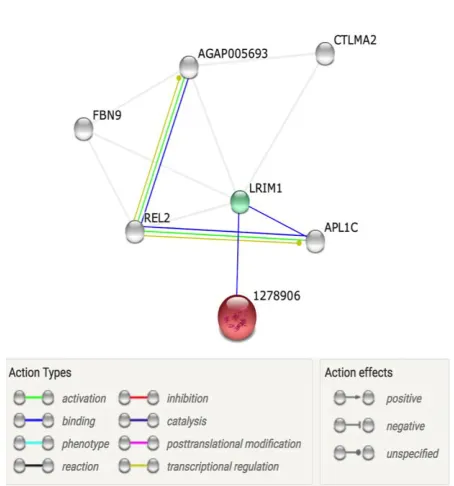
Most of the protein-protein interactions
prediction show that TEP binds with different
proteoforms of leucine-rich immune protein
(LRIM1), which in turn binds to APL1C and
REL2 and other uncharacterized proteins (Fig.
1). The binding of TEP to LRIM1 is strong,
judging by its affinity score of 0.845. Besides
REL2 binding to AL1C, its aid in activation
and translational regulation of APL1C and the
uncharacterized protein. The interaction
net-work also shows that the evidence of these
bindings is both experimental determination
and text mining. All interactions have a high
confidence.
Fig. 1: Protein-Protein interaction network of TEP in an invertebrate
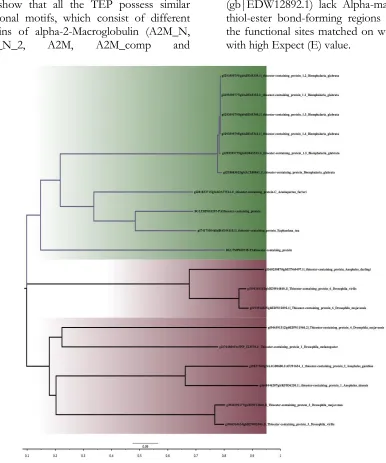
The entire insect TEP selected formed a major
Claude while the others from Mollusca formed
show similarities as seen between
A.
darling
(gb|ETN60497.1)
and
D.
virilis
(gb|EDW64840.1) as well as
D. mojavensis
(gb|EDW12892.1). The two proteoforms of
B.
glabrata
TEP shows similarity to the two other
Mollusca species;
Azumapecten farreri
and
Eu-phaedusa tau
(Fig. 2). Functional domain
anal-yses show that all the TEP possess similar
functional motifs, which consist of different
domains of alpha-2-Macroglobulin (A2M_N,
A2M_N_2,
A2M,
A2M_comp
and
A2M_recep) as well as Alpha-macro-globulin
thiol-ester bond-forming region
(Thiol-ester_cl) Fig. 3. However,
B. glabrata
TEP
iden-tified from vectorbase dataset do not conform
to this possessing just a few of the motifs.
A.
darling
(gb|ETN60497.1),
D.
virilis
(gb|EDW64840.1)
and
D.
mojavensis
(gb|EDW12892.1) lack Alpha-macro-globulin
thiol-ester bond-forming regions (Fig. 3). All
the functional sites matched on were obtained
with high Expect (E) value.
Fig. 2: Phylogenetic analysis of the different invertebrates TEP based on neighbor-joining method. There are
Fig. 3: Functional domains/families of the different invertebrates TEP
Keys
Discussion
The success of
Schistosoma
infection and
transmission is tied to the presence of
com-patible intermediate snail hosts (26). Thus,
proteins employed by snails in mounting
de-fense responses to prevent infection may have
a significant impact on the transmission and
control of schistosomiasis (12). Consequently,
exploiting snail resistance responses could
lim-it the number of new snail infections in the
wild (20, 26). Some of the proteins implicated
in immune responses of snails include
fibrino-gen-related protein (26) and the recently
iden-tified protein, Biomphalysin (30, 27). The
needs to decipher the immunity of the snail
vector against
Schistosoma
infection have led to
glabrata
genome to identify additional proteins
useful for snail immunity (19). One of such
proteins suggested to play a vital role in snail
immunity is thioester-containing protein
(TEP). Numerous studies have highlighted the
role of TEP in a few invertebrates especially
arthropods such as
Anopheles
mosquitoes and
Drosophila melanogaster
(35). Some of these
works have employed molecular and
compu-tational tools in the identification and
charac-terization of Thioester-containing Protein
from other Mollusca such as from Zhikong
scallop. However, none has identified the
presence of thioester-containing protein in the
proteome of
B. glabrata
(32, 34).
Our structural and functional analyses
re-vealed that most of the proteins studied were
stable. Some of these proteins may possibly be
secreted via the non-classical pathway and
others through the classical pathway. Host
survival during infections is determined by the
ability of the immune response proteins, some
of which are secretory, interfering with
para-site development (50). Our identification of
TEP in
B. glabrata
may provide a probable
rea-son to why some snails are susceptible and
some resistant to schistosome infection.
Iden-tified immune molecule, fibrinogen-related
protein 3 (FREP3) is important for snail
de-fenses against schistosome infections in
Bi-omphalaria
(22, 25). A loss of resistance in
in-fected snails was associated with a strong
down-regulation of FREP3 and other
candi-date immune molecules. TEP may also
func-tion in the same way as observed in FREP3 by
inducing immunity during infection. An
un-derstanding of how the susceptibility of snails
in schistosomiasis endemic areas can be
ma-nipulated may result in snails with reduced
capacity for parasite transmission (22). TEP
was identified via functional studies in
A.
gambiae
mosquitoes as one of the key proteins
important in the immunity of infection against
Plasmodium
(35). The expression of TEP1 in
some strains of
A. gambiae
is responsible for
the resistance of these mosquitoes to
Plasmodi-um
infections. Functional in vivo assays may
be required to validate the role of TEP in
B.
glabrata
, and provide a clearer picture of the
role of this protein in the snail’s immune
re-sponse.
The predicted protein-protein interaction
network confirmed TEP binding to the
APL1C/LRIM1
complex. Our prediction also
shows that REL2 and an uncharacterized
pro-tein bind to the complex as presented in Fig. 1.
The binding REL2 to AL1C may be vital in
the activation and translational regulation of
APL1C and the uncharacterized protein may
play a role in the regulation of TEP. There is
concrete evidence from both ‘wet’ and ‘dry’
laboratory experiment on the presence of TEP
in insects like
Anopheles
mosquitoes (35) and
D.
melanogaster,
and also investigated the role and
mechanism of action of this protein in these
arthropods (49).
Although, we employed
A. gambiae
model on
the functional protein association networks
since neither
B. glabrata
nor other Mollusca
genome has not been included in the database.
The organisms that are in the String database
are those whose genome has been well
anno-tated and published. Different crystal
struc-tures of
A. gambiae
TEP1 have been mapped
and deposited in Protein Data Bank
(
http://www.rcsb.org/pdb/home/home.do
).
TEP had a highly reactive thioester motif,
which can undergo spontaneous hydrolysis.
This research identified these functional
mo-tifs as Alpha-macro-globulin thiol-ester
bond-forming region. However, this vital motif was
absent from
A. darling
(gb|ETN60497.1),
D.
virilis
(gb|EDW64840.1) and
D. mojavensis
(gb|EDW12892.1) TEP homologues as
pre-sented in Fig. 3. If experimental research can
validate the absent of thioester motif from
these insects, it shows that they employ other
proteins and mechanism in development of
resistant to pathogens in strain. Alternatively,
maybe not all strains of an insect express TEP
as seen in
D. virilis
and
D. mojavensis
. One
strain of
D. virilis
and
D. mojavensis
with the
accession
no
gb|EDW65046.2,
and
motif while the same species with accession
number
gb|EDW64840.1
and
gb|EDW12892.1 respectively lacks the TE
motif.
Conclusion
The presence of the TE motif in TEP-like
protein and this motif is similar to that found
in
A. gambiae
; therefore, this could open a new
era of schistosomiasis control research by
dis-rupting
schistosome–snail
compatibility.
Moreover, our exploitation of the recently
re-leased
B. glabrata
genome for TEP was
suc-cessful and an ongoing work on
shotgun
proteomic and bioinformatics analyses of the
hemolymph of
B. glabrata
in our laboratory
reveals some proteoforms of this protein.
However, further experimental studies could
involve sensitive genomic, transcriptomic and
proteomics tools.
Acknowledgments
The Research work was sponsored by
TWAS, CNPq, and CAPES (FP number:
3240274297).
Conflict of interest
The authors declare that there is no conflict
of interest.
References
1. Prentice MA. Schistosomiasis and its interme-diate hosts in the Lesser Antillean Islands of the Caribbean. Pan Am J Public Health. 1980; 14(3):258-68.
2. Lockyer AE, Spinks JN, Walker AJ et al. Bi-omphalaria glabrata transcriptome: identification of cell-signalling, transcriptional control and immune-related genes from open reading frame expressed sequence tags (ORESTES). Dev Comp Immunol. 2007; 31(8):763-82. 3. Mutuku MW, Dweni CK, Mwangi M et al.
Field-derived Schistosoma mansoni and
Biomphalar-ia pfeifferi in Kenya: a compatible association characterized by lack of strong local adaptation, and presence of some snails able to persistently produce cercariae for over a year. Parasit Vec-tors. 2014; 7(1):533.
4. Zoni AC, Catalá L, Ault SK. Schistosomiasis Prevalence and Intensity of Infection in Latin America and the Caribbean Countries, 1942-2014: A Systematic Review in the Context of a Regional Elimination Goal. PLoS Negl Trop Dis. 2016; 10(3):e0004493.
5. Colley DG, Bustinduy AL, Secor WE, King CH. Human schistosomiasis. Lancet. 2014; 383(9936):2253-64.
6. Lai YS, Biedermann P, Ekpo UF et al. Spatial distribution of schistosomiasis and treatment needs in sub-Saharan Africa: a systematic re-view and geostatistical analysis. Lancet Infect Dis. 2015; 15(8):927-40.
7. Michaud CM, Gordon WS, Reich MR. The global burden of disease due to schistosomia-sis. Disease Control Priorities Project Working Paper. 2003; 19.
8. Bocanegra C, Gallego S, Mendioroz J et al. Epidemiology of schistosomiasis and Useful-ness of Indirect Diagnostic Tests in School-Age Children in Cubal, Central Angola. PLoS Negl Trop Dis. 2015; 9(10):e0004055.
9. Fenwick A, Webster JP, Bosque-Oliva E et al. The schistosomiasis Control Initiative (SCI): ra-tionale, development and implementation from 2002–2008. Parasitol. 2009; 136(13):1719-30. 10. French MD, Churcher TS, Webster JP et al.
Estimation of changes in the force of infection for intestinal and urogenital schistosomiasis in countries with schistosomiasis control initia-tive-assisted programmes. Parasit Vectors. 2015; 8(1):1.
11. de Moraes J. Antischistosomal natural com-pounds: present challenges for new drug screens. Cur Top in Trop Med. 2012; 333-58 12. Coeli R, Baba EH, Araujo N, Coelho PM,
Oliveira G. Praziquantel treatment decreases
Schistosoma mansoni genetic diversity in experi-mental infections. PLoS Negl Trop Dis. 2013; 7(12):e2596.
14. Lardans V, Dissous C. Snail control strategies for reduction of schistosomiasis transmission. Parasit Today. 1998; 14(10):413-7.
15. King CH, Bertsch D. Historical perspective: snail control to prevent schistosomiasis. PLoS Negl Trop Dis. 2015; 9(4):e0003657.
16. Southgate VR. Schistosomiasis in the Senegal River Basin: before and after the construction of the dams at Diama, Senegal and Manantali, Mali and future prospects. J Helminthol. 1997; 71(02):125-32.
17. Adenowo AF, Oyinloye BE, Ogunyinka BI, Kappo AP. Impact of human schistosomiasis in sub-Saharan Africa. Braz J Infect Dis. 2015; 19(2):196-205.
18. Kenny NJ, Truchado-García M, Grande C. Deep, multi-stage transcriptome of the schisto-somiasis vector Biomphalaria glabrata provides platform for understanding molluscan disease-related pathways. BMC Infect Dis. 2016; 16(1):618.
19. Coustau C, Gourbal B, Duval D, Yoshino TP, Adema CM, Mitta G. Advances in gastropod immunity from the study of the interaction be-tween the snail Biomphalaria glabrata and its par-asites: a review of research progress over the last decade. Fish Shellfish Immu. 2015; 46(1):5-16.
20. Zhang SM, Loker ES, Sullivan JT. Pathogen-associated molecular patterns activate expres-sion of genes involved in cell proliferation, immunity and detoxification in the amebocyte-producing organ of the snail Biomphalaria glabra-ta. Dev Comp Immunol. 2016; 56:25-36. 21. Coustau C. Immunity in parasite-vector snails.
Med Sci (Paris). 2009; 25(4):399-403.
22. Hanington PC, Forys MA, Loker ES. A somat-ically diversified defense factor, FREP3, is a de-terminant of snail resistance to schistosome in-fection. PLoS Negl Trop Dis. 2012; 6(3):e1591. 23. Gorbushin AM, Panchin YV, Iakovleva NV. In search of the origin of FREPs: characteriza-tion of Aplysia californica fibrinogen-related proteins. Dev Comp Immunol. 2010; 34(4):465-73.
24. Dheilly NM, Duval D, Mouahid G et al. A family of variable immunoglobulin and lectin domain containing molecules in the snail Bi-omphalaria glabrata. Dev Comp Immunol. 2015; 48(1):234-43.
25. Hanington PC, Zhang SM. The primary role of fibrinogen-related proteins in invertebrates is defense, not coagulation. J Innate Immun. 2010; 3(1):17-27.
26. Adema CM. Fibrinogen-related proteins (FREPs) in mollusks. In: Pathogen-Host Inter-actions: Antigenic Variation v. Somatic Adapta-tions 2015 (pp. 111-129). Springer International Publishing.
27. Pinaud S, Portela J, Duval D et al. A shift from cellular to humoral responses contributes to innate immune memory in the vector snail Bi-omphalaria glabrata. PLoS Pathog. 2016; 12(1):e1005361.
28. Coustau C, Kurtz J, Moret Y. A Novel Mecha-nism of Immune Memory Unveiled at the In-vertebrate–Parasite Interface. Trends Parasitol. 2016; 32(5):353-5.
29. Humphries J, Harter B. Identification of nucle-ar factor kappaB (NF-κB) binding motifs in Bi-omphalaria glabrata. Dev Comp Immunol. 2015; 53(2):366-70.
30. Galinier R, Portela J, Moné Y. Biomphalysin, a new β pore-forming toxin involved in Biompha-laria glabrata immune defense against Schistosoma mansoni. PLoS Pathog. 2013; 9(3):e1003216. 31. Giraldo-Calderón GI, Emrich SJ, MacCallum
RM. VectorBase: an updated bioinformatics re-source for invertebrate vectors and other or-ganisms related with human diseases. Nucleic Acids Res. 2014:gku1117.
32. Moné Y, Gourbal B, Duval D, Du Pasquier L, Kieffer-Jaquinod S, Mitta G. A large repertoire of parasite epitopes matched by a large reper-toire of host immune receptors in an inverte-brate host/parasite model. PLoS Negl Trop Dis. 2010; 4(9):e813.
33. Deleury E, Dubreuil G, Elangovan N. Specific versus non-specific immune responses in an invertebrate species evidenced by a compara-tive de novo sequencing study. PLoS One. 2012; 7(3):e32512.
34. Mitta G, Adema CM, Gourbal B, Loker ES, Theron A. Compatibility polymorphism in snail/schistosome interactions: From field to theory to molecular mechanisms. Dev Comp Immunol. 2012; 37(1):1-8.
the mosquito, Anopheles gambiae. Cell. 2001; 104(5):709-18.
36. Dinguirard N and Yoshino TP. A Biomphalaria glabrata thioester-containing protein. 2008. (GenBank Accession No: ACL00841.1) Un-published.
37. Wu XJ, Humphries JE, Dinguirard N, Chung CY, Yoshino TP. Differentially expressed gene transcripts from LTP (larval transformation protein) treated Biomphalaria glabrata embryonic cell line identified by subtractive hybridization. 2013. (GenBank Accession No: AHH81765.1) Unpublished.
38. Megy K, Emrich SJ, Lawson D. Vector Base: improvements to a bioinformatics resource for invertebrate vector genomics. Nucleic Acids Res. 2012; 40(D1):D729-34.
39. Kearse M, Moir R, Wilson A. Geneious Basic: an integrated and extendable desktop software platform for the organization and analysis of sequence data. Bioinformatics. 2012; 28(12):1647-9.
40. Conesa A, Götz S, García-Gómez JM, Terol J, Talón M, Robles M. Blast2GO: a universal tool for annotation, visualization and analysis in functional genomics research. Bioinformatics. 2005; 21(18):3674-6.
41. Conesa A, Götz S. Blast2GO: A comprehen-sive suite for functional analysis in plant ge-nomics. Int J Plant Gege-nomics. 2008; 619832. doi:10.1155/2008/619832.
42. Götz S, García-Gómez JM, Terol J et al. High-throughput functional annotation and data mining with the Blast2GO suite. Nucleic Acids Res. 2008; 36(10):3420-35.
43. Ittner LM, Götz J. Amyloid-β and tau—a toxic pas de deux in Alzheimer's disease. Nat Rev Neurosci. 2011; 12(2):67-72.
44. Gasteiger E, Hoogland C, Gattiker A, Duvaud SE, Wilkins MR, Appel RD, Bairoch A. Pro-tein identification and analysis tools on the ExPASy server. Humana Press; 2005.
45. Petersen SE, Posner MI. The attention system of the human brain: 20 years after. Annu Rev Neurosci. 2012; 35:73.
46. Emanuelsson O, Nielsen H, Brunak S, Von Heijne G. Predicting subcellular localization of proteins based on their N-terminal amino acid sequence. J Mol Biol. 2000; 300(4):1005-16. 47. Khachatryan V, Sirunyan AM, Tumasyan A et
al. Precise determination of the mass of the Higgs boson and tests of compatibility of its couplings with the standard model predictions using proton collisions at 7 and 8\,\ text {TeV}. Eur Phys J E. 2015; 75(5):1-50. 48. Bjellqvist B, Hughes GJ, Pasquali C et al. The
focusing positions of polypeptides in immobi-lized pH gradients can be predicted from their amino acid sequences. Electrophoresis. 1993; 14(1):1023-31.
49. Bjellqvist B, Basse B, Olsen E, Celis JE. Refer-ence points for comparisons of two‐dimensional maps of proteins from differ-ent human cell types defined in a pH scale where isoelectric points correlate with polypep-tide compositions. Electrophoresis. 1994; 15(1):529-39.
50. Chazan A. Peptide property calculator. Evans-ton, IL: Northwestern University: http://www. basic. nwu. edu/biotool/ProteinCalc. html. 2002.