DEMOGRAPHIC RESEARCH
VOLUME 29, ARTICLE 9, PAGES 233-246
PUBLISHED 13 AUGUST 2013
http://www.demographic-research.org/Volumes/Vol29/9/ DOI: 10.4054/DemRes.2013.29.9
Descriptive Finding
Family influence in fertility: A longitudinal
analysis of sibling correlations in first birth
risk and completed fertility among Swedish
men and women
Johan Dahlberg
© 2013 Johan Dahlberg.
This open-access work is published under the terms of the Creative Commons Attribution NonCommercial License 2.0 Germany, which permits use, reproduction & distribution in any medium for non-commercial purposes, provided the original author(s) and source are given credit.
2 Data and methods 235
2.1 Data 235
2.2 Method 236
3 Results 238
3.1 Brother and sister correlation in fertility 238
3.2 Sensitivity analyses 240
4 Conclusions 241
5 Acknowledgement 242
Family influence in fertility: A longitudinal analysis of sibling
correlations in first birth risk and completed fertility among Swedish
men and women
Johan Dahlberg1
Abstract
BACKGROUND
The intergenerational transmission of fertility has received much attention in demography. This has been done by estimating the correlation between parents’ and offsprings’ fertility. An alternative method that provides a more comprehensive account of the role of family background - sibling correlations - has not been used before.
OBJECTIVE
I estimate the overall importance of family background on entry into parenthood and completed fertility and whether it changed over time. Furthermore, I compare the intergenerational correlation in completed fertility with corresponding sibling correlations.
METHODS
Brother and sister correlations in first birth hazard and in final family size were estimated using multi-level event-history and multi-level linear regression on Swedish longitudinal register data.
RESULTS
The overall variation in fertility that can be explained by family of origin is approximately 15%-25% for women and 10%-15% for men. The overall importance of the family of origin has not changed over the approximately twenty birth cohorts that were studied (1940-63 for women, 1940-58 for men). Parents’ completed fertility accounts for only a small share of the total family background effect on completed fertility.
CONCLUSIONS
This study contributes to the existing understanding of intergenerational transition of fertility, both methodologically, by introducing a new and powerful method to study the overall importance of family of origin, and substantially, by estimating the overall
importance of family of origin and its development over time. A non-negligible proportion of the variation in fertility can be attributed to family of origin and this effect has remained stable over twenty birth cohorts.
1. Introduction
The influence of family background on outcomes in adulthood has long been of interest in the social sciences. Fertility researchers have been particularly interested in the association between parents and children’s fertility behaviors (e.g., Duncan et al. 1965; Johnson and Stokes 1976; Zimmer and Fulton 1980; Thornton 1980; Anderton et al. 1987; Axinn et al. 1994; Murphy 1999; Murphy and Wang 2001; Murphy and Knudsen 2002). They have found a consistently positive, yet rather weak, correlation (typically between 0.1 and 0.15) between parents’ and children’s completed family size in developed countries (Murphy 1999) and have described how early childbearing is transmitted across generations (e.g. Furstenberg et al. 1990; Horwitz et al. 1991; Kahn and Anderson 1992; Manlove 1997; Barber 2001; Steenhof and Liefbroer 2008).
A limitation with these studies is that they consider only one aspect of family background; namely, parents’ number of children or their age at parenthood. In this study, I estimate the total effect of family background on completed fertility and age at parenthood using sibling correlations (SC). This method of comparing siblings can be regarded as an omnibus measure of family background effects as it captures the effects of everything shared by the siblings including genes, parental influences, and neighborhood effects. The stronger the sibling similarity, the more important these shared factors (Mian, Shoukri, and Tracy 1991). As a more overarching measure of family background effects than intergenerational correlations (IGC), they have become popular in research on such outcomes as income and SES attainment (e.g., Solon 1999; Björklund et al. 2002; Mazumder 2008; Erola, Härkönen, and Jäntti 2008; Björklund, Jäntti, and Lindquist 2009), and school performance (e.g. Björklund, Lindahl, and Sund 2003; Mazumder 2008; Lindahl 2011).
This study provides the first application of the SC method to fertility analysis, although comparable methods have been used to estimate the heritability of fertility (Rodgers et al. 2001). Although not being the main focus, sister correlations for age at marriage were also reported in two studies using historical Dutch data (van Poppel, Monden, and Mandemakers 2008; van Bavel and Kok 2009).
which have focused on early childbearing. Second, I compare the completed fertility estimates to intergenerational correlation (IGC) estimates of completed fertility to determine how much of the family background effect is due to the parents’ number of children. Third, I analyze whether the sibling correlations have changed over approximately twenty successive cohorts. I use register data on over one million Swedish women and their sisters, and over one million Swedish men and their brothers. The data are analyzed using multilevel OLS and discrete-time event history models. The sibling correlations are calculated from their error terms.
2. Data and methods
2.1 Data
Data were retrieved from the Swedish multigenerational registers, which contain information on all Swedes born from 1932 onwards and who have been registered as residents in Sweden at any time since 1961. These data contain information on vital events with very high accuracy. The oldest cohort (1940 as well as their brothers/sisters born in 1936 or later) was determined by the data. The baseline analyses include biological siblings born up to four years earlier or later and the 1936 cohort is the first one to contain sufficiently few cases of missing information on biological mothers (through whom siblings were identified). Biological mothers were identified for 85 % of the 1936 cohort, 90 % for the 1940, 95 % for the 1945, and 98 % for the 1950 cohorts, respectively.
another index person. The birth cohorts refer to those of the index person. Thirty percent of individuals had one same-sex sibling within the age limits. Another five percent had two or more same-sex siblings within these age limits. Following most previous sibling correlation studies with multilevel models, singletons were included in the analysis (for a discussion, see Mazumder 2008). In total, the data contain 1,312,960 women from 937,174 families and 1,096,120 men from 687,017 families.
2.2 Method
I used multilevel OLS regressions to estimate sibling correlations in completed fertility and multilevel discrete-time event history analysis to estimate sibling correlations in first birth hazard. Alternative plausible methods for completed fertility —mainly count regression— lack robust and well established procedures for estimating intra-class correlations (sibling correlations) and were not applied (Rabe-Hesketh and Skrondal 2012).
The multilevel OLS model without covariates can be expressed as
𝑦𝑖𝑗=𝜇+𝑎𝑖+𝑏𝑖𝑗 (1)
where 𝑦𝑖𝑗 is number of children for sibling 𝑗 from family 𝑖(at age 45 for women and 50 for men), 𝜇 is the population mean, 𝑎𝑖 is a family-specific factor shared by all siblings from family 𝑖, and 𝑏𝑖𝑗 is an individual-specific factor unique to individual 𝑗 from family
𝑖. Assuming that 𝑎𝑖 and 𝑏𝑖𝑗 are independent and normally distributed, the variance of
𝑦𝑖𝑗 is the sum of variances of family and individual factors:
𝜎𝑦2= 𝜎𝑎2+𝜎𝑏2 (2)
The proportion of total variance explained by shared family background is
𝜌= 𝜎𝑎2
𝜎𝑎2+𝜎𝑏2 (3)
Multilevel discrete-time event history techniques were used to estimate sibling correlations in first birth hazard. Event history analysis is a set of methods for modeling the hazard of experiencing an event. It allows for right-censored cases (those not experiencing the event), and results from these models refer at the same time to the ultimate probability of an event as well as its timing (e.g., Hoem 1993). The estimated sister and brother correlations thus indicate how much of the hazard of becoming a parent is explained by shared family characteristics. The time variable was age and individuals were followed from age 15 until parenthood or censoring due to death, emigration, or aging out of the observation window (upper age 40 years for women, 45 for men). Following Hedeker’s and Gibbons’s (2006) recommendation to use the complementary log-log link when applying multi-level event-history techniques to discrete-time data, the model specification can be expressed as
cloglog[h(t)] = α(t) (4)
where α(t) =α1𝑡1+α2𝑡2+ . . . + α30𝑡30and 𝑡1,𝑡2, . . . ,𝑡30 are dummies for years 1, 2, . . . 30. To estimate the sibling correlation, I introduced random effects which represents the sibling-specific error term:
cloglog�hj(t)�= α(t) +𝑎𝑖(𝑡)+𝑏𝑖𝑗(𝑡) (5)
where 𝛼(𝑡) captures the population mean, 𝑎𝑖(𝑡) is the family-specific factor shared by all siblings in family i, and 𝑏𝑖𝑗(𝑡) is an individual specific component which represents the individual-level deviation from this family-specific factor. 𝑏𝑖𝑗(𝑡) has a Gumbel distribution with a variance of 𝜋62 (Collett 1991). The share of the variance in the hazard of becoming a parent attributed to family of origin is estimated by;
𝜌=𝜓+π𝜓2⁄6 (6)
where 𝜓 is the variance between families and 𝜌 is the sibling correlation (SC) (Hedeker and Gibbons 2006).
Additionally, I calculated the intergenerational correlation (IGC) in completed fertility by calculating Pearson correlations (𝑟𝑥𝑦);
𝑟𝑥𝑦= ∑ (𝑥𝑖−𝑥̅)(𝑦𝑖−𝑦�)
𝑛 𝑖=1
where 𝑥 is the index person’s same-sex parents’ final number of children and 𝑦 the index person’s final number of children. Hence, men's completed fertility was compared to their father’s completed fertility and the women's completed fertility was compared with their mother’s. IGC in completed fertility was then compared to sister and brother correlations in completed fertility. Solon et al. (1991) shows that the relationship between the intergenerational correlation (IGC) and corresponding sibling correlation is: proportion of sibling correlation (SC) explained by IGC = IGC2/SC.
There is no suitable corresponding intergenerational correlation measure to the sister/brother correlations in first birth hazard since first birth hazard is at the same time a measure both of the timing and ultimate probability to become a parent. The intergenerational correlation in age at first birth is limited only to those who ever enter parenthood. Therefore no corresponding IGC was estimated for the first birth hazard.
3. Results
3.1 Brother and sister correlation in fertility
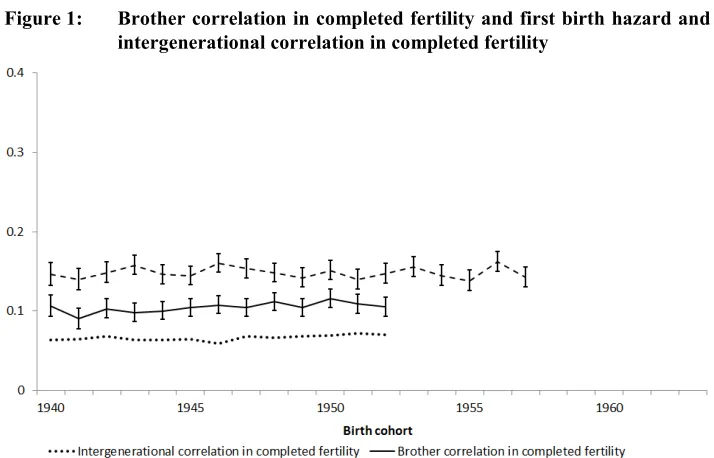
Figures 1 and 2 show brother and sister correlations in completed fertility, first birth hazard, and intergenerational correlation in completed fertility over the cohorts. The brother correlation in first birth hazard (Figure 1, dashed line) varies between 0.10 and 0.15. Sister correlations in first birth hazard (Figure 2, dashed line) are consistently above 0.20. There are no clear cohort patterns in either the brother or the sister correlations.
Figure 1: Brother correlation in completed fertility and first birth hazard and intergenerational correlation in completed fertility
Figure 2: Sister correlation in completed fertility and first birth hazard and intergenerational correlation in completed fertility
3.2 Sensitivity analyses
4. Conclusions
This study showed that 10-15 % of the variation in the hazard of entering fatherhood and 20-25 % of the hazard of entering motherhood in Sweden can be explained by factors shared by the siblings. Furthermore, approximately 10 % of completed fertility among men and just under 15 % of the completed fertility among women is explained by the same factors. These are lower than corresponding estimates of the importance of family background in income attainment in Sweden (Björklund, Jäntti, and Lindquist 2009). The findings also demonstrate that the importance of family background has remained stable over twenty birth cohorts (starting from 1940). This can be considered to be somewhat surprising given that the brother correlations in income attainment have declined significantly across the same cohorts (Björklund, Jäntti, and Lindquist 2009).
Being a summary measure of the importance of family background, these sibling correlations do not point to any specific shared characteristics which affect siblings’ fertility and hence are responsible for the remarkable stability in the sibling correlations. Candidates include socioeconomic family resources, cultural influences, and neighborhood and cohort effects. However, the findings did show that the parents’ completed fertility plays only a very minor role in affecting the offspring’s completed fertility: only between 2.5% and 5% of brother correlations and between 6% and 10% of sister correlations can be explained by mother’s/father’s number of children. The same result was obtained when mother’s/father’s final family size was included in the multilevel model as a fixed effect. The similarity in siblings’ fertility behaviors thus stems mainly from other sources. Another explanation could be that siblings’ fertility are influenced by one another (Murphy and Knudsen 2009). However, the increased propensity to become a parent immediately after a sibling makes the same transition is only strong for first births (Lyngstad and Prskawetz 2010). Thus, sibling effects may play a part in explaining the stable sibling correlation in first birth propensity but might be less important in the understanding of the equally stable sibling correlation in completed fertility.
That women are more affected than men by their family of origin is in line with previous research (Booth and Edwards 1989; Amato and Keith 1991; Amato 1996). One possibility as to why women are more affected by family of origin is that parents’ influences over their children decline as the child grows older. Since women, on average, enter parenthood earlier than men, they are also more responsive to family background influences when entering parenthood (Rossi and Rossi 1990). Another explanation refers to women’s role as kinkeepers and thus their stronger susceptibility to parental influence.
than the propensity and timing of becoming a parent. The final number of children in a family is generally decided at a later stage in life than the entry into parenthood.
5. Acknowledgements
References
Amato, P.R. (1996). Explaining the intergenerational transmission of divorce. Journal of Marriage and the Family 58(3): 628–640. doi:10.2307/353723.
Amato, P.R. and Keith, B. (1991). Parental divorce and adult well-being: A meta-analysis. Journal of Marriage and the Family 53(1): 43–58. doi:10.2307/ 353132.
Anderton, D.L., Tsuya, N.O., Bean, L.L., and Mineau, G.P. (1987). Intergenerational transmission of relative fertility and life course patterns. Demography 24(4): 467-480. doi:10.2307/2061386.
Axinn, W., Clarkberg, M.E., and Thornton, A. (1994). Family influences on family size preferences. Demography 31(1): 65-79. doi:10.2307/2061908.
Barber, J. (2001). The intergenerational transmission of age at first birth among married and unmarried men and women. Social Science Research 30(2): 219–247.
doi:10.1006/ssre.2000.0697.
Björklund, A., Eriksson, T., Jäntti, M., Raaum, O., and Österbacka, E. (2002). Brother correlations in earnings in Denmark, Finland, Norway and Sweden compared to the United States. Journal of Population Economics 15(4): 757-772.
doi:10.1007/s001480100095.
Björklund, A., Jäntti, M., and Lindquist, M. (2009). Family background and income during the rise of the welfare state: brother correlations in income for Swedish men born 1932–1968. Journal of Public Economics 93(5-6): 671–680.
doi:10.1016/j.jpubeco.2009.02.006.
Björklund, A., Lindahl, M., and Sund, K. (2003) Family background and school performance during a turbulent era of school reforms. Swedish Economic Policy Review 10: 111–136.
Booth, A. and Edwards, J.N. (1989). Transmission of marital and family quality over the generations: The effects of parental divorce and unhappiness. Journal of
Divorce 13(2): 41–58. doi:10.1300/J279v13n02_02.
Collett, D. (1991). Modelling binary data. London: Chapman and Hall.
Erola, J., Härkönen, J., and Jäntti, M. (2008). Trends in brother correlations in class and incomes in Finland: A comparison of cohorts born in 1932-62. Prepared for the ISA Research Committee 28 Spring Meeting, Florence, Italy, May 15-18, 2008.
Field, A.P. (2005). Intraclass correlation. In: Everitt, B.S. and Howell, D.C. (eds.).
Encyclopedia of Statistics in Behavioral Science. Chichester: John Wiley and Sons: 948-954. doi:10.1002/0470013192.bsa313.
Furstenberg, F.F., Levine, J.A., and Brooks-Gunn, J. (1990). The children of teenage mothers: Patterns of early childbearing in two generations. Family Planning Perspectives 22(2): 54–61. doi:10.2307/2135509.
Guo, G. and Wang, J. (2002). The mixed or multilevel model for behavior genetic analysis. Behavior Genetics 32(1): 37–49. doi:10.1023/A:1014455812027.
Hedeker, D. and Gibbons, R.D. (2006). Longitudinal data analysis. New York: Wiley. Hoem, J.M. (1993). Classical Demographic Methods of Analysis and Modern
Event-History Techniques. 281–91 in IUSSP: 22nd International Population
Conference, Montreal, Canada, Vol. 3.
Horwitz, S.M., Klerman, L.V., Sung Kuo, H., and Jekel, J.F. (1991). Intergenerational transmission of school-age parenthood. Family Planning Perspectives 23(4): 168–177. doi:10.2307/2135740.
Johnson, N.E. and Stokes, C.S. (1976). Family size in successive generations: The effects of birth order, intergenerational change in lifestyle, and familial satisfaction. Demography 13(2): 175-187. doi:10.2307/2060799.
Kahn, J.R. and Anderson, K.E. (1992). Intergenerational patterns of teenage fertility.
Demography 29(1): 39-57. doi:10.2307/2061362.
Lindahl, L. (2011). A comparison of family and neighborhood effects on grades, test scores, educational attainment and income – evidence from Sweden. Journal of Economic Inequality 9(2): 207-226. doi:10.1007/s10888-010-9144-1.
Lyngstad, T.H. and Prskawetz, A. (2010). Do siblings' fertility decisions influence each other? Demography 47(4): 923-934. doi:10.1007/BF03213733.
Manlove, J. (1997). Early motherhood in an intergenerational perspective: The experiences of a British cohort. Journal of Marriage and Family 59(2): 263-279.
Mazumder, B. (2008). Sibling similarities and economic inequality in the US. Journal of Population Economics 21(3): 685–701. doi:10.1007/s00148-006-0127-2.
Mian, I.U.H., Shoukri, M.M., and Tracy, D.S. (1991). Maximum likelihood estimation of sibling correlations in the analysis of family data. Journal of Statistical Planning and Inference 27(1): 125–141. doi:10.1016/0378-3758(91)90086-T.
Murphy, M. (1999). Is the relationship between fertility of parents and children really weak? Social Biology 46(1-2): 122-145. doi:10.1080/19485565.1999.9988991. Murphy, M. and Knudsen, L.B. (2002). The intergenerational transmission of fertility in
contemporary Denmark: The effects of number of siblings (full and half), birth order, and whether male or female. Population Studies 56(3): 235-248.
doi:10.1080/00324720215937.
Murphy, M. and Knudsen, L.B. (2009). The relationship of parents', brothers' and sisters' fertility histories with the onset of childbearing in contemporary Denmark. In: Festy, P. and Sardon, J.-P. (eds.). A Demographer by Profession. A Homage to Gérard Calot: Special Edition of Population. Paris: INED: 265-284. Murphy, M. and Wang, D. (2001). Family-level continuities in childbearing in
low-fertility societies. European Journal of Population 17(1): 75-96. doi:10.1023/ A:1010744314362.
Rabe-Hesketh, S. and Skrondal, A. (2012). Multilevel and Longitudinal Modeling Using Stata, Volume II: Categorical Responses, Counts, and Survival (Third Edition). College Station: Stata Press.
Rodgers, J.L., Kohler, H-P., Kyvik, K.O., and Christensen, K. (2001). Behavior genetic modeling of human fertility: Findings from a contemporary Danish twin study.
Demography 38(1): 29-42. doi:10.1353/dem.2001.0009.
Rossi, A.S. and Rossi, P.H. (1990). Of human bonding: Parent–child relations across the life course. New York: Aldine de Gruyter.
Solon, G. (1999). Intergenerational mobility in the labor market. In: Ashenfelter, O.C. and Card, D. (eds.). Handbook of Labor Economics, vol. 3A. Amsterdam: North Holland: 1761–1800. doi:10.1016/S1573-4463(99)03010-2.
Steenhof, L. and Liefbroer, A.C. (2008). Intergenerational transmission of age at first birth in the Netherlands for birth cohorts born between 1935 and 1984: Evidence from municipal registers. Population Studies 62(1): 69–84. doi:10.1080/ 00324720701788616.
Thornton, A. (1980). The influence of first generation fertility and economic status on second generation fertility. Population & Environment 3(1): 51-72. doi:10.1007/ BF01253070.
van Bavel, J. and Kok, J. (2009). Social control and the intergenerational transmission of age at marriage in rural Holland, 1850-1940. Population (English Edition)
64(2): 343-360. doi:10.3917/pope.902.0341.
van Poppel, F., Monden, C., and Mandemakers, K. (2008). Marriage timing over the generations. Human Nature 19(1): 7-22. doi:10.1007/s12110-008-9033-5.