Standard Cell Transistor Level ATPG Coverage
Ang Boon Chong
eASIC Corp Email: [email protected]
Abstract—A study of components field failure rate over the years shows reduction in failure rates of various component [1] while another study [2] shows only 20% the percentage of system meeting reliability requirement from 1996 to 2000. The contradict observation between two studies drives the need to understand the system testability not only from logic gate functional perspective but the true coverage from transistor level as well. In the automotive semiconductors industry, the target tolerated field failure rates is zero percentage and the defect parts per million, DPM for automotive semiconductor is 1DPM. Hence there is a need to put more efforts on device, board and system level testability in order to deliver a consistently reliable and cost effective product to market. This paper will analyze the standard cell’s ATPG coverage at transistor level with commercial ATPG tool. Hopefully the finding will benefit the readers.
Index Terms—standard cell, ATPG modeling, transistor
I. INTRODUCTION
Test is a mechanism to verify the device under test (DUT) is correctly manufactured. Study [1] has shown that the measured field failure rate of different component has improved over the years in Fig. 1 while the study [2] from 1996 to 2000 shows that only 20% of the systems meeting the reliability requirement in Fig. 2.
From Fig. 1 and Fig. 2, it shows that improved components measured field failure rate over the years does not improve the system reliability for operational tests. Hence there is a need to have a more in depth understanding of component coverage improvement over the years.
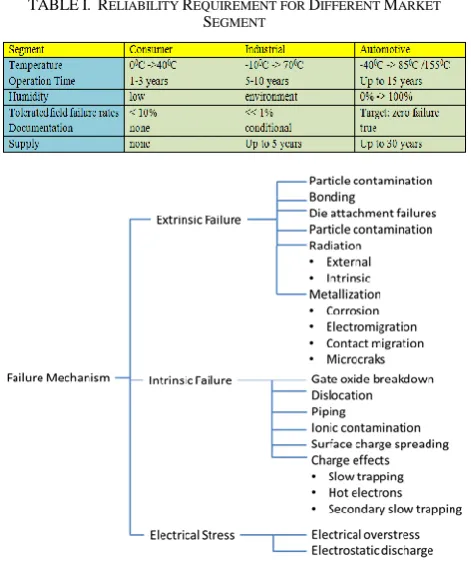
As each market segments have different reliability requirements, as shown in Table I. A clear understanding of the requirement will help the designer to improve the product reliability to cater the needs of various industries.
Figure 1. Component’s measured field failure rate [1]
Manuscript received April 25, 2014; revised June 27, 2014.
Figure 2. Demonstrated reliability versus requirements for operational tests, 1996-2000 [2]
TABLEI. RELIABILITY REQUIREMENT FOR DIFFERENT MARKET
SEGMENT
Figure 3. Failure mechanism [3]-[12]
For chip failures, it can be generalized as 3 classes shown in Fig. 3:
Extrinsic failure: Extrinsic failures originate in the packaging and interconnection processes.
Electrical stress failure: Electrical stress failures are caused by poor design or careless handling Till now, for stuck at fault coverage, the major idea is to present a gate level model to the automatic test pattern generator including the cell-aware library modeling [13], ATPG tool to generate patterns to detect physical defects as close to the gate model as possible. The library model generation from transistor level equivalent to the gate level representation is done through non-commercial tool like GateMaker [14]. GateMaker is a tool developed by IBM and Intel which generate the gate level models from schematics. GateMaker use path tracing to map groups of transistors to a channel connected component and paths pruning to simplify the circuit to a final equivalent form. The success of GateMaker and the adoption is proven previously [15], [16].
Previous researches on transistor level ATPG fault coverage, mainly focus on the ATPG generation technique at transistor level circuit through [17]-[19]:
Custom generation tool
Circuit modification during ATPG generation In this paper, the scope of discussion will be standard cell transistor level automatic test pattern generator, ATPG coverage correlation using the commercial ATPG tool. The modeling and generation methodology is beyond the scope of discussion in this paper. The analysis of standard cell transistor level coverage will be partition by:
Universal logic function Input’s width of logic Logic’s architecture Logic’s drive strength
Hopefully, the readers can benefit from the sharing.
II. TRANSISTOR LEVEL ATPGFLOW
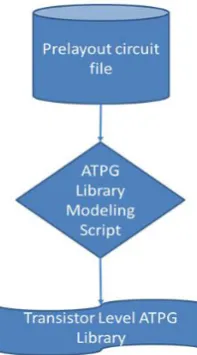
The transistor level ATPG flow is shown in Fig. 4.
Figure 4. Standard cell transistor level library generator
The transistor level modeling with Z-propagation removal technique in commercial ATPG tool will not be discussed in this paper. Special care is needed in translating the NMOS and PMOS transistor in the circuit file, as the direction of the MOS’s drain and source
contacts in spice modeling is interchangeable, while the direction for MOS’s drain and source contact in Verilog primitive is fixed. The illustration is shown in Fig. 5.
Figure 5. MOS instantiation
The ATPG coverage extraction flow is shown in Fig. 6.
Figure 6. Standard cell transistor level ATPG coverage extraction flow
III. BASIC LOGIC FUNCTION
For basic logic function coverage extraction, only the universal cells such as 2 inputs NAND, 2 inputs NOR and Inverter are analyzed. The transistor level coverage for universal cells is shown in Table II.
TABLEII. UNIVERSAL LOGIC CELL TRANSISTOR ATPGCOVERAGE
function total fault pattern coverage total fault pattern coverage
Inverter 4 2 100 12 2 100
2 input NOR 6 3 100 18 3 83.33
2 input NAND 6 3 100 20 3 86.67
Gate level Transistor Level
From Table II, it is shown that inverter has 100% transistor level automatic test pattern generator, ATPG coverage while the transistor level automatic test pattern generator, ATPG coverage for NAND and NOR gate is 86.67 and 83.33% respectively. The detailed breakdown for universal logic gates automatic test pattern generator, ATPG fault classification is shown in Table III.
TABLEIII. UNIVERSAL LOGIC CELL TRANSISTOR LEVEL FAULT
CLASSIFICATION
fault class Inverter 2 Input NOR 2 Input NAND
Detected 8 11 14
Possible detected 0 0 0
Undetectable 4 4 3
ATPG untestable 0 3 3
Not detected 0 0 0
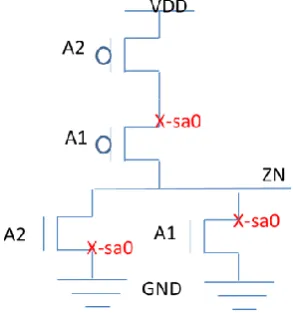
From Table III, the undetectable fault nodes are due to supply or ground connection to the MOS transistor and the transistor’s gate off state. The ATPG untestable fault class is caused by series connection of same transistor type. The 2 input NAND gate’s ATPG untestable nodes is shown in Fig. 7.
Figure 7. 2-Input NAND gate atpg untestable fault
For the 2-Input NOR gate’s ATPG untestable node is shown in Fig. 8.
Figure 8. 2-Input NOR Gate ATPG Untestable Fault
From Fig. 7 and Fig. 8, it is concluded that the reported ATPG untestable node is due to the constant supply and ground propagation. It concludes that though at cell level, the ATPG coverage per cell node may be 100%, the actual transistor node coverage is not 100% for universal gate. Constant propagation removal will result in risk of masking off weak short. However, the isolation cannot be achieve through commercial ATPG tool. The fault removal of those nodes also highly depended on the propagation of the supply or ground, special scripting effort is required to remove the false ATPG untestable node.
The impact of Gate’s input width to transistor level DC coverage is shown in Fig. 9.
From Fig. 9, it is observed that transistor level DC coverage reduced as the input width increase, for both NAND and NOR gate. The fault classification for each NAND and NOR gate with different input’s width is shown in Table IV.
Figure 9. Width dependence transistor level DC coverage
TABLEIV. WIDTH DEPENDENCE TRANSISTOR LEVEL FAULT
CLASSIFICATION
fault class 2 Input NOR 3 Input NOR 4 Input NOR 2 Input NAND 3 Input NAND 4 Input NAND
Detected 11 15 19 14 20 26
Possible detected 0 0 0 0 0 0
Undetectable 4 5 6 3 4 5
ATPG untestable 3 6 10 3 6 9
Not detected 0 0 0 0 0 0
Total faults 18 26 35 20 30 40
From Table IV, it is observed that ATPG untestable node increase as the input width of NOR and NAND gate increase. The increase of ATPG untestable nodes is same as Fig. 7 and Fig. 8’s explanation.
V. LOGIC’S DRIVE STRENGTH
The same analysis is repeated on inverter, 2 input NOR gate and 2 input NAND gate with various drive strength and the transistor level stuck-at-fault coverage is shown in Fig. 10.
Figure 10. Drive strength dependence transistor level DC coverage
From Fig. 10, it is observed that Inverter gate stuck-at-fault coverage remain 100% regardless of the gate’s drive strength. For NAND gate and NOR gate, the transistor level stuck-at-fault coverage reduced as the gate’s drive strength increases. The fault classification for drive strength dependence analysis is shown in Table V, Table VI and Table VII.
TABLEV. INVERTER’S DRIVE STRENGTH DEPENDENCE TRANSISTOR
LEVEL FAULT CLASSIFICATION
fault class INVD0 INVD1 INVD2 INVD4 INVD8
Detected 8 10 10 12 20
Possible detected 0 0 0 0 0
Undetectable 4 4 8 20 40
ATPG untestable 0 0 0 0 0
Not detected 0 0 0 0 0
Total faults 12 12 18 32 60
TABLEVI. NANDGATE’S DRIVE STRENGTH DEPENDENCE
TRANSISTOR LEVEL FAULT CLASSIFICATION
fault class NAND2D0 NAND2D1 NAND2D2 NAND2D4 NAND2D8
Detected 14 14 18 22 38
Possible detected 0 0 0 0 0
Undetectable 3 3 6 16 32
ATPG untestable 3 3 8 12 24
Not detected 0 0 0 0 0
Total faults 20 20 32 50 94
TABLEVII. NORGATE’S DRIVE STRENGTH DEPENDENCE TRANSISTOR
LEVEL FAULT CLASSIFICATION
fault class NOR2D0 NOR2D1 NOR2D2 NOR2D4 NOR2D8
Detected 11 11 11 17 29
Possible detected 0 0 0 0 0
Undetectable 4 4 8 16 32
ATPG untestable 3 3 11 13 25
Not detected 0 0 0 0 0
Total faults 18 18 30 46 86
From Table V, Table VI and Table VII, the total faults count increase as the gate’s drive strength increase. The total faults count increase is expected as for the width of the MOS transistor is constrained by the physical height of the standard cell library. The standard cell gate’s drive strength increment is done by multi-finger approach since the width of the MOS transistor is uniform.
VI. LOGIC’SARCHITECTURE
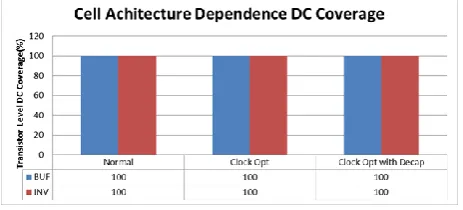
For logic’s architecture, the same analysis is repeated on Inverter and buffers for normal buffer, clock buffer, clock buffer with decoupling capacitance, normal inverter, clock inverter and clock inverter with decoupling capacitance. The stuck-at-fault coverage result is shown in Fig. 11.
Figure 11. Cell architecture dependence DC coverage
From Fig. 11, the transistor level stuck-at-fault coverage for buffer and inverter remains 100% regardless of the cell’s architecture. From Fig. 11, it is concluded that cell architecture has no impact to the buffer and inverter transistor level stuck-at-fault coverage report. The buffer and inverter’s fault classification is shown in Table VIII.
TABLEVIII. CELL ARCHITECTURE DEPENDENCE TRANSISTOR LEVEL
FAULT CLASSIFICATION
fault class BUF CBUF DCBUF INV CINV DCINV
Detected 46 46 46 36 36 36
Possible detected 0 0 0 0 0 0
Undetectable 57 57 57 80 80 80
ATPG untestable 0 0 0 0 0 0
Not detected 0 0 0 0 0 0
Total faults 103 103 103 116 116 116
From Table VIII, the total faults for each variant of buffer and inverter remain the same as the same drive strength for each variant is used for comparison.
VII. CONCLUSION
The summary of transistor level ATPG coverage for standard cell is shown in Table IX.
TABLEIX. TRANSISTOR LEVEL ATPGCOVERAGE FOR STANDARD CELL
SUMMARY
Scenario Comments
Basic Logic Function
Special script is required to filter ATPG untestable node due to constant propagation
Input Width of Logic
The coverage reported from the tool degrade as the inputs' width increase
Logic's Drive Strength
The coverage reported from the tool degrade as the drive strength increase for NAND gate and NOR gate
Logic's Architecture
The ATPG tool is able to report the effective ATPG fault coverage properly
From Table IX, it concludes that:
A special scripting is required to intelligently filter the power and ground propagation through NMOS and PMOS in order to reflect the effective equivalent gate level DC coverage while transistor level DC coverage may not be 100%
Transistor level effective DC coverage is 100% correlated with gate level DC coverage for universal cell like Inverter, NAND gate and NOR gate if constant propagation stuck at fault untestable node is removed. The caveat of this assumption is, ignoring the possibility of weak short occurance [20].
ACKNOWLEDGEMENTS
Thanks to eASIC management, Lai Kok Keong and Massimo Verita for the support given.
REFERENCES
[1] Orjan Hallberg, Failure Free Electronics-A Reliability Challenge, Stockholm, Sweden: Ericsson Telecom AB, 1998.
[2] Reliability Performance Today, ATEC/PEO, Jul. 2001.
[3] B. G. West, “accuracy requirements in at speed functional test,” in Proc. Int. Test Conf, 1999, pp. 780-787.
[4] J. T. Y. Chang, C-W. Tseng, et al., “Experimental result for IDDQ and VLV Testing,” in Proc. VLSI Test Symp, 1998, pp. 118-123. [5] Y. Zorian, “Testing the monster chip,” IEEE Spectrum, pp. 54-60,
Jul. 1999.
[6] B. I. Dervisoglu and G. E Stong, “Design for testability: Using scanpath techniques for path-delay test and measurement,” in Proc Int. Test Conf., 1991, pp 365-374.
[7] S. Kim, M. Soma, and D. Risbud, “An effective defect-oriented BIST architecture for high-speed phase-locked loops,” in Proc. VLSI Test Symp., 2000, pp. 231-236.
[8] S. C. Ma, P. Franco, and E. J. Mccluskey, “An experiemental chip to evaluate test techniques experimental results,” in Proc. Int. Test Conf., 1995, pp. 663-672.
[9] (2008). The evolution and future of DFx in modern ICs. Future Fab. [Online]. Available: www.future-fab.com
[11] P. C. Maxwell, R. C Aitken, K. R Kollitz, and A.C Brown, “IDDQ and AC scan: The war against unmodeled defects,” in Proc. Int. Test Conf., 1996, pp. 250-258.
[12] P. Nigh, W. Needham, K. Butler, P. Maxwell, R. Aitken, and W. Maly, “So what is an optimal test mix? A discussion of the SEMATECH methods experiment,” in Proc. Int. Test Conf., 1997, pp. 1037-1038.
[13] F. Hapke, R. Krenz-Baath, et al., “Defect-Oriented cell-aware ATPG and fault simulation for industrial cell libraries and designs,” in Proc. ITC, 2009, pp. 1-10.
[14] S. Kundu, “GateMaker: A transistor to gate level model extractor for simulation, automatic test pattern generation and verification,” in Proc. Int’l Test Conf., 1998, pp. 372.
[15] L. Day, et al., “Test Methodology for a microprocessor with partial scan” in Proc. Int’l Test Conf., 1998, pp. 137.
[16] M. P. Kusho, et al., “Microporcessor test and test tool methodology for the 500MHz IBM S/390 G5 chip,” in Proc Of Int’l Test Conf., 1998, pp. 717.
[17] Y. Higami, K. K. Saluja, H. Takahashi, S. Kobayashi, and Y. Takamatsu, “Fault simulation and test generation for transistor shorts using stuck-at test tools,” IEICE Trans on Information and Systems, pp. 690-699, 2008.
[18] Y. Higami, K. K. Saluja, H. Takashi, S. Y. Kobayashi, and Y. Takamatsu, “Test generation for transistor shorts using stuck-at fault simulator and test generator,” in Proc. Asian Test Symposium, 2007, pp. 271-274.
[19] L. A. Patel and S. K. Hadia, “Transistor level fault finding in VLSI Circuit using genetic algorithm,” IJESIT, pp. 142-147, 2013. [20] Y. Higami, K. K. Saluja, H. Takahashi, and Y. Takamatsu, “Fault
coverage and fault efficiency of transistor shorts using gate-level simulation and test generation,” in Proc. VLSID, 2007, pp. 781-786.