Mathematical Modeling and Simulation of
Permanent Magnet Synchronous Machine
Mrs. S S Kulkarni
Department of Electrical Engineering, College of Engineering, Jalgaon, Maharashrtra State, India.
[email protected]
A G Thosar
Department of Electrical Engineering, College of Engineering, Aurangabad, Maharashrtra State, India.
[email protected]
Abstract—Rapid developments are occurring in design of electrical machines and its control. To get optimum performance under normal/fault condition needs implementation of fault tolerance. Next decade is of Permanent Magnet Synchronous Machines. The paper presents mathematical modeling of PMSM. A current and speed controller is designed to implement fault tolerance and its stability analysis.
Index Terms—PMSM, fault tolerance, mathematical model
I. INTRODUCTION
Performance of motor control systems contribute to a great extent to the desirable performance of drive. Existing motors in the market are the Direct Current and
Alternative Current motors, synchronous and
asynchronous motors. These motors, when properly controlled and excited produce constant instantaneous torque
A. Objective of Problem
In what respect PMSM are better and whether motor be designed from few watts to mega watt with stable operation
B. Classification of Faults in PMSM
Replacing rotor field windings and pole structure with permanent magnets makes the motor as brushless motors. Permanent Magnet Synchronous Machines (PMSM) can be designed with any even number poles. Greater the number of poles produces greater torque for the same level of current [1]. Surface Mounted PMSM and Interior PMSM are two types of PMSMs. In SPMSM magnets are mounted on the rotor, air gap is large hence armature reaction is negligible. Whereas in IPMSM, magnets are buried inside the rotor,rotor is robust and airgap is uniform hence suitable for high speed operation. Most frequently occurring faults in PMSM can be classified as:
Faults related to electrical structure
Faults related to mechanical structure
Manuscript received March 1, 2013; revised June 12, 2013.
The survey indicates that the stator related faults are major faults around 35-40% and are related to the stator winding insulation and core. The terminal connector failure may also result in winding faults. Stator winding related failures can be divided into winding open circuit fault, winding short circuit fault and winding turn to turn short circuit fault, winding to ground short circuit fault. These faults are the consequence of long term or overstressed operation in the motor drive. The second set of faults is magnetic or mechanical. Among these faults are partial demagnetization of the rotor magnets, rotor eccentricity.
Feature of a fault tolerant system is the ability to detect the fault and then to clear it. Based on this, the optimal excitation for the stator winding has to be calculated. This data is stored in the memory and in case of a fault the optimal currents would be applied to the remaining healthy phases to get the maximum torque per ampere in the output. This needs deriving a mathematical model in suitable form [2].
II. MATHEMATICAL MODEL OF PMSM
In PMSM the inductances vary as a function of the rotor angle. The two-phase (d-q) equivalent circuit model is used for analysis. The space vector form of the stator voltage equation in the stationary reference frame is given as:
vs= rsis + dλs/dt (2.1)
where rs, Vs , is , and λs are the resistance of the stator winding, complex space vectors of the three phase stator voltages, currents, and flux linkages, all expressed in the stationary reference frame fixed to the stator, respectively. They are defined as:
vs= [vsa (t) + avsb (t) + a2vsc (t)]
is=[isa (t) + aisb (t) + a2isc (t)] (2.2)
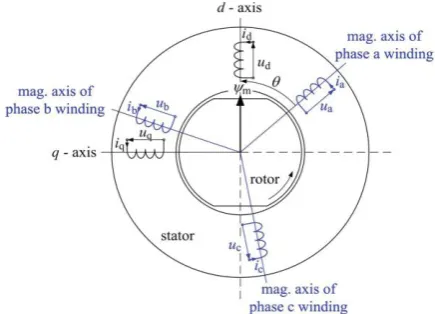
Figure 1. Schematic representation of a two-pole, three-phase permanent magnet synchronous machine.
Fig. 1 illustrates a conceptual cross-sectional view of a three-phase, two-pole surface mounted PMSM along with the two-phase d-q rotating reference frame. Symbols used in (2.2) are explained in detail below:a, and a2 are spatial
operators for orientation of the stator windings, a = e j2π/3 and a2 = e
j4π/3
. vsa, vsb, vsc. are the values of stator instantaneous phase voltages. isa, isb, isc are the values of
stator instantaneous phase currents. λsa, λsb, λsc are the
stator flux linkages and are given by:
λsa = Laaia + Labib + Lacic + λra
λsb=Labia+ Lbbib + Lbcic + λrb (2.3)
λsc = Lacia + Lbcib + Lccic + λrc
where Laa, Lbb, and Lcc, and are the self-inductances of the stator a,b and c-phase respectively. Lab, Lbc and Lca, are the mutual inductances between the ab, bc and ac phases respectively [3]. λra, λrb and λrcare the flux linkages that change depending on the rotor angle established in the stator a, b, and c phase windings respectively due to the presence of the permanent magnets on the rotor. They are expressed as:
λra= λr cosθ
λrb= λr cos (θ -120°) (2.4)
λrc= λr cos (θ +120°)
In equation (2.4), λr represents the peak flux linkage due to the permanent magnet. It is often referred to as the back-emf constant. Note that in the flux linkage equations, inductances are the functions of the rotor angle. Self-inductance of the stator a-phase winding, Laa including leakage inductance and a and b-phase mutual inductance,
Lab= Lbchave the form:
Laa= Lls + L0 - Lms cos (2θ) (2.5)
Lab = Lba = ½ L0 - Lms cos (2θ )
where Llsis the leakage inductance of the stator winding due to the armature leakage flux.L0 is the average
inductance due to the space fundamental air-gap flux; L0
= ½ (Lq + Ld), Lmsis the inductance fluctuation (saliency); due to the rotor position dependent on flux Lms= ½ (Ld –
Lq).Similar to that of Laabut with θ replaced by (θ-2π/3) and (θ-4π/3)for b-phase and c-phases self-inductances.
Lbb and Lcc, can also be obtained similarly. All stator inductances are represented in matrix form below:
Lss=
Lls + L0 – Lms cos 2θ -.5L0- Lms cos 2(θ-π/3) .5L0- Lms cos 2(θ+ π/3)
-.5L0- Lms cos 2(θ-π/3) Lls + L0 – Lms cos 2(θ-2π/3) -.5L0- Lms cos 2(θ-π)
- .5L0- Lms cos2(θ+ π/3)-.5L0- Lms cos 2(θ+π) Lls+ L0 – Lms cos 2(θ+ 2π/3)
(2.6) It is evident from the above equation that the elements of Lss are a function of the rotor angle which varies with time at the rate of the speed of rotation of the rotor. Under a three-phase balanced system with no rotor damping circuit and knowing the flux linkages, stator currents, and resistances of the motor, the electrical three-phase dynamic equation in terms of phase variables can be arranged in matrix form similar to that of (2.1) and written as:
[vs]=[rs][is]+d/dt[λs] (2.7) where, [vs] = [vsa, vsb, vsc ]t
[Is] = [isa, Isb, I sc ]t
[rs]=[ra,rb,rc]t (2.8)
[λs] = [λsa, λsb, λsc ]t
In (2.7), vs, is, and λs refer to the three-phase stator voltages, currents, and flux linkages in matrix forms as shown in equation(2.8) respectively. Further all the phase resistances are equal and constant, rs= ra = rb= rc
A. Park’s Transformation
As Lsspresents computational difficulty (in equation, 2.1) when used to solve the phase quantities directly. To obtain the phase currents from the flux linkages, the inverse of the time varying inductance matrix will have to be computed at every time step [4]. The computation of the inverse at every time step is time-consuming and could produce numerical stability problems. To remove the time-varying quantities in voltages, currents, flux linkages and phase inductances, stator quantities are transformed to a d-q rotating reference frame using Park’s transformation. This results in the above equations having time-invariant coefficients. The idealized machines have the rotor windings along the d- and q-axes. Stator winding quantities need transformation from three-phase to two-three-phase d-q rotor rotating reference frame. Park’s transformation is used to transform the stator quantities to d-q reference frame, the d-axis aligned with the magnetic axis of the rotor and q-axis is leading the d axis by π/2 as shown in Fig.1. The original d-q Park’s Transformation [Tdq0 ] is applied to the stator quantities
n in equation 2.7 is given by:
[vdq0] = [Tdq0 (θr)][vs]
[idq0]=[Tdq0(θr)][is] (2.9)
[λdq0] = [Tdq0 (θr)][λs]
Where
[vdq0]=[vdvqv0] (2.10)
[vdq0]=[Tdq0(θr)][rs][Tdq0(θr)]-1[idq0]+[Tdq0r)]p[Tdq0(θr)]-1[dq0](2.11)
The model of PMSM without damper winding has been developed using the following assumptions:
Saturation is neglected.
The induced EMF is sinusoidal.
Eddy currents and hysteresis losses are negligible.
There are no field current dynamics. Voltage equations are given by:
vd = Rs id – ωrλq +
vq=Rsiq–ωrλd+ (2.18)
λdλ=Ldid+λf
λq=Lqiq (2.19)
Substituting equations 2.19 in 2.18:
Vd = Rsid – ωrLqiq + (Ldid+ λf)
Vq = Rsiq – ωrLqiq + (Lqiq) (2.20)
The developed torque is given by
Te=1.5(P/2)( λdiq- λqid) (2.22)
The mechanical Torque equation is
Tm=TL+Bωm+J(dωm/dt) (2.23)
Solving for the rotor mechanical speed from equation 2.23
ωm= ([(Te - TL - Bωm)/J]dt
ωm= ωr(2/P) (2.24)
In the above equations ωr is the rotor electrical speed
where as ωm is the rotor mechanical speed.
III. MATHEMATICAL MODEL OF REFERENCE
CURRENT CALCULATION
The back emf voltages of an n-phase fault tolerant PM motor drive can be given as
ej = Ke ω ej (θ) ( 3.1)
Here j is an integer representing the phase number of the motor(j= 1,2,3…n.) The output torque T0 with two phases
can be expressed as a function of the phase currents and corresponding back emf voltages as
T0=Ke[e1i1+e2i2] (3.2)
Here i1 and i2 are instantaneous phase currents. From
equation (1.2) current i2 can be derived as:
i2=[(T0/ke)-e1i1]/e2
Pcu=(i1 2
+i2 2
)R (3.3)
R is resistance of phase winding. For copper loss to be minimum, Y=(i12+i22) should be minimum
Y=i1 2
+(1/e2 2
)[(T0 2
/ke 2
)-2*(T0/ke)e1i1+e1 2
]
i1=[e1/(e1 2
+e2 2
)] (T0/ke) (3.4)
i2=[e2/(e12+e22)] (T0/ke)
A. Fault Analysis in Fault Tolerant Motor Drives
Winding open circuit fault is the most common fault and detected by the phase current sensor when the phase
current is zero. Desirable currents for zero torque ripple operation assuming i1=Im sin θ, i2=Im sin(θ-1200), i3=Im
sin(θ+1200)
Here, Im is peak value of phase current [5]. Hence for healthy operation the total output torque for single motor drive is T0 =(3/2)KeIm0.
If phase 1 is open circuited and no fault remedial strategies are adopted, the total output torque is given by
Tf0 =KeIm(1+0.5cos2θ)
Here Tf0 is torque under faulty condition
B. Winding Short Circuit Fault Analysis
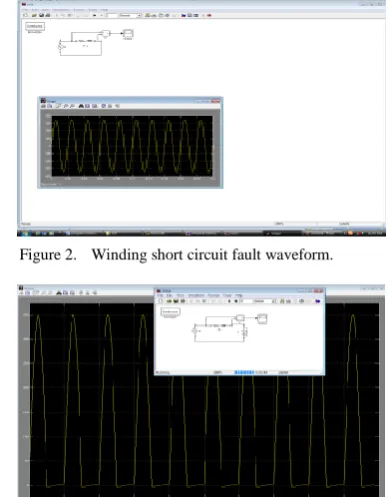
The winding short circuit fault is the most critical fault. Equivalent circuit of winding short circuit fault and switch short circuit fault and its waveforms are shown in Fig. 2 and Fig. 3.
Figure 2. Winding short circuit fault waveform.
Figure 3. Switch short circuit fault waveform.
For a sinusoidal back emf, during short circuit fault operation, a short circuit current Isc will be generated in
the winding and the peak steady state current is given by
Iscm = Em/(√(R2+[ωmL]2
But Em is function of rotor speed and back emf constant I sc = Keωm // (√(R2+[ωmL]2
Corresponding copper loss is expressed as
Pcusc= (Iscm2 /√2)2
Tdrag = I sc Em cos φ /2ωm, cos φ =R/(√(R2+[ωmL]2
Tdrag = I sc Em cos φ /2ωm = Ke 2 Rωm /2* ((R2+[ωmL]2)
Assuming base voltage is equal to back emf voltage at rated rotor speed. Base current is equal to winding short circuit current
Isc = ωm /(√Rpu2+(ωpu +Lpu)2
Tavedrag = ωpuRpu / Rpu2+ (ωpu +Lpu)2
Where Rpu and Lpurepresent the per unit resistance and the inductance of the short circuited windings. ωpu is the
per unit value of the angular speedthe motor. This needs reference current controller to be designed [6].
C. Current Controller Design
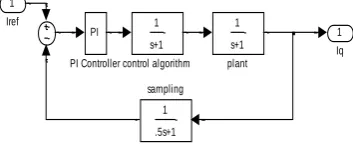
The error between reference speed and measured speed is send to a PI controller. Since d and q axis controller are identical tuning of q axis controller is sufficient. Structure of q axis current controller is shown in Fig. 4.
1
Iq
1
.5s+1 sampling
1
s+1
plant 1
s+1
control algorithm PI
PI Controller 1
Iref
Figure 4. Q axis current controller.
PI controller offers a zero steady state error. Its transfer function is Gc(s)=U(s)/E(s)
= kpi+kii/s
= kpi (1+Tiis)/ Tiis
where kpiis proportional gain, Kii is integrator gain Tii integrator time constant. It is a ratio between Kpi and Kii
Tii= Kpi/ Kii ,Ts=0.2 ms
Gpe(s)= iq(s)/Uq(s)
=1/Rs+sLs=1/ Rs (1+s Ls/Rs)
= K/(1+sTq) k=1/Rs Rs-stator resistance
Tq= Ls/Rs =0.116sec is the time constant of the motor
The feedback is the delay introduced by digital to analog conversion. It is a first order transfer function with time constant Ts
Gsam(s)= 1/(0.5 Ts s+1)
Thus modified q axis controller with unity feedback is shown in Fig. 5 below [7].
1
iqmea
1
s+1
sampling
1
s+1
Plant(1/.Ls+Rs)
In1Out1
PI
1
s+1
Control Algorithm
1
1/(0.5Ts S+1)
Figure 5. Modified q axis current controller.
The open loop transfer function is given by
GOL(s)=Gsam(s)*Gc(s)*GCA(s)GPL(s)
=[1/(0.5Tss+1)]*[kpi(1+Tiis)/Tiis][1/(Tss+1)]*[ K/(
1+sTq)]
The slowest pole is the one of PMSM transfer function and is meant to cancel the zero of controller, making the system more stable. This implies
(1+Tiis)→ (1+sTq)→ Tii
Tq = Ls/Rs =0.116sec
In order to simplify the transfer function a time constant is introduced [8]. It represents the approximation of first order transfer function that introduce delays. Its transfer function will be replaced by a unique transfer function of first order having the time constant equal to the sum of all the time constants from the system.
Tsi = 1.5Ts=0.3msec
With above assumptions the open loop transfer function of second order system has the form
Gom(s)=1/2ζs(ζs+1)
Kpi K/Tii =(1/2*Tsi)
= Kpi
= (Tii Rs )/(2*Tsi)
=3.333
Thus Pi transfer function is
Gc(s)=3.33+(300/s)
The bode diagram of the q axis current controller is shown in Fig. 6.
Bode Diagram
Frequency (rad/sec)
10-2 10-1 100 101 102
-180 -135 -90
P
ha
se
(
de
g)
-100 -50 0 50 100
System: sys Frequency (rad/sec): 2.79 Magnitude (dB): -18.3
M
ag
ni
tu
de
(
dB
)
Figure 6. Bode plot of q axis controller .
GM=19.1dB, PM=63.6, Closed loop system stable? yes Maximum overshoot Mp= 4.32 %
Settling time ts=2.53 ms , Rise time tr= 0.912 ms
D. Design of Speed Controller
The speed controller block diagram is shown below The transfer function of Pi controller is given by
Gc(s)= Kps(1+Tiss)/ Tiss
Where Kps is the proportional gain of the speed controller
and Tis is the time constant. The delay introduced by the
[9]. Transfer function has the form of a first order system with time constant Ts=0.2ms=1/5k=1/fs, GA(s) =1/1+Tss
The current control loop can be expressed like a first order system Tiq=Tii Rs /Kpi
TF= Gc(s)=1/(1+Tiqs)
The mechanical equation of PMSM is given by
Tm=Jdwm/dt +Bwm +TL
TL is the load torque and is considered as disturbance hence will not be considered. Filter has time constant
Tf=1/wc=1/2πf=0.796 ms
The sampling block introduces delay for digital to analog conversion and is equal to Ts,
Gsam(s)=1/0.5Tss+1
Thus sampling the TF, the disturbances are not taken
into consideration. The closed loop system is modified with unity feedback as shown below [10].
1 wm 1
0.5s+1 sampling
1
gain control 1
s+1 filter
1
PI 1
s+1 Mech time
1
s+1 Current control 1
(1+s)(0.5s+1)
Figure 7. Modified closed loop current control system.
Its open loop transfer function:
GOL(s)=[1/(0.5Tss+1)(Tfss+1)][Kps(1+Tiss)/iss)]*[1/Tss+1][ 1/(1+Tiqs )]
In order to simplify the transfer function all the time constants of the delays are approximated with one time constant:
Tss=1.5Ts +Tf+Tiq = 1.8 ms
So, the open loop transfer function becomes:
GOL(s)=kc Kps (1+Tiss)/JTiss2(1+Tsss)
With kc=1.5*λm , Kps=1/k1T1=0.462,
Tis=4T1 =4Tss
101 102 103 104 105 106 -180
-135 -90
P
h
a
s
e
(
d
e
g
)
Bode Diagram
Frequency (rad/sec) -300
-200 -100 0 100 200
M
a
g
n
it
u
d
e
(
d
B
)
Figure 8. Bode plot for modified system.
Step Response
Time (sec)
A
m
p
lit
u
d
e
0 5 10 15 20 25 30 35 40 45 50
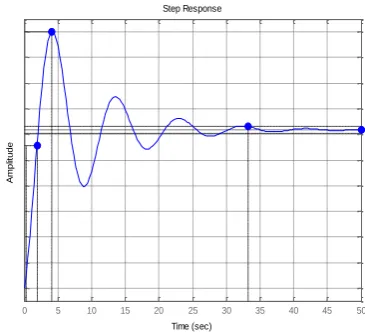
Figure 9. Step response for modified system.
Its bode plot and step response is shown in Fig. 8 and Fig. 9.
GM=13(dB) at 689 rad/sec PM=34.89deg) at 300 rad/ sec Closed loop system is stable? yes
IV. CONCLUSION
The mathematical model helps to design reference current controller needed to design fault tolerant system. The design of the current and speed controllers are necessary for good implementation of control strategy. As shown by bode plot for current and speed controller, the system is second order hence stable. Further use of permanent magnets helps in reduction of size and gives higher current, torque and speed compared to machine with electromagnets. The only drawback is higher cost of magnets.
REFERENCES
[1] H. Amano, “Characteristics of a permanent-magnet synchronous motor with a dual-molding permanent-magnet rotor,” IEEE Power Engineering Society General Meeting, 2007, pp 1298-1304.
[2] M. I. A. El-Sebahy, “PMSM position control with a SUI PID controller”, IEEE, 2009, pp. 516-526.
[3] N. C. Kar, “A new method to evaluate the q-axis saturation characteristic of cylindrical-rotor synchronous generator,” IEEE, 2000, pp. 269-276.
[4] V. Comnac, “Sensor less speed and direct torque control of surface permanent magnet synchronous machines using an extended kalman filter,” IEEE, 2001, pp. 217-226.
[5] Radovan, Jaroslav, “Traction permanent magnet synchronous motor torque control with flux weakening,” Radio Engg, pp. 601-610, 2009.
[6] A. Hassanpour, “Design of a permanent magnet synchronous machine for the hybrid electric vehicle,” WAS, pp. 566-576, 2007
[7] Z. Zhang, “Study on novel twelve-phase synchronous generator rectifier system,” DRPT, 2008, pp. 2270-2274.
[8] S. Bologani, “Experimental fault-tolerant control of a PMSM drive,” IEEE, 2000, pp. 1134-1141.
[9] F. Morer, “Permanent magnet synchronous machine hybrid torque control,” IEEE, 2008, pp. 501-511.
ACKNOWLEDGEMENT
The authors wish to thank to Govt. College of Engineering, Aurangabad (M.S.),India for pursuing research.
Mrs. S S Kulkarni is assistant professor with Department of Electrical Engineering, Govt. College of Engineering, Jalgaon,(M.S.),India and persuing her research under the guidance of Dr. A G Thosar. Her area of interest is fault tolerant control, control of drives. She has published five papers in national and international conferences.
Dr. Mrs. A G Thosar, was born in 1971. In 1992 she had completed her graduation in Electrical Engg from Walchand College of Engineering, Sangli, Shivaji University, Kolhapur (M.S.), India. She received her Post Graduation degree in Control Systems in 1997 from the same institute. She gained her PhD from IIT Kharagpur, India in 2010. Now she is working as associate professor, with Department of Electrical Engineering, Govt. College of Engineering, Aurangabad, (M.S.), India. Her areas of interests are automatic control systems, fault tolerance. She has published many papers in various national, international conferences