Classification of Satellite Images by
Texture-Based Models Modulation Using MLP,
SVM Neural Networks and Nero Fuzzy
Gholam Reza Shahriari, Abbas Gharibi, and Azim Rezaei Motlagh
Iranian Oil Terminal CompanyEmail: [email protected], [email protected], and [email protected]
Abstract—The purpose of this paper is the automatic identification of various districts in satellite images using the textural feature, while comparing them by two methods of GLCM and Fourier Spectrum. The modulation of discrete violet and GLCM yielded a new method for the identification of the urban areas that is used as a criterion for measuring the development rate in the urban areas using satellite images. Through the modulation of GLCM and spatial features, MLP Neural Network and saliency measurements made it possible to determine the most important textural features for sub-metric spatial resolution imagery of urban scenes. That is used as a criterion for measuring the development rate in the urban areas using satellite images. The results of simulation using MATLAB/IMAGE PROCESSING software on IKONOS database, from which the images have been collected, verify the accuracy of the performance of this system.
Index Terms—textural features, GLCM matrix, MLP
neural network, feature vector, satellite images.
I. INTRODUCTION
Satellite images are being widely used in several fields of technology. Due to the abundance of the available data in this field, we need advanced automatic methods for extracting and providing the user with the required data out of these images. The Technical Committee of data extraction DFT is a subgroup of Land Remote Sensors team. Institute of Electrical & Electronic Engineers (IEEE) has been working on this field for many years and it has published several works including the most recent achievements of researchers in this field.
The problem investigated in this paper is the automatic identification of various areas in a satellite image. These areas are selected based on the application of this article. GLCM matrix is one of the major elements in this study. GLCM matrix is a 2D matrix and the (i,j) element is the number of co-occurrences of i and j. Neural networks, with a remarkable ability to derive meaning from complicated or ambiguous data, for extract patterns and identify the methods and techniques that knowledge of those will be complex and difficult for computer and humans, Will be used. A trained neural
Manuscript received April 25, 2013; revised November 28, 2013
network can be considered as a special category of information that has to be taken into account for the analysis. This expertise can be used to estimate the desired new position and answer the question of "what if". Other advantages include the following Adaptive learning: The ability to learn how to do tasks based on training experience for introductory information [1].
II. PROBLEMSTATEMENT
The geographists have been working on several urban areas on the map for a long time. It seems more essential than ever to have an intelligent and powerful system updated with urban development and improvements. The techniques that process a wide area with a high speed and accuracy are highly needed, so the researchers are working on these techniques.
During the last decade, digital imaging tools have been progressed rendering it possible to view the surface of an area with its spatial and spectral details. Advanced aerial photography spectrometers are being increasingly used in various applications [1], [2]. However, the cost of the data received from these multi-spectral sensors is really high. The researchers with limited financial resources would not afford to observe the required data from high-frequencies. The next problem for multi-spectral aerial data is their high resolution which makes the feature identification, data processing, data extraction and object classification in the images quite difficult [2], [3]. This chapter deals with the analysis of the method suggested in this article and its advantages and disadvantages will be observed on various images. The input to this system is the satellite images collected from the source mentioned in which is widely used as a source in most works on urban zones classification. These reference images are classified under the following categories: Green space, street, highway, residential houses. Hence, we have four classes which should be called input images and the areas where these classes are located have to be identified.
human brain. The learning and training mechanisms of the brain is basically rooted in experience. An artificial neural network is an idea for data processing which has been inspired by the biological neural system and deals with data processing just like brain. These images are used in this way: a feature vector is extracted from the images of each class and this feature vector is used for training the neural network. In other words, the neural network is trained to show the highway class at the output if the feature vector of this class was introduced as the input. A feature vector is obtained for each image and it corresponds to the same image. The program reads an image in every attempt and processes it to extract its feature vector. Another point considered in the collection of the neural network tutorial images database is the high number of its images, as the higher the number of tutorial samples the more the generalization possibility for the neural network. The other point is different sizes of images. The system is designed so that it would be able to work on all images with any sizes. When collecting the classes, the attempt was made to choose the images that are totally different in size. The designed system enables us to easily increase the number of classes. Here, we have considered 4 classes; however, this system can be used for any number of classes [3].
III. PROPOSED MLPNEURAL NETWORK FOR CLASSIFICATION OF SATELLITE IMAGES
This chapter deals with the analysis of the method suggested in this article and its advantages and disadvantages will be observed on various images. The input to this system is the satellite images collected from the source mentioned in which is widely used as a source in most works on urban zones classification. These reference images are classified under the following categories: green space, street, highway, residential houses. Hence, we have four classes which should be called input images and the areas where these classes are located have to be identified.
The available images are used to train the neural system; therefore, these samples were selected so that they would be as different as possible. Through a considerable level of overlook, the neural networks can be called the electronic models of the neural system of human brain. The learning and training mechanisms of the brain is basically rooted in experience. An artificial neural network is an idea for data processing which has been inspired by the biological neural system and deals with data processing just like brain. These images are used in this way: a feature vector is extracted from the images of each class and this feature vector is used for training the neural network. In other words, the neural network is trained to show the highway class at the output if the feature vector of this class was introduced as the input. A feature vector is obtained for each image and it corresponds to the same image. The program reads an image in every attempt and processes it to extract its feature vector. Another point considered in the collection of the neural network tutorial images database is the high
number of its images, as the higher the number of tutorial samples the more the generalization possibility for the neural network. The other point is different sizes of images. The system is designed so that it would be able to work on all images with any sizes. When collecting the classes, the attempt was made to choose the images that are totally different in size [4].
The designed system enables us to easily increase the number of classes. Here, we have considered 4 classes; however, this system can be used for any number of classes.
found a good way to do it is more trial and error with the number of layers and hidden layer neuron is determined. Another disadvantage of the MLP, the output of which is used for training should include both desirable and undesirable output is Network to become familiar with all types of data, but sometimes produce undesirable data is not possible. Many segmentation methods have been proposed. Traditional methods, histogram and cluster threshold setting and identify the edge of the area to be extracted. One disadvantage of these methods is that most of these techniques are not suitable for noisy environments. Furthermore, each of these has its own problems. For example, the investment threshold Histogram of the histogram of data only takes into account the space details of the matter will not be visible. The cluster has a big problem and it is to determine number of clusters. Edge detection is still vulnerable against noise. Edge of the image without noise is measured with high accuracy, but the actual image, the noise is inevitable. Region-based methods, are insensitive to noise and spatial data and attribute data are considered Although this method has a problem and it is the choice of the starting area, and much depends on the choice of [8], [9]. In Table I the differences between classification methods and their features has been compared.
TABLEI.ACOMPARISON OF CLASSIFICATION METHODS
Technique Feautures Advantages Defects Setting threshold, the cluster Setting threshold is required that Hystogram have a number of peak. Cluster by assuming that each region in the
image has a separate cluster in feature space
.
Setting threshold: there is no need
for any data pre-computation
complexity is low
.
Cluster-out: it is easy to implement . The threshold Setting: the identified peaks in the
histogram does not work well and there
is no guarantee that
the item be always Continuous . Cluster problem: to determine the number of clusters Edge method is based on
Discontinuity detection Resistant to noise
Time consuming, the growth is related to the choice of the starting area . Using fuzzy Using math functions and fuzzy rules and segmentation Fuzzy belonging
functions can not be used to express some propertie. . Sometimes the calculation is very heavy . Neural network Using neural networks for segmentation Parallel characteristics of neural network is fully utilized
.
Slow learning and more
learning
IV. DEFINITION OF GLCM
Co-occurrence matrix is a matrix that is defined over an image. If the distribution of co-occurrence values are
located in a specific offset, Matrix C will be defined over a n×m image with offset (Δx, Δy) parameters as follows:
)1)
Co-occurrence matrix is a statistical method that can extract the second-order statistics in a textural image. Another definition that can be offered for GLCM is that: GLCM is a 2D histogram in which the (i,j) element refers to the co-occurrences of i and j. Co-occurrence matrix is identified in two pixels by relative frequencies of P(i,j,d, θ ), if these two pixels are located in the distance of d and direction of θ , one with the brightness of i and the other with the brightness of j. Hence, GLCM is a function of the distance of r and angle of θ and the brightness of i and j. We should look for appropriate r and θ , when identifying the letters.
When GLCM matrix is estimated, the features should be extracted from the matrix. As this matrix cannot be directly given to neural network classifier as a feature vector, some mathematical operations have to be performed on GLCM. These mathematical operations are known as feature extraction from GLCM. Some of these features are mentioned here.
1) Mean GLCM:
j j i p j i p f ) , ( ) , ( 1 2) Contrast:
2 (, )2 i j p i j
f i j
3) Entropy:
i j pi j
j i p f ) , ( log ) , ( 3
4) Angular Second Moment:
2 4
(, )i j j i p f 5) Homogeneity
i j i j j i p f 1 ) , ( 5 6) Dissimilarity
i j j i p j if6 (, )
7) Correlation
i j x y
y x j pi j
i f )( ) (, ) ( 8 8) Energy
fg = √ ∑ ∑ p2(i,j)
These features, as implied by their relations, yield a number of a GLCM and they are appropriate for the production of feature vector [10].
GLCM, as mentioned earlier, can express the way of distribution of pixels values, through appropriate selection of d and θ. It is more common in GLCM works to use the vector form instead of d and θ. For example instead of d=1, and θ =45°, we will write offset=[1 1]. Fig. 1 shows this concept schematically.
Figure 1. Vector Expression of d and in the definition of GLCM
Therefore, the selection of offset parameter will significantly influence the results obtained from the application of GLCM, because it shows the way of its formation.
In this research, the image was first divided into 7×7 windows. In other words, we transfer the input image matrix to 7×7 matrices. Then, 12 matrices will be estimated for four distances d=2,3,4,5 and angles of θ=0, 45, 90. All offsets are shown in Table II.
TABLEII.ALL OFFSETS USED IN THIS RESEARCH FOR GLCM
[ 2,0 ] [
2 , 0 ] [
2 , 2 ]
[ 3,0 ] [
3 , 0 ] [
3 , 3 ]
[4,0] [
4 , 0 ] [
4 , 4 ]
[ 5,0 ] [
5 , 0 ] [
5,5 ]
when 12 GLCM of 7×7 windows are estimated, the feature extraction will be followed. 5 features of correlation, angular second moment, dissimilarity, homogeneity and energy will be obtained from each matrix. Therefore, 15 features will be achieved for every line of Table I and the total number of 60 features will be obtained for Table II.
V. SIMULATION RESULT
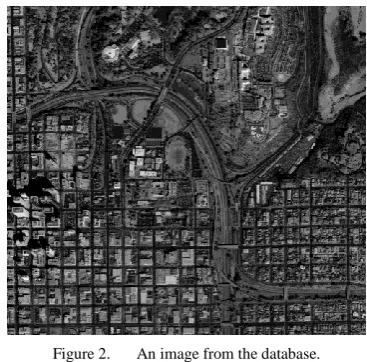
Here, the results of implementation of the algorithm, that was defined in the earlier sections, discussed. The database where the images were collected from is called IKONOS [11]. This database is one of the most well-known databases used in most essays on Images. One of the most significant features of the images of this database is the high resolution of images. High quality is not available in all databases. This feature has made the database distinguishable. Another fact related to the images of this database is the aerial images of urban areas.
Figure 2. An image from the database.
Fig. 2 illustrates one of the images available in the database. We will use this image here to show the results obtained from the algorithm. First, as it was mentioned earlier, the visual sample will be collected from each class. The number of samples of each class is shown in Table III. The neural network used in this section is obtained from MLP simulation. There are 60 input neurons in the neural network and there are 35 hidden layer neurons and 4 output layer neurons. Tangent-sigmoid transfer function is used to transfer several layers [12].
TABLE III.THE NUMBER OF SAMPLES OF EACH CLASS
Resident ial houses High
way Street
Tree Class
44 44
20 30
Number
After training the neural network, the system should be tested by an image. Fig. 2 is an image that is used to test a system. After training the neural network, the error criterion value is changed as follows and it will tend toward zero (Fig. 3).
Figure 3. Change of error criterion during neural network tutorial
street, and green shows green spaces. In this section we will see the results of the application of neural networks.
A. Neural Network MLP
Figure 4. Picture of the overall system test
Figure 5. The result of the test image in Fig. 4
The second test image, shown in Fig. 6 and the result is shown in Fig. 7.
Figure 6. Test Image No. 2
Figure 7. The result of the test image in Fig. 6
Figure 8. Picture of the overall system test for hidden layer neurons 50
Figure 9. The result of the test image in Fig. 8
Figure 10. The result of hidden layer neurons against 20
B. Neural Network SVM:
In this section the results of the SVM Neural network will be presented. SVM is a powerful Neural network, on of the neural network, can be defined as the kernel of demarcation between the classes and do not need to be straight line. Linear kernel function is used in this simulation.
Figure 11. Results obtained using the SVM neural network
Figure 12. Image input system testing ANFIS
Do fuzzy system called ANFIS is also known. The system combines neural networks and fuzzy systems are used in many applications for classification tasks. The initial fuzzy system is the Takagi-Sugeno type.
Figure 13. The result of the ANFIS
VI. CONCLUSION
The textural analysis plays a significant role in digital image processing and its expression, and it can provide us with the extra data for working on the satellite images. Using the concept of texture, we came to this concept that the area of different zones on satellite images has different textures. Then, the co-occurrence matrix was used to obtain the features of these regions. The extracted features include: dissimilarity, angular second moment, correlation, energy and homogeneity. Four classes of residential houses, highways, street, green space were considered in this study. The results reveal that SVM neural network has the best efficiency.
REFERENCES
[1] A. Nazif, Y. Vural, and T. Fatos, “An overview of character recognition based focused on off-line handwriting,” IEEE Transactions on Systems, Man, and Cybernetics-Part C:
Applications and Reviews, vol. 31, no. 2, May 2001.
[2] Ø. D. Trier and A. K. Jain, “Goal directed evaluation of binarization methods,” IEEE Trans. Pattern Anal. Machine Intell., vol. 17, pp. 1191–1201, Dec. 1995.
[3] L. Lam, S. W. Lee, and C. Y. Suen, “Thinning methodologies—A comprehensive survey,” IEEE Trans. Pattern Anal. Machine Intell., vol. 14, pp. 869–885, Sept. 1992.
[4] B. S. Manjunath and W. Ma, “Texture features for browsing and retrieval of image data,” IEEE Transactions on Pattern Analysis and Machine Intelligence, vol. 18, no. 8, pp. 837-842, August 1996.
[5] A. P. Carleer and E. Wolff, “Urban land covermulti-level region-based classification of VHR data by selecting relevant features,” International Journal of Remote Sensing, vol. 27, pp. 1035−1051, 2006.
[6] M. Tuceryan and A. K. Jain, (1993) “Texture analysis,” in Handbook of Pattern Recognition and Computer Vision Singapore: World Scientific,.C. Chen, L. Pau, & P. Wang (Eds [7] K. S. Shanmugan, V. Narayanan, V. Frost, S. Stiles, J. A., and J.
C. Holtzman, “Textural features for Dadar image analysis,”
IEEE Transactions on Geoscience and Remote Sensing, vol. 19,
pp. 153−156, 1981.
Remote Sensing, vol. 42, pp. 215−228, 2004.
[9] Information from Imagery. [Online]. Available: www.isprs.org [10] R. R. Jensen, J. R. Boulton, and B. T. Harper. “The relationship
between urban leaf area and summertime household energy use,”
in Geo-spatial Technologies in Urban Environments, R. R.
Jensen, J. D. Gatrell, and D. McLean Eds. Springer, 2005. [11] E. G. Irwin, N. E. Bockstael, and H. J. Cho, “Measuring and
modeling urban sprawl: Data, scale, and spatial dependencies,”
in Proc. 53rd Annual North American Regional Science
Association Meetings of the Regional Science Association
International, Toronto, Canada, 2006.
[12] V. C. Radeloff, R. B. Hammer, and S. I. Stewart, “Rural and suburban sprawl in the U.S. Midwest from 1940 to 2000 and its relation to forest fragmentation,” Conservation Biology, vol. 19, pp. 793-805, 2005.
Gholam Reza Shahryari received a B.S. and a M.S. in
Electronic and Electrical of Engineering from Bushehr University, Iran in 2007 and 2011 respectively. From 2011 to 2012, he was a senior researcher in the Oil Terminal Company Institue (O.T.C.I). Also, he has been working as a senior researcher in the Power Conversion and System for Renewable Energy Center of the Young Researchers Club (BPJ), Iran. His main research interests are Analysis and Simulation of Power Regulation and integrated circuits (cmos).
Abbas Gharibi received B.S and M.S degrees in
Electronic and Electrical of Engineering from Bushehr University, Iran in 2007 and 2011, respectively. From 2011 to 2012, he was a senior researcher in the the Department of Electronic and Electrical Engineering Bushehr & Borazjan University, Bushehr, Iran, He joined the Department of Electrical Engineering of Borazjan University in 2011, where he has been active in research on the digital signal processing systems and intelligent systems using integrated blocks and circuitshe is also have many done researchers on am modulators, neural network, and automatic gain control and CMOS technology.
Azim RezaeiMotlagh received B.S and M.S degrees.