IJBCP
International Journal of Basic & Clinical Pharmacology
Original Research Article
A questionnaire based study on the knowledge, attitude, practice of staff
nurses about pharmacovigilance in a tertiary care hospital
Prema M.*, Nalini G. K., Sahana G. N., Deepak P., Jayashree V. Nagaral,
Geeta Rathod, Nuthan Kumar U. S.
INTRODUCTION
Drugs are the most common medical interventions, primarily used to relieve sufferings. But it has been recognized long ago that drug themselves can prove fatal; as the saying rightly goes “Drugs are Double Edged Weapons”.1
Adverse drug reactions are one of the major reasons of morbidity and mortality all over the world and hence proper monitoring of ADRs is mandatory.2
As per World Health Organization, Adverse drug reactions (ADR) is any noxious, unintended and undesired effect of the drug which occurs at doses used in humans for the prophylaxis, diagnosis or therapy of a disease or the modification of physiological state.3,4
Studies have shown that ADRs are an important cause of hospital admissions.4-7
The incidence of serious ADRs is 6.7% in India and reporting of serious ADRs rarely exceeds 10%.8-10
ABSTRACT
Background: Adverse drug reactions (ADR) - one of the global problems of major concern leading to morbidity and mortality. Spontaneous reporting of ADR is the cornerstone of Pharmacovigilance (PV) programme and it is important to reduce the risk of drug related harm to the patient. The active participation of healthcare professionals (Doctors, Nurses, Pharmacist) play a major role in the success of Pharmacovigilance. The objective of the study was to assess the knowledge, attitude, practice of Staff Nurses about Pharmacovigilance in a tertiary care hospital.
Methods: A Cross sectional, Observational questionnaire based study was carried out using a pre designed KAP questionnaire. Study included 100 staff nurses who were working in Hassan institute of medical sciences (HIMS). The results were analyzed using descriptive statistics
Results: In our study 65% participants knows the correct definition and 48.8% knows the important purpose of Pharmacovigilance and 77.5% aware of existence of ADR reporting system in India. There was huge gap between ADR experienced (53.8%) and ADR reported (21.3%). The determinants of under reporting from our study include Lack of time / overburdened (33.7%) and lack of knowledge about ADR (31.25%).
Conclusions: This study showed that majority of participants understand the need for reporting of ADR. In spite of that the reporting rate of ADRs by them is very low. Hence, there is a need to create awareness about the importance of reporting ADR by conducting many Pharmacovigilance programme.
Keywords: Adverse drug reaction, Pharmacovigilance, Staff nurses DOI: http://dx.doi.org/10.18203/2319-2003.ijbcp20172744
Department of Pharmacology, Hassan Institute of Medical Sciences, Hassan, Karnataka, India
Received: 06 May 2017
Accepted: 31 May 2017
*Correspondence to: Dr. Prema M.,
Email: premimuthusamy@ gmail.com
Pharmacovigilance is defined as science and activities
related to detection, assessment, understanding and prevention of adverse drug reactions or any drug related problem.4,11 Spontaneous reporting of ADRs is the
important part of pharmacovigilance and is mainly to maintain the patient safety.
In India, all healthcare professionals including doctors, nurses, and pharmacists can report an ADR by filling an ADR form of the Central Drugs Standard Control Organization (CDSCO) and the active participation of these people can improve the ADR reporting.2,12 There
are so many studies conducted about Pharmacovigilance among doctors.13-17 Even though Doctors are the one who
are prescribing drugs, it is the Nurses who are close to the patient and administering drugs, monitor them continuously, known to have an important role in ADR reporting and constitute a potentially valuable source for spontaneous ADR reports in hospitals.18 Thus, the
knowledge and attitudes of hospital nurses on spontaneous reporting of ADRs and difficulties in reporting and the ways to solve them are very important. This study was conducted to assess the knowledge, attitude and practice (KAP) of staff nurses in our hospital (Hassan Institute of Medical Sciences).
METHODS
This study was conducted at Hassan Institute of Medical Sciences, a tertiary care Hospital in Hassan, Karnataka, India. The duration of the study was one month, July 2015.
A cross-sectional questionnaire-based study conducted after getting informed consent from 100 staff nurses, who were working at the hospital during the study period.
KAP questionnaire was designed to assess, their knowledge of pharmacovigilance, attitudes towards pharmacovigilance, and their practice on ADR reporting. There were 16 questions of which seven related to knowledge, four related to attitude, and four related to practice. One question was asked to determine the reasons for under reporting.
Statistical analysis
Descriptive statistics was applied to infer the findings.
RESULTS
Knowledge related questions
Nurses knowledge towards the ADR reporting was evaluated using 6 pharmacovigilance related questions.
65% staff nurses gave correct response regarding the definition of pharmacovigilance and 48.8% know the important purpose of Pharmacovigilance and 77.5% aware of existence of ADR reporting system in India.
[image:2.595.310.549.197.518.2]47.5% were aware that the regulatory body responsible for monitoring ADRs in India is Central Drugs Standard Control Organization (CDSCO). Only 32.5% were aware that International Center for ADR monitoring is located in Sweden. Unfortunately, only 33.75% healthcare professional were aware that a serious adverse event should be reported to the regulatory authority within 14 calendar days (Table 1).
Table 1: Knowledge related questions.
Questions Correct
response (%)
Incorrect response (%) 1. Pharmacovigilance
is defined as 65 35
2. The important purpose of
Pharmacovigilance is
48.75 51.25
3. Are you aware of existence of ADR reporting system in India?
77.5 22.5
4. Which regulatory body is
responsible for monitoring ADRs in India?
47.5 52.5
5. Where are the International centre for ADR monitoring is located?
32.5 67.5
6. A serious adverse event should be reported to regulatory body within
33.75 66.25
Attitude related questions
To explore nurses attitudes towards pharmacovigilance, 4 questions were designed.
Figure 1: Opinion about establishing ADR monitoring centre.
58.75% 21.25%
10% 10%
Should be in every hospital
one in a city is sufficient
Not necessary in every hospital
[image:2.595.310.547.585.736.2]58.75% agreed that ADR monitoring center should be [image:3.595.311.545.71.231.2]
established in every hospital and 60% chose phone as the preferred mode to inform about ADR (Figure 1 and Figure 2).
Figure 2: Different methods of reporting ADRs by nurses.
58.75% mentioned that ALL ADRs should be reported. 27.5% mentioned only SERIOUS ADRs should be reported. 50% of Staff nurses mentioned that ADR reporting doesn’t damage professional image.
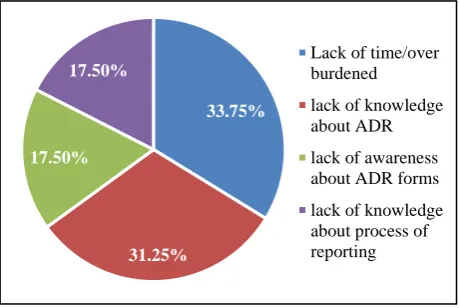
[image:3.595.50.280.128.275.2]The factors discouraging participants from reporting ADRs were lack of time to report ADR (33.75%) and lack of knowledge about ADR (31.25%) (Figure 3).
Figure 3: Factors discouraging reporting of ADR.
Practice related questions
Majority of the participants, 69 out of 80 (86.3%) accepted that reporting of ADR is necessary and 53 out of 80 (66.3%) were taught about ADR reporting.
[image:3.595.51.281.437.591.2]The interesting fact here is 53.6% have come across ADR but only 21.3 % reported ADR which shows the unawareness of nurses about the importance of ADR reporting (Figure 4).
Figure 4: Practice related questions.
DISCUSSION
Hospital nurses could play an important role in ADRs reporting, because they are close to the patient and have good knowledge of health criteria, symptoms, drugs and ADRs. Given their unique position in drug administration and recording side effects, nurses are well-placed to monitor the patients’ response to drugs. They are often the source in alerting the responsible physician about possible ADRs. There is thus a logical reason to involve nurses and encourage them to contribute in ADR reporting system.18
According to the results of our study 65% knows the correct definition of Pharmacovigilance and 48.75% knows the importance of Pharmacovigilance whereas in other study conducted by Hanafi S et al, only 32% knows the correct definition of ADR.18
77.5% aware of existence of ADR reporting system in India. A study conducted by Rajesh R et al, showed that 68% are aware of existence of ADR reporting system.19
47.5% knew that in India the Central Drugs Standard Control Organization (CDSCO) is a regulatory body responsible for monitoring ADRs which is high compared to study conducted by Arjun T N et al, where only few i.e. 28.57% gave correct response.12
The above findings showed that nurses in our college has better knowledge about pharmacovigilance and this might be due to the frequent pharmacovigilance awareness programme conducted by our institution.
Most of the staff nurses (86.3%) accepted that reporting ADR is necessary and pharmacovigilance should be taught in detail to healthcare professionals. These findings are in correlation with findings of a study conducted by Arjun T N et al.12
In our study there was huge gap between ADR experienced (53.8%) and ADR reported (21.3%) in spite of people trained on how to report an ADR (66.3%)
60% 26.25%
7.50% 6.25%
Phone Drop box Email Personal visit
33.75%
31.25% 17.50%
17.50%
Lack of time/over burdened lack of knowledge about ADR lack of awareness about ADR forms lack of knowledge about process of reporting
53.6
86.3
66.3
21.3 46.3
13.8
33.8
78.6
0 20 40 60 80 100
COME ACROSS ADR
ADR REPORTING NECESSARY
TRAINED ON HOW TO REPORT ADR
EVER REPORTED
ADR
P
ER
C
EN
T
A
G
E
similar to a study conducted by Gupta SK et al, showed
that gap between ADR experienced (64.4%) and reported (22%).2
Most of them in our study were not aware of what kind of ADR to be reported. 58.75% mentioned that ALL ADRs should be reported. 27.5% mentioned only SERIOUS ADRs should be reported.
Lack of time/ overburdened (33.7%) and lack of knowledge about ADR (31.25%) were the major determinants of under reporting from our study which is similar to the studies conducted by Amancharla MK et al.4
These findings suggest the need for interventions to improve the KAP of the nurses.
CONCLUSION
This study showed that majority of the participants had good knowledge and attitude about pharmacovigilance and understand the need for reporting. In spite of that the reporting rate of ADRs by them is very low. Hence, there was huge gap between the ADR experienced and ADR reported. The fact that majority of respondents agreed that reporting of ADR is necessary and awareness that pharmacovigilance should be taught in detail to healthcare professionals emphasize that they have started to understand the importance of pharmacovigilance.
ACKNOWLEDGMENTS
Authors would like to thank all the professors, post graduates of Department of Pharmacology and staff nurses of Sri Chamarajendra Hospital, Hassan Institute of Medical Sciences, Hassan.
Funding: No funding sources Conflict of interest: None declared
Ethical approval: The study was approved by the Institutional Ethics Committee of Hassan Institute of Medical Sciences (HIMS), Hassan
REFERENCES
1. Shamna M, Dilip C, Ajmal M, Mohan PL, Shinu C, Jafer CP, et al. A prospective study on Adverse Drug Reactions of antibiotics in a tertiary care hospital. Saudi Pha J. 2014;22:303-8.
2. Gupta SK, Nayak RP, Shivaranjani R, Vidyarthi SK. A questionnaire study on the knowledge, attitude, practice of Pharmacovigilance among the healthcare professionals in a teaching hospital. 2015;6(1):45-52. 3. The world health organization: A safety of medicines
a guide to detecting and reporting adverse drug reactions, Geneva, 2002.
4. Amancharla MK, Choppara JV, Keelu RK, Kommavarapu P, Kotannagari VV. Study of Awareness of Pharmacovigilance among healthcare
professionals in a tertiary care hospital in Andhrapradesh. IJCMAAS. Jan 2015;5(2):63-7. 5. Lazarou J, Pomeranz BH, Corey PN. Incidence of
adverse drug reactions in hospitalized patients: a meta-analysis of prospective studies. JAMA. 1998 Apr 15;279(15):1200-5.
6. Ramesh M, Pandit J, Parthasarathi G. Adverse drug reactions in a south Indian hospital-their severity and cost involved. Pharmacoepidemiol Drug Saf. 2003;12:687-92.
7. Arulmani R, Rajendran SD, Suresh B. Adverse drug reaction monitoring in a secondary care hospital in South India. Br J Clin Pharmacol. 2007;65:210-6. 8. Importance of ADR reporting in India. [Last cited on
2011 Mar 15]. Available at:
http://www.pharmacovigilance.co.in/whyadrreporting .html
9. Desai CK, Iyer G, Panchal J, Shah S, Dikshit RK. An evaluation of knowledge, attitude, and practice of adverse drug reaction reporting among prescribers at a tertiary care hospital. Perspectives in Clinical research. 2011 Oct-Dec;2(4):129-36.
10. Green CF, Mottram DR, Rowe PH, Pirmohamed M. Attitudes and knowledge of hospital pharmacists to adverse drug reaction reporting. Br J Clin Pharmacol. 2001 Jan 1;51(1):81-6.
11. Arbind KC, Nivedhitha S, Manicvasagam S, Tirumalikolundu SP. Awareness and perception experiences on adverse drug reaction among doctors, nurses and pharmacists of a tertiary care rural teaching hospital.Indian J Drugs Dis. 2013;2:248-58. 12. Arjun TN, Sudhir H, Gouraha A, Jain S, Chavan K,
Dayma A. Assessment of knowledge, attitude and practice related to pharmacovigilance among the healthcare professionals in a teaching hospital in central india: A questionnaire study. World J Pharm Pharm Sci. 2015 Jan 17;4:785-99.
13. Gupta P, Udupa A. Adverse drug reaction reporting and pharmacovigilance: Knowledge, attitudes and perceptions amongst resident doctors. J Pharm Sci Res. 2011;3(2):1064-9.
14. Ramesh M, Parthasarathi G. Adverse drug reactions reporting: attitudes and perceptions of medical practitioners. Asian J Pharm Clin Res. 2009 Apr;2(2):10-4.
15. Palanisamy S, Kumaran AKS, Rajasekaran A. A study on assessment, monitoring, documentation and reporting of adverse drug reactions at a multi-specialty tertiary care teaching hospital in South India. Int J Pharm Tech Res. 2009;4:1519-22. 16. Amirta P, Singh SP. Status of spontaneous reporting
of adverse drug reaction by physicians in Delhi, Indian J. Pharmacy practice. 2011;4(2):29-36. 17. Rehan HS, Vasudev K, Tripathi CD. Adverse drug
reaction monitoring: knowledge, attitude and practices of medical students and prescribers. National Medical Journal of India. 2002 Jan 1;15(1):24-6.
nurses regarding adverse drug reaction reporting.
Iranian journal of nursing and midwifery research. 2012 May 1;17(1):21-5.
19. Rajesh R, Vidyasagar S, Varma DM. An Educational Intervention to assess Knowledge Attitude Practice of pharmacovigilance among Health care professionals in an Indian tertiary care teaching hospital. Int J Pharm Tech Res. 2011 Apr;3(2):678-92.