4-2006
Atomistic lattice-gas modeling of CO oxidation on
Pd(100): Temperature-programed spectroscopy
and steady-state behavior
Da-Jiang Liu
Ames Laboratory, [email protected]
James W. Evans
Iowa State University, [email protected]
Follow this and additional works at:
http://lib.dr.iastate.edu/physastro_pubs
Part of the
Biological and Chemical Physics Commons
, and the
Mathematics Commons
The complete bibliographic information for this item can be found athttp://lib.dr.iastate.edu/physastro_pubs/201. For information on how to cite this item, please visithttp://lib.dr.iastate.edu/howtocite.html.
Atomistic lattice-gas modeling of CO oxidation on Pd(100):
Temperature-programed spectroscopy and steady-state behavior
Abstract
We have developed an atomistic lattice-gas model for the catalytic oxidation of CO on single-crystal Pd(100)
surfaces under ultrahigh vacuum conditions. This model necessarily incorporates an detailed description of
adlayer ordering and adsorption-desorption kinetics both for CO on Pd(100), and for oxygen on Pd(100).
Relevant energetic parameters are determined by comparing model predictions with experiment, together
with some guidance from density functional theory calculations. The latter also facilitates description of the
interaction and reaction of adsorbed CO and oxygen. Kinetic Monte Carlo simulations of this reaction model
are performed to predict temperature- programed reaction spectra, as well as steady-state bifurcation behavior.
Keywords
adsorption-desorption kinetics, atomistic lattice-gas models, temperature-programmed spectroscopy,
ultrahigh vacuum conditions, carbon monoxide, catalysis, desorption, mathematical models, Monte Carlo
methods, oxidation, reaction kinetics, spectroscopic analysis, vacuum applications, crystal lattices
Disciplines
Biological and Chemical Physics | Mathematics
Comments
The following article appeared in
Journal of Chemical Physics
124,15 (2006): 154705 and may be found at doi:
10.1063/1.2186314
.
Rights
Copyright 2006 American Institute of Physics. This article may be downloaded for personal use only. Any
other use requires prior permission of the author and the American Institute of Physics.
spectroscopy and steady-state behavior
Da-Jiang Liu and J. W. EvansCitation: The Journal of Chemical Physics 124, 154705 (2006); doi: 10.1063/1.2186314 View online: http://dx.doi.org/10.1063/1.2186314
View Table of Contents: http://scitation.aip.org/content/aip/journal/jcp/124/15?ver=pdfcov
Published by the AIP Publishing
Articles you may be interested in
Transient and steady state CO oxidation kinetics on nanolithographically prepared supported Pd model catalysts: Experiments and simulations
J. Chem. Phys. 123, 054701 (2005); 10.1063/1.1949167
Lattice-gas modeling of CO adlayers on Pd(100)
J. Chem. Phys. 121, 4352 (2004); 10.1063/1.1778134
Metal nanoparticles as models of single crystal surfaces and supported catalysts: Density functional study of size effects for CO/Pd(111)
J. Chem. Phys. 117, 9887 (2002); 10.1063/1.1516798
Reaction kinetics on supported model catalysts: Molecular beam/in situ time-resolved infrared reflection absorption spectroscopy study of the CO oxidation on alumina supported Pd particles
J. Vac. Sci. Technol. A 19, 1516 (2001); 10.1116/1.1345910
The CO oxidation kinetics on supported Pd model catalysts: A molecular beam/in situ time-resolved infrared reflection absorption spectroscopy study
J. Chem. Phys. 114, 4669 (2001); 10.1063/1.1342240
Atomistic lattice-gas modeling of CO oxidation on Pd
„
100
…
:
Temperature-programed spectroscopy and steady-state behavior
Da-Jiang Liua兲
Ames Laboratory—U.S. Department of Energy, Iowa State University, Ames, Iowa 50011
J. W. Evans
Ames Laboratory—U.S. Department of Energy, Iowa State University, Ames, Iowa 50011 and Department of Mathematics, Iowa State University, Ames, Iowa 50011
共Received 7 September 2005; accepted 16 February 2006; published online 17 April 2006兲
We have developed an atomistic lattice-gas model for the catalytic oxidation of CO on single-crystal Pd共100兲 surfaces under ultrahigh vacuum conditions. This model necessarily incorporates an detailed description of adlayer ordering and adsorption-desorption kinetics both for CO on Pd共100兲, and for oxygen on Pd共100兲. Relevant energetic parameters are determined by comparing model predictions with experiment, together with some guidance from density functional theory calculations. The latter also facilitates description of the interaction and reaction of adsorbed CO and oxygen. Kinetic Monte Carlo simulations of this reaction model are performed to predict temperature-programed reaction spectra, as well as steady-state bifurcation behavior. © 2006 American Institute of Physics.关DOI:10.1063/1.2186314兴
I. INTRODUCTION
Traditionally, mean-field rate equations have been used for the analysis of chemical kinetics observed in heteroge-neous catalytic reactions on metal surfaces under well-controlled ultrahigh vacuum共UHV兲conditions.1While such analyses have been particularly instructive, it has long been recognized that the mean-field assumption of well-stirred spatially randomized reactants can break down due to ad-layer ordering or islanding.2 Such ordering occurs primarily as a result of adspecies interactions. In principle, atomistic lattice-gas共LG兲modeling can provide a realistic description of such ordering, where LG model behavior can be deter-mined precisely by Monte Carlo simulation. This approach has been applied extensively to single-species chemisorption systems, primarily to analyze phase transitions in adsorbate ordering,3,4 and temperature-programed desorption 共TPD兲 spectra.5–7In contrast, because of the greater complexity of catalytic surface reactions, realistic atomistic modeling of these processes is rare. This is the case even for basic reac-tions such as CO oxidation on low-index 共100兲 and 共111兲 single-crystal surfaces of such metals as Pt, Pd, or Rh.
There have, however, been significant recent advances in atomistic LG modeling incorporating energetic information based entirely on ab initiodensity functional theory共DFT兲. This approach has been applied to both TPD behavior for simpler systems,8–10 and for surface reaction behavior in more complex systems.11,12When such models are analyzed by kinetic Monte Carlo共KMC兲simulation, this approach is sometimes referred to as ab initio KMC. TPD studies have exploited ab initio energetics to describe adspecies interac-tions in terms of pair, triplet, etc., components,8 as well as incorporating different types of adsorption sites.9 Reaction
studies have considered systems with complex many step mechanisms where adspecies are relatively disordered,11 as well as high-pressure CO oxidation where strong chemical interactions rather than weak adspecies interactions dominate reaction kinetics.12For the latter, simultaneous activation of several reaction pathways can reduce the level of accuracy required in determination of individual activation barriers. In both cases, adlayer ordering is not a significant determinant of reaction behavior.
Our interest here is in CO oxidation under UHV condi-tions on well-characterized single-crystal surfaces. Com-pared with the above mentioned complex system, reaction is generally controlled in large part by a subtle cooperative ef-fect, i.e., ordering of the mixed reactant adlayer. This order-ing is in turn determined by and very sensitive to not just one but many weak adspecies interactions. It should be noted that such modeling must also appropriately treat the kinetics of adsorption-desorption. The latter impacts behavior of non-equilibrium reactive steady states and of temperature-programed reaction共just as it does for TPD behavior in sim-pler systems兲.
One could in principle applyab initio KMC to model such systems. However, the current state of DFT theory is not adequate to reliably determine all of the relevant energet-ics, especially the weaker adspecies interactions. Thus, our approach is to develop an atomistic LG model based on an understanding of the most important features of the reaction system. Then, the key interactions and activation barriers are treated as free parameters. We use selectedab initio energet-ics as a guideline, while adjusting these important parameters to fit with experimental observations for adlayer ordering, TPD, etc. This approach has been criticized as based on ef-fective parameters with possibly limited physical significance.12 However, with an informed choice of model, currently this approach can often achieve better predictive
a兲Electronic mail: [email protected]
THE JOURNAL OF CHEMICAL PHYSICS124, 154705共2006兲
0021-9606/2006/124共15兲/154705/13/$23.00 124, 154705-1 © 2006 American Institute of Physics
capability than generic ab initioKMC. This is the case not just for reaction systems, but also for other processes such as thin film growth13where behavior is controlled by small bar-riers or weak interactions.
In this paper, we provide comprehensive atomistic mod-eling of CO oxidation on the Pd共100兲 surface under UHV conditions. We consider both steady-state behavior under si-multaneous exposure of the catalyst surface to CO and oxy-gen, as well as temperature-programed reaction kinetics. Per-haps the most comparable previous study involved realistic modeling of CO oxidation on Pt共111兲.14This work analyzed titration of preadsorbed oxygen by exposure to CO, as well as TPD. Our choice of CO oxidation on Pd共100兲is motivated by the fact that CO on Pd共100兲and oxygen on Pd共100兲 con-stitute classic chemisorption systems 共although analysis of these systems was quite incomplete until recently15,16兲. The Pd共100兲 substrate, like Pt共111兲, does not reconstruct during reaction, which simplifies our atomistic modeling. In the ab-sence of surface reconstruction, CO oxidation is expected to constitute a classic bistable system.1At lower temperatures, a stable reactive state 共with high oxygen coverage and low O coverage兲can coexist with an inactive or near CO-poisoned state 共with high CO coverage and low oxygen coverage兲. Bistability should disappear for temperatures above some critical value共i.e., a nonequilibrium critical point, which cor-responds to a cusp bifurcation兲.
It is appropriate to mention here some additional previ-ous investigations relevant to CO oxidation on Pd共100兲. A pioneering UHV study by Stuve et al.17 provided detailed temperature-programed reaction 共TPR兲 spectra, as well as some low energy electron diffraction 共LEED兲 data for this system. Subsequent TPR work explored the reactivity of various surface oxygen phases on Pd共100兲to CO, although mainly focusing on surface oxide phases associated with high oxygen exposures.18A recent study revealed a signifi-cant role of oxide formation during CO oxidation on Pd共100兲 at high pressure.19 Our study considers only oxygen expo-sures below the threshold for surface oxide formation, al-though our model is a natural starting point for atomistic analysis of the high-pressure regime. Finally, there have also been recent DFT studies exploring specific aspects of this reaction.20,21
The outline of the paper is as follows. A detailed descrip-tion of the various atomistic processes and interacdescrip-tions incor-porated into our LG reaction model for CO oxidation on Pd共100兲is presented in Sec. II. In addition, we describe our procedure for determination of relevant energetic parameters. In Sec. III, we briefly discuss some algorithmic issues per-taining to KMC simulation of the LG model. Before present-ing results for the reaction of CO and oxygen on Pd共100兲, it is appropriate to review model predictions for adsorption and desorption of the individual reactants. As these individual processes are key components of CO oxidation, realistic be-havior must obtained in order for the reaction model to be deemed reliable. Thus, we first present simulation results for the sticking coefficient and the TPD spectrum for CO on Pd共100兲 in Sec. IV. Corresponding results for oxygen are presented in Sec. V. Finally, our major simulation results for CO oxidation on Pd共100兲are presented in Sec. VI. There are
two main parts: determination of temperatuprogramed re-action共TPR兲spectra and characterization of the steady-state bifurcation behavior共mapping out the regime of bistability兲.
II. LATTICE-GAS REACTION MODEL
A. Basic components of the LG model and parameter determination
Our lattice-gas reaction model is based on the standard Langmuir-Hinshelwood mechanism for CO oxidation on Pd共100兲. This mechanism includes the following steps. 共1兲 CO undergoes reversible molecular adsorption on the
surface.
共2兲 O2 undergoes dissociative adsorption on the surface 共which is effectively irreversible under typical reaction conditions兲. Only atomic oxygen atoms and no molecu-lar oxygen exists on the surface.
共3兲 Nearby adsorbed molecular CO and oxygen atoms re-act to produce the product CO2which immediately de-sorbs into the gas phase.
In this paper, we focus on the regime of chemisorption with no substrate reconstruction or oxide formation. Adsor-bates reside on well-defined chemisorption sites of the共100兲 surface of fcc Pd, for which the surface lattice constant equals a= 2.75 Å. For CO, adsorption sites are bridge 共br兲, fourfold hollow共4fh兲, and on-top共top兲sites. For O, only the 4fh sites can be occupied. Each site can accommodate only one adsorbate. In addition, we assume that adsorbates inter-act with pairwise-additive interinter-actions which include an ef-fective hard-core repulsion. 关The hard-core interaction should generally depend on the types of the pair of adspecies under consideration. However, in our modeling for CO and O on Pd共100兲, we reasonably impose the requirement that no pair of any type can be separated by a distance of less than a.兴We say that an adsorption site isavailablefor adsorption if it is empty and if its occupancy does not incur any hard-core repulsion with its neighboring adsorbates.
In the following subsections, we discuss the details of the model together with our determination of key energetic parameters. As noted above, our general philosophy is to use DFT as a guide, but to choose parameters to recover selected experimental observations. Our previous preliminary model-ing focused on matchmodel-ing adlayer ordermodel-ing,15,16,22whereas the current study also considers TPD data. Our DFT studies were performed using the Vienna ab initio simulation package 共VASP兲.23,24 Unless noted otherwise, the generalized gradient approximation 共GGA兲 with the Perdew-Burke-Ernzerhof 共PBE兲 exchange-correlation functional25 and the projector augmented wave共PAW兲method26is used. Calculations were performed with four layer slab of Pd substrate using the the-oretical equilibrium lattice constant of 3.96 Å 共experiment 3.89 Å兲separated by 16 Å of vacuum. The bottom two lay-ers of Pd atoms were fixed at their bulk position, with the top two layers free to relax. Adsorbates were located on one side of the substrate. Calculations were also performed on five-layer-thick slab with no substrate relaxation, and with adsor-bates on both sides of the slab. No significant differences were found between these different setups, and the
ences in binding energies between one-side versus two-side adsorption are less than 20 meV. These observations are con-sistent with previously reported calculations.20
B. Adsorption of oxygen
O2 molecules adsorb dissociatively on the Pd共100兲 sur-face with no molecular adsorption. The generic model for dissociative adsorption assumes that the diatomic can land on nearest-neighbor 共NN兲 pair of empty adsorption sites.27 However, it was argued that on various fcc共100兲 transition metal surfaces such as Ni共100兲28and Pd共100兲,16,29,30oxygen adsorption follows a so-called “eight-site-ensemble” rule. Since there is a strong repulsion between oxygen adatoms on NN 4fh sites, the two adatoms formed by dissociative ad-sorption will occupy diagonal or next NN 4fh sites with separationd=
冑
2a共in contrast to the commonly assumed NN 4fh sites with separation d=a兲. Also due to the strong NN O–O repulsion, the six NN 4fh sites adjacent to the two adsorption sites共indicated by crosses in Fig.1兲must be free of oxygen for adsorption to occur, making a total of eight 4fh sites empty of O. These six NN 4fh sites need not necessarily be free of CO for oxygen adsorption. However, we do re-quire that there should not be any COwithina distancea of either of the two adsorption sites.Unlike CO described below, we assume that oxygen ada-toms reside only at 4fh sites. DFT calculations with local density approximation 共LDA兲 show that the binding energy at the bridge site is 0.90 eV higher than the hollow site, although with GGA, the difference is much smaller 共e.g., 0.35 eV using the PBE exchange-correlation functional兲. Ad-ditional assessment of this energy difference also comes from the analysis of the diffusion barrier for O on Pd共100兲 which will be discussed in Sec. II E.
C. Adsorption of CO
Under common experimental conditions of low CO ex-posure, only bridge sites are found to be occupied for pure CO adsorption on Pd共100兲 surfaces.31 However, other sites
are occupied for higher exposure. Of particular relevance here is the feature that the occupation of 4fh sites also needs to be considered when CO is coadsorbed with oxygen. Since oxygen resides on 4fh sites and tends to form a checkerboard c共2⫻2兲 structure at higher coverages, CO–O repulsion共 de-scribed in more detail below兲 tends to force CO into the remaining unoccupied 4fh sites. In addition, it has been argued20 that during adsorption, CO is initially steered to-ward the on-top sites. DFT calculations with the PW91 exchange-correlation functional by Eichler and Hafner20 us-ing a c共2⫻2兲unit cell with CO= 0.5 ML indicate that the binding energy of CO at bridge, 4fh, and on-top sites are 1.92, 1.74, and 1.44 eV, respectively. However, DFT predic-tions of CO binding energy on metal surfaces are especially prone to errors.32 In fact, using a p共2⫻2兲unit cell with a lower coverage CO= 0.25 ML, similar DFT-GGA calcula-tions show that the bridge site and hollow site are almost degenerate. A recent study33 with the DFT binding energy corrected through an extrapolation method predicts 1.641, 1.503, and 1.348 eV for bridge, 4fh, and on-top sites, respec-tively. Based on these various observations, in our LG model, we allow occupancy of CO at all three types of ad-sorption sites.
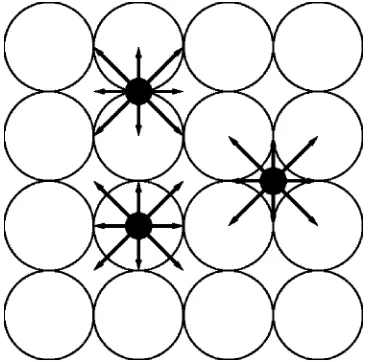
In this paper, we use a rather specific rule for CO ad-sorption, motivated by experiments31,34,35 and DFT calculations.20 A CO molecule in the gas phase is steered toward the on-top site. If the on-top site is available for ad-sorption, it will initially stick there. Otherwise it will first probe the four neighboring bridge sites. If any of these bridge sites is available, the CO molecule will adsorb there 共and if more than one such site is available, one is chosen at random兲. If no such bridge site is available, it will then probe the four neighboring 4fh sites, and adsorb there if any is available. Figure2 provides a schematic of this CO adsorp-tion process. As can be seen from the figure, for this model, presence of oxygen adsorbates does not inhibit CO adsorp-tion, even when they form a high-coverage c共2⫻2兲 struc-FIG. 1. Schematic for O2 adsorption. The two grey circles represent O
[image:6.612.315.558.48.191.2]atoms. Crosses denote the six additional 4fh sites that should be free of O. The large circles with dashed line represent regions for which no CO should reside strictly within the interior.
FIG. 2. Schematic for CO adsorption. CO molecule共black circle兲is steered toward an on-top site. The arrows show the neighboring sites which it will check for the availability should the on-top site not be available for adsorp-tion. The solid arrow indicates available adsorption sites and the dashed arrow indicates unavailable sites. On the left side, grey circles represent adsorbed oxygen which form ac共2⫻2兲structure. On the right side, dark circles show adsorbed CO forming an ordered c共2冑2⫻冑2兲R45° domain. Inside this CO domain, no site is available for further CO adsorption. 154705-3 Modeling of CO oxidation on Pd共100兲 J. Chem. Phys.124, 154705共2006兲
[image:6.612.84.266.49.230.2]ture. On the other hand, a CO domain with perfect c共2
冑
2⫻
冑
2兲R45° ordering completely inhibits CO adsorption. We discuss this further in Sec. IV.D. Adspecies interactions
We assume a Hamiltonian for the mixed adlayer system with the following form:
H=
兺
i,␣
ni␣⑀i␣+
兺
i⬍j兺
␣,ni␣nji␣,j
,
, 共1兲
where␣and= CO or O denote different possible adsorbed species, and iand j are the indices for the adsorption sites, which include br, 4fh, and top for CO 共or just 4fh for O兲. Here, we assume that pairwise-additive interaction domi-nates adlayer ordering and reaction behavior. However, many-body interactions8,10also play some role, and could be readily be incorporated into a more detailed LG treatment. Furthermore, we allow for the dependence of the binding energy ⑀i␣ and the pair interaction i␣,j
,
on the adsorption sites.
DFT provides a very useful tool for estimating lateral interactions between adsorbates. However, current accura-cies, which are assumed to be around 50 meV, often are not sufficient to predict the correct equilibrium adlayer ordering. The latter requires uncertainties significantly below the ther-mal energy, kBT, of about 25– 40 meV for typical reaction
temperatures of around 300– 450 K. Hence, in this paper, we adopt a multifaceted approach in “deriving” the lateral inter-actions. We first studied the equilibrium phase diagrams for single-species adsorbate ordering in the appropriate tempera-ture range. For CO, the relevant ordering is c共2
冑
2⫻
冑
2兲R45°. For oxygen, the relevant ordering is 共2⫻2兲 or c共2⫻2兲. Comparing phase diagrams from statistical me-chanical analysis of the lattice-gas model and from experi-ment, we can place some constraints on the possible magni-tudes of interactions. Some of these analyses has been reported previously.15,16 In this work, our choice of interac-tions is also guided by the requirement of obtaining reason-able TPD spectra. Since different experimentally measurreason-able quantities are sensitive to different interactions, modeling va-riety of such observations can effectively narrow down the range of viable interaction values. In addition, results from DFT calculations reported below further narrows down the range of possibilities. Our choice of parameters can reason-ably reproduce all available experimental data, and also fall within the recognized uncertainties of current first-principles methods. Finally, we note that the “deduced” parameters can-not be the final answer, since adspecies interactions cancan-not be precisely described by pairwise interactions in the form of Eq. 共1兲. However, we believe that our model, which can be considered as semiempirical, captures the dominant behav-ior.TableIsummarizes the lateral interactions between CO and O adsorbates. DFT calculations were performed with squared 共1⫻1兲, c共2⫻2兲, 共2⫻2兲, and 共3⫻3兲 supercells, with Brillouin-zone integration using 共12⫻12⫻1兲, 共8⫻8
⫻1兲,共6⫻6⫻1兲, and共4⫻4⫻1兲k points, respectively. The cutoff energy for all atoms is 400 eV. To derive the lateral
interaction from DFT calculations, we compare the binding energy per adsorbate from calculations with different peri-odic adlayer orderings and coverages. We assume additive pairwise interactions as in the lattice-gas Hamiltonian in Eq.
共1兲, and ignore interactions for separations beyond d= 2a. Then, the difference in binding energy between a 1 ML共1
⫻1兲and a 1 / 2 MLc共2⫻2兲system corresponds to two NN interactions per adsorbate, and therefore the strength of NN interactionNN=关Eb共1 / 2 ML兲−Eb共1 ML兲兴/ 2. Alternatively,
one can also calculate NN by comparing the difference in binding energy between an isolated adsorbate and a single NN pair. For the NN repulsion between two oxygen in hol-low sites, the former method predicts a value of 0.36 eV, while the second method 关performed using a共3⫻3兲 super-cell兴predicts a value of 0.38 eV. This supports the adequacy of the pairwise-additive interaction approximation. Since we are mostly interested in systems with coverages near or above that of ordered structures, we use the first method for deriving lateral interactions. 关As an aside, comparing ener-gies between a 1 / 4 ML 共2⫻2兲 system and a 1 / 2 ML 共2
⫻1兲system predicts a 0.52 eV NN repulsion, perhaps due to a strong orientational dependence in lateral interaction. For-tunately, such 共2⫻1兲 ordering is highly energetically unfa-vorable, therefore accurate treatment is not required.兴
Note that many of the values for interaction energies used in the model are different from the DFT values also listed in Table I. For example, we deduce15 from experiments31,36,37on the heat of adsorption that the interac-tion between two bridge site CO molecules at a distance ofa to be 0.17 eV, rather than a value in the range of 0.22– 0.30 eV obtained from DFT calculations.
E. Diffusion of adsorbates
[image:7.612.315.559.113.321.2]At low to moderate coverages, by far the most prevalent and rapid process is the diffusive hopping of CO across the TABLE I. Lateral interactions between CO and oxygen adsorbates. The first column indicates the site separation,d, in units ofa. The second column indicates the adsorption sites for each of the two interacting adspecies, where “4fh” denotes fourfold hollow, “top” denotes on-top, and “br” denotes bridge sites. There are two br-br pairs withd=a: “br-br共1兲” is across a 4fh site, and “br-br共2兲” is across a Pd atom. Energies are in unit of eV.
d共a兲 Adsorption sites DFT values Value used
CO–CO
1 4fh-4fh 0.408 0.408
1 br-br共1兲 0.221 0.170
1 br-br共2兲 0.304 0.170
冑5 / 2 br-4fh 0.174 0.174
冑5 / 2 br-top 0.078 0.174
冑2 br-br 0.020 0.030
O–O
1 4fh-4fh 0.368 0.360
冑2 4fh-4fh 0.104 0.085
2 4fh-4fh −0.041 −0.020
CO–O
1 4fh-4fh 0.426 0.326
冑5 / 2 br-4fh 0.200 0.190
冑2 4fh-4fh 0.087 0.000
surface. Even the rate of hopping of relatively immobile O will exceed rates for other adsorption, desorption, and reac-tion processes at 300 K and above. A kinetic model that pre-cisely describes all hopping processes is beyond the scope of this paper, but in any case is rather unnecessary. The main effect of diffusion is to achieve some degree of equilibration of the adlayer. This can be achieved by any kinetic model that treats diffusion in a way that satisfies detailed balance and ergodicity. In this paper, we use a simple Metropolis dynamics 共or algorithm兲 where the hopping rate for adspe-cies of type ␣is given by
h=h0␣min兵关1,e共Ei−Ef兲/共kBT兲兴其. 共2兲
Here, Ei 共Ef兲 is the total initial共final兲adspecies interaction
energy for this adsorbate before共after兲hopping.h0␣ is a ref-erence hopping rate 共described further below兲 which is as-sumed to have the Arrhenius form
h0␣=␣exp关−E␣0/共kBT兲兴, 共3兲
where= 1013s−1 for both CO and oxygen.
This form forh is certainly an oversimplification. It has the property that the hopping rate is independent of the lat-eral interactions as long as the hopping movement does not raise the energy. In general, one might expect that the hop-ping rate for adsorbate diffusion will increase to some extent with an increase in Ei, as evidenced in experiments on the
hopping of O on Ru共0001兲.38 However, again, here we deal primarily with the regime of rapid diffusion, where the main impact of diffusion is adlayer equilibration, and where the details of the diffusion dynamics are not so important.
Since CO can reside on different types adsorption sites, we allow hopping between them. For example, a CO共ads兲on a bridge site can hop to any of the four NN bridge sites, the two NN 4fh sites, or the two NN on-top sites共if available兲. Figure3illustrates all of the possibilities. In contrast, O共ads兲 can only reside at 4fh sites, and is only allowed to hop to any of four NN 4fh sites共if available兲.
For oxygen 共␣= O兲, which occupies only 4fh sites, h0O corresponds to the rate of hopping between NN 4fh sites for an isolated O adatom. We choose a hopping barrier for oxy-gen ofE0O=Ed
O
= 0.65 eV. This choice is based on a detailed
analysis of LEED experiments characterizing the nonequilib-rium ordering dynamics of O / Pd共100兲.16,29As an aside, we note that this value should correspond to the difference in binding energy between bridge and 4fh sites.
For CO共␣= CO兲, because we allow direct hops between the lowest energy bridge sites共which can lead to long-range diffusion兲, it follows that E0CO=EdCO eV must be chosen to
correspond to the diffusion barrier for isolated CO. 共As an aside, if one forbids direct hops between bridge sites, then the dominant pathway for long-range diffusion presumably corresponds to hopping between neighboring bridge sites via the intervening 4fh site. In this case, the activation barrier for long-range diffusion of CO, EdCO, must satisfy EdCO=E0CO +␦CO, where␦CO=⑀4fhCO−⑀brCO.兲In any case, this difference in site energies, ␦CO, undoubtedly provides a lower bound on Ed
CO
for the real system. This␦COwas estimated as 0.18 eV from DFT studies in Ref. 20, but was found to be signifi-cantly lower in our analysis共although a value of 0.18 eV is used in our modeling, as noted below兲. A recent more de-tailed analysis33 suggests that ␦CO= 0.14 eV, and our DFT results suggest an additional barrier of around 0.1 eV for diffusion corresponding to Ed
CO
in the range of 0.20– 0.25 eV.
However, since we deal with situations where CO diffu-sion is very fast, its precise value is not particularly relevant. In fact, in our simulations, we slow down CO diffusion sig-nificantly from its physical value 共and sometimes also oxy-gen diffusion兲. We have checked that the results presented in this paper are mostly insensitive to the values of these diffu-sion rates. See Sec. III and the Appendix for further discus-sion.
F. Desorption of O
Desorption of oxygen is associative or recombinative, i.e., of second order. The desorption pathway starts from a diagonal NN pair of oxygen adatoms on 4fh sites. Rates for the oxygen adsorption-desorption process must satisfy de-tailed balance. Since we assume no barrier for dissociative adsorption of oxygen 共just requiring satisfaction of the site availability condition兲, the rate for the reverse process of associative desorption must satisfy
dO2=O2exp关−共⑀O2+Elat O2兲/共k
BT兲兴. 共4兲
Here,⑀O2is the adsorption energy of a O
2molecule, i.e., the difference in energy between O2 in the gas phase and two isolated O adsorbed at 4fh sites on the Pd共100兲surface.ElatO2
is the total lateral interaction for the pair of desorbing O with the rest of the coadsorbate,includingthe interaction between this pair of adsorbed O of iO,O,j where兵i,j其correspond to a
diagonal NN pair of 4fh sites. In our model, we assumeO
2= 10
13 s−1. Fitting to
experi-mental TPD spectra共see below兲so that the main desorption peak is at 800 K with heating rate of 5 K / s and an initial coverage of 0.15 ML gives⑀O2= 2.25 eV. A DFT calculation
without spin polarization predicts that ⑀O2= 3.43 eV. Better
agreement with the experiment can be achieved by consider-FIG. 3. Schematic indicating allowed CO hopping paths.
154705-5 Modeling of CO oxidation on Pd共100兲 J. Chem. Phys.124, 154705共2006兲
[image:8.612.81.265.49.230.2]ing spin polarization for O2molecule共but still assuming no spin polarization for the adsorption system兲, which yields the prediction⑀O2= 2.33 eV.
G. Desorption of CO
Rates for the CO adsorption-desorption process must also satisfy detailed balance. Since we assume no barrier for CO adsorption 共just requiring satisfaction of the site avail-ability condition兲, the rate for the reverse process of CO desorption from sitei must be given by
dCO=COexp关−共⑀i
CO
+ElatCO兲/共kBT兲兴, 共5兲
where⑀i
CO
is the binding energy of an isolated CO on sitei and ElatCO is the total lateral interaction of this CO with its neighboring adsorbates. In this paper, we assume that CO = 1016s−1, a value taken from experiments by Behmet al.31 This choice is significantly larger than the canonical preex-ponential factor of 1013 s−1, however, it has been argued39
to be reasonable for CO desorption from metal surfaces. We also assume that ⑀CO= 1.60 eV for the bridge site, ⑀CO = 1.42 eV for the 4fh site, and ⑀CO= 1.13 eV for the on-top site.
H. Reaction of CO and O
DFT calculations by Zhang and Hu21 show that the ac-tivation barrier for the CO oxidation reaction on Pd共100兲is about 1.05 eV in a 2⫻3 unit cell with 1 / 6 ML coverage of each of O and CO, and about 0.78 eV in a unit cell of 2
⫻2 with 1 / 4 ML coverage of each of O and CO. In the former case, the O is initially at a 4fh site and the CO at the closest available bridge site 共d= 1.118a兲 or a next NN 4fh site 共d= 1.414a兲. These are the typical reaction configura-tions for lower adlayer coverages, and in our modeling we assume that a CO–O pair with these configurations can react with an activation barrier of 1.00 eV. In the later case, the O and CO are both on NN 4fh sites separated by a shorter distancea. This scenario applies for CO oxidation when the oxygen coverage is high. Then, this alternative reaction path-way becomes significant. The lower activation barrier is pre-sumably due to the higher initial energy associated with the higher local coverage. In our modeling, we assume an acti-vation barrier of 0.73 eV for this reaction pathway. Figure4 provides a schematic of both pathways.
Note that the above choice of activation barriers for re-action is insensitive to the initial configurational energy which incorporates lateral interactions. Thus, for example, the reaction barrier for CO at a bridge sites inside a p共2
⫻2兲 oxygen domain is the same as for CO at a bridge site outside of the domain but close to the edge. For reaction, there are no constraints imposed by detailed-balance require-ments since the reverse process of dissociative adsorption of CO2is not included in the model. Thus, there is considerable flexibility in the choice of rates. Analogous to our imposition of Metropolis dynamics in Eq. 共2兲 for hopping, our choice for reaction is certainly an oversimplification. Other possi-bilities incorporate the effect of interactions in the initial configuration, e.g., to lower the barrier for CO at bridge sites within oxygenp共2⫻2兲domains共relative to CO outside such
domains兲. However, as we will show in Sec. VI B, our model can reproduce TPR features that are associated with oxygen islanding.
III. KEY FEATURES OF THE KMC SIMULATION ALGORITHM
Because of the complexity of our LG reaction model, a fully rejection-free Bortz-type algorithm is impractical to implement. Also, due to the vast range of dynamical rates for the various atomistic processes, a “standard” algorithm where the sites are randomly selected is extremely ineffi-cient. Thus, we implement a tailored algorithm to accommo-date these difficulties.
We maintain individual lists of CO adspecies and O ada-toms on the various types of adsorption sites, i.e., CO on top sites, CO on 4fh sites, CO on bridges sites共in fact, we dis-tinguish between two types of such sites, one between Pd aligned along the x direction and the other between Pd aligned along the y direction兲, and O on 4fh sites. In our simulations, we first determine the highest possible rate for each process, e.g., hopping of a bridge CO to a neighboring bridge sites, reaction between a bridge CO and a neighboring 4fh O, etc., based on the current configuration. We use these values as the reference or attemptrates for the various pro-cesses 共for a certain period of time, as described below兲. Then, at each Monte Carlo step, a process is then selected based on the above mentioned lists weighted by the attempt rates. The probability for successful implementation of this process is given by the ratio of its actual rate to the maximal attempt rate.
[image:9.612.317.557.48.219.2]It should be noted that for such activated processes as desorption of CO and O, there can be a great variation in the associated rates 共reflecting variations in the local lateral in-teraction energetics兲. Thus, the acceptance rate can vary from unity to very low values. For adspecies hopping, the depen-dence of rates on lateral interactions also results in consider-able variation in the acceptance rate. Adsorption processes must be treated appropriately along with desorption, reac-tion, and hopping. We do not keep lists of available adsorp-tion sites, so acceptance depends whether or not the selected site共or sites in the case of O2 adsorption兲is available.
FIG. 4. Schematic of the two CO + O reaction pathways.
Returning to the determination of reference or attempt rates, we indicated above that these are not determined con-tinuously throughout the simulation. Rather, they are deter-mined from some current configuration and then used for a certain interval of time. At the end of that interval, they are recalculated based on the updated current configuration. Strictly speaking, there can and will be cases where the “real” rate is larger than the reference rate thus determined. Consequently, we are possibly capping rates for these faster processes by the reference rates, effectively slowing down these processes slightly. However, if one updates the refer-ence rates frequently enough, capping occurs rarely and will not corrupt the verity of the simulation.
Another issue particular to surface reaction systems is that adspecies diffusion is usually by far the fastest process. If we simulate diffusion processes using their physical rates 共particularly for CO兲, this would consume almost all of the computational resources. However, since we consider only spatially homogeneous systems, as noted above, the effect of diffusion is primarily to equilibrate the system. Thus, behav-ior is typically insensitive to the exact magnitude of hopping rates provided that they are sufficiently large. Thus, in this paper, we typically cap the hopping rates of CO and O共by reducing the reference hopping rates,h0␣兲to be 10–100 times the fastest rate for the other processes, irrespective of whether it will be associated with reaction, deposition, etc. This approach significantly reduces rates for CO hopping, but not necessarily for O hopping共which is subject to much higher barriers兲. This has the advantage of preserving a real-istic description of reordering dynamics of the O adlayer, e.g., during TPR.
An alternative strategy is to use an “artificial dynamics,” at least for CO, to more efficiently equilibrate the system 共e.g., with longer range hopping or artificial desorption read-sorption using the Metropolis dynamics兲. However, due to the high coverage and strong repulsive interactions between adsorbate, such dynamics is highly restrained and no signifi-cant speedup is achieved. We are, however, pursuing the use of a cluster-type algorithm in a more general surface reaction studies.
As an aside, we note that for spatially inhomogeneous behavior in these reaction-diffusion systems, the characteris-tic length is proportional to the square root of the chemical diffusion coefficient for the most mobile species. Thus, re-ducing hop rates corrupts description of spatiotemporal be-havior共which might be corrected by rescaling兲. However, we have also developed a heterogeneous coupled lattice-gas 共HCLG兲 multiscale simulation approach for surface reactions.22,40Here, parallel simulations of the local state of the reaction system at a grid of macroscopic points across the pattern are suitably coupled to reflect macroscopic transport by surface diffusion.
IV. SIMULATION RESULTS FOR ADSORPTION AND DESORPTION OF CO
Figure5presents our simulation results for the coverage dependence of the normalized sticking coefficient,SCO共CO兲, for CO adsorption on Pd共100兲. One caveat is that these
re-sults are specific to the steering mechanism for CO adsorp-tion described in detail in Sec. II C. The most salient feature is that the sticking coefficient remains very close to unity for CO coverages up to at least 0.2 ML. This contrasts conven-tional linearly decreasing behavior with increasing CO cov-erage, as predicted by the Langmuir model for monomer adsorption. A slow or negligible initial decrease is a common phenomena in chemisorption systems, and is most typically attributed to existence of a physisorbed precursor state,41 al-though it has also been recognized that this behavior can reflect a steering mechanism being operative.42
For our model, the initial slow decrease of SCO共CO兲 with increasing CO is due to the steering effect. At low coverages, preadsorbed CO will steer an incoming gas-phase CO to a nearby adsorption site, rather than block the adsorp-tion as in the normal Langmuir model of adsorpadsorp-tion. As the CO coverage increases to about 0.5 ML, such a steering is no longer possible, since most nearby sites which can accom-modate additional CO adsorption are already filled, as it is shown in Fig.2. Therefore, the sticking coefficient decreases sharply around 0.5 ML.
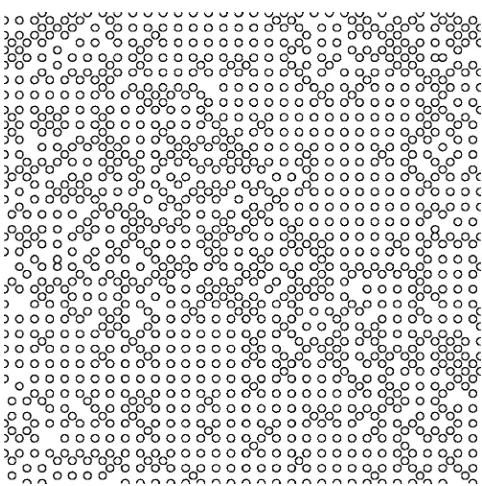
Figure 6 shows simulation results for TPD spectra ob-tained with a heating rate of 13 K / s. The initial configuration is generated from simulated configurations obtained immedi-ately following the deposition of various amounts of CO at two different temperatures, Tdep: 共a兲 Tdep= 250 K and 共b兲 Tdep= 350 K. The impingement rate was 2⫻10−3per Pd共100兲 lattice site per second, taking the initial sticking coefficient equal to unity. This corresponds to a CO pressure of about 10−7torr. The coverage of CO obtained under these condi-tions for an exposure of 1 L共1 L = 10−6torr s兲is about 0.53 ML forTexp= 250 K, and 0.44 ML forTexp= 350 K. Here, for modeling purposes, we define 1 L as the amount of exposure to cover the surface with 1 ML of CO if every incoming molecule sticks to the surface.共Later for O2adsorption, only a dose of 0.5 L is needed to cover the surface with 1 ML of oxygen if every molecule sticks, since each O2produces two atomic O.兲
[image:10.612.331.539.47.195.2]The dominant peak in our TPD spectra at 490 K agrees with experiments by Behm et al.31 This should be expected since we have used a desorption prefactorCO= 1016 s−1and binding energy ⑀brCO= 1.60 eV taken from that study. Decon-volution of the spectra would produce a secondary peak at FIG. 5. Normalized sticking coefficient for CO adsorption at 300 K with impingement rate 1 ML/ s.
154705-7 Modeling of CO oxidation on Pd共100兲 J. Chem. Phys.124, 154705共2006兲
about 440 K. This peak reflects enhanced desorption due to the weak second NN CO共br兲–CO共br兲 repulsion 共d=
冑
2a兲 within c共2冑
2⫻冑
2兲R45° domains. When the surface is ex-posed to CO at a lower temperature, there is an additional peak at 360 K 共as well as the main 490 K peak and the secondary 440 K peak兲. Behmet al.also mentioned a peak at 370 K in their experiments.31The same feature appears in TPD spectra of Stuveet al.17following adsorption at 125 K. In our model, this additional low temperature peak is due to the greatly reduced desorption barrier for CO molecules within high-density boundaries between different c共2冑
2⫻
冑
2兲R45° domains. The barrier for such adspecies is re-duced due to the strong NN CO共br兲–CO共br兲 repulsion. Figure7 shows a snapshot, a configuration generated in the TPD simulation when the system is at 360 K, with initial CO adsorption at 250 K.As indicated above, TPD spectra can be quite sensitive to the lateral adspecies interactions, and, in fact, can be used to deduce these interactions共e.g., see Ref.7兲. In our model-ing, we used a NN CO共br兲–CO共br兲repulsion of 0.17 eV de-duced from the heat of adsorption experiments.15 This gen-erates a 360 K TPD peak as shown above. In contrast, if one uses the higher DFT values for the NN CO共br兲–CO共br兲 re-pulsion listed in TableI, this low temperature peak is shifted to near 320 K, too low to be consistent with the experiment. Therefore, the location of this peak in the TPD spectrum
gives additional evidence that our lower value of 0.17 eV provides a better description of this CO NN repulsion.
V. SIMULATION RESULTS FOR ADSORPTION AND DESORPTION OF OXYGEN
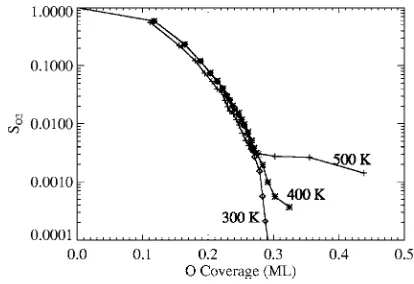
Figure 8 shows simulation results for coverage depen-dence of the normalized sticking coefficient, SO2共O2兲, for oxygen adsorption on Pd共100兲at various temperatures共from 300 to 500 K兲. At these temperatures, diffusion of adsorbed oxygen is activated. When the oxygen coverage approaches 0.25 ML, p共2⫻2兲ordering emerges and the sticking coeffi-cient decreases sharply. This reflects the feature that the population of eight-site adsorption ensembles vanishes for such ordering. While the behavior of the sticking coefficient for lower coverages is only weakly dependent of temperature and pressure in this regime, there is a strong dependence for behavior near saturation.
We should mention a few caveats regarding these simu-lation results. First, the “eight-site rule” undoubtedly pro-FIG. 6. Simulated TPD spectrum for CO desorption on Pd共100兲for various
[image:11.612.69.278.45.354.2]CO exposures at共a兲250 K and共b兲350 K. Exposures are at 0.1, 0.2, 0.3, 0.4, 0.5, 0.6, 0.7, 0.8, 1.0, 1.2, 1.6, and 2.0 L, assuming an initial sticking coefficient of unity. Simulations are performed on a 512⫻512 system. The CO hopping rate is at least 100 times the desorption rate of an isolated CO at bridge sites.
FIG. 7. Snapshot of the the configuration of CO adsorbates at 360 K during a TPD simulation. The surface was initially exposed to 2 L of CO at 250 K.
FIG. 8. Normalized sticking coefficients for oxygen adsorption at various temperatures. ForT= 300 and 400 K, the impingement rate is 0.0002 ML/ s. ForT= 500 K, the impingement rate is 1 ML/ s.
[image:11.612.317.557.45.287.2] [image:11.612.331.538.580.722.2]vides a somewhat oversimplified description of the dissocia-tive deposition dynamics for oxygen. Plausibly, there is a reduced but finite probability of sticking when one or more of the six 4fh sites neighboring the next NN 4fh adsorption sites is occupied by O. Likely, any NN pair of O thus formed would rapidly separate via thermal hopping. Second, when the oxygen coverage is around or above 0.5 ML, adsorption is not completely blocked as in our model. Instead, a 共
冑
5⫻
冑
5兲R27° oxide structure emerges which involves Pd sur-face reconstruction. See Refs. 43and 44for recent investi-gations of this structure. Presently, substrate reconstruction has not been incorporated in our reaction model, but it is important for CO oxidation on Pd共100兲 at high pressure.19 This regime will be the focus of our future research. Another factor is that real Pd substrates always have defects such as steps which limit the size of p共2⫻2兲 domains. This likely also leads to the enhancement of oxygen adsorption. In sum-mary, due to these various factors, our modeling presumably somewhat underestimates the physical sticking coefficient.Figure9shows results of TPD simulations for different oxygen exposures at 400 K. Consistently, experimental TPD spectra45 show that the dominant peak shifts from above 800 K to around 750 K as oxygen exposure increases. An additional shoulder or peak around 650 K starts to emerge when the initial coverage of oxygen is above 0.25 ML. The latter reflects the influence of next NN repulsive O–O inter-actions, which lower the desorption barrier. This behavior in Fig.9 is also seen in experiments. Figure10shows a snap-shot of adlayer configuration at 620 K during TPD. We do not reproduce the very sharp peak for observed oxygen ex-posure over 30 L.45,46However, this sharp peak is due to the 共
冑
5⫻冑
5兲R27° phase mentioned above47 which is not incor-porated into our modeling.As an aside, we mention that the TPD spectra in this and the previous section were calculated directly from KMC simulation of a LG model in which desorption rates are specified explicitly. A prominent alternative method for de-termining TPD spectra assumes adlayer equilibration and evaluates the desorption rate in terms of the adsorbate chemi-cal potential and the sticking coefficient.5 This method is
appealing since determination of the chemical potential using the transfer matrix technique avoids potentially expensive simulations incorporating surface diffusion processes. One drawback, however, is that one must know the specific form for the coverage dependence of the sticking coefficient at the relevant desorption temperature. As shown earlier in Fig.9, this form is sensitive to temperature, and it is typically not available at desorption temperature. Therefore, the utility of this approach for precisely predicting TPD spectra might be questioned. The assumption of equilibrium of chemisorbed phases during desorption is reasonable. However, there are certainly situations 共e.g., surface oxide formation兲 where equilibrium is not achieved, as is demonstrated, e.g., by a dependence of the TPD spectrum on the deposition tempera-ture.
VI. SIMULATION RESULTS FOR CO OXIDATION
A. Ordering of mixed CO + oxygen adlayer
As a prelude for our study of TPR and steady-state be-havior for CO oxidation, it is instructive to briefly discuss the ordering within a mixed adlayer of CO and oxygen under conditions of limited reaction. We have already described the ordered structures formed by pure CO and by pure oxygen on the Pd共100兲 surface. Our selection of CO–CO and O–O adspecies interactions is made in part to ensure that our model recovers this experimentally observed ordering.15,16In principle, one can also utilize information about ordered structures formed within mixed adlayers to deduce lateral interactions between different types of adspecies. However, such information is quite limited, especially given the larger parameter space needed for a comprehensive analysis.
[image:12.612.315.556.44.287.2]A two-stage deposition procedure is implemented in our simulations quite similar to that of titration experiments. However, the second stage of deposition, which produces the FIG. 9. Simulated TPD spectrum for oxygen desorption on Pd共100兲for
various O2exposure at 400 K. Exposure time is 0.1, 0.2, 0.4, 0.6, 0.8, 1, 2,
3, 6, 10, 20, and 50 s, with impingement rate at 1 ML/ s and assuming an initial sticking coefficient of unity. Other conditions are the same as in Fig.6.
FIG. 10. Snapshot of the configuration of adsorbed oxygen at 620 K during a TPD simulation. The surface was initially exposed to 50 L of oxygen at 400 K.
154705-9 Modeling of CO oxidation on Pd共100兲 J. Chem. Phys.124, 154705共2006兲
[image:12.612.69.279.46.198.2]mixed adlayer, is performed at a lower temperature where the reaction between CO and oxygen is insignificant共except in the later stages when the total coverage is high兲. Specifi-cally, we first deposit an oxygen adlayer withO= 0.24 ML at 400 K. As mentioned above, adsorbed oxygen forms a p共2
⫻2兲structure under these conditions. We then deposit CO at 270 K with a flux of 10−4ML/ s. Figure 11 shows typical configurations at various CO coverages. For CO⬍0.1 ML, CO mostly mixes into the oxygen adlayer which maintains its long-ranged p共2⫻2兲 order. When CO⬎0.1 ML, c共2
⫻2兲 patches with higher oxygen coverage start to appear, leaving space in which CO can aggregate. Eventually, no p共2⫻2兲 regions remain, and the surface locally separates 共i.e., locally entropically demixes兲 into c共2⫻2兲 oxygen patches and c共2
冑
2⫻冑
2兲R45° CO patches.This is qualitatively consistent with the LEED study of Stuve et al.17 One difference is that in our model, local de-mixing only occurs whenT⬎250 K共on time frame of about an hour兲, while Stuveet al.observed demixing occurring at temperatures as low as 80 K. This may due to the fact that our Metropolis algorithm for hopping of oxygen imposes a minimum diffusion barrier of 0.65 eV. This value is derived from experiments at low oxygen coverages. However, a more realistic algorithm for hopping might allow the diffu-sion barrier be significantly reduced at high CO and oxygen coverage, due to the effect of repulsive interactions. How-ever, in this paper, we will not pursue such refinements since we mostly deal with high temperature behavior where such details are not likely to be crucial.
B. TPR spectra
TPR is a powerful technique for probing details of the reaction process. The presence of CO on the surface strongly inhibits oxygen adsorption. Thus, the typical experimental
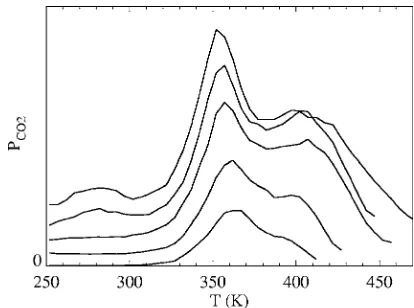
procedure is to first expose the surface to some selected amount of oxygen, then to expose the oxygen-precovered surface to CO, and subsequently to monitor the reaction products while increasing the substrate temperature. We have performed simulations mimicking this experimental proce-dure. First, we dose the surface with 2.5 L of oxygen at 400 K, resulting in an oxygen coverage of about 0.25 ML. We then deposit various amounts of CO at 250 K. The tem-perature is subsequently raised at the rate of 5 K / s.
Figure12shows results for TPR spectra from our simu-lations. With a low initial CO coverage, there is just one reaction peak at around 360 K. As the initial CO coverage increases above 0.1 ML, another peak emerges actually at a higher temperature of about 400 K. With even higher CO coverage, a shoulder below 300 K also appears. These TPR features are associated with specific reaction scenarios: 共i兲 the peak at 360 K is due to reaction involving a CO within the oxygen p共2⫻2兲 structure;共ii兲 the shoulder at 400 K is due to reaction between a CO outside an oxygen domain with peripheral oxygen, or between a CO and an isolated oxygen atom; and 共iii兲 the lowest temperature state corre-sponds to reaction between a CO and an O at NN 4fh sites 共with separationd=a兲.
We next elucidate the dependence of these features on CO coverage. The origin of the 360 K peak is clear. For low CO, the amount of CO is insufficient to destroy the ordered oxygen p共2⫻2兲 structure. CO molecules are always within this ordered structure, where the reaction barrier is around 1.00 eV. A rather counterintuitive result in Fig. 12 is that increasing the initial CO coverage introduces a shoulder or peak in the TPR spectrum at a higher temperature. In con-trast, in typical TPD experiments for adlayers with repulsive adspecies interactions, increasing initial coverage typically introduces lower temperature peaks. However, in our TPR study, introducing a sufficiently large amount of CO can de-stroy the ordered oxygen structure共either through repulsion, or by reacting away oxygen so that the amount of oxygen is not sufficient for maintaining ordering兲. Then after the initial peak at 360 K, the remaining CO and oxygen are disordered. In this situation, reaction between CO and oxygen have to overcome an additional barrier due to repulsive interaction between CO and oxygen of 0.19 eV. Thus the effective re-FIG. 11. Configurations of mixed CO and oxygen adlayers at 270 K. Open
[image:13.612.52.296.45.293.2]circles denote oxygen and closed circles denote CO.
FIG. 12. Simulated TPR spectrum with heating rate 5 K s−1. The initial
coverage of oxygen is 0.252 ML, and the initial coverage of CO, from bottom to top, is 0.050, 0.099, 0.193, 0.279, and 0.396 ML.
[image:13.612.331.538.47.201.2]action activation energy is 1.19 eV. Introducing an even larger initial amount of CO leads to significant population of 4fh sites directly between adjacent O in the p共2⫻2兲 struc-ture. Such CO reacts with a low barrier of 0.73 eV producing the low temperature peak.
The positions of the TPR peaks and their order of ap-pearance 共360 K, then 400 K, and finally 300 K, with in-creasing CO coverage兲 are consistent with experiments of Stuveet al.17The formation of a peak below 400 K and then emergence of a peak above 400 K with increasing CO cov-erage is also consistent with共but less clear in兲the TPR spec-tra of Zheng and Altman.18There are some minor discrepan-cies between experiments and simulations, but also between the experiments themselves. In experiments for higher CO coverage, the peak at around 360 K does not change position much with increasing CO coverage. For our model, this peak position shifts slightly to lower temperatures as CO coverage increases. However, we have adopted a fairly simple pre-scription of the reaction barriers in our model 共from many possible more complex choices兲, so this minor discrepancy is not surprising. It is worth noting that the broadness of TPR peaks is sensitive to how the reaction barriers depend on lateral interactions. On the other hand, the present model seems quite satisfactory when the total coverage is not much larger than 0.5 ML.
C. Reactive steady states and bistability
In this subsection, we study steady-state behavior of the reaction system under constant CO and oxygen pressure and for fixed temperature. As expected from traditional mean-field studies, for sufficiently low temperatures, our simula-tions reveal a range of CO partial pressures, where the sys-tem can either exist in a stable inactive or nearly CO-poisoned state 共with little CO2 production兲, or in a stable reactive state 共with high CO2 production兲. This regime of bistability disappears above a nonequilibrium critical point 共in the temperature and CO partial-pressure plane兲, corre-sponding to a cusp bifurcation in traditional mean-field treat-ments.
There has been much interest in related nonequilibrium phase transitions and critical phenomena in idealized reac-tion models which usually incorporate limited adspecies mo-bility. In such models, simulation reveals a first-order phase transition at the partial pressure where the inactive and reac-tive states are equally stable.48The discontinuous transition disappears at a nonequilibrium critical point which is of the Ising type.49,50A constant-coverage simulation approach was proposed51 which conveniently maps out the discontinuous variation of coverages with partial pressures. Loosely speak-ing, this approach is analogous to using a canonical rather than a grand canonical ensemble in equilibrium statistical physics. In the constant-coverage approach, one fixes either the CO or oxygen coverage共but not both兲and lets the pres-sure change to maintain this prescribed coverage.
For realistic reaction models with rapid adspecies diffu-sion, the discontinuous transition is replaced by bistability.52 The nonequilibrium critical point becomes of mean-field type rather than Ising type.50The constant-coverage
simula-tion approach allows one to map out not just the stable steady states, but also the connecting unstable steady state.52 These unstable states cannot be readily probed with conven-tional simulation techniques. Thus, in analyzing our LG model for CO oxidation on Pd共100兲, we utilize this constant-coverage simulation approach to provide the first steady-state bifurcation diagram for a realistic atomistic model of a sur-face reaction under UHV conditions.
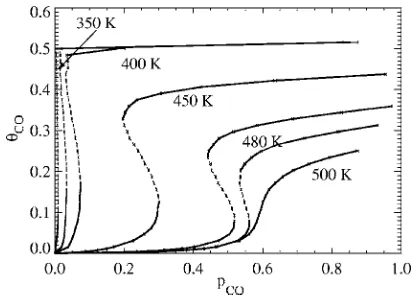
Figure13shows for different temperatures the variation of CO coverage with CO partial pressure,pCO, in the stable and unstable steady states. Notice that bistability disappears at a critical temperature just below 500 K共although we cau-tion that this value depends quite sensitively on the specifi-cation of CO desorption兲. Here, we have set the total flux of CO and oxygen to a fixed value of 1 ML/ s. At relatively low temperatures, starting from the reactive steady state with low CO coverage 共and high O coverage兲, as pCOincreases, CO coverage increases. Then at a certain pressure, the system will abruptly jump from the inactive state with high CO cov-erage and low oxygen covcov-erage at the so-called upper spin-odal point共where the reactive and unstable states merge and annihilate兲. Conversely, starting from an inactive state with high CO coverage at high CO pressure, aspCOdecreases, the system will jump to the reactive state with low CO coverage at the lower spinodal point共where the inactive and unstable states merge and annihilate兲. Such hysteresis behavior is commonly observed in experimental studies of CO oxidation.1 The associated discontinuous jumps should not be共but often are兲confused with the discontinuous transition in idealized reaction models with limited adspecies mobility. Results for bistability from the above simulations can be presented more directly. Figure14shows the bistable region 共shaded兲in aT-pCObifurcation diagram. The boundaries of the bistable region correspond to the loci of the spinodal points. The bistable region terminates at higher temperatures at a cusp point. For high temperature or low CO partial pres-sure outside this region, only the reactive steady state exists. For low temperature or high CO partial pressure, only the inactive near CO-poisoned steady state exists.
Figure 15 shows snapshots of the system under the steady-state conditions at various temperatures and CO par-tial pressures. The pressures are chosen to be midway be-FIG. 13. Phase diagram showing behavior of the steady-state CO coverage for CO oxidation on Pd共100兲. The solid lines represent stable phases, while the dotted lines represent the unstable phase.
154705-11 Modeling of CO oxidation on Pd共100兲 J. Chem. Phys.124, 154705共2006兲
[image:14.612.332.539.47.195.2]tween the upper and lower spinodal pressures. These are usu-ally close to but not exactly at the equistability pressure where the two steady states are equally stable 共in the sense that an interface between the two states is stationary兲.22,52 Notice that as the temperature increases, the distinction be-tween the inactive near CO-poisoned state and the reactive state diminishes. At the cusp point, the two states merge and become identical, resulting in critical fluctuations. An inter-esting feature is that for low temperatures, the oxygen ad-layer in the reactive steady states has some long-range order-ing. This has consequences for reaction front propagation in spatially nonuniform systems as it leads to significant reac-tion in the chemical diffusivity of CO. Some preliminary analysis has been published recently.22
VII. SUMMARY AND DISCUSSION
A long-standing goal of UHV surface science has been to provide a detailed understanding of catalytic surface reac-tions. Due to the complexity of these systems, there has been very little modeling based on a detailed and realistic atomis-tic description of the reaction process. Thus, here we were motivated to develop a realistic atomistic LG reaction model for CO oxidation on Pd共100兲under UHV conditions. In ad-dition to dependence on the kinetics of various processes,
behavior of such a model is very sensitive to adlayer order-ing which is controlled by the magnitude of weak adspecies interactions. Thus, considerable effort was expended to ob-tain precise values for the relevant energetic parameters. We combine information from both ab initio DFT calculations and statistical analysis of experimental observations. Exten-sive simulations are performed to directly confront a variety of standard surface science experiments. For the first time, we provide results for both TPR spectra and steady-state bi-furcation behavior for CO oxidation under UHV conditions, which are based on an atomistic model rather than traditional phenomenological mean-field rate equations.
To a certain degree, this work represents a benchmarking effort to test the practicality and reliability of atomistic mod-eling of surface reaction systems, especially under UHV con-ditions. Thus, here we choose to model a classic surface reaction system, i.e., CO oxidation on Pd共100兲. A growing trend in such modeling is to exploit increasingly readily available tools forab initiocalculations for energetics. This applies in our study, although given current limitations of DFT, we also demand that the selected energetic parameters produce behavior consistent with TPD and ordering behavior observed in experimental studies of single-adspecies sys-tems. With this multifaceted approach, satisfactory agree-ment with experiagree-ment has been achieved.
ACKNOWLEDGMENTS
This work was supported by the Division of Chemical Sciences of the U.S. Department of Energy 共Basic Energy Sciences兲. It was performed at Ames Laboratory which is operated for the U.S. DOE by Iowa State University under Contract No. W-7405-Eng-82.
APPENDIX: DEPENDENCE OF REACTIVE STEADY STATES ON DIFFUSION RATES
During CO oxidation under typical conditions, the ato-mistic process with by far the fastest rate is CO diffusion. For simulation of systems with a reasonable size and over an experimentally relevant period of time, it is usually not fea-sible to implement CO diffusion with the physically correct rate. Fortunately, some understanding is available of the de-pendence of reaction behavior on hopping rates. A well-defined hydrodynamic limit should be achieved as one sys-tematically increases the hopping rates. However, it is important to determine how quickly this limit is attained. Figure16shows constant-coverage simulation results for the dependence on hopping rates of the steady-state CO cover-age versus CO partial pressure. Specifically, for an “artifi-cial” reference choice of equal hopping rates for CO and O, we show the dependence of steady-state behavior on the magnitude of the hopping rates 共where all other rates are selected with their physical values at 400 K兲.
[image:15.612.70.276.47.190.2]For low hopping rates, bistability is replaced by a first-order transition between reactive and inactive states 共 occur-ring at relatively high CO partial pressure兲. This transition corresponds to the pressure where these states are equistable. There is a weak metastable extension of the reactive共 inac-tive兲state above共below兲this transition. As the hopping rate FIG. 14. Steady-state bifurcation diagram for CO oxidation on Pd共100兲. The
[image:15.612.53.294.548.710.2]shaded area represents the regime of bistability.
FIG. 15. Configuration of the mixed CO and oxygen adlayer in the steady states for CO oxidation on Pd共100兲at various temperatures and CO partial pressures. The upper panel shows the reactive steady states and the lower panel shows the near CO-poisoned steady states.