Ames Laboratory Publications Ames Laboratory
2014
Multi-Functionalization of Nanoporous Catalytic
Materials to Enhance Reaction Yield: Statistical
Mechanical Modeling for Conversion Reactions
with Restricted Diffusive Transport
Jing Wang Iowa State University
Andrés Garcia
Iowa State University, [email protected]
David Ackerman
Iowa State University, [email protected]
Mark S. Gordon
Iowa State University, [email protected]
Igor I. Slowing
Iowa State University, [email protected]
See next page for additional authors
Follow this and additional works at:http://lib.dr.iastate.edu/ameslab_pubs
Part of theChemistry Commons,Mathematics Commons, and thePhysics Commons
The complete bibliographic information for this item can be found athttp://lib.dr.iastate.edu/ ameslab_pubs/295. For information on how to cite this item, please visithttp://lib.dr.iastate.edu/ howtocite.html.
Multi-Functionalization of Nanoporous Catalytic Materials to Enhance
Reaction Yield: Statistical Mechanical Modeling for Conversion Reactions
with Restricted Diffusive Transport
Abstract
Multi-functionalization of catalytically-active nanomaterials provides a valuable tool for enhancing reaction yield by shifting reaction equilibrium, and potentially also by adjusting reaction-diffusion kinetics. For example, multi-functionalization of mesoporous silica to make the interior pore surface hydrophobic can enhance yield in dehydration reactions. Detailed molecular-level modeling to describe the pore environment, as well as the reaction and diffusion kinetics is challenging, although we briefly discuss current strategies. Our focus, however, is on coarse-grained stochastic modeling of the overall catalytic process for highly restricted transport within narrow pores (with single-file diffusion), while accounting for a tunable interaction of the pore interior with reaction products. We show that making the pore interior unfavorable to products can significantly enhance yield due to both thermodynamic and kinetics factors.
Disciplines
Chemistry | Mathematics | Physics
Comments
This article is fromMRS Proceedings1641 (2014): 6 pp., doi:10.1557/opl.2014.321. Posted with permission.
Authors
Jing Wang, Andrés Garcia, David Ackerman, Mark S. Gordon, Igor I. Slowing, Takeshi Kobayashi, Marek Pruski, and James W. Evans
Mater. Res. Soc. Symp. Proc. Vol. 1641 © 2014 Materials Research Society DOI: 10.1557/opl.2014.32
Multi-functionalization of nanoporous catalytic materials to enhance reaction yield: Statistical mechanical modeling for conversion reactions with restricted diffusive transport
Jing Wang1,2, Andrés Garcia1,4, David M. Ackerman1, Mark S. Gordon1,3, Igor I. Slowing1,3, Takeshi Kobayashi1, Marek Pruski1,3 and James W. Evans1,2,4
1Ames Laboratory – USDOE, and Departments of 2Mathematics, 3Chemistry,
and 4Physics & Astronomy, Iowa State University, Ames, IA 50011, U.S.A.
ABSTRACT
Multi-functionalization of catalytically-active nanomaterials provides a valuable tool for enhancing reaction yield by shifting reaction equilibrium, and potentially also by adjusting reaction-diffusion kinetics. For example, multi-functionalization of mesoporous silica to make the interior pore surface hydrophobic can enhance yield in dehydration reactions. Detailed molecular-level modeling to describe the pore environment, as well as the reaction and diffusion kinetics is challenging, although we briefly discuss current strategies. Our focus, however, is on coarse-grained stochastic modeling of the overall catalytic process for highly restricted transport within narrow pores (with single-file diffusion), while accounting for a tunable interaction of the pore interior with reaction products. We show that making the pore interior unfavorable to products can significantly enhance yield due to both thermodynamic and kinetics factors.
INTRODUCTION
Functionalization of nanoporous materials can create stable, separable heterogeneous catalysts [1]. For example, mesoporous silica nanoparticles (MSN) with diameters ~100 nm can be synthesized via soft-templating [2] wherein a TEOS silica precursor aggregates around
cylindrical micelles composed of CTAB molecules, which in turn self-assemble into a hexagonal array. Functionalization is achieved either during MSN synthesis (co-condensation), or after removal by calcination of CTAB (grafting). Co-condensation produces a more uniform distribution of catalytic and other functional groups within the pores [2]. The resulting functionalized linear nanopores can have effective diameters below 2 nm resulting in highly restricted diffusive transport of reactants and products, such as is the case for zeolite catalysts [1]. The extreme case of “no-passing” within the pores is termed single-file diffusion (SFD) [3].
In addition to functionalization of the interior pore surface with catalytic groups, multi-functionalization by additional groups could modify selectivity if the groups act as “gatekeepers” near the pore openings [2], or tune activity, e.g., by strongly interacting with one of the products to alter the reaction equilibrium [4]. We focus on the latter effect where one expects that making the pore interior unfavorable to a reaction product should lower its equilibrium concentration inside the pore, thus shifting the reaction equilibrium to higher conversions. Making the pore environment favorable should have the opposite effect. In addition, altering reaction product – pore interior interactions could impact reaction-diffusion kinetics, since modifying
concentrations inside the pore can strongly impact the extent of restricted diffusive transport. To provide an explicit example of the above ideas, consider a dehydration reaction, esterification (acid + alchohol ↔ ester + water), in MSN. One motivation for these studies is that esterification of fatty acids with methanol to produce methyl esters is a pretreatment step in the production of bio-diesel. Here, multi-functionalization to include hydrophobic as well as
catalytic groups has been shown to significantly enhance reactivity in several systems [4,5], most dramatically by utilizing hydrophobic 3-(pentafluorophenyl) polypropyl (PFP) groups [4].
In this paper, we model of the overall reaction-diffusion process for catalytic conversion in narrow linear nanopores with SFD of at least some reactants and products. The tunable interaction of the pore interior with reaction product(s) is captured by a single parameter, α, which determines the ease of product reentry to the pore [6]. We utilize spatially-discrete coarse-grained (CG) stochastic models wherein continuous space inside the pore is divided into cells of width ~1 nm comparable to reactant/product size, and diffusion is described by hopping or exchange between adjacent cells [6,7]. Adsorption-desorption at pore openings and reaction within the pore at catalytic sites are appropriately specified. Our focus is on overall reactivity versus the fractional conversion, F, of reactant outside the pore to product, for various α.
Precise analysis of these stochastic models is achieved by Kinetic Monte Carlo (KMC) simulation. Deeper insight comes from consideration of the exact master equations accounting for spatially non-uniform states. Mean-field (MF) treatments of diffusion reduce these to natural spatially-discrete reaction-diffusion equations describing concentration profiles within the pores. Unfortunately, these MF treatments fail dramatically in describing SFD due to the development of strong spatial correlations. However, a “generalized hydrodynamic” (GH) approach has been developed which does effectively capture anomalous diffusion behavior. As well as KMC simulation, this GH approach is applied in the current study for more efficient analysis [7].
Next, we discuss possible strategies for molecular-level description and modeling of multi-functionalized catalytic MSN systems. However, subsequently, we restrict our focus to CG stochastic modeling. First, we describe in more detail the models, the associated master
equations, and their analysis. Then, we present results for the influence of the reaction product – pore interior interaction on the dependence of overall reactivity vs. conversion.
MOLECULAR-LEVEL DESCRIPTION OF CATALYTIC MSN SYSTEMS
An important goal is to develop a detailed molecular-level description and modeling tools for both functionalized catalytic nanomaterials and reaction-diffusion kinetics. This information could provide system-specific input to CG stochastic models which enable simulation of the overall reaction-diffusion process on appropriate time and length scales. However, current capabilities are limited, and CG modeling tends to be more generic. Here, we briefly review theoretical methods and challenges for obtaining a comprehensive molecular-level picture.
For MSN, silica within the pore walls has an amorphous structure. MSN modeling could utilize a simple tailored force field or more reliable classes of many-body interactions (ReaxFF or COMB). To describe structure, one could then apply Molecular Dynamics (MD) with rapid quenching from a melt in the presence of a cylindrical “resist” to enforce pore formation [8], or bond-switching Monte Carlo for continuous random network (CRN) models [9], or more tailored Monte Carlo simulations with simplified representations of the micelles [10]. Perhaps none of these approaches could capture the actual silica network structure resulting from the liquid-phase polymerization synthesis processes. However, catalytic behavior is primarily determined by pore surface or near-surface structure, and particularly the relative populations of various surface motifs (e.g., silanol and siloxane groups). NMR data indicates that the local near-pore surface structure resembles the β-cristobalite phase of silica with a (111) surface. Thus, recent modeling of MSN has utilized a ReaxFF force field to relax a (111)-oriented few-layer β-cristobalite silica slab, potentially introducing non-crystalline defects in the silica network topology [11].
is being explored. Upright configurations will more greatly impede transport within the pore, although no MD studies of this effect have been implemented. Assessment of the influence of multi-functionalization on the interaction with reaction products is challenging. For dehydration reactions with H2O as the product, one scenario is direct repulsive interaction of hydrophobic
organic groups with H2O [5]. For PFP-functionalized MSN, solid-state NMR studies have shown
that PFP lies prone in the presence of H2O, thus covering hydrophilic groups on the MSN surface
[4,12]. DFT analysis consistently shows that the attractive interaction of the PFP group with small clusters representing surface groups (in the absence of solvent) exceeds that of H2O [12].
Ideally, a statistical mechanical analysis of the relative chemical potential of the product molecule inside and outside the pore is needed, but such analyses are not available at present.
Other key molecular-level analysis would of course assess catalytic reaction barriers with a suitable level of electronic structure theory, ideally accounting for the presence of the solvent.
MODELS FOR CATALYTIC CONVERSION REACTIONS IN LINEAR NANOPORES Stochastic Unimolecular A ↔ B Reaction-Diffusion Model
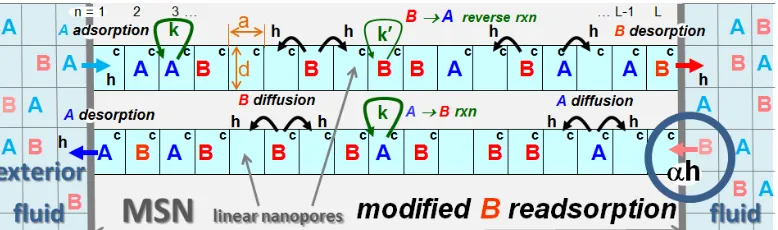
In this model (Fig.1), species within pores are localized to cells on a 1D lattice traversing the pore. The cell width “a” is ~1 nm. To describe the surrounding fluid, we extend the 1D lattice to a 3D lattice outside the pore. We specify external reactant and product concentrations in the surrounding fluid as <Ao> and <Bo>. These give the probabilities that cells on the 3D lattice are
occupied, where fluid cell occupation is assumed random due to efficient stirring. Note that <Xo> = <Ao> + <Bo> is constant, and F = <Bo>/<Xo> gives the fractional conversion. SFD
[image:5.612.98.487.414.529.2]within the pores corresponds to A and B hopping only to adjacent empty (E) sites at rate h. SFD applies in the reasonable scenario where, e.g., the effective pore diameter, d, is ~1.5 nm, and the effective linear diameters of reactants and products are around ~0.75 nm or above.
Figure 1. Schematic of the CG reaction-diffusion model illustrating processes within linear pores (light blue), as well as indicating the surrounding fluid. ‘c’ denote catalytic sites.
Other mechanistic steps are [6]: (i) Adsorption of external species at terminal sites of the pore at rate h<Ao> (αh<Bo>) for A (B), provided that these end sites are unoccupied or empty
(E); α is the key parameter capturing product-pore interaction with α<1 (α>1) corresponding to unfavorable (favorable) interaction. (ii) Desorption of A or B from terminal sites at rate h when the fluid cell just outside the pore is unoccupied (which has probability <Eo> = 1 - <Xo>); (iii)
Conversion A → B at catalytic (c) sites within the pore at rate k, and B → A at rate k′; in our modeling, c-sites occupy the entire pore. The equilibrium fractional conversion is given by Feq =
Keq/(Keq + α) [6]; Keq = k/k′ is the equilibrium constant for the reaction inside the pore. Thus,
Sites within the pore(s) are labeled by n=1, 2,…, L, for a pore of length La. An exact description of our model is provided by the hierarchical master equations for the evolution of probabilities of various configurations within the pore [6,7]. Here, <Cn> denotes the probability
for species C = A or B at site n, <CnEn+1> for the pair probability that C is at site n and for site
n+1 to be empty (E), etc. One has for 1<n<L that [6,7]
d/dt <An> = -k<An> +k′<Bn> - ∇JAn→n+1, d/dt <Bn> = +k<An> -k′<Bn> - ∇JBn→n+1, (1)
with separate equations for terminal sites reflecting adsorption-desorption boundary conditions. In (1), we have defined the discrete derivative, ∇Kn = Kn – Kn-1. The net flux of A from site n to
n+1 is given by JAn→n+1 = h[<AnEn+1> - <EnAn+1>], and the net flux, JBn→n+1, of B is analogous.
In this model, <Xn> = <An> + <Bn> = <Xo> is constant in the steady-state [6,7]. Simple MF
factorization, <CnEn+1> ≈ <Cn><En+1> = <Cn><Eo> neglecting correlations, produces a closed set
of discrete reaction-diffusion equations (dRDE) for concentrations with, e.g., JAn→n+1(MF) =
-h<Eo>∇<An> greatly overestimating the SFD flux. Our precise “generalized hydrodynamic”
(GH) theory replaces this expression with JAn→n+1(GH) = -Dtr(n)∇<An> for a suitable GH tracer
diffusion coefficient, Dtr(n) < h, which is enhanced near pore openings and which vanishes for
SFD deep inside the pore [7]. The net rate of production of B is Rnet = ∑n (k<An> - k′<Bn>).
Stochastic Bimolecular A+c ↔ B+d Reaction-Diffusion Model
This model mimics bimolecular esterification reactions. In our model, “large” species A and B are subject to SFD within the pore, but “small” species have essentially unrestricted diffusion. A and B occupy a 1D lattice of cells within the pore and undergo SFD as above. For simplicity, we regard c and d as occupying a separate 1D lattice of cells, parallel to that on which A and B reside, with sites again labeled by n, and which can at most contain one species.
Unrestricted diffusion of c and d can be implemented by allowing exchange of adjacent species with rate h, in addition to hopping to adjacent empty sites. This type of model applies in the scenario where, e.g., the effective pore diameter is ~1.5 nm, and the effective linear diameters of larger reactants and products are around ~0.75 nm, and of smaller species (like H2O) are ~0.2
nm. 1D lattices are extended to 3D outside the pore as above. We specify concentrations <Ao>,
<Bo>, <co>, and <do> outside the pore, where <Xo> = <Ao> + <Bo> and <xo> = <co> + <do> are
constant. We consider only <Ao> = <co> and <Bo> = <do> and define fractional conversion F =
<Bo>/<Xo>. Adsorption and desorption are treated analogous to above modifying the adsorption
rate for either B or d by a factor of α. Forward (reverse) reaction rates are again denoted by k (k′) with Keq = k/k′. The equilibrium fractional conversion is now given by Feq = √Keq/(√Keq + √α).
Using a natural site concentration notation, we set Rn = +k<An><cn> - k′<Bn><dn>, neglecting
any weak spatial correlations for c and d. Then, for concentrations at site n, one has
d/dt <An> = -Rn - ∇JAn→n+1, d/dt <cn> = -Rn - ∇Jcn→n+1, (2a)
d/dt <Bn> = +Rn - ∇JBn→n+1, d/dt <dn> = +Rn - ∇Jdn→n+1, (2b)
for 1<n<L, with separate equations for terminal sites reflecting adsorption-desorption boundary conditions. JA,Bn→n+1 can be accurately represented by GH expressions, and one has that Jcn→n+1 =
-h∇<cn> and Jdn→n+1 = -h∇<dn>.The net rate of production of product is given by Rnet = ∑n Rn.
SIMULATION RESULTS FOR CONVERSION REACTIONS IN LINEAR NANOPORES Stochastic Unimolecular A ↔ B Reaction-Diffusion Model
Fig.2 compares steady-state concentration profiles for <An> and <Bn> versus n with SFD
reaction (F = 0, with any α), and for F/Feq = 0.625 with α = 0,1,5. KMC profiles (shown) match
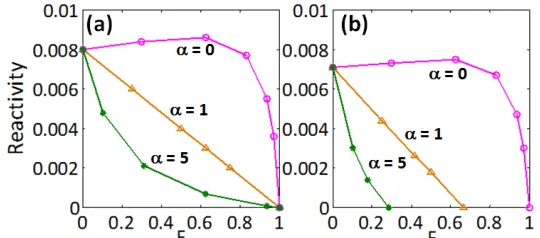
GH profiles [6]. Fig.3 compares the dependence of Rnet on conversion, F, for α = 0 (blocked
[image:7.612.80.538.182.295.2]product reentry), 1 (neutral), and 5 (enhanced reentry). The shift in equilibrium is clear for the reversible case (right), but a dramatic enhancement in reactivity occurs for α = 0 even for irreversible reaction (left). This is due to kinetic factors: blocking product reentry to the pore reduces the total concentration within the pore which enhances adsorption, but more dramatically enhances diffusion which is severely restricted at high concentrations due to the SFD constraint.
Figure 2. Steady-state concentration profiles from KMC for L = 100, k = 0.001, h = 1, <Xo> =
0.8. Left a,b (Right c,d): irreversible (reversible) reaction. <A> (<B>) is blue, solid (red, dashed).
Figure 3. Net reaction rate Rnet vs. conversion F: (a) irreversible; (b) reversible reaction Keq=2.
Behavior is shown for blocked product reentry (α=0), neutral (α=1) and enhanced (α=5) entry. Stochastic Bimolecular A+c ↔ B+d Reaction-Diffusion Model
Fig.4a shows steady-state concentration profiles at the onset of reversible reaction (k′= 1/4 k) with F=0 for any α. Profiles for c ≈ <co> and d ≈ <do> are nearly constant due to efficient
diffusion within the pore. Fig.4b,c compares the dependence of Rnet on conversion, F, for
blocked product reentry of B (αB=0) or d (αd=0), neutral reentry (α=1), and enhanced reentry
αB=5 or αd=5. The shift in equilibrium is clear for the reversible case (c), and reactivity is
enhanced for α=0 even for irreversible reaction (b). This is due to kinetic factors: blocking product reentry to the pore reduces the total concentration within the pore which enhances adsorption and diffusion. Enhancement is greatest if the blocked product is B (not d) noting the feature that B undergoes SFD inside the pore with respect to A, but diffusion of d is unrestricted.
CONCLUSIONS
[image:7.612.101.371.341.460.2]the pore interior unfavorable to the product (in the extreme case, blocking product reentry) can strongly enhance reactivity both by shifting reaction equilibrium and due to kinetics factors. These features apply for both unimolecular and bimolecular conversion reactions. Our modeling is motivated by comparative studies of the reaction of heptanoic acid and 3-phenylpropionic acid with benzyl alchohol to form an ester plus water in catalytically-functionalized MSN with and without PFP [4]. Addition of PFP enhances yield by a factor of 2-3 due to inhibiting pore reentry by the product H2O, thereby shifting reaction equilibrium towards completion. This enhancement
is compatible with the behavior seen in our simplified modeling for bimolecular reactions, although we note that the system-specific features of the experimental system are not included.
Figure 4. (a) GH concentration profiles for reversible reaction Keq=4, with F=0 (α independent).
Net reaction rate Rnet versus conversion F: (b) irreversible; (c) reversible (Keq=4) reaction.
Behavior is compared for blocked reentry of B or d (αB=0 or αd=0), neutral reentry (α=1), and
enhanced (αB=5 or αd=5) entry of B or d. We set L=100, k = 0.001, h = 1, <Xo> = <xo> = 0.8.
This work was supported by the Division of Chemical Sciences, Office of Basic Energy Sciences, U.S. Department of Energy (USDOE). It was performed at Ames Laboratory which is operated for the USDOE by Iowa State University under Contract No. DE-AC02-07CH11358.
REFERENCES
1. K. Tajima and T. Aida, Nanostructured Catalysts, Plenum, New York, 2003.
2. S. Huh, J.W. Wiench, J.-C. Woo, M. Pruski, and V.S.-Y. Lin, Chem. Mater. 15, 4247 (2003). 3. T.E. Harris, J. Appl. Prob. 2, 323 (1965).
4. C.-H. Tsai, H.-T. Chen, S.M. Althaus, K. Mao, T. Kobayashi, M. Pruski, and V.S.-Y. Lin, ACS Cat. 1, 729 (2011).
5. I.S. Mbaraka and B.H. Shanks, J. Catalysis 229, 365 (2005).
6. J. Wang, D.M. Ackerman, V.S.-Y. Lin, M. Pruski, and J.W. Evans, J. Chem. Phys, 138, 134705 (2013).
7. D.M. Ackerman, J. Wang, and J.W. Evans, Phys. Rev. Lett. 108, 228301 (2012). 8. T.S. Gulmen and W.H. Thompson, MRS Symp. Proc. 889E, 0899-N06-05.1 (2006). 9. Y. Tu, J. Tersoff, G. Grinsetin, and D. Vanderbilt, Phys. Rev. Lett. 81, 4899 (1998).
10. C. Schumacher, J. Gonzalez, P. Wright, and N.A. Seaton, J. Phys. Chem. B 110, 319 (2006). 11. S. Nedd, T. Kobayashi, C.-H. Tsai, I.I. Slowing, M. Pruski, and M.S. Gordon, J. Phys. Chem. C 115, 16333 (2011).