A Generative Model for Identifying Target Companies of Microblogs
Yeyun Gong, Yaqian Zhou, Ya Guo, Qi Zhang, Xuanjing Huang
Shanghai Key Laboratory of Intelligent Information Processing School of Computer Science, Fudan University
825 Zhangheng Road, Shanghai, P.R.China
{12110240006, zhouyaqian, 13210240002, qz, xjhuang}@fudan.edu.cn
Abstract
Microblogging services have attracted hundreds of millions of users to publish their status, ideas and thoughts, everyday. These microblog posts have also become one of the most attractive and valuable resources for applications in different areas. The task of identifying the main targets of microblogs is an important and essential step for these applications. In this paper, to achieve this task, we propose a novel method which converts the target company identification problem to the translation process from content to targets. We introduce a topic-specific generative method to model the translation process. Topic specific trigger words are used to bridge the vocabulary gap between the words in microblogs and targets. We examine the effectiveness of our approach via datasets gathered from real world microblogs. Experimental results demonstrate a 20.2% improvement in terms of F1-score over the state-of-the-art discriminative method.
1 Introduction
With the rapid growth of social media, about 72% of adult internet users are also members of a social networking site1. Over the past few years, microblogging has become one of the most popular services. Meanwhile, microblogs have also been widely used as sources for analyzing public opinions (Bermingham and Smeaton, 2010; Jiang et al., 2011), prediction (Asur and Huberman, 2010; Bollen et al., 2011), reputation management (Pang and Lee, 2008; Otsuka et al., 2012), and many other applications (Bian et al., 2008; Sakaki et al., 2010; Becker et al., 2010; Guy et al., 2010; Lee and Croft, 2013; Guy et al., 2013). For most of these applications, identifying the microblogs that are relevant to the targets of interest is one of the basic steps (Lin and He, 2009; Amig´o et al., 2010; Qiu et al., 2011; Liu et al., 2013). Let us firstly consider the following example:
Example 1:11” MacBook Air can run for up to five hours on a single charge.
“MacBook Air” can be considered to be the target being discussed on the microblog, and we can also infer from the microblog that it is related to Apple Inc. The ability to discriminate which company is being referred to in a microblog is required by many applications.
Previous studies on fine-grained sentiment analysis and aspect-based opinion mining proposed supervised (Popescu and Etzioni, 2005; Liu et al., 2012a; Liu et al., 2013) and unsupervised methods (Hu and Liu, 2004; Wu et al., 2009; Zhang et al., 2010) to extract targets of opinion expressions. Based on the associations between opinion targets and opinion words, some methods were also introduced to simultaneously solve the opinion expression and target extraction problems (Qiu et al., 2011; Liu et al., 2012a). However, most of the existing methods in this area only focus on extracting items about which opinions are expressed in a given domain. The implicated information of targets is rarely considered. Moreover, domain adaptation is another big challenge for these fine-grained methods in processing different domains.
This work is licenced under a Creative Commons Attribution 4.0 International License. Page numbers and proceedings footer are added by the organizers. License details:http://creativecommons.org/licenses/by/4.0/
1It is reported by the Pew Research Center’s Internet & American Life Project in Aug 5, 2013.
The WePS-32(Amig´o et al., 2010) and RepLab 20133(Amig´o et al., 2013) evaluation campaigns also addressed the problem from the perspective of the disambiguation of company names in microblogs. Microblogs that contain company names at a lexical level are classified based on whether it refers to the company or not. Various approaches have been proposed to address the task with different methods (Pedersen et al., 2006; Yerva et al., 2010; Zhang et al., 2012; Spina et al., 2012; Spina et al., 2013). However, the microblogs that do not contain company names cannot be correctly processed using these methods. From analyzing the data, we observe that a variety of microblog posts belong to this type. They only contain products names, slang terms, and other related company content.
To achieve this task, in this paper, we propose the use of a translation based model to identify the targets of microblogs. We assume that the microblog posts and targets describe the same topic using different languages. Hence, the target identification problem can be regarded as a translation process from the content of the microblogs to the targets. We integrate latent topical information into the translation model to facilitate the translation process. Because product names, series, and other related information are important indicators for this task, we also incorporate this background knowledge into the model. To evaluate the proposed method, we collect a large number of microblogs and manually annotate a subset of these as golden standards. We compare the proposed method with state-of-the-art methods using the constructed dataset. Experimental results demonstrate that the proposed approach can achieve better performance than the other approaches.
2 The Proposed Method 2.1 The Generation Process
Given a corpus D = {di,1≤i≤ |D|}, which contains a list of microblogs {di}. A microblog is a sequence ofNdwords denoted bywd={wd1, wd2, ..., wdNd}. Each microblog contains a set of targets
denoted bycd = {cd1, cd2, ..., cdMd}. A word is defined as an item from a vocabulary withV distinct
words indexed byw={w1, w2, ..., wV}. Thenth word in thedth microblog is associated with not only one topiczdn, but also an indicator variableldn which indicates whether wdn belongs to the ontology
(ldn = 1), which contains company names, product names, series, and other related information, or is a
common word (ldn = 0). Each target is from the vocabulary withCdistinct company names indexed by
c ={c1, c2, ..., cC}. Themth target in thedth microblog is associated with a topiczdm. The notations
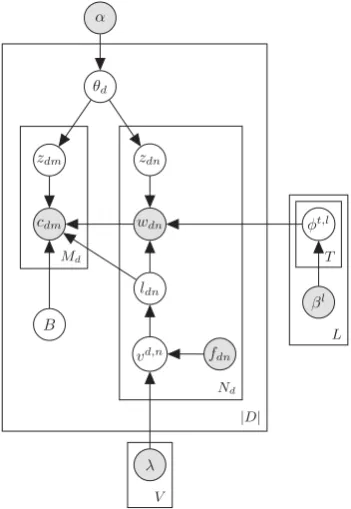
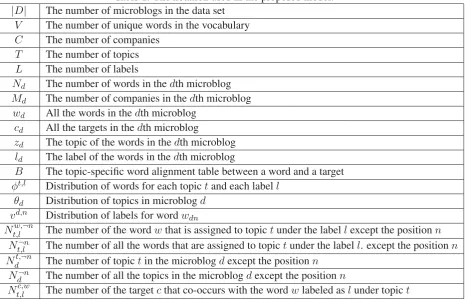
used in this paper are summarized in Table 1. Fig. 1 shows the graphical representation of the generation process. The generative story for each microblog is as follows:
1. Sample word distributionφt,lfromDir(βl)for each topict= 1,2, ..., Tand each labell= 1, ..., L.
2. For each microblog d=1,2,...,|D|
a. Sample topic distributionθdfromDir(α)
b. For each wordn= 1,2, ..., Nd
i. Sample a topiczdn=tfromMultinomial(θd)
ii. Sample a labelldn=lfrom the distribution over labels,vd,n
iii. Sample a wordwaccording to multinomial distributionP(wdn =w|zdn =t, ldn =l, φt,l)
c. For each targetm= 1,2, ..., Md
i. Sample a topiczdm=tfromMultinomial(θd)
ii. Sample a targetcdm=caccording to probabilityP(cdm=c|wd, ld, zdm=t, B)
As described above, we useldnto incorporate the ontology information into the model. In this work,
we construct an ontology which contains 4,926 company names, 7,632 abbreviations, and 26,732 product names. These companies names are collected based on the top search queries in different categories4. We propose to use the distributionvd,nto indicate the probability of variablel
dn. We setvd,nby applying
2http://nlp.uned.es/weps/weps-3
wdn
Figure 1: The graphical representation of the proposed model. Shaded circles are observations or constants. Unshaded ones are hidden variables.
various sources of ontology (presented byλ) and the context features of the wordwdn(presented byfdn).
In this work, we only consider the word itself as its context feature. This information is encoded into the hyperparameters {λw|w ∈ {w1, w2, ..., wV}}, where λw is hyperparameter for the word w, and λw
0 +λw1 = 1. For each wordwin the ontology, we setλw1 to a value 0.9,λw0 to a value 0.1. For each
wordwnot contained by ontology, we setλw
1 to a value 0 andλw0 to a value 1. Based on the ontology, vd,ncould be set as follows:
P(ldn=l|wdn=w) =vld,n= λ
We use collapsed Gibbs sampling (Griffiths and Steyvers, 2004) to obtain samples of hidden variable assignment and to estimate the model parameters from these samples.
On the microblog content side, the conditional probability of a latent topic and label for thenth word in thedth microblog is:
P r(zdn =t, ldn =l|wdn =w,w¬n,z¬n,l¬n)∝ λ
number of all the words that are assigned to topictunder the labell;Ndt,¬nis the number of topictin the microblogd;N¬n
d is the number of all the topics in the documentd;¬nindicates taking no account
of the current positionn.
Given the conditional probability ofzdn=t, ldn=l, we formalize the marginal probability ofzdn=t
Table 1: The notation used in the proposed model.
|D| The number of microblogs in the data set
V The number of unique words in the vocabulary
C The number of companies
T The number of topics
L The number of labels
Nd The number of words in thedth microblog Md The number of companies in thedth microblog
wd All the words in thedth microblog cd All the targets in thedth microblog
zd The topic of the words in thedth microblog ld The label of the words in thedth microblog
B The topic-specific word alignment table between a word and a target
φt,l Distribution of words for each topictand each labell θd Distribution of topics in microblogd
vd,n Distribution of labels for wordwdn
Nt,lw,¬n The number of the wordwthat is assigned to topictunder the labellexcept the positionn N¬n
t,l The number of all the words that are assigned to topictunder the labell. except the positionn Ndt,¬n The number of topictin the microblogdexcept the positionn
N¬n
d The number of all the topics in the microblogdexcept the positionn
Nt,lc,w The number of the targetcthat co-occurs with the wordwlabeled aslunder topict
After re-assigning the topiczdn = tfor the current word, the conditional probability of ontology label for thenth word in thedth microblog is:
On the target side, we perform topic assignments for each target as follows:
P r(zdm =t|cdm=c,c¬m,w,l,z¬m)∝
t,ldn is the number of the companycthat
co-occurs with the wordwdnlabeled asldnunder topict;γCis a smoothing part;Nt,lwdndnis the number of
the wordwdnlabeled asldnunder topict;Ndt,¬mis the number of occurrences of topictin the document d;N¬m
d is the number of occurrences of all the topics in the documentd;¬mindicates taking no account
of the current positionm.
Based on the above equations, after enough sampling iterations, we can estimate word alignment table
B, Bc,w,t,l = δl N
c,w t,l
Nw
t,l+γC. Some companies just occur few times, and most of the words co-occur with
them also alignment with other companies, for this case, we useγC to smooth, whereCrepresent the number of company c. And also we can estimate topic distribution θ for each document, and word distributionφfor each topic and each label, as follows:
θtd= Ndt+α
employ a linear interpolation with topic-free word alignment probability to avoid data sparsity problem:
B∗c,w,t,l=σBc,w,t,l+ (1−σ)P(c|w), (6)
whereP(c|w) is topic-free word alignment probability between the word wand the company c. σ is trade-off of two probabilities ranging from 0.0 to 1.0.
2.3 Target Company Extraction
Just like standard LDA, the proposed method itself finds a set of topics but does not directly extract targets. Suppose we have a dataset which contains microblogs without targets, we can use the collapsed Gibbs sampling to estimate the topic and label for the words in each microblog. The process is the same as described in Section 3.2.
After the hidden topics and label of the words in each microblog become stable, we can estimate the distribution of topics for thedth microblog by:P(t|wd) =θdt = N
t d+α
Nd+T α. With the word alignment table
B∗, we can rank companies for thedth microblog in unlabeled data by computing the scores:
P r(cdm|wd)∝ T
t=1 Nd
n=1
P(cdm|t, wdn, ldn, B∗)·P(t|wd)P(wdn|wd), (7)
where P(wdn|wd) is the weight of the wordwdn in the microblog content wd. In this paper, we use
inverse document frequency (IDF) score to estimate it. Based on the ranking scores calculated by Eq.(7), we can extract the top-ranked targets for each microblog to users.
3 Experiments
In this section, we will introduce the experimental results and datasets we constructed for training and evaluation. We will firstly describe the how we construct the datasets and their statistics. Then we will introduce the experiment configurations and baseline methods. Finally, the evaluation results and analysis will be given.
3.1 Datasets
We started by using Sina Weibo’s API5to collect public microblogs from randomly selected users. The dataset contains 282.2M microblogs published by 1.1M users. We useRAW-Weiboto represent it in the following sections. Based on the collected raw microblogs, we constructed three datasets for evaluation and training.
3.1.1 Training data
Since social media users post thoughts, ideas, or status on various topics in social medias, there are a huge number of related companies. Manually constructing training data is a time consuming and cost process. In this work, we propose a weakly manual method based on ontology and hashtag. A hashtag is a string of characters preceded by the symbol#. In most cases, hashtags can be viewed as an indication to the context of the tweet or as the core idea expressed in the tweet. Hence, we can use hashtag as the targets.
We extract the microblogs whose hashtags contain ontology items as training data and the corresponding ontology items as targets. Obviously, the training data constructed based on this method is not perfect. However, since this method can effectively generate a great quantity of data, we think that general characteristics can be modeled with the generated training data. To evaluate the corpus, we randomly selected 100 microblogs from the training data and manually labeled their targets. The accuracy of the sampled dataset is 91%. It indicates that the proposed training data generation method is effective. From theRAW-Weibo dataset, we extracted a total of 1.79M microblogs whose hashtags contain more than one target. Training instances for 2,574 target companies are included in the training data.
3.1.2 Test data
For evaluation, we manually constructed a datasetRAN-Weibo, which contains 2,000 microblogs selected fromRAW-Weibo. Three annotators were asked to label the target companies for each microblog. To evaluate the quality of annotated dataset, we validate the agreements of human annotations using Cohen’s kappa coefficient. The average κ among all annotators is 0.626. It indicates that the annotations are reliable.
Since some targets are ambiguous, inspired by the evaluation campaigns WePS-3 and RepLab 2013, we also constructed a datasetAMB-Weibo, where microblogs include 10 popular company names which may cause ambiguity. For each target, we randomly selected and annotated 200 microblogs as golden standards. Three annotators were also asked to label whether the microblog is related the given target or not. The agreements of human annotations were also validated through Cohen’s kappa coefficient. The averageκamong all annotators is 0.692.
3.2 Experiment Configurations
We use precision (P), recall (R), and F1-score (F1) to evaluate the performance. We ran our model
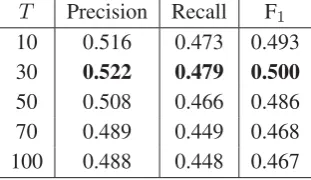
with 500 iterations of Gibbs sampling. We use 5-fold cross-validation in the training data to optimize hyperparameters. The number of topics is set to 30. The other settings of hyperparameters are as follows:
α= 50/T,β = 0.1,δ= 20,γ = 0.5. The smoothing parameterσis set to 0.8. For baselines, we compare the proposed model with the following baseline methods.
• Naive Bayes (NB): The target identification task can be easily formalized as a classification task, where each target is considered as a classification label. Hence, we applied Naive Bayes to model the posterior probability of each target given a microblog.
• Support Vector Machine (SVM): The content of microblogs are represented as vectors and SVM is used to model the classification problem.
• IBM1: Translation model (IBM model-1) is applied to obtain the alignment probability between words and targets.
• TTM: Topical translation model (TTM) was proposed by Ding et al. (2013) to achieve microblog hashtag suggestion task. We adopted it to estimate the alignment probability between words and targets.
3.3 Experimental Results
We evaluate the proposed method from the following perspectives: 1) comparing the proposed method with the state-of-the-art methods on the two evaluation datasets; 2) identifying the impacts of parameters. Table 2 shows the comparisons of the proposed method with the state-of-the-arts discriminative and generative methods on the evaluation dataset RAN-Weibo. “Our” denotes the method proposed in previous sections. “Our w/o BG” represents the proposed method without background knowledge. From the results, we can observe that the proposed method is better than other methods. Discriminative methods achieve worse results than generative methods. We think that the large number of targets is one of the main reasons of the low performances. The results of the proposed models with and without ontology information also show that background knowledge can benefit both the precision and recall. TTM achieves better performance than IBM1. It indicates that topical information is useful for this task. The performances of our method are significantly better than TTM. It illustrates that our smoothing method and incorporation of background knowledge are effective.
Table 2: Evaluation results of NB, SVM, IBM1, TTM, and our method on the evaluation dataset RAN-Weibo.
Methods Precision Recall F1
NB 0.168 0.154 0.161
SVM 0.312 0,286 0.298
IBM1 0.236 0.214 0.220
TTM 0.356 0.327 0.341
Our w/o BG 0.488 0.448 0.467 Our 0.522 0.479 0.500
Table 3: The influence of the number of topicsT of the proposed method.
T Precision Recall F1
10 0.516 0.473 0.493 30 0.522 0.479 0.500 50 0.508 0.466 0.486 70 0.489 0.449 0.468 100 0.488 0.448 0.467
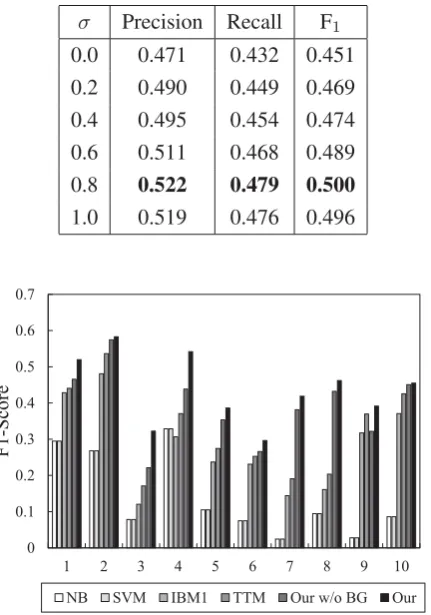
estimating topic-specific translation probability. Table 4 shows the influence of the translation probability smoothing parameterσ. Whenσis set to0.0, it means that the topical information is omitted. Comparing the results ofσ = 0.0and other values, we can observe that the topical information can benefit this task. Whenσis set to1.0, it represents the method without smoothing. The results indicate that it is necessary to address the sparsity problem through smoothing.
Figure 2 shows the results of different methods on the datasetAMB-Weibo. All the models are trained with same dataset as the above experiments. From the results, we can observe that the F1-scores vary from less than 0.40 up to almost 0.60. The performances’ variations of other methods are also huge. We think that training data size and difficulty level are two main reasons. The size of training data of different targets vary greatly in the dataset. However, comparing with other method, the proposed method is the most stable one. Comparing with other methods, the proposed method achieves better performance than other methods for all targets.
4 Related Work
Organization name disambiguation task is fundamental problems in many NLP applications. The task aims to distinguish the real world relevant of a given name with the same surface in context. WePS-36(Amig´o et al., 2010) and RepLab 20137(Amig´o et al., 2013) evaluation campaigns have also addressed the problem from the perspective of disambiguation organization names in microblogs. Pedersen et al. (2006) proposed an unsupervised method for name discrimination. Yerva et al. (2010) used support vector machines (SVM) classifier with various external resources, such as WordNet, metadata profile, category profile, Google set, and so on. Kozareva and Ravi (2011) proposed to use latent dirichlet allocation to incorporate topical information. Zhang et al. (2012) proposed to use adaptive method for this task. However, most of these methods focused on the text with predefined surface words. The documents which do not contain organization names or person names can not be well processed by these methods.
To bridge the vocabulary gap between content and hashtags, Liu et al. (2012b) proposed to use translation model to handle it. They modeled the tag suggestion task as a translation process from
6http://nlp.uned.es/weps/weps-3
Table 4: The influence of the smoothing parameterσof the propose method.
σ Precision Recall F1
0.0 0.471 0.432 0.451 0.2 0.490 0.449 0.469 0.4 0.495 0.454 0.474 0.6 0.511 0.468 0.489 0.8 0.522 0.479 0.500 1.0 0.519 0.476 0.496
0 0.1 0.2 0.3 0.4 0.5 0.6 0.7
1 2 3 4 5 6 7 8 9 10
F1-Score
NB SVM IBM1 TTM Our w/o BG Our
Figure 2: Evaluation results of NB, SVM, IBM1, TTM, and our method on the different companies in the test datasetAMB-Weibo.
document content to tags. Ding et al. (2013) extended the translation based method and introduced a topic-specific translation model to process the multiple meanings of words in different topics. Motivated by these methods, we also propose to use topic-specific translation model to handle vocabulary problem. Based on the model, in this work, we incorporate the background knowledge information into the model.
5 Conclusions
To identify target companies of microblogs, in this paper, we propose a novel topical translation model to achieve the task. The main assumption is that the microblog posts and targets describe the same thing with different languages. We convert the target identification problem to a translation process from content of microblogs to targets. We integrate latent topical information into translation model to hand the themes of microblogs in facilitating the translation process. We also incorporate background knowledge (such as product names, series, et al.) into the generation model. Experimental results on a large corpus constructed from a real microblog service and a number of manually labeled golden standards of easily ambiguous entities demonstrate that the proposed method can achieve better performance than other approaches.
6 Acknowledgement
References
Enrique Amig´o, Javier Artiles, Julio Gonzalo, Damiano Spina, Bing Liu, and Adolfo Corujo. 2010. Weps3 evaluation campaign: Overview of the on-line reputation management task. In CLEF (Notebook Papers/LABs/Workshops).
Enrique Amig´o, Jorge Carrillo de Albornoz, Irina Chugur, Adolfo Corujo, Julio Gonzalo, Tamara Mart´ın, Edgar Meij, Maarten Rijke, and Damiano Spina. 2013. Overview of replab 2013: Evaluating online reputation monitoring systems. In Information Access Evaluation. Multilinguality, Multimodality, and Visualization, volume 8138 ofLecture Notes in Computer Science, pages 333–352. Springer Berlin Heidelberg.
S. Asur and B.A. Huberman. 2010. Predicting the future with social media. InProceedings of WI-IAT 2010. Hila Becker, Mor Naaman, and Luis Gravano. 2010. Learning similarity metrics for event identification in social
media. InProceedings of WSDM ’10.
Adam Bermingham and Alan F. Smeaton. 2010. Classifying sentiment in microblogs: is brevity an advantage? In Proceedings of CIKM ’10.
Jiang Bian, Yandong Liu, Eugene Agichtein, and Hongyuan Zha. 2008. Finding the right facts in the crowd: factoid question answering over social media. InProceedings of WWW ’08.
Johan Bollen, Huina Mao, and Xiaojun Zeng. 2011. Twitter mood predicts the stock market. Journal of Computational Science, 2(1):1 – 8.
Zhuoye Ding, Xipeng Qiu, Qi Zhang, and Xuanjing Huang. 2013. Learning topical translation model for microblog hashtag suggestion. InProceedings of IJCAI 2013.
Thomas L. Griffiths and Mark Steyvers. 2004. Finding scientific topics. InProceedings of the National Academy of Sciences, volume 101, pages 5228–5235.
Ido Guy, Naama Zwerdling, Inbal Ronen, David Carmel, and Erel Uziel. 2010. Social media recommendation based on people and tags. InProceedings of SIGIR ’10.
Ido Guy, Uri Avraham, David Carmel, Sigalit Ur, Michal Jacovi, and Inbal Ronen. 2013. Mining expertise and interests from social media. InProceedings of WWW ’13.
Minqing Hu and Bing Liu. 2004. Mining opinion features in customer reviews. InProceedings of AAAI’04.
Long Jiang, Mo Yu, Ming Zhou, Xiaohua Liu, and Tiejun Zhao. 2011. Target-dependent twitter sentiment classification. InProceedings of ACL-HLT 2011, Portland, Oregon, USA.
Zornitsa Kozareva and Sujith Ravi. 2011. Unsupervised name ambiguity resolution using a generative model. In Proceedings of the First Workshop on Unsupervised Learning in NLP, EMNLP ’11, pages 105–112, Stroudsburg, PA, USA. Association for Computational Linguistics.
Chia-Jung Lee and W. Bruce Croft. 2013. Building a web test collection using social media. InProceedings of SIGIR ’13, SIGIR ’13.
Chenghua Lin and Yulan He. 2009. Joint sentiment/topic model for sentiment analysis. InProceedings of CIKM ’09.
Kang Liu, Liheng Xu, and Jun Zhao. 2012a. Opinion target extraction using word-based translation model. In Proceedings of EMNLP-CoNLL ’12.
Zhiyuan Liu, Chen Liang, and Maosong Sun. 2012b. Topical word trigger model for keyphrase extraction. In Proceedings of COLING.
Kang Liu, Liheng Xu, and Jun Zhao. 2013. Syntactic patterns versus word alignment: Extracting opinion targets from online reviews. InProceedings of ACL 2013, Sofia, Bulgaria.
Takanobu Otsuka, Takuya Yoshimura, and Takayuki Ito. 2012. Evaluation of the reputation network using realistic distance between facebook data. InProceedings of WI-IAT ’12, Washington, DC, USA.
Ted Pedersen, Anagha Kulkarni, Roxana Angheluta, Zornitsa Kozareva, and Thamar Solorio. 2006. An unsupervised language independent method of name discrimination using second order co-occurrence features. InComputational Linguistics and Intelligent Text Processing, pages 208–222.
Ana-Maria Popescu and Oren Etzioni. 2005. Extracting product features and opinions from reviews. In Proceedings of HL-EMNLP 2005, Vancouver, British Columbia, Canada.
Guang Qiu, Bing Liu, Jiajun Bu, and Chun Chen. 2011. Opinion word expansion and target extraction through double propagation. Comput. Linguist., 37(1):9–27, March.
Takeshi Sakaki, Makoto Okazaki, and Yutaka Matsuo. 2010. Earthquake shakes twitter users: real-time event detection by social sensors. InProceedings of the 19th international conference on World wide web, WWW ’10, pages 851–860, New York, NY, USA. ACM.
Damiano Spina, Edgar Meij, Maarten de Rijke, Andrei Oghina, Minh Thuong Bui, and Mathias Breuss. 2012. Identifying entity aspects in microblog posts. InProceedings of SIGIR ’12.
Damiano Spina, Julio Gonzalo, and Enrique Amig´o. 2013. Discovering filter keywords for company name disambiguation in twitter. Expert Systems with Applications, 40(12):4986 – 5003.
Yuanbin Wu, Qi Zhang, Xuangjing Huang, and Lide Wu. 2009. Phrase dependency parsing for opinion mining. InProceedings of EMNLP 2009, Singapore.
Surender Reddy Yerva, Zoltn Mikls, and Karl Aberer. 2010. It was easy, when apples and blackberries were only fruits. In Martin Braschler, Donna Harman, and Emanuele Pianta, editors, CLEF (Notebook Papers/LABs/Workshops).
Lei Zhang, Bing Liu, Suk Hwan Lim, and Eamonn O’Brien-Strain. 2010. Extracting and ranking product features in opinion documents. InProceedings of COLING ’10.