*Correspondence: Cellular and Molecular Biology Research Center, Health Research Institute, Babol University of Medical Sciences, Babol,
Iran. E-mail:[email protected]
IBBJ
Summer 2016, Vol 2, No 3
Can Allergic Disorders Decrease the Risk of
Thromboembolic Events in Atherosclerosis?
an Evidence-based Review
Ahmad Karkhah
1, 2*, Ebrahim Zabihi
1, Forough Ebrahimtabar
2,
Tahereh Babajani Roshan
21.
Cellular and Molecular Biology Research Center, Health Research Institute, Babol University of MedicalSciences, Babol, Iran.
2.Student Research Committee, Babol University of Medical Sciences, Babol, Iran.
Submitted 17 Oct 2016; Accepted 24 Nov 2016; Published 10 Dec 2016
Atherosclerosis is a complex inflammatory disorder of the medium and large-sized arteries. Recent experiments demonstrated that atherosclerosis is a Th1 dominant autoimmune condition, whereas Th2 cells are rarely detected within the atherosclerotic lesions. Several studies have indicated that Th2 type cytokines could be effective in the reduction and stabilization of atherosclerotic plaque. Therefore, modulation of the adaptive immune response by shifting immune responses toward Th2 cells could represent a promising approach to prevent from progression and thromboembolic events in coronary artery disease. Since Th2-mediated immune response is mostly implicated in asthma and most allergic disorders, this evidence-based review will discuss how asthma and other Th2-mediated allergic disorders can decrease the risk of thromboembolic events in atherosclerotic patients with focus on the suggested immune mechanisms.
Keywords: Atherosclerosis, allergic disorders, Th1/Th2 balance, atheroprotection
therosclerosis is an autoimmune disorder of arterial wall characterized by the formation of inflammatory lesions, which consist of many components of innate and adaptive immune systems including infiltrating T cells, macrophages, smooth muscles, cytokines, growth factors, and other pro-inflammatory mediators (1-2). According to the World Health Organization (WHO) reports, coronary atherosclerosis disease is the first cause of death in the world (3). Atherosclerosis has
traditionally been assumed as a simple deposition of lipids within the walls of the medium and large-sized arteries. It is now considered as a complex endothelial dysfunction induced by various risk factors such as elevated and modified low-density lipoproteins (LDL), free radicals, infectious microorganisms, hypertension and smoking (4-5). These risk factors increase oxidative stress in vascular cells and intensify the upregulation of cellular adhesion molecules expression, which in
A
Mini Review
Int. Biol. Biomed. J. Summer 2016; Vol 2, No 3 92 turn facilitate the adherence and infiltration of
leukocytes to the dysfunctional endothelium and subsequently into the arterial wall (6). In this review we considered the inflammatory aspect of atherosclerosis development.
Adaptive T cell immunity and
atheros-clerosis
Accumulated evidence have revealed a potential role for T helper (Th) cells in the progression of the atherosclerotic plaque (7). Th cells are usually classified functionally into Th1 and Th2 subtypes based on the different patterns in cytokine production. Although both Th1 and Th2 cellular immune responses are responsible for different types of protection in human body, dysregulation in homeostasis of Th1/Th2 activity leads to several immunopathological disorders such as atherosclerosis (8). In atherosclerosis as a Th1 dominant autoimmune disease, the Th1 cells produce various pro-inflammatory cytokines including IFN-γ, interleukin (IL) 2 and tumor necrosis factor (TNF) which play pivotal roles in the
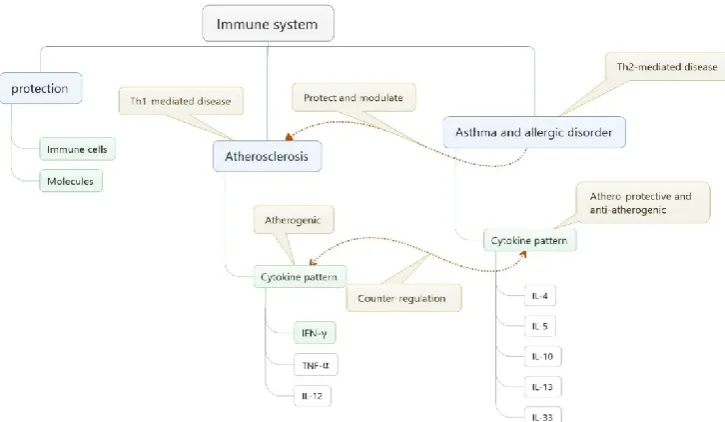
initiation and progression of atherosclerosis (9-10). Several studies demonstrated that pro-inflammatory Th1-related cytokines levels in serum are positively correlated to the severity of atherosclerosis disease. In particular, high circulating levels of IFN-γ and TNF-α are predictors of the incident coronary and cardiovascular events. Interestingly, Th2-mediated immune responses which are rarely detected within the atherosclerotic lesions could strongly neutralize pro-atherogenic and pro-inflammatory effects of Th1- mediated immune response and consequently improve atherosclerosis. Moreover, it is well-established that Th2 type cytokines such as 4, IL-5, IL-10 and IL-13 can inhibit the development of atherosclerosis (11-13). Taken together, the modulation of the adaptive immune response by maintaining an immunological balance between Th1 and Th2 immune responses or by shifting immune response properly toward Th2 cells could introduce new therapeutic approaches to prevent or decrease the risk of cardiovascular events in patients with coronary atherosclerotic disease (figure 1).
Figure 1. Atherogenic and atheroprotective immune responses.The inflammatory activity in atherosclerotic plaques is dependent on the balance between pro-inflammatory and anti-inflammatory immune responses.
93 Int. Biol. Biomed. J. Summer 2016; Vol 2, No 3
Allergic disorders as a protective factor
in atherosclerosis: a novel
immunol-ogical-based hypothesis
In this review, we suggest that asthma and other Th2-mediated allergic disorders can decrease the risk of thromboembolic events in atherosclerotic patients by balancing the Th1 and Th2 immune responses and also their related circulating cytokines (figure 2). Relatively, Th2-mediated immune response could potentiate the inhibition of the development of atherosclerosis and as asthmatic and allergic patients have elevated circulating levels of Th2- related cytokines as well as IL-33 in comparison with non-allergic subjects, this condition could be beneficial in the reduction and stabilization of atherosclerotic plaque. In addition, it is also suggested that the risk of thromboembolic events in healthy subjects without coronary atherosclerosis disease suffering from asthma and allergic disorders might be lower than other people.
Atheroprotective potential of allergic
disorders in atherosclerosis: current
immune mechanisms
During the last decade, it was suggested that reduced microbial exposure in early life as a result of improved hygiene leads to a Th1/Th2 dichotomy and immunological shift toward a Th2 instead of the Th1 immune response (14). Many investigations confirm that Th2 lymphocytes are presently considered as a central orchestrator in allergic disorders and asthma. Activated Th2 lymphocytes produce various cytokines including 4, 5, IL-9, IL-10 and IL-13 which are involved in IgE production by B cells, eosinophil activation /recruitment and mucus production (15-16). There are many studies indicating that Th2-related cytokines have both anti-atherogenic and atheroprotective roles and can also inhibit the development of atherosclerosis (10, 17-18). IL-4 is an important Th2-secreted cytokine which is involv-
Figure 2. Schematic diagram of related immune mechanisms suggesting atheroprotective potential of asthma and allergic disorders in atherosclerosis.
S
Int. Biol. Biomed. J. Summer 2016; Vol 2, No 3 94 ed in Th2 cells differentiation. IL-4 also down
regulates the expression of IFN-γ. Some studies have indicated that IFN-γ inhibits cell proliferation of the vascular smooth muscles, reduces collagen production and also upregulates the expression of matrix metalloproteinases (MMPs) leading to thinning and instability of the atherosclerotic plaque (13, 19). Therefore, down regulation of IFN-γ expression by IL-4 may reduce the risk of plaque rupture. In addition, IL-4 inhibits the production of most MMPs from macrophages which have crucial role in digesting the fibrous cap of coronary atherosclerotic plaque and in consequence plaque instability and finally plaque rupture (20-22). In conclusion, high circulating levels of IL-4 in atherosclerotic patients suffering from asthma and other Th2- mediated allergic disorders could down regulate IFN-γ expression and MMPs production which provides more stability in atherosclerotic plaque.
A large body of studies support a substantial anti-inflammatory role for IL-10 in both early and advanced human atherosclerotic plaques. IL-10, mainly secreted by Th2 lymphocytes, is an anti-inflammatory cytokine with potent deactivating properties on both macrophages and T cells (20). IL-10 was reported to downregulate the pro-inflammatory functions of macrophages and also most aspects of their activity including the secretion of matrix degrading enzymes such as MMPs. IL-10 also inhibits many cellular processes which play an important role in plaque progression, rupture and thrombosis including nuclear factor-kB (NF-kB) activation, metalloproteinase production, the synthesis of tissue factor (TF) and the production of thrombin (21, 23-25). Hence, based on mentioned evidence, high circulating levels of IL-10 in asthma and allergic patients could be considered as a preventive factor decreasing the risk of thromboembolic complications in these patients.
Recently, excessive and inappropriate production of IL-33 has been considered to be involved in the development of various disorders such as allergic and asthma diseases. The levels of circulating IL-33 increase in the serum and lung of asthmatic patients in comparison with healthy subjects. Interestingly, Miller et al. have shown that systemic administration of IL-33 reduces the development of atherosclerosis in apolipoprotein E-deficient (ApoE -/-) mice by inducing a Th1 to Th2 shift. They also found that IL-33 significantly increased IL-4, IL-5 and IL-13 levels while interestingly it decreased the level of IFN-γ in serum and lymph node cells of ApoE (-/-) mice (26). Taken together, the high levels of circulating IL-33 in the serum of atherosclerotic patients or healthy subjects having asthma and allergic disorders induce a Th1 to Th2 shift and decrease the level of IFN-γ which both of them have protective and beneficial roles in biology of atherosclerosis.
The immunological balance between Th1- and Th2-type immune responses significantly affects the initiation and progression of numerous inflamm-atory diseases such as atherosclerosis (27). Recent investigations on human and animal models have demonstrated a critical involvement of Th1 immune response in pathogenesis of atherosclerosis (28). Th1 cytokines localize in atherosclerotic plaques of both humans and mice and promote the development of the atherosclerosis (29), whereas, Th2 cytokines are rarely detected within the atherosclerotic lesions (10). Various studies support that Th2-mediated immune response could strongly neutralize pro-atherogenic and pro-inflammatory effects of Th1- mediated immune response and consequently suppress and ameliorate the atherosclerosis-related inflammation. Moreover, it is well-established that Th2-type cytokines could inhibit the development of
Discussion
95 Int. Biol. Biomed. J. Summer 2016; Vol 2, No 3
atherosclerosis (11). Therefore, it seems that modulation of the adaptive immune response with a new method which increases Th2-related response or shifts immune response towards Th2 cells could be regarded as a promising approach in prevention and treatment of coronary atherosclerosis disease. In this review, we propose that asthma and other Th2-mediated allergic disorders may be able to protect against atherosclerosis by shifting immune response toward Th2 and also maintaining an immunological balance between Th1 and Th2 immune responses (30). Immune response shifting toward Th2 as a therapeutic option has attracted attentions previously for the treatment of some autoimmune diseases. Similar to asthma and allergic disorders, chronic worm infection is a Th2-mediated disease which in some reports is indicated to have been associated with significant attenuation of atherosclerosis through both lowering lipid levels and directing immune balance toward Th2 cells (31). Mice infected with Schistosoma mansoni
exhibit reduced atherogenesis through decreased expression of IFN-γ in vessel walls in ApoE -- mice / (32). In addition, chronichelminthic infections or in other words Th2-skewing infections, regulate activation and chemotaxis of monocytes to the site of inflammation and atherosclerotic plaques (33). Several lines of evidence have shown that chronic worm infection downregulates the expression of major histocompatibility complexes (MHC) and adhesion molecules through overexpression of IL-10 (34). IL-IL-10 reduces inflammation at the site of vascular damage and inhibits the development of atherosclerotic plaques. Remarkably, chronic worm infection is associated with more stabilized atherosclerotic plaques which can be attributed to overexpression of IL-10 (33). Therefore, high circulating levels of allergic related cytokines such as IL-4, IL-5, IL-10, IL-13 and also IL-33 in patients with atherosclerotic lesions or healthy subjects
suffering from asthma and allergic disorders might be considered as protective factors that decrease the risk of thromboembolic complications.
Finally, if confirmed by experimental data, new therapeutic approaches for immunomodulation and prevention of atherosclerosis may be introduced. For example, if asthma and allergic diseases downregulate the inflammatory condition of atherosclerotic plaques, it may be beneficial to avoid treating mild stages of allergic disorders in children. Because atherosclerotic lesions are formed in early childhood, routine immunosuppressive therapy in mild cases of asthmatic/allergic children would decrease the fine immune modulation towards Th2-mediated responses, leading finally to the development of early atherosclerotic plaques. The use of pills containing genetically modified allergens which can be released in human body and shift immune responses towards Th2 cells could also be considered in the future. Also, allergen therapy by safe allergens for the prevention of atherosclerosis may be considered as a future innovation that may become applicable once atheroprotective effects of asthma and allergic disorders have been proved.
We would like to thank Mr. Navid Rafat for his worthwhile comments during manuscript preparation.
Conflict of interest
The authors declared no conflict of interest.
1. Hansson G K, Libby P. The immune response in atherosclerosis: a double-edged sword. Nat Rev Immunol. 2006;6:508-19.
2. Karkhah A, Amani J. A potent multivalent vaccine for modulation of immune system in atherosclerosis: an in silico approach. 2016;5:50-9.
Acknowledgement
References
Int. Biol. Biomed. J. Summer 2016; Vol 2, No 3 96 3. Hansson G K. Inflammation, atherosclerosis, and
coronary artery disease. N Engl J Med. 2005;352:1685-95.
4. Wick G, Jakic B, Buszko M, et al. The role of heat shock proteins in atherosclerosis. Nat Rev Cardiol. 2014;11:516-29.
5. Mizuno Y, Jacob R F, Mason R P. Inflammation and the development of atherosclerosis. J Atheroscler Thromb. 2011;18:351-8.
6. Businaro R, Tagliani A, Buttari B, et al. Cellular and molecular players in the atherosclerotic plaque progression. Ann N Y Acad Sci. 2012;1262:134-41. 7. Andersson J, Libby P, Hansson G K. Adaptive immunity and atherosclerosis. Clin Immunol. 2010;134:33-46.
8. Zhang Y, Zhang Y, Gu W, et al. Th1/Th2 cell's function in immune system. Adv Exp Med Biol. 2014;841:45-65.
9. Lu X, Lu D, Narayan U, et al. The role of T-helper cells in atherosclerosis. Cardiovasc Hematol Agents Med Chem. 2011;9:25-41.
10. Mallat Z, Taleb S, Ait-Oufella H, et al. The role of adaptive T cell immunity in atherosclerosis. J Lipid Res. 2009;50 Suppl:S364-9.
11. Ait-Oufella H, Taleb S, Mallat Z, et al. Recent advances on the role of cytokines in atherosclerosis. Arterioscler Thromb Vasc Biol. 2011;31:969-79. 12. Szodoray P, Timar O, Veres K, et al. TH1/TH2 imbalance, measured by circulating and intracytoplasmic inflammatory cytokines--immunological alterations in acute coronary syndrome and stable coronary artery disease. Scand J Immunol. 2006;64:336-44.
13. Tedgui A, Mallat Z. Cytokines in
atherosclerosis: pathogenic and regulatory pathways. Physiol Rev. 2006;86:515-81.
14. Tan H P, Lebeck L K, Nehlsen-Cannarella S L. Regulatory role of cytokines in IgE-mediated allergy. J Leukoc Biol. 1992;52:115-8.
15. Nouri H R, Karkhah A, Mohammadzadeh I, et
al. Elevated caspase1 activity and IL1beta expression are associated with the IPAF inflammasome in an experimental model of allergy. Mol Med Rep. 2016;13:3356-62.
16. Nouri H R, Karkhah A, Varasteh A, et al. Expression of a Chimeric Allergen with High Rare Codons Content in Codon Bias-Adjusted Escherichia coli: Escherichia coli BL21 (DE3)-Codon Plus RIL as an Efficient Host. Curr Microbiol. 2016;73:91-8.
17. Huber S A, Sakkinen P, David C, et al. T helper-cell phenotype regulates atherosclerosis in mice under conditions of mild hypercholesterolemia. Circulation. 2001;103:2610-6.
18. Binder C J, Shaw P X, Chang M K, et al. The role of natural antibodies in atherogenesis. J Lipid Res. 2005;46:1353-63.
19. Buono C, Come C E, Stavrakis G, et al. Influence of interferon-gamma on the extent and phenotype of diet-induced atherosclerosis in the LDLR-deficient mouse. Arterioscler Thromb Vasc Biol. 2003;23:454-60.
20. de Vries J E. Immunosuppressive and anti-inflammatory properties of interleukin 10. Ann Med. 1995;27:537-41.
21. Lacraz S, Nicod L P, Chicheportiche R, et al. IL-10 inhibits metalloproteinase and stimulates TIMP-1 production in human mononuclear phagocytes. J Clin Invest. 1995;96:2304-10.
22. de Waal Malefyt R, Abrams J, Bennett B, et al. Interleukin 10(IL-10) inhibits cytokine synthesis by human monocytes: an autoregulatory role of IL-10 produced by monocytes. J Exp Med. 1991;174:1209-20.
23. Jungi T W, Brcic M, Eperon S, et al. Transforming growth factor-beta and interleukin-10, but not interleukin-4, down-regulate procoagulant activity and tissue factor expression in human monocyte-derived macrophages. Thromb Res. 1994;76:463-74.
97 Int. Biol. Biomed. J. Summer 2016; Vol 2, No 3
24. Lentsch A B, Shanley T P, Sarma V, et al. In vivo
suppression of NF-kappa B and preservation of I kappa B alpha by interleukin-10 and interleukin-13. J Clin Invest. 1997;100:2443-8.
25. Arai T, Hiromatsu K, Nishimura H, et al. Endogenous interleukin 10 prevents apoptosis in macrophages during Salmonella infection. Biochem Biophys Res Commun. 1995;213:600-7.
26. Miller A M, Xu D, Asquith D L, et al. IL-33 reduces the development of atherosclerosis. J Exp Med. 2008;205:339-46.
27. Schulte S, Sukhova G K, Libby P. Genetically programmed biases in Th1 and Th2 immune responses modulate atherogenesis. Am J Pathol. 2008;172:1500-8.
28. Hansson G K, Holm J, Jonasson L. Detection of activated T lymphocytes in the human atheros-clerotic plaque. Am J Pathol. 1989;135:169-75. 29. Leon M L, Zuckerman S H. Gamma interferon: 30. a central mediator in atherosclerosis. Inflamm Res. 2005;54:395-411.
31. Deo S S, Mistry K J, Kakade A M, et al. Role
played by Th2 type cytokines in IgE mediated allergy and asthma. Lung India. 2010;27:66-71. 32. Magen E, Bychkov V, Ginovker A, et al. Chronic Opisthorchis felineus infection attenuates atherosclerosis--an autopsy study. Int J Parasitol. 2013;43:819-24.
33. Doenhoff M J, Stanley R G, Griffiths K, et al. An anti-atherogenic effect of Schistosoma mansoni infections in mice associated with a parasite-induced lowering of blood total cholesterol. Parasitology. 2002;125:415-21.
34. Magen E, Borkow G, Bentwich Z, et al. Can worms defend our hearts? Chronic helminthic infections may attenuate the development of cardiovascular diseases. Med Hypotheses. 2005;64:904-9.
35.Hailer N P, Glomsda B, Blaheta R A. Astrocytic factors down-regulate the expression of major histocompatibility complex-class-II and intercellu-lar adhesion molecule-1 on human monocytes. Neurosci Lett. 2001;298:33-6.