Pandimadevi et al. World Journal of Engineering Research and Technology
DESIGN OF PI CONTROLLER FOR A CONICAL TANK SYSTEM
*G. Pandimadevi M. E. and Dr. V. Selvakumar2
Lecturer, Engineering Department, Nizwa College of Technology, Nizwa, Sultanate of
Oman.
Article Received on 15/11/2017 Article Revised on 06/12/2017 Article Accepted on 27/12/2017
ABSTRACT
Conical tanks are widely used in the process industries because of its
shape that contributes better drainage for solid mixtures, slurries and
viscous liquids. The cone is a well-known system, which is having
high non linearity, due to the variation of the area with respect to
height. Level control of conical tank is a challenging task due to its
non-linear shape and constantly varying cross-section. Thus automatic control of such
nonlinear process is a challenging task. To recover the nonlinearity problem dynamics, those
sys-tems should be analyzed properly. This paper proposes the tuning of PI controller by
Ziegler Nicholas and Cohen coon method. The controllers are designed and compared based
on the performance analysis.
KEYWORDS: Ziegler Nicholas, Cohen Coon; Controller; Conical Tank; Simulation.
INTRODUCTION
The common need for accurate and efficient control of today’s industrial applications is
driving the system identification field to face the constant challenges of providing better
models of physical phenomena. Systems encountered in practice are often nonlinear or have
time varying nature. So, it is difficult to identify accurate models of a nonlinear system.
Approximate linear models are used in most of the industrial controllers, which may lead to
lower the control performance. Hence, it is important to develop a simple and practical
method for nonlinear process modeling and identification, and use that model for the control
of nonlinear processes.
World Journal of Engineering Research and Technology
WJERT
www.wjert.org
SJIF Impact Factor: 4.326*Corresponding Author
G. Pandimadevi M. E.
Lecturer, Engineering
Department, Nizwa College
of Technology, Nizwa,
The control of liquid level in tank and flow in the tank is a basic problem in process
industries. The process industries require the liquids to be pumped, stored in tanks and then
pumped to another tank. Many times the liquid will be processed by chemical or mixing
treatment in the tanks, but always the level of the fluid in the tanks must be controlled.
Controlling of liquid level is an important and common task in process industries, in this level
process, the tank is conical shape in which the level of liquid is desired to maintain at a
constant value. The level control in the conical tank is a challenging problem because of its
constantly changing its cross sectional area.[1]
This is achieved by controlling the input flow into the tank. The control variable is the level
in a tank and the manipulated variable is the inflow to the tank. Conical tanks find wide
applications in process industries, namely hydrometallurgical industries, food process
industries, concrete mixing industries and wastewater treatment industries. Conical tank gives
better drainage to the solid materials, semi solid materials as well as viscous fluids. The
Proportional Integral Derivative (PID) Controllers have been widely used in the process
industries for many years, due to their simplicity, flexibility and efficiency.[2] The tuning of a
PID Controller is necessary, for the satisfactory operation of the process. Standard methods
for tuning include, Zeigler-Nichol’s (ZN) ultimate cycling method, and Cohen- Coon’s (CC)
open loop tuning method. In both these methods, the parameters of the controller are obtained
for an operating point, when the plant or process model is linear. This paper focuses on the
design of PI controllers for controlling the level of a conical tank process.
2. PROCESS DESCRIPTION
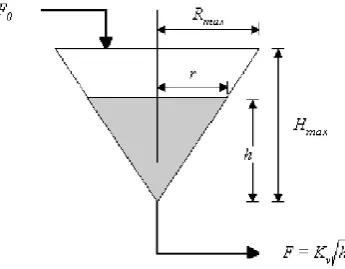
The conical tank system has single input and single output process. The output of this process
is the level and the input to the process is the flow of liquid. The structure of the conical tank
system is given in fig 1.
A liquid of constant density is fed at a constant volumetric rate Fo into a conical tank of
height Hmax and maximum radius Rmax.The outflow from the tank is , where h is the
height of the liquid in the tank and is the valve coefficient.
The process has high nonlinearity due to the changes in Process gain and time constant with
respect to the height of the liquid tank.[3,4]
Let the inflow (F0), outflow (F). by the mass conservation law,
Mass accumulation = inflow –outflow
Accumulation manifests itself as an increase or decrease in volume.(i.e) Accumulation is the
change in volume with respect to time.
(1)
Right circular cone has volume
(2)
Consider
= (3)
Hence (4)
Therefore
(5)
(6)
(7)
So (8)
The above mathematical model is analyzed in MATLAB Simulink and the responses are
3. PROCESS OPERATING PARAMETERS
The various system parameters[5] obtained are tabulated as:
Table 1: Parameters of Conical-tank system.
Parameter Description Value
Rmax Total radius of the cone 19.25 cm
Hmax Maximum total height of the tank 73 cm
Fo Maximum inflow rate of the tank 400 LPH
Kv Valve Coefficient 55cm2 /s
h Height of the liquid level Varied with the requirement
F Outflow Variable
r Radius at the height h Variable
4. SIMULATION RESULTS
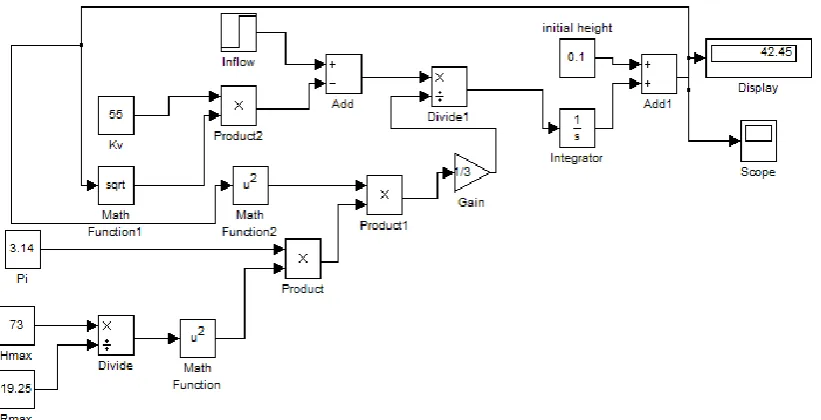
Based on the dynamic equation derived in Mathematical Modelling section, a Simulink block
diagram in figure 2 showing the nonlinear model of the plant is designed in MATLAB. Also
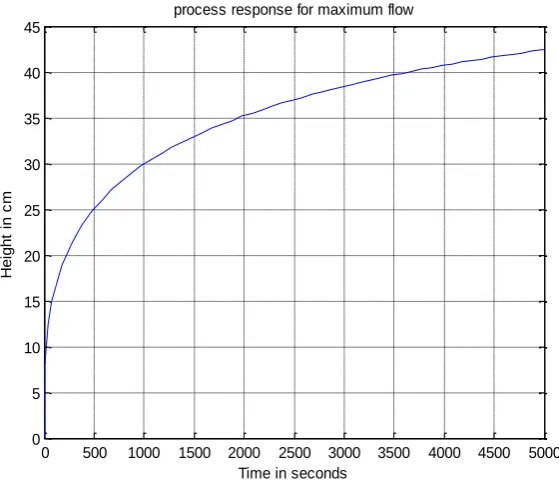
the open loop response of the system is obtained as shown in figure 3.
0 500 1000 1500 2000 2500 3000 3500 4000 4500 5000 0 5 10 15 20 25 30 35 40 45
Time in seconds
H e ig h t in c m
process response for maximum flow
Figure 3: Process input-output characteristic.
To obtain a linear model the characteristic is divided into four different linear regions as
shown in Figure 4.
0 50 100 150 200 250 300 350 400 450 500
0 5 10 15 20 25 30
Piecewise linearized response
H e ig h t in c m
Time in seconds I
II III
IV
Figure 4: Piecewise linearized process input- output characteristic.
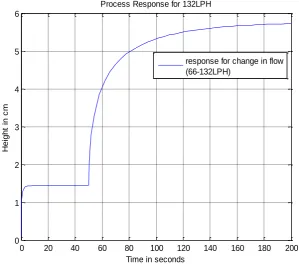
A first order mathematical model is then obtained for each region using process reaction
curve method and the reaction curves for regions 1 to 4 are shown in Figures 5 to8. The gain
(K), dead time (td) and time constant (τ) are measured from the reaction curves and are given
0 5 10 15 20 25 30 35 40 45 50 1.3
1.35 1.4 1.45 1.5
Time in seconds
H
e
ig
h
t
in
c
m
Response for Inflow(0-66)LPH
response of model equation
Figure 5: Reaction curve for first region when step change in inflow (0-66)LPH.
0 20 40 60 80 100 120 140 160 180 200
0 1 2 3 4 5 6
Time in seconds
H
e
ig
h
t
in
c
m
Process Response for 132LPH
response for change in flow (66-132LPH)
0 200 400 600 800 1000 1200 1400 1600 1800 2000 0
2 4 6 8 10 12 14
H
e
ig
h
t
in
c
m
Time in seconds Process Response for 198LPH
Response for change in flow (132-198LPH)
Figure 7: Reaction curve for 3rd region inflow(132-198)LPH.
0 500 1000 1500 2000 2500 3000 3500 4000 4500 5000
0 5 10 15 20 25
Time in seconds
H
e
ig
h
t
in
c
m
Process Response for 264LPH
Response for change in flow (198-264LPH)
Table 2: Process parameters obtained from the reaction curves. Inflow
(LPH)
Time (Seconds)
Height/Level
(cm) Steady state gain
Time constant (Secs)
0-66 0-50 1.44 0.0218 0.002
66-132 50-150 5.76 0.087 0.24
132-198 150-250 12.81 0.194 1.97
198-264 250-500 23 0.348 11.75
5. CONTROLLER TUNING 5.1 Ziegler Nicholas Method
The Ziegler-Nichols design methods are the most popular methods used in process control to
determine the parameters of a PID controller. Although these methods were presented in the
1940s, they are still widely used. The step response method is based on an open-loop step
response test of the process. Hence requiring the process to be stable, the unit step response
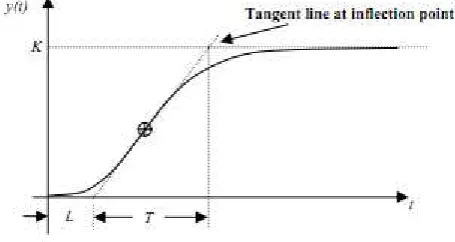
of the process is characterized by two parameters L and T. These are determined by drawing
a tangent line at the inflexion point, where the slope of the step response has its maximum
value. The intersections of the tangent and the coordinate axes give the process parameters as
shown in Figure 9, and these are used in calculating the controller parameters.[6]
Figure 9: Response curve for ZN method.
The parameters for PID controllers obtained from the Ziegler Nichols step response method
are shown in Table 3.
From the MATLAB Simulink model the ZN open loop response is observed and the value of
T, L are obtained and the parameters of Kp and Ki are calculated by using the above table.
The calculated values are Kp=50 and KI =25000.
5.2 Cohen Coon Method
The Cohen-Coon method is a more complex version of the Ziegler-Nichols method .This
method is more sensitive than the Ziegler-Nichols method. It is observed that the response of
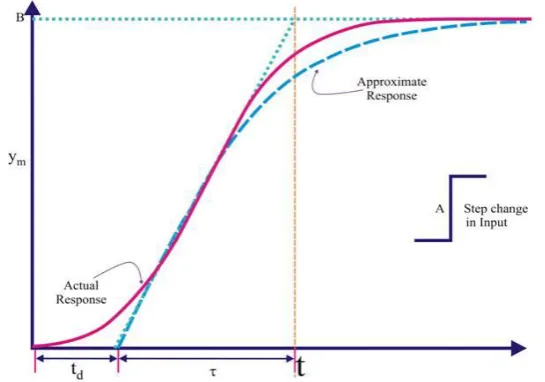
most of the processes under step change in input yields a sigmoidal shape (figure 10).The
parameters for PID controllers obtained from the Cohen Coon step response method are
shown in Table 4.
Figure 10: Response curve for CC method.
Table 4: Parameters tuned using Closed-Loop CC Method.
From the MATLAB Simulink model the open loop response is observed and the value of K,
Kp and Ki are calculated by using the above table. The calculated values are Kp=492.90 and
KI = = 407547.01.
6. RESULTS AND DISCUSSION
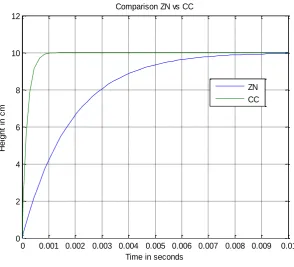
The response of Ziegler Nicholas method is compared with the Cohen Coon type tuning. The
comparison graph is shown in figure 11.
0 0.001 0.002 0.003 0.004 0.005 0.006 0.007 0.008 0.009 0.01 0
2 4 6 8 10 12
Comparison ZN vs CC
H
e
ig
h
t
in
c
m
Time in seconds
ZN CC
Figure 12: ZNT v/s CC Response.
The graph shows that the Cohen Coon tuned controller is reaching the set point value in less
time compared to the ZN.The performance of the controllers are analyzed by calculating the
Integral Square Error (ISE), Integral time multiplied by Square Error (ITSE), Integral
Absolute Error (IAE) and Integral time multiplied by absolute Error (ITAE).The obtained
values are tabulated in Table 5.
Table 5: Comparison of ZNT and CC.
Parameter ZNT CC
ISE 0.09161 0.008973
IAE 0.01835 0.002165
ITAE 3.367e-005 1.194e-006
7. CONCLUSION
The conical tank system is identified as a non-linear system. The model of conical tank
system is implemented with the help of first principle differential equation. MATLAB
ODE45 solver/Simulink is used to solve the differential equation. The results are validated by
using the transfer function model and ODE response. The conventional PI controller is
implemented to track the multi set point changes in level of the conical tank process by using
different tuning rules.
The performance index of different tuning rules are also obtained. The simulation results
proven that the Cohen Coon control method is an easy-tuning and more effective way to
enhance stability of time domain performance of the conical tank system.
8. REFERENCES
1. Nithya.S, Abhay Singh.G, Radhakrishnan.T.K, Balasubramanian. T and Anantharaman.
N, “Design of intelligent controller for non-linear process”, Asian Journal of applied
Science, 2008; 1: 33-45.
2. N. S Bhuvaneshwari, G. Uma, T. R. Rangaswamy, Adaptive and optimal control of an
nonlinear process using intelligent controllers, Applied soft computing, 2009; 9: 182-190.
3. B Ziegler, G. and Nichols, N. B,.Optimum settings for automatic controllers, Trans.
ASME, 1942; 64: 759-768.
4. S.Anand, V.Aswin, S.Rakeshkumar, “Simple tuned adaptive PI Controller for conical
tank process” International Conference on Recent Advancements in Electrical,
Electronics and Control Engineering (ICONRAEeCE), 263-267.
5. E.Kesavan, E.Arunkumar, Deivasigamani, “Design of an Adaptive Controller for Non
Linear System”, International Journal of Advanced Research in Electrical, Electronics
and Instrumentation Engineering, 2013; 2(9).
6. P.Aravind, M.Valluvan, S.Ranganathan, “Modelling and Simulation of Non Linear Tank”
International Journal of Advanced Research in Electrical, Electronics and Instrumentation