243
Antimicrobial Activity of Some Novel Pyrazoline Derivatives
Biresh K Sarkar*1, Ritesh Patel2, Upendra Bhadoriya2
1. Sri Balaji College of Pharmacy, Jaipur, India.
2. College of Pharmacy, Indore Professional Studies (IPS) Academy, Rajendra Nagar,
Indore, (M.P.), India.
*Corresponding author: [email protected]
ABSTRACT:
Different Pyrazoline derivatives were synthesized by cyclization of substituted chalcone
derivatives in presence of hydrazine hydrate (P1-P6). All the synthesized compounds
were characterized by spectral analysis (IR, MS and NMR). These compounds were
screened for their antibacterial activity against Gram-positive bacteria and Gram
negative bacteria. Antifungal activity was also performed using agar cup plate method.
The minimum inhibitory concentrations (MICs) of the compounds were also determined
by agar streak dilution method. Among the synthesized compounds; (P1) was found to
exhibits the most potent in-vitro antimicrobial activity with the MICs of 3.121, 1.5, 22
µg/ml against E. coli, P. aeruginosa, B. pumilus respectively. Compound (P6) was found
to exhibit the most potent in-vitro anti-fungal activity with MICs 0.83 and 0.093 µg/ml
against A. niger and P. chrysogenum.
Keywords: - Antimicrobial, MIC, Pyrazoline, Heterocyclic-compound
INTRODUCTION:
Considerable attention has been focused on Pyrazolines and substituted Pyrazolines
due to their interesting biological activities. They have found to possess anti-fungal,
anti-depressant, anti-convulsant, anti-inflammatory, anti-bacterial, anti-cancer,
antioxidant, anti-pyretic, anti-neoplastic activities, anti-viral, anti-amoebic, acaricidal
agro chemical fungicides or insecticides, cholinergic, antidiabetic, HIV,
anti-malarial, anaxiolytic, antiparasitic, anti-allergic, anti-microbial, anti-tuberculosis,
tyrosinase inhibitor, hypoglycemic, hypotensive, immuno suppressive, anti-tumor
[1-15]. Pyrazoline have usually been prepared by starting from aldehydes or ketones. The
purpose of this study was to develop new pyrazoline derivatives as potent anti-microbial
agents.
244
Melting points were determined by Thieles tube method (Table 1) and were uncorrected.
1H NMR spectra were recorded on Avance II 400 (Make; Bruker, France) NMR
Spectrometer. FT-IR spectra were recorded on MB 3000 (Make; ABB Bomem, Canada)
spectrometer and Mass spectra were recorded on Q-TOF Micro (Make; Waters,
Massachusetts) spectrometer.
Synthesis of substituted pyrazoline derivatives:
1. Procedure for synthesis of substituted chalcone derivative:
A solution of sodium hydroxide (40%) in water and rectified spirit was placed in a flask
provided with a mechanical stirrer. The flask was immersed in a bath of crushed ice.
Substituted acetophenone (0.005M) was poured with constant stirring, Substituted
benzaldehydes (0.005M) was added to the solution. The temperature of the mixture was
kept at about 250C and stirred vigorously until the mixture was thick enough to retard
the stirring (4 hr). The stirrer was removed and the reaction mixture was kept at 8 oC
overnight. The product was filtered with suction on a buchner funnel, washed with cold
water until the washings were neutral to litmus and then with ice cold ethanol. The
crude product was recrystallized from ethanol.
2. Procedure for synthesis of substituted pyrazoline derivatives:
Addition and cyclization:
In a mixture of substituted chalcone in ethanol, hydrazine hydrate was added drop wise
in a round bottom flask. The reaction mixture was heated under reflux for 6 hrs on a
water bath followed with addition of ice cold water at room temperature. The mixture
was kept overnight at 8 oC. The precipitates were filtered, washed with distilled water
and dried. The product was recrystallized with ethanol to get final product.
Biological evaluation:
In-vitro Antimicrobial Screening:
The in vitro antibacterial screenings of synthesized compounds were performed against
the following standard bacterial strains: Bacillus pumillus (MTCC 1456), Pseudomonas
fluorescens (MTCC 2421), Micrococus luteus (MTCC 1538), Pseudomonas aeruginosa
(MTCC 424), Escherichia coli (MTCC 1573), Bacillus subtilis (MTCC 441) and
Staphylococcus aureus (MTCC 1430). For antifungal screening Penicillium chrysogenum
245
Cylinder plate method:A definite volume of the microbial suspension (inoculums) was poured into the sterilized
nutrient agar media (cooled at 40ºC) and mixed thoroughly. About 20 ml of this
suspension was poured aseptically in the petri plates and kept till the solidification. The
surface of agar plates was pierced using a sterile cork borer. The prepared wells were
filled with equal volume of a solution of synthesized compounds and standard drugs;
separately. After a period of pre-incubation diffusion, the plates were incubated face up
for a definite time under specified conditions. The zones of inhibition were measured as
a parameter of antimicrobial properties of synthesized derivatives.
Minimum inhibitory concentration (MIC)
A series of glass tubes containing different concentrations of the synthesized
compounds (In Dimethyl Sulphoxide) with Mueller Hinton broth was inoculated with
the required amount of the inoculum to obtain a suspension of microorganism which
contains 105 colony forming units per milliliter. Growth control tube was prepared with
the addition of the compound and blank was prepared without the addition of
microorganism. The tubes were incubated at 37 °C for 24 h. The turbidity produced in
each tube was recorded by using a UV–visible spectrometer.
RESULTS AND DISCUSSION:
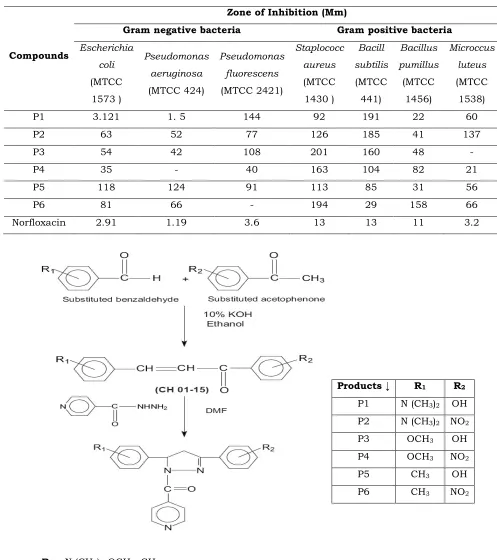
Novel pyrazoline derivative were synthesized by cyclization of substituted chalcone
derivatives in presence of hydrazine hydrate (Figure 1). Physiochemical properties of
synthesized compounds were determined in terms of melting point & % yield (Table 1).
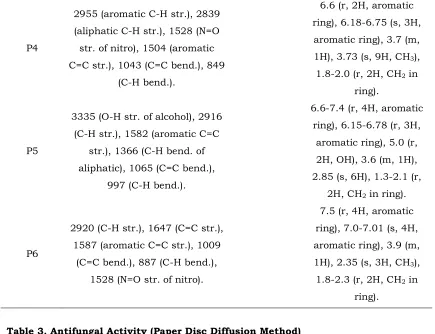
Synthesized compounds were also characterized using FT-IR and 1H-NMR. The IR
spectrum of the synthesized compounds revealed the presence of C =O stretching at
1615-1655 cm-1, 3402 cm-1 (O-H str. of alcohol), 1528 cm-1 (N=O str. of nitro) and C=N
(aromatic) stretching at 1515-1655 cm-1. In 1H-NMR spectra δ value of various
synthesized compounds was found in the range of 129-1.68 for methyl proton and
6.14-7.87 for benzyl proton (Table 2). The synthesized derivatives showed the presence of
aromatic ring which was also evident in the 1H NMR spectra Antifungal & antibacterial
activities were also performed as in-vitro antimicrobial screening against fungal strains
& bacterial strain respectively (Table 3 & 4). The minimum inhibitory concentrations
246
Table: 1 Physical constant of synthesized Pyrazoline derivatives.
Table: 2 Spectral analysis of the synthesized derivatives.
Comp.
code
IR spectra
(cm-1)
1H NMR Spectra
(δ) in ppm
P1
3402 (O-H str. of alcohol), 3339
(N-H str.), 3198 (aromatic C-H
str.), 1624 (C=C str.), 1000 (C=C
bend. aliphatic), 800 (C-H bend),
603 (C-Br str.).
7.40 (r, 4H, aromatic
ring), 6.15-6.78 (s, 4H,
aromatic ring), 4.58 (r,
2H, OH), 3.64 (m, 1H),
1.25-2.59 (r, 2H, CH2 in
ring).
P2
3285 (N-H str.), 2930 (C-H str.),
1682 (C=C str.), 1531 (aromatic
C=C str.), 1048 (C=C bend.
aliphatic), 927 (C-H bend.), 1528
(N=O str. of nitro).
6.62-7.39 (r, 4H,
aromatic ring), 6.14-6.62
(s, 3H, aromatic ring),
4.0 (r, 3H), 3.7 (m, 1H),
1.5-2.1 (r, 2H, CH2 in
ring).
P3
3425 (O-H str. of alcohol), 3350
(aromatic O-H str.), 2922 (C-H
str.), 1576 (aromatic C=C str.),
1092 (C=C bend.), 925 (C-H
bend.).
7.27-7.43 (r, 4H,
aromatic ring), 6.15-6.78
(s, 3H, aromatic ring),
4.5 (r, 2H, OH), 3.9 (m,
1H), 1.2-2.5 (r, 2H, CH2
in ring).
Compound
Code
Melting
range (0C)
% Yield
(Mean±S.D.)
Rf-value
(Mean±S.D.)
P1 110-115 60±0.1 0.67±0.01
P2 111-115 65±0.2 0.78±0.02
P3 115-118 70±0.4 0.71±0.06
P4 101-104 83±0.5 0.64±0.03
P5 104-108 78±0.1 0.84±0.04
247
P4
2955 (aromatic C-H str.), 2839
(aliphatic C-H str.), 1528 (N=O
str. of nitro), 1504 (aromatic
C=C str.), 1043 (C=C bend.), 849
(C-H bend.).
6.6 (r, 2H, aromatic
ring), 6.18-6.75 (s, 3H,
aromatic ring), 3.7 (m,
1H), 3.73 (s, 9H, CH3),
1.8-2.0 (r, 2H, CH2 in
ring).
P5
3335 (O-H str. of alcohol), 2916
(C-H str.), 1582 (aromatic C=C
str.), 1366 (C-H bend. of
aliphatic), 1065 (C=C bend.),
997 (C-H bend.).
6.6-7.4 (r, 4H, aromatic
ring), 6.15-6.78 (r, 3H,
aromatic ring), 5.0 (r,
2H, OH), 3.6 (m, 1H),
2.85 (s, 6H), 1.3-2.1 (r,
2H, CH2 in ring).
P6
2920 (C-H str.), 1647 (C=C str.),
1587 (aromatic C=C str.), 1009
(C=C bend.), 887 (C-H bend.),
1528 (N=O str. of nitro).
7.5 (r, 4H, aromatic
ring), 7.0-7.01 (s, 4H,
aromatic ring), 3.9 (m,
1H), 2.35 (s, 3H, CH3),
1.8-2.3 (r, 2H, CH2 in
ring).
Table 3. Antifungal Activity (Paper Disc Diffusion Method)
Compounds
Antifungal Activity (Paper Disc Diffusion Method)
Zone of Inhibition (mm)
Minimum Inhibitory Concentration
( g mL-1)
Fungal Strain
Penicillium
chrysogenum
(MTCC 161)
Aspergillus
niger
(MTCC2546)
Penicillium
chrysogenum
(MTCC 161)
Aspergillus niger
(MTCC 2546)
P1 24 29 37 84
P2 24 31 51 61
P3 21 19 62 108
P4 27 18 21 92
P5 21 22 61 91
P6 32 31 0.83 0.093
248
Table 4. Antibacterial Activity (Minimum Inhibitory Concentration)
Compounds
Zone of Inhibition (Mm)
Gram negative bacteria Gram positive bacteria
Escherichia
coli
(MTCC
1573 )
Pseudomonas
aeruginosa
(MTCC 424)
Pseudomonas
fluorescens
(MTCC 2421)
Staplococc
aureus
(MTCC
1430 )
Bacill
subtilis
(MTCC
441)
Bacillus
pumillus
(MTCC
1456)
Microccus
luteus
(MTCC
1538)
P1 3.121 1. 5 144 92 191 22 60
P2 63 52 77 126 185 41 137
P3 54 42 108 201 160 48 -
P4 35 - 40 163 104 82 21
P5 118 124 91 113 85 31 56
P6 81 66 - 194 29 158 66
Norfloxacin 2.91 1.19 3.6 13 13 11 3.2
R1 = N (CH3)2, OCH3, CH3 R2 = OH, NO2
Fig. 1: Scheme for the synthesis of substituted pyrazoline derivatives
Products ↓ R1 R2
P1 N (CH3)2 OH
P2 N (CH3)2 NO2
P3 OCH3 OH
P4 OCH3 NO2
P5 CH3 OH
249
According to preliminary antibacterial screening by paper disc method all compounds
were found to have comparable antibacterial activity against S. aureus, B. subtilis B.
pumillus, E. coli compared to Norfloxacin as a standard drug, and for antifugal
screening all compounds were found to active against A. niger and P. chrysogenum
using Fluconazole as a standard drug. The antimicrobial screening revealed that the
compound P1 & compound P6 exhibited potent antibacterial & antifungal activity
respectively as compared to other derivatives. Compounds (P1) was found to exhibits
potent in-vitro antimicrobial activity with the MICs of 3.121, 1.5, 22 µg/ml against E.
coli, P. aeruginosa, B. pumilus respectively while compound (P6) was found to exhibit
potent in-vitro anti-fungal activity with MICs 0.83 and 0.093 µg/ml against A. niger and
P. chrysogenum. (Table 3, Table 4).
CONCLUSION:
Present research work involves synthesis of novel pyrazoline derivative to explore their
antimicrobial activity. Compound P1 exhibited highest antibacterial activity against E.
coli, P. aeruginosa and B. Pumillus. Compound A6 exhibited highest antifungal activity
against A. niger and P. Chrysogenum. Hence, it is concluded that there is ample scope
for further study in developing these as good lead compounds for the treatment of
bacterial strain as well as fungal strain.
REFERENCES:
1. Korgaokar, S. S.; Patil, P. H.; Shah, M. J; Parekh, Synthesis and characterization of
a novel 2- pyrazoline, H. H. Indian J. Pharm. Sci., 1996; 58: 22-25.
2. J. C. Jung, E. B. Watkins and M. A. Avery, Anticancer activities of some newly
synthesized pyridine, pyrane, and pyrimidine derivatives, Heterocycles, 2005; 65:
77–94.
3. Udupi, R. H., Narayanrao, S. and Bhat, A. R., Synthesis, characterization, and
biological activities of new
1-[(2,5-dichloroanilinomalonyl)-3-(N-2’-cyanoethyl)-2-(N-acetyl) 2,5-dichloroanilino)]-5-phenyl pyrazoline derivatives, Indian J. Heterocyclic
Chemistry, 1998; 7: 217-220.
4. Kousalya K, Thirumurugu S, Arumainayagam DC, Manavalan R, Vasantha J, Reddy
CM. Antimicrobial resistance of bacterial agents of the upper respiratory tract in
south Indian population. J Adv Pharm Tech Res 2010;1:207-15.
5. Sadaf Sadiq Khan and Aurangzeb Hasan; Synthesis, characterization, and biological
activities of new 1-[(2, 3 dichloroanilinomalonyl)-3-(N-2’-cyanoethyl)-2-(N-cinnamoyl)
2, 3-dichloroanilino)]-5- phenyl pyrazoline derivatives, Heterocycl. Commun, 2007;
250
6. Hull, M.A.; Ko, S.C.W.; Hawcroft, G. Mol., Prostaglandin E2-EP4 receptor signalling
promotes tumorigenic behaviour of HT-29 human colorectal cancer
cellsProtumorigenic activity of PGE2-EP4 receptor signaling, Cancer Therapy, 2004;
3: 1031-1039.
7. Panda SK, Dutta SK, Bastia AK. Antibacterial activity of Croton roxburghii balak.
against the enteric pathogens. J Adv Pharm Tech Res 2010;1:419-22.
8. R. Lin, G. Chiu, Y. Yu, P. J. Connolly, S. Li, Y. Lu, M. Adams, A. R. Fuentes-
Pesquera,S. L. Emanuel and L. M. Greenberger, Design, synthesis, and evaluation of
3,4-disubstituted pyrazole analogues as anti-tumor CDK inhibitors, Bioorg. Med.
Chem. Lett., 2007; 17: 4557–4561.
9. Olsen, D. B., A. B. Eldrup, L. Bartholomew, B. Bhat, M. R. Bosserman, A. Ceccacci,
L. F. Colwell, J. F. Fay, O. A. Flores, K. L. Getty, J. A. Grobler, R. L. LaFemina, E. J.
Markel, G. Migliaccio, M. Prhavc, M. W. Stahlhut, J. E. Tomassini, M. MacCoss, D.
J. Hazuda and S. S. Carroll, A 7-deaza-adenosine analog is a potent and selective
inhibitor of hepatitis C virus replication with excellent pharmacokinetic properties,
Antimicrob. Agents Chemother, 2004; 48: 3944–3953.
10.Abid M, Azam A., Synthesis, Characterization and Antiamoebic Activity of
1-(Thiazolo[4,5-b]quinoxaline-2-yl)-3-phenyl-2-pyrazoline Derivatives, Bioorg Med
Chem Lett., 2006; 16: 2812-2816.
11.Habib NS, Soliman R, Ismail K, Hassan AM, Sarg MT, Synthesis of novel
pyrimidines, 1,2,4-triazolo[4,3-a]pyrimidin-7-ones and pyrimidino[2,1-c][1,2,4]
triazin-8-ones for their antimicrobial and anticancer activities, Boll Chim Farm,
2003; 142: 396-405.
12.Greenlee, R.-T.; Hill-Marmon, M.-B.; Murray, T.; Thun, M., Synthesis and Cytotoxic
Activity of Novel Pyrazoline Derivatives against Human Lung Tumor Cell Line (A549)
Cancer J. Clin., 2001; 51: 15-36.
13.Tambekar DH, Dahikar SB. Antibacterial activity of some Indian ayurvedic
preparations against enteric bacterial pathogens. J Adv Pharm Tech Res
2011;2:24-9.
14.Panda SK, Padhi LP, Mohanty G. Antibacterial activities and phytochemical analysis
of Cassia fistula (Linn.) leaf. J Adv Pharm Tech Res 2011;2:62-7.
15.Bhalodia NR, Shukla VJ. Antibacterial and antifungal activities from leaf extracts