Http://www.ijetmr.com©International Journal of Engineering Technologies and Management Research [84]
THE EFFECT OF PERSONALITY AND INTEGRITY TO AFFECTIVE
ORGANIZATIONAL COMMITMENT
Yuka Agustin Chalistya *1, I Made Putrawan 2, Supadi 3
*1, 3 Educational Management Department, Universitas Negeri Jakarta, Indonesia
2 Environmental Education Department, Universitas Negeri Jakarta, Indonesia
Abstract:
Affective organizational commitment felt by employees in institutions provides benefits to the institution because of the emotional attachment of the individual to the institution influenced by personality and integrity factors. That is why the objective of this research is to find out whether there is a direct effect of personality and integrity on employees affective organizational commitment. A causal survey used by selecting 116 employees at Universitas Negeri Jakarta by using Simple Random Sampling (SRS). There were three instruments developed to measure affective organizational commitment (37 items) with a reliability of 0.961, personality (44 items) with reliability 0.967, and integrity (29 items) with a reliability of 0.94. Data were analyzed using regression, correlation, and path analysis. The results showed that personalityand integrity directly and significantly affect employees affective organizational commitment, however integrity was not a good mediated variable between personality and affective organizational commitment. These findings mean that when employees organizational commitment would be improved, factors such as personality, especially big-five personality and integrity could be taken into account.
Keywords: Personality; Integrity; Affective Organizational Commitment; Management; Education.
Cite This Article: Yuka Agustin Chalistya, I Made Putrawan, and Supadi. (2019). “THE EFFECT OF PERSONALITY AND INTEGRITY TO AFFECTIVE ORGANIZATIONAL COMMITMENT.” International Journal of Engineering Technologies and Management Research, 6(1), 84-93. DOI: https://doi.org/10.29121/ijetmr.v6.i1.2019.348.
1. Introduction
Http://www.ijetmr.com©International Journal of Engineering Technologies and Management Research [85] employee has the skills, abilities, and attitudes that can be used to accelerate the achievement of organizational goals efficiently and effectively.
HR who are loyal to the organization has a high commitment where it is the strength of the attachment felt by individuals to an organization and measured by the extent to which individuals are ready to adopt organizational values and goals. Organizational commitment is important because HR that has a high level of organizational commitment will accelerate the achievement of organizational goals. There are three components that can be considered for organizational commitment based on Colquitt, Lepine, and Wesson (2017), namely affective organizational commitment (the tendency of people to share their energy and loyalty to continue their work in the organization), ongoing commitment (willingness to carry out sustainable activities based on recognition of costs associated with leaving the organization), and normative commitment (a sense of obligation to remain as a member of the organization)[11]. Colquitt et.al. (2017) stated affective commitment is defined as a desire to remain a member of an organization due to an emotional attachment, and involvement with, that organization. Put simply, you stay because you want to [11]. The definition is confirmed by McShane and Glinow. McShane and Glinow (2018) defined affective organizational commitment in detail, namely affective organizational commitment is the employee's emotional attachment to, involvement in, and identification with an organization [20]. Affective commitment is a psychological bond whereby one chooses to be dedicated to and responsible for the organization.
Organizations will get benefits from members who have affective organizational commitment. This is because when individuals have affective organizational commitment, these individuals will be involved in free roles and behaviors that provide benefits to the organization. Individuals who have high affective organizational commitment to the organization will continue to engage in positive discretionary behavior and not express rejection of changes proposed by the organization because the individual will work well and assume that the organization is also his. Organizational commitment can be measured by several indicators, including the emotional attachment of someone to the organization, the contribution of someone in the organization, the existence of one's obedience to the organization, and the suitability of one's values and personal goals with organizational goals, ownership of the organization, regard colleagues as its family, and there is a sense of comfort towards the organization.
Organizations need members who have personalities that support the emergence of behaviors that are in accordance with the achievement of the goals of the organization, thus that personality is an important aspect of psychology in determining individual behavior. Robbins and Judge (2017) defined personality as the sum total of ways in which an individual reacts to and interacts with others[19]. McShane et.al also stated the definition of personality. McShane et.al (2018) stated personality is the relatively enduring pattern of thoughts, emotions, and behaviors that characterize a person, along with the psychological processes behind those characteristics[20].
Http://www.ijetmr.com©International Journal of Engineering Technologies and Management Research [86] prediction with significant and positive corelation with the three dimensions of commitment [13]. This statement shows that conscientiousness and extraversions have a positive effect on affective organizational commitment because affective organizational commitment is one of the dimensions of commitment. Hawass (2012) also has the same opinion, namely agreeableness and conscientiousness are found to be positively and significantly predictive on employees affective organizational commitment [10].
Personality can be measured through these five basic dimensions, namely (1) conscientiousness with indicators (a) having the nature of being dependent on the institution, (b) having the nature of responsibility for the tasks given by the institution, (c) having a careful attitude in carrying out tasks given by the institution, and (d) having the nature of discipline towards the institution; (2) agreeableness with indicators (a) having trust in the organization, (b) having the ability to cooperate in organizations, and (c) having an empathic sense towards the organization; (3) emotional stability with indicators have confidence, calm, relaxed, and no doubt; (4) openness to experience with indicators (a) having creative and imaginative characteristics; (b) have curiosity; (c) broad minded; and (d) sensitive to institutions; and (5) extraversions with indicators (a) having friendly characteristics towards other members of the organization; (b) active speaking, socializing and making friends; and (c) being strict in the organization.
A person's personality affects the level of integrity that the individual has. This is confirmed by Kreitner and Kinicki (2008), namely trust is defined as reciprocal faith in others’ intentions and behavior, propensity to trust is a personality trait involving one’s general willingness to trust other [17]. Anwar et.al (2012) confirmed the statement, as honesty, benevolence and integrity (elements of SEL) build trust and social exchance relationship should enhance organizational commitment ultimately [2]. Based on the statement, it is known that someone who has high integrity will have a high organizational commitment. This statement is in line with the results of Nyhan's research (2013) which stated that trust is the key to increasing the commitment of one's affective organization [18].
Table 1: Five Element of Trust
Competence consistency Loyalty Openness
Integrity
(Without integrity, all other elements may be meaningless)
Http://www.ijetmr.com©International Journal of Engineering Technologies and Management Research [87] Integrity is the characteristic of an individual in interacting with his environment which is identified by the compatibility between what is said and what is done and consists of three dimensions, namely (1) honesty with indicators (a) speak for what they are, (b) do not pretend, and (c) open; (2) consistent with indicators (a) actions in accordance with what is said, (b) focus on specific occupations, (c) make statements according to principles, and (d) maintain principles that are considered correct; and dimensions (3) trustworthiness with indicators (a) the desire to be trusted by friends, (b) the fulfillment of friend's expectations, (c) the desire to work together on assignments, and (d) the desire to always be together to achieve organizational goals.
Based on this, the purpose of writing in this study is to find out (1) does personality has a direct effect on affective organizational commitment ?; (2) does integrity have a direct effect on affective organizational commitment ?; (3) does personality directly affect integrity ?; and (4) does personality have an indirect effect on affective organizational commitment but through integrity? Integrity becomes an intervening variable in this study because it is to find out whether personality can have an indirect effect on affective organizational commitment through integrity or not. This is because in reality a person's integrity is always associated with personality.
2. Materials and Methods
This research is a quantitative research that uses survey method with causal technique. This method is used to uncover the problems of the facts studied to find the effect of exogenous and endogenous variables, namely two exogenous variables including (1) personality and (2) integrity and endogenous variables are affective organizational commitment. Path analysis is used to test the direct effect of the variables to be studied. This study involved 116 employees of State University of Jakarta as respondents with a composition of 20 employees as respondents for instrument testing and 95 employees selected in research samples using Simple Random Sampling (SRS). There were three instruments used to measure affective, personality, and integrity organizational commitment whose validity has been measured using Pearson Product Moment and reliability using Cronbach Alpha with the help of Statistical Package for Social Science (SPSS) 23.
Instrument for measuring affective organizational commitment consisted of 37 items statement were measured by the scale of affective organizational commitment 5-4-3-2-1, from those who strongly agree to strongly disagree, with validity around 0.44 to 0.844 and reliability 0.961. The instrument for measuring personality consisted of 44 items measured using a 5-4-3-2-1 personality scale, from very accurate to very inaccurate, with validity around 0.461 to 0.851 and reliability 0.967. The instrument for measuring integrity consisted of 29 items measured on integrity scale of 5-4-3-2-1, from what is always done until it has never been done, with validity around 0.447 to 0.794 and reliability 0.940. Data analyzed by regression, correlation and path analysis.
3. Results and Discussions
Http://www.ijetmr.com©International Journal of Engineering Technologies and Management Research [88] 37 items. Data on affective organizational commitment had an empirical score range between 93 and 162, range of scores 69, average score 134.48, median 136, mode 136, standard deviation 12.83, variance 164.53. Personality variable data obtained based on the charging instrument consisting of 44 items. Personality data had a range of empirical scores between 137 to 213, range of scores of 76, an average score of 169.73, median 169, mode 168, standard deviation of 14.33, variance of 205.35. The integrity variable data obtained based on the charging instrument consisting of 29 items. Data integrity had an empirical score range of 84 to 141, range of scores of 57, an average score of 121.51, median 122, mode 123, standard deviation of 10.31, variance of 106.25.
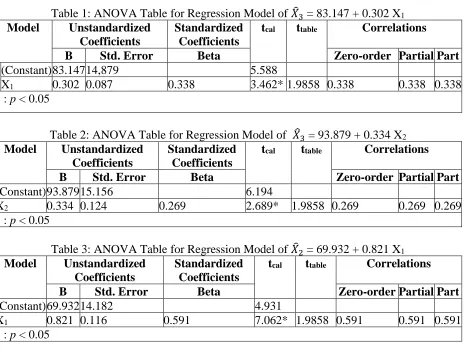
Table 1: ANOVA Table for Regression Model of 𝑋̂3 = 83.147 + 0.302 X1
Model Unstandardized
Coefficients
Standardized Coefficients
tcal ttable Correlations
B Std. Error Beta Zero-order Partial Part
1 (Constant) 83.147 14,879 5.588
X1 0.302 0.087 0.338 3.462* 1.9858 0.338 0.338 0.338
* : p < 0.05
Table 2: ANOVA Table for Regression Model of 𝑋̂3 = 93.879 + 0.334 X2
Model Unstandardized
Coefficients
Standardized Coefficients
tcal ttable Correlations
B Std. Error Beta Zero-order Partial Part
(Constant) 93.879 15.156 6.194
X2 0.334 0.124 0.269 2.689* 1.9858 0.269 0.269 0.269
* : p < 0.05
Table 3: ANOVA Table for Regression Model of 𝑋̂2 = 69.932 + 0.821 X1
Model Unstandardized
Coefficients
Standardized Coefficients
tcal ttable Correlations
B Std. Error Beta Zero-order Partial Part
(Constant) 69.932 14.182 4.931
X1 0.821 0.116 0.591 7.062* 1.9858 0.591 0.591 0.591
* : p < 0.05
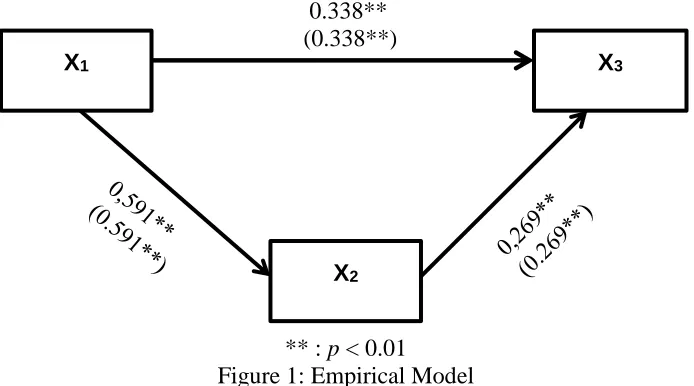
Http://www.ijetmr.com©International Journal of Engineering Technologies and Management Research [89] Next Step after the significance and linearity test of the regression equation was the path analysis test. Based on Table 1, Table 2, and Table 3, the empirical model of the path analysis test results can be seen in Figure 1.
** : p < 0.01
Figure 1: Empirical Model
Table 4: A Summary of Hyphothesis Test’s Results
Direct or Indirect n Path Coefficient tcal ttable
0.05 0.01
X1 on X3 95 0.338 3.462** 1.9858 2.6297
X2 on X3 95 0.269 2.689** 1.9858 2.6297
X1 on X2 95 0.591 7.062** 1.9858 2.6297
X1 on X3 through X2 95 0.159 1.5447ns 1.9861 2.6303 ** : p < 0.01; ns : non-significant
The result of this research showed that (1) personality had a significant direct effect to affective organizational commitment with path coefficient Phi31= 0,338 and tcal= 3,461; (2) integrity had a significant direct effect to affective organizational commitment with path coefficient Phi31= 0,269 and tcal= 2,689; (3) personality had a significant direct effect to integrity with path coefficient Phi31= 0,591 and tcal= 7,062; and (4) personality had non-significant indirect effect to affective organizational commitment through integrity with path coefficient Phi31= 0,159 and tcal= 1,5447. A summary of hyphothesis test’s results were presented in Table 4.
The results of the testing of the first hypothesis indicated that there was a significant direct influence between personality to affective organizational commitment, so it was proven that personality can affect the commitment of affective organizations. The results of this study were in line with the results of Syed, Saeed, Farrukh (2016) who stated that conscientiousness and openness to experience positive associations with affective commitment[14]. Conscientiousness and openness to experience are part of the top five personality models. Erdheim, Wang, and Zickar (2006) stated the people who earn high scores in openness to experience high levels of respect for exploration, are more willing to pursue alternatives to their jobs[12]. Based on this, it can be concluded that employees with an openness to experience personality trait had an affective organizational commitment and continuance organizational commitment on average.
X3
X2 X1
Http://www.ijetmr.com©International Journal of Engineering Technologies and Management Research [90] In addition to openness to experience factors, agreeableness and conscientiousness factors also influenced affective organizational commitment. This was in accordance with the results of the Izzati et al. (2015) study which stated agreeableness and conscientiousness that significantly influenced the affective organizational commitment[22]. The study used the teacher as a sample and it was proven that teachers with agreeableness and conscientiousness have emotional attachments, identification, and were fully involved in school. The sample in the study with the research conducted was indeed different, but the results of the study had similarities, namely personality directly affected the commitment of affective organizations.
Bartholomew, Awa, and Ukoha (2016) also stated the existence of a positive relationship between personality and affective organizational commitment[7]. The study mentioned personality influenced the level of commitment of employee affective organizations, so companies needed to pay attention to these two aspects to minimize the decline in productivity, decreased employee loyalty, and increased employee turnover rates. Employees who had affective organizational commitment tended to stay with the organization because there was a sense of attachment to the organization they worked for. Research by Asif et.al. (2015) also had the same results, namely extraversion, conscientiousness, and agreeableness that had a significant relationship with affective organizational commitment, but neuroticism and openness to experience did not have a significant relationship[3].
Based on the results of several previous studies that were relevant to the results of this study, it appeared that there were differences even though all the results stated that personality had an influence on the commitment of affective organizations. Previous studies examined each of the factors in the top five personality models to see the influence of each of the factors on affective organizational commitment, while this study examined the whole of the five major personality models. Affective organizational commitment was not only influenced by personality, but by integrity. This was in accordance with the second hypothesis of this study.
The results of testing the second hypothesis indicate that there was a significant direct influence between integrity on affective organizational commitment, so it was proven that integrity could affect the commitment of affective organizations. This was in accordance with the results of the study by Pertiwi et al. (2018) which stated the influence of integrity on the commitment of affective organizations[16]. The study stated that integrity includes a person's commitment to the principles or community organization. Larger stated integrity based ethics programs produce employees who are more committed to being in their organization, more aware of ethical sense and more willing to report ethical problems in nature.
Http://www.ijetmr.com©International Journal of Engineering Technologies and Management Research [91] Integrity was the most important element of trust from other elements because integrity influenced other elements. Trust had an influence on affective organizational commitment. This was in accordance with the results of Nyhan's research (2013) which stated that there was a significant influence between interpersonal trust in affective organizational commitment[18]. This study stated the essence of the relationship between affective commitment and trust flows from the complexity of the organizational climate and the need for public employees to be empowered in making organizational decisions. Kanter and Mirvis (1989) stated public employees tend to be more cynical and creative of organizations (particularly if they are seen to be" politicized") than employees in the private sector, and that loss of trust by public employees creates the need for more "red-tape" and leads to a loss of organizational effectiveness [5].
Based on previous research that was relevant to this study, there was a difference. The difference from previous research and this research was the sample used. Some previous studied used a sample of employees in the company, while the sample of this study was employees at the institution. Not only that, there were previous studies that examine the integrity of leaders of an organization as a dependent variable through affective organizational commitment as a mediator variable. However, although there were some differences, the whole study showed that integrity had an influence on affective organizational commitment. The integrity of a person is influenced by his personality. This was in accordance with the results of the third hypothesis test in this study.
The results of testing the third hypothesis indicate that there was a significant direct influence between personality integrity, so it was proven that personality could affected integrity. This was in accordance with previous studies from Staden (2018), namely the existence of a positive relationship between integrity and conscientiousness[15]. The study stated agreeableness was an important trait in integrity testing because it measured interpersonal tendencies such as trust, altruism, obedience, and directness. Thus, pleasant individuals had a harmonious interpersonal environment because of their desire to get along with others. Employees with a low level of agreeableness tended to be more counterproductive than employees who score high on this dimension.
The research findings of Ones, Viswesvaran, and Schmidt (2003) showed that the validity of personality-based integrity tests to predict absenteeism was quite large and could be generalized[6]. Personality-based integrity tests were specifically designed to predict counterproductive behavior other than theft, while open tests were specifically designed to predict theft. The results of this study indicated that, in predictions of absenteeism using integrity tests, concurrent design could lead to overestimations of predictive validity. Based on these findings, there was an influence between personality and integrity as well as findings in this study.
Http://www.ijetmr.com©International Journal of Engineering Technologies and Management Research [92] Based on the results of several previous studies that were relevant to the results of this study, there were differences. This difference could be seen from the results of previous findings that discuss the relationship of integrity with each factor of personality, while this study discussed the whole of the five personality factors. Although there were differences, the overall results of the study concluded that personality had an influence on integrity. However, it turned out that integrity was not a good intervening variable between personality variables and affective organizational commitment. This was evident from the results of the fourth hypothesis test in this study.
The results of testing the fourth hypothesis indicated that there was no significant indirect effect between personality on affective organizational commitment through integrity, so that integrity could not be said as a good intervening variable between personality and affective organizational commitment. Making integrity as a mediator of personality variables and affective organizational commitment was a renewal of this research. It turned out that after being tested, integrity was not good as a mediator even though integrity had an influence on personality and affective organizational commitment. Integrity did affect personality, but integrity did not play a role in influencing personality on affective organizational commitment. Based on the findings of this study, it could be concluded that both of personality and integrity had a direct effect on affective organizational commitment. However, integrity was not suitable to be used as a mediator to measure the indirect effect of personality on affective organizational commitment.
4. Conclusions and Recommendations
Based on these findings, it can be concluded that personality and integrity must be considered in building affective organizational commitment because personality had significant direct effect to affective organizational commitment and integrity had significant direct effect to organizational affective commitment. Integrity also had a significant direct affect to personality. The role of integrity was not a good mediating factor because there was non significant indirect effect of personality to affective organizational commitment through integrity. Empirically, variables such as personality, integrity, and affective organizational commitment must be considered and taken into account in developing the quality of employees in an institution. Good personality and high integrity will increase employee’s affective organizational commitment so as to provide benefits for the institution.
Based on the results of research and discussion above may be considered suggestions as follows: 1) For other researchers who are interested in the same problems, are expected to conduct research involving a larger number of participants with sampling techniques are more numerous and add other variables related to this study; 2) This research can proceed with the design of the study and analysis of different techniques.
Acknowledgements
Http://www.ijetmr.com©International Journal of Engineering Technologies and Management Research [93]
References
[1] Laginess, Andrew J Laginess. Mapping Integrity in The Domain of Traits Personality. Thesis of Florida International University, 2016
[2] Antonius Gea. Personal Integrity and Leadership. Journal Humaniora Vol.7 No.3, 2016.
[3] Aymen Asif, Nighat Ansari, and Kashif Rathore. Empirical Relationship of Big Five Personality Traits and Affective Commitment Among the Public Sector Employees. International Journal of Management Sciences and Business Research vol.4, issue 11, 2015.
[4] C. Suzzane, O. Karen, and Z. Beth. Interpersonal Skills in Organizational, Third edition. Asia: McGraw- Hill Educational, 2009.
[5] D. L. Kanter and P. H. Mirvis. The cynical Amencans Living and working in an age of discontent and disillusion. San Francisco: Jossey-Bass Publishers, 1989.
[6] Deniz S. Ones, Chockaliman Viswesvaran, dan Frank L Schimidt. Personality and Absenteeism: A Meta-Analysis of Integrity Tests. European Juornal of Personality, 2003.
[7] Emecheta Bartholomew, Hart O. Hawa, and Ujiabo Ukoha. Personality Characteristics and Employee Affective Commitment: Nigeria Experience. International Journal of Business and Management Review, 2016.
[8] Farooq Anwar et.al. Investigating the Mediating Role of Affective Commitment Between Supervisor's Ethical Leadership and Citizenship Behaviors. World Applied Science Journal, 2012. [9] Garl Yulk. Leadership in Organization. New Jersey: Pearson Education, 2010.
[10] H. H. Hawass. Committed salesforce: an investigation into personality traits, International. Journal of Business and Management, 2012.
[11] Jason A. Colquitt, Jeffery Lepine, and Michael J. Wesson. Organizational Behavior: Improving Performance and Commitment in The Workplace. New York: McGraw-Hill Education, 2017. [12] J. Erdheim, M. Wang, and M. J. Zickar. Linking the Big Five personality constructs to
organizational commitment. Personality and Individual Differences, 2006.
[13] K. Kumar and A. Bakhshi. The Five-factor Model Of personality and Organizational Commitment: Is There Any Relationship. Humanity and Social Science Journal. 2010.
[14] Nida Syed, Arfa Saeed, and Muhammad Farrukh. Organization Commitment and Five Factor Model of Personality: Theory Recapitulation. Asian Economic and Social Society Journal, 2016. [15] Oaitsee Sameeng Van Staden. Relationship Between Personality, Integrity and Counterproductive
Work Behaviour: A Namibian Study. Stellenboschy University, 2018.
[16] Riza Pertiwi, Mukhneri Muchtar, and Yetti Supriyati. The Influence of Ethical Leadership, Integrity and Affective Commitment on Organizational Citizenship Behaviour of Teacher of State Senior High School at The City Of Depok. Journal of Education and Practice, Vol.9, No.10, 2018. [17] Robert. Kreitner and Angelo Kinicki. Organizational Behavior 8th. Boston: McGraw-Hill Irwin,
2008.
[18] Ronald C Nyhan. Increasing Affective Organizational Commitment in Public Organization: The Key Role of Personal . Journal. Sage Publication: Florida Atlantic University, 2013.
[19] Stephen P. Robbins and Timothy A. Judge. Organizational Behavior. England: Pearson Education Limited, 2017.
[20] Steven L. McShane and Mary Ann Von Glinow. Organizational Behavior: Emerging Knowledge. Global Reality. New York: McGraw-Hill Education, 2018.
[21] Sultan Saqar Oqaiand Alwahaibi. The Impact of Human Resource Practices, Social Support and Personality Traits on Affective Organizational Commitment. Journal International Business Management, 11: 2026-2033, 2017.
[22] Umi Anugerah Izzati, Fendy Suhariadi, and Cholichul Hadi. Personality Trait as Predictor of Affective Commitment. Journal of Social Science, 2015.
*Corresponding author.