Printed in The Islamic Republic of Iran, 2018 © Shiraz University
Multiobjective Pareto Optimization of Bone Drilling
Process Using NSGA II Algorithm
V. Tahmasbi
*1, H. Safikhani
2, F. Setoudeh
31Department of Mechanical Engineering, Arak University of Technology, Arak, Iran. 2Department of Mechanical Engineering, Arak University, Arak, Iran. 3Department of Electrical Engineering, Arak University of Technology, Arak, Iran.
Abstract: Bone drilling process is one of the most common processes in the orthopedic surgeries and bone break treatments. It is also very frequent in dentistry and bone sampling operations. Bone is a complex material and the machining process itself is sensitive, so bone drilling is one of the most important, common and sensitive processes in Biomedical Engineering field. Orthopedic surgeries can be improved using robotic bone drilling systems and mechatronic bone drilling tools. In the present study, multiobjective optimization is performed on the temperature and trust force at two steps. At the first step, two regression models are developed for modeling the temperature and force in bone drilling process considering three design variables, namely tool’s rotational speed (V), feed rate (f) and tool diameter (D). At the second step, using the regression models, multi-objective genetic algorithm is used for the Pareto based optimization of bone drilling process considering two conflicting objectives: temperature and force. It has been found out that there are considerable connections and feasible principles for an optimal design of the process in case of applying Pareto-based multi-objective optimization; otherwise, these interesting results would not be discernible.
Keywords: Pareto optimization, Bone drilling, Temperature, Thermal necrosis, NSGA II, Biomechanics.
1. Introduction
During treating a broken bone, it is attempted to help the broken bone make its exact original place. Therefore, segregated bone parts should be located accurately in a fixed place. Bolts are usually used to hold the broken parts tight and firm. Anticipating and controlling the temperature and force of the process during bone drilling is very crucial to succeed in orthopedic operations. Developments in the drilling tool and employing automatic drills or surgery-assisting robots have already drawn researchers’ attention. Studies try to optimize the performance of bone drilling surgery and to avoid any undesired harm to the bone [1, 2]. Currently, due to the use of automatic drills and surgery-assisting robots, orthopedic operations have been remarkably promoted. Louredo et al. increased the accuracy of the tool used in bone layer removing surgery and reduced the force imposed to the issue by developing a robotic system[3]. Aziz et al. introduced a higher accuracy of tool positioning and control of the imposed force in addition to forward/backward movements of the tool by introducing an algorithm [4]. Diaz et al. studied a robotic control system in orthopedic surgery. They concluded that the use of surgical robots could cause potential problems, including thermal necrosis and excessive force, compared to conventional surgery[5]. During bone drilling process force behavior and temperature behavior are crucial in order to achieve desirable results [6]. Thermal necrosis and cell death occur due to temperature increase in the bone tissue [7]. Dramatic temperature rises in bone drilling changes the state of the bone Phosphates alkaline which consequently leads to thermal necrosis and cell death. It also attributes to the death of the bone tissue and a decrease in material stiffness in the neighborhood of where the drilling operation has been performed[8]. This loosens the fixing bolts in the operation[9] and also
provides long-awaited recoveries which in some cases are very doomed. Thermal necrosis phenomenon in the bone is attributed to temperature increase which makes it difficult for blood to flow to it. Thus it yields to cell death and local absence of the bone tissue and weakening of its structure[10]. Thermal necrosis forces the implant to loosen the screws and therefore causes a failure in the surgery [5].
The level of damage to the bone is directly related to the increase in temperature and heat exposure time [11] . Based on different reports, thermal necrosis is possible in a wide range of temperature (440C to 100oC). When temperature gets higher than 70o C, thermal necrosis occurs immediately [12]. Rising temperature from 47 to 50o C influences the bone tissue even in a minute exposure time. However, with the temperature less than 44o C the thermal impact is negligible if the exposure time equals a minute or less [13, 14]. Nevertheless, most of the researches unanimously agreed that increasing the temperature from 47oC within a minute causes thermal necrosis in the bone tissue [2, 15]. Initiation of micro cracks and harm to the bone tissue due to high process forces worsens the surgery and extends the recovery period [16]. Furthermore, the imposed force to the bone tissue is directly corresponding to the increasing temperature in cortical bone [17].
Both temperature and force in bone drilling process are important conflicting objective functions to be optimized simultaneously. These objective functions are obtained either from experiments or tedious and costly FEM approaches. These methods cannot be used in an iterative optimization task unless a simple but effective meta-model is present over the response surface produced by numerical or experimental data. Therefore, in the present study a multi objective optimization problem is investigated using experimental data, regression models and objective genetic algorithms. One of the most complete and the best multi-objective optimization algorithms also used in this paper is NSGA II algorithm. This algorithm, proposed by Deb et al. [18] for the first time, has been applied abundantly for the multi-objective optimization of engineering issues in recent years [19-21].
In this paper regression models are applied to developed polynomial models considering the effects of the geometrical and process parameters on both temperature and force in bone drilling process. Such an approach, of meta-modeling of experimental results, allows for iterative optimization techniques to design the governing parameters optimally. The specified simple polynomial models are then used in a Pareto based multiobjective optimization approach to find the best possible combinations of design variables, known as the Pareto front. The corresponding variations of design variables, known as the Pareto set, constitute some prominent and informative design principles.
1.1. Defining design variables
Tool rotational speed, feed rate, diameter and the geometry of the tool are foremost parameters in temperature and force evolution during bone drilling. Up to now, many studies have focused on the effect of tool rotational speed and feed rate on force and temperature behaviors. Previously, many researchers had studied the effect of the tool’s rotational speed and feed rate on force and temperature trends. Apart from numerous investigations and studies on the parameters of the process to improve force and temperature, there are conflicts and contrasts [22]. Different studies about the effect of the cutting speed on the process force report conflicting results. According to Alam et al. [23], Basiaga et al. [24] and Jacob et al. [25], a raise in the tool’s rotational speed reduces the force during bone drilling, whereas Lee et al. [26] interpreted that an increase in the rotational speed boosts up the process force. Udiljak et al. found that tool rotational speed is not influential on axial force and it can be tagged as an ineffective parameter [27].
The effect of the tool's rotational speed and feed rate on temperature behavior has also been contradictorily reported [28]. Vaughn et al. [29] stated that the process temperature increases with a raise in the rotational speed. Augustin et al. [30, 31], Karaca et al. [32], Lee et al. [33], Udiljak et al. [27] and Pandey
the temperature. Matthews et al. [35] observed that boosting up the rotational speed from 345 rpm to 2900 rpm did not have a discernible influence on the temperature of the process when focused on human femur bone drilling process, and Sharawy et al. [36], observed that increasing the rotational speed from 1225 rpm to 2500 rpm reduced the process temperature. Moreover, Shakouri et al. [37] concluded that drilling with high rotational speeds reduced the process temperature. Augustin et al. [38] reported that the maximum machining temperature subsided with an increase in the feed rate and, according to Pandey and Panda [22], a reduction in the feed rate decreased the process temperature. Alam [39] found that the process temperature with a feed rate of 20 mm/min was lower than that with a feed rate of 50 mm/min. As can be inferred, it seems very hard to draw a simple conclusion about the relation of the process temperature with rotational speed and feed rate. Though there are many studies concentrating on this issue, a proper design of the experiment and statistical model, parameters’ optimization and simultaneous optimization of the temperature and force, using accurate statistical models, had not been performed until recently [2]. Among rare studies focusing on the process optimization, Pandey and Panda have developed an optimization using Taguchi method. However, they only included the feed rate and rotational speed as main factors [40-42]. Recently, Tahmasbi et al. have conducted a multiobjective optimization in the process of robotic bone drilling by performing the experimental investigation and using analytical and statistical models [43-46].
As can be seen, the available literature does not lead to a united conclusion on the effect of rotational speed and feed rate. Moreover, despite lots of experimentations, up to now, an accurate design of the experiments and statistical modeling is absent. Furthermore, no optimization for the process temperature and force based on accurate statistical modeling has been introduced. Additionally, the interaction of these two parameters has not been scrutinized. In this paper, first, the process temperature and force are modeled using response surface method. Then the experiments’ accuracy, the effect of variables, process governing models and multi objective optimization are investigated while taking into account three important parameters and their interactions: tool’s rotational speed, feed rate and diameter.
2.Materials and Methods
In this study the rotational speed of the tool (V), feed rate (f), and tool diameter (D) are taken into account as main factors in bone drilling analysis. Foremost responses are the maximum process temperature (T) and maximum thrust force (F). The drill bit used in the experiments was made high-speed steel (HSS). In order to omit the effect of tool wear, all experiments were done by new drills. Drills had diameters of 2.5, 4 and 5 millimeter. Drill bits had standard twist drill bits, helix angle of 30 degree, and chisel angle of 55 and axis angle of 118 degree. CNC Drill Tabriz (MST) was used for the experiments. Dynamometer was used to measure axial force; the force hindering the penetration of the drill into bone tissue.
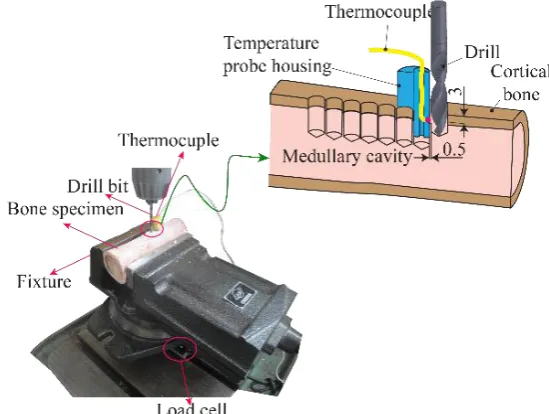
The depth of the holes in the analysis was 8 mm. The thrust force was measured with a dynamometer. To measure the temperature K-type thermocouples were used and the measurement was performed in the depth of 3 mm and distance of 0.5 mm from the hole wall [47, 48]. Figure 1 shows the typical set up of the experiments.
In the experiments bovine femur cortical bone was used which is similar to human cortical bone. To make the experiments more similar to what occurs in a real surgery, the bone tissue used to make the experimental samples was one which was alive a few hours before the experiments. The location of thermocouples is shown in Fig. 2.
Fig. 2. Experimental Setup and Thermocouple positioning in bone drilling process.
2.2. Mathematical modeling and experimental procedures
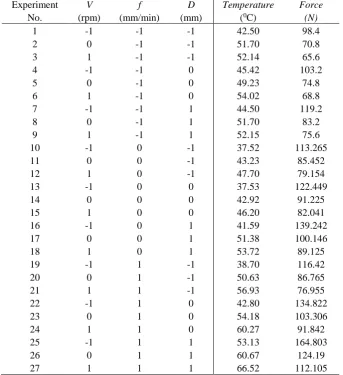
Rotational speed, feed rate and tool diameter were selected as input variables and a 33 full factorial experiments was performed. Response Surface Method (RSM) was employed to develop the model. In Table 1, input variables and their range of variation are listed based on three coded units.
Response surface method is a mathematical-statistical method used to model and analyze problems as complex functions of some variables. The goal of ‘response surface methodology' (RSM) is to statistically model and optimize the problem [49]. The basics of the RSM are the design of experiments and statistical optimization. The design of experiments is a suitable tool for engineers in developing experiments with less time and expense. Applying this method requires less process time and costs [50]. Evaluation of the accuracy of experiments, governing the mathematical model of the experiments, developing interaction diagrams of input variables, the experiments’ optimization and assuring of the exact reliance of the developed model are some of the advantages of RSM [51]. Considering the factors and effective interactions, the general form of the equation is Eq. (1) [52]:
𝑦 = 𝛽0+ ∑𝑘𝑖=1𝛽𝑖𝑥𝑖+ ∑𝑘𝑖=1𝛽𝑖𝑖𝑥𝑖2+ ∑ ∑ 𝛽𝑖 𝑗 𝑖𝑗𝑥𝑖𝑥𝑗+ 𝜀 (1)
Furthermore, RSM is able to model the relation between the inputs and outputs and represent it as a second-order linear integration equation [53].
Table 1. Coded units of input variables in bone drilling process 1 0
-1 Factors
2500 1500
500
V (rpm)
50 30
10
f (mm/min)
5 4
2.5
D (mm)
Table 2. Implemented experiments and maximum measured temperature and maximum trust force Experiment
No.
V
(rpm)
f
(mm/min)
D
(mm)
Temperature
(0C)
Force (N)
1 -1 -1 -1 42.50 98.4
2 0 -1 -1 51.70 70.8
3 1 -1 -1 52.14 65.6
4 -1 -1 0 45.42 103.2
5 0 -1 0 49.23 74.8
6 1 -1 0 54.02 68.8
7 -1 -1 1 44.50 119.2
8 0 -1 1 51.70 83.2
9 1 -1 1 52.15 75.6
10 -1 0 -1 37.52 113.265
11 0 0 -1 43.23 85.452
12 1 0 -1 47.70 79.154
13 -1 0 0 37.53 122.449
14 0 0 0 42.92 91.225
15 1 0 0 46.20 82.041
16 -1 0 1 41.59 139.242
17 0 0 1 51.38 100.146
18 1 0 1 53.72 89.125
19 -1 1 -1 38.70 116.42
20 0 1 -1 50.63 86.765
21 1 1 -1 56.93 76.955
22 -1 1 0 42.80 134.822
23 0 1 0 54.18 103.306
24 1 1 0 60.27 91.842
25 -1 1 1 53.13 164.803
26 0 1 1 60.67 124.19
27 1 1 1 66.52 112.105
Using RSM and data analysis, a second order linear regression equation was derived to relate the output variable to the input parameters. Model optimization has also been followed.
3. Modeling of Temperature and Force Using Regression Method
Based on temperature and force data analysis, Analysis of Variance (ANOVA) is presented in Tables 3 and 4 for both process temperature and process force.Assuming the reliability of 95% in a precise engineering experimentation, a P-value of less than 0.05 is a must to ascertain the effectiveness of different model terms[50].
Table 3. ANOVA on temperature based on the effective parameters in bone drilling process. Terms DF Seq SS Adj SS Adj MS F Pvalue Model 9 1332.83 1332.83 148.092 49.23 0.000
V 1 623.85 625.54 625.54 207.96 0.000
f 1 91.08 77.29 77.29 25.70 0.000
D 1 149.47 163.81 163.81 54.46 0.000
V2 1 26.66 26.66 26.66 8.86 0.008
f2 1 282.96 282.96 282.96 94.07 0.000
D2 1 32.48 32.48 32.48 10.80 0.004
V·f 1 44.81 44.81 44.81 14.90 0.001
V·D 1 2.05 2.05 2.05 0.68 0.421
Table 4. ANOVA on force based on the effective parameters in bone drilling process.
Terms DF Seq SS Adj SS Adj MS F Pvalue
Model 9 15298.7 15298.7 1699.85 182.26 0.000
V 1 7629.3 7423.3 7423.30 795.93 0.000
f 1 2443.2 2563.3 2563.29 274.84 0.000
D 1 3517.0 3284.5 3284.54 352.17 0.000
V2 1 842.2 842.2 842.20 90.30 0.000
f2 1 177.0 177.0 177.00 18.98 0.000
D2 1 20.6 20.6 20.65 2.21 0.155
V·f 1 124.4 124.4 124.39 13.34 0.002
V·D 1 49.4 49.4 49.36 5.29 0.034
f·D 1 495.4 495.4 495.45 53.12 0.000
By second order linear model PRESS value for temperature is 136.470 and for force it is 435.473. Second order linear regression equations governing the temperature and force behaviors are presented in Eqs. (2) and (3) respectively.
T = 69.8213 + 0.01057V − 1.45454𝑓 − 11.8733D − 0.000002109V2
+ 0.0171684𝑓2+ 1.56149D2− 0.0001V × 𝑓 − 0.0004V × D + 0.102253𝑓 × D (2)
𝐹𝑜𝑟𝑐𝑒 = 145.607 − 0.0432796𝑉 + 0.150566𝑓 − 21.6122𝐷 + 0.0000118476𝑉2
+ 0.00464𝑓2+ 3645𝐷2− 0.00010143𝑉 × 𝑓 − 0.00256𝑉 × 𝐷 + 0.255𝑓 × 𝐷 (3)
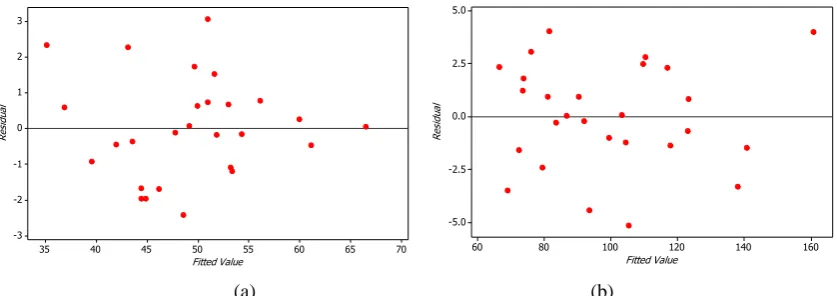
Considering the temperature values, R-sq= 96.31%, R-sq (pred) = 90.12% and R-sq (adj) = 94.35% and given the force values, R-sq= 98.97%, R-sq (pred) = 97.18% and R-sq (adj) = 98.43%. These values prove that the accuracy of the developed model is acceptable.
Based on Fig. 3, it can be inferred that the accuracy of the developed model for temperature and force is acceptable.
(a) (b)
Fig. 3.Residual distribution versus fitted value (a): temperature, (b): force
4. Multi Objective Optimization Results
The main goal is to optimize the process outcomes. Results from studying bone drilling process are used in tuning conditions in a real surgery. In a bone surgery, it is desirable to have the minimum process force and temperature while performing surgery in the shortest possible amount of time. In order to obtain the optimal performance of the geometrical and operational parameters as mentioned in Table 1, the regression models elicited are now employed in a multiobjective optimization procedure using NSGA II algorithms [54, 55]. The population size of 60 along with crossover probability Pc and mutation probability of 0.7 and 0.07
respectively, were selected for all run cases. Considering the design variables (Table 1), the process force and temperature will be optimized as two conflicting objectives at the same time.
The multi-objective optimization problem can be formulated in the following form:
{
𝑀𝑖𝑛𝑖𝑚𝑖𝑧𝑒 𝐹 = 𝑓
1(𝐷, 𝑓, 𝑉)
𝑀𝑖𝑛𝑖𝑚𝑖𝑧𝑒 𝑇 = 𝑓
2(𝐷, 𝑓, 𝑉)
𝑆𝑢𝑏𝑗𝑒𝑐𝑡 𝑡𝑜 [
2.5 ≤ 𝐷 ≤ 5 (𝑚𝑚)
10 ≤ 𝑓 ≤ 50 (𝑚𝑚/𝑚𝑖𝑛)
500 ≤ 𝑉 ≤ 2500 (𝑟𝑝𝑚)
(4)
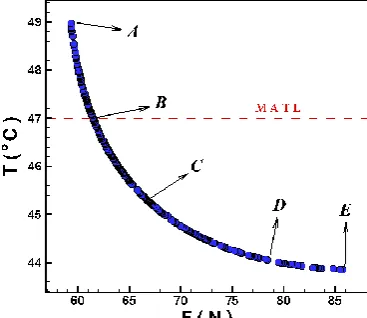
Non-dominated optimum design points are shown in Fig. 4 as Pareto front for both objective functions. The corresponding design variables and objective functions for each of optimum design points: A, B, C,D
and E are listed in Table 5. As shown the maximum allowable temperature level (MATL) is equal to 47o C and should be controlled in order to prevent any harm to the bones. Tradeoffs from both process temperature and force objective functions, shown by these points, reveal that an appropriate design is obtained through compromise. It also can be seen from Fig. 4 that all optimum design points are non-dominated, and therefore they all can be assumed as optimum conditions in Pareto front. Consequently, a value with higher fitness to one objective function in Pareto front yields lower fitness for another objective function.
Fig. 4. Multiobjective Pareto results for temperature and force related to optimal design points.
In Fig. 4, the design points A and E stand for the best force and the best temperature respectively. Moreover, the other optimum design points, B and D can be simply recognized from Fig. 4. The design point B exhibits important optimal design concepts. In fact, the optimum design point B obtained in this paper exhibits an increase in the force (about 10.5%) in comparison with that of point A whilst its temperature improves about 32.2%; similarly, the optimum design point D exhibits an improvement in the force (about 19.1%) in comparison with that of point E whilst its temperature increases about 9.6%.
Table 5. The values of objective functions and their associated design variables of the optimum points
Optimum design points as a tradeoff for both objective functions are desired. They can be introduced using mapping method presented in this paper where values for entire non-dominated points are mapped into a range from 0 to 1. The summation of these values for each non-dominated point can obtain a tradeoff point
Point D(mm) f(mm/min) V(rpm) F(N) T(℃)
A 4.5 10 500 59.35 48.97
B 4.2 10 500 61.46 47.00
C 3.9 13.2 500 65.79 45.51
D 3.3 20 500 78.41 44.05
which has the minimum summation [54]. Therefore, the optimum design C is a set of tradeoff points emerged from mapping method.
The Pareto front obtained from the regression models (Fig. 4) has been superimposed with the corresponding experimental data in Fig. 5. It can be clearly seen from this figure that such an obtained Pareto front lies on the best possible combination of the objective values of the experimental data, which demonstrates the effectiveness of this method both in deriving the model and in obtaining the Pareto front [55].
Fig. 5. Overlap graph of the obtained optimal Pareto front with the related experimental data.
Optimal process temperature and force values, corresponding to assumed design variables, are presented in Figs. 6 and 7 respectively. In bone drilling process, there are remarkable design facts applicable for thermal necrosis analysis. It can be inferred that the correspondence between the optimum design variables of bone drilling parameters would not be unconcealed if a multi objective Pareto optimization, presented in this paper, was not followed.
Fig. 6. Optimal variations of force with respect to design variables (f and D).
5. Conclusion
A multiobjective Pareto-based optimization of bone drilling process has been successfully performed using Genetic Algorithms. Regression model using some experimental data revealed two different polynomial equations for each process temperature and process force objective. These polynomials were used in an evolutionary multiobjective optimization based on Pareto method. Useful findings have been reached for analyzing thermal necrosis in bone drilling process. These findings were correspondent to design variables in Pareto front for both of the conflicting objective functions namely force and temperature. The combination of experimental data, regression model and Pareto optimization shows promising potentials in revealing useful design relationships.
6. References
[1] W. Wang, Y. Shi, N. Yang, X. Yuan, Experimental analysis of drilling process in cortical bone, Medical engineering & physics 36(2) (2014) 261-266.
[2] R.K. Pandey, S. Panda, Drilling of bone: A comprehensive review, Journal of clinical Orthopaedics and Trauma
4(1) (2013) 15-30.
[3] M. Louredo, I. Díaz, J.J. Gil, DRIBON:A mechatronic bone drilling tool. Mechatronics 22(8) (2012) 1060-1066. [4] M.H. Aziz, M.A. Ayub, R. Jaafar, Real-time algorithm for detection of breakthrough bone drilling, Procedia
Engineering 41 (2012) 352-359.
[5] I. Díaz, J.J. Gil, M. Louredo, Bone drilling methodology and tool based on position measurements, Computer methods and programs in biomedicine 112(2) (2013) 284-292.
[6] J. Sui, N. Sugita, K. Ishii, K. Harada, Mechanistic modeling of bone-drilling process with experimental validation
Journal of Materials Processing Technology 214(4) (2014) 1018-1026.
[7] G. Augustin, T. Zigman, S. Davila, T. Udilljak, Cortical bone drilling and thermal osteonecrosis, Clinical biomechanics 27(4) 2012 313-325.
[8] K.N. Bachus, M.T. Rondina, D.T. Hutchinson, The effects of drilling force on cortical temperatures and their duration: an in vitro study, Medical engineering & physics 22(10) (2000) 685-691.
[9] P. FG, Histological change in bone after insertion of skeletal fixation pins,J Oral Surg Anest Hosp Dent Serv 18 (1960) 9.
[10]F. Bronner, M.C. Farach-Carson, J. Rubin, S.D. Bain, Bone Resorption, (2005): Springer.
[11]A. Eriksson, T. Albrektsson, Temperature threshold levels for heat-induced bone tissue injury: a vital-microscopic
study in the rabbit, The Journal of prosthetic dentistry 50(1) (1983) 101-107.
[12]A.R. Moritz, F. Henriques Jr, Studies of thermal injury: II. The relative importance of time and surface temperature
in the causation of cutaneous burns, The American journal of pathology 23(5) (1947) p. 695.
[13]R. Eriksson, T. Albrektsson, The effect of heat on bone regeneration: an experimental study in the rabbit using the
bone growth chamber, Journal of Oral and Maxillofacial surgery 42(11) (1984) 705-711.
[14]Y. Hou, C. Li, H. Ma, Y. Zhang, M. Yang, X. Zhang, A Theoretical Analysis on Bone Drilling Temperature Field
of Superhard Drill, The Open Mechanical Engineering Journal 10(1) (2016).
[15]L. Lamazza, G. Garreffa, D. Laurito, M. Lollobrigida, L. Palmieri, et al., Temperature Values Variability in
Piezoelectric Implant Site Preparation: Differences between Cortical and Corticocancellous Bovine Bone, BioMed research international (2016) 2016.
[16]R.K. Pandey, S.S. Panda, Optimization of multiple quality characteristics in bone drilling using grey relational
analysis, Journal of orthopaedics 12(1) (2015) 39-45.
[17]J. Lundskog, Heat and bone tissue. An experimental investigation of the thermal properties of bone and threshold
[18]K. Deb, S. Karthik. Dynamic multi-objective optimization and decision-making using modified NSGA-II: a case
study on hydro-thermal power scheduling, International conference on evolutionary multi-criterion optimization
(2007). Springer.
[19]H. Safikhani, A. Hajiloo, M.J.C. Ranjbar, Modeling and multi-objective optimization of cyclone separators using
CFD and genetic algorithms, Computers & Chemical Engineering 35(6) (2011) 1064-1071.
[20]S. Eiamsa-Ard, C. Nuntadusit, P.J.H.T.E. Promvonge, Effect of twin delta-winged twisted-tape on thermal
performance of heat exchanger tube, 34(15) (2013) 1278-1288.
[21]H. Safikhani, A. Abbassi, A. Khalkhali, Multi-objective optimization of nanofluid flow in flat tubes using CFD,
Artificial Neural Networks and genetic algorithms 25(5) (2014) 1608-1617.
[22]R.K. Pandey, S.J.M. Panda, Optimization of bone drilling parameters using grey-based fuzzy algorithm, Heat Transfer Engineering. 47 (2014) 386-392.
[23]K. Alam, A. Mitrofanov, V.V.J.M.e. Silberschmidt, Experimental investigations of forces and torque in
conventional and ultrasonically-assisted drilling of cortical bone, Medical engineering & physics 33(2) (2011) 234-239.
[24]M. Basiaga, Z. Paszenda, J. Szewczenko, Numerical and experimental analyses of drills used in osteosynthesis.
Acta of Bioengineering and Biomechanics13(4) (2011) 29-36.
[25]C. Jacobs, M. Pope, J. Berry, F.J.J.o.B. Hoaglund, A study of the bone machining process—orthogonal cutting,
Journal of Biomechanics 7(2) (1974) 131-136.
[26]J. Lee, B.A. Gozen, O.B.J.J.o.b. Ozdoganlar, Modeling and experimentation of bone drilling forces, Journal of Biomechanics45(6) (2012) 1076-1083.
[27]T. Udiljak, D. Ciglar, S.J.A.i.P.E. Skoric, Investigation into bone drilling and thermal bone necrosis,Advances in Production Engineering & Management 2(3) (2007) 103-112.
[28]R. Eriksson, T.J.J.o.O. Albrektsson, M. Surgery, The effect of heat on bone regeneration: an experimental study
in the rabbit using the bone growth chamber, Journal of Prosthetic Dentistry 42(11) (1984) 705-711.
[29]R. Vaughn, F. Peyton, The influence of rotational speed on temperature rise during cavity preparation, Journal of dental research 30(5) (1951) 737-744.
[30]G. Augustin, S. Davila, K. Mihoci, T. Udiljak, D.S. Vedrina, Thermal osteonecrosis and bone drilling parameters
revisited, Archives of Orthopaedic and Trauma Surgery 128(1) (2008) 71-77.
[31]G. Augustin, S. Davila, T. Udilljak, T. Staroveski, D. Brezak Temperature changes during cortical bone drilling
with a newly designed step drill and an internally cooled drill, International Orthopaedics 36(7) (2012) 1449-1456.
[32]F. Karaca, B. Aksakal, M.J.M.E. Kom, Physics, Influence of orthopaedic drilling parameters on temperature and
histopathology of bovine tibia: an in vitro study, Medical Engineering & Physics 33(10) (2011) 1221-1227. [33]J. Lee, O.B. Ozdoganlar, Y.J.M.e. Rabin, physics, An experimental investigation on thermal exposure during bone
drilling, Medical Engineering & Physics 34(10) (2012) 1510-1520.
[34]R.K. Pandey, S.J.M. Panda, Multi-performance optimization of bone drilling using Taguchi method based on
membership function, measurement 59 (2015) 9-13.
[35]L.S. Matthews, C.J.J. Hirsch, Temperatures measured in human cortical bone when drilling, Journal of bone and joint surgery 54(2) (1972) 297-308.
[36]M. Sharawy, C.E. Misch, N. Weller, S.J.J.o.O. Tehemar, Heat generation during implant drilling: the significance
of motor speed, Part H: Journal of Engineering in Medicine 60(10) 2002 1160-1169.
[37]E. Shakouri, M.H. Sadeghi, M. Maerefat, Experimental and analytical investigation of the thermal necrosis in
high-speed drilling of bone,Modares Mechanical Engineering 228(4) (2014) 330-341.
[38]G. Augustin, S. Davila, K. Mihoci, T. Udiljak, D.S. Vedrina, A. Antabak, Thermal osteonecrosis and bone drilling
[39]K. Alam, Experimental and numerical analysis of conventional and ultrasonically-assisted cutting of bone (2009), © Khurshid Alam.
[40]R.K. Pandey, S. Panda, Optimization of bone drilling parameters using grey-based fuzzy algorithm,Measurement
47 (2014) 386-392.
[41]R.K. Pandey, S. Panda, Multi-performance optimization of bone drilling using Taguchi method based on
membership function, Measurement 59 (2015) 9-13.
[42]R.K. Pandey, S. Panda, Optimization of bone drilling using Taguchi methodology coupled with fuzzy based
desirability function approach, Journal of Intelligent Manufacturing 26(6) (2015) 1121-1129.
[43]V. Tahmasbi, M. Ghoreishi, M.J.P.o.t.I.o.M.E. Zolfaghari, Investigation, sensitivity analysis, and multi-objective
optimization of effective parameters on temperature and force in robotic drilling cortical bone, Part H: Journal of Engineering in Medicine 231(11) (2017) 1012-1024.
[44]V. Tahmasbi, M. Ghoreshi, M.J.I.J.o.E.-T.A.B. Zolfaghari, Temperature in bone drilling process: Mathematical
modeling and Optimization of effective parameters, 29(7) (2016) 946-953.
[45]V. Tahmasbi, M. Ghoreishi, M.J.B. Zolfaghari, Sensitivity analysis of temperature and force in robotic bone
drilling process using Sobol statistical method,Biotechnology & Biotechnological Equipment 32(1) (20181) 30-141.
[46]H. Heydari, M. Zolfaghari, M. Ghoreishi, V. Tahmasbi, Analytical and experimental study of effective parameters
on process temperature during cortical bone drilling, Proceedings of the Institution of Mechanical Engineers, Part H: Journal of Engineering in Medicine 232(11) (2018) 230-245.
[47]T. Staroveski, D. Brezak, T. Udiljak, Drill wear monitoring in cortical bone drilling, Medical engineering & physics 37(6) (2015) 560-566.
[48]V. Tahmasbi, M. Ghoreshi, M. Zolfaghari, Temperature in bone drilling process: Mathematical modeling and
optimization of effective parameters (Technical Note), International Journal of Engineering-Transactions A: Basics 29(7) (2016) 946.
[49]M. Ghoreishi, V. Tahmasbi, Optimization of material removal rate in dry electro-discharge machining
process,Modares Mechanical Engineering 14(12) (2015) 9.
[50]D.C. Montgomery, Design and analysis of experiments. (2008) John Wiley & Sons.
[51]T.H. Hou, C. H. Su, W. L. Liu, Parameters optimization of a nano-particle wet milling process using the Taguchi
method, response surface method and genetic algorithm, Powder Technology 173(3) (2007) 153-62.
[52]R.H. Myers, D.C. Montgomery, C.M.J.A.P. Anderson-Cook, Response Surface Methodology: Process and Product Optimization Using Designed Experiments (Wiley Series in Probability and Statistics). (1995).
[53]S.M. Assarzadeh, Ghoreishi, A dual response surface-desirability approach to process modeling and optimization
of Al2O3 powder-mixed electrical discharge machining (PMEDM) parameters, The International Journal of Advanced Manufacturing Technology 64(9-12) (2013) 1459-1477.
[54]H. Safikhani, A. Hajiloo, M. Ranjbar, Modeling and multi-objective optimization of cyclone separators using CFD
and genetic algorithms, Computers & Chemical Engineering 35(6) (2011) 1064-1071.
[55]H. Safikhani, A. Abbassi, A. Khalkhali, M. Kalteh, Multi-objective optimization of nanofluid flow in flat tubes