Helping a Microfinance Institution Select its
Clients: A Risk Analysis using Social Networks
Sayantan Mitra
College of Wooster
Varunavi Newar
College of WoosterFollow this and additional works at:
https://openworks.wooster.edu/blackandgold
Part of the
Finance Commons
,
Growth and Development Commons
, and the
Other Applied
Mathematics Commons
This Article is brought to you for free and open access by Open Works. It has been accepted for inclusion in Black & Gold by an authorized
Recommended Citation
Mitra, Sayantan and Newar, Varunavi (2015) "Helping a Microfinance Institution Select its Clients: A Risk Analysis using Social Networks,"Black & Gold: Vol. 1.
Introduction and Motivation
Determining credit worthiness in a developed society can be accomplished
without great effort using an individual’s credit history based on their previous financial transactions with formal banking institutions. However, in less developed
societies where there is an absence of formal financial institutions, this becomes
difficult. This is because of a variety of factors. Firstly, the absence of formal
banking institutions leads to a lack of financial records and data regarding an
individual’s financial transactions. Secondly, poverty, which is common in these societies, implies the absence of assets that can be valued as collateral for formal
loans. Therefore, informal financial institutions that serve these societies depend
on alternative measures of determining credit worthiness of a borrower.
In traditional individual based microfinance, an eligible borrower is selected by
a microfinance institution (MFI) on the recommendation of a local agent. The
MFI agent judges the “credit worthiness” of an individual based on the opinions of the local community about the person and a subjective evaluation of the
individual’s ability to repay a loan. Thus, the eligibility of a potential borrower to
receive a loan depends entirely on the judgement of the agent. However, this may
be problematic as the agent’s judgement might be heavily influenced by his/her
personal biases, prejudices and background. This skews the MFI’s valuation of the
risk associated with lending to its clients. For example, this might lead the MFI to lend money to a person who, based on the agent’s personal judgement, is
considered “credit worthy” but actually has a high probability of defaulting. On
the other hand, the MFI may also lose out on an opportunity to invest in a person
who is considered to be “risky” but actually has a very low probability of
defaulting. In this paper, we address this problem through the use of social networks. A social network is a network or pattern of social interactions or
personal relationships which connect people. It consists of nodes, representing
entities, and edges, representing the relationship or ties between those entities.
Microfinance is the ideal example of a program that uses social capital in such a
way that it mobilizes the social network to alleviate poverty [6]. The importance of
the social network in modeling the diffusion of microfinance in a community has been documented in Banerjee, et al (2013) [2]. Therefore, it is natural to use social
network analysis to aid us in formulating a mechanism for the MFI to determine
the risk associated with a potential borrower. The contribution of this paper
would be to use social networks to analyze the different characteristics of the loan
portfolio. In this paper we deal only with credit risk, but it opens up a path to
Therefore, there is a need for an objective model based on social network
theory that can be used by MFIs globally to accurately assess the credit worthiness
of a potential borrower in a community. This would provide the MFI with an objective method of screening potential borrowers that would depend minimally
on judgment of the agent. The goal of this paper is to formulate an effective
simplistic mathematical model that generates the credit worthiness of a potential
MFI client based on his/her position in the social network in their community and
their individual financial characteristics. Some of the financial characteristics we will be dealing with in this model include ownership of tangible assets, monthly
per capita income and the risk associated with the proposed investment.
The Model
As stated in Section 1, our goal is to measure credit risk in an environment
where conventional means fail. In order to create our model, we first describe the setting where this model is being implemented and the assumptions of the model
before proceeding to set up the model. A community in this model is defined as a
collection ofnhouseholds which are situated in geographical proximity to each
other which constitutes an administrative unit such as a village. This community
is part of a less developed society with no formal financial institutions. The
members of the community are poor and hence, do not own any tangible assets that can be sufficiently valued as a collateral for getting a loan.There is only one
informal financial institution in the form of an MFI operating in the community.
There is no information about the credit history of the individuals of the
community. The MFI provides loans to only one individual per household. The
MFI provides subsequent loans to households only after repayment of the previous loan. Thus, there is an incentive for the household to repay the loan.
Assumptions
(A1) The MFI’s decision to lend to an individual depends on the following factors:
(A1.1) The level of trust of other community members regarding the potential
borrower.
(A1.2) The monthly income per capita of the potential borrower’s household.
(A1.3) The nature of the investment that the potential borrower wishes to use
the loan for.
(A1.4) Ownership of transferable assets such as precious metals, which is not
(A2) A relationship of trust between two households is mutual. For example, if
household X trusts household Y, then it is assumed that household Y trusts
household X.
(A3) The more trusted a household is in the community, the higher the
household’s credit worthiness.
Role of Social Networks
Anetwork is a collection of nodes, some of which are connected by edges. In a social network, a node represents an entity and an edge represents the ties between those entities. In this model, we construct asocial network based on the trust that
community members have for other households in the community. Letndenote
the number of households in the community. Each household is represented by a
node,Ni, for 1≤i≤n. An edge,Ei,j, connecting nodesNi andNj, with i6=j,
represents trust between householdsi andj. An edge is present between two
households if the two households reveal that they trust each other. In light of (A2),
the trust relation is symmetric and thus the network constructed here isundirected, i.e. householdi trusts householdj if and only if householdj trusts householdi.
The level of trust that a household enjoys in the community is increased by
having trust relationships with other households that are themselves highly trusted
in the network. This gives each householdia “trust score”Ti, proportional to the
sum of the trust scores of the households to which it has a trust connection. This
measure is more reliable than just measuring the number of people who have trust
connections with a household (known as degree centrality). Here, we use the
concept of eigenvector centrality. This is a measure of how central a node is in a
network. This concept is used in network theory to measure influence and impact
[5]. This measure was proposed by Bonacich [3] in 1987 as a measure of power[3] . In order to determine the trust score of the households using the above
mentioned mechanism, we make some initial guess about the trust scoreTi of each
node (household)i. For instance, we could start off by settingTi= 1 for alli.
Obviously this is not a useful measure, but we can use it to calculate a better one
Ti0, which we define to be the sum of the trust scores ofi’s neighbors. Thus
Ti0= X
j
ai,jTj,
whereaij is thei, jth element of the adjacency matrixAof the trust network. The
adjacency matrix is a matrix with rows and columns labeled by graph vertices,
For a simple unidirected graph with no self-loops such as this trust network, the
adjacency matrix has 0’ s on the diagonal and is symmetric. We can also write this
expression in matrix notation as
~
T0 =A ~T ,
whereT~ is the column vector with elementsTi . Repeating this processt times to
make better estimates, we have a vector of trust scoresT~(t) given by
~
T(t) =AtT~0.
Now we writeT~0 as a linear combination of the eigenvectors~v
i of the adjacency
matrix, thus:
~ T0 =X
i civ~i,
for some appropriate choice of constantsci . Then
~
T(t) =AtX i
civ~i= X
i
ciλtiv~i.
In order to normalize the relation with respect to the largest eigenvalueλ1 (also
called thespectral radius ofA),
~
T(t) =λt1
X
i ci
λi λ1
t ~ vi,
whereλi are the eigenvalues ofA, which are all smaller thanλ1. By Perron’s
Theorem, a real square matrix withnon-negative entries has a unique largest real eigenvalue and that the corresponding eigenvector has strictly non-negative
components [4]. This holds true in this case as the adjacency matrix is a real
square matrix with non-negative entries. Sinceλi/λ1<1 for alli6= 1, all terms in
the sum, other than the first, decay exponentially astbecomes large. Therefore,
the limitt→ ∞we getT~(t)→c1λt1v~1. In other words, the limiting vector of trust
scores is simply proportional to the leading eigenvector of the adjacency matrix. Equivalently we could say that the trust score vectorT~ satisfies
This can be re-written as
~
T = 1
λ1
A ~T .
Rearranging, we get
(A−λ1I)T~ = 0, (1)
whereI is then×nidentity matrix. Thus we see thatT~ is an eigenvector for the eigenvalueλ1. By the properties of eigenvectors and eigenvalues, we know
det(A−λ1I) = 0.
Therefore, equation (1) has infinitely many solutions. We can find a particular
solution in this case by setting the free variable equal to 1 (we know that there is
only one free variable because the algebraic multiplicity is 1).
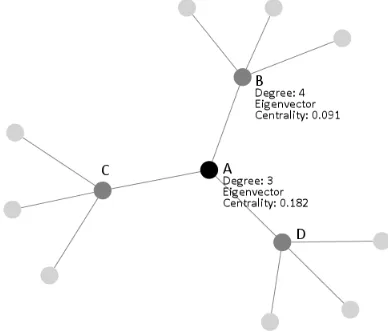
In order to illustrate this, let us consider a small hypothetical network with
the given trust relationships.
Figure 1: A simple network with eigenvector centrality, taken fromhttp://www.
umasocialmedia.com/socialnetworks/glossary/eigenvector-centrality/.
In Figure 1, degree refers to the number of nodes a particular node is
connected to, which is also referred to as the “degree centrality”. The eigenvector
centrality in this example represents the “trust score” of each household. As
demonstrated above, being trusted by a large number of households (degree centrality) is not the same as being trusted by households that are themselves
to more households than household A, but household A has a higher trust score as
it is connected to other trusted households C and D.
Role of individual financial characteristics
Besides the role of the trust that other community members have in a
particular household, the household’s financial characteristics play a significant
role in determining it’s credit worthiness. Specifically, the monthly income of the
household, the value of transferable assets owned by the household and the nature of the proposed investment of the loan are considered as vital determinants of
credit worthiness in our model.
The monthly income per capita of the household is said to affect the credit
worthiness of the household in this model. A high monthly income per capita can
be correlated with the availability of funds to overcome financial shocks, which
would ensure a lesser probability of default on the loan. We use the per capita income and not the total household income in order to account for the number of
dependents per household.
The value of the transferable assets that the household owns is also a key
determinant of the credit worthiness of the household. The ownership of these
assets (which are not sufficient to be used as collateral) can be a source of
emergency funds in times of financial shocks. Therefore, the household can use these assets to repay a loan, thus reducing the chances of default.
Finally, the nature of the proposed investment that the loan would be used for
plays a pivotal role in deterring credit worthiness. Specifically, the risk factor
involved with such an investment is key to our calculation. The risk of the
potential business/investment varies from one geographical region to another and is determined by the resources available at hand and the demand in the market for
the particular service or product proposed. For example, investment in an
agricultural business would be considered a risky venture in an area that is
characterized by infertile soil, but may be the safest investment in an area which is
highly irrigated.
The individual financial characteristics can be aggregated with the variableβi
which is represented as
βi=f(Mi, Ai, Ri),
whereMi is the monthly per capita income of householdi,Ai is the value of the
transferable assets of the householdi, andRi is the measure of how risky the
proposed investment of the householdiis.
βi is [0,1] in order to ensure a balanced measure of credit risk. It would require an
MFI to collect data regarding these characteristics and find a relation between
these characteristics and repayment rates.
The model for credit-worthiness
Our model incorporates the trust level of a household in a social network with
the financial characteristics of an individual household to predict the credit
worthiness of a potential borrower. Incorporating the financial characteristics into the trust score provides each household (node) in the network with a specific
credit-worthiness score. It provides a small amount of centrality for free to each
node, regardless of its position in the network or the centrality of its neighbors.
This can be formulated in the form of a Katz centrality approach, where the βi is
added to the trust scoreTi for each node [5]. Therefore, the credit worthiness can
be represented as
Ci=Ti+βi,
whereTi stands for the trust level of the household in the social network andβi
stands for the individual financial characteristics of the household.
Limitations
We derive this model based on our understanding of the current Grameen
Bank model of individual-based microfinance [7]. This might not be an accurate
approach that can be reciprocated in all parts of the globe.
This model requires households to reveal their trust networks, which may not
be very easy to obtain. In certain cases, it might not be feasible and against the
rights of clients to reveal their trust networks to MFIs. However, this is an empirical question which can be dealt with in innovative ways of questioning.
Moreover, this model assumes a very idealistic model of microfinance where
there is only one MFI in the community and it lends only to the extremely poor in
the community. Relaxing these assumptions might have effects that may not follow
from this model and these can be the basis for further research.
Conclusion
This model can be utilized by MFI’s in less developed countries around the
world to check the eligibility of a potential borrower without relying on the
judgement of an agent. This eliminates the source of human error in evaluating
the risk associated with lending. This model would also help an MFI cut
eligibility of potential borrowers.
This model also seeks to address the problem of high interest rates, which is
one of the key issues that plague microfinance globally. Using this model, it will be possible for MFIs to accurately judge the risk potential associated with the
borrowers. This will allow them to charge an interest rate that is proportionate to
an individual’s risk potential, thus eliminating high interest rates which impoverish
poor families and leave out safe borrower households from the MFI’s client pool [1].
References
[1] Beatriz Armendariz. The economics of microfinance. MIT Press, Cambridge,
Mass, 2010.
[2] Abhijit Banerjee, Arun G Chandrasekhar, Esther Duflo, and Matthew O
Jackson. The diffusion of microfinance. Science, 341(6144), 2013.
[3] Phillip Bonacich. Power and centrality: A family of measures. American
journal of sociology, pages 1170–1182, 1987.
[4] Peter Lax. Linear Algebra and Its Applications. Wiley, Hoboken, 2013.
[5] M. E. J. Newman. Networks: An introduction. Oxford University Press,
Oxford, 2010.
[6] Katherine N Rankin. Social capital, microfinance, and the politics of
development. Feminist economics, 8(1):1–24, 2002.
[7] Muhammad Yunus. Grameen bank ii: designed to open new possibilities.