What Is the EU?
József Böröcz
Rutgers University1Mahua Sarkar
Binghamton University, SUNYabstract:This interpretive article relies on insights from three critical literatures – world-systems analysis, postcolonial studies and, to the extent of an extended simile, the economic sociology of flexible global production – to propose a geo-political understanding of what the European Union (EU) is. The authors begin by interrogating the tendency within much of the current research and commentary on the EU to treat it as a state of sorts. They then outline some mechanisms – pertaining to its internal and external linkage structures – that have enabled the EU to perform successfully in a geo-political context where most of the main actors are states. Finally, drawing on critical insights from the sociology of subcontracted production and distributed organization, the authors suggest ways in which the EU, in its current form, might be thought of beyond the constraints of the current theoretical language of statehood.
keywords:coloniality ✦dependency ✦eastern enlargement ✦
European integration ✦public authority ✦statehood
Not a State
The history of West European integration presents numerous instances of disunity, posturing and contentious bargaining. And yet, the introduction and apparent success of the common currency – the euro – seems to have in effect marginalized the view, not uncommon in earlier writing, that the EU is ‘just’ a customs union or an intergovernmental organization. Notwithstanding the continued appeal of observations such as ‘the member states of the EU have with surprising success defended their positions as the masters of their economy’ (Streeck, 1996: 65), or that the
International Sociology ✦June 2005 ✦Vol 20(2): 153–173 SAGE (London, Thousand Oaks, CA and New Delhi)
EU continues to be ‘characterised by a . . . dualism between supranational European law and intergovernmental European policy-making’ (Scharpf, 1996: 15) – an image of the EU as a unified, single entity, very much like a state, has come to dominate the literature. This is so even though, as Philippe Schmitter (1996b: 133–8) has recently shown, statehood is clearly only one of the logically possible outcomes of political integration in Western Europe. There is, of course, much disagreement about what kind of a (quasi-)state the EU is or could be (federal-supranational or confed-erate-intergovernmental, unified-single-layer or multi-level, centralized or decentralized, etc.). There is even a dispute regarding whether the EU represents a meaningful unit of analysis at all (Stone-Sweet and Sand-holtz, 1998; Caporaso et al., 1997) – a point to which we return at the end of this article. It is also clear that, in general, ‘states are not the exclusive and may no longer be the predominant actors in the regional/inter-national system’ (Schmitter, 1996a: 6). Yet, the conceptual tools and the emphases in the literature on the EU reveal at least an implicit proclivity to seeing the EU through the looking-glass of the West European state. This is coupled with and, in our view, partly explained by, a nearly universal tendency in the literature on the EU to disregard the external aspects of the EU’s structural features and its behaviour that might help shed light on the specificity of the EU as a geopolitical entity.
The EU also maintains embassies abroad and regularly signs treaties with states. Finally, and perhaps most significantly, the EU commands a certain geopolitical weight – as manifested in its ability to both influence its immediate environment and project its power to the world outside – that is matched only by a handful of actors on the world scene, all of whom are states. Given those features, the EU is, clearly, some kind of a public authoritythat looks, in some important respects, like a state.
There is, however, one crucial aspect of the EU’s organization that sets it fundamentally apart from a conventionally defined state: the EU has
no executive apparatus. While the Commission may be referred to as the
government of the EU, the reference remains merely metaphorical since the EU has no executive machinery2below the level of the Directorates-General. According to the definition prevalent since Max Weber, a state is that organization that has a monopoly on the use of legitimate violence within a given territory. The EU, in contrast, has no such monopoly over the use of legitimate violence; indeed, it has practically no means of coercion of its own at all, except for the recently established, but not nearly fully operational, Rapid Reaction Force, whose command structures and tasks are as yet unfinalized. Consequently, as was clear during a political stalemate in 2000 – inaugurated by the accession to power of a ultra-right-wing coalition government in Austria, which the other European governments deemed ideologically undemocratic and, hence, politically unacceptable3– the EU has no exclusionary provisions, and in fact almost no institutional arrangements for disciplining and punishing member states for purported misbehaviour. It thus lacks a capacity to act autonomously vis-à-vis actors, within its own area of jurisdiction or outside. As we see it, given this crucial absence in terms of executive abilities, the EU simply cannot qualify as a state as conceived by conven-tional definitions of statehood.
Public Authority without an Apparatus:
Enforcement via Linkages
How, then, does the EU achieve the remarkable success of having its
Acquis generally adhered to by actors both inside and outside the EU?
More importantly, how does the EU as a non-state accomplish the most important geopolitical requirement of shaping its international environ-ment, made up of states, to its advantage? How, in other words, can public authority function without a monopoly over the means of coercion? On close scrutiny, what emerges is an elaborate system that involves four main mechanisms through which the EU achieves execution of the Acquis
and manages to project its power to its environment: apparatuses of the member states, intergovernmental organizations, the process of ‘eastern enlargement’ and, finally, the workings of transnational corporations. In the following section of the article, we consider a little more closely each of these mechanisms/apparatuses through which the EU functions.
Apparatuses of the Member States
First, the Acquis is executed, and the EU’s geopolitical interests are furthered, by the state apparatuses of the member states. Full member-ship in the EU implies that the member state must carry out the Acquis
as its own law. This of course presents a set of political difficulties as the legitimacy structures of the member states are radically different from that of the EU’s various legislative and regulatory bodies. In this sense, the famously elegant official formula used widely to describe the EU as an organization ‘sharing and pooling of the member states’ sovereignty’4 denotes a contractual relationship in which the EU is ‘riding on the back’ of the member states, becoming in effect a meta-state itself.
distance and the widespread concern among the citizens of the current member states with it. This removal also contributes to substantiating the charges that the EU is an undemocratic institution.
Intergovernmental Organizations
A second, and even more interesting mechanism through which the EU manages to wield its considerable power, especially over the world outside its boundaries, is by virtue of the concurrent membership of its member states in such intergovernmental organizations and strategic alliances as the WTO, the IMF, the EBRD, the WEU, the OSCE, the UN and its myriad specialized agencies, and NATO. Military capacity is among the most significant executive functions of states, and it is obviously crucial for the projection of the international power of large polities. How a public authority’s defence is organized is, therefore, of prime relevance to understanding its nature.
As it turns out, the bulk of what counts as the EU’s global, strategic defence takes place under the aegis of NATO: that is, a set of institutional mechanisms that is far from, indeed much bigger than, a simple deriva-tive of the ‘sharing and pooling’ of the member states’ respecderiva-tive military and related apparatuses. The fact that NATO provides de facto defence to the EU is made possible by, but by no means follows simply from, the fact that many EU member states also happen to be members of NATO. Rather, the arrangement comes with deep historical roots in the Cold War, and is one of the clearest indicators of the EU’s origins in that 45-year long bipolar geopolitical standoff. The EU, thus, successfully transfers – one might even say, subcontracts out – to NATO, albeit via its member states, one of the key functions of statehood: defence. This is a truly remarkable arrangement: the EU’s external defence is provided (and to a certain extent paid for) by an organization that neither the EU itself nor its member states control, indicating the existence of a particularly strong set of geopolitical ties between the North American and West European nodes of economic and political interests in the contemporary world system – a point we revisit shortly.
‘Eastern Enlargement’
this imposition of direct legal authority, and the attendant relinquishment of sovereignty to a foreign authority, in exchange for associate member-ship in the EU that is widely recognized to be asymmetrically benefiting the EU in both economic and geopolitical terms, and what seemed at the time as some vague promise of full membership in the unforeseeable future.
It is crucial here to distinguish ‘eastern enlargement’ from the concept of accession, which refers to the eventual act of an applicant state formally joining the EU as a full member so that it is granted the appropriate number of seats in the EU’s Commission, Council, Parliament and other organs. ‘Eastern enlargement’ may notresult in accession, as the states and societies of Romania, Bulgaria and Turkey (invited to join the process of ‘eastern enlargement’ along with the other 10 applicants in the mid-1990s but barred from accession in the 2004 round) have recently learnt first-hand. Accession ought to be distinguished, further, from full inclusion, which involves the extension of equal union-wide rights to all citizens of the member states. Formal accession does not necessarily mean full inclusion; the reluctance of most existing member states to open up their economy for East European labour7has ensured that the full spectrum of the rights involved in EU citizenship (including the right to free movement, settle-ment and work) will be extended to the citizens of the states that achieved formal accession in the 2004 round only after an additional seven years. Needless to say, no such restrictions apply to EU labour or capital from the existing member states, should they seek entry into the ‘eastern appli-cant’ countries, with the exception of some restrictions on the immediate purchase of East European agricultural land by EU-based agribusiness.
Meanwhile, since implementation of the Acquis is a precondition for becoming a serious applicant in ‘eastern enlargement’, i.e. its implemen-tation by default precedes accession by several years, the applicant states are exposed to the pressures of having to undertake all substantive responsibilities of membership, especially in the realm of opening their borders for EU capital, without any of the rights of full membership. Although membership involves dues payments – an obligation the appli-cants avoid until accession – the subsidy flows and badly needed infra-structural funds from the EU’s various development funds are expected to represent an amount many times higher than dues. The longer the waiting time between the onset of ‘eastern enlargement’ and the completion of full accession, the more likely that the attendant ‘interim’ imbalances will become intrinsic to the very structures of these societies, especially since such imbalances are the hallmark of the East European history of capitalism.
somewhat similar to that of ‘dependencies’, ‘protectorates’ and a form of externally supervised government reminiscent of the history of colonial empires’ ‘indirect rule’. In the case of the EU–Eastern Europe relationship, the weight of external authority in Eastern Europe has been particularly pronounced in the area of economic policy. For the entrants during the 2004 round of accessions (who will enjoy equal rights within the EU by 2011), this quasi-dependency status will have lasted for 18 years. For next-round members Romania, Bulgaria and Turkey – optimistically assuming only a five-year delay – it can be expected to be circa 23 years (see also Böröcz, 2003).
Transnational Corporations
The recent transformation of the economies of the EU’s former state-socialist neighbours provides a particularly good illustration for the creation of this kind of dependence not only through foreign direct invest-ment, trade and technological means, but also by way of the forced transfer of regulations, the systematic influencing of economic policy, as well as legislation on military, border policing, educational, health and other social issues, irrespective of whether they are part of the EU’s competencies.
During the last period of their state-socialist history, the societies of East-Central Europe experienced a rather unique system of external linkages described as dual dependency (Böröcz, 1992a, 1992b, 1993). This structure emerged as the result of a number of parallel processes, among which the introduction of partial market elements in their economic system in the late 1960s to mid-1970s, the turn of their states to subsidiz-ing the private consumption of non-essential commodities, and the pres-sures experienced by their states due to the global explosion of fossil fuel energy prices (on which their economies were very heavily dependent) may have been the most significant. While the Moscow centre of the state-socialist world continued to maintain a firm geopolitical authority over them, the societies of East-Central Europe also came increasingly under a peculiarly late state-socialist form of economic dependence on western capital, primarily in the form of a fast escalating indebtedness (Andor and Summers, 1998: 8–16). The collapse of state socialism in the late 1980s involved the gradual, disciplined self-removal of the Soviet geopolitical grip over Eastern Europe (hence releasing one of the two prongs of their dual dependency) and, with it, the last remaining institutional vestiges of society-wide social protection mechanisms, inherited from the state-socialist period (Ferge, 1997; Thoma, 1998; Bereti, 2003). Partly because of their already existing linkages of dependence on West European-based transnational finance capital, and partly due to the power of the new geopolitical logic created by the single unified and ever deepening West European integration, the societies of East-Central Europe quickly fell into a situation of a new kind of intense, singular dependence on the EU. Much of the modern history of Eastern Europe is, of course, that of dependence on various West European states. In this sense, post-state-socialist depen-dency is unique only in two regards: in its intensity, and the fact that the West European location – the central object of Eastern Europe’s depen-dence – is more unified than ever, presenting them with a situation of intense dependency on a singular, locally hegemonic actor that is unprece-dented in the region’s history.
sites, with their collapsed state-socialist industries reconstructed almost exclusively by foreign capital, under spectacular tax breaks, to produce primarily for the EU market.10 By the time of the first round of formal accession in 2004, West European manufacturing transnationals had established joint control with finance capital over the process of valoriz-ing the resources of the former state-socialist economies on the EU’s eastern perimeter.
The concept of external economic dependence was developed initially to conceptualize Latin America’s economic, political and social histories in the 1960s and 1970s.11However, the analogy between Latin America and Eastern Europe goes only so far, since the US – Latin America’s main regional metropole – is a state in the Weberian sense, possibly the most powerful hegemonic state of the post-Second World War period of the world economy; the EU – Eastern Europe’s metropole – on the other hand, is not a state but an evolving, in many respects rather elusive, public auth-ority with an economic and geopolitical power that is comparable to that of the US, but without direct access to comparable means of coercion, which functions through a set of highly complex but flexible, subcon-tracting mechanisms that we outlined earlier. In the closing section of this article, we turn to an analysis of this flexible nature of the EU’s linkages and assess some of its possible implications.
The Centrality of External Linkages
One persistent tendency in the literature on the EU, especially in the debate carried on mostly by political scientists over the nature of the EU – whether it is a ‘federative’ or ‘confederative’ structure – is to focus exclusively within. In this, that debate shares the shortcomings of the ‘sharing and pooling of sovereignty’ formula that we have already discussed. The EU, in such a formulation, is imagined as a product of some kind of summation of its parts. Discussions that follow from that assumption therefore only articulate those precise institutional and legal conditions that would realize that imagined summation.
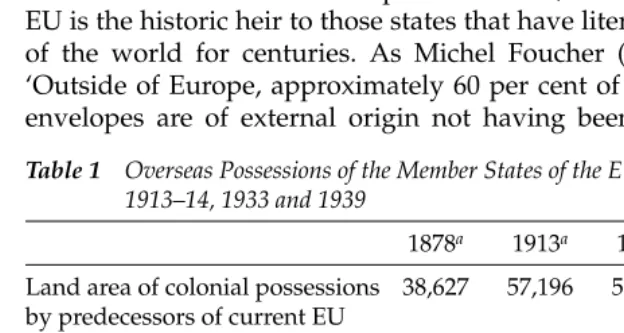
There is perhaps an even more compelling, deeply historical reason for contextualizing the EU globally in order to understand just what it is. One of the least evoked aspects of the EU is the historical role of its member states and their predecessors in creating the most fundamental structures of the world commonly known as the world economy and the interstate system today. The states that constituted the EU at the turn of the 21st century are the same states that had exercised imperial rule over nearly half of the inhabitable surface of the globe outside Europe just two to three generations ago. As recently as the early 1930s, their colonial possessions amounted to nearly three-quarters of all the foreign territorial holdings in the world and covered almost half of the inhabited surface of the world outside Europe. Table 1 summarizes some data relevant to this point.13
[image:10.595.76.388.311.477.2]A number of significant historical corollaries follow from the connec-tions summarized in this simple table. First, this is a reminder that the EU is the historic heir to those states that have literally carved up the rest of the world for centuries. As Michel Foucher (2001: 160) points out, ‘Outside of Europe, approximately 60 per cent of the borders of current envelopes are of external origin not having been drawn by the states
Table 1 Overseas Possessions of the Member States of the EU (as of 2002) in 1878, 1913–14, 1933 and 1939
1878a 1913a 1914b 1933a 1939b
Land area of colonial possessions 38,627 57,196 55,392 57,533 36,206 by predecessors of current EU
member states (000 km2)
Land area of colonial possessions 31.1% 46.1% 44.6% 46.3% 29.2% by predecessors of current EU
member states as percentage of inhabited surface of the globe outside Europec
Land area held by predecessors 57.8% 73.4% 73.6% of today’s EU member states
as percentage of world total territorial holdingsd
aComputed from Clark (1936: 23–4, Table I) by summing the ‘mandates’, ‘dependencies’ and
‘self-governing territories’ of the UK, France, Italy, Belgium, Denmark, Germany, the Nether-lands, Portugal and Spain.
bComputed from Ansprenger (1989), who is quoting Veit (1915) for the 1914 data.
cThe total land surface of the globe is 148,941,000 km2. From this, we subtracted the area of
uninhabited Antarctica (14,235,000 km2) and Europe (10,507,630 km2). This leaves 124,198,370 km2inhabited territory outside Europe. Source: Hammond (1913).
dComputed from Clark (1936: 32, Table IV, ‘Percentages of Territorial Holdings of the Western
adjoining them today.’ Nearly 40 percent of those lines (Foucher, 2001: 160) have been drawn by the British and French imperial powers alone. This, of course, also applies within Europe so that, for instance, practi-cally all current borderlines in Central and Eastern Europe have been drafted by West European imperial powers as part of the dissolution and reorganization of various local empires
The history of modern West European-centred empires and coloniality – i.e. the very history of capitalism and modern statehood worldwide – is but the history of the long-term exploitation of the extra-European societies subjected to the imperial pursuits of a handful of West European states and agents acting on their behalf. The EU’s reliance on external actors, processes and structures today has, therefore, a powerful history behind it: the West European imperial states’ matter-of-fact subjugation and exploitation of actors, processes and structural conditions outside Europe. That history works both as a system of path dependence (limiting actors’ ability to take new directions) and as an institutional component of global hegemony: a storehouse of inherited sociocultural patterns of thinking about, and behav-iour concerning, ‘Europe’, the rest of the world and that very distinction. If seen as an organization that ‘shares and pools’ its member states’ sover-eignty, then the EU should also be recognized as sharing and pooling its member states’ historical record of imperialism and colonial extraction from the rest of the world.
Second, the history of empire and colonialism continues to be of enormous economic, political, cultural, moral and geopolitical signifi-cance. The existence and character of the imperial-colonial ties constitute the single most potent variable that explains the early emergence of some West European states to a position of global power. The most powerful current consequence of that history is the remarkably advantageous subsequent position the societies of Western Europe enjoy in the world economy today. That position of economic advantage and international power is, in turn, a defining aspect of the EU’s daily reality, as well as a key reason for its attractiveness to applicants for full membership. The EU shares and pools in its member states’ colonial loot, and the appli-cants are now asking for a share.
extra-European world through the Union Française, i.e. France’s colonial empire – a move that Aimé Césaire seems to have anticipated, in as early as 1950, when he wrote his seminal Discourse on Colonialism(see Césaire, 2000) partly in response to emerging plans for a pan-West-European ture of integration, discussed in Western Europe as a future, benign struc-ture of integration for Europe ‘after Nazism’.
The success of anti-colonial struggles, leading to the collapse of the global system of colonial capitalism, prevented the creation of a pan-West-European meta-empire that would have united the most powerful West European imperial states, including their colonial empires, in a single West European colonial monolith. It would be both naive and ill-informed, however, to claim that the EU’s current reality can be mean-ingfully deciphered without taking into account the historicity of empire – that is, the historical impact of empire on today’s world. The various postcolonial ‘commonwealths’ are but concrete organizational reminders of the existence of historically very long-lasting, unequal, neocolonial relationships that keep large parts of the postcolonial ‘third world’ tied to their former rulers in Europe in ever renewed bindings of dependence. In this sense as well, the EU shares and pools its member states’ neo-colonialist projects, including the blatantly asymmetrical links to their former colonies – much of today’s ‘third world’.
The only aspects of this postcolonial dependence that enter into discus-sions about the EU’s future are the Europe-bound human flows that have resulted from those asymmetrical linkages and the involvement of the wealthiest West European states in providing aid to their former colonies. The massive, continued centripetal transfers of economic value, the after-math of sustained political violence, imperial wars and genocide, the ceaseless projection of military-strategic power through ‘spheres of influence’, the ongoing destruction of the cultural, political, moral and religious fibres of the formerly colonial, now formally independent societies left often with little to no resources of their own, are conveniently elided. If the former colonial ties are, clearly, relevant to immigration policy,14 they must be relevant to all other areas as well – most signifi-cant, perhaps, to the question of what the EU is.
example, the Virgin Islands and the Falklands, Martinique and Réunion, Greenland and Aruba. In the light of the EU member states’ colonial past, it is hardly surprising that the EU’s recent Commissioner for External Affairs16 is none other than the last British colonial governor of Hong Kong. The late 20th-century notion of West European state sovereignty emerged in the context of an imperial world order, dominated by the colonizing states of Western Europe. To the extent that the European Union stands for the ‘sharing and pooling’ of the sovereignty of its member states, it must also be seen as sharing in their remaining imperial engagements, not to mention the inheritance from their past exploits.
Fourth, unless we assume the complete absence of any mechanism of cross-generational transmission in the realm of collective experiences, knowledges, mentalities – in short: cultures – we should expect that the colonial history of the current EU member states, and empire’s role in enabling the historical forces that have produced their current wealth, power, privilege and claims of cultural superiority, should feature promi-nently in the collective consciousness of the societies of Western Europe. Of the total population of the EU in 2003, 90 percent were citizens of states that appear in Table 1 as colonial powers. The EU is, thus, a centrally important location for the continued articulation of those cultures, the cultures of colonialism and empire.17
and with, the ruins of those empires during the 19th and 20th centuries. The immediate relevance of this land-based type18of imperial experience for the EU’s role in the region thus cannot be exaggerated.
What, Then, Is the EU?
So, in what terms can we think about the EU, given this evidence? What does this empirical phenomenon tell us about the nature of public auth-ority and power?
If we evaluate the EU only in terms of the conventional Weberian criterion of monopoly over legitimate means of coercion, we must dismiss the idea that the EU is a state because of the absence of an executive appar-atus, and hence the lack of means of coercion of its own. What it does have is an extremely well-crafted, sophisticated system of linkages that functions as a mechanism of distancing that produces the EU as a meta-state. Therefore, in order to understand what the EU is, it may be insufficient to focus, as is done conventionally, only on ‘Brussels’, i.e. on union-level political and legal-regulatory processes. An alternative analytical approach ought to consider all of the parties involved – the member states, the European-based multinational corporations, the trans-Atlantic ruling class interests, as well as the social, cultural, political and economic dynamics of the pan-European political public at large, in addition to ‘Brussels’ – in a single, intricately interwoven network clique of actors with a set of shared geopolitical concerns and interests. The EU is the centrepiece of this clique, a public authority that is, due to the char-acter of its internal and external linkages, one step removed from sites of coercion, the signifier of Weberian statehood.
services that continue to subsidize the EU’s accumulation process without the EU ever having to get involved in the messy business of the social and environmental violence associated with the extraction of surplus. To a large extent precisely because of its distance from institutional locales where direct coercion happens, the EU is widely portrayed as the epitome of goodness in world politics today, reinforcing a centuries-old, Euro-centric ideology of superiority. In promoting the ideology of ‘European goodness’, the political process of European identity construction tries to hide the corpse of colonialism while it continues, of course, to partake of the material inheritance of the same colonialism.19
Coercion has been a crucial component of statehood because it can produce order. However, monopoly over legitimate violence means that modern states have to face demands for accountability – something that other coercive organizations do not have to deal with. The absence of an executive apparatus and hence the institutional setup for direct coercion has entailed, in the case of the EU, the parallel absence of a tight system of direct accountability not only to the citizens of the EU, but the rest of the world as well, making it difficult for affected societies to hold the EU legislative, and the economic and political coalitions behind it, responsible. The EU’s elaborate system of distributing and subcontracting major functions of authority and coercion, and the gap in the feedback loop of accountability, can be fruitfully compared to contemporary organizations of global economic production, especially the structures of flexible special-ization (Piore and Sabel, 1984), network-governance (Powell and Smith-Doerr, 1994) and just-in-time production,20which often involve extremely elaborate, multidimensional systems of subcontracting (Eccles, 1981; UN, 1981; Deyo, 1995). In our reading, much of what the EU has been doing resonates very closely with the findings of recent macro-comparative research on commodity chains (Gereffi and Korzeniewicz, 1994), especially the ‘buyer-driven’ type outlined by Gary Gereffi (1994), in which an absentee merchant capital interest organizes the production process, distributed to a large number of producers over complex, inter-secting linkages in global geographical space, in an area of trade that is very highly diversified and mercurial in terms of its demand structures. Just as multinationals manage to lock in remarkably low labour costs and at the same time avert accusations of unfair labour practices by setting up elaborate systems of subcontracting, the EU has been able to remain elegantly outside the purview of accountability with respect to the processes of dependency and displacement that ensue from the activities of actors who act on its behalf and in its interest.
involvement in the unholy processes that lie beneath them. It would seem that the spell of the ‘invisible hand’ is no longer restricted to the market; it is now operating in the political realm as well. With approximately 6 percent of the world’s population, the EU of late 2003 registered about one-third to one-quarter of the world’s GDP.21Practically without lifting a finger, it has managed to secure the compliance of almost all the post-state-socialist states on its perimeter, transforming the region into the age-old West European geopolitical dream of a buffer zone and a repository of secure natural and social resources. With over half of the world’s remaining colonies in its possession, and bound by a history of oppres-sion, racism and systematic political violence, it is widely depicted as the force of ultimate political goodness. Backed by the world’s only remain-ing military superpower in NATO, a military-strategic organization whose members together – roughly one-tenth of the world’s population – command over half of the world’s GDP, it is able to project a self-image that is neutral, peaceful, kind and gentle vis-à-vis the rest of the world.
The task for sociology, if its practitioners wish to grasp the EU and the phenomenon of escaping global accountability in general as social facts, seems to be to go beyond the limits of the conventional theoretical formu-lations of statehood. A certain new reality is already here: it is the burden of theory to catch up with it.
Notes
The authors are grateful to Siba N. Grovogui, Attila Melegh and Patrick Ziltener for some very useful conversation about the issues covered in this article, and benefited from the comments by International Sociology’s anonymous reviewers. All the usual disclaimers regarding the article’s remaining faults and omissions apply.
1. Part of the research for this project was executed, and an earlier version of the article written while the first author was a visiting scholar at the Max Planck Institute for the Analysis of Societies, Cologne.
2. The Bosnian city of Mostar, run directly by the EU, is the only exception to this rule.
extreme-right and/or xenophobic parties in the various governments of other EU member states has not even elicited this much reaction from the EU Commission.
4. The phrase is ubiquitous in official EU parlance. Some recent references include Thomas Klestil (president of the Republic of Austria), at: www. austria.org/press/prel0715b.htm; Chris Patten (until 2004, EU Commissioner for External Affairs), at: www.publicservice.co.uk/pdf/europe/spring2003/ EU5%20Chris%20Patten%20ATL.pdf; Romano Prodi (until 2004, president of the EU Commission), at: europa.eu.int/comm/external_relations/news/ prodi/sp02_465.htm; and Jack Straw (British Foreign Secretary), at: europa. eu.int/futurum/documents/other/oth270701_en.htm (all references as of 5 December 2003.)
5. For the data, see www.idea.int/elections/voter_turnout_europe/images/ EPElections-Table1.pdf, for analysis, see www.idea.int/elections/voter_ turnout_europe/index.htm
6. Belgium and Luxembourg have been dropped from this comparison because their electoral law prescribes and strictly enforces compulsory voter partici-pation, i.e. their turnout data cannot be interpreted as expressions of substan-tive electoral interest in determining the outcomes of the elections.
7. Of the 15 member previous member states, only the UK and Ireland – i.e. the two member states that lie farthest away from Eastern Europe – opened their labour market for citizens of the new member states in 2004.
8. www.corporateeurope.org/tpntabd.html as of 21 July 2004.
9. www.corporateeurope.org/tpntabd.html, referring to ‘Paragraph 17 in the “European Parliament resolution on the state of the Transatlantic Partnership on the eve of the EU-US Summit in Dublin on 25–26 June 2004” (P5_TA-PROV(2004)0375 – B5–0185/2004)’; at: www2.europarl.eu.int/omk/ sipade2?PUBREF=-//EP//TEXT+TA+P5-TA-2004–0375+0+DOC+XML+V0// EN&LEVEL=3&NAV=X as of 21 July 2004.
10. A detailed empirical demonstration of these points is beyond the scope of this article. The sources quoted earlier, along with work by Adam Burgess (1997), Böröcz (1999), Hannes Hofbauer and Andrea Komlosy (e.g. 1998), Hofbauer (e.g. 2003), Hugo Radice (e.g. 1998) and Szalai Erzsébet (e.g. 1999) should provide further pointers.
11. For excellent summaries of this literature, see, for example, Larrain (1989) or So (1990).
12. For the basic formulations, and most powerful insights, of the literature on global relations – the world-system approach – see, for instance, Wallerstein (1974), Amin (1976), Arrighi (1996), Chase-Dunn (1998) and Arrighi and Silver (1999).
13. Böröcz (2001) used this table to make a similar point, with a slightly different emphasis.
16. Chris Patten was a member of the Prodi Commission, whose term expired in 2004. In the negotiations after the 2004 elections, Patten’s name briefly appeared as a possible new Commission president.
17. For an excellent, brief review, see Hall (1995: esp. 205–25).
18. For more on the distinction between detached (colonial) and contiguous (land-based) empires, and its implications for constructions of otherness, see Böröcz (2001).
19. We are grateful to Siba Grovogui for this metaphor.
20. Just-in-time production is a type of organizational design developed, first, for Toyota Corporation in the 1980s. As a management consulting website indicates, it is an innovation that leads to high profitability by radically ‘decreas[ing] the time between customer order and shipment’ (at: rockfordconsulting.com/lean.htm, accessed 18 July 2004) as well as between other points in the production–distribution process. Existing ‘just-in-time’ systems can span very large geographical distances (Prakash et al., n.d.). See also McMichael (1996: 107).
21. Computed at current exchange rates from data presented in IBRD (2002).
References
Amin, Samir (1976) Unequal Development: An Essay on the Social Formations of Peripheral Capitalism.New York: Monthly Review Press.
Anderson, Perry (1997) ‘Under the Sign of the Interim’, in Peter Gowan and Perry Anderson (eds) The Question of Europe, pp. 51–76. London: Verso.
Andor, László and Summers, Martin (1998) Market Failure: A Guide to the Eastern Europe’s ‘Economic Miracle’.London: Pluto Press.
Ansprenger, Franz (1989) The Dissolution of the Colonial Empires. London and New York: Routledge.
Arrighi, Giovanni (1996) The Long Twentieth Century: Money, Power and the Origins of Our Times. London: Verso.
Arrighi, Giovanni and Silver, Beverly J., eds (1999) Chaos and Governance in the Modern World System. Minneapolis: University of Minnesota Press.
Arrighi, Giovanni, Barr, Kenneth and Hisaeda, Shuji (1999) ‘The Transformation of Business Enterprise’, in Giovanni Arrighi and Beverly J. Silver (eds) Chaos and Governance in the Modern World System, pp. 97–150. Minneapolis: University of Minnesota Press.
Bereti Gábor (2003) ‘Helyzetkép és jövó´kép. Szociális fórum Miskolcon, 2003. április 5–6’, Eszmélet60: 128–32.
Bornschier, Volker and Ziltener, Patrick (1999) ‘The Revitalization of Western Europe and the Politics of the “Social Dimension”‘, in Thomas Boje, Bart van Steenbergen and Sylvia Walby (eds) European Societies: Fusion or Fission?, pp. 33–52. London: Routledge.
Böröcz, József (1992a) ‘Dual Dependency and Property Vacuum: Social Change on the State Socialist Semiperiphery’, Theory and Society21: 77–104.
Böröcz, József (1993) ‘Simulating the Great Transformation: Property Change under Prolonged Informality in Hungary’, Archives européennes de sociologie/ Europäisches Archiv für Soziologie/European Journal of SociologyXXXIV(1): 81–107. Böröcz, József (1999) ‘From Comprador State to Auctioneer State: Property Change, Realignment and Peripheralization in Post-State-Socialist Central Europe’, in David A. Smith, Dorothy J. Solinger and Steven C. Topik (eds) States and Sovereignty in the Global Economy,pp. 193–209. London: Routledge. Böröcz, József (2000) ‘The Fox and the Raven: The European Union and Hungary
Renegotiate the Margin of “Europe”’, Comparative Studies in Society and History 42(4): 847–75.
Böröcz, József (2001) ‘Introduction: Empire and Coloniality in the “Eastern Enlargement” of the European Union’, in József Böröcz and Melinda Kovács (eds) Empire’s New Clothes: Unveiling EU-Enlargement, pp. 4–50. Holly Cottage: Central Europe Review; at: aei.pitt.edu/archive/00000144/01/Empire.pdf Böröcz, József (2003) ‘East European Entrants to EU: Diffidently Yours’, The Polish
Foreign Affairs Digest3(4): 47–58.
Burgess, Adam (1997) Divided Europe: The New Domination of the East. London: Pluto Press.
Caporaso, James A., Marks, Gary, Moravcsik, Andrew and Pollack, Mark A. (1997) ‘Does the European Union Represent an nof 1?’, ECSA ReviewX(3): 1–5. Césaire, Aimé (2000) Discourse on Colonialism. New York: Monthly Review Press.
(Orig. pub. 1950.)
Chase-Dunn, Christopher (1998) Global Formation: Structures of the World-Economy. Lanham, MD: Rowman and Littlefield.
Clark, Grover (1936) The Balance Sheet of Imperialism: Facts and Figures on Colonies. Morningside Heights, NY: Columbia University Press.
Deyo, Frederic C. (1995) ‘Capital, Labor, and State in Thai Industrial Restructur-ing: The Impact of Global Economic Transformations’, in David A. Smith and József Böröcz (eds) A New World Order? Global Transformations in the Late Twentieth Century, pp. 131–44. Westport, CT: Greenwood Press.
Eccles, Robert (1981) ‘The Quasifirm in the Construction Industry’, Journal of Economic Behavior and Organization2(4): 335–57.
Ferge, Zsuzsa (1997) ‘The Perils of the Welfare State’s Withdrawal’, Social Research 64(4): 1381–402.
Foucher, Michel (2001) ‘The Geopolitics of Front Lines and Borderlines’, in Jacques Lévy (ed.) From Geopolitics to Global Politics: A French Connection, pp. 159–70. London: Frank Cass. (Orig. pub. 1988.)
Gereffi, Gary (1994) ‘The International Economy and Economic Development’, in Neil J. Smelser and Richard Swedberg (eds) The Handbook of Economic Sociology, pp. 206–33. Princeton, NJ: Princeton University Press/New York: Russell Sage Foundation.
Gereffi, Gary and Korzeniewicz, Miguel, eds (1994) Commodity Chains and Global Capitalism. Westport, CT: Greenwood Press.
Stuart Hall, David Held, Don Hubert and Kenneth Thompson (eds) Modernity: An Introduction to Modern Societies.Cambridge: Polity Press.
Hammond (1913) Hammond Universal World Atlas. Maplewood, NJ: Hammond. Hofbauer, Hannes (2003) Ost-Erweiterung. Vom Drang nach Osten zur peripheren
EU-Integration.Vienna: Promedia.
Hofbauer, Hannes and Andrea Komlosy (1998) ‘Tó´kefelhalmozás és a gazdasági fejló´dés dilemmái Kelet-Európában’, in Krausz Tamás (ed.) Rendszerváltás és társadalomkritika. Tanulmányok a kelet-európai átalakulás történetébó´l, pp. 87–113. Budapest: Napvilág kiadó.
IBRD (2002) World Development Indicators, CD-ROM. Washington, DC: International Bank for Reconstruction and Development.
Kovács, Melinda (2001) ‘Putting Down and Putting Off: the EU’s Discursive Strategies in the 1998 and 1999 Follow-Up Reports’, in József Böröcz and Melinda Kovács (eds) Empire’s New Clothes: Unveiling EU-Enlargement, pp. 196–234. Holly Cottage: Central Europe Review; at: at aei.pitt.edu/archive/00000144/ 01/Empire.pdf
Kovács, Melinda and Kabachnik, Peter (2001) ‘Shedding Light on the Quantitative Other: The EU’s Discourse in the Commission Opinions of 1997’, in József Böröcz and Melinda Kovács (eds) Empire’s New Clothes: Unveiling EU-Enlargement, pp. 147–95. Holly Cottage: Central Europe Review; at: aei.pitt.edu/archive/ 00000144/01/Empire.pdf
Larrain, Jorge (1989) Theories of Development: Capitalism, Colonialism and Dependency. Cambridge: Polity Press.
McMichael, Philip (1996) Development and Social Change: A Global Perspective. Thousand Oaks, CA: Pine Forge Press.
Piore, Michael and Sabel, Charles (1984) The Second Industrial Divide. New York: Basic Books.
Pollack, Mark A. and Schaffer, Gregory C., eds (2001) Transatlantic Governance in the Global Economy. Lanham, MD: Rowman and Littlefield.
Portes, Alejandro and Böröcz, József (1989) ‘Contemporary Immigration: Theor-etical Perspectives on its Determinants and Modes of Incorporation’, Inter-national Migration Review23(3): 606–30.
Powell, Walter W. and Smith-Doerr, Laurel (1994) ‘Networks and Economic Life’, in Neil J. Smelser and Richard Swedberg (eds) The Handbook of Economic Sociology, pp. 368–402. Princeton, NJ: Princeton University Press/New York: Russell Sage Foundation.
Prakash, Amarnath C., Wetherbe, James C. and Janz, Brian D. (n.d.) ‘Reducing Cycle Time in the Apparel Retailer-Manufacturer Global Supply Chain Through Interorganizational Linkages’; at: www.people.memphis.edu/~cscm/ CTR3/ReducingCTinApparelSC.pdf (accessed 17 July 2004).
Radice, Hugo (1998) ‘A feltámadt kapitalizmus: Kelet-Közép-Európa a globalizáció fényében’, in Krausz Tamás (ed.) Rendszerváltás és társadalomkritika. Tanulmányok a kelet-európai átalakulás történetébó´l, pp. 194–209. Budapest: Napvilág kiadó. Sampat, Preeti (2003) Economic Globalisation Today: Resource Book.Bangalore: Books
for Change.
Schmitter and Wolfgang Streeck (eds) Governance in the European Union, pp. 15–39. London: Sage.
Schmitter, Philippe (1996a) ‘Examining the Present Euro-Polity with the Help of Past Theories’, in Gary Marks, Fritz W. Scharpf, Philippe C. Schmitter and Wolfgang Streeck (eds) Governance in the European Union, pp. 1–14. London: Sage.
Schmitter, Philippe (1996b) ‘Examining the Future of the Euro-Polity with the Help of New Concepts’, in Gary Marks, Fritz W. Scharpf, Philippe C. Schmitter and Wolfgang Streeck (eds) Governance in the European Union, pp. 121–50. London: Sage.
So, Alvin Y. (1990) Social Change and Development: Modernization, Dependency, and World-System Theories.Newbury Park, CA: Sage.
Stone-Sweet, Alec and Sandholtz, Wayne (1998) ‘Integration, Supranational Governance, and the Institutionalization of the European Polity’, in Wayne Sandholtz and Alec Stone-Sweet (eds) European Integration and Supranational Governance, pp. 1–26. Oxford: Oxford University Press.
Streeck, Wolfgang (1996) ‘Neo-Voluntarism: A New European Social Policy Regime?’, in Gary Marks, Fritz W. Scharpf, Philippe C. Schmitter and Wolfgang Streeck (eds) Governance in the European Union, pp. 64–94. London: Sage. Szalai Erzsébet (1999) Oroszlánok és globalizáció. Kísérlet az 1998. tavaszán hatalomra
került körmány szociológiai és szociálpszichológiai elemzésére. Budapest: MTA PTI – Új Mandátum.
UN (1981) Transnational Corporation Linkages in Developing Countries: The Case of Backward Linkages via Subcontracting: A Technical Paper.New York: UN Centre on Transnational Corporations.
Thoma László (1998) ‘Védtelen társadalom. A rendszerváltás és a szakszervezetek (1988–1992)’, in Krausz Tamás (ed.) Rendszerváltás és társadalomkritika. Tanulmányok a kelet-európai átalakulás történetébó´l, pp. 245–69. Budapest: Napvilág kiadó. Van der Pijl, Kees (1984) The Making of an Atlantic Ruling Class. London: Verso. Veit, Valentin (1915) Kolonialgeschichte der Neuzeit. Tübingen.
Wallerstein, Immanuel (1974) The Modern World-System: Capitalist Agriculture and the Origins of the European World-Economy in the Sixteenth Century.New York: Academic Press.
Biographical Note:József Böröcz is Associate Professor of Sociology and Director of Hungarian Studies, Rutgers University, and Senior Research Associate at the Institute for Political Studies of the Hungarian Academy of Sciences.
Address: Department of Sociology, Rutgers University, 54 Joyce Kilmer Ave, Piscataway, NJ 08854–8045, USA. [email: [email protected]]
Biographical Note: Mahua Sarkar is Assistant Professor of Sociology at Bing-hamton University – SUNY.