Development, Processing and Evaluation of
Azolla Enriched Breads for Nutraceutical
Application
Mohd Azhar1, Sadaf Pervez2, Bibhu Prasad Panda2, Sushil Kumar Gupta1 1
Department of Pharmacy, Sunrise University, Alwar, Rajasthan
2
Department of Food Technology, Jamia Hamdard, New Delhi
Dr. Bibhu Prasad Panda, Assistant professor, Department of Food Technology, Jamia Hamdard, New Delhi
Abstract
People who feed on vegetarian diets often suffer from B vitamin deficiency as plant sources lack in B vitamins. Incorporation of Azolla in bread can target the affected population. Texture analysis revealed that there was less increase in hardness in case of bread fortified with 5% Azolla. Sensory analysis performed by panelist’s shows inclination towards bread with 5% Azolla however bread fortified with 15% of Azolla powder has shown acceptability because of its color. Therefore, it can be concluded that Azolla is packed with macronutrients like protein and micronutrients like VitB12, VitB9 and non-enzymatic antioxidants that can
be used in various food fortification and enrichment products, which would ultimately cater the needy population.
Key words
Azolla; Fortified bread; Texture analysis; VitB1;VitB9
I. INTRODUCTION
Cereals and cereal- based products have constituted the major component of the human diet through the world since from the earliest times.
Cereal crops are energy dense, providing
approximately 10-20 times more energy than most juicy fruits and vegetables. Wheat and rice are the most important cereals with regard to human nutrition. Nutritionally they are important sources of dietary protein, carbohydrates, the B group vitamins, vitamin E, iron, trace minerals and fibers. Nevertheless, wheat is the unique cereal that is suitable for the preparation of wide diversity of leavened breads that meet consumer demands and requirements worldwide. Among baked goods, bread has been a staple food for many civilizations. Even today, bread and cereal-based products constitute the base of the food pyramid, and its consumption is recommended in all dietary guidelines. Since, bakery products are consumed as the staple, fortification of
be easily accepted by the target population. Bread is an ideal matrix by which functionality can be delivered to the consumer in an acceptable way. It is an appropriate food vehicle which will be consumed by those most at risk of micro nutrient deficiency (Bickoff et. al. 1975). Azolla contains many useful phytochemicals (secondary metabolites) such as flavonoids, steroids, alkaloids, phenols, triterpenoid compounds, varieties of amino acids and fatty acids (Selvaraj, et al. 2014) These bioactive components contribute to many useful and medicinal properties
like antioxidant, anti-carcinogenic,
anti-inflammatory, anti-diabetic, hepato and
gastro-protective, anti-viral, neuro-protective, cardio
protective, anti-hypertensive properties (Hertog et al.,1992) Thus azolla has got tremendous potential for development and production of functional foods and nutraceuticals. Besides these phytochemicals it contains all the essential amino acids making it favourable for fortification and enrichment of bakery products made from wheat flour which is deficient in essential amino acids like lysine (Mohamed et al . 2006). Therefore in the present research, Azolla is used as fortifying material for developing functional bread further analysed and evaluated for suitability to be use a food.
II. MATERIALS AND METHODS
A) Collection and cultivation of Azolla
Two species of azolla namely
Azolla microphylla and Azolla caroliniana collected from the Centre for Conservation and Utilization of
Blue-Green Algae (CCUBGA), ICAR-Indian
Agricultural Research Institute, New Delhi, Plants were grown in Espianase and Watanabe medium (Espianase and Watanabe, 1976) without nitrogen in herbal garden of Jamia Hamdard, New Delhi.
B) Procurement of Bread Making Ingredients
C) Processing of Azolla
The collected Azolla was allowed to stand for 1hr to drain excess water and then processed by different drying methods at different time temperature combinations.
These methods included:
Fluidized bed drying at a temperature of 60°C for 25min, Hot air oven drying 60°C 3 hours Sun drying in shady place for 3 days. The high chlorophyll content of Azolla would affect the nutritional analysis of Azolla and also adversely affect the appearance of bread and hinder the bread consumer acceptability. Chlorophyll was extracted from dry Azolla by using ethanol as solvent in Soxhlet apparatus at 60°C for 1hr. Further the biomass is dried in oven.
D) Food Product Formulation
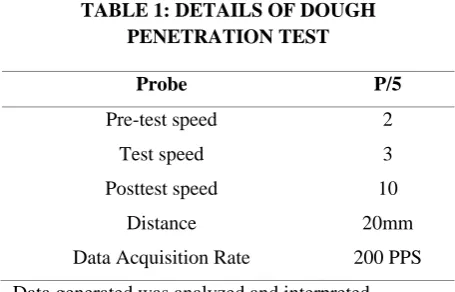
1)Dough penetration test by Texture profile analyses using a P/5 probe:
For optimization of Azolla microphylla powder to be incorporated in bread dough, dough with different proportions of wheat flour and powdered Azolla microphylla were made i.e,5% A.microphylla powder and 95% wheat flour ;10% Azolla microphylla and 90% wheat flour; 15 %Azolla powder and 85% wheat flou. Dough penetration test of this dough was carried out using Texture profile analyzer. Different force was required by probe to penetrate the dough depending on hardness of the dough. Elasticity is the desirable
characteristic of bread dough. Therefore, the combination which required less penetration force and was selected. Proper round shaped dough was placed between the TPA plate and the probe (Miller 1993). Following settings (table 1) were loaded and the test was carried out.
TABLE 1: DETAILS OF DOUGH PENETRATION TEST
Probe P/5
Pre-test speed 2
Test speed 3
Posttest speed 10
Distance 20mm
Data Acquisition Rate 200 PPS
Data generated was analyzed and interpreted. Four different types of bread were prepared: 1. Plain bread made from Maida (refined flour): 2. Bread made from 5% Azolla microphylla powder and Maida.
3. Bread made from 10% Azolla microphylla powder
and Maida.
4. Bread made from 15% Azolla microphylla powder
and Maida.
The ingredients composition for all type of Bread is given in Table 2
TABLE 2: INGREDIENTS COMPOSITION IN BREAD MAKING
Type of bread Maida
(g)
Azolla
microphylla (g)
Water (ml) Yeast (g) Sugar (g) Salt (g) Shortening (g)
Plain bread 94 0 60 1 2 2 1
Bread with 5%
A. microphylla 89.3 4.7 60 1 2 2 1
Bread with
10%
A. microphylla
84.6 9.4 63 1 2 2 1
Bread with 15%
A microphylla 79.9 14.4 75 1 2 2 1
E) Bread Making Procedure
All the ingredients were accurately weighed (Maida, Yeast, salt, sugar, shortening & water)Yeast was suspended in Luke warm water (Dry active yeast). All the ingredients were mixed properly yeast and water was added to
form viscoelastic dough. The dough was kneaded for 30 min to ensure uniform distribution of yeast. The dough was gently shaped into a round ball and placed in a bowl for 40-80 minutes till it doubles in size. Damp towel was placed on mould to prevent a
degassed or knock backed to release excess carbon dioxide produced by the yeast during rising to prevent "yeasty" flavor in the final bread. The degassed dough was placed in bread mould and covered by damp towel to provide moist environment and subject to final proofing for 30 min. The dough was then baked in baker’s oven at 180˚C for 30 min. Bread was allowed to cool. Bread was then sliced into pieces of uniform size. Finally bread was packed in polythene pouches and sealed.
F) Bread Firmness Test
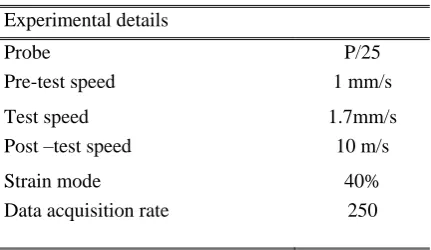
The firmness of all the 4 types of bread was determined by three step by using Texture Profile Analysis by carrying out firmness test using AACC (74-09) standard method (Table 3).
TABLE 3: EXPERIMENTAL DETAILS OF BREAD FIRMNESS TEST
Experimental details
Probe P/25
Pre-test speed 1 mm/s
Test speed 1.7mm/s
Post –test speed 10 m/s
Strain mode 40%
Data acquisition rate 250
Three step procedure
One Uniform slices of bread were placed between TPA test plate and probe.
The above program was loaded and the test was carried out.
After the test data was generated, analyzed and interpreted.
G) Sensory Evaluation
Sensory analysis or sensory evaluation of the three types of bread was done by using a quantitative descriptive method with the modification of using product-specific references (Mohamed et al., 2006). Panel of judges was employed for assessing the sensory characteristics. They ranked the product characteristics on 7 point scale called Hedonic scale ranging from “excellent” to "horrible”. Attributes like appearance (shape and crumb color), odor (beany and savory), crumb elasticity and texture (hardness) were evaluated. Internal and external preference mapping was calculated and plotted by using Sensomaker Software7.1.
III.RESULT AND DISCUSSION
A) Dough Penetration Test
The hardness of different types of dough was determined by Dough Penetration test. The results are given in table 4.
Table 4: Different force required to penetrate dough
Sample force (g)
0% 113.203
5% 151.910
10% 167.001
15% 178.73
It was analysed that with the increase in Azolla concentration, the elasticity of bread decreased. Also, it was observed that with the addition of 10% of Azolla powder there was drastic increase in hardness of bread (Figure 1).
Fig1. Dough penetration test at different Azolla concentration
0 50 100 150 200
0% 2% 4% 6% 8% 10% 12% 14% 16%
Azolla Percentage
Fig 2: Types of Bread after azolla fortification B) Physical Parameters of All Four Types of Bread
Different parameters like loaf volume, loaf area & crumb height was measured for the four types of bread. Increased Loaf volume and Crumb height was observed with the increase in Azolla percentage as shown in figure 2
Table 5: Different physical parameters of bread
Code Of Samples Bread type Loaf volume
(cm3) Loaf area (cm
2
) Crumb height (cm)
A Plain Maida Bread 27.65 27.65 1
B Bread with 5% Azolla 49.4 38 1.3
C Bread with 10% Azolla 43.68 27.3 1.6
D Bread with 15% Azolla 40.77 21.46 1.9
Increase in loaf volume and height was observed in fortified breads. Maximum volume of 38cm2 was observed in bread with 5% fortification. However, maximum height of 1.9 cm was observed in bread with 15% fortification.
C) Texture Profile Analysis
Texture of all four types of bread was studied using Texture Profile Analyses (Miller et al., 1993; Nishinari et al., 2013 )
D) Bread Firmness Test
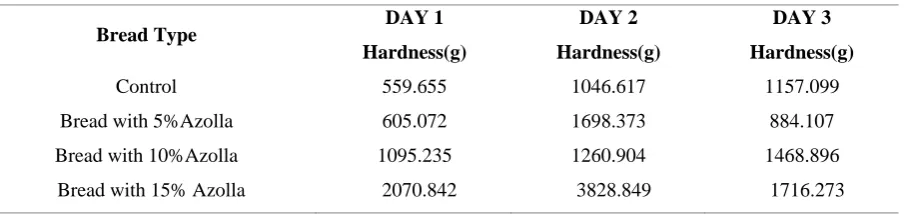
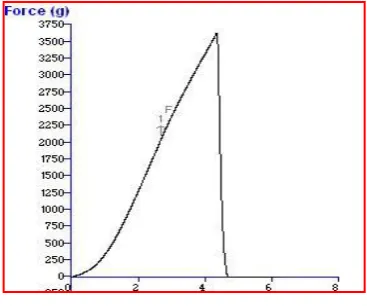
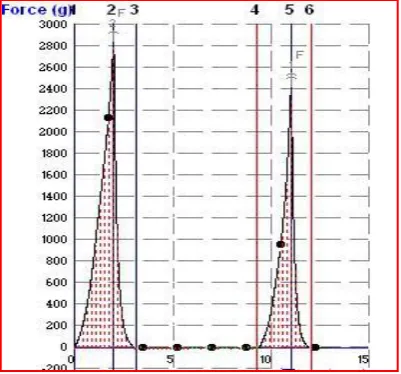
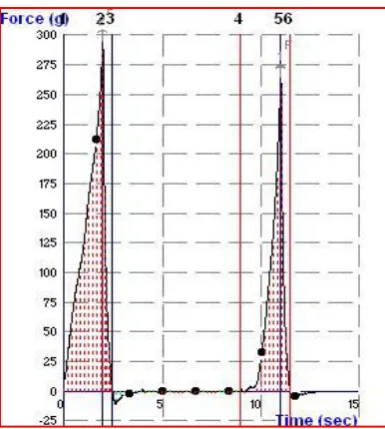
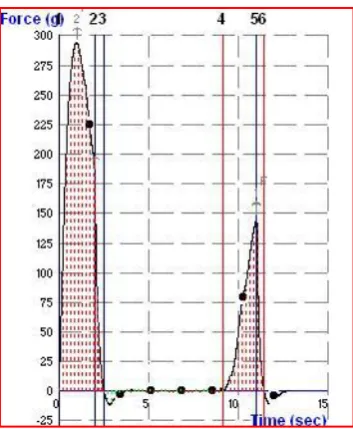
The firmness test was conducted (Miller et al., 1993; Nishinari et al., 2013) for consecutive 3 days. The results are given in Table 6, figure 3.
Table 6: Force required for compressing the bread
Bread Type DAY 1
Hardness(g)
DAY 2 Hardness(g)
DAY 3 Hardness(g)
Control 559.655 1046.617 1157.099
Bread with 5%Azolla 605.072 1698.373 884.107
Bread with 10%Azolla 1095.235 1260.904 1468.896
Bread with 15% Azolla 2070.842 3828.849 1716.273
Figure 3: Plots of firmness test for all types of bread
Day 1:
Control Maida Bread
Control Maida Bread with 5% Azolla Fortification
Bread with 10% Azolla Fortification
Bread with 15% Azolla Fortification
DAY 2:
Control Maida Bread
Control Maida Bread with 10% Azolla
Fortification
Bread with 15% Azolla Fortification
DAY 3:
Control Maida Bread
Control Maida Bread with 5% Azolla
Fortification
Bread with 10% Azolla Fortification
E) TPA analysis all the Breads
A comparative study of changes in different textural characteristics of bread for 3 progressive days was carried out by conducting TPA tests. The variation of different characteristics in 4 types of bread for 3 successive days is shown in figure 4.
Figure 4: Plots of TPA analysis in each day
DAY 1:
Control Maida Bread
Bread with 5% Azolla Fortification
Bread with 10% Azolla
Fortification Bread with 15% Azolla
Fortification
DAY2:
Bread with 5% Azolla Fortification
Bread with 10% Azolla Fortification
Bread with 15% Azolla Fortification
DAY3:
Control Maida Bread
Bread with 5% Azolla Fortification
Table 7: Hedonic Scale Used For Sensory Analysis
Sr. No. Sensitivity Analysis Score
1 Horrible 1
2 Very Bad 2
3 Bad 3
4 O.K 4
5 Good 5
6 Very Good 6
Bread with 10% Azolla Fortification
Bread with 15% Azolla Fortification
From the graphs (figure 4) it is well expressive that the hardness was maximum in the bread with 15% of Azolla fortification. The Fracturbility peculiarity was observed only for control and bread with 15% enrichment with Azolla powder on day 3rd. The adhesiveness attribute was found to be higher in
bread with 15% addition of powdered Azolla. Over
three days adhesiveness increased sharply for bread with 15% fortification, however adhesiveness attribute of bread with 5% addition of powdered Azolla showed a decrease in trend. Relatively springiness of control remained same for three successive days. Overall, springiness of bread with 5% & 10% fortification increased while as, in bread with 15% fortification springiness decreased. Cohesiveness was found to be least in bread with 5% fortification. Gumminess is related to hardness and it was found to be maximum in bread with 15% fortification. Chewiness was found to be maximum in bread with 15% fortification. The decrease in chewiness over three constant days was higher in bread with 15% fortification. Resilience was found to be higher in bread with 10% fortification and least in control. The resilience of bread with 5% & 10% enrichment with Azolla powder remained balanced on day 2nd and there was no change in resilience attribute for bread with 5% fortification on day 2nd and day 3rd resp.
F) Sensory Evaluation of Breads
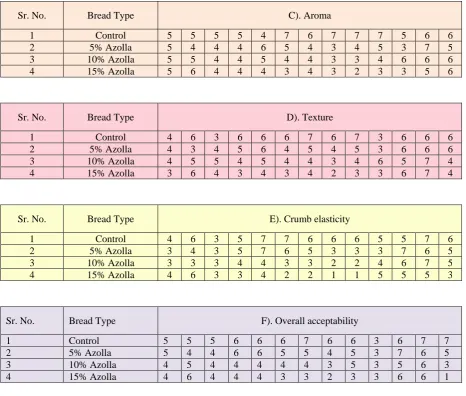
The sensory analysis result is based on 7 point hedonic scale showed in the Table 7.
Table 8: Sensory analysis of on a). Crust colour b). Crumb and appearance c). Aroma d). Texture e). Crumb elasticity and f). Overall acceptability.
Sr. No. Bread Type A). Crust Colour
1 Control 6 4 5 6 4 6 7 7 7 6 5 7 7
2 5% Azolla 4 4 4 6 3 4 5 3 5 4 5 7 6
3 10% Azolla 3 5 4 4 4 4 3 4 4 4 5 5 6
4 15% Azolla 3 6 6 4 6 3 3 4 3 4 5 6 7
Sr. No. Bread Type B). Crumb and Appearance
1 Control 5 4 6 6 5 5 7 7 7 6 3 7 7
2 5% Azolla 4 3 5 5 6 4 5 2 5 3 5 6 6
Sr. No. Bread Type C). Aroma
1 Control 5 5 5 5 4 7 6 7 7 7 5 6 6
2 5% Azolla 5 4 4 4 6 5 4 3 4 5 3 7 5
3 10% Azolla 5 5 4 4 5 4 4 3 3 4 6 6 6
4 15% Azolla 5 6 4 4 4 3 4 3 2 3 3 5 6
Sr. No. Bread Type D). Texture
1 Control 4 6 3 6 6 6 7 6 7 3 6 6 6
2 5% Azolla 4 3 4 5 6 4 5 4 5 3 6 6 6
3 10% Azolla 4 5 5 4 5 4 4 3 4 6 5 7 4
4 15% Azolla 3 6 4 3 4 3 4 2 3 3 6 7 4
Sr. No. Bread Type E). Crumb elasticity
1 Control 4 6 3 5 7 7 6 6 6 5 5 7 6
2 5% Azolla 3 4 3 5 7 6 5 3 3 3 7 6 5
3 10% Azolla 3 3 3 4 4 3 3 2 2 4 6 7 5
4 15% Azolla 4 6 3 3 4 2 2 1 1 5 5 5 3
Sr. No. Bread Type F). Overall acceptability
1 Control 5 5 5 6 6 6 7 6 6 3 6 7 7
2 5% Azolla 5 4 4 6 6 5 5 4 5 3 7 6 5
3 10% Azolla 4 5 4 4 4 4 4 3 5 3 5 6 3
4 15% Azolla 4 6 4 4 4 3 3 2 3 3 6 6 1
G)Statistical Analysis of Sensory Evaluation
The acceptability preference of all four types of breads is shown in Figure 5 a & b. The acceptability of bread with 5% fortification was found to be higher than the other two when compared with control.
Figure 5 A: External Sensory Analysis
Figure 5 B: Internal Sensory Analysis
IV. CONCLUSION
People who feed on vegetarian diets often suffer from B vitamin deficiency as plant sources lack in B vitamins. Incorporation of Azolla in bread can target the affected population. TPA analysis revealed that there was less increase in hardness in case of bread fortified with 5% Azolla. Sensory analysis performed by panelist’s shows inclination
towards bread with 5% Azolla however bread
be concluded that Azolla is packed with macronutrients like protein and micronutrients like VitB12, VitB9 and non-enzymatic antioxidants that can be used in various food fortification and enrichment products, which would ultimately cater the needy population.
REFRERENCES
[1] Bickoff, E. M.; Booth, A. N.; Fremery, D. de.; Edwards, R. H.; Knuckles, B. E.; Miller, R. E.; Saunders, R. M.; Kohler, G. 0. Nutritional evaluation of alfalfa leaf protein concentrate. In Protein nutritional quality of foods and feeds; Friedman, M., Ed.; Dekker: New York, 1975. [2] Hertog, M.G.L., P.C.H. Hollman, and M.B. Katan.
Content of potentially anticarcinogenic flavonoids of 28 vegetables and 9 fruits commonly consumed in the Netherlands. J. Agr. Food Chem. 1992; 40:2379–2383. [3] K.Selvaraj, Ranjana Chowdhury, Chiranjib Bhattacharjee.
A green chemistry approach for the synthesis and characterization of bioactive gold nanoparticles using Azolla microphylla methanol extract. Front. Mater. Sci. 2014; 8(2):123-135.
[4] M Mohamed, Ibrahim, M Eazaz and Mostafa, UV-B Effect on Constituents of Azolla caroliniana. Zeitschrift fur Naturforschung - Section C Journal of Biosciences. 2006; 6293-4):246-252.
[5] Miller RO, Jacobsen JS, Skogley EO. Aerial accumulation and partitioning of nutrients by hard red spring wheat. Commun Soil Sci Plant Anal. 1993; 24:2389–2407.