R E S E A R C H
Open Access
Comparison of range-of-motion and variability in
upper body movements between transradial
prosthesis users and able-bodied controls
when executing goal-oriented tasks
Matthew J Major
1,2*, Rebecca L Stine
1,2, Craig W Heckathorne
1, Stefania Fatone
1and Steven A Gard
1,2Abstract
Background:Current upper limb prostheses do not replace the active degrees-of-freedom distal to the elbow inherent to intact physiology. Limited evidence suggests that transradial prosthesis users demonstrate shoulder and trunk movements to compensate for these missing volitional degrees-of-freedom. The purpose of this study was to enhance understanding of the effects of prosthesis use on motor performance by comparing the movement quality of upper body kinematics between transradial prosthesis users and able-bodied controls when executing
goal-oriented tasks that reflect activities of daily living.
Methods:Upper body kinematics were collected on six able-bodied controls and seven myoelectric transradial prosthesis users during execution of goal-oriented tasks. Range-of-motion, absolute kinematic variability (standard deviation), and kinematic repeatability (adjusted coefficient-of-multiple-determination) were quantified for trunk motion in three planes, shoulder flexion/extension, shoulder ab/adduction, and elbow flexion/extension across five trials per task. Linear mixed models analysis assessed between-group differences and correlation analysis evaluated association between prosthesis experience and kinematic repeatability.
Results:Across tasks, prosthesis users demonstrated increased trunk motion in all three planes and shoulder abduction compared to controls (p≤0.004). Absolute kinematic variability was greater for prosthesis users for all degrees-of-freedom irrespective of task, but was significant only for degrees-of-freedom that demonstrated increased range-of-motion (p≤0.003). For degrees-of-freedom that did not display increased absolute variability for prosthesis users, able-bodied kinematics were characterized by significantly greater repeatability (p≤0.015). Prosthesis experience had a strong positive relationship with average kinematic repeatability (r = 0.790, p = 0.034).
Conclusions:The use of shoulder and trunk movements by prosthesis users as compensatory motions to execute goal-oriented tasks demonstrates the flexibility and adaptability of the motor system. Increased variability in movement suggests that prosthesis users do not converge on a defined motor strategy to the same degree as able-bodied individuals. Kinematic repeatability may increase with prosthesis experience, or encourage continued device use, and future work is warranted to explore these relationships. As compensatory dynamics may be necessary to improve functionality of transradial prostheses, users may benefit from dedicated training that encourages
optimization of these dynamics to facilitate execution of daily living activity, and fosters adaptable but reliable motor strategies.
Keywords:Upper limb, Transradial amputation, Kinematics, Trunk, Prosthesis
* Correspondence:[email protected]
1Northwestern University Prosthetics-Orthotics Center, Northwestern University
Feinberg School of Medicine, 680 N Lake Shore Dr, Suite 1100, Chicago, IL 60611, USA
2
Jesse Brown VA Medical Center, 820 S Damen Ave, Chicago, IL 60612, USA
Background
The musculoskeletal architecture of the upper body (i.e., trunk and arms) contains redundant degrees-of-freedom (DoFs) from which the central nervous system (CNS) has the benefit of selecting various task-equivalent motor strategies and associated inter-joint coordination patterns to satisfy task requirements [1-3]. The advantage of this redundancy is that the neuromuscular system is highly adaptable and capable of accounting for a loss in DoFs due to pathology [4-9]. This motor adaptability is of crit-ical advantage for individuals with transradial limb loss in the context of task performance, as typical upper limb prostheses do not replace the active DoFs distal to the elbow inherent to intact physiology, including forearm pronation/supination and wrist flexion/extension [10]. There is substantial evidence to suggest that due to loss of active DoFs, users of transradial prostheses employ com-pensatory movements predominantly at the trunk and shoulder to execute goal-oriented tasks [5,6]. Studies have further emphasized the impact of forearm and wrist move-ment on compensatory motions during execution of goal-oriented tasks by demonstrating that able-bodied individ-uals exhibit similar compensatory motions as transradial prosthesis users (e.g., lateral trunk flexion) when forearm and wrist movement is restricted [11,12], and fixing the prosthetic wrist in different flexion angles affects pros-thetic arm compensatory movements (e.g., shoulder ante-version and abduction) [13].
Despite indication that compensatory motions may re-sult in overuse injuries [12,14], the opinion exists that this behavior should not be discouraged when operating an upper limb prosthesis as it demonstrates adaptability given the functional limitations of the device, and appropriate strategies should be identified to facilitate task execution [15]. The key to control when using a transradial pros-thesis is to properly manage the remaining DoFs [5], and studies indicate that the CNSs of prosthesis users create accurate internal models of the affected arm through re-sidual sensory feedback and utilize adapted motor control strategies (i.e., coordinated joint torques and geometry) for task execution [16-19]. Importantly, evidence suggests that although upper limb prosthesis users adapt to novel task environments, they demonstrate increased motor variabil-ity, but dedicated experience and training with the device may facilitate long-term motor adaptation and increased kinematic repeatability [18,20,21]. Therefore, the ultimate goal of rehabilitation therapy to enhance motor learning and refine these movements through practice via task repetition is reasonable [18-20,22,23]. A certain level and type of kinematic variability may be considered an asset to upper limb prosthesis users for the purpose of exploiting motor flexibility that may aid task execution [24], but the amount of variability associated with upper body move-ment in this group compared to able-bodied controls has
not been adequately explored. Furthermore, dependable motor behavior, as reflected by reduced movement vari-ability that results from appropriate prosthetic training, may reflect better prosthetic control, which could prevent user dissatisfaction and device abandonment [25-27]. How-ever, despite the common therapeutic goal of enhancing movement quality, there still remains a dearth of informa-tion on the characteristics of upper body compensatory movements and associated variability of transradial pros-thesis users when executing goal-oriented tasks, and the re-lationship of these dynamics with device experience [20]. This is partially due to the paucity of upper limb pros-thetic research studies incorporating methods for the characterization of upper body kinematics as a form of outcome measurement to assess performance [15,20].
The objectives of this study were to compare upper body movements and their associated variability between able-bodied individuals and transradial prosthesis users during execution of goal-oriented tasks that reflect activ-ities of daily living (ADLs), and to assess relationships between movement variability and prosthesis experience. We hypothesize that: 1) prosthesis users will display al-tered range-of-motion (RoM) at the trunk and shoulder compared to able-bodied individuals to compensate for a loss in active distal DoFs, 2) prosthesis users will dis-play increased within-subject movement variability as they recruit compensatory motions to execute novel goal-oriented tasks, and 3) movement repeatability of prosthesis users has a positive direct relationship with prosthesis ex-perience. Importantly, upper limb prosthesis use perform-ance has traditionally been assessed through the use of clinical outcome measures [28-30]. Although these mea-sures provide useful clinically-relevant information, they only provide information on functional outcome and are unable to assess the contribution of movement quality to overall performance [23]. The results from this study will allow for improved insight into the movement quality as-sociated with upper limb prosthesis user performance, contribute to quantification of compensatory movements when executing goal-oriented tasks, and enhance under-standing of how the motor strategies of prosthesis users differ from able-bodied individuals and are related to de-vice experience.
Methods Participants
that the prosthesis be self-suspending with a supracon-dylar socket design. Ethical approval was obtained from the University Institutional Review Board, and informed consent was provided by each participant prior to data collection.
Six able-bodied individuals (3 male, 3 female, 35 ± 11 years) and seven individuals with limb loss at the transradial level (5 male, 2 female, 49 ± 18 years) partici-pated in this study. Limb loss etiology included traumatic (n = 4) and congenital (n = 3). User devices included the System Electric Hand (n = 1; Otto Bock, Duderstadt, Germany), MyoHand VariPlus Speed Hand (n = 1; Otto Bock), Transcarpal Hand (n = 1; Otto Bock), Motion Control Hand (n = 1; Motion Control, Salt Lake City, UT), i-Limb Ultra Revolution (n = 1; Touch Bionics, Livingston, UK), i-Limb Ultra (n = 1; Touch Bionics), and i-Limb Hand (n = 1; Touch Bionics). For all participants with traumatic amputation, the amputated limb was considered their dominant limb prior to the amputation and the aver-age time since amputation was 9.5 ± 11.0 years. Across all subjects, the average reported prosthesis experience was 20.3 ± 18.1 years. Prosthetic socket comfort was quanti-fied with the socket comfort score [31], which asks users to rate their prosthesis on an ordinal scale from 0 (most uncomfortable socket imaginable) to 10 (most comfortable socket imaginable), and the average score was 8.9 ± 1.1, suggesting a high level of comfort across participants.
Experimental protocol
Participants were requested to execute five goal-oriented tasks while seated at a table of standard height (73.7 and 28 cm from floor and seat top, respectively). The tasks and associated protocol were adopted from the Southampton Hand Assessment Procedure (SHAP) [32], as this as-sessment provided a standardized protocol for con-trolled, repeated performance of goal-oriented tasks that reflect ADLs:
1) Food cutting–picking up and positioning a knife to slice through a small plasticine roll located at midline of the body.
2) Page turning–grasping a page, located on one side of the body, with the hand on the contralateral side and turning the page over to the ipsilateral side as if turning the page of a book.
3) Carton pouring–lifting a carton, located at midline of the body, and emptying the liquid contents into a jar on the contralateral side with minimal spilling. 4) Lifting and transferring a weighted object–lifting a
liquid-filled jar, located on one side of the body, with the hand on the contralateral side and transferring to the ipsilateral side over a low-level barrier at midline of the body.
5) Lifting and transferring a tray–lifting a tray, located on the contralateral side of the body, with both hands and transferring to the ipsilateral side over a low-level barrier at midline of the body.
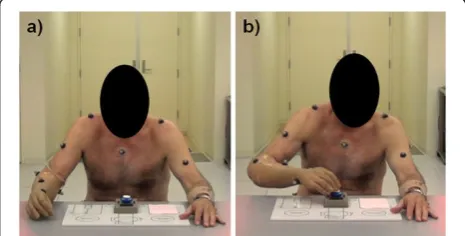
Per the SHAP protocol, participants were requested to complete each task as fast as possible. Tasks did not re-quire participants to position their joints/segments in any particular orientation in space, but only to complete the task requirements. Able-bodied controls and pros-thesis users performed these tasks using their non-dominant and prosthetic limb, respectively, for unimanual tasks (page turning, carton pouring, lifting and transfer-ring a weighted object). For the tasks of page turning and lifting and transferring a weighted object and tray, the ob-ject was first positioned on the side of the body opposite to the non-dominant or prosthetic limb. Prior to data col-lection and the start of each task, the participants rested both hands on the table in the same position (Figure 1a). Once the participants were requested to start the task, they struck a large button at midline of the body with their non-dominant or prosthetic limb (Figure 1b) and this event denoted the start of the task. Following execution of each task, the participant again struck the button and this denoted the end of the task. Five trials of each task were performed in random order to minimize acute learning ef-fects [22], as the intent was to observe performance of the desired tasks and not capture changes due to learning through repetition [23]. Participants were permitted prac-tice to familiarize themselves with the task requirements prior to data collection.
Data collection and analysis
Kinematic data were collected with a digital motion cap-ture system (Motion Analysis Corporation, Santa Rosa, CA) at 120 Hz using a custom upper extremity retro-reflective marker set to define three rigid-body segments (forearm, upper arm, and trunk) and three additional markers on the table surface to define the work plane. A subset of the anatomical locations of retro-reflective
markers used in this analysis include: C7 spinous process, sacrum, top of the sternum, bilateral acromion processes, medial and lateral humeral epicondyles, and radial and ulnar styloids. For prosthesis users, the locations of the epicondyle and styloid markers mimicked the relative pos-ition of these bony landmarks on the intact arm. Virtual elbow and wrist joint centers were created as the midpoint between the epicondyle and styloid markers, respectively. The forearm was defined as the segment linking the vir-tual wrist and elbow centers, and the upper arm was de-fined as the segment linking the virtual elbow center and acromion process marker.
Upper body kinematics (i.e., shoulder flexion/exten-sion, shoulder ab/adduction, elbow flexion/extenflexion/exten-sion, trunk lateral flexion, trunk transverse rotation, and trunk forward flexion) were estimated from the five trials of each task using custom software (Matlab, Natick, MA). A trunk-based local reference frame was calculated using the C7, sacrum, and sternum markers to define the ana-tomical sagittal, frontal, and transverse planes. Shoulder flexion/extension was defined as the angle between the upper arm and trunk anterior-posterior axis (zero angu-lar displacement defined as perpendicuangu-lar alignment of the upper arm and trunk axis). Shoulder abduction was defined as the angle between the upper arm and shoul-der axis created by the acromion markers (zero angular displacement defined as perpendicular alignment of the upper arm and shoulder axis). Elbow flexion/extension was defined as the angle between the upper arm and forearm (180° of angular displacement was defined as full elbow extension). Trunk lateral flexion was defined as the angle between the trunk inferior-superior axis and table medial-lateral axis (i.e., table width) projected onto the frontal plane (zero angular displacement defined as perpendicular alignment of the trunk and table axes). Trunk transverse rotation was defined as the angle be-tween the shoulder axis and table medial-lateral axis projected onto the transverse plane (zero angular dis-placement defined as parallel alignment of the shoulder and table axes). Trunk forward flexion was defined as the angle between the trunk inferior-superior axis and table anterior-posterior axis projected onto the sagittal plane (zero angular displacement defined as perpendicu-lar alignment of the trunk and table axes). Kinematic data were filtered with a bidirectional 4th order low-pass Butterworth filter at 6 Hz. DoF angle trajectories were normalized to task completion time (i.e., from the first to second button strike).
For each task, average RoM, absolute kinematic vari-ability and kinematic repeatvari-ability of the observed DoF angles across five trials were calculated for each partici-pant. The RoM of each DoF was estimated by subtract-ing the maximum and minimum recorded angles. Absolute kinematic variability across the five trials was
estimated as the average standard deviation (SD) across all time points of the normalized DoF angle trajectory. Kinematic repeatability was estimated by the adjusted coefficient of multiple determination (CMD), also com-monly reported as theR2value [33]. The CMD provides a statistical estimate of the similarity between waveforms and typically ranges between 0 and 1 [33], with values closer to 1 indicating increased repeatability. Although a useful method for assessing kinematic repeatability, limi-tations with the CMD method have been reported, such as a direct relationship with DoF RoM and lack of information on absolute measurement variability [34,35]. Consequently, SD is also reported here to complement CMD as a measure of absolute variability and between-group comparisons of CMD are limited to an analysis for each respective DoF [34,35]. In light of its utility, CMD has successfully been ap-plied to upper body kinematic studies on children with cerebral palsy executing goal-oriented tasks [36-41].
Statistical analysis
Statistical analyses were conducted using SPSS (IBM, Armonk, NY) and the critical alpha was set at 0.05. Nor-mality of the data was confirmed using the Shapiro-Wilk test. A linear mixed model (LMM) analysis (fixed factor: group, task, group × task; random factor: subject) was used to assess if group classification resulted in individ-ual DoF RoM, SD, and CMD differences. Group means and 95% confidence intervals were calculated for each task to illustrate task-specific differences and group × task interaction effects. An overall CMD value was cal-culated for each participant by averaging CMD values across DoFs and tasks (as a measure of overall within-subject kinematic repeatability) and a Pearson correl-ation coefficient was estimated between prosthesis users’ overall CMD values and prosthesis experience.
Results
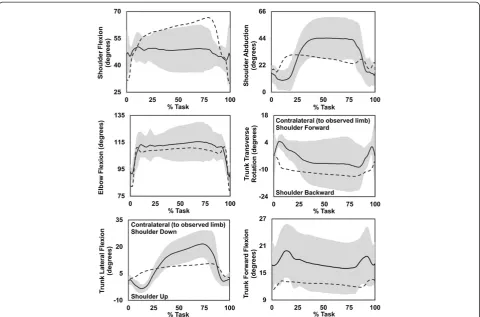
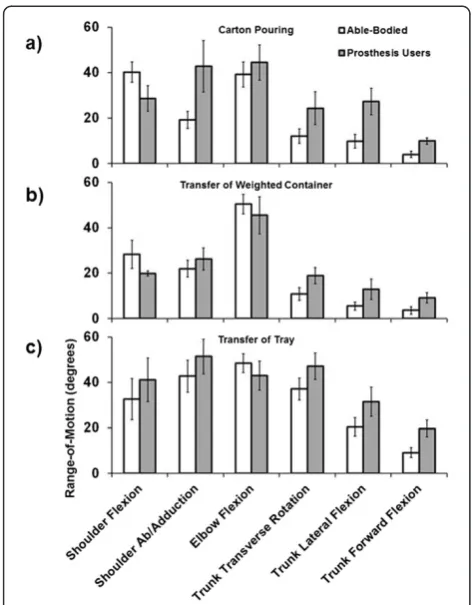
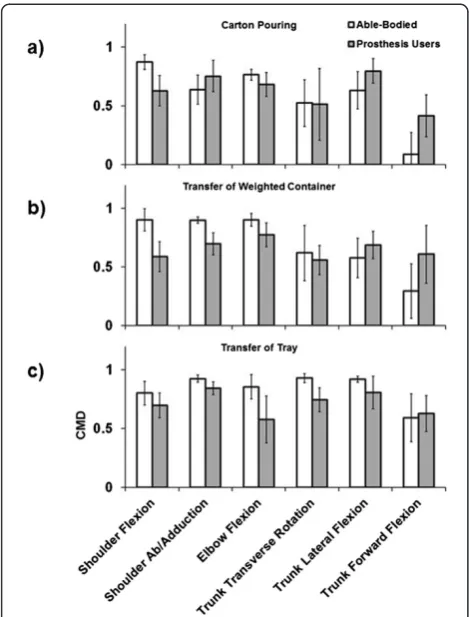
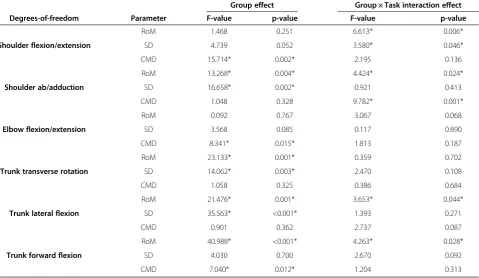
The majority of prosthesis users were unable to rou-tinely execute tasks 1 (food cutting) and 2 (page turning) as required by the protocol due to their inability to maintain grip of the knife and fully rotate the page from front to back, respectively, with their prostheses. Conse-quently, data from these tasks were eliminated from the analysis. Additionally, one prosthesis user was unable to execute task 5 (tray lift and transfer) due to inadvertent opening of the prosthetic hand and these data are miss-ing from the analysis. To aid in visualization of kinematic results, an example of group ensemble average kinematics of task 3 (carton pouring) is presented in Figure 2. Group data for RoM, SD, and CMD of tasks 3, 4, and 5 are dis-played in Figures 3, 4, and 5, respectively, and the LMM statistical results are displayed in Table 1.
transverse rotation, trunk lateral flexion, and trunk for-ward flexion RoM. Additionally, for prosthesis users, all of the DoFs with increased RoM apart from trunk for-ward flexion also displayed increased absolute kine-matic variability as reflected by increased average SD. For shoulder flexion/extension, elbow flexion/extension, and trunk forward flexion, which did not display differ-ences in absolute kinematic variability (SD), able-bodied controls demonstrated increased kinematic repeatability as reflected by greater CMD values. Few interaction ef-fects (group × task) were revealed by the statistical ana-lyses, and these were primarily limited to RoM of shoulder flexion/extension and abduction, and trunk lateral and forward flexion (see Figures 3, 4, and 5), demonstrating that these DoFs RoM varied between groups based on task. Overall CMD values of the pros-thesis users were strongly correlated with prospros-thesis experience in years (r = 0.790, p = 0.034) with an age of 0.67 ± 0.07 (range: 0.54 to 0.74), while the aver-age able-bodied CMD value was 0.71 ± 0.03 (range: 0.67 to 0.74).
Discussion
Controlled goal-oriented tasks that reflected ADLs were executed by prosthesis users and able-bodied controls to determine if: 1) the loss of active distal DoFs associated with a transradial prosthesis encouraged alterations in kine-matic RoM, 2) transradial prosthesis users demonstrated in-creased kinematic variability, and 3) prosthesis experience was associated with increased kinematic repeatability.
Degrees-of-freedom range-of-motion
Prosthesis users demonstrated greater shoulder abduction and trunk RoM than the able-bodied controls when ob-served across tasks (Figure 3). Generally, the kinematic profiles of prosthesis users were distinct from those of able-bodied individuals, and Figure 2 provides an example of the unique management of upper body DoFs for pros-thesis users. The use of available trunk DoFs to compen-sate for loss of active distal arm DoFs of transradial prosthesis users has been reported previously [5,6] and these results agree with the literature. Given that the abil-ity to manipulate end point position in the sagittal plane is
not affected by use of a transradial prosthesis, the absence of significant differences in shoulder and elbow flexion/ex-tension RoM seems reasonable. Similar to individuals post-stroke and with frozen shoulder, transradial pros-thesis users appear to be using the trunk as part of the kinematic chain to manipulate endpoint position [4-8]. The combination of increased shoulder abduction and trunk motion facilitates execution of the required tasks for prosthesis users, as these DoFs working in synergy would theoretically compensate for absence of active supination/ pronation of the forearm. Although there is some evidence to suggest that trunk restraint training reduces trunk compensatory motions and elicits modifications in arm kinematics to facilitate task execution in individuals post-stroke [42-44], the complete loss of active distal DoFs in transradial prosthesis users likely requires consistent re-cruitment of the trunk DoFs. Given that transradial pros-thesis users possess an internal model of the affected limb to drive motor patterns that are comparable to normal physiologic function [16-19], this further suggests that trunk and shoulder compensatory motions are essential voluntary behavior to facilitate task execution.
Overall, these results seem to support the idea that it may be advantageous to encourage compensatory movements
in a manner that is optimally ergonomic to facilitate task execution and minimize injury, and this may have implications for prosthetic training. The recruitment of trunk and shoulder motion demonstrates the flexibility of the upper body motor system and the adaptability of transradial prosthesis users when executing ADLs. Training that encourages successful management of the DoFs of the upper body could counter the functional limitations of currently available transradial prostheses, and although compensatory movements may impose unfavorable metabolic costs, the functional improve-ments may ultimately enhance user perception of device utility [25-27]. However, as there is indication that sus-tained trunk forward flexion compared to upright posture [45] and iso-directional coupled arm movement compared to anti-directional coupling [46] during standing increases metabolic cost, future research should investigate the im-pact of upper body compensatory motions and posture on metabolic cost during upper body goal-oriented task execu-tion. Furthermore, with advances in upper limb prosthetic control techniques for active wrist rotation [47], the contri-bution of this voluntary DoF to upper body compensatory movements warrants investigation.
Figure 3Group average RoM (maximum angle–minimum angle) for the carton pouring (a), weighted container transfer (b), and tray transfer tasks (c).Error bars represent the 95% confidence interval.
Kinematic variability
Apart from trunk forward flexion, the DoFs that displayed increased RoM in prosthesis users also demonstrated a significant increase in within-subject SD compared to able-bodied controls. These results suggest that these compensatory dynamics appear to be associated with an increase in average variability of movement, such that prosthesis users generally do not converge on a defined motor synergy to the degree observed in able-bodied indi-viduals. The DoFs that did not demonstrate a significant increase in SD for prosthesis users, which would otherwise indicate greater variability, displayed a significant increase in CMD for able-bodied controls. This result suggests greater kinematic repeatability of controls compared to prosthesis users for those DoFs, and also the complemen-tary information provided by the SD and CMD tech-niques. The increased shoulder and trunk variability of prosthesis users did not preclude execution of tasks 3, 4, and 5, and this further demonstrates the utility of the motor flexibility associated with the upper body kinematic chain to manipulate end point position. Consequently, this variability may be seen as advantageous when operating a transradial prosthesis with reduced active distal DoFs and reflective of healthy motor performance [24,48], where the
various DoFs are able to compensate for each other to en-sure repeated task execution. However, this motor flexibil-ity is not without limitation, as the majorflexibil-ity of participants were unable to rotate a page 180 degrees as required by page turning in a book (task 2).
Increased variability may also be viewed as diminished movement quality when compared to able-bodied indi-viduals, as real-time adaptation during execution was not necessary since there were no external factors such as perturbation. Although the tasks executed in this study did not require specific joint/segment configura-tions, able-bodied individuals were able to maintain rela-tively low levels of within-subject absolute variability (Figure 5) and while only significant for some DoFs, pros-thesis user variability averages were consistently greater across all tasks and DoFs. Increased movement variability may consequently be identified by prosthesis users as consistent or unreliable device response, and hence in-crease end-user frustration and diminish the perceived utility of the device as has been demonstrated during hu-man interaction with computers via a controller [49,50]. Frustration may be a realistic outcome if prosthesis users perceive kinematic variability as an obstacle to consistent goal attainment, and anecdotally, such a response was ob-served in this study when some users were unable to re-position the knife in their prosthesis to replicate execution of task 1.
Overall kinematic repeatability shared a direct rela-tionship with prosthesis experience. As only prosthesis users were tested in this study and only during one test-ing session, the causal relationship between experience and variability is unknown, i.e., whether kinematic vari-ability decreases over time with device experience, or low levels of variability encourage continued device use. However, motor adaptation and learning through practice and experience is essential for upper extremity neuroreh-abilitation to minimize variable outcomes and maximize likelihood of successful task execution [23]. Similarly, there is some evidence to suggest that an inverse relation-ship exists between athletic skill and movement variability for those dynamics responsible for performance [51-53]. Consequently, it may be reasonable to postulate that kinematic variability of goal-oriented tasks would de-crease with training and experience, such that those in-dividuals with greater experience would possess an enhanced ability to integrate various forms of sensory feedback to execute tasks with near normal reliability [20,54]. In fact, the linear trend in experience and kine-matic repeatability was such that as experience in-creased, repeatability approached values equivalent to that of able-bodied controls. These results further en-courage investigations into the relationships between kinematic variability, device experience, training modal-ities, and user satisfaction.
A limitation of this study is that due to the small sample size, which reflects the practicalities ofin-vivo prosthetic upper limb research given a small overall population size, prosthetic designs varied between participants. Although there is limited evidence to suggest that there is no differ-ence in functional performance between single DoF and multi-articulated prosthetic hands [55], the use of different devices may have introduced a confounding factor to kine-matic performance. However, the mixed model analysis helped account for within-subject variability across tasks and thereby lends confidence that the statistical results re-flect true differences between groups. Additionally, only a selection of tasks were executed by participants in this study and, although they reflect ADLs, generalization of the results should be made with caution based on this limitation. Finally, the assessments of kinematic variability to produce single statistical measures were based on time-normalized kinematic profiles that are unable to identify the individual contributions of phase and mag-nitude differences. Other, more sophisticated, methods to quantify these aspects of variability, such as dynamic time-warping [56], may offer additional insight into this outcome measure.
Conclusions
Transradial prosthesis users utilize shoulder abduction and trunk movement as compensatory motions to execute goal-oriented tasks, and the majority of these motions are
accompanied by increased kinematic variability when compared to able-bodied controls. The average repeatabil-ity of upper body kinematics was positively associated with prosthesis experience. As these dynamics may be neces-sary to compensate for the absence of active distal DoFs in the prosthetic arm, transradial prosthesis users may benefit from dedicated training that: 1) encour-ages optimization of these dynamics to facilitate execu-tion of ADLs, and 2) fosters adaptable but reliable motor strategies. Importantly, results from this study further emphasize the utility of motion capture for in-vestigating movement quality of upper limb prosthesis users, which can complement information on func-tional clinical outcomes when assessing overall per-formance. As new upper limb prosthetic designs with increased active DoFs become commercially available, more sophisticated outcome metrics that consider functional clinical outcomes and movement quality may be necessary to effectively assess the contribution of these design features to user performance.
Abbreviations
DoF:Degree-of-freedom; CNS: Central nervous system; ADL: Activity of daily living; RoM: Range-of-motion; SHAP: Southampton Hand Assessment Procedure; SD: Standard deviation; CMD: Adjusted coefficient of multiple determination; LMM: Linear mixed model.
Competing interests
The authors declare no conflict of interest with this work. Table 1 Linear mixed model results for group and group × task interaction effects for each DoF
Group effect Group × Task interaction effect Degrees-of-freedom Parameter F-value p-value F-value p-value
Shoulder flexion/extension
RoM 1.468 0.251 6.613* 0.006*
SD 4.739 0.052 3.580* 0.046*
CMD 15.714* 0.002* 2.195 0.136
Shoulder ab/adduction
RoM 13.268* 0.004* 4.424* 0.024*
SD 16.658* 0.002* 0.921 0.413
CMD 1.048 0.328 9.782* 0.001*
Elbow flexion/extension
RoM 0.092 0.767 3.067 0.068
SD 3.568 0.085 0.117 0.890
CMD 8.341* 0.015* 1.813 0.187
Trunk transverse rotation
RoM 23.133* 0.001* 0.359 0.702
SD 14.062* 0.003* 2.470 0.108
CMD 1.058 0.325 0.386 0.684
Trunk lateral flexion
RoM 21.476* 0.001* 3.653* 0.044*
SD 35.563* <0.001* 1.393 0.271
CMD 0.901 0.362 2.737 0.087
Trunk forward flexion
RoM 40.988* <0.001* 4.263* 0.028*
SD 4.030 0.700 2.670 0.092
CMD 7.040* 0.012* 1.204 0.313
Authors’contributions
RS and CH carried out data collection. MM and RS carried out data processing. MM performed statistical analyses and drafted the manuscript. CH and MM conceived of the study, and CH, MM, and RS participated in its design. All authors participated in results interpretation, manuscript revisions, and read and approved the final manuscript.
Acknowledgements
The authors would like to thank Elisah Pietersma for her assistance with development of the analysis software, Dr. Laurence Kenney for his critical review of the manuscript, and Dr. Jody Ciolino of the Northwestern University Biostatistics Collaboration Center for statistics consultation. This work was supported by the National Institute on Disability and Rehabilitation Research (US Department of Education) under grant H133E080009, and the David Rubin, MD, Enrichment Fund. The opinions contained in this publication are those of the grantee and do not necessarily reflect those of the Department of Education.
Received: 20 May 2014 Accepted: 2 September 2014 Published: 6 September 2014
References
1. Bernstein NA:The co-ordination and regulation of movements.Oxford, UK: Pergamon Press; 1967.
2. Mussa Ivaldi FA, Morasso P, Zaccaria R:Kinematic networks. A distributed model for representing and regularizing motor redundancy.Biol Cybern
1988,60:1–16.
3. Ma S, Feldman AG:Two functionally different synergies during arm reaching movements involving the trunk.J Neurophysiol1995,
73:2120–2122.
4. Cirstea MC, Levin MF:Compensatory strategies for reaching in stroke. Brain2000,123(Pt 5):940–953.
5. Metzger AJ, Dromerick AW, Holley RJ, Lum PS:Characterization of compensatory trunk movements during prosthetic upper limb reaching tasks.Arch Phys Med Rehabil2012,93:2029–2034.
6. Carey SL, Dubey RV, Bauer GS, Highsmith MJ:Kinematic comparison of myoelectric and body powered prostheses while performing common activities.Prosthet Orthot Int2009,33:179–186.
7. Robertson JV, Roby-Brami A:The trunk as a part of the kinematic chain for reaching movements in healthy subjects and hemiparetic patients. Brain Res2011,1382:137–146.
8. Fayad F, Hanneton S, Lefevre-Colau MM, Poiraudeau S, Revel M, Roby-Brami A:
The trunk as a part of the kinematic chain for arm elevation in healthy subjects and in patients with frozen shoulder.Brain Res2008,1191:107–115. 9. Wee SK, Hughes AM, Warner M, Burridge JH:Trunk restraint to promote
upper extremity recovery in stroke patients: a systematic review and meta-analysis.Neurorehabil Neural Repair2014,28(7):660–677. 10. III Meier RH, Atkins DJ:Functional restoration of adults and children with upper
extremity amputation.New York, NY: Demos Medical Publishing, Inc.; 2004. 11. Carey SL, Jason Highsmith M, Maitland ME, Dubey RV:Compensatory
movements of transradial prosthesis users during common tasks. Clin Biomech2008,23:1128–1135.
12. Mell AG, Childress BL, Hughes RE:The effect of wearing a wrist splint on shoulder kinematics during object manipulation.Arch Phys Med Rehabil
2005,86:1661–1664.
13. Bertels T, Schmalz T, Ludwigs E:Objectifying the functional advantages of prosthetic wrist flexion.J Prosthet Orthot2009,21:74–78.
14. Ostlie K, Franklin RJ, Skjeldal OH, Skrondal A, Magnus P:Musculoskeletal pain and overuse syndromes in adult acquired major upper-limb amputees.Arch Phys Med Rehabil2011,92:1967–1973 e1961.
15. Bouwsema H, Kyberd PJ, Hill W, van der Sluis CK, Bongers RM:Determining skill level in myoelectric prosthesis use with multiple outcome measures. J Rehabil Res Dev2012,49:1331–1348.
16. Metzger AJ, Dromerick AW, Schabowsky CN, Holley RJ, Monroe B, Lum PS:
Feedforward control strategies of subjects with transradial amputation in planar reaching.J Rehabil Res Dev2010,47:201–211.
17. Dromerick AW, Schabowsky CN, Holley RJ, Monroe B, Markotic A, Lum PS:
Effect of training on upper-extremity prosthetic performance and motor learning: a single-case study.Arch Phys Med Rehabil2008,89:1199–1204.
18. Schabowsky CN, Dromerick AW, Holley RJ, Monroe B, Lum PS:Trans-radial upper extremity amputees are capable of adapting to a novel dynamic environment.Exp Brain Res2008,188:589–601.
19. Bouwsema H, van der Sluis CK, Bongers RM:Movement characteristics of upper extremity prostheses during basic goal-directed tasks. Clin Biomech2010,25:523–529.
20. Bouwsema H, van der Sluis CK, Bongers RM:Changes in performance over time while learning to use a myoelectric prosthesis.J Neuroeng Rehabil
2014,11:16.
21. Lee TD, Swanson LR, Hall AL:What is repeated in a repetition? Effects of practice conditions on motor skill acquisition.Phys Ther1991,71:150–156. 22. Bouwsema H, van der Sluis CK, Bongers RM:The role of order of practice
in learning to handle an upper-limb prosthesis.Arch Phys Med Rehabil
2008,89:1759–1764.
23. Kitago T, Krakauer JW:Motor learning principles for neurorehabilitation. Handb Clin Neurol2013,110:93–103.
24. Latash ML, Anson JG:Synergies in health and disease: relations to adaptive changes in motor coordination.Phys Ther2006,86:1151–1160. 25. Ostlie K, Lesjo IM, Franklin RJ, Garfelt B, Skjeldal OH, Magnus P:Prosthesis use in adult acquired major upper-limb amputees: patterns of wear, prosthetic skills and the actual use of prostheses in activities of daily life. Disabil Rehabil2012,7:479–493.
26. Ostlie K, Lesjo IM, Franklin RJ, Garfelt B, Skjeldal OH, Magnus P:Prosthesis rejection in acquired major upper-limb amputees: a population-based survey.Disabil Rehabil2012,7:294–303.
27. Lake C:Effects of prosthetic training on upper-extremity prosthesis use. J Prosthet Orthot1997,9:3–9.
28. Lindner HY, Natterlund BS, Hermansson LM:Upper limb prosthetic outcome measures: review and content comparison based on International Classification of Functioning, Disability and Health. Prosthet Orthot Int2010,34:109–128.
29. Wright V:Prosthetic outcome measures for use with upper limb amputees: A systematic review of the peer-reviewed literature, 1970 to 2009.J Prosthet Orthot2009,21:3–63.
30. Biddiss EA, Chau TT:Upper limb prosthesis use and abandonment: a survey of the last 25 years.Prosthet Orthot Int2007,31:236–257. 31. Hanspal RS, Fisher K, Nieveen R:Prosthetic socket fit comfort score.
Disabil Rehabil2003,25:1278–1280.
32. Light CM, Chappell PH, Kyberd PJ:Establishing a standardized clinical assessment tool of pathologic and prosthetic hand function: normative data, reliability, and validity.Arch Phys Med Rehabil2002,83:776–783. 33. Kadaba MP, Ramakrishnan HK, Wootten ME, Gainey J, Gorton G, Cochran
GV:Repeatability of kinematic, kinetic, and electromyographic data in normal adult gait.J Orthop Res1989,7:849–860.
34. Roislien J, Skare O, Opheim A, Rennie L:Evaluating the properties of the coefficient of multiple correlation (CMC) for kinematic gait data. J Biomech2012,45:2014–2018.
35. McGinley JL, Baker R, Wolfe R, Morris ME:The reliability of three-dimensional kinematic gait measurements: a systematic review. Gait Posture2009,29:360–369.
36. Heyrman L, Feys H, Molenaers G, Jaspers E, Van de Walle P, Monari D, Aertbelien E, Desloovere K:Reliability of head and trunk kinematics during gait in children with spastic diplegia.Gait Posture2013,37:424–429. 37. Reid S, Elliott C, Alderson J, Lloyd D, Elliott B:Repeatability of upper limb
kinematics for children with and without cerebral palsy.Gait Posture
2010,32:10–17.
38. Fitoussi F, Diop A, Maurel N, Laassel el M, Pennecot GF:Kinematic analysis of the upper limb: a useful tool in children with cerebral palsy.J Pediatr Orthop B2006,15:247–256.
39. Mackey AH, Walt SE, Lobb GA, Stott NS:Reliability of upper and lower limb three-dimensional kinematics in children with hemiplegia. Gait Posture2005,22:1–9.
40. Jaspers E, Desloovere K, Bruyninckx H, Molenaers G, Klingels K, Feys H:
Review of quantitative measurements of upper limb movements in hemiplegic cerebral palsy.Gait Posture2009,30:395–404.
41. Jaspers E, Feys H, Bruyninckx H, Cutti A, Harlaar J, Molenaers G, Desloovere K:The reliability of upper limb kinematics in children with hemiplegic cerebral palsy.Gait Posture2011,33:568–575.
43. Woodbury ML, Howland DR, McGuirk TE, Davis SB, Senesac CR, Kautz S, Richards LG:Effects of trunk restraint combined with intensive task practice on poststroke upper extremity reach and function: a pilot study. Neurorehabil Neural Repair2009,23:78–91.
44. Michaelsen SM, Dannenbaum R, Levin MF:Task-specific training with trunk restraint on arm recovery in stroke: randomized control trial. Stroke2006,37:186–192.
45. Saha D, Gard S, Fatone S, Ondra S:The effect of trunk-flexed postures on balance and metabolic energy expenditure during standing.Spine2007,
32:1605–1611.
46. Esposti R, Esposito F, Ce E, Baldissera F:Difference in the metabolic cost of postural actions during iso- and antidirectional coupled oscillations of the upper limbs in the horizontal plane.Eur J Appl Physiol2010,108:93–104. 47. Miller LA, Lipschutz RD, Stubblefield KA, Lock BA, Huang H, Williams TW 3rd,
Weir RF, Kuiken TA:Control of a six degree of freedom prosthetic arm after targeted muscle reinnervation surgery.Arch Phys Med Rehabil2008,
89:2057–2065.
48. Stergiou N, Decker LM:Human movement variability, nonlinear dynamics, and pathology: is there a connection?Hum Mov Sci2011,30:869–888. 49. van de Laar B, Plass-Oude Bos D, Reuderink B, Poel M, Nijholt A:How much
control is enough? Influence of unreliable input on user experience. IEEE Trans Cybern2013,43:1584–1592.
50. Scheirer J, Fernandez R, Klein J, Picard RW:Frustrating the user on purpose: a step toward building an affective computer.Interact Comput
2002,14:93–118.
51. Dai B, Leigh S, Li H, Mercer VS, Yu B:The relationships between technique variability and performance in discus throwing.J Sports Sci2013,31:219–228. 52. Hiley MJ, Zuevsky VV, Yeadon MR:Is skilled technique characterized by
high or low variability? An analysis of high bar giant circles.Hum Mov Sci
2013,32:171–180.
53. Fleisig G, Chu Y, Weber A, Andrews J:Variability in baseball pitching biomechanics among various levels of competition.Sports Biomech2009,
8:10–21.
54. Sobuh MMD:Visuomotor behaviours during functional task performance with a myoelectric prosthesis. PhD.University of Salford, School of Health Sciences; 2012.
55. Otr OV, Reinders-Messelink HA, Bongers RM, Bouwsema H, Van Der Sluis CK:
The i-LIMB hand and the DMC plus hand compared: a case report. Prosthet Orthot Int2010,34:216–220.
56. Thies SB, Tresadern PA, Kenney LP, Smith J, Howard D, Goulermas JY, Smith C, Rigby J:Movement variability in stroke patients and controls performing two upper limb functional tasks: a new assessment methodology. J Neuroeng Rehabil2009,6:2.
doi:10.1186/1743-0003-11-132
Cite this article as:Majoret al.:Comparison of range-of-motion and variability in upper body movements between transradial prosthesis users and able-bodied controls when executing goal-oriented tasks.
Journal of NeuroEngineering and Rehabilitation201411:132.
Submit your next manuscript to BioMed Central and take full advantage of:
• Convenient online submission
• Thorough peer review
• No space constraints or color figure charges
• Immediate publication on acceptance
• Inclusion in PubMed, CAS, Scopus and Google Scholar
• Research which is freely available for redistribution