USF Scholarship: a digital repository @ Gleeson Library | Geschke
USF Scholarship: a digital repository @ Gleeson Library | Geschke
Center
Center
Master's Theses Theses, Dissertations, Capstones and Projects
1997
Using Controlled Misalignment to Increase Poetry Appreciation
Using Controlled Misalignment to Increase Poetry Appreciation
Among High School Students
Among High School Students
Kelli Cliff McCrea
Follow this and additional works at: https://repository.usfca.edu/thes
USING CONTROLLED MISALIGNMENT TO INCREASE
POETRY APPRECIATION AMONG HIGH SCHOOL STUDENTS
A Dissertation
Presented to
The Faculty of the School of Education
Curriculum and Instruction Program
In
Partial Fulfillment
Of the Requirements for the Degree
Doctor of Education
by
Kelli Cliff McCrea
presented to and accepted by the Faculty of the School of Education in
partial fulfillment of the requirements for the degree of Doctor of Education.
The content and research methodologies presented in this work represent the
work of the candidate alone.
Candidate
SecondR der Date
LIST OF TABLES... iv
LIST OF FIGURES... iv
ACKNOWLEDGMENTS...
VICHAPTER I.
INTRODUCTION... 1
Statement of the Research Problem and Purpose of the Study... 1
Research Questions and Predictions... 3
Definition of Key Terms... 4
Background and Need ... 8
Theoretical Rationale ... 11
Limitations of the study... 14
Implications of the study... 14
CHAPTER II. REVIEW OF THE LITERATURE ... 16
Introduction... 16
Reader-Response Theories and Research ... 18
Articulated Response Research... 19
Unarticulated Response Research... 22
Literary Appreciation ... 24
Instructional Alignment... 26
Misalignment as Transfer Demand... 31
Controlled Misalignment... 32
CHAPTER III.
METHODS ... 35
Research Design... 35
Variables... 36
Intervention (Independent Variable)... 36
Graduated (G) Treatment Level... 37
Non graduated (NG) Treatment Level... 39
Criterion Variables... 41
BPPS Assessment... 41
Correct Discriminations... 41
Qualitative Reports... 42
Population... 42
Obtaining the Sample... 42
Demographic Information... 43
Human Subjects Review Committee ... 45
Developing and Validating Instructional Treatments... 45
Selecting Poetic Passages for the Tasks... 46
Designing Instructional Modules... 48
Training Subjects to use Tasks and Comparisons... 49
Developing Assessments... 49
The Best Poetic Passage Selection (BPPS) Assessment... 49
Correct Discriminations... 52
Content Analysis ... 52
Procedures ... 53
Before the Experiment. ... 53
Setting ... 53
Administering the BPPS Assessment... 54
Delivering Treatments... 54
Piloting the Study... 55
Collecting and Analyzing Data... 56
BPPS Scoring ... 56
Correct Discriminations Scoring... 57
CHAPTER IV.
FINDINGS ... 57
Overview ... 57
BPPS Percent Correct Scores... 59
Percentage of Correct Discriminations... 63
Qualitative Findings... 73
CHAPTER V.
DISCUSSION... 76
Introduction... 76
Discussion of Research Questions... 77
Discussion of Qualitative Findings ... 82
Summary ... 85
REFERENCES ... 88
APPENDIXES
Appendix A
Treatment Module Graduated (G)...
96
AppendixB
Treatment Module Non-Graduated (NG)... 116
Appendix C
Treatment Module Graduated-Revised (G-R) ... 140
Appendix D
Treatment Module Non-Graduated Revised (NG-R) ... 151
Appendix£
BPPS Assessment Of Appreciation ... 166
AppendixF
Best Poetic Passage Selection (BPPS) Response Sheets ... 206
AppendixH
Letter to Students ... 210
Appendix I
Consent Form... 212
Appendix}
Participant Data Sheet... 215
Appendix K
Participant Post-Instruction Questionnaire ... 217
AppendixL
Letters to Educators ... 219
AppendixM
Instructions to Raters ... 223
AppendixN
Table 1 Table2 Table3 Table4 TableS Table6 Figure 1 Figure 2 Figure 3 Figure 4 Figure 5 Figure 6 Figure 7 Figure 8 Figure 9 Figure 10
UST OF TABLES
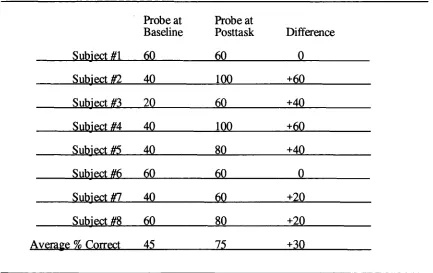
BPPS Percent Correct Scores for Baseline Compared to
Posttask for 8 Subjects... 60
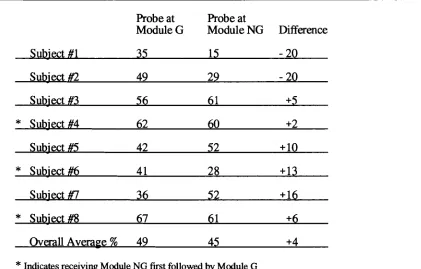
BPPS Percent Correct Scores for Treatment Modules for 8 Subjects, and Percent Change Based on Which Module
Was Received First. ... 61
BPPS Percent Correct Scores for Baseline to Instructional
Modules to Posttask for 8 Subjects ... 63
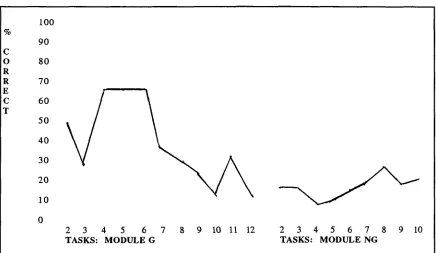
Average Percentage of Correct Discriminations for Module G and NG Tasks for 8 Subjects, and Percent Difference at the End of
Instruction Based on Which Module Was Received First... 64
Content Analysis of Student Responses During the BPPS ... 74
Content Analysis of Student Responses from the Modules... 75
UST OF FIGURES
Example of a Graduated (G) Treatment Task... 39
Example of a Non-graduated (NG) Treatment Task... 40
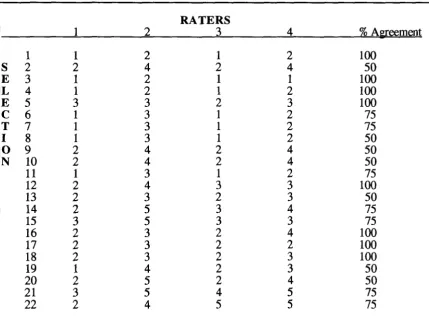
Poetry Selections for Module G and NG Interrater
Agreement on the Likert Complexity Scale ... 47
BPPS Interrater Agreement on the Likert Complexity Scale... 52
Subject #1 Percentage of Correct Discriminations for
Module G to NG Tasks... 65
Subject #2 Percentage of Correct Discriminations for
Module G to NG Tasks... 66
Subject #3 Percentage of Correct Discriminations for
Module G to NG Tasks... 67
Subject #4 Percentage of Correct Discriminations for
Module NG to G Tasks ... 68
Subject #5 Percentage of Correct Discriminations for
Module G-R to NG-R Tasks ... 69
Subject #6 Percentage of Correct Discriminations for
Figure 11 Subject #7 Percentage of Correct Discriminations for
Module G-R to NG-R Tasks ... 71
Figure 12 Subject #8 Percentage of Correct Discriminations for
ACKNOWLEDGMENTS
I would like to express my sincerest appreciation to everyone who made this
dissertation possible. Specifically, thank you Dr. Cohen for chairing my dissertation
committee. Your knowledge, guidance, and good humor kept me motivated. Thank you
Dr. Hyman and Dr. Evans for serving on my committee and providing me with valuable
advise on my dissertation as well as throughout my doctoral program. Thank you Mom
and Dad for supporting me emotionally and financially throughout my schooling. And
CHAPTER I
INTRODUCTION
STATEMENT OF THE RESEARCH PROBLEM AND PURPOSE OF THE STUDY
To what extent would defining poetry appreciation as a transfer demand generate an
effective way to teach poetry? This study investigated the feasibility of using Cohen's
Controlled Misalignment model of instruction (Cohen, 1994) to teach eleventh- and
twelfth-graders to transfer their skills for appreciating language from non-poetic to poetic
forms. This model is intended to create in learners a
set for transfer,enabling them to
"naturally" transfer previously learned behaviors to increasingly misaligned stimulus
conditions presented in poetry.
Previous studies used the Controlled Misalignment model to teach various age
students the
transfer habit,called
cognitive stretching(Nolen, 1991; Boris, 1991). The
results of these studies indicate that this model can be used to teach students to handle both
near and far transfer demands in math and reading. These results also suggested that
Controlled Misalignment might be a possible strategy for teaching students to process the
peculiarities of poetic language, a transfer demand for anyone who has mastered ordinary
prose.
The purpose of this study was to determine the effects of the Controlled Misalignment
intervention on poetry appreciation. In this single-subject design, eight high schoolers
were sensitized to the variations in stimulus conditions between prose samples and poetry
under several variations of transfer demand. Each variation represented a difference in the
instructional pacing, allowing the researcher to identify the most efficient way to control the
transfer demand. Instruction was designed to provide
a setfor, and practice in, meeting
increasing transfer demands with regard to semantic and syntactic features. Subjects were
measured formally by requiring students to discriminate the better of two poetic passages,
one being the original and one in which the semantics and syntax were altered. Students
were also required to explain their choices. The ability to recognize the aesthetic elements
in the original poem was defined as an indicator of appreciation. A content analysis of
subject's responses served as an informal measure of effect and provided additional
quantitative as well as qualitative data.
The present study defined understanding and appreciating poetry as a transfer demand
because poetry is the use of language under stimulus conditions that vary from ordinary
written or spoken prose. "Many students regard poetry as more 'unnatural' than prose.
Poetry is more abstract and hence, seen as unrealistic" (Perricone, 1991, p.675). Students
often develop a fear or dislike of poetry because of the emphasis in educational settings on
understanding poetry rather than appreciating it. Both cases, however, require the ability to
process poetic language's transfer demand. Traditional poetry instruction does not seem to
instruct students systematically in the subtle and overt differences in stimulus conditions
between poetry and ordinary prose. Students are simply expected to transfer knowledge of
standard syntax and vocabulary already existing in their repertoires to gain an
understanding and appreciation of poetic language (Capella, 1994; Ford, 1987; Bryant,
1984).
This study proposed that by providing subjects with an "expectation" of variations in
stimulus conditions differentiating poetic language from prose, they would learn the
transfer habit. The researcher predicted that subjects would develop a set for transfer such
that when they were presented with new poetic passages, they would expect and seek
variations in semantic and syntactic features. Furthermore, the researcher predicted that
certain degrees of variations, referred to as instructional pacing or size of transfer demand,
would produce more or less appreciation effects. The study was designed to vary the size
RESEARCH QUESTIONS AND PREDICTIONS
This multiple baseline, single-subject design investigated the validity of using the
Controlled Misalignment method of instruction to shape poetry appreciation in high school
students. The first research question addressed the proposition that poetry appreciation is,
at least partially, a function of ability to discriminate and process poetic syntax and
semantics from ordinary prose. Therefore, if the Controlled Misalignment treatment shapes
a set for transfer and is applied to poetry instruction, students should show a post baseline
effect. To test this proposition, each subject took a Best Poetic Passage Selection (BPPS)
assessment of appreciation as a baseline (pretreatment) probe and a BPPS assessment after
each instructional task. Hence, the research question:
1. Was there a baseline-to-posttask BPPS percentage correct appreciation score
difference?
The study also investigated the subject's ability to discriminate the critical features that
differentiated the more poetic passages from ordinary prose passages. The research
questions for this part of the study were:
2. Since the two different instructional treatment series, graduated from near to far
transfer demand (G and G-R) and non-graduated (NG and NG-R), were performed by
each subject (i.e., each was his/her own series comparison), and since the sequence in
which the two series were applied was counterbalanced across subjects, what were the
differences in (a) the BPPS percentage correct appreciation scores and (b) the percentage of
correct discriminations for treatments G/G-R and NG/NG-R?
3. Given the two different instructional treatment series, was there a difference
between the two in the number of practice tasks needed before subject's abilities to
discriminate critical features reached criterion?
In addition to the formal measurements (BPPS, percentage of correct discriminations,
understanding and appreciation (articulated
andunarticulated responses). These qualitative,
anecdotal fmdings were recorded and reported and, when appropriate, quantified.
DEFINITION OF KEY TERMS
Co~nitive Stretchin~
refers to a technique for tolerating increasingly misaligned
conditions and involves the "recognition of critical features of stimulus conditions that are
the same as and that are different from previous stimulus conditions of problems previously
successfully solved (Nolen, 1991, p. 5)."
Cognitive stretchingis the
transfer habit,in the
present study, an expectancy that poets vary the syntax and semantics of prose. In the
present study, Controlled Misalignment is intended to shape the behaviors that are
subsumed under this construct.
Controlled
Misali~nmentrefers to a technique for systematically varying each
subsequent activity's features and requiring two criterion performances, the correct
"answer," and the correct description of the misalignment (Cohen, 1995). This systematic
variation is intended to develop the
cognitive stretchingor
transfer habitdescribed above
and is the treatment intervention used in the present study.
Graduated Treatment was considered to be less difficult than the non-graduated
treatment intervention. The graduated treatment module (Module G/G-R) was graduated in
three ways: there were several variations (comparisons) of the same line or stanza, single
lines or couplets were compared before stanzas, and poetic passages rated as 1 s or 2s on
the Likert Complexity Scale were used before passages rated as 3s, 4s, or 5s.
Modules contained the controlled misalignment poetry intervention (treatment) which
required subjects to compare and code changes between lines or stanzas. There were four
modules: Module G, Module G-R, Module NG, and Module NG-R.
Instructional Alignment refers to the degree to which stimulus conditions of
instruction, assessment, and intended outcomes are congruent (Cohen, 1987).
Itis the
Non-~duated Treatment was considered to be more difficult than the graduated
treatment intervention. Tasks in the non-graduated treatment module (Module NG/NG-R)
consisted of only a few variations (comparisons), and required subjects to compare stanzas
rated as 3s, 4s, or 5s on the Likert Complexity Scale.
~ is an artful use of language which "aims at the fulfillment of a purpose
intrinsic to the language itself (Oliver, 1994, p. 30)." It is "writing that formulates a
concentrated imaginative awareness of experience in language choices and [is] arranged to
create a specific emotional response through meaning, sound and rhythm (Webster, 1979,
p. 880)." This study defmes understanding and appreciating poetry as a transfer demand
because it is the use of language that varies in semantics and syntax from prose which was
assumed to be within the high school student's repertoire. In the present study, poetry is a
reflection of the poems used in the Controlled Misalignment intervention and the Best
Poetic Passage Selection (BPPS) assessment of appreciation. A complete list of poems is
in Appendix F. These poems were identified by literary critics and English educators to be
good poetry and appropriate for a high school English curriculum.
Poetry Awreciation, also referred to as Literary Appreciation and Appreciation,
involves recognizing the aesthetic value of poetry through heightened perception or
understanding. It is the ability to grasp the quality, nature, worth or significance of a
poem. In this study, poetry appreciation was measured formally in the Best Poetic Passage
Selection (BPPS) assessment.
Prose is generally written to communicate a message; its purpose is to be useful.
Novels, essays, and letters are examples of prose. In the present study, prose samples are
used in the Controlled Misalignment intervention to teach the transfer habit. The samples
are systematically misaligned such that what first represented "everyday language" becomes
Semantics is "the classification of changes in the signification of words or forms
(Webster, 1979, p.1044)." In this study, semantics refers to "words the writer chooses to
assign to things or people," specifically poetic diction, similes, and metaphors. Poetic
diction usually refers to artificial-sounding or outdated language in a poem such as "thou"
or "hath." Poetic diction uses language distinct from ordinary speech (e.g., "the whiskered
vermin race" instead of "rats"). A simile is a comparison of two things, indicated by some
connective, usually "like," "as," "than," or a verb such as "resembles." A simile expresses
a similarity, but the things compared have to be dissimilar in kind (e.g., "Oh, my love is
like a red, red rose"). A metaphor is a statement that one thing is something else, which, in
a literal sense, it is not (e.g., "Oh, my love is a red, red rose"). In this study, students
wrote the code "P" above the word where there was a change in poetic language or
semantics from the previous line or stanza.
Set for Transfer refers to an expectancy that stimulus conditions present in a given
situation vary, but are related to stimulus conditions present in previously learned
behaviors. The intent is to sensitize the learner to stimulus variations, building a tolerance
for transfer demand (Cohen, 1995; Stover, 1979). This term is synonymous with
expectancy, transfer habit, and cognitive stretching.
Syntax is defined as "the way in which words are put together to form phrases,
clauses, or sentences. A connected or orderly system: harmonious arrangement of parts or
elements of language (Webster, 1979 , p.ll75)." In this study, syntax is the musical
quality of a line or poem and is categorized by rhythm/beat and rhyme. Rhythm is more or
less regular recurrence of units of sound. Many literary critics describe rhythm as being
unique to a poet's style and as something that is "felt" by the reader. However, rhythm can
be measured by finding patterns of stresses (meter) in lines of poetry. Rhyme is the
repetition of sounds. Different types of rhyme include: full or end rhyme, half or near
(rhymed words within a line), and alliteration or head rhyme (the repetition of the same
sound at the beginning of successive or nearby words in the same line). In this study
students wrote "B" above the words or line in the prose samples where there was a change
in rhythm/beat from the previous line or "R" where there was a change in rhyme.
Transfer demand refers to the degree to which a student must transfer knowledge
already existing in their repertoires to a new situation. Cohen defined transfer as the
appropriate action linked to stimulus conditions that vary more or less from those
conditions to which the action was originally linked (Cohen, 1995). "More or less" refers
to the transfer demand, or what cognitive transfer theories call "near or far transfer."
Students can be taught to handle transfer demand if the instructional designer intentionally
manages the stimulus variations so that they progressively increase in transfer demand. In
this case, instruction would require the student to solve the problem and identify the
misalignments; i.e. describe how the stimulus conditions of the current task vary from the
stimulus conditions to which the action had been previously linked. This study defined
poetry as a transfer demand because the semantic and syntactic features of poetry vary from
prose.
Transfer of Learnin~, also known as applying previous learning, cognition, or problem solving, refers to appropriately transferring previously learned actions with their
component thoughts and feelings to new events without direct instruction (Cohen, 1995).
In instructional alignment, transfer of learning describes an appropriate behavior under
stimulus events that vary from those events present when learning originally occurred. In
this study, Controlled Misalignment is the methodology used to teach transfer of learning.
BACKGROUND AND NEED
As long as human beings have existed, they have been preoccupied with the
appreciation of beauty. But exactly what causes us to perceive beauty remains elusive, and
most frequently stipulated goal of poetry instruction, the inability or hesitancy to
operationally define poetry appreciation has left a void in most poetry curriculums.
Consequently, this goal is rarely achieved. Two events motivated this study. One was a
literature search on how to teach this appreciation. The other was a finding in a recent
study using Controlled Misalignment that suggested the possibility that poetry appreciation
may be a function of successfully handling transfer demand.
Many theorists and researchers agree that a crucial aspect of language and cognitive
development involves aesthetic learning and literary appreciation (Anderson
&Rubano,
1991; Greene, 1982; Vygotsky, 1962; Britton, 1970). For example, Greene (1982) points
out that "aesthetic experiences are not only affective and intuitive, ... they involve persons
perceptually and cognitively as much as they do emotionally (p. 327)." Britton (1970)
argues that aesthetic forms of language are essential with regard to constructing a world
view, and that literary reading is a "principal means to individuation" in adolescence
(p.265). However, with the exception of English, every subject in school emphasizes
reading for comprehension rather than for aesthetic experience.
IfEnglish curriculums do
not nurture aesthetic responses and appreciation, students will not develop those skills
elsewhere. " ... An aesthetic emphasis in reading and responding is meant to reinforce
aesthetic language experience as the primary domain of the English language arts
(Anderson and Rubano, 1991, p.86)."
Educators frequently complain that while students are competent in literal-level
comprehension skills, they lack competence in higher-order thinking skills needed for more
sophisticated reading (Purves, 1984). Most schools employ "comprehension" models
rather than models that promote appreciation and aesthetic responses to literature. "Indeed,
emphasis on comprehension has transformed literature study from an activity aimed at
enriching the linguistic and experiential background of our students to one concerned with
Rubano, 1991, p. 1)." This focus on reading comprehension has been enhanced by the
New Criticism model for literary study, which places considerable emphasis on finding the
objective or authoritative meaning of the text.
In the 1980's a number of references to this problem appeared in the professional
literature. For example, a study conducted by the International Association for the
Evaluation of Educational Achievement (lEA) found that higher-achieving, as compared to
lower-achieving students, exhibited fewer different kinds of responses to reading (Gaida,
1982). Gaida (1982) claimed that when reading and responding to literature, students tend
to assume a "moralistic interpretive response stance (p. 119)." Purves, Harnisch, Quirk &
Bauer (1981) suggested that, most likely, students have been taught in school that "certain
responses and only certain responses are appropriate (p. 89)." Eisner (1985) asserted that
one of the main reasons for aesthetic knowing being devalued in schools is the prevalence
of, and the "short-term and the instrumental" focus on testing.
When poetry is presented in school, generally little time is spent introducing students
to its critical features that vary from prose. Typical techniques for presenting poetry range
from giving the students a poem to read and the teacher supplying the "translation," to
counting syllables in a line of verse (Dias, 1979; Perricone, 1991). These techniques and
others probably do not foster an appreciation of poetry.
The present study investigated the use of Cohen's Controlled Misalignment model of
instruction (1995) to train students to recognize the variations in stimulus conditions (e.g.,
semantics and syntax) between prose and poetry to gain understanding and appreciation
when reading poetry. In controlled misalignment, the critical features of events are
systematically varied from smaller to greater disparity from one task to another. The
student is required to respond in the usual manner as in any instruction, but is required, in
addition, to describe these stimulus variations; i.e. how the current task varies from the
noting the stimulus variations as well as on "getting it right," thereby sensitizing the learner
to transfer demand and building a tolerance for it. Cohen calls this tolerance a set for
transfer (1995).
In 1991, Cohen directed a study testing the Controlled Misalignment construct on
transfer across as well as within vocabulary and math content areas (Boris, 1991). Half the
students were alerted to misalignments and given practice items during vocabulary
instruction while the transfer habits of the other half were shaped during math instruction.
To determine if students transferred their newly learned transfer habit to a different area of
instruction, they were given aligned and misaligned assessment items in both the area in
which they received instruction, and the other area (i.e., math and vocabulary). With the
average experimental group student outperforming 90% of the control group, Boris' study
demonstrated that once students learned the transfer habit, they were able to apply the skill
in another content area.
A specific finding in the Boris study led to the current study. When the data showed
little or no Controlled Misalignment effect on vocabulary assessments, Boris discovered a
negative skewing of score distributions for both experimental and control group posttest
scores. Cohen concluded that this finding was caused by unexpected ceiling effects,
indicating that children "naturally" transfer vocabulary without being taught directly to do
so. Any new word always appears in everyday life under conditions that vary from those
originally learned. Therefore, to learn a word means to be able to transfer more or less far.
A unique feature of poetry, meanwhile, is to stretch transfer demand to the maximum. The
poet's task is to create extraordinary experiences by using syntax as well as words in
unusual contexts. In the present study, the researcher investigated whether students could
learn the transfer habit such that they would more easily tolerate poetic language's transfer
The Boris study's results suggested that the Controlled Misalignment model of
instruction might provide practitioners with an effective way to shape a set for transferring
ordinary language processing to poetic language processing. Hence, the present study.
TIIEQRETICAL RA TIONAI .E
This study defined understanding and appreciating poetry as a transfer demand
because the semantic and syntactic features of poetry vary from prose. Cohen's Controlled
Misalignment Model of instruction (1995) was used to train students to recognize the
variations between prose and poetry and to create a set for transfer such that they would
transfer previously learned prose language behaviors to increasingly misaligned stimulus
conditions presented in poetry. The researcher predicted that when students create a set for
transfer in poetry, appreciation increases.
Ferster and Skinner's Stimulus Control construct (1957) provided the foundation for
Cohen's Controlled Misalignment construct. Stimulus control involves managing the
critical stimulus features of events that reinforcers are intended to link to actions to form a
learned behavior. Cohen first applied the stimulus control construct to instruction by
specifying and aligning the stimulus conditions of instruction and assessment, requiring
instructional designers to operationize intended outcomes as the assessment. He called this
Instructional Alignment (1984a). Cohen predicted that when actual assessment items rather
than objectives were aligned to instruction, students would show significant improvement
in test scores. This prediction proved to be true (Stover, 1979; Koczor, 1984; Tallarico,
1984; Elia, 1986; Fahey, 1986; Graby 1987; Wishnick, 1989; and Rapaport, 1994).
The Controlled Misalignment construct was developed as a result of a common
problem that surfaced in nearly all the studies in instructional alignment, the problem of
transfer demand. The more students were required to transfer what they learned in
greater the misalignment among desired outcomes, instruction, and assessment, the less
well students were able to perform on the assessment.
Most attempts to understand transfer use cognitive models. They
try
to impose"critical thinking" strategies. In contrast, Cohen proposed that teaching students to transfer
learning should be approached behaviorally, in which case, the instructional alignment
model was most relevant. The key to applying the alignment model is operationalizing the
outcome, in this case, transfer. He defined transfer as the appropriate action linked to
stimulus conditions that vary more or less from those conditions to which the action was
originally linked. "More or less" refers to the size of the transfer demand, what cognitive
transfer theories call "near or far transfer."
Cohen hypothesized that students could be taught to handle transfer demand by
systematically varying the stimulus conditions and requiring students to not only solve the
problem, but also identify the misalignments; i.e. describe how the stimulus conditions of
the current task vary from the stimulus conditions to which the action had been previously
linked.
Furthermore, Cohen hypothesized that if instruction routinely demanded this dual
response to instructional tasks, the student would routinely expect each task to vary and
would not fmd "new" situations particularly strange. In a sense, the student would soon
acquire an expectation or set for transfer (Cohen, 1995). If the instructional designer
intentionally managed the stimulus variations so that they progressively increased in
transfer demand, the student would easily and painlessly learn to handle far transfer,
perhaps, to that point often referred to as "creativity." In this sense, Cohen was defining
creativity as a far transfer event.
Two studies
in
Controlled Misalignment demonstrated that it was possible for studentsto acquire a set for transfer in math and English whereby they were able to solve the
Boris, 1991 ). The finding in the Boris study suggested to Cohen that its variation in
stimulus conditions from those conditions of ordinary prose or spoken language is what
defmed a passage as poetic. In poetry, the syntax and even the visual text are varied from
prose to affect a poetic style or musical quality. Words are used in their most metaphoric
role so that, for example, one's lover is a "red red rose." Assuming a student can
understand and appreciate prose, then learning to understand and appreciate poetic language
is a transfer demand in which semantics and syntax vary from ordinary exposition but are,
nevertheless, the same language. In A Poetry Handbook, Oliver (1994) writes,
(1) poetry is language, (2) poetry is a use oflanguage rather than a kind oflanguage, (3) poetry is artful, not natural, and (4) poetry aims at the fulfillment of a purpose intrinsic to the language itself (p.30).
Like poetic language, prose is meant to elicit the reader's awareness of experience and
emotional response. Assuming the reader's ability to respond appropriately to prose, the
lack of that response to poetry can be at least partially explained by its semantic and
syntactic transfer demand. Furthermore, if poetry has validity, those features that identify
its variation from prose cause poetic language to elicit more intensive levels of awareness
and emotion. Therefore, assuming they can already respond appropriately to prose,
students taught to handle poetry's transfer demand should demonstrate increased poetry
appreciation.
As defined in this study, poetry appreciation involves recognizing the aesthetic value
of poetry through heightened perception or understanding. In other words, the ability to
identify the language variations increases the likelihood of an aesthetic response and
appreciation. Since Controlled Misalignment has been demonstrated to successfully create
a set for transfer in other skill and content areas, then its application to poetry appreciation
should result in similar success. What remains to be investigated is the application and
pacing of the Controlled Misalignment's transfer demands that elicit maximum
LIMITATIONS OF THE STUDY
The present study assumed that an indicator of appreciation was the ability to
discriminate the syntactic and semantic features that distinguish poetry from ordinary prose.
Hence, the study limited its operational definition of appreciation to a score on the Best
Poetic Passage Selection (BPPS) assessment designed by the researcher. The researcher
acknowledges that appreciation of any aesthetic experience probably depends on many
factors beyond the ability to discriminate critical features (e.g., personality factors, level of
comfort, needs). Therefore, incidental observations and spontaneous responses were
recorded during sessions and content analyzed where appropriate. The study did not
include other factors such as how often the subject chooses to read, write, listen to, or
recite poetry in contrast to competing activities, which are also reasonable operational
definitions of poetry appreciation.
There were no unique characteristics to the population being studied which limited
generalizabilty. The study demonstrated an effect significant enough to reasonably expect
other populations' learning behaviors in other domains to respond to the Controlled
Misalignment method of building a set for transfer.
IMPLICATIONS OF THE STUDY
It
seems logical to assume that teachers create learning experiences whereby students
are challenged to apply what they have learned to "real-world" situations outside the
classroom and further, create opportunities to demonstrate appreciation of
art or literature.However, literature, research, and experience indicate otherwise. Teachers do not
purposely shelter students from these experiences; they simply do not have the
"know-how."
One of the most important implications of this study is that the Controlled
Misalignment model of instruction may contribute to giving teachers the "know-how" to
evidence of effective poetry instruction, there is very little empirical research. Teachers
generally rely on their own or other teachers' successful experiences rather than an
empirically demonstrated technique.
Defining poetry appreciation as a transfer demand could generate an effective way to
teach it. Not only would students develop a set for transfer and a transfer habit which
might transfer to other school subjects, they would also learn to appreciate poetry as a
variation from prose. Distinguishing the variations could lead to greater understanding of
syntax and semantics. Ultimately, students may learn to appreciate poetic language and
CHAPTER II
REVIEW OF THE LITERATURE
INTRODUCTION
McGovern (1993) cites a government report from 1987 which was specifically
commissioned to investigate the teaching of poetry in secondary schools. The report found
that 'poetry is frequently neglected and poorly provided for; its treatment is inadequate and
superficial.' According to Dias and Hayhoe (1988), the prevalent teaching methodology,
which is characterized by the excessively dominant role of the teacher, has contributed to
the negative view of poetry. Bugeja's research (1992) supports this view: "Nearly half of
the students thought poetry was exciting until a teacher made a value judgment about their
intellect, based on their explication (p. 32)." In their book, Dias and Hayhoe describe
several teaching techniques which focus on the reader. The teacher merely acts as an
observer and consultant and offers her/his opinion as a point of discussion only after
students have formulated their own. McGovern (1993) suggests a more precise method of
teaching poetry which is based on the teaching of skills and modeled after reading
instruction for foreign language learners.
McGovern's method (1993) divides skills into four major categories: (1)
understanding skills, (2) consolidation skills, (3) appreciation skills, and (4) evaluation
skills. Understanding skills focus attention on the content of the poem, which includes the
title, vocabulary, sentence structure, imagery, and theme. Consolidation skills emphasize
identifying and interpreting tone, style, irony, symbols, innuendoes, mood, and so on.
According to McGovern, "The Consolidation Skills form an effective bridge between
understanding a poem and appreciating it (p. 31 ). " Appreciation skills assist the learner in
clarifying his/her opinion about how well a poem is crafted and involve identifying and
more reader-focused than text-focused and aim to encourage the learner to develop from
being a dependent to an independent reader of poetry (p. 33)." Evaluation involves
comparing skills involved in reading poetry to other works, using appropriate language to
articulate opinions about a poem, and using reference works such as dictionaries and
literary reference guides. This method is very similar the method espoused by Wolfe and
Shuman (1976) in study using high ability high school students.
Poetry is a work of art. However, poetry appreciation is more difficult than other arts
because words get in the way of immediacy. In everyday language, words are used
carelessly. But in poetry, words are selected and used with great care, and their meanings
are precise. Good analysis of a poem should increase understanding and enjoyment.
Marshall (1993) points out that "the Report of the Commission on English minimizes the
poem as a work of art. Possibly they took it for granted that everyone naturally responds
to poetry but needs to be taught discrimination. The latter is certainly true; though the
former is not (p. 26)." She advocates waiting until a student is emotionally moved or
fascinated by a poem before proceeding with analysis.
Couch (1987) condemns the way poetry is traditionally taught in schools. He claims
that the emphasis on simply regurgitating factual information about a poem on a worksheet
undermines the goal of teaching appreciation and taste. Similarly, in his book titled
Teachine literature to adolescents, Dunning (1977) argues that poor teaching methods cause
students to dislike poetry, which inhibits the development of discriminating taste.
Grosshuesch (1991) goes so far as to say that "poetry is considered a form of torture
because of the way with which it is approached (p. 49)."
Purves (1989) concludes that a major function ofliterature education is "the
development of what one might call preferences or habits of mind in reading and writing
(p. 4)." In other words, students not only need to learn to read aesthetically, but they must
poetry. Furthermore, "literature education is supposed to develop something called 'taste'
or the love of 'good literature,' so that literature education goes beyond reading and writing
in the inculcation of specific sets of preferred habits of reading and writing ... (p.
4)."
Pollard (1978) discusses the results from a study which found that one out of two
students in advanced art courses needed "aesthetic remediation (p.
1 ). " She states that the
"lack of aesthetic understanding limits not only our ability to create art and to appreciate it,
but also narrows our vision of ourselves (p.
20)."
Although Perricone's essay (1991) is directed toward the use of poetry in foreign
language instruction, she discusses pertinent issues related to poetry instruction in general.
For example, she discusses deficiencies in students' education which commonly includes
"little or no understanding of the development of poetry, a paucity of knowledge with
respect to critical analysis of the genre, a poor grasp of the terminology required for that
analysis, etc.
(p.675)." She also discusses the importance of instructing students about
fundamental differences between poetry and prose and the creative process.
READER-RESPONSE THEORIES AND RESEARCH
Not only is there a large body of theoretical work on reading processes and the role of
readers, but over the last three decades a considerable amount of research has been done on
the process of responding to literature (Gaida, 1982; Applebee, 1977; Purves & Beach,
1972; Cooper, 1971). While a wide variety of approaches have been used and validated
over the years, literature education has remained largely unchanged. There are, however,
only a few researchers who have made a significant contribution to literature education.
Rosenblatt is one of those.
In 1938, Rosenblatt endeavored to redefme literary reading in schools in her book
Literature as Exploration.
Forty years later, she further refined her work by proposing the
notion of "efferent" and "aesthetic" psychological stances assumed by readers. While
aesthetic reading is concerned with recreating an emotional experience. During and
following aesthetic reading, the reader is engaged in personal and qualitative responses.
For the most part, efferent reading is emphasized over aesthetic reading in school
curriculums. Efferent reading and responding is reflected in questions such as "What is
this type of poem called?" Part of the problem is that because aesthetic reading and
appreciation are rarely operationally defined, available teaching materials focus on other
efferent models such as comprehension. Rosenblatt (1978) contends that very few
students benefit from poetry instruction which employs analytical and critical ways of
thinking borrowed from other parts of the curriculum.
There is a common misconception that until a student can read analytically for
comprehension, they cannot read aesthetically for appreciation. In fact, research on child
development suggests the opposite. For example, Gardner (1982) found that metaphor
production preceded metaphor comprehension developmentally. Similarly, Koch (1990)
discovered that fourth graders can respond to poems by writing poems, thus demonstrating
an aesthetic response to literature.
"The theoretical center (and, therefore, the teaching focus) of reader response is the
point at which the reader interacts with the text. Reader response investigates the
interaction of text and reader, the affective and cognitive processes of understanding and
enjoyment (Anderson & Rubano, 1991, p. 7)." As reflected in the research, the two
primary categories of response are: 1.) Articulated Response and 2.) U narticulated
Response. Articulated response research, generally referred to as protocol analysis
research, analyzes oral or written responses (protocols) of readers before, during, or after
reading a piece of literature. Unarticulated Response research, also called passive ability
research, provides opportunities for readers to respond to literature in ways which do not
require an oral or written response.
In contrast with articulated response research,
Articulated Response Research
The publication of Richards' Practical Criticism in 1929 marked the beginning of
articulated response research. Richards hoped that by gaining an understanding of how
students responded to poetry, he might learn how to better teach it. The protocol analysis
methodology used by Richards has provided significant insights into adolescent and child
reading behavior and is still the most frequently employed in reader-response research.
Richards (1929) presented his students with 13 selected poems and invited their free
responses. He then recorded and analyzed their protocols (comments). His analysis led
him to identify 10 major difficulties in their approach to reading poetry. They were:
making out the plain sense of poetry, sensuous apprehension, imagery, mnemonic
irrelevancies, stock responses, sentimentality, inhibition, doctrinal adhesions, technical
presuppositions, and general preconceptions. Richards concluded that the following
problems interfered with the ability to read poetry critically, correctly, and meaningfully:
immaturity, lack of experience in reading poetry, general inability to construe meaning,
succumbing to stock responses, preconceptions, bewilderment, and deference to authority.
Furthermore, Richards found that there was little consistent quality in responses; there were
extremes of perception and obtuseness.
Richards' approach necessitates that the teacher assist the reader in becoming a more
advanced interpreter of literature through written response such as an essay question on a
literature exam.
Other researchers have used different techniques to elicit articulated responses. For
example, Applebee's (1978) research analyzed response protocols as a way to look through
transactional language and uncover poetic response. Squire (1964) analyzed verbal
responses to open-ended questions asked at different points during a reading.
In an effort
to confirm that small group work is as productive as, if not more than, teacher-led and
teacher-dominated instruction in a large group, Dias (1979) asked small groups of students
to work out their interpretations of a poem and bring those back to the entire class for
further discussion. Using a combination of journal writing and small group discussion,
Bryant (1984) noted that subjects increased their ability to respond aesthetically to a poem.
The use of journals or reader-response logs has, in recent years, become fairly
widespread. Bleich (1975) was one of the first to research this method of response. He
describes using reading logs and activities such as having students select "the most
important element in the story" to investigate their criteria for making the judgment. Most
educators support this method to some extent, as it gives students self-direction and control
over the learning situation and it strengthens students' writing and their ability to relate to
literature. Responses need not be gushy personal testimonies. Instead, an aesthetic
response is that which not only belongs to the individual concerned, but can be appreciated
and shared by others.
While most reader-response research assumes communication to an audience, a basic
assumption of "poetic discourse response" is that language is used for its own sake, "not
for any ulterior end, any purpose that lies outside the activity itself (Britton, 1970, p. 30)."
Providing readers with tasks that require response in poetic discourse promotes aesthetic
reading. For example, following an explanation of what is meant by imagery, teachers
could have students report as vividly as possible, "images" they recall from a poem.
Images would include sights, sounds, and smells associated with one part or the entire
distance themselves from the "images" and discuss, in writing, the source of their imagery
(Anderson and Rubano, 1991).
U narticulated Res.ponse Research
Many researchers have acknowledged that " ... overt response (verbal, etc.) may
indicate very little of the inner response (Harding in Squire, 1968, p. 11 ). " In contrast
with articulated response research, unarticulated response research attempts to "try to go
beyond such descriptions and statements and try to get closer to the response itself
(Hansson, 1985, p. 217)." Hansson noted that "The passive ability of the less-educated
readers to notice and judge linguistic, literary, and experiential qualities were much more
developed than their active ability to verbalize their interpretations and experiences in
written statements (p. 217)." Unarticulated response research assumes that many readers
have passive ability with regard to responding in traditional oral or written forms. Even
"sophisticated" readers are occasionally confronted with difficulty in articulating a response
to certain poems which they have proclaimed to be masterpieces. In other words, they
have tacit knowledge: they "know more than they can say."
Many methods used in unarticulated response research can be used in the classroom.
For example, Hansson (1973) had readers respond to every two lines in a poem using
twenty-five different bipolar verbal scales with such descriptors as: simple-complex,
vibrant-static, bitter-sweet, and tragic-happy. This semantic differential technique can also
take the form of single pole scales, e.g., 01234567 Happy. At the end of the poem,
readers in Hansson's study were required to respond to all twenty-five scales. A
significant finding in his research is that regardless of the level of reading sophistication
(i.e., scholars and teachers of literature or skilled workers with only seven years of
compulsory school), the response profiles on the scales show remarkable similarity (1985).
Using the semantic differential with a variety of readers from all walks of life, [Hansson] showed that there was a central tendency in the response to a poem. Only when the readers began to articulate their responses did diversity enter, for then readers began to focus on different aspects of the poem, began to make critical statements (p. 809).
Another method of unarticulated response research used by Purves (1979) was to ask
readers to choose what they thought were the most important questions to ask about a given
poem. The questions are broken into descriptive, not hierarchical, categories. However, a
teacher may choose to ask students to rank -order the questions in order of personal
preference. They range from "Has the incident in the
story
[poem] ever happened to you?"to "What qualities make this
story
a goodstory
[poem]?" to "What would you rather bedoing than reading this
story
[poem]?" He found "that each text is unique not simple in itsmeaning and emotion but in the critical perspective that it elicited from students, and this
across a broad spectrum of cultures and educational systems (p. 810)." Purves also found
that a few readers exhibited a personal response pattern regardless of the type of text.
To investigate unarticulated response, Abbott and Trabue (1921) had readers choose
the best and worst versions among four versions of the same poem, one of which was the
original. One version of the poem was rewritten to reflect a more sentimental tone.
In
another version the meter (rhythm) was disturbed, and in the fourth version the rhyme was
altered. Elementary and high school students tended to choose the sentimental version as
best while college juniors, seniors and graduate students chose the original version. Like
Purves, Abbott and Trabue also found central tendencies in response.
In an adaptation of
this study, Anderson (1988) used "poetic convention" (i.e., rhyme, meter, diction) to alter
poems. In the classroom, this technique has the added benefit of enabling the teacher to
recognize the aesthetic elements in the original poem (Anderson and Rubano, 1991).
Many other researchers and educators advocate similar methods for helping students
discern the difference between good and bad poetry. For example, in their books, Hall
poetry and present criteria for evaluation. Perrine purports that the objective of a liberal
education should be "to develop one's ability to judge and to discriminate (p. 730)."
Regardless of whether response is unarticulated or articulated, the aesthetic experience
must be accounted for. According to Anderson and Rubano (1991), the best approaches
toward that end are unarticulated response and articulated response through poetic
discourse because they "avoid all possibilities of efferent response (p. 24)." While poetry
appreciation is enhanced through aesthetic reading, it is demonstrated through aesthetic
responses.
LITERARY APPRECIATION
While there is a plethora of literature on poetry instruction, very little is based on
empirical fact. This is particularly true when the instruction seeks to elicit appreciation.
Part of the problem lies in the difficulty educators have in defining what they mean by
"appreciation." Kornfeld (1972) recognized the need for a "clear, valid definition of
literary appreciation" and consequently, designed a study to "develop a theoretical and
operational definition of literary appreciation as well as procedures for establishing and
measuring the validity of that defmition (p. 1 ). " An analysis and synthesis of relevant
writings in literary criticism and aesthetics and empirical studies in literary education
provided the foundation for the operational definition.
According to Kornfeld, "literary appreciation generally refers to a response to
literature that is evaluative and that indicates a perception of the qualities of literature
(1972, p. 5)." The resultant operational defmition of literary appreciation as validated in
Kornfeld's study is made up of three components:
a. Taste and Judgment: Given literary selections to read, S Chooses the better quality from the lesser quality.
b. Understanding and Appreciation: S writes answers to questions about literary work.
Appreciation is the "consumatory experience of art" and consists of taste and judgment
or acts ofliking and acts of valuing (Jessup, 1959, p. 55). Whereas taste is a feeling
response of liking, judgment involves acts of valuing through a comparison of other
literary works. "The aesthetic appreciator is aware of his likes (his taste) and can relate
them to the relationship of the qualities of the literary object; he also values certain works
Gudgment) when, through comparison, he is aware of the aspects which ally or
differentiate this object from other works (Kornfeld,1972, p. 57)."
Understanding generally leads to appreciation, although not necessarily a full
appreciation of its aesthetic impact. On the other hand, a reader may appreciate a poem
without necessarily understanding or liking it (Cooper, 1972). In fact, the research
indicates that literary appreciators do not base their judgment of quality on personal
preferences. "Appreciation, then, is based on understanding and can be independent of
valuing. It is an aesthetic process, involving the evaluation of separate facets of the work
and concluding with an overall assessment of its literary merit (Cooper, 1972, p. 6)."
In Kornfeld's study, attentiveness to beauty and the aesthetic attitude is presented as
the heart of appreciation. "Beauty, an inherent value, is dependent upon the perceiver, for
it belongs to the object for those who can be affected or 'nourished' by it (Kornfeld, 1972,
p. 58)." Appreciation requires having an aesthetic attitude as demonstrated by a sensitivity
and attentiveness to certain qualities of literature. According to Jarrett (1957), those
qualities are:
a. Sensory qualities -- attention to the sensory materials such as the nature of the words used
It is these unique qualities of poetry which cause students to fear it. Generally, very little
time is focused on introducing students to the critical features and variations from prose.
Over the years, the most common measure of appreciation has been a test requiring
subjects to discriminate among poems or poetic passages. Content validity comes from
either the source of the selection (i.e., a recognized classic) or expert opinion. Abbott and
Trabue's (1921) study was one of the first to use different version of a poem to measure
appreciation. Eight years later, Speer's test of recognition of merit in poetry (1929)
required subjects to make a choice between two poems which had undergone an elaborate
process of judging by experts. Leopold (1933), Williams, Winter, and Woods (1938), and
Britton (1970) all used similar tests. The Rigg Poetry Judgment Test, published in 1942
by the Bureau of Educational Research and Services at the University of Iowa, is believed
to be the only test available from a commercial test publisher. It consists of 40 extracts of
poetry and along with a second version which was purposely made inferior.
INSTRUCTIONAL ALIGNMENT
Instructional Alignment refers to how precisely the stimulus conditions among desired
outcomes, instructional processes, and assessment align (Cohen, 1984a). By using
outcome indicators instead of behavioral objectives, teachers design instruction with critical
features that match the outcome indicator's critical features. The more these critical features
match, the higher the scores on these indicators which define the intended outcome.
Cohen's Instructional Alignment construct has generated significant increases in learning
and test scores (Stover, 1979; Koczor, 1984; Tallarico, 1984; Elia, 1986; Fahey, 1986; and
Graby, 1987).
The Instructional Alignment construct has roots in Ferster and Skinner's Stimulus
Control construct (1957) and Neidermeyer's Curriculum Alignment model (1979).
Skinner defined a behavior as an action in combination with discriminating and reinforcing
learning is a linkage among the action, reinforcers, and discriminative events. Before
learning something new, learners must have certain actions already existing in their
repertoires (Skinner, 1957). For example, before students can appreciate poetry, they must
understand normal daily oral language and be able to process language. In other words,
students do not learn a new action called appreciating poetry; they learn new linkages
between, on the one hand, appreciation actions (statements, expressions, signals) with their
contingent prose language events and, on the other hand, with new "poetic" language
events.
When students read a poem, reinforcers such as self satisfaction or understanding link
their appreciating actions (signals indicating appropriate thoughts and feelings) to the poetic
stimuli in the poem. The words in the poem, or the way in which they appear on the page,
or the syntax, or the way they are used are some of the critical features of those stimuli that
discriminate poetry from "ordinary" prose. When the poem's discriminative events are the
same or very close to the prose form, the two behaviors are said to be aligned. A stimulus
control problem exists when the discriminative events misalign with "normal" prose.
Usually the "greater" this misalignment, the "more" poetic the passage. The poet
manipulates "normal" language to create poetic effects. Behavior researchers would call
this manipulation a "stimulus condition that varies from the normal use of language."
When we ask normal language users to understand and appreciate these varying critical
features, we introduce a transfer demand.
In addition to Skinner's influence on Cohen's Instructional Alignment model,
Neidermeyer's Curriculum Alignment construct (1979) provided the model for instructional
alignment. Curriculum Alignment refers to the match among objectives, instruction and
assessments in any given curriculum. In a study investigating the effects of consistency
between the conditions presented during instruction and testing, Neidermeyer administered
received traditional kindergarten instruction, while four experimental classes received
instruction under conditions consistent with assessment conditions. Tests were rated on a
six-point rating scale (0 =no response to
5
=very legible). In the experimental group,86% to 96% of the students were rated 3 or higher in contrast to 54%,74%,75% and 86%
in the four comparison groups (Neidermeyer, 1973). In another study, Neidermeyer and
Moncrief (1975) examined the effects of an elementary school nutrition unit designed to
align objectives, instructional activities and the posttest. Once again, significant increases
were shown on experimental group posttests (30%- 36%). Although the effects were
statistically significant, Cohen was troubled by Neidermeyer's "spotty" results and set out
to further refme the curriculum alignment construct by proposing that instruction and
assessment would be better aligned by using actual assessment items rather than behavioral
objectives. Over the next decade, he supervised a number of studies on Instructional
Alignment at the University of San Francisco.
In one of the earliest of these studies, Cohen and Stover discovered the power of
Instructional Alignment, reporting effect sizes of 1.44, 3.00 and 3.44 sigma (Stover,
1979). Sixth-graders were taught three different math word problem-solving techniques.
While all three groups received the same posttest, only one-third of the posttest items were
aligned with practice items given to each student. In other words, regardless of the
instructional technique used, mastery was achieved when the items were instructionally
aligned.
Encouraged by Stover's results (1979), Cohen and Hyman at the University of San
Francisco began a review of doctoral dissertations and journal articles reporting research
related to instruction. They discovered effects up to 3.5 sigma when the instruction was
aligned to the assessment, a condition more likely to be found in formal experiments in
which the construct validity of the dependent variable is a core criterion of a research