THE OTHER SIDE OF THE ATOMIC AIR FORCE: ARTIFACTS OF THE AIR FORCE'S PEOPLE PROGRAMS
by
Yancy D. Mailes
A thesis
submitted in partial fulfillment of the requirements for the degree of
Master of Arts in History Boise State University
BOISE STATE UNIVERSITY GRADUATE COLLEGE
DEFENSE COMMITTEE AND FINAL READING APPROVALS
of the thesis submitted by
Yancy D. Mailes
Thesis Title: The Other Side of the Atomic Air Force: Artifacts of the Air Force’s People Programs
Date of Final Oral Examination: 27 April 2017
The following individuals read and discussed the thesis submitted by student Yancy D. Mailes, and they evaluated his presentation and response to questions during the final oral examination. They found that the student passed the final oral examination.
David M. Walker, Ph.D. Chair, Supervisory Committee Lisa Marie Brady, Ph.D. Member, Supervisory Committee Nicholas Miller, Ph.D. Member, Supervisory Committee
iv
ACKNOWLEDGEMENTS
v
AUTOBIOGRAPHICAL SKETCH OF THE AUTHOR
Mr. Yancy Mailes is the Director of the Air Force Global Strike Command History and Museums Program, Barksdale AFB, Louisiana. He is responsible for establishing policy and preserving the Command’s institutional memory and its material heritage. The Command's nine wings control the nation's entire inventory of Minuteman III intercontinental ballistic missiles, B-1, B-2 and B-52 bomber aircraft. Therefore, he is responsible for ensuring that historians concentrate on documenting recent history (both at home station and in the deployed area), while maintaining the Command’s unclassified and classified archives, and answering leadership and public inquiries. He also directs the Command’s heritage program through museum exhibits, heritage displays, well-maintained airparks, and educational outreach programs. Lastly, he is responsible for Command’s Air Force Art Program.
vi ABSTRACT
vii
TABLE OF CONTENTS
ACKNOWLEDGEMENTS ... iv
AUTOBIOGRAPHICAL SKETCH OF THE AUTHOR...v
ABSTRACT ... vi
TABLE OF CONTENTS ... vii
LIST OF TABLES ... ix
LIST OF FIGURES ...x
LOCATION OF DOCUMENTS AND FORMATTING ... xi
INTRODUCTION ...1
CHAPTER 1 ...10
Recruiting After WW II and Before 1950 ...10
SAC's Response to Manning Shortfalls and Recruiting ...19
The Army and Air Force Reach an Agreement ...24
CHAPTER 2 ...44
Retaining A Qualified Force ...44
LeMay’s Housing Programs ...47
SAC Dormitories ...55
The People Programs ...58
Recruiting the Right Person ...61
viii
The Turbulent Years ...64
CHAPTER 4 ...72
The Air Force And the All-Volunteer Force ...72
Personnel Programs and the Erosion of Benefits ...72
Social Programs ...76
The New Definition of Family, Daycare and Dual Income ...79
CHAPTER 5 ...88
The USAF's Entitlement Artifacts ...88
Housing ...94
Bachelors' Quarters ...99
Child Care ...105
Education ...106
Morale, Welfare, and Recreation (MWR) ...106
CHAPTER 6 ...109
Conclusion ...109
Figure 12 Air Force People Programs circa 2010 ...112
ix
LIST OF TABLES
x
LIST OF FIGURES
Figure 1 Mt Home AFB circa 1948... 9
Figure 2 Model plane contest-Air Force Day 1948 Davis-Monthan... 31
Figure 3 Example of U.S. Army U.S. Air Force recruitment poster ... 38
Figure 4 Example of U.S. Army U.S. Air Force recruitment poster ... 39
Figure 5 Example of U.S. Army U.S. Air Force recruitment poster ... 40
Figure 6 Base Map from Mountain Home AFB circa 1967 ... 49
Figure 7 Wherry and Capehart Layouts ... 51
Figure 8 Transformation from Barracks to Dormitories ... 57
Figure 9 Examples of SAC’s People Programs... 59
Figure 10 Gen LeMay and SAC’s People Programs ... 60
xi
LOCATION OF DOCUMENTS AND
FORMATTING
Much has been written about the overall military benefits established in the 1950s and 1960s, but this study focuses on the programs established by the Air Force, more specifically Strategic Air Command, that directly influenced recruitment and retention demand. Because the national command authority placed the emphasis on Strategic Air Command and Air Defense Command throughout most of the time period covered by this study, a great deal of emphasis is placed on document collections from those two organizations. The collection of SAC documents reside in part at Barksdale AFB, Louisiana, in the Bohn Global Strike Research Facility. All but two of the cited documents are freely available.
INTRODUCTION
The evolution of Strategic Air Command’s “People Programs” and its air base designs supported the Air Force’s overall recruitment and retention goals while improving the quality of life for its Airmen and their families. The roots of these concepts are traced to the seeds planted in the 1950s and 1960s. The efforts of General Curtis LeMay and his staff played a critical role in the development of the Air Force, but the true success of SAC's People Programs came from the young service's ability to create rather than inherit.
General LeMay is critical to the discussion, not only because of his unwavering support to SAC's People Programs, but more so for his longevity as SAC's leader and his follow-on assignments. General LeMay served as SAC's second commander from 1948 until 1957, and in that time created SAC's People Programs, championed efforts to build Air Force housing, and created a culture unlike any in the past. He departed SAC to become the Vice Chief of Staff of the Air Force and then a few years later assumed the duties as the Air Force's leader, the Chief of Staff. In those 17 years, he was responsible for shepherding the Air Force through its early critical growth, building a solid foundation for quality of life programs that supported the idea of recruitment and retention, but he also played a key role in the Air Force embracing the concept of equality.
their home station's as just a port or just a post, the Air Force viewed the air base as not only its power project base, but also its home. The Air Force’s runways represent modern American strategic airpower while its housing and its People Programs represented a shift in the military’s thinking, one from a society focused on the single man to one embracing the society of families. The ability to create air bases, or in some cases revive old World War II installations, while developing innovative personnel policy allowed the Air Force to build a system of entitlements that attracted and retained a talented workforce. The other services did not enjoy this benefit of creating and were wed to old practices. As expected, they fell victim when they did not adopt better quality of life programs to attract and retain their recruits. Their decisions to not change were rooted in their history and how they fought in the past. The Army's post was just a stop over until the next fight and the Navy's port was just a way point until they got underway again. The Air Force elected to choose a different path. Together with a strong leader and the ability to take a different path, SAC and the Air Force created a new future for the young service.
In the afterglow of the atomic bomb mission and the demonstration of American airpower might, some asked if the United States needed a large standing force. Mr. Charles C. Rohrer summed up the sentiment when he stated, "We all recognize the next war will be won by the nation which has the latest in scientific achievements. Masses of foot soldiers can no longer compete with the atomic bombs."1 Later, Lt. General Jimmy Doolittle claimed "a 'small, but adequate, ultramodern, highly mobile' establishment built around air
1 Address Before Committee on Military Affairs. Demobilization of the Armed Forces,
power was the most economical defense organization for the U.S."2 Some continued to argue for a larger force and they received feedback that they were planning for the last war, rather than the war of the future. With the Air Force clearly earning favor for its future military role the question of how to man the postwar military began very early. Air Force leaders chose volunteered recruitment. However, by January 1946, the volunteers failed to make up for the lack of military members recruited under selective service, the draft.
By the latter part of February 1946, despite a decline in the uproar over demobilization, the Secretary of War, Robert J. Patterson braced himself for another wave of public protest this time over the Army's caste system. In the glow of the end of World War II, enlisted men voiced their disapproval for officers' restaurants, hotels, nightclubs and bars that were "Off Limits to Enlisted Men" and "For Officers Only;" the separate post exchanges, hospital wards, and even latrines. They lamented officers having better access to female companionship, their extra liquor rations, and their reserved seats at the theater. Robert Neville, a writer for the Stars and Stripes summarized the repercussions this would have on enlistment writing, "that until the Army changed its practices despite lures of pay, travel and vacations, relatively few men in this country of ours will elect to enter a caste-ridden organization in which they immediately become the untouchables."3 The Secretary of War agreed with Neville's findings and appointed Lt General James "Jimmy" Doolittle to lead an investigation with Major Wilson R. G. Bender as his recorder. Together with Robert Neville and General Troy Middleton, the "Doolittle Board" surveyed the allegations
2 Address Before Committee on Military Affairs. Demobilization of the Armed Forces,
Hearings before a Subcommittee of the Senate Committee on Armed Forces on S. 1355, 79th Congress, 2nd Session, 1946.
and the issues and then made recommendations to the Secretary of War.4 The announcement of the board composition received mixed comments. Some believed the board members were not qualified, lacked diversity, and would probably white wash the whole report until the establishment could take over once again. Others stated quite the opposite, claiming that "from Doolittle on down to the buck sergeant the personnel of the committee is representative of our civilian Army."5 In April 1946, the board announced that the first phase had been completed and that in the next phase they would study the testimony, letters, and literature on the subject.
In early May 1946, just two months after the War Department re-designated Continental Air Forces as Strategic Air Command, Doolittle reviewed the draft report and began making changes.6 By the end of May, Secretary Patterson released the report to the public, which was generally well received. The Doolittle Board recommended 14 suggestions and Patterson approved twelve. The recommendations, some vague and some very specific, quickly received flak from the regular solider. "Thanks to some noisy and completely un informed civilians we have about killed the caste system and in doing so we have all but killed an innocent bystander--the non-commissioned officer."7 Later during the Korean War, the professional soldiers who led the small and half trained army in the
4 Kevin Phillip Anastas, "Demobilization and Democratizing Discipline: The Doolittle Board and the Post World War II Response to Criticism of the United States Army," (Duke University, 1983), pp. 47, 50, 58-62, 69.
5 Anastas, "Demobilization and Democratizing" Discipline 69.
6 Dr. Daniel Haulman, “Lineage and Honors of the Air Force Global Strike Command (USAF),” Air Force Historical Research Agency, June 30, 2009.
first few battles realized that something was very wrong with the system and they loudly voiced their opinion of the source of the problem. Sergeant Lloyd Pate noted a lack of discipline. "That Doolittle Board who wanted to make everything dandy for the poor damn private, that's what did it. And you can quote me on that."8 In later testimony he said, "The post-war 'Doolittle Board,' caused severe damage to service effectiveness by recommendations intended to 'democratize' the Army--a concept that is self-contradictory."9
In total, seven of the Doolittle recommendations were partially or completely implemented and only two were out right disapproved. So, the only real change the Doolittle Board made was to stop enlisted men from saluting officers off post or when off duty, but the perception that the Board had indeed made change took on a mythical status. It empowered the average G.I. while making leadership believe that they had been stripped of some authority. The reality was that the "Caste System" study achieved Secretary Patterson's main goal, which was to quiet the public and make them believe that change had taken place, and portray the military as a place an enlisted man could make a career. As a second order effect, and arguably more damning, many began to believe that the recommendations, and the changes, of the Doolittle Board led to problems in recruitment
8 Kevin Phillip Anastas, "Demobilization and Democratizing Discipline: The Doolittle Board and the Post World War II Response to Criticism of the United States Army," (Duke University, 1983), pp. 93.
and retention of soldiers.10 They were probably correct as the old traditions of the military had been put on trial as Doolittle sought "to make the army more compatible with a democratic nation."11 The report's authors stressed, "Note must be taken of changing concepts, social unrest, a transitional period in which thinking is directed toward the perfection of democratic processes, with greater emphasis on human relations, security, the dignity of the individual."12
Some later debated the true power of the Doolittle Committee in reference to the Code of Military Justice after WW II. In a May 1961 St. John's Law Review article, "The Background and the Problem," Robert J. White argued that while the Doolittle Committee recommended "a review of the machinery for administering military justice and the courts-martial procedure,"13 the follow-on efforts were what really changed the military justice system. He added, "To attribute a dominating influence to the Doolittle Report is to fall into the same error as the Board itself--a fascination with the reform of social amenities, salutes, and fraternization."14 While his argument is sound, it is wrong to overlook the
10 Kevin Phillip Anastas, "Demobilization and Democratizing Discipline: The Doolittle Board and the Post World War II Response to Criticism of the United States Army," (Duke University, 1983), pp. 93-97, 109.
11 The Doolittle Report: The Report of the Secretary of War's Board on Officer-Enlisted Man Relationships, May 27, 1946.
12 Mark R Grandstaff., FOUNDATION of the FORCE: Air Force Enlisted Personnel
Policy 1907-1956. (Washington D.C.: Air Force History and Museums Program, 1997), 62.
13 Robert J. White. "The Background and the Problem," St John's Law Review Issue 2 Vol. 35, May 1961, Number 2, pp 203.
power of America's desire for reform in the post-WW II era and how the Army embraced these concepts.
America was changing. It was becoming modern and futuristic and the average American wanted the opportunity to embrace the American Dream. In response, and in an effort to make the military a more desirable career choice, several years after World War II, the Army announced that every youth drafted into the Army "will be treated as a human being, never a raw recruit."15 This and other changes in the Army, together with the G.I. Bill and a VA loan, and the Air Force's move to become more businesslike, confirmed that the Doolittle Report signaled the need for major change in how the military would recruit and retain qualified and later highly trained men and women. These post war reforms would become the cornerstone of the newly created Air Force and from its inception, these issues would dominate its very existence. It must be stressed, however, that the Air Force, unlike some of the other services, recognized these lessons very early. Because of this, early airpower leaders embraced the idea to offer entitlements to entice Airmen to enlist, but better yet, to stay.16
As the Air Force began to build up in late 1946 and early 1947, so too did the United States, and like the Air Force, great change was coming. The nation began building massive neighborhoods and the military offered returning WW II veterans access to the G.I. Bill
15 Edgar L. Jones. "You're in the Army--Again," The Atlantic, Jan 49, retrieved 6 September 2016.
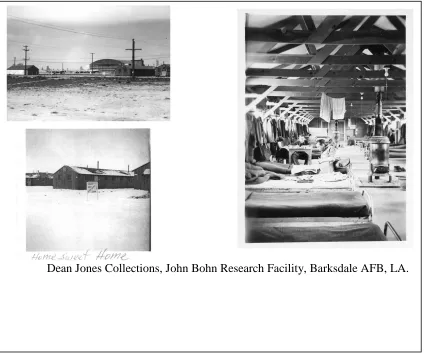
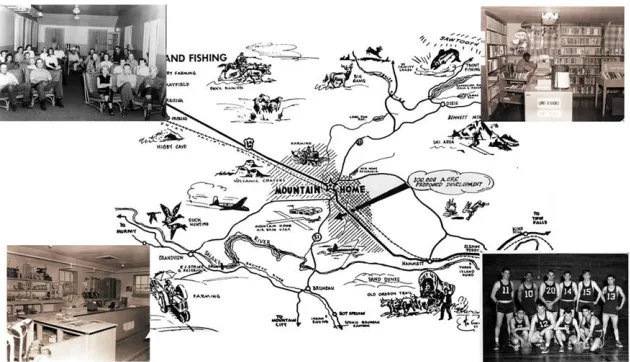
and options for purchasing a home.17 So, as leaders in SAC and the Air Force worked to attract the best and brightest, they competed with the temptation of the American Dream of owning a home and having a good life. To offset these temptations, SAC and the Air Force leaders implemented numerous People Programs and constructed Levitt Town-like neighborhoods at each air base to replace the dilapidated structures at most WW II bases-(Figure 1.) The majority of these programs for the Air Force originated in the late 1950s and matured during the mid- 1960s. This social welfare apparatus pre-dates the Army's reaction to All Volunteer Force changes of 1973 and has shaped the culture of the United States Air Force. The Air Force’s early decision to focus on quality of life programs created a successful recruitment and retention program.
Figure 1 Mt Home AFB circa 1948
CHAPTER 1
Recruiting After WW II and Before 1950
In the mid 1950's, Mr. George F. Lemmer, an Air Force historian assigned to pen portions of A History of the United States Air Force wrote, "Many of the Air Force's later manpower difficulties had their roots in the chaotic demobilization after World War II."18 Statements from Maj. Gen St. Clair Streett, the Deputy Commander of the Continental Air Forces in October 1945 supported Mr. Lemmer’s thoughts.
It is clearly apparent that the emphasis on demobilization has served to obscure the fact that we will have soon reached a point, if it has not been reached, at which the Army Air Forces can no longer be considered anything more than a symbolic instrument of National Defense [Italics added].... Our Zone of Interior potential, because of the "willy-nilly" discharge of trained maintenance specialists and key men, is rapidly becoming impotent to provide anything in the form of units approaching the combat capacity which would be required in the event of any emergency. The attitude of Russia, if gleaned from no other source than the newspapers, should serve to jar any complacency we might now have as to a final and entirely satisfactory settlement of the Peace.19
General Streett believed the nation had demobilized in a haphazard manner and too quickly. In his words, this method would produce a “potpourri of warm bodies inadequately seasoned by too few regular army officers and enlisted men. The basic structure of what
18 Alfred Goldberg. A History of the United States Air Force. New York: Arno Press, 1974, pp. 161.
19 John C. Sparrow, Department of the Army Pamphlet No. 20-210: History of
has been our Air Force will have dissipated.”20 To offset these poor decisions he directed that the Air Force reinstate a training system “to prepare the men who are going to be left with us for the job that we are going to expect of them.”21
On V J Day, the Army Air Forces had 2,253,000 men and women in its ranks. By the end of December 1945, that number had been cut to 888,769 and by May 1947, the Air Force's military strength reached its low point of 303,600. Referencing the drastic cuts to troop strength, in 1945 General Carl Spaatz openly stated that overseas commanders "had insufficient personnel to carry out the responsibilities assigned by the Joint Chiefs of Staff."22 On VJ Day the Army Air Force had 218 combat groups, but by the end of 1945, demobilization had reduced that number to 109. A year later, the Air Force had been reduced to 55 groups with only two combat ready and effective. The mass migration back home had left airfields, both overseas and in the states, untended and silent, airplanes un-serviced and on the ground, and the Army Air Forces in shambles.23 This, and many other aspects of the demobilization process took President Truman by surprise as his inner circle had briefed him that all was well. President Truman had told James Forrestal that the
20 John C. Sparrow, Department of the Army Pamphlet No. 20-210: History of
Personnel Demobilization in the United States Army (Washington D.C.: Department of the Army, 1952), pp. 268.
21 John C. Sparrow, Department of the Army Pamphlet No. 20-210: History of
Personnel Demobilization in the United States Army (Washington D.C.: Department of the Army, 1952), pp. 268.
22 John C. Sparrow, Department of the Army Pamphlet No. 20-210: History of
Personnel Demobilization in the United States Army (Washington D.C.: Department of the Army, 1952), pp. 270.
demobilization process "had been done efficiently and thoroughly."24 His confusion more than likely stemmed from the compartmentalization of the process, but he quickly jumped into action to address troop strength and morale issues.
As planned, the post war force would dwarf previous peacetime American militaries, but the debate of Universal Military Training (UMT) and an independent air force, coupled with the combinations of post-WW II benefits, including the G.I. Bill, and the suburbanization of America perpetuated problems with recruitment, training, and retention. To meet the problems of recruitment, as a rule, each service determined its own policies and administered its own programs. While the War Department opted to rely on the draft, the Army Air Force, later the United States Air Force, wanted to do what it had always done, recruitment through volunteers.25 Beginning in fall of 1945, General Spaatz, who would later become Commanding General of the Army Air Forces in February 1946, began writing to General Dwight D. Eisenhower, who had succeeded Marshall as Army Chief of Staff, explaining how the Army's recruiting system continued to fail the Army Air Forces and requested that the Air Force have greater control over its own recruiting. Under the Army recruiting system of 1946, the Army Air Force received too many non-specialized, non-skilled technicians, but General Eisenhower opposed a separate air force system citing it would duplicate existing agencies and might be unfavorable to the
24 Daniel Eugene Garcia, "Class and Brass: Demobilization, Working Class Politics, and American Foreign Policy between World War and the Cold War," Diplomatic History, Vol 34, No 4 (September 2010). pp. 696.
25 Herman S. Wolk. Planning and Organizing the Postwar Air Force 1943-1947. (Washington D.C.: Office of Air Force History, 1984), pp. 74-75; Mark R Grandstaff.,
unification program. Of the 200,000 recruits pushed to the AAF, many were non-specialists lacking education and mental aptitude and Spaatz believed they had played a role with the alarming climb in accidents due to poor maintenance. In addition, the AAF leaders learned the Regular Army recruiters had made promises to potential recruits in order to meet quotas. Those promised had not always been kept.26
To counter the poor quality of the Army's recruits, Spaatz proposed several options. First, he requested that the AAF have an opportunity to screen recruits that the Service Force recruiting agencies obtained for the AAF. He offered to place an Air Force Sergeant at each of the principle Service Force recruiting centers and the AAF would have each recruit undergo a simple trade test before they were accepted. He also wanted to stimulate recruiting in any way possible and to actually accept applicants at any location as long as it did not duplicate efforts at existing recruiting facilities. To make recruiting in small towns and at country fairs and other gatherings easier, the AAF planned to deploy recruiting caravans from current Air Force bases carrying specially prepared displays. He thought that the recruiting service of the Service Force should prepare bill boards, write articles and advertise in newspapers while using any other method to encourage war-trained technicians to return to the Air Force. To support that effort, he offered to supply these agencies with information specific to the Air Force mission.27
General Spaatz also addressed his desire to separate men who did not meet the needs of the Air Force. Because Army recruiters had filled the Army Air Force's ranks with
26 Memorandum, General Carl A. Spaatz to General Dwight Eisenhower, "Present Status of Air Force Recruiting," March 21, 1946.
non-specialized, non-skilled technicians, many of these men fell below the Air Force standard and could not perform as needed. They also occupied valuable manpower billets that Air Force leaders wanted to use for qualified technicians that they had selected. So, in order to recruit the proper men, the AAF needed to get rid of the dead wood. General Spaatz stressed, "It should not be necessary to produce evidence that a man is practically a moron before he can be eliminated from a technical arm of the service."28 Lastly, General Spaatz requested that the Army raise the required Army General Classification Test (AGCT) score for AAF recruits.29
In April 1946, General Eisenhower responded to General Spaatz's requests. He strongly opposed the idea to refuse enlistment in the AAF to recruits who had lower AGCT scores as it "is not compatible with the continued induction of the same type personnel for assignment to the Army Air Forces." Because of this, at the time, he refused to let the AAF discharge personnel with lower AGCT scores. He made General Spaatz aware that he had learned that the AAF had started construction on twelve caravans and while AAF personnel would operate the vans, he directed that General Spaatz work directly with the Military Personnel Procurement Service to avoid duplication of effort. While he did not oppose the caravans, he did not authorize the AAF to operate, to recruit, independent of the Army.30
28Ibid.
29 Mark R Grandstaff., FOUNDATION of the FORCE: Air Force Enlisted Personnel
Policy 1907-1956. (Washington D.C.: Air Force History and Museums Program, 1997), pp. 91-92.
The following month General Spaatz reinforced his stance on the need for better AAF recruitment and retention procedures. His letter focused solely on enlisted men highlighting that the structure of the AAF at the time was unsound due to the large numbers of men who were of no real value. Prescribing a long lasting remedy, Spaatz offered that an aggressive, sustained, and realistic recruiting program that was open and selective would allow the AAF to procure the men and women it needed. He had no desire to duplicate the efforts of Military Personnel Procurement Service's current recruiting procedures as he more than likely saw that organization as part of the problem. Addressing the AGCT scores, it was also not his intent to insist on higher qualifications for AAF enlistment at the detriment of the Army and Navy. However, Spaatz believed the AAF could take action on two efforts, better recruitment campaigns and raising the AGCT score, without harming the other services.31
Out of the demobilization-shattered remains of the mightiest air force in the world, peace-time leaders strove to weld an airpower arm by turning their attention toward the war-experienced youth and recent high school graduates in a recruiting campaign to attract three-year enlistees to whom General Spaatz pledged “a betterment of the situation of the enlisted man, including technical training and opportunity for degrees in civilian educational institutions.”32 Of minor importance, but one that spoke to the Doolittle Committee’s findings, enlisted men and officers would wear the same uniform and plans had already been put in place to field a distinctive air force-only uniform. Also, the AAF’s
31 General Carl A. Spaatz to General Dwight Eisenhower, Memorandum, "Present Status of Air Force Recruiting," March 21, 1946.
32 AAF, War Department Bureau of Public Relations. Many Jobs For Graduates In
proposed recruiting program offered individual needs to enlistees that aligned with a democratic society. A sample of entitlements included:
1. Good living conditions with better food, clothing, quarters, and recreation available under a peacetime system.
2. An interesting day-to-day life with an opportunity for participation in the rapidly advancing research and development projects throughout the world.
3. The opportunity to prepare for the future in either military or civilian life through the increasingly facilities of AAF schools and through off-duty and post-service educational opportunities.
While the proposed recruiting program emphasized benefits that included better living, Spaatz made clear the AAF’s marketing tagline, “To maintain the peace; to pioneer the future, noting that “[t]he advance of air power depends on scientific progress.”33 Because of the air force’s role in futuristic combat, the AAF marketed advancements like all-weather flying, radio research, guided missiles, new aircraft and the atomic armada in hopes of attracting the best and brightest.
Education became a cornerstone of the future air force. Spaatz wrote, “Education is of prime importance, to the furtherance of air power.” To this end, the AAF established Air University at Maxwell Field, Alabama, and the Air Forces Institute of Technology at Wright Field, Ohio, for continuing formal and specialized technical training. In addition, AAF recruiters made every potential recruit aware that any man who enlisted for a three-year period before July 1, 1946, would receive full privileges under the G.I. Bill. Therefore, a man enlisting for three years would be able, at the end of his enlistment, to attend college for as long as 48 months, receiving up to $500 per year for tuition as well as $65 or $90
33 AAF, War Department Bureau of Public Relations. Many Jobs For Graduates In
per month for living allowances, dependent on marital status. However, while on duty, each enlistee would have valuable training in many fields, from radar physics to administrative bookkeeping, and would have an opportunity to take fully accredited correspondence or extension courses or to attend civilian colleges with part of his expenses paid.34
The Army Air Force also planned to pay specialist ratings that included multiple lucrative bonus packages. As an example, if a former aircraft maintenance crew chief with more than 30 months’ of service elected to return to service, he would return as a technical sergeant, rather than a private. Airplane and engine mechanics returned as staff sergeants. If a man reenlisted 90 days since his separation date, he would reenlist in the grade at the time of discharge. As for first-time enlistees, if they elected to enlist for three years they not only selected their branch of service, but they selected an area of assignment, such as Germany or some other overseas location. Other highlights of the AAF program included: an increase in reenlistment bonuses to $50 for each year of active service since the bonus was last paid, mustering out pay to all men discharged, family allowances for the term of enlistment for dependents of men who enlist before July 1, 1946, life insurance, and the best pay scale, medical care, food, quarters, and clothing in the history of the Army.35
For the proposed recruiting program, General Spaatz requested that the Army provide $600,000 for a specialized advertising program that appealed to the type of man the Army Air Forces needed. This type of publicity had worked in the past and filled the
34 AAF, War Department Bureau of Public Relations. Many Jobs For Graduates In
Reorganized Air Force. May 28, 1946.
35 AAF, War Department Bureau of Public Relations. Many Jobs For Graduates In
WW II Army Air Forces with qualified men. Of note, General Spaatz wanted to use the minimum AGCT score of 80, rather than 70, as the prerequisite to determine eligibility for enlistments and reenlistments. The War Department refused to approve either of these requests, so the discussion continued throughout the remainder of 1946 and into mid-1947.36
During this time, the AAF tested its recruiting caravan concept, effectively making contact with potential recruits; however, those operating the caravans did not have the authority to enlist candidates on the spot. Rather, the caravan recruiters told the potential recruits to proceed to the nearest Army recruiting office and make that facility aware that they wanted to join the Air Force. While the caravan concept proved useful, the War Department refused additional funds, so the AAF discontinued the operation in the winter of 1946.37 Maj Gen Frederick Lewis Anderson, the AAF Director of Personnel and Administration summed it up well.
Since the personnel needs of the Army Air Forces are peculiar and differ considerably from the other arms and services, it appears essential that we be permitted to select and recruit the type of people we need. The Navy and Marines have undertaken their own recruiting programs with exceptional success. They have been able to exercise selectivity and recruit people for their individual needs. It appears desirable that the Army Air Forces be permitted this same freedom.38
36 General Carl A. Spaatz to General Dwight Eisenhower, Memorandum, "Army Air Forces Recruiting," May 1, 1946.
37 General Carl A. Spaatz to General Dwight Eisenhower, Memorandum, "Army Air Forces Recruiting," May 1, 1946; Maj Gen F.L. Anderson to Mr. Stuart Symington, Memorandum, "Army Air Forces Recruiting Program," September 24, 1946; Maj Gen F.L. Anderson to Maj Gen St. Clair Streett, Memorandum, "Proposed Recruiting Organization," January 9, 1947.
Enlistments for the Regular Army and the Army Air Forces had dropped off sharply towards the end of 1946 and it was the opinion of many AAF leaders that the trend would continue if the War Department did not embrace change.
SAC's Response to Manning Shortfalls and Recruiting
Demobilization had created many complex and multifaceted problems for SAC and its leaders. The first, and most obvious, the mass migration of talented, well trained men and women to civilian life. The loss of manpower hounded SAC and from March to December 1946 officer strength decreased from 14,739 to 4,120 while enlisted strength plummeted beyond repair, so much that it was necessary for SAC to institute an extensive recruiting campaign to offset its hemorrhaging of enlisted personnel. Despite a concerted effort, SAC could not maintain its authorized enlisted end strength at any time during 1946.39
For those left behind, SAC relied on them even more, but many of these recruits did not have the requisite skills sets to perform SAC's critical jobs and for some who desired training, they did not possess the mental acumen for the type of instruction. Maj. Gen. St. Clair Streett, the Deputy Commander of SAC in 1946, labeled this situation as the "dead-wood" problem and outlined his opinion without feigning concern for the sensitive. we find ourselves with the people who elected to come into the Air Forces; they weren't invited by us, but were taken in by the Adjutant General's Department, which were out for quantity and not quality...We truly have a job in this increasingly technical service of ours which does not call for a high degree of intelligence, not necessarily book learning, but native intelligence, people capable of receiving and taking training. All of our airplanes and all of our gadgets and all of the things that go with them require brains, or at least some brains if they are to be operated
efficiently...Unfortunately, we find ourselves with a bunch of guys that can't be used because they haven't not enough between the ears to be of any value to use.40
The War Department defined this type of man as those "who normally lack the mental qualifications necessary to become soldiers (generally personnel whose AGCT is below 70) or those who, because of repeated commission of minor offenses requiring disciplinary action, cannot be economically utilized."41 Most understood that during the war, the military lowered its standards to fill its personnel coffers, but with the advent of peace, SAC strove to procure and retain only the higher type of personnel. SAC leaders, and for that matter Air Force leaders, felt that the time had come to build a strong peacetime force on stable foundations. SAC leaders believed, "Our peacetime organizations should consist entirely of personnel who we either retain or procure as skilled specialists and who, in case of any future emergency will become the nucleus of an efficient striking force."42 Although SAC strove to balance its enlisted strength while aggressively working to discharge inapt personnel, by late December 1946, 15th Air Force leaders openly
40 SAC Historian. History of Strategic Air Command 1946. (HQ Strategic Air Command: Nebraska, Apr 1948), pp. 181; Maj Gen St Clair Street to Col William T. Hudnell, Memorandum, "Personal letter about dead wood," November 20, 1946.
41 SAC Historian. History of Strategic Air Command 1946. (HQ Strategic Air Command: Nebraska, Apr 1948), pp. 179; HQ AAF to Commanding General SAC, Letter, "Elimination of Inapt Enlisted Personnel," September 13, 1946.
complained that Training Command continued to dump inapt personnel into the field, leaving the separation process to field commanders.43
Due to the mass separation issue and the imbalance of technical work to untrained, unskilled workers, SAC leaders proposed two immediate initiatives. The first, that for those who had been assigned to work outside of their original military occupational specialty (MOS) that the service specialty numbers (SSNs) be awarded "on the basis of careful testing, extended observation of ability, and in accordance with highly selective criteria and that commanders should be allowed to divert personnel to other tasks under certain conditions and in accordance with broad general policy."44 Second, but also SAC's top priority project, was recruitment to replace those who departed under demobilization and those who SAC separated because they did not meet the intelligence standards of the Air Force.45
By June 1946, the manpower situation in the AAF looked grim and the solution rested on the recruitment program, so much that General Arnold directed that all commanders make it a top priority project. At the time, the AAF had recruited 182,571 enlistees, slightly half the objective of 338,000. To make up the difference, the AAF placed special emphasis on three-year enlistments because AAF leaders believed those would
43 SAC Historian. History of Strategic Air Command 1946. (HQ Strategic Air Command: Nebraska, Apr 1948), pp. 189.
44 SAC Historian. History of Strategic Air Command 1946. (HQ Strategic Air Command: Nebraska, Apr 1948), pp. 170; Major Frank Rogers AGD, Ass Adj General, SAC for Commanding General to Commanding General, Army Air Forces, Washington 25, D.C., Memorandum, “Revision of the Personnel Classification and Accounting System,” December 23, 1946.
come from career men who already received training. However, a cloud overshadowed the current recruiting efforts as the AAF could not overcome the amount of short term enlistments (18-24 months) preparing to leave the service. Even though the AAF lacked the personnel numbers, General Arnold and his staff continued to stress quality over quantity.46 As SAC historians later wrote, “The AAF needs intelligent, high type three-year enlistees. Every effort must be made to obtain quality instead of quantity. Mental and physical examinations must be fairly and impartially administered. Unqualified personnel are not desired or needed in the AAF.”47 To this end, SAC began an aggressive recruitment program.
The AAF, and SAC for that matter, used a variety of methods to recruit. As already mentioned some AAF recruiters used caravans with nominal success, but a lack of funding cut those operations by September 1946. In the meantime, in a novel approach, recruiters at MacDill Field flew personnel enlisting at MacDill to the reception center at Fort McPherson. For many, this was the first time they had ever flown. Other air force leaders encouraged base commanders to use skywriting. Pilots would use smoke to pen recruiting slogans in the air. This normally took place in conjunction with a local air show, which ensured a large audience. Strategic Air Command personnel also gave speeches at civic gatherings and contacted graduating high school classes. However, even with all this effort,
46 SAC Historian. History of Strategic Air Command 1946. (HQ Strategic Air Command: Nebraska, Apr 1948), pp. 177-179; War Department Headquarters of the Army Air Forces, Washington D.C. to Commanding General, Strategic Air Command, Bolling Field, D.C., Memo, “Local Recruiting Feature,” May 28, 1946; War Department Bureau of Public Relations, Press Branch, AAF, Press Release, “Many Jobs for Graduates in Reorganized Air Force,” circa May 1946.
SAC still struggled to attract recently discharged personnel. So, they wrote letters encouraging those recently discharged to reconsider the air force as a career.48
For as much effort as the Air Force and SAC put into its recruitment drives, potential candidates made it clear why they elected other avenues of employment. Many cited the lack of permanence in the assignment process, lack of increased pay, lack of promotions, isolated base locations, and the failure of the Air Force to fulfill promises made by recruiting personnel. To gain a perspective of why the short-term enlistees elected to leave versus reenlisting, the Air Force conducted a survey. The survey revealed similar reasons as above, but in addition, many cited a lack of housing for married personnel, lack of modern quarters for some enlisted men living on base, a lack of recreational facilities, poor food administration, and high PX and commissary prices. More shocking was the revelation that many enlisted to gain access to the G.I. Bill with no intent to reenlist.49
In December 1946, General Kenney’s SAC Headquarters team ordered a concentrated effort to underscore the importance of reenlisting and while communicating that the Army Air Force needed these men and women. While SAC leaders recognized the role of the central recruiting stations, General Kenney stressed that recruiting needed to become the job of every person in the AAF, not just the recruiters. In a letter to the field,
48 SAC Historian. History of Strategic Air Command 1946. (HQ Strategic Air Command: Nebraska, Apr 1948), pp. 185-187; War Department Bureau of Public Relations, Press Branch, AAF, Press Release, “Many Jobs for Graduates in Reorganized Air Force,” circa May 1946; Colonel H.M. Jones, Deputy AGD to Colonel Martin, Memorandum, “AGSP 341, Army Air Forces Recruiting Program,” December 20, 1946.
the SAC Assistant Adjutant General, Major Frank Rogers wrote, “Individuals reenlist because they are happy in their work, because their friends are reenlisting, because they are proud of their activities and accomplishments and because they see opportunities for advancement and self-improvement.”50 He added,
The other benefits of an Army Career such as good pay security, training, etc. can be pointed out by the Recruiting Officer; but only when a man is otherwise satisfied with his Army life will such inducements convince him to reenlist. The feeling that every ‘G.I Joe’ is an individual and that the Army, by virtue of the responsibility placed upon every commissioned officer, is vitally interested in his person welfare and ambitions must permeate throughout the Strategic Air Command.51
As a result, General Kenney directed SAC commanders to initiate a program and have personnel specialists interview short term enlistees to ascertain their dislikes and gripes. SAC would use this information to form a game plan and increase reenlistments.52 The Army and Air Force Reach an Agreement
By December 1946, General Anderson had added several new aspects to the AAF's campaign for a separate recruitment and retention program. First, to support his argument, he explained that approximately 100 AAF stations (bases) had recruited almost 50% of the AAF's enlistments over the last five months of 1946. At the time, the Army used two methods for recruiting, first from the central recruiting stations in major cities and second by allowing base commanders to conduct their own programs. In the past, the latter
50 Major Frank Rogers, AGD, Ass Adjutant General, SAC to Commanding General, Fifteenth Air Force, Colorado Springs, CO, Memorandum, “Short Term Enlistees,” December 13, 1946.
51Ibid.
program had centered almost entirely on reenlistments and not so much on initial recruiting. The AAF base recruiting programs had accomplished this feat without the expenditure of appropriated recruiting funds and the program showed that “AAF personnel who operate under the direct control of AAF commanders are much more effective in recruiting for the Army Air Forces than is the Army Recruiting Service.”53 General Anderson used this and examples from progressive organizations like Pontiac, Buick, and Chevrolet who decentralized their procurement activities, to again stress the need for the AAF's autonomy. This would allow the AAF to divorce itself from the Army's present recruiting drive, which General Anderson believed lowered efficiency and the prestige of the AAF.54
When discussing advertisement programs, General Anderson felt the AAF should mimic many of the Marine Corps' themes. Specifically, he thought the Marines' theme “If you are good enough we may take you” was much better than the Army’s “Make it a million.” It had been brought to General Anderson’s attention that the Military Personnel Procurement Service had botched the AAF's recruitment advertisements inadvertently omitting the AAF’s theme, “You’ve got to be good” while highlighting the Army's secondary theme, “40,000 good jobs each month.” None of the Army's themes spoke to the technical nature of serving in the AAF and it had become understood that the bureaucratic
53 Maj Gen F. L. Anderson, AC/AS-1, to Colonel Robert M. Warren, Memorandum, “Army Air Forces Recruiting Program: The Problem,” December 16, 1946.
nature of the Army's print service had taken five months to produce the AAF's recruitment pamphlet which was obsolete by the time it hit the mass market. Furthermore, while the national advertising program was the most complete coverage available, the themes and approaches were of little value to AAF recruiting. Much of the material that had been prepared for the AAF had not been cleared by AAF personnel and though General Anderson and his staff had furnished N.W. Ayer and Son, Inc, the advertising firm that handled the Army's recruiting programs, with material very little of it had been used by December 1946. Because of all this, General Anderson requested that the AAF have control over its recruiting advertisement budget.55
Lastly, General Anderson addressed two very specific recruitment programs. The first would allow the AAF to enlist civilian technicians in grades commensurate to their background and training. This would allow the AAF to attract highly qualified personnel who could enter the service at a higher grade rather than enlisting as a private. Next, to recruit pilots the AAF planned to reopen its aviation cadet program. General Anderson requested that the AAF have sole control of this recruitment program to allow recruitment of the best possible candidates.56
If approved, an independent recruiting program would allow the AAF to completely fill its requirements with voluntary enlistments and maintain the necessary force to fulfill its assigned mission. This was of particular interest to Gen George Kenney, the first
55 Col Robert M. Warren to Gen F. L. Anderson, memorandum, “Independent Air Force Recruiting Program,” December 13, 1946; Maj Gen F. L. Anderson, AC/AS-1, to Colonel Robert M. Warren, memorandum, “Army Air Forces Recruiting Program: The Problem,” December 16, 1946.
commander of Strategic Air Command (SAC), and Lt Gen George E. Stratemeyer, the first commander of Air Defense Command (ADC). Though the reorganized air forces consisted of eight major commands, with the threat of the U.S.S.R growing more and more possible, ADC would warn of a pending enemy attack and SAC would generate the bombers and aircrews who would respond. Therefore, in the post-WW II time, manning these two commands became the Air Force’s primary responsibility. Fortunately the wartime relationships continued after the war with wartime leaders taking their rightful place of power in the recreated Air Force. As expected, SAC had its influence on the early Air Force from almost the start.57
Just before Christmas 1946, General Spaatz met with General Streett, who now served as the commander of the Military Manpower Procurement Department (MMPD) at the War Department. During that conversation, General Spaatz discussed the previous staff work and proposed a test program that would address all that has been discussed above, but he also stressed the importance of the caravan program. He wanted the recruiting caravans to operate as complete central examining stations that would go out and contact potential candidates, sell them on the Air Force by using effective, attractive, specialized displays, and then enlist them on the spot. Furthermore, he wanted authorization to create an Air Force Procurement Division of the Military Personnel Procurement Service that would report to the commanding generals of each major command like SAC and ADC.
This new division would use the air force installations and facilities of the major air commands, thus seceding from the War Department.58
By early 1947, General Streett had reviewed the ongoing debate between the AAF and the War Department concerning an independent Air Force recruiting program. After great consideration, he approved the AAF to raise the minimum Army-wide AGCT score to 80, later 110, and to set its own AGCT standard if the need drove further changes. This would allow the AAF to screen potential applicants and to discharge those who did not meet the standard. He also gave the AAF responsibility for its own recruiting advertising budget (40% compared to 60% for the Army) and he increased the number of AAF recruiters in the Army. He did not separate the two programs. In 1947, the responsibility of the AAF recruiting program fell to major Air Force commanders and all base commanders. Each air base was assigned the responsibility of recruiting within a certain area. The personnel who worked in downtown recruiting offices within that area reported to the local base commander. In short, the air base headquarters assumed essentially the same functions that had been performed by the district recruiting headquarters of the Army Areas and the scarcely populated areas.59
58 Maj Gen F.L. Anderson to Maj Gen St. Clair Streett, memorandum, “Proposed Recruiting Organization,” January 9, 1947.
59 Mark R Grandstaff., FOUNDATION of the FORCE: Air Force Enlisted Personnel
In the afterglow of General Streett’s approval to raise the AGCT minimum score from 70 to 90, some worried that enlistment may dwindle by more than half. To compensate for the potential losses, AAF commanders emphasized off-station recruiting. In yet another modification of its recruitment offerings, the AAF now allowed potential enlistees a choice of technical training. In short, after the potential recruit took an AAF-centric test, recruiters tabulated the results and then offered the recruit several options for employment based on their scores. If a recruit tested well in electronics or mechanical skills, recruiters could offer him a job in radar or working on jet engines. If the recruit tested well with attention to detail and a penchant for numbers, he may be offered a job in finance. The AAF hoped this new program would increase voluntary enlistments from high school graduates and target an improved caliber of personnel. The Air Force felt the plan would result in large numbers of recruits because none of the other branches of service offered such opportunities. Lastly, to promote interest in aviation and the AAF, General Spaatz’s staff suggested that each base establish model airplane clubs-Figure 2. The Air Force believed these clubs would promote general aviation interest, but to avoid duplication of effort, local commanders worked with Civil Air Patrol units that planned similar programs. These early social programs, created for recruitment and retention purposes, would serve as the beginnings for a transformation of the overall cultural fabric that would become part of the modern United States Air Force.60
In 1947, when the Air Force reduced its planned 70-group commitment to 55, SAC leadership, specifically its vice commander, grew more interested in cutting expenses and shifting manpower to the correct levels in the organization, but SAC leaders also discussed options for expanding its recruitment program to attract women and African-Americans. In addition to pushing previous headquarters authorization down to the wings, SAC discussed the best methods for utilizing the pool of African-American troops stationed both in the United States and overseas. At the time, with restrictions dictated via regulations, SAC commanders could only employ enlisted African-Americans in such units as mess, transportation, and aviation squadrons, so many were used to rebuild the dilapidated bases. Although direction from higher authorities would direct integration in 1948, SAC leaders wanted to immediately expand opportunities for African-American troops along with promotion opportunities now. SAC leaders believed African-Americans represented an untapped personnel resource that would add to the labor pool and therefore improve efficiencies and production for the new command. because they viewed the group as . In addition, the Air Force saw women as a potential area of recruitment expansion as plans for base hospitals had been established and the Air Force would need nurses. Lastly, towards the end of 1947, the influence of the family, predominately the spouse, became an area of concern for SAC and the Air Force as more and more complaints poured into SAC suggestion boxes concerning housing, or the lack thereof.61
Spaatz, memorandum, “Air Force Recruiting,” May 23, 1947; General Carl A. Spaatz to Commanding General SAC, memorandum, “Recruiting,” June 2, 1947.
Housing would go on to become the best known of SAC’s People Programs be Figure 2-Model plane contest-Air Force Day 1948 Davis- Figure 2 Model plane contest-Air Force Day 1948 Davis-Monthan
Housing would go on to become the best known SAC’s People Programs because it not only assisted the person serving in the Air Force, but also the family. Generations of children who lived in Air Force housing would later reminisce about how great their
“Utilization of Negro Manpower,” December 28, 1947; Lt Col Noel T. Cumba, Chief of Personnel Analysis Division, Visiting Staff Officer, to SAC Commanding General, memorandum, “Report of Supervisory Staff Visits, Ft Worth AAF, HQ 8AF, Smokey Hill AAF,” January 10, 1947; Lt Col D. T. Hamilton, Asst Adjutant General, to Commanding General, SAC, memorandum, “Reenlistment Survey,” July 11, 1947; Lt Col Thomas Badger, Jr, Executive Military Personnel Division, to Commanding General, SAC, memorandum, “Off-Station Recruiting Activities,” July 2, 1947.
childhood had been living on base and therefore it became the leading topic when asked about SAC's People Programs. Strategic Air Command purposely located its bases in isolated areas and because of this off base housing had been limited. The post-war housing shortage amplified the problem and affected reenlistments so much so, that in early 1948, Eighth Air Force leadership lobbied SAC headquarters to further restrict, if not eliminate all together, the policy of reenlisting military personnel in the lower grades if they had families. At the time, and for many years to come, the policy of “rank has its privileges” (RHIP) formed the basis for who received base housing and who did not. The military reserved housing for officers and non-commissioned officers, but when vacancies existed, lower ranking enlisted men could apply to live on base. This was a rare occurrence. The increased cost of living and living on the local economy made it difficult for enlisted men in the lower four grades who needed to provide for their families while maintaining a standard of living comparable to civilians living in the suburbs being built around the United States. Eighth Air Force leadership believed that the quota method used in Army recruiting had resulted in high pressure salesmanship where the recruiter only discussed the attractive aspects of Air Force life while limiting, or purposely omitting, the problems with the lack of housing and life for the family. The lack of housing led to morale issues and because the military did not have the budget to build houses, the immediate answer was to exclude lower ranking airmen with families from reenlisting.62
In 1948, two legislative acts paved the way for equality and integration in the military. The first came when Congress passed the Women’s Armed Services Integration Act of 1948 on June 12, 1948, which allowed women to serve as permanent, regular members of not only the Army, but also the Navy, the Marine Corps, and the Air Force. As part of this effort, the Air Force sought 300 WAF officers and 4,000 enlisted women to join over the next two years. While this passage did not clear women to serve in all capacities, because the 1949 Combat Exclusion Law forbade women from serving on combat ships and in combat aircraft squadrons, it did present opportunities for women to serve in greater roles. In preparation to the new legislation, the Air Force began selecting females who would fill the recruiter role for its Women’s’ Air Corps (WAC) and Women’s Air Force (WAF) recruiting program. The Air Force required potential women recruiters to have an AGCT score of 110 or higher, "be between 25-35 years of age, be neat in appearance, be of high moral character, and have the ability to express herself easily, cogently, and tactfully."63 The Air Force directed potential recruiters to encourage potential recruits to seek employment in base hospitals, where they could replace enlisted men and civilians, but to also communicate that women would not be limited to strictly clerical and administrative jobs. Of interest, the Air Force did not allow married women to enlist and SAC leadership directed the Numbered Air Force commanders, like Eighth Air Force and Fifteenth Air Force to assign women to bases that had suitable housing or where quarters could be converted.64
63 Major Earl C. Miller to Commanding General Fifteenth Air Force, memorandum, “WAF Enlisted Personnel for Recruiting Duty,” August 5, 1948.
64 Stephanie Gutmann. The Kinder, Gentler Military: Can America’s Gender-Neutral
The second piece of legislation came in July 1948 when President Harry S. Truman directed the armed forces to integrate. Immediately after the war, a few key, far sighted individuals sought to disband the 33d Fighter Group, the famous Red Tails of WW II, and integrate its personnel into the greater air force, but this met resistance. It must be stressed that at the time, the military reflected the accepted societal norms so segregation existed in many forms in the military. As a result, many injustices took place and the MacDill Field riot, while only one incident, still reflected the feeling African-American soldiers had towards the Air Force. A later report explained that the black airmen rioted because MacDill Field lacked proper on- and off-duty activities and that there were fewer or no technical jobs available to them and very little encouragement given to them to attend technical schools. Many believed “there was no future for them at MacDill Field or in the Army” because they were not assigned important jobs. Riots took place at other air bases including Roswell Army Air Field, New Mexico, the home of America’s Atomic Air Force.65
During this time, SAC leaders agonized how to best employ African-American soldiers. The massive demobilization had stripped precious manpower from the military and while the AAF had implemented a robust recruiting effort, white men had not
Recruiting Duty,” August 5, 1948; 1st Lt Montie Thompson, Jr. to Commanding General Fifteenth Air Force, memorandum, “Utilization of WAF and WAC Personnel in Medical Installations,” September 17, 1948; Colonel Richard T. King to Commanding General Fifteenth Air Force, memorandum, “Utilization of WAF Personnel,” October 27, 1948; Colonel Richard T. King to Commanding General Eighth Air Force, memorandum, “Utilization of WAF Personnel,” November 15, 1948; SAC Historian. History of Strategic Air Command 1948. (HQ Strategic Air Command: Nebraska, nd.), pp. 86-87.
reenlisted or joined in the numbers that would offset the losses. Therefore, SAC leaders studied possibilities of how to fully integrate black soldiers into the SAC operations, but the basics like housing, entertainment, and off-base life stymied progress. To prepare for integration, SAC evaluated potential bases, and for example, leadership at Spokane AFB, Washington, and Castle AFB, California, indicated they may be able to accept African-American soldiers immediately. However, to determine housing availability and to gauge community prejudices, those base commanders polled local communities and the surveys revealed towns unwilling to accept blacks. But this was not the only case. A blatant form of bigotry took place when the Mount Clemens Board of Commerce, adjacent to Selfridge Field, Michigan, wrote, “Needless to say, Mount Clemens with a population of approximately 16,000 people and only a very small minority of colored citizens, is decidedly lacking in adequate entertainment, housing, and other recreational facilities pertinent to the welfare and general high morale of colored troops.”66 They went on to add, “While it is not our intent to be prejudiced in any way to the addition of colored personnel to your organization, we do feel that because of existing conditions and in complete fairness to troops involved that the present time is not condusive [sic] to a completely harmonious relationship between all parties concerned.”67 As a result, SAC leaders elected to not assign black soldiers to these bases. They did have success, however, at Godman Field in Kentucky and Lockbourne AFB in Ohio.68
66 John E. Sedan to Colonel William T. Hudnell, Commanding Officer, Selfridge Field, Michigan, memorandum, “Board of Commerce, Mount Clements, Michigan discussion on moving colored troops into Selfridge Field and Mount Clements,” January 16, 1948.
67Ibid.
While it took some time to fully integrate the Air Force, the military had no control over the local communities. Air Force leaders realized they had no “power of right to insist on a change of local community practices with respect to racial segregation...Where segregation is required by law in the community, the base has an obligation to stimulate activities on behalf of its Negro personnel among the Negro community, just as it does for its white personnel in the white community.”69 While the Air Force would eventually build on-base housing where black airmen could live and schools where their children could receive an education without harassment, lower ranking black airmen still had to live downtown and suffer the indignities of local intolerance. Worse yet, some technical schools under civilian contract remained segregated and black airmen had to decide to choose humiliation or refuse the opportunity to gain rank or knowledge. Eventually, the fence line of the base would form a barrier between the military and the local community and the base neighborhoods would become a sanctuary from blatant racism and therefore an even more powerful recruitment tool.70
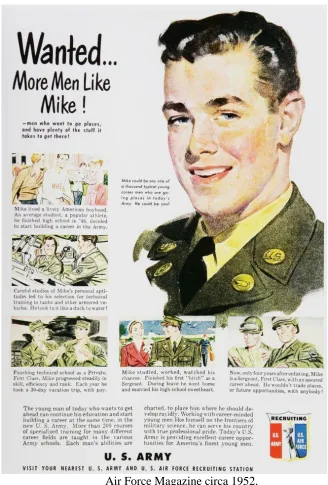
In 1948, even though the Air Force was now a separate service, the Army and the Air Force formally united their recruiting service under the banner of the U.S. Army and U.S. Air Forces Recruiting Service. As cited in Grandstaff's book, FOUNDATION of the FORCE: Air Force Enlisted Personnel Policy 1907-1956, almost prophetic in his opinion
Hudnell, Commanding Officer, Selfridge Field, Michigan, memorandum, “Board of Commerce, Mount Clements, Michigan discussion on moving colored troops into Selfridge Field and Mount Clements,” January 16, 1948.
69 Alan L Gropman. The Air Force Integrates 1945-1964. (Washington D.C.: Air Force History and Museums Program, 1985), pp 163.
concerning the Army and its recruitment program, General Stratemeyer contended at the Sixth Meeting of the Air Board the week of September 9, 1947, that.
We can get all the recruits we need if we enlist them ourselves and go out and get them. But if we have to do it through the Army I don't know...I'll just issue a warning...whenever there is a chance, where they are going to take something over we are entitled to, we have to step out and insist on our rights and recommendations.71
This organizational structure continued until March 6, 1954, when Secretary of Defense Charles E. Wilson signed an order directing the USAF to assume operational control of Air Force recruiting no later than July 1, 1954. This split took place, because although the Air Force had met its recruitment quotas, it was the opinion of Air Force leaders that the Army did not always have the Air Force's best interest in mind when it came to recruitment.72
71 Mark R Grandstaff., FOUNDATION of the FORCE: Air Force Enlisted Personnel
Policy 1907-1956. (Washington D.C.: Air Force History and Museums Program, 1997), pp. 92.
Air Force Magazine circa 1952.
Air Force Magazine circa 1954.
Air Force Magazine circa 1954.