Open Access
Research article
Search for computational modules in the C. elegans brain
Markus Reigl
1, Uri Alon
2and Dmitri B Chklovskii*
1Address: 1Cold Spring Harbor Laboratory, Cold Spring Harbor, NY 11724, USA and 2Department of Molecular Cell Biology and Department of Physics of Complex Systems, Weizmann Institute of Science, Rehovot, 76100, Israel
Email: Markus Reigl - [email protected]; Uri Alon - [email protected]; Dmitri B Chklovskii* - [email protected] * Corresponding author
Abstract
Background: Does the C. elegans nervous system contain multi-neuron computational modules that perform stereotypical functions? We attempt to answer this question by searching for recurring multi-neuron inter-connectivity patterns in the C. elegans nervous system's wiring diagram.
Results: Our statistical analysis reveals that some inter-connectivity patterns containing two, three and four (but not five) neurons are significantly over-represented relative to the expectations based on the statistics of smaller inter-connectivity patterns.
Conclusions: Over-represented patterns (or motifs) are candidates for computational modules that may perform stereotypical functions in the C. elegans nervous system. These modules may appear in other species and need to be investigated further.
Background
There is little doubt that neurons are elementary building blocks of the nervous system [1]. It is less clear, however, whether multi-neuron modules (smaller than inverte-brate ganglia or verteinverte-brate nuclei and cortical columns) can be meaningfully defined, either anatomically [2] or physiologically [3]. The existence of such multi-neuron modules would greatly simplify the description of nerv-ous system structure and function. An example of such simplification can be found in electrical engineering. An electronic circuit is often represented in terms of modules such as operational amplifiers, logical gates and memory registers rather than as a wiring diagram showing each transistor, resistor and diode. However, unlike electrical engineers who designed these modules themselves, neu-robiologists did not design the brain, and evolution rarely leaves records of its experimentation. Therefore, if
multi-neuron modules have indeed evolved they need to be dis-covered.
In this paper, we search for anatomically defined multi-neuron modules in the Caenorhabditis elegans nervous sys-tem. We choose C. elegans as a model organism because its wiring diagram is largely known, including the identities of all 302 neurons and most synapses between them [4-6]. Our approach follows the reasoning developed previ-ously in the context of gene regulation and other networks [7,8]. If a certain multi-neuron module performs some stereotypical function it may appear in the nervous system repeatedly. Therefore, search for multi-neuron connectiv-ity patterns that appear more often than by "chance" (compared with the expectations as defined below) may yield these multi-neuron modules. Of course, there may be functionally important modules that appear infre-quently and would be missed by our analysis. In the
elec-Published: 02 December 2004
BMC Biology 2004, 2:25 doi:10.1186/1741-7007-2-25
Received: 01 December 2003 Accepted: 02 December 2004
This article is available from: http://www.biomedcentral.com/1741-7007/2/25
© 2004 Reigl et al; licensee BioMed Central Ltd.
tronic circuit analogy, our approach would discover logical gates in a processor wiring diagram but not a recti-fier in a power supply, which is essential but appears only once.
To search for N-neuron modules, we sort all N-neuron combinations into classes defined by their inter-connec-tivity pattern and count the number of combinations in each class. By comparing these counts with the mean counts from random networks, constructed based on our expectations, we detect significantly over-represented pat-terns, or motifs. In order to avoid assigning significance to a N-neuron pattern just because it contains N-1-neuron motifs we incorporate the N-1-neuron statistics into the expectations used to search for N-neuron motifs [8]. To do this, we perform our search sequentially, by starting with doublets (or neuronal pairs, N = 2) and then increasing the number N of neurons included in the pattern sequen-tially up to quintuplets (N = 5).
We look for motifs in the wiring diagram of the C. elegans
nerve ring (a large fraction of the nervous system) assem-bled in two datasets [6]. Datasets 1 and 2 were obtained from serial-sections electron microscopic (EM) recon-structions of two different animals [4]; for details see Methods. The datasets contain the numbers of synapses formed in a subset of C. elegans neurons. Two given neu-rons may be connected by more than one synapse, which we call the multiplicity of connection. However, the small size of the dataset compels us to use the binary represen-tation of these connections (connected or unconnected). In order to obtain binary connectivity matrices, we thresh-old the multiplicity of connections at various values Θ: Pairs having less than Θ synapses are considered uncon-nected while those having at least Θ synapses are consid-ered connected. Such procedure is justified because more than a single synaptic contact may be necessary for an observable physiological effect of one neuron on another. Since we do not know the physiologically relevant count of synapses, we repeat our calculation for 1 ≤ Θ ≤ 7.
Unfortunately, datasets 1 and 2 contain a caveat of synap-tic ambiguities, which arises from the limitations of EM in C. elegans. When one pre-synaptic neuron makes contact with two adjacent processes of different neurons (send_joint in Durbin notation [6]), it is not known which of these processes acts as a post-synaptic terminal; both might be involved. We address this ambiguity by performing our analysis in two ways. In the main text we present the results obtained on the datasets that include both send and send_joint synaptic connections. We repeated the analysis on the datasets where send_joint synapses were split equally between the two potential post-synaptic partners. Specifically, we calculated multi-plicity of connections by adding send_joint synapses at
50% synaptic strength. In the limit of high multiplicity, this is equivalent to assigning the post-synaptic neuron by chance. We find essentially the same results for this con-nectivity dataset (see Supplementary Information [Addi-tional file 1]).
Results
Bi-directionally connected doublets (N = 2) are over-represented
We classify all possible doublets (or pairs) of the C. ele-gans neurons into three classes: unconnected, uni-direc-tionally connected and bi-direcuni-direc-tionally connected, and compare the number of doublets in each class to that expected in a random network (Figure 1). The random network ensemble consists of connectivity matrices that preserve the numbers of incoming and outgoing synapses for each neuron but not the identities of the partners [9,10]. The motivation behind this choice of the random matrix ensemble and the details of the algorithm are explained in Methods.
We find that the number of doublets in each class deviates from the mean of the random matrix counts, as shown in Figure 1 for a representative threshold Θ = 3. For the pur-poses of module search, the most interesting finding is the over-representation of the reciprocally connected dou-blets (pattern #3), for two reasons. First, if a set of neurons
Doublet counts in the C. elegans network compared to the
random matrix ensemble Figure 1
were to function as a module it should not consist of two (or more) disconnected subsets. This consideration rules out pattern #1. Second, since our search for modules is aimed at identifying over-represented inter-connectivity patterns we are less interested in under-represented ones. This consideration rules out pattern #2. We note that pat-tern counts are not independent, but are subject to sum rules. For example, the number of neurons in the network fixes the total doublet count. Also, the total number of connections is equal to the count of pattern #2 plus twice the count of pattern #3. These sum rules place stringent constraints on possible combinations of doublet counts. Yet, for patterns with greater number of neurons (N>2), these constraints become less stringent because the number of patterns increases (see below).
We repeat the above calculations for other datasets and threshold values and consistently find the significant over-representation of bi-directionally connected dou-blets (data not shown). In C. elegans, such over-represen-tation was reported previously on a qualitative level [4]. Interestingly, an over-representation of bi-directionally connected doublets was also found for pyramidal neurons in mammalian neocortex [11-13]. This suggests that motifs may represent evolutionary conservation or con-vergence driven by similar computational constraints. Next, we discuss whether C. elegans can provide a clue to the functional significance of the over-representation of reciprocally connected doublets.
Can bilateral (left-right) symmetry of the C. elegans neuro-nal network account for the over-representation of the reciprocally connected doublets? Indeed, about two thirds of C. elegans neurons have a bilaterally symmetric partner. If connections between these pairs obeyed bilateral sym-metry then they could not be uni-directional, creating a bias in favor of bi-directional connections. To see whether this is the case, we calculate the percentage of bi-direc-tional connected doublets, which consist of a bilateral neuron pair. We find that these percentages are small: 7.1% and 5.5% in datasets 1 and 2, respectively. There-fore, bilateral symmetry is not sufficient to explain the observed result.
The over-representation of reciprocally connected dou-blets in C. elegans has been explained [6] as a consequence of correlation between adjacency and connectivity of rons. The argument is that, if there is a synapse from neu-ron A to neuneu-ron B, they must be adjacent. If neuneu-rons A and B are adjacent then a synapse from B to A is more likely than chance, increasing the probability of a recipro-cal connection. Analysis of original EM reconstructions [4] supports this argument [6,14]. Adjacency in this case does not refer to the nearby placement of cell bodies but
to the number of EM sections (divided by five) in which the processes of the two neurons are in contact [6,14].
Although correlation between adjacency and connectivity may account for the over-representation of reciprocally connected doublets, why such correlation would exist in
C. elegans remains unclear. It could be that the number of neuronal pairs, which can be adjacent, is limited by phys-ical constraints. This would restrict the adjacent pairs only to the ones that need to connect for functional reasons. Indeed, volume exclusion explains neuron dimensions in the cortical column ([15] and references therein). In the
C. elegans network, however, the small number of neurons should in principle allow a contact between any pair of neurons. This argument is supported by the observation that many neuronal processes are longer than the distance between the corresponding cell bodies, suggesting that the connection can be made. However, processes tend to run in bundles and make synapses only in their (often vary-ing) neighborhoods [14]. This suggests that other (e.g. developmental) constraints may restrict the number of adjacent neurons. Alternatively, it could be that network functionality requires over-representation of reciprocal connections (or clustering). These issues must be explored in the future.
Several triplet classes (N = 3) are over-represented
We classify all connected triplets in the C. elegans wiring diagram into 13 classes and count the number of triplets in each class. We compare the actual number of triplets in each class to the null-hypothesis random matrix ensemble defined as follows. In order to include the observed over-representation of reciprocally connected doublets, we construct random networks that preserve the numbers of bi-directional and uni-directional connections for each neuron. Figure 2 shows triplet counts for each class rela-tive to the mean of the random matrix ensemble. For threshold Θ = 2 we find that several triplet counts are noticeably different from the mean of the random matrix ensemble, e.g. patterns #10, #12, #14 and, possibly, #15 and/or #16 in Figure 2. Similar results were found for other values of the threshold (within the biologically plausible range, Θ = 1 to 7).
hypothesis testing and requires an adjustment of the raw
p-values (see Methods).
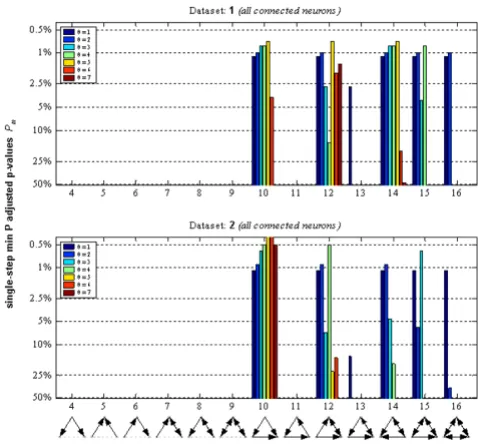
We chose to perform multiple hypothesis testing adjust-ment by controlling the family-wise error rate, i.e. the probability of mistakenly reporting at least one non-over-represented pattern, by using the single-step min P proce-dure [16,17]. The adjusted p-values for every class and threshold represent the probability of finding a random matrix R, in which at least one class i has smaller (or equal) raw p-value than that found for a given class and threshold in the actual network. This measure can be cal-culated by counting the number of random matrices, which have a smaller (or equal) raw p-value (in at least one class) than that in the actual network for a given class and threshold. By dividing this number of matrices by the total size of the random matrix ensemble, we estimate the multiple hypotheses testing corrected significance meas-ure Pm for each class and threshold, Figure 3 (see Meth-ods).
According to the significance measure, Pm, one of the most consistently over-represented motifs is the feedforward loop (triplet pattern #10), previously noticed in C. elegans
[5,18] and other networks [7,8]. For the full list of feedfor-ward loops see Supplementary Information [Additional files 2 and 3]. Could some known feature of neuronal
organization account for the observed over-representation of the feedforward loop? We consider two hypotheses:
i. The three-layered feedforward neuronal network is not sufficient to account for over-representation of the feedforward loop
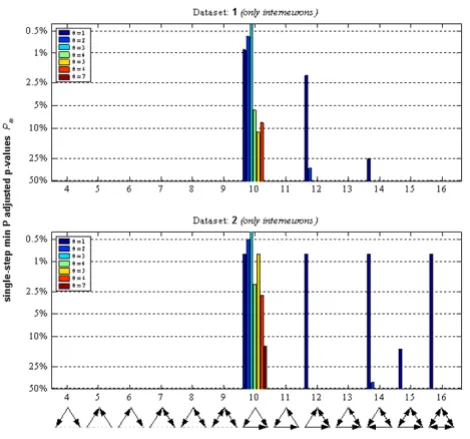
If one views the C. elegans nervous system as a three-layer feedforward network, where sensory neurons synapse mostly on interneurons, and interneurons synapse on other interneurons or motorneurons, this could explain the over-representation of the feedforward loop. We argue that this is not the case for two reasons. First, the feedfor-ward loop is also over-represented among interneurons (Figure 4). Second, the three-layer model of the C. elegans
nervous system is overly simplified. For example, there are feedback connections from interneurons to sensory neu-rons and from motorneuneu-rons to interneuneu-rons. To evaluate whether detected feedforward loops fit the three-layer feedforward network, we analyze the function of the neu-rons in these loops. About 40% of the detected feedfor-ward loops either contain all neurons from the same functional group or at least one connection goes from a neuron in a lower layer to a neuron in a higher layer, Table
Triplet counts in the C. elegans network compared to the random matrix ensemble
Figure 2
Triplet counts in the C. elegans network compared to the random matrix ensemble. Blue squares show triplet counts for the actual network (dataset 1, threshold Θ = 2), red crosses show counts for each random connectivity matrix relative to the mean count for the whole random matrix ensemble. Three framed motifs are discussed in the main text. All matrices in this ensemble (n = 1000) preserve the counts of uni- and bi-directional connections for each neuron. A count for a given pattern is often the same in many matrices resulting in few crosses (e.g. there are only 25 crosses for pattern 12 because the count of this pattern in the random matrix ensemble varies between 6 and 32; 29 and 31 were not observed).
Significance measure Pm of triplet over-representation for
dif-ferent thresholds Figure 3
Significance measure Pm of triplet over-representa-tion for different thresholds. The multiple hypothesis testing corrected p-values for triplet patterns show signifi-cant over-representation of patterns 10, 12 and 14 (datasets 1 and 2, n = 1000). The significance measure Pm represent the
1. These loops do not fit into this three-layer model, undermining the hypothesis.
ii. The likelihood of connectivity between nearby neurons may partially account for over-representation of the feedforward loop Since connectivity and adjacency are correlated in C. ele-gans and other nervous systems one could argue the fol-lowing [4]. If two neurons have a common synaptic partner, then they are likely to be adjacent to that com-mon partner, and hence to each other. If the two neurons are adjacent they are likely to be connected to each other.
Again, adjacency cannot refer to the cell body position: The fraction of over-represented triplets that consist of neurons belonging to the same ganglia is typically less than 30%. Yet this argument could be valid if the adja-cency refers to the contacts between neuronal processes (see above) and needs to be verified using original EM reconstructions [4]. The problem with this argument is that it would also predict an over-representation of all strongly connected patterns (#10 to #16), as opposed to the weakly connected patterns (#4 to #9). Yet, strongly connected triplet classes #13 and #11 (the feedback loop) are not over-represented (Figure 3) so further explanation is required.
It is possible that the over-representation of the feedfor-ward loop is a consequence of other factors or their com-binations (such as feedforwardness and locality of connectivity combined). But even if these factors are found, the characterization of the network in terms of over-represented motifs remains valid. The over-represen-tation of the feedforward loop still requires a functional explanation just as the bi-directionally connected doublet does. In gene transcription regulation networks, the feed-forward loop was proposed to carry out information processing functions such as filtering out fluctuations and responding only to persistent stimuli [7]. Feedforward loop can also carry out other functions [5,18], depending on the polarity of synapses involved and the dynamic response of neurons. Once these factors are established experimentally, motif function can be analyzed theoreti-cally.
In addition to the feedforward loop, we find that two other (both symmetric) patterns are consistently over-rep-resented: pattern #12 and pattern #14 (Figure 3). For the full list of these patterns see Supplementary information [Additional files 2 and 3]. Previous work [8] did not iden-tify these patterns as motifs because of their low absolute count at the only threshold considered (Θ = 5). Again, we ask whether this could be a consequence of the bilateral symmetry of the C. elegans nervous system. Indeed, the bilateral symmetry implies that pairs of bilaterally sym-metric neurons are also connected symsym-metrically, mean-ing that triplets containmean-ing such a pair are likely to be symmetric. However, we find that the fraction of triplets #12 and #14 containing a bilaterally symmetric pair of neurons and an unpaired neuron is rather small (between 10% and 20% in datasets 1 and 2). This suggests that the bilateral symmetry of the nervous system is not sufficient to explain the over-representation of pattern #12 and #14.
Just like in any other screening algorithm, our criteria for outliers are somewhat subjective and the goal is to draw attention to interesting candidates. We limit our discus-sion to over-represented patterns #10, #12 and #14
Significance measure Pm of triplet over-representation among
interneurons shows that pattern #10 is significantly over-rep-resented
Figure 4
Significance measure Pm of triplet over-representa-tion among interneurons shows that pattern #10 is significantly over-represented. Multiple hypothesis test-ing corrected p-values for the triplet over-representation in datasets 1 and 2 (n = 1000). The figure shows that motif #10 is significantly over-represented within interneurons.
Table 1: Feedforward loops that do not fit into consideration of a 3-layer feedforward network.
Theta =
1 2 3 4 5
Dataset 1 49 % 39 % 33 % 38 % 34 % 2 47 % 40 % 41 % 39 % 29 %
because in our judgment they are most robust outliers based on the several criteria used. The reader may judge that some other patterns are over-represented as well. For example, patterns #15 and #16 are significantly over-rep-resented for small thresholds (Figure 3). Because the abso-lute counts of these patterns in the C. elegans network are small, we cannot verify that they are consistently over-rep-resented. Further work on larger datasets will show whether these patterns may be viewed as motifs.
Several quadruplet classes (N = 4) are over-represented
We classify all connected quadruplets into 199 classes and count the number of quadruplets in each class. Then we compare the actual counts of quadruplets in each class to the mean counts of quadruplets in a random matrix ensemble. In this case, random matrices preserve the numbers of uni-directional and bi-directional connec-tions for each neuron and, in addition, the numbers of tri-plets (see Methods). Because of the large number of quadruplet classes, we show results (Figure 5) only for patterns selected according to the following criteria: the multiple hypothesis testing corrected significance values
Pm must be less than 0.1 for at least one threshold per pat-tern, while the number of quadruplets in the actual net-work must be at least 5. The last condition excludes patterns that may appear as over-represented due to very small quadruplet counts.
We find that quadruplet pattern #45 is consistently over-represented [8]. Can we explain this observation by some other known factor? We consider the following two hypotheses:
i. Bilateral symmetry of the nervous system is not sufficient to explain the over-representation of the quadruplet pattern #45
One could propose that symmetric patterns should be over-represented because of the bilateral symmetry of the nervous system. We think that this argument by itself can-not explain the observed over-representation for two rea-sons. First, the fraction of feedforward quadruplets containing two bilaterally symmetric neuron pairs in motif 45 is rather small (less than 10% in dataset 1 and less than 14.3% in dataset 2). Second, many symmetric patterns are not over-represented, such as, for example, patterns 25, 30, 31, 35, 43, 44 and 65 (Figure 6).
ii. Feedforward structure of the nervous system may partially explain the over-representation of the feedforward quadruplet
One could propose that the feedforward three-layer struc-ture of the nervous system could account for this observa-tion (see over-represented triplets). We find that 14% to 37% of the feedforward quadruplets do not fit into this proposition because either they contain a feedback con-nection or all neurons belong to the same layer (Table 2). After comparing these percentages to the relative excess
values we conclude that the feedforward structure may explain over-representation for some threshold values but not for others.
It is possible that some other factors (in addition to feed-forwardness) account for the reported quadruplet over-representation. Just as argued in case of triplets, discover-ing these factors would be complementary to the charac-terization of the over-represented motif. It would be particularly interesting to determine the functional role of these motifs. Again, we arbitrarily limit our discussion of over-represented quadruplets to pattern #45. The reader may judge that some other patterns are over-represented and deserve attention (e.g. patterns #36, 50). This is why in Figure 5 we show all the outliers satisfying relatively weak criteria.
We find no over-represented quintuplet classes (N = 5)
We classify all connected quintuplets into 9364 classes (out of 9608 patterns total, i.e. connected and uncon-nected) and count the actual number of quintuplets in each class. We compare these counts with the mean of the
Significance measure Pm of selected quadruplet over-repre-sentation for different thresholds
Figure 5
Significance measure Pm of selected quadruplet over-representation for different thresholds. Multiple hypo-thesis testing corrected p-values for the quadruplet over-rep-resentation in datasets 1 and 2 (n = 1000). The patterns shown satisfy the following selection criteria: There must be a significant value Pm < 0.1 for at least one Θ and the count of
random matrix ensemble. In this case, the random matri-ces preserve the numbers of uni- and bi-directional con-nections for each neuron and, in addition, keep the numbers of all triplets and quadruplets in a 10% range of the actual network. We do not find any significantly over-represented quintuplets. This could happen because there are no significantly over-represented quintuplets with a given number of quadruplets. Alternatively, this could happen because specifying the numbers of triplets and quadruplets constrains the number of quintuplets in any random matrix the size of the C. elegans network. There-fore, absence of significantly over-represented quintuplets in C. elegans does not rule out the existence of five-neuron modules that can be detected as motifs by applying our algorithm to larger networks.
Discussion
By comparing counts of multi-neuron patterns in the C. elegans wiring diagram to the mean counts of the appro-priate random matrix ensemble, we find several over-rep-resented motifs. First, we find that bi-directionally connected doublets (out of three possible doublet classes) are over-represented, given the number of connections on each neuron is fixed. Second, several triplet classes (out of thirteen possible connected patterns) are over-repre-sented, given the actual number of bi-directional (as well as uni-directional) connections for each neuron. Third, we find that several quadruplet classes (out of 199 connected
patterns) are over-represented, given the numbers of tri-plets are preserved in addition to previously listed con-straints. We find no over-represented quintuplet classes. Some of these results, such as the over-representation of the feedforward loop and the feedforward quadruplet, have been reported previously [5,8,18]. The current paper extends and complements previous reports by performing a systematic motif search for various connection multi-plicity thresholds and rigorous statistical significance assessment. Also, we consider whether the discovered motifs can be accounted for by previously known facts about the organization of the nervous system. There is no functional explanation for the existence of the motifs. Therefore, the identified motifs are candidates for mod-ules that may perform stereotypical functions in the C. ele-gans nervous system, and they need to be investigated further.
Although the main motivation for this work, search for modules, led to our focus on over-represented patterns, we also checked for under-representation. For example, previous work indicated that the number of triplets with pattern #11 (or feedback loops) was small [6]. To deter-mine significance, we applied the single-step min P proce-dure to the absolute value of the deviation of counts from the mean. We found that the feedforward loop is not sig-nificantly under-represented, yet many other patterns, such as weakly connected triplets were significantly under-represented (see Supplementary Information [Additional File 1]).
Our motif search algorithm is different from previous attempts to find modules [19]. For example, traditional clustering approaches look for the subsets of nodes, which are connected with their own subset more strongly than with other subsets. In our algorithm, we consider all the connections within a pattern (unlike [20], who consid-ered only some connections within the pattern) but ignore the connections with neurons outside the pattern. One could question the expediency of ignoring multiple possible inputs to the neurons in a module since those
Examples of symmetric quadruplet patterns that are not over-represented Figure 6
Examples of symmetric quadruplet patterns that are not over-represented.
Table 2: Percentage of quadruplets in pattern #45, which do not fit into the three-layer feedforward network model.
motif i = 45 Theta =
1 2 3 4 5
Dataset 1 37 % 31 % 29 % 25 % 23 % 2 34 % 25 % 16 % 19 % 14 %
inputs could influence the operation of that module. To counter this, we point out that if there were a particularly recurring way to attach an external connection to a given
N-neuron motif then it would appear as an N + 1-neuron motif. If, on the other hand, the motif is connected in many different ways in different instances, their signifi-cance will be washed out. Thus our approach may hierar-chically detect modules with recurring input/output sites, growing them out of smaller patterns. A second justifica-tion for looking at N-neuron patterns is that the nervous system is capable of performing many different functions under different circumstances and neurons active in one case may be silent in another. Therefore, in any particular case, many of the anatomical inputs to the module may remain silent and can safely be ignored. This speculation may be verified experimentally by simultaneous monitor-ing of neuronal activity in different neurons.
The strategy and algorithms we described in this paper can be applied to incompletely mapped networks because a highly significant pattern is also likely to be over-repre-sented in a sub-network. However, the statistical power of our algorithm increases with the knowledge of the wiring diagram. Therefore it was natural to choose the C. elegans
nervous system, whose wiring diagram is largely known. Unfortunately, C. elegans has some disadvantages when it comes to the interpretation of the results: the polarity of a synapse (excitatory vs. inhibitory) in C. elegans is often unknown; electrophysiological investigations are still dif-ficult in C. elegans [21]; and the whole network contains only 302 neurons, limiting the statistical power of the approach. Yet we hope that recent technological develop-ments [22] will eliminate the first two disadvantages and allow functional analysis of the discovered modules. Moreover, we expect that our results have implications for understanding nervous system structure and function beyond C. elegans. The modules we identify in C. elegans
may be a general property of the nervous system, and, once identified, can be searched for in other species. Finally, the algorithm itself can be applied to other net-works [8] once they become available.
As in any other theoretical analysis, we made several sim-plifications. For example, we assumed that the strength of synaptic connection between a pair of neurons is charac-terized by its multiplicity (i.e. the number of synapses between that pair). This assumption may be questioned if synapses implementing high-multiplicity connections are weaker than those implementing low-multiplicity con-nections, as known to happen in nematodes [23]. Yet, this assumption represents a reasonable first step in the sys-tematic quantitative analysis, which may be extended in the future by estimating synaptic strength from the origi-nal EM reconstructions. In addition, we ignored the polar-ity of the synapses and the existence of gap junctions. Yet
our results are robust to the inclusion of these factors in the future because if an over-represented class is found, it will remain over-represented even if divided into smaller sub-classes. It would be interesting to see whether the inclusion of the above factors will reveal specific over-rep-resented sub-classes.
Conclusions
We have shown that certain neuronal connectivity pat-terns are significantly over-represented in the C. elegans
nervous system. These patterns, called motifs, are candi-dates for computational modules that may perform stere-otypical functions. It would be interesting to determine what these functions are and whether these motifs appear in other nervous systems.
Methods
Representation of the networks
We transformed the C. elegans synaptic connectivity data into a binary matrix A, called Adjacency Matrix or Connec-tivity Matrix, in which an entry Aij is 1 if there is a connec-tion from neuron i to neuron j and 0 otherwise. The order in which neurons are assigned to rows in this matrix is not important for our calculations. The multiplicity of syn-apses between two given neurons is mapped to a binary value by applying a threshold to the data. We assume a synaptic connection of threshold Θ from neuron i to neu-ron j if neuron i makes at least Θ synapses on to neuron j. Adjacency matrices that we used are available in the Sup-plementary Information [Additional files 2 and 3].
Detecting & counting patterns
We implemented two strategies for counting the number of triplets, quadruplets and quintuplets in a given connec-tivity matrix. First, to obtain the count of all N-neuron patterns, we took all different N-neuron subsets and char-acterized their connectivity. Second, we took all possible
N-neuron subsets out of the neighborhood of a neuron x. This neighborhood is defined by all neurons that can be reached from x, if the directed connectivity matrix is made undirected. In both cases it is crucial for the run time of the algorithm to detect the pattern class from these con-nectivity sub-matrices as quickly as possible. We realized this by defining a function that maps each possible N -neuron sub-matrix to a unique integer value. Then we classified all the sub-matrices based on the function value and a pre-calculated lookup table, which identifies the pattern class from the function value.
Creating random matrices
net-work as described above, the out-degree of a neuron x can be calculated as the sum of row x, the in-degree as the sum of column x.
N = 2. For the first step of our analysis we create random matrices that preserve the in-degree and out-degree of every neuron but change their connection partners. Start-ing with an empty matrix, our algorithm selects neurons in a random order and connects each with the required number of other neurons, chosen randomly out of the remaining neurons with in-degree and out-degree less than that in the C. elegans network. This choice of random matrices is motivated by the observation that the distribu-tion of in-degrees and out-degrees in C. elegans is signifi-cantly different from Poisson, which is expected for a randomly generated matrix without any correlations (Erdõs-Rényi random graph) (Figure 7).
N = 3. We keep the number of incoming and outgoing uni-directional connections as well as the number of reciprocal connections for each neuron the same. One of the implemented algorithms starts with an empty matrix. Then it randomly selects a neuron and does three things.
It reconnects all outgoing connections of that neuron to other neurons, as long as their in-degree does not exceed that in the C. elegans network. It reconnects all incoming connections of that neuron to other neurons, as long as their out-degree does not exceed that in the C. elegans net-work. It reconnects all reciprocal connections of that neu-ron to other neuneu-rons with available unconnected reciprocal connections. We also implemented a second algorithm to verify the robustness of our results. This algo-rithm [9,10] will randomly pick and swap 2 unidirec-tional or 2 bi-direcunidirec-tional connections (a→b and c→d will be changed to a→d and c→b).
N = 4. For comparing the count of quadruplets, we con-struct random matrices that keep the same not only in-degree and out-in-degree of uni-directional and bi-direc-tional connections for each neuron but also the count of the 16 different 3-neuron pattern in the whole matrix. Starting from a random matrix for N = 3 as described above, we use the Simulated Annealing algorithm [24] by swapping two connections of the same type until the count for all triplets in the random matrix matches the real network. Since this swapping operation does not
Distribution of degree in C. elegans in comparison to Poisson distribution Figure 7
Distribution of degree in C. elegans in comparison to Poisson distribution. The distribution of in-degree and out-degree in a random matrix (Erdõs-Rényi random graph) can be approximated by Poisson. We observe that the distribution in
change the degrees of the various connection types for the neuron, the algorithm only has to check if the triplet count in all 16 classes is identical to C. elegans.
N = 5. For the analysis of the quintuplets, we modified the Simulated Annealing algorithm to match the count of all 4-neuron patterns to the real network. With this algorithm we could only find random matrices for which the relative difference between the count of each pattern in the ran-dom matrix and the real dataset was less than 10%.
Coin-tossing example of multiple hypothesis testing correction
Here we illustrate the issue of multiple hypothesis testing by considering a classical coin-tossing example. Imagine determining whether a given coin is fair (i.e. yielding heads with probability 1/2) or not by tossing it 100 times and recording the number of heads. If the number of heads is not too different from 50, we expect that the coin is fair. The significance of the deviation in the number of heads from 50 is characterized by the p-value, which is the probability that a fair coin would have that or greater devi-ation. For example, the probability of getting 62 or more heads is about 1% and the corresponding p-value = 0.01. Now consider testing simultaneously 100 different coins by tossing each 100 times. Analyzing these 100 experi-ments for outliers reveals that one coin yielded 62 heads. Does this mean that this specific coin is unfair? Not nec-essarily. Even if all the coins are fair, such a seemingly unlikely result will be observed approximately once when examining 100 coins. In other words, the p-value esti-mated for a single coin is an underestimation of the true
p-value when 100 coins are examined simultaneously. This situation is called multiple hypotheses testing and requires a modification of the p-value definition.
p-Value calculation/multi hypotheses testing correction
Assume the number of N-neuron patterns in the i-th class in the actual network A and a random network R is given by: cN,i (A) and cN,i (R). Then the raw p-value is defined by:
pi = Pr(cN,i (Rk) ≥ cN,i (A), Rk ∈ {R}).
Because we look for over-representation of all connected patterns in parallel (and there are m = 13 patterns for N = 3, m = 199 patterns for N = 4 and m = 9364 patterns for N
= 5), there is an increased probability of finding an over-represented pattern by chance. We correct for that by cal-culating a multiple hypothesis testing corrected p-value for each pattern and threshold. This p-value, Pm, reflects the probability that one random matrix Rk0 out of our
ran-dom matrix ensemble {R} will have at least one pattern,
i, which has smaller (or equal) raw p-value than the given pattern in C. elegans. This is known as the single-step min P
procedure and controls for family-wide error rate [16,17]. In mathematical notation the single-step min P adjusted
p-values are defined by:
where denotes the complete null hypothesis, pi the probability that the count for pattern i in a random matrix
R is greater than the count in C. elegans, and Pj denotes the raw p-value for the ith pattern in a random matrix k0: Pj = Pr(cN,j (R) ≥ cN,j (Rk0)).
To determine Pm for a pattern i we perform the following procedure:
pi P p
j m j i
= ≤
≤ ≤
Pr min |
1
H0C
H0C
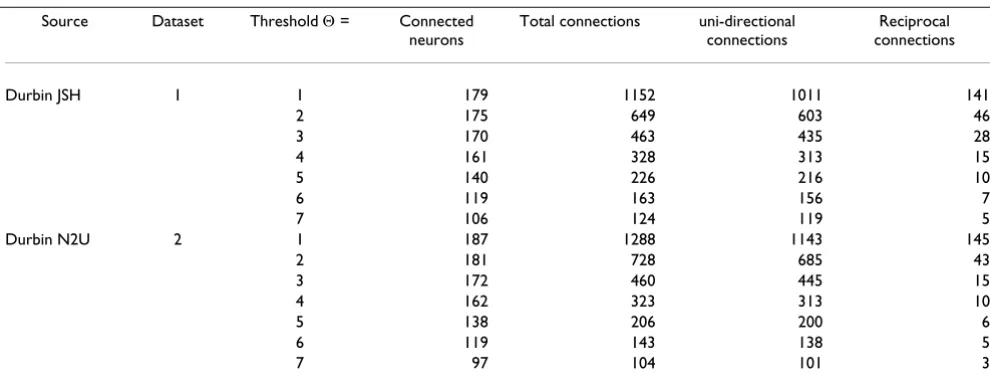
Table 3: Number of connected neurons and the count of the different connection types after applying thresholds to the two datasets.
Source Dataset Threshold Θ = Connected neurons
Total connections uni-directional connections
Reciprocal connections
Durbin JSH 1 1 179 1152 1011 141
2 175 649 603 46
3 170 463 435 28
4 161 328 313 15
5 140 226 216 10
6 119 163 156 7
7 106 124 119 5
Durbin N2U 2 1 187 1288 1143 145
2 181 728 685 43
3 172 460 445 15
4 162 323 313 10
5 138 206 200 6
6 119 143 138 5
1. For all random matrices (k0 is the index of the ran-dom matrix; we usually created n = 1000 of them) out of
the ensemble we calculate between
and all other random matrices in this ensemble for each pattern i:
.
2. We then derive the raw p-value for as a minimum
of these values across all patterns i: .
3. We calculate the probability that for a given pattern i
the observed count in a random matrix Rk out of our ensemble {R} is greater than the count in the C. elegans
network :
4. Last, we calculate the single-step min P adjusted p-value
Pm for a given pattern i as:
In addition, we verified our results with the alternative sin-gle-step max T adjusted p-value [16,17] (for figures and explanations see Supplementary Information [Additional file 1]).
Datasets/data sources
We used data from [6], which provides separate connec-tivity data for the different reconstructions JSH and N2U done by White et al. (1986). We deleted 11 non-neuronal cell or classes from the dataset: CEPshDR, CEPshVL, CEP-shVR, GLRDL, GLRDR, GLRL, GLRR, GLRVL, GLRVR, hyp, mu_bod. The classification of the neurons into their func-tion and their locafunc-tion was taken from [20].
Additional material
Acknowledgements
We thank Armen Stepanyants and Sen Song for ideas and discussion of sta-tistical issues, and Carlos Brody and Ingrid Ehrlich for comments on the manuscript. This work was initiated at the Aspen Center for Physics and was supported by the Lita Annenberg Hazen Foundation and the David and Lucile Packard Foundation at Cold Spring Harbor Laboratory and by the Minerva Foundation grant to UA.
References
1. Ramón y Cajal S: Textura del Sistema Nervioso del Hombre y de los tebrados. Translation: Texture of the Nervous System of Man and the Ver-tebrates New-York: Springer; 1999:1899.
2. Peters A, Sethares C: Myelinated axons and the pyramidal cell modules in monkey primary visual cortex.J Comp Neurol 1996,
365:232-255.
3. Abeles M, Gerstein GL: Detecting spatiotemporal firing pat-terns among simultaneously recorded single neurons.J Neu-rophysiol 1988, 60:909-924.
4. White JG, Southgate E, Thomson JN, Brenner S: The structure of the nervous system of the nematode Caenorhabditis ele-gans.Philos Trans R Soc Lond B Biol Sci 1986, 314:1-340.
5. Hall DH, Russell RL: The posterior nervous system of the nem-atode Caenorhabditis elegans: serial reconstruction of iden-tified neurons and complete pattern of synaptic interactions.
J Neurosci 1991, 11:1-22.
6. Durbin RM: Studies on the Development and Organisation of the Nervous System of Caenorhabditis elegans. Ph.D. Cam-bridge University; 1987.
7. Shen-Orr SS, Milo R, Mangan S, Alon U: Network motifs in the transcriptional regulation network of Escherichia coli.Nat Genet 2002, 31:64-68.
8. Milo R, Shen-Orr S, Itzkovitz S, Kashtan N, Chklovskii D, Alon U:
Network motifs: simple building blocks of complex net-works.Science 2002, 298:824-827.
9. Maslov S, Sneppen K: Specificity and stability in topology of pro-tein networks.Science 2002, 296:910-913.
10. Newman ME, Strogatz SH, Watts DJ: Random graphs with arbi-trary degree distributions and their applications.Phys Rev E Stat Nonlin Soft Matter Phys 2001, 64:026118.
11. Markram H, Lübke J, Frotscher M, Roth A, Sakmann B: Physiology and anatomy of synaptic connections between thick tufted pyramidal neurones in the developing rat neocortex.J Physiol
1997, 500(Pt 2):409-440.
12. Sjöström PJ, Turrigiano GG, Nelson SB: Rate, timing, and cooper-ativity jointly determine cortical synaptic plasticity.Neuron
2001, 32:1149-1164.
13. Holmgren C, Harkany T, Svennenfors B, Zilberter Y: Pyramidal cell communication within local networks in layer 2/3 of rat neo-cortex.J Physiol 2003, 551:139-153. Epub 2003 Jun 2017.
Additional File 1
A document containing supplementary information and data not pre-sented in the paper. See also http://www.cshl.edu/labs/mitya/Celegans/ additional_info.doc
Click here for file
[http://www.biomedcentral.com/content/supplementary/1741-7007-2-25-S1.doc]
Rk
0
Pi k, Rk , R \Rk
0
(
0{ }
0)
Rk
0
Pi k,0 Rk0, R \Rk0 PrcN i,(Rk) cN i,(Rk0),k k0 Pr cN i,(Rk
1 2
{ }
(
)
=(
> ≠)
+(
))=cN i,(Rk0),k≠k0)
Rk
0
Pk P
i i k
0 =min ,0
pi=Pr
(
cN i,(Rk)>cN i,( ),A Rk∈{ }R)
+1Pr cN i,(Rk)=cN i,( ),A Rk∈{ }R2
((
)
.Pm =Pr
(
Pk ≤pi, ≤k ≤n)
.0 1 0
Additional File 2
Description of the files containing triplet lists and used data sets. See also http://www.cshl.edu/labs/mitya/Celegans/SupMain.html
Click here for file
[http://www.biomedcentral.com/content/supplementary/1741-7007-2-25-S2.doc]
Additional File 3
Zip file containing files mentioned in Additional file 2 Click here for file
Publish with BioMed Central and every scientist can read your work free of charge "BioMed Central will be the most significant development for disseminating the results of biomedical researc h in our lifetime."
Sir Paul Nurse, Cancer Research UK
Your research papers will be:
available free of charge to the entire biomedical community peer reviewed and published immediately upon acceptance cited in PubMed and archived on PubMed Central yours — you keep the copyright
Submit your manuscript here:
http://www.biomedcentral.com/info/publishing_adv.asp
BioMedcentral
14. White JG, Southgate E, Thomson JN, Brenner S: Factors that determine connectivity in the nervous system of C. elegans.
Cold Spring Harb Symp Quant Biol 1983, 48 pt 2:633-640.
15. Chklovskii DB: Synaptic connectivity and neuronal morphol-ogy: Two sides of the same coin.Neuron 2004, 43:609-617. 16. Dudoit S, Shaffer J, Boldrick J: Multiple hypothesis testing in
microarray experiments.Statistical Science 2003, 18:71-103. 17. Westfall PH, Young SS: Resampling-based multiple testing:examples and
methods for p-value adjustment New York: Wiley; 1993.
18. White JG: Neuronal connectivity in Caenorhabditis elegans.
Trends Neurosci 1985, 8:277-283.
19. Gerstein GL, Bedenbaugh P, Aertsen MH: Neuronal assemblies.
IEEE Trans Biomed Eng 1989, 36:4-14.
20. Achacoso TB, Yamamoto WS: Neuroanatomy of C. elegans for compu-tation Boca Raton, FL: CRC Press; 1992.
21. Goodman MB, Hall DH, Avery L, Lockery SR: Active currents reg-ulate sensitivity and dynamic range in C. elegans neurons.
Neuron 1998, 20:763-772.
22. Kerr R, Lev-Ram V, Baird G, Vincent P, Tsien RY, Schafer WR: Opti-cal imaging of Opti-calcium transients in neurons and pharyngeal muscle of C. elegans.Neuron 2000, 26:583-594.
23. Angstadt JD, Donmoyer JE, Stretton AO: The number of morpho-logical synapses between neurons does not predict the strength of their physiological synaptic interactions: a study of dendrites in the nematode Ascaris suum.J Comp Neurol
2001, 432:512-527.