
Knowledge is power
A theory of information, income, and welfare spending
∗
Jo Thori Lind
†Dominic Rohner
‡April 22, 2013
Abstract
No voters cast their votes based on perfect information, but richer voters are on average best informed. We develop a model where the voting mistakes resulting from
low political knowledge reduce the weight of poor voters, and cause parties to choose political platforms that are better aligned with the preferences of rich voters. In US election survey data, income is more important in affecting voting behavior for more informed voters than for less informed voters. Further, when there is a strong
corre-lation between income and political information, Congress representatives vote more conservatively, which is also in line with our theory.
JEL Classification: D31, D72, D82, H53.
Keywords: Redistribution, Welfare Spending, Information, Income, Voting, Political
Eco-nomics.
∗This paper has benefitted from helpful discussions with Stephen Coate, Philippe de Donder, Clare
Leaver, Kalle Moene, Nicolas Van de Sijpe, and Fredrik Willumsen. We would also like to thank seminar participants in Gothenburg, Oslo, the Norwegian Business School, and Oxford and participants to the Public Economics UK meeting in Warwick, the EEA conference in Milan, the 10th CESifo PSE conference and the ESOP Workshop on Culture, Behavior and Distribution for helpful comments. The usual disclaimer applies.
†Department of Economics, University of Oslo, Email: [email protected]. Lind’s work is part of his
research activities at the centre of Equality, Social Organization, and Performance (ESOP) at the Department of Economics at the University of Oslo. ESOP is supported by the Research Council of Norway.
‡Department of Economics, University of Lausanne, Email: [email protected]. Financial support
1
Introduction
Voters are imperfectly informed about politics, and the level of political information varies
among people. What are the consequences if some voters are better informed about politics,
and thus better at picking the most suitable political party for themselves? And what
happens if this political knowledge is systematically skewed – i.e. if the better educated –
who tend to be wealthier – are better at choosing their most favorable party? These are the
questions we study in this paper.
In our model, we abandon the usual assumption of perfect information and assume that
only a fraction of the voters observe the electoral platforms. The probability that a given
voter observes them is increasing in what we label her political knowledge. Income and
political knowledge are often positively correlated, for instance because the better educated
are both better informed and better paid. This implies that richer voters are on average
better at seeing through political rhetoric and at choosing the best party to implement
their interests. We insist that also uninformed voters are rational, so the model contains
real uncertainty over adopted policy platforms. This would not be possible with converging
political platforms.
Specifically, parties have political ideal points but trade these off for appeal to as many
voters as possible. Voters face uncertainty over parties’ ideal points, and hence over
pro-posed platforms. Generally, the lower the level of political information, the more the parties
concentrate on their own ideal points as fewer voters grasp their platforms. If information
is unevenly distributed – with rich voters being better informed, this tends to pull both
left-wing and right-wing parties towards the preferences of the rich, which in our setting
implies less redistribution.
We test the model’s assumptions and predictions using data from the American National
Election Studies (ANES). First, we confirm that more educated and richer voters are indeed
better informed politically. Our measure of political information is measured by self reported interest in politics and by whether voters follow politics and the electoral campaigns in the
media. We also construct a measure of factual political knowledge, which yield similar
results.
To explore the predictions on voter behavior, we study how the relationship between
income and voting depends on the level of information. As our model predicts, income is a
better predictor of voting for the better informed voters whereas the voting behavior of the
less well informed voters contains more randomness. To study the effect of the distribution of
information on party behavior, we compare representatives in the House and the Senate from
states and periods where the correlation between income and our measures of information is high to representatives in other states and periods where this income-information correlation
Democrat representatives shift to the right. To the best of our knowledge these are novel
empirical findings.
Our paper relates to several literatures. The benchmark for our theoretical framework is
based on existing models of electoral competition1, and our results may shed new light on
the so-called “redistribution puzzle”,2 i.e. the robust empirical finding that redistribution
levels are not as high as predicted by these models and that levels of redistribution are lower
rather than higher in more inegalitarian societies.3
There is also a quite extensive theoretical literature on the effect of information on voters’
decisions. It has been argued that the level of voter information does not matter for electoral
outcomes and that uninformed voters can achieve a “full information equivalent” outcome through cues, information shortcuts and biases cancelling out in aggregation (McKelvey and
Ordeshook, 1985; Wittman, 1989; Lupia, 1992). Also the pivotal voting literature usually
predicts that uninformed voters balance the partisan bias or abstain, assuring in this way
that the same outcome as under full information occurs (cf., for example, Austin-Smith and
Banks, 1996; Feddersen and Pesendorfer, 1996, 1997). In contrast, our theory aims to show
that information does matter for political outcomes.4
These theoretical contributions also contrast with most of the empirical evidence, which
usually finds that uninformed voters do not vote “correctly” (i.e. according to their best
interest), and that lack of information biases voting outcomes (Palfrey and Poole, 1987; Delli Carpini and Keeter, 1996; Bartels, 1996; Gilens, 2001). There is also an important emerging
literature on the effects of media on politics. The main focus has been on political turnout
(Oberholzer-Gee and Waldfogel, 2009), voting outcomes (Della Vigna and Kaplan, 2007;
Gerber et al., 2009), political outcomes (Str¨omberg 2004a,b), and the relationship between
media markets and political outcomes (Chan and Suen, 2008).
There are a few models of voting under incomplete information in the literature, but
none of them links information to income.5 Banks (1990) studies conditions under which an 1Cf. the median voter models of Downsian electoral competition (Downs, 1957; Romer, 1975; Roberts,
1977; Meltzer and Richard, 1981) and probabilistic voting models (Lindbeck and Weibull, 1987).
2See for example Perotti (1996) or Moene and Wallerstein (2001, 2003). Lind (2005) provides a survey
of this literature.
3There are also other theoretical arguments and explanations in the literature for why redistribution
levels are relatively low and the poor do not expropriate the rich, including the lower level of political participation of the poor (Harms and Zink, 2003; Larcinese, 2005), multi-dimensional issue spaces (Roemer, 1998), collective action problems of the poor and interest groups (Olson, 1965), the deadweight loss from taxation (Meltzer and Richard, 1981), the need for a social hierarchy (Corneo and Gr¨uner, 2000), the dynamics of perceived social mobility (Piketty, 1995) and the prospects of upward mobility (Hirschman and Rothschild, 1973).
4A related strand of literature studies how some uninformed voters give special interest groups political
influence through campaign contributions and endorsements (Baron 1994, Grossman and Helpman 1996).
5One exception is the lobbying model of Bradhan and Mookherjee (2000) who allow for voters from
equilibrium exists when voters do not know politicians’ exact positions. Martinelli (2006)
and Feddersen and Sandroni (2006) model the conditions under which rational voters would
have incentives to acquire costly information. Lohmann (1998) finds that smaller and
better-informed special interest groups benefit from policies biased in their favor. Rohner (2009)
builds a model with noisy signals, where in societies with a high proportion of uninformed
voters candidates with a low level of “valence” (i.e. of honesty and competence) have an
increased probability of getting elected into office. Gul and Pesendorfer (2009) emphasize a
framework with ignorant voters, where candidates with a “preferred personality” can gain
re-election despite implementing partisan policies that lead to lower expected payoffs for the
electorate.6
Also the large literature on American Politics is relevant for our paper. In recent years
several influential contributions have studied the causes of the increasing polarization
be-tween Democrats and Republicans and the division bebe-tween “red” and “blue” states.
Mc-Carty, Poole and Rosenthal (2006), Bartels (2008) and Gelman et al. (2009)7 all find that
within-states, the pattern of high-income voters supporting the less redistributive
Republi-cans is still strong and persistent. McCarty, Poole and Rosenthal (2006) and Bartels (2008)
both conclude that a large, poor part of the electorate are excluded from politics, and that
their preferences are not taken into account.8 In Bartels’ words, “elected officials are utterly unresponsive to the policy preferences of millions of low-income citizens” (2008: 2) and there is “a good deal of ignorance and misconnection between values, beliefs, and policy
prefer-ences among people who pay relatively little attention to politics” (2008: 4). Our current
contribution argues that these stylized facts are consistent with a framework in which poor
voters are less well informed and hence vote more often against their economic interests.
versus national level. Also their model is very different from ours, as they only have three income groups (rather than a continuum like in our case) and the parties only maximize the winning probability (while in our framework parties also care about policy outcomes).
6In Hodler, Loertscher and Rohner (2010) incumbents can manipulate beliefs by implementing inefficient
policies.
7Gelman et al. (2009) argue that although there is still a strong tendency for rich voters to vote
Repub-lican, this tendency is less strong in blue states. Their explanation for this is that rich blue state voters are mostly influenced by non-economic issues.
8Brunner, Ross and Washington (2013) use Californian data to study how legislator votes correlate with
The remainder of our contribution is organized as follows. Section 2 presents a simple
model, while Sections 3 and 4 test the model’s predictions with respect to voting behavior
and political outcomes, respectively. Section 5 concludes and the Appendix contains an
extension of the model, data information and supplementary estimations.
2
The Model
2.1
Voters
We consider a unit mass of voters differentiated by income y, where y follows a distribution with cdf F and density f. There is a government that imposes a policy which we describe
by a parameter τ. For simplicity we refer to τ as a tax rate, but it may equally well be
an index describing the total tax pressure, the progressiveness of the tax system, or the
amount of welfare state coverage more generally. The basic requirement is that poorer
voters prefer a higher level ofτ. A voter with incomey has preferences over taxes described
by the indirect utility functionU(τ, y). To assure the existence of a political equilibrium, we
impose Assumption 1.
Assumption 1 The preferred tax rate is decreasing in income, and U satisfies Gans and
Smart’s (1996) single crossing property.
Individuals have different levels of political information and knowledge. If information
acquisition has even a small cost, it is implausible that agents acquire it for the sole purpose
of making appropriate party choices, as the probability of being pivotal is minuscule. Still,
one would expect that more educated individuals are better informed. One rationale for
this is that information has a consumption value, but acquisition of information is costly.
If the cost is declining in the level of human capital, this generates a positive correlation
between political knowledge and human capital. As education and income are positively
correlated, this also implies a positive correlation between income and political information. To summarize:
Assumption 2 Education is both positively related to income and negatively related to the
cost of acquiring political information. Hence, ceteris paribus, rich voters are better informed.
In Appendix A.1 we present a simple model that provides micro foundations for these
two assumptions.
The voters face two parties Land R that both propose a political platform described by
tax policies τL and τR. The parties announce their platforms publicly, but the amount of
To keep the model as tractable as possible we assume that a voter either receives a perfect
signal or no signal at all. An informative signal with precise information on the platforms
τL and τR is received with probability π(y). If a voter does not receive any signal, he does
not get to learn τL and τR. To simplify further, we assume that uninformed voters have
Knightian uncertainty over the parties’ political ideal points and hence cannot form beliefs
over the proposed platforms. The main objection to this assumption is that uninformed
voters could learn the ideal points from observing the political outcomes of past elections.
In a companion paper, Lind and Rohner (2011), we consider an extended version of the
current model where there are different candidates running for each party at each election.
This introduces uncertainty about the preferences of the currently running candidate and hence resolves this problem. The conclusions are virtually unchanged, but the model becomes
more involved.
2.2
Political parties
The two parties Land R care both about winning the elections and about the implemented
policies, following Wittman’s (1983) approach. The reason for choosing such a setting is
twofold: First, there is clear and strong empirical evidence suggesting that in reality parties
care about policies as well as about winning elections and that party platforms do never fully
converge (cf. the discussions in Roemer, 1998, 1999). Second, Downsian or probabilistic
voting models with converging political platforms either preclude non-informed voters or
imply irrational voters as the non-informed voters could simply solve the model.9 Uninformed voters could of course be modeled as voters with volatile political preferences in probabilistic
framework, but this would entail less political power to this group by assumption.
We assume that parties value policies according to the same utility function U as voters.
Specifically, the parties have political positions corresponding to the income levels yL and
yR, respectively.10 They simultaneously propose platforms τL, τR ∈[0,1] with commitment.
We assume thatyLand yRare such that partyLchooses a policy to the left of the utilitarian
9This is for instance a drawback of Str¨omberg’s (2004a,b) model. He builds a probabilistic voting model
where voters care about the policies implemented and have some randomly distributed preferences over personal characteristics of the candidates. As all aspects of the model (besides the platforms) are common knowledge, the uninformed voters face the same information set as the parties and should accordingly be able to work out what platforms the parties will choose. Str¨omberg (2004b: 269) is aware of this problem and solves it by assuming that “each voteriis uncertain about how useful the publicly provided services are to the other voters (...). They know the continuous distribution from which these parameters are drawn, but not the realized values. This makes the voters unable to solve for the unique political equilibrium spending levels (...)”. However, for this argument to have any major impact on policy outcomes, the electorate has to be very small. Given the law of large numbers, even in modest electorates the theoretical distribution of voters is a close approximation of the realized outcome.
10The income y
i could be seen as the candidates’ true income in a citizen-candidate framework (Besley
maximum and R a policy to the right, i.e.
τR<arg max τ
Z +∞
0
U(τ, y)dF(y)< τL. (1)
Voters then vote sincerely for their preferred party, and the party with the largest number
of votes takes office and implements its proposed policy.
Platform τL is chosen to maximize
P (τL, τR) [U(τL, yL) +Z] + [1−P (τL, τR)]U(τR, yL), (2)
where P(τL, τR) is the probability of party L winning the election for the given set of
platforms and Z ≥0 are rents from being in office. An analogue expression holds for party
R. Assuming that P is differentiable (which will be shown below), the chosen platform
satisfies the first order condition:
∂P(τL, τR)
∂τL
[U(τL, yL)−U(τR, yL) +Z] =−P(τL, τR)
∂U(τL, yL)
∂τL
. (3)
This implies that the chosen platform is a trade-off between the politician’s preferred policy
and the policy that maximizes the probability of winning the election.
2.3
Voting behavior
Voters are assumed to care about policies τ and the popularity or valence of the politician,
which is in line with the probabilistic voting literature (Lindbeck and Weibull, 1987). After
announcing their policies, politicians receive an aggregate popularity shock δ and
idiosyn-cratic taste shocks σi. This assumption guarantees continuity and differentiability of the
election probability P. In particular, the aggregate popularity shock δ captures R’s relative popularity and is assumed to have mean zero and a symmetric distribution with cdf H.
Moreover, we make the technical assumption that H is log concave, i.e. that Hh((δδ)), with h(δ) = H0(δ), is decreasing in δ. Most commonly used distributions, such as the normal or
the uniform, have log concave cdf – see Bagnoli and Bergstrom (2005) for a more complete
list and discussion of log concave distributions. The individual shocks σi, capturing the
relative taste for R, have a symmetric distribution centered around zero and cdf S.
A voter with income yi is informed with probabilityπ(yi). When informed, voters vote
for the platform which best satisfies their preferences. An informed voter with income yi
then votes L if U(τL, yi) > U(τR, yi) +δ+σi. Thus, a shareS[U(τL, y)−U(τR, y)−δ] of
voters with income y vote L.
From the single crossing property it follows that for given proposed platforms, δ, and
above votesR. Hence, S[U(τL, y)−U(τR, y)−δ] is decreasing in y. Finally, the number of
votes party L receives from informed voters is given by
VI(τL, τR, δ) =
Z +∞
0
S[U(τL, y)−U(τR, y)−δ]π(y) dF(y). (4)
With probability 1−π(y), a voter is uninformed and receives no signal about the parties’
platforms. As beliefs about positions have been assumed away, it follows that their vote
is not affected by their private economic situation, only by the random popularity of the
partiesδand an individual taste shockσi. Hence, the number of votes partyLreceives from
non-informed voters is
VN I(δ) = S(−δ)
Z +∞
0
[1−π(y)] dF(y). (5)
To summarize the results on individual voting decisions:
Proposition 1 For informed voters, the probability of voting R is increasing in income.
The vote of uninformed voters does not depend on their incomes, but only on the aggregate
popularity shock δ and idiosyncratic taste shocks σi.
Income affects voting behavior, both by making voters less favorable to redistribution,
and by increasing the probability of the voter being informed. The first empirically testable implications of the model can be summarised as follows:
Result 1 i) Overall, voters with a higher income have a greater probability of voting for
right wing parties. ii) The effect of income on voting is stronger if a given voter has greater
political knowledge (as this increases the likelihood of being “informed”).
2.4
Political equilibrium
We are now ready to study the political equilibrium. PartyL’s total vote share isVI(τL, τR, δ)+
VN I(δ). There is a critical level ˆδ(τL, τR) such thatL wins if and only if the observedδ <δˆ.
This critical level is found as the solution to
VI(τL, τR,δˆ) +VN I(ˆδ) = 1/2. (6)
The effect of a change in the proposed tax rate on this critical level is given by
∂δˆ ∂τL
=− V
I τL VI
δ +VδN I
=
Z +∞
0
∂U ∂τL
µ(y)dF(y), (7)
µ(y) =
s
h
U(τL, y)−U(τR, y)−ˆδ
i
π(y)
R+∞
0 (s[U(τL, y)−U(τR, y)−δ]π(y) +s(−δ)[1−π(y)]) dF(y)
≥0, (8)
where s is the first derivative (i.e. the pdf) of S.
Note first that for the average voter ∂U/∂τL <0 in the relevant range of τL (i.e. for τL
being somewhere between the social optimum andL’s bliss point). Further, notice that for a
given income, the numerator of equation (8) is the responsiveness of the vote share stemming
from utility changes due to tax changes. The denominator is an adjustment yielding the effect
of the critical value ˆδ on the vote share.
Party L’s probability of winning the election is
P (τL, τR) =P r
h
δ <δˆ(τL, τR)
i
=H[ˆδ(τL, τR)], (9)
and we have
∂P(τL, τR)
∂τL
=h[ˆδ(τL, τR)]
Z +∞
0
∂U ∂τL
µ(y) dF(y). (10)
where h is the first derivative (i.e. the pdf) of H, and µis as defined in equation (8).
A change in party L’s platform affects voting behavior in all income groups. There are three factors that affect how much the changed behavior in each group affects overall winning
probabilities: How much the group’s utility is changed by the change in platform, given by
∂U
∂τL, the group’s leverage on ˆδ given by µ(y), and finally the group’s size.
This implies that when politicians consider the effect on their winning prospects of a
change in platform, they ultimately only respond to a “listening” electorate with incomes
distributed according to µ(y)f(y). As we see below, whenπ is increasing in y, this implies
that parties put more weight on voters from the upper part of the income distribution than
under uniformly distributed information.
Rearranging equation (3) we find that the optimal choice of τL satisfies
−∂P(τL, τR) ∂τL
τL
P(τL, τR)
= ∂U(τL, yL) ∂τL
τL
U(τL, yL)−U(τR, yL) +Z
. (11)
The left hand side of the expression corresponds to the effect of a policy change on the
probability of winning the election whereas the right hand side represents the utility gain of
the politician of changing the policy. We see that the optimal policy is where the elasticity
of the winning probability with regard to the policy equals that of the party’s utility gain.
Interestingly, as the support from the uninformed voters does not depend on the actual
platforms selected, they will be treated as a constant by the parties. Thus, despite the
addi-tional uncertainty in our model, the optimization decision of the parties becomes analogous
equilibrium (1983: 154f) also applies to our setting. Besides for non-generic special cases
this framework always features some platform divergence.
2.5
The distribution of information
To see the effect of unevenly distributed information, a natural benchmark is the case where
π(y) = 1, so that all voters are informed. This corresponds to the classic Wittman (1983)
model and is an implicit assumption in most electoral models. Compare it first to a
situ-ation where only some voters are informed, but where the probability of being informed is
independent of income, i.e. π(y) = π0. Label the left hand side of (11 ) EP. This is the
elasticity of the winning probability with regard to the proposed platform. If EP decreases,
it means that party L has a better position and can to a larger extent choose a policy it
desires itself, i.e. a higher tax rate τL. Combining (9) and (10), we obtain
EP =−∂P(τL, τR)
∂τL
τL
P(τL, τR)
=−τL
h(ˆδ)
H(ˆδ)
Z +∞
0
∂U ∂τL
µ(y) dF(y), (12)
where as before µ(y) is given by equation (8).
At π0 = 0, i.e. with no informed voters, we see that EP = 0, so party L chooses τL to
maximize their own utility without any attention paid to voters. Similarly, party R chooses
their platform to maximize their own utility.
At π0 = 1, the weight µ(y) > 0, which means that voters are taken into account. At
partyL’s bliss point, we haveEP >0 as by assumption this policy is above the one preferred
by the average voter (i.e. ∂U/∂τL <0 for most voters). Hence party L’s proposed platform
is closer to the average preferred policy than when π0 = 0.
Although EP > 0 for all π
0 > 0, it is not necessarily maximized at π0 = 1. The
reason for this is that an increase in π0 changes ˆδ, increasing it if a majority of formerly
uninformed voters decide to vote L when they get informed11 and vice versa. This may in itself improveL’s position (increaseP(τL, τR)) enough that it can move back towards its bliss
point. However, as only one party can have its position improved, at least one of the parties
chooses a less polarized platform for a higherπ0. See Appendix A.2 for further discussion of
this. To summarize, we obtain the following Proposition:
Proposition 2 When some voters are uninformed, but information is unrelated to income
levels, at least one of the parties’ policy becomes more “polarized” than with perfect
informa-tion, i.e. further away from the social optimum.
Let us now introduce a probability of being informed that is increasing in income. Con-sider the effect of making some poor informed voters non-informed and the same number of
11Whether this is the case depends on y
L, yR, the utility function, as well as the exact shape of F. A
rich non-informed voters informed. We do this by perturbating theπfunction, and hence the
fraction of informed voters with income y is π(y) +αν(y) where ν(y)≤ 0 fory below some
threshold andν(y)≥0 fory above. The total number of informed voters is kept unchanged,
i.e. R0+∞ν(y) dF(y) = 0.
The following lemma shows that for a small perturbation party L chooses a more right
wing platform:
Lemma 1 EP is increasing in α.
The proof is given in Appendix A.3. There are two effects: First, the critical value ˆδ goes down as the group of informed rich voters generally favoring party R increases. This
weakensL’s position, which consequently pays less attention to own preferences in the aim of
regaining popularity. Second, the weightµ(y) changes, placing more emphasis on rich voters.
Both these effects induce L to propose a more right wing platform. The same two forces
also make party R move its platform to the right. To summarize, we obtain the following
Proposition:
Proposition 3 When some voters are uninformed, the more information depends on
in-come, the more right wing the platforms of each of the parties become.
This has the following empirically testable implication:
Result 2 The higher the correlation between income and information, the less redistributive
are the platforms of both parties.
3
Information and voting behavior
3.1
Data
To test the predictions of the model we use data from the American National Election
Studies, containing information from individual interviews from 1960 to 2004. First we
use a number of indicators of how well informed the respondent is about public policy in
general and the electoral campaign in particular. We have 3-points and 4-points scales on
how interested the respondent is in the election and in public affairs in general and binary
variables on whether she followed the campaign on TV, on radio, and in the newspapers. A factor analysis of these indicators reveals that there is a single very strong factor, pointing
out the scope for data reduction. Therefore, we use a principal component analysis to reduce
the five indicators to a single indicator of how informed the respondent is, which is the main
As these measures may put more emphasis on interest in politics and the electoral
cam-paign rather than information about politics per se, and as respondents may inflate
self-reported interest and information exposure (cf. Prior, 2009), we also construct an
alter-native measure of political knowledge. ANES interviewers assess their perception of the
respondent’s political knowledge before and after the interview. Respondents are also asked
whether they know which party is in majority in the House, which constitutes a pure
knowl-edge measure. Knowlknowl-edge measured by these three instruments are highly correlated, so
we use principal component analysis to extract a common factor for most of our analyses.
The measures of information and knowledge are also positively related with a correlation
coefficient of 0.57. As the knowledge measure is available for a smaller sample, we have cho-sen to mostly rely on the measure of political information, and use the knowledge measure
for robustness checks. The two measures give very similar results in almost all estimations,
which suggests that they measure the same underlying factor.
To measure political behavior we mostly rely on voting in presidential elections as this is
perfectly comparable across states, although we also analyze voting in congressional elections
in some robustness checks. We only consider voting for the two major parties in order to
assure comparability over time. Income is reported household income by income group, with
totally five income groups. Further, data on the respondent’s stand on a number of policy
issues as well as the usual vector of background variables are included. A full description of the data is provided in Appendix B.1, and Appendix C provides descriptive statistics.
3.2
Who are informed
Assumption 2 implies that more educated voters with higher income are better informed
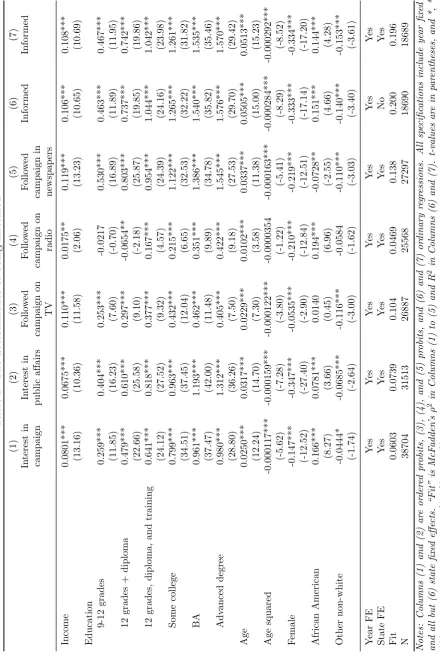
about politics than those with less education and lower income. To check if this holds, Table
1 displays the results from estimations where the indicators of being politically informed
are regressed on income and education, as well as on a vector of explanatory variables and
year and state dummies. We first use the five individual indicators of being informed, then
the composite measure from the principal component analysis with and without state fixed
effects.
For all specifications we obtain the expected result that voters with higher income and more education tend to be better informed. These results are in most cases significant at
the 1% level. Moving from the lowest to the highest level of education increases the level of
information by 1.07 standard deviations whereas an increase from the lowest to the highest
income category increases information by 0.37 standard deviations.12 Furthermore, the level
of information is increasing in age for most relevant ranges (the level is for instance maximized
at age 88 for specification (7)). Also, men have a higher level of political knowledge than
women. Controlling for the other background characteristics, African American voters are
the best informed, followed by whites and the others group.
Appendix Table A-2 reports results from the same analyses on the knowledge data.
Results are similar, indicating that the measures of information and knowledge tend to
measure the same underlying factors.
3.3
Income and voting
The core of Proposition 1 and Result 1 is that income is a better predictor of voting behavior
for more informed voters than for less informed voters. A simple way to test this is to regress
observed voting on the interaction of income and information, obviously also controlling for
background variables. We use a probit model, but logit or OLS as well as using sampling
weights yields qualitatively identical results. Results from this estimation are shown in Table 2. In Panel A we use our measure of information. Column (1) shows that as expected, higher
income increases the probability of Republican voting. Increased information has a negative
effect. Columns (2) and (3) display the results from a probit model without and with
state fixed effects, while Column (4) presents the results from an ordinary regression on a
binary outcome variable. All methods confirm that a rise in income increases the probability
of voting republican, and this effect is stronger for the more informed than for the less
informed voters. Going from the 25th to the 75th percentile on the level of information
increases the coefficient on income in the specification in Column (3) from 0.138 to 0.171,
which corresponds to about a 24% increase in the impact. The results for voting for Congress reported in Column (5) are somewhat weaker, but similar in sign and magnitude. In these
specifications we use repondents’ income groups. Using dummies for each income group
yields similar results (results available upon request).
In Panel B of Table 2, we run the same specifications as above, but use the measure of
political knowledge and this measure interacted with income instead of information. The
results are remarkably similar: a high level of knowledge combined with high income is a
good predictor of Republican voting.
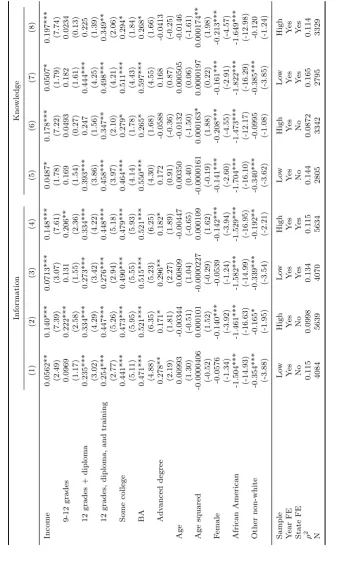
Another way to study this pattern is to split the sample between voters with high and
low levels of information. Results from this approach are reported in Table 3, where we have estimated a probit model with a number of demographic characteristics for the least
and most informed and knowledgeable halves of the sample. Most of the demographics
have fairly similar effects in both specifications, but we notice again that income is a much
more important determinant of voting for the more informed and knowledgeable part of the
sample, both with and without state fixed effects.
One competing explanation for these findings could be that what we label less informed
Table 2: The effect of income and being informed on Republican voting
President Congress
(1) (2) (3) (4) (5)
Panel A: Information
Income 0.117*** 0.0941*** 0.106*** 0.0371*** 0.0999***
(7.89) (6.26) (6.92) (6.93) (6.94)
Informed -0.0222* -0.104*** -0.0951*** -0.0335*** -0.0638** (-1.90) (-3.30) (-2.99) (-3.07) (-2.10)
Income × Informed 0.0282*** 0.0245** 0.00863** 0.0171*
(2.87) (2.46) (2.51) (1.84)
Fit 0.116 0.102 0.116 0.126 0.0957
N 9715 9715 9715 9715 11139
Panel B: Knowledge
Income 0.137*** 0.110*** 0.124*** 0.0439*** 0.123***
(7.35) (5.86) (6.46) (6.68) (6.09)
Knowledge -0.0521*** -0.176*** -0.166*** -0.0587*** -0.0812* (-3.17) (-4.42) (-4.13) (-4.36) (-1.83)
Income × Knowledge 0.0430*** 0.0388*** 0.0139*** 0.0234*
(3.47) (3.10) (3.29) (1.72)
Fit 0.129 0.113 0.131 0.144 0.104
N 6129 6129 6129 6129 5687
Model Probit Probit Probit OLS Probit
State FE Yes No Yes Yes Yes
Notes: Equations (1), (2) and (4) are probit estimations, equation (3) an ordinary regression. All
specifica-tions include age, age squared, sex, race, 7 dummies on educational level, and year dummies. Specificaspecifica-tions
(1), (3) and (4) also have state fixed effects. “Fit” is McFadden’s goodness of fit-measure ρ2 for the probits
and R2 for the OLS regression. Perfectly predicted observations in Specifications (1) and (3) are removed
throughout Specifications (1) to (4). t-values are in parentheses, and *, **, and *** denotes significant at
Figure 1: The effect of income on electoral outcomes: The intensive and extensive margins
0
.5
1
1.5
2
2.5
1960 1964 1968 1972 1976 1980 1984 1988 1992 1996 2000 2004 Year
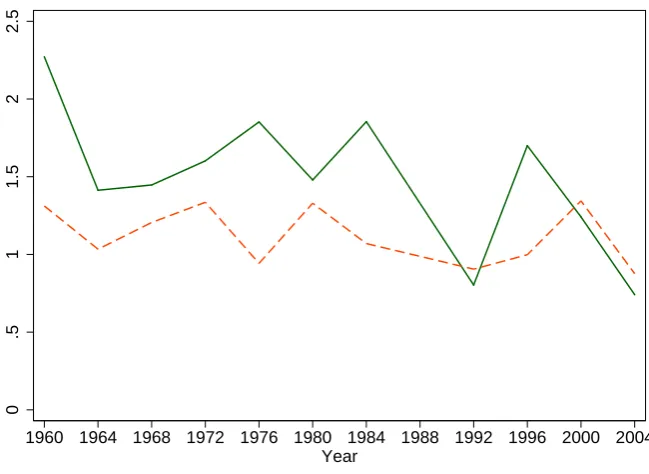
Notes: The simulation is based on the estimates reported in Column (1) of Table 2. The solid line is the simulated percentage point gain for the Democratic party from no voters abstaining; the dashed line is the simulated percentage point gain for the Democratic party from all voters having the maximum level of information.
to own needs. In Appendix E we show that if we take voting according to social preferences
into account, less informed voters still vote less according to their stated preferences.
3.4
Voting versus abstention
As highlighted by e.g. Larcinese (2005, 2007), there are both theoretical reasons and
empir-ical support for the tendency of less informed voters to abstain more often from elections. It might be that this effect completely overshadows our mechanism. To study this, we conduct
a simulation based on the estimates from Column (1) in Table 2. We simulate the outcome
of elections in two cases: First, if all voters had voted, where the voting pattern of those
abstaining is predicted from the regression. Second, if all voters had the maximum level of
information, again predicting voting behavior. The results are presented in Figure 1. We
see that the gain for the Democratic party from all citizens voting is about 1.5 percentage
points whereas the effect of the changed voting pattern from all voters being informed is
somewhat smaller, at about one percentage point. Still, the effects of both channels are of
Figure 2: Relationship between income and information by US state
0 .2 .4 .6 .8
Correlation income−information
South CarolinaLouisiana North DakotaMississippi ArizonaUtah Alabama Wyoming Oklahoma New HampshireMaine NebraskaKansas Illinois South Dakota North CarolinaVirginia ColoradoTexas ConnecticutFlorida Maryland KentuckyMissouri West VirginiaArkansas TennesseeWisconsin Iowa Ohio New York MassachusettsGeorgia MichiganIndiana New Jersey WashingtonCalifornia DC PennsylvaniaOregon MinnesotaIdaho
Notes: Bars depict the average correlation between level of information and income by state.
4
Information and political outcomes
Our theory predicts that when there is a strong positive correlation between income and
the level of information, this reduces the equilibrium level of public goods provision. To get
a grasp of the macro level effects of information, we study in this section the relationship
between how information is spread and various political outcomes. All the data is described
in detail in Appendix B.2.
Using the ANES data employed earlier, we can compute the correlation between the
variables Informed and Income state by state and for various years.1314 The average corre-lations by state are shown in Figure 2. One approach would be to associate these with state policies. However, most redistributive policies are determined at the federal level, so state
level policies tend to be uninformative. We look at the measure of tax revenues as share of
13ANES does not sample respondents in every state, hence some states are missing. Also, excluding states
with few observations does not qualitatively change the results reported below.
14We have also tried to use the General Social Survey (GSS) to calculate these correlations. However,
total state revenues used by e.g. Besley et al. (2010), but focus on voting behavior in the
House and the Senate.
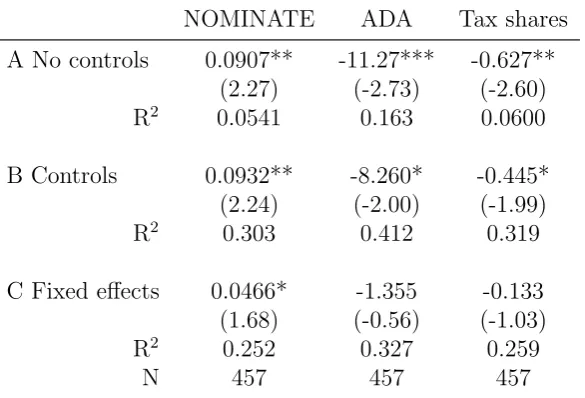
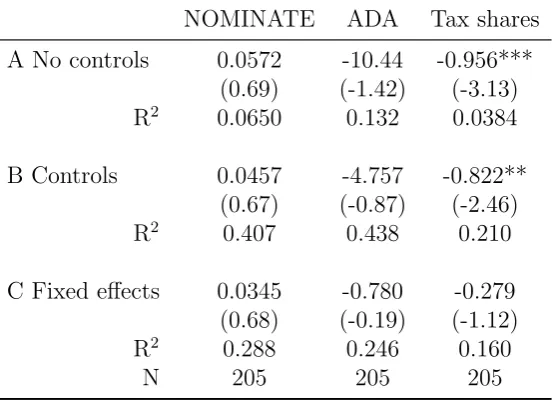
In Table 4 we analyze whether a stronger correlation between information and income
leads to less redistributive platforms for both Democrats and Republicans, as predicted by
Result 2. It is not easy to get exact measures of voting behavior on redistributive issues
completely isolated from all other issues. Instead, we rely on standard measures of political
orientation, namely McCarty, Poole and Rosenthal’s (Poole and Rosenthal, 1997; McCarty,
Poole and Rosenthal, 1997) NOMINATE scores estimated from actual voting behavior as
well as the scores collected by Americans For Democratic Action (ADA). These capture
the political orientation of all Congress members from both parties. Right-wing political platforms are reflected by high NOMINATE scores and low ADA scores. Our final dependent
variable is the tax share of personal income, which is a direct measure of how redistributive
the final policy is. In Table 4 the coefficients of the variableCorrelation income-information
are displayed in three different panels. In panel A no additional controls are included, in
panel B a battery of controls are added, and in panel C the same controls are included,
together with state fixed effects.
Panel A of Table 4 shows that states with a high correlation between income and
informa-tion do have more conservative representatives both measured by the NOMINATE and the
ADA scores, and their tax share of personal income is lower than in states where this corre-lation is weaker. These findings are robust to including our battery of control variables. The
findings using the NOMINATE scores are also robust to controlling for state fixed effects,
but the ADA and tax share results are no longer significant when we only consider within
state variation. This indicates that the findings are mostly driven by differences between
states, although within state changes also have some effects on the political position of
rep-resentatives. This pattern may be due to the fact that the correlation between information
and income is rather persistent and evolves only slowly over time.
We have also re-done the analysis using the correlation between income and our measure
of knowledge. The results, reported in Appendix Table A-3, are similar to those in Table 4. However, the sample is substantially smaller, as the knowledge instrument is not available
for all years, and the results are less significant.
5
Conclusion
This paper has argued that “knowledge is power”. Poorly informed voters do not perceive
the party platforms correctly, and accordingly do not vote in their best economic interest.
Such “noise voters” are disregarded by both the government and opposition, as they do not react to concessions and platform changes. Hence, the preferences of whole segments of the
Table 4: Aggregate policy outcomes
NOMINATE ADA Tax shares
A No controls 0.0907** -11.27*** -0.627** (2.27) (-2.73) (-2.60)
R2 0.0541 0.163 0.0600
B Controls 0.0932** -8.260* -0.445*
(2.24) (-2.00) (-1.99)
R2 0.303 0.412 0.319
C Fixed effects 0.0466* -1.355 -0.133 (1.68) (-0.56) (-1.03)
R2 0.252 0.327 0.259
N 457 457 457
Whether the parties’ strategic ignorance of the uninformed is a problem for a democracy
depends on how information is spread in the society. If in all income classes and ethnic
groups the proportion of poorly informed voters is roughly similar, we should not expect too
severe biases in policies. Lack of information may in this case simply lead to more polarized
party platforms, with parties putting a relatively higher weight on their preferred bliss point,
given that pandering to voters is less lucrative if fewer people perceive it.
If however lack of political information strikes particularly the poor or people from
par-ticular ethnic groups, it could become a serious problem. In many contexts this is the case.
Higher education results on average in higher income, and at the same time makes it easier
to access and process political information. Hence, income and information tend to be sys-tematically correlated, in some cases more and in some cases less. In societies where almost
only the rich know about politics the preferences of the poor “noise voters” are barely taken
into account by the political establishment and policies are catered towards the thin elite
of the population who follows politics. Accordingly, the state becomes less redistributive
and policies of all parties become less favourable for the poor. In societies with a smaller
correlation between income and political information this bias is less severe. The
mecha-nism would be similar for some ethnic minority group that may for various reasons be less
informed about politics.
The irony of this is that the people who are most in need of the protection of the state, i.e. the uneducated ones with poor jobs, are least heard and accounted for by all parties
(including the left-wing ones). The natural normative question to ask is whether the state
should intervene to change this. One point of view could be that the poor are themselves
to blame if they do not get their act together and if they “disenfranchise” themselves by
lacking interest in politics. Things seem however more complex. The bias from badly
informed poor voters may well end up being self-reinforcing and becoming persistent. In
societies where knowledge is spread very unevenly it may well be that the thin elite who
dominates politics may not find it in their interest to build a costly system of good state
schools, as they can afford to send their children to expensive private schools. This however reinforces the correlation between income and information in the following generation and
the concentration of political power in the hands of the few accentuates. In contrast, in
other societies political knowledge may initially be widely spread and available and the large
influence of the poor may promote big investments in high-quality public schooling, which
generates a further democratization of knowledge. What seems certain is that there is plenty
of scope for further research on this and related topics in the future. One particular question
on our research agenda is how providing detailed public information before legislative votes
(as done e.g. in the voluminous official information leaflets sent to all Swiss households)
References
American National Election Studies, 2010, dataset, www.electionstudies.org.
Anderson, Sarah, and Philip Habel, 2009, “Revisiting Adjusted ADA Scores for the U.S.
Congress, 1947-2007”, Political Analysis 17: 83-88.
Austen-Smith, David and Jeffrey Banks, 1996, “Information Aggregation, Rationality and
the Condorcet Jury Theorem”, American Political Science Review 90: 34-45.
Bagnoli, Mark, and Ted Bergstrom, 2005, “Log-concave probability and its applications”,
Economic Theory 26: 445-69.
Banks, Jeffrey S., 1990, “A model of electoral competition with incomplete information”,
Journal of Economic Theory 50: 309-25.
Bardhan, Pranab, and Dilip Mookherjee, 2000, “Capture and Governance at Local and
National Levels”,American Economic Review 90: 135-39.
Baron, David P., 1994, “Electoral competition with informed and uninformed voters”,
Amer-ican Political Science Review 88: 33-47.
Bartels, Larry, 1996, “Uninformed Votes: Information Effects in Presidential Elections”,
American Journal of Political Science 40: 194-230.
Bartels, Larry, 2008, Unequal Democracy: The Political Economy of the New Gilded Age,
Princeton: Princeton University Press.
Besley, Timothy and Stephen Coate, 1997, “An economic model of representative
democ-racy”, Quarterly Journal of Economics 112: 85-114.
Besley, Timothy, Torsten Persson and Daniel Sturm, 2010, “Political Competition, Policy
and Growth: Theory and Evidence from the United States”,Review of Economic Studies
77: 1329-1352.
Brunner, Eric, Stephen Ross, and Ebonya Washington, 2013, “Does Less Income Mean Less
Representation?”, forthcoming in American Economic Journal: Economic Policy.
Chan, Jimmy, and Wing Suen, 2008, “A Spatial Theory of News Consumption and Electoral Competition”, Review of Economic Studies 75: 699-728.
Corneo, Giacomo and Hans Peter Gr¨uner, 2000, “Social limits to redistribution”, American
Economic Review 90: 1491-1507.
Della Vigna, Stefano and Ethan Kaplan, 2007, “The Fox News Effect: Media Bias and
Voting”, Quarterly Journal of Economics 122: 1187-1234.
Delli Carpini, Michael and Scott Keeter, 1996, What Americans Know About Politics and
Why It Matters, New Haven: Yale University Press.
Downs, Anthony, 1957, An Economic Theory of Democracy, New York, Harper and Row.
Feddersen, Timothy and Wolfgang Pesendorfer, 1996, “The Swing Voter’s Curse”,American Economic Review 86: 408-24.
Aggregation in Elections with Private Information”,Econometrica 65: 1029-58.
Feddersen, Timothy and Alvaro Sandroni, 2006, “Ethical Voters and Costly Information
Acquisition”, Quarterly Journal of Political Science 1: 287-311.
Gans, Joshua, and Michael Smart, 1996, “Majority voting with single-crossing preferences”,
Journal of Public Economics 59: 219-37.
Gelman, Andrew, David Park, Boris Shor, Joseph Bafumi, and Jeronimo Cortina, 2009, Red
State, Blue State, Rich State, Poor State: Why Americans Vote the Way They Do,
Princeton: Princeton University Press.
Gerber, Alan S., Dean Karlan, and Daniel Bergan, 2009, “Does the Media Matter? A
Field Experiment Measuring the Effect of Newspapers on Voting Behavior and Political Opinions”, American Economic Journal: Applied Economics, 1: 35-52.
Gilens, Martin, 2001, “Political Ignorance and Collective Policy Preferences”, American
Political Science Review 95: 379-96.
Grossman, Gene M., and Elhanan Helpman, 1996, “Electoral competition and special
inter-est politics”, Review of Economic Studies 63: 265-286.
Gul, Faruk, and Wolfgang Pesendorfer, 2009, “Partisan politics and election failure with
ignorant voters”, Journal of Economic Theory 144: 146-74.
Harms, Philipp and Stefan Zink, 2003, “Limits to redistribution in a democracy: a survey”,
European Journal of Political Economy 19: 651-68.
Hirschman, Albert and Michael Rothschild, 1973, “The changing tolerance for income
in-equality in the course of economic development”, Quarterly Journal of Economics 87:
544-66.
Hodler, Roland, Simon Loertscher, and Dominic Rohner, 2010, “Inefficient Policies and
Incumbency Advantage”, Journal of Public Economics 94: 761-767.
Larcinese, Valentino, 2005, “Electoral Competition and Redistribution with Rationally
In-formed Voters”, Contributions to Economic Analysis and Policy 4: Issue 1, Article 4.
Larcinese, Valentino, 2007, “Does Political Knowledge Increase Turnout? Evidence from the
1997 British General Election”, Public Choice 131: 387-411.
Leip, David, 2010, “Atlas of US Presidential Elections”, dataset, www.uselectionatlas.org.
Lind, Jo Thori, 2005, “Why is there so little redistribution?”, Nordic Journal of Political
Economy 31: 111-25.
Lind, Jo Thori, and Dominic Rohner, 2011, “Voting under uncertainty about candidates”,
mimeo, University of Oslo and University of Lausanne.
Lindbeck, Assar and J¨orgen Weibull, 1987, “Balanced-budget redistribution as the outcome
of political competition”, Public Choice 52: 273-97.
Lohmann, Susanne, 1998, “An Information Rationale for the Power of Special Interests”,
Lupia, Arthur, 1992, “Busy Voters, Agenda Control, and the Power of Information”,
Amer-ican Political Science Review 86: 390-403.
Martinelli, C´esar, 2006, “Would rational voters acquire costly information?”, Journal of
Economic Theory 129: 225-51.
McCarty, Nolan M., Keith T. Poole, and Howard Rosenthal, 1997, Income Redistribution
and the Realignment of American Politics. Washington, DC: AEI Press.
McCarty, Nolan M., Keith T. Poole, and Howard Rosenthal, 2006, Polarized America: The
Dance of Ideology and Unequal Riches. Cambridge MA: MIT Press.
McKelvey, Richard and Peter Ordeshook, 1985, “Elections with limited information: A
fulfilled expectations model using contemporaneous poll and endorsement data as in-formation sources”, Journal of Economic Theory 36: 55-85.
Meltzer, Allan and Scott Richard, 1981, “A rational theory of the size of government”,
Journal of Political Economy 89: 914-27.
Moene, Karl Ove and Michael Wallerstein, 2001, “Inequality, social insurance, and
redistri-bution”, American Political Science Review 95: 859-74.
Moene, Karl Ove and Michael Wallerstein, 2003, “Earnings inequality and welfare spending:
A disaggregated analysis”, World Politics 55: 485-516.
Oberholzer-Gee, Felix, and Joel Waldfogel, 2009, “Media Markets and Localism: Does Local
News en Espa˜nol Boost Hispanic Voter Turnout?”, American Economic Review 99: 2120-28.
Olson, Mancur, 1965, The Logic of Collective Action, Cambridge MA, Harvard University
Press.
Osborne, Martin and Al Slivinski, 1996, “A model of political competition with
citizen-candidates”, Quarterly Journal of Economics 111: 65-96.
Palfrey, Thomas and Keith Poole, 1987, “The Relationship between Information, Ideology,
and Voting Behavior”, American Journal of Political Science 31: 511-30.
Perotti, Roberto, 1996, “Growth, income distribution, and democracy: What the data say”,
Journal of Economic Growth 1: 149-87.
Persson, Torsten, and Guido Tabellini, 2000, Political Economics: Explaining Economic
Policy, Cambridge, MA: MIT Press.
Piketty, Thomas, 1995, “Social mobility and redistributive politics”, Quarterly Journal of
Economics 110: 551-84.
Poole, Keith T, and Howard Rosenthal, 1997,Congress : a political-economic history of roll
call voting. Oxford : Oxford University Press.
Prior, Markus, 2009, “The immensely inflated news audience: Assessing bias in self-reported
news exposure”, Public Opinion Quarterly 73: 130-143.
Roemer, John, 1998, “Why the poor do not expropriate the rich: an old argument in new
garb”, Journal of Public Economics 70: 399-424.
Roemer, John, 1999, “The Democratic Political Economy of Progressive Income Taxation”,
Econometrica 67: 1-19.
Rohner, Dominic, 2009, “Coup at the Polls: Information, Closeness of Elections and Bad
Politicians”, mimeo, University of Lausanne.
Romer, Thomas, 1975, “Individual welfare, majority voting and the properties of a linear
income tax”, Journal of Public Economics 4: 163-85.
Str¨omberg, David, 2004a, “Radio’s Impact on Public Spending”, Quarterly Journal of
Eco-nomics 119: 189-221.
Str¨omberg, David, 2004b, “Mass Media Competition, Political Competition, and Public
Policy”, Review of Economic Studies 71: 265-84.
Wittman, 1983, “Candidate Motivation: A Synthesis of Alternative Theories”, American
Political Science Review 77: 142-57.
Wittman, Donald, 1989, “Why Democracies Produce Efficient Results”, Journal of Political
Economy 97: 1395-424.
Appendix A
Extensions and proofs
A.1
A formal model of political information
We consider a continuum of voters differentiated by their stock of human capital Ei. Each
voter i has a utility function
Ui =xi+ξdi+J(g), (A-1)
where xi is voter i’s amount of private goods, di her level of political knowledge, and g the
amount of public goods provided in society. The function J is assumed to be concave and
increasing (i.e. Jg >0 and Jgg <0), andξ > 0 is a parameter indicating how much citizens
value information. As in standard political economics models (e.g. Persson and Tabellini, 2000) the voters’ utility depends positively on both the private and public goods consumed.
Here we also include the level of political knowledge of the voter.
The voter has an incomeyi that is taxed at a rate τ. Post tax income is divided between
consumption and investments into information acquisitionsi (e.g. cost of buying books and
magazines, the opportunity cost of watching the news etc), yielding a budget constraint
(1−τ)yi =xi+si. (A-2)
yi =f(Ei), (A-3)
which is increasing inEi. Finally, we represent the generation of political knowledge by
di =κ(si, Ei), (A-4)
where we assume κs >0 and κss <0. We also assume that human capital and investments
in political knowledge are complementary, i.e. κsE >0.
The citizens make their optimal choices of s∗i and gi∗ at the beginning of the first
pe-riod. These choices are independent of the actions in the remainder of the game. Inserting
equations (A-2) and (A-4) into equation (A-1), and using the government budget constraint
g = τ y, where y = average income, we obtain the objective function for the citizens to
optimize:
Ui = (y−g)yi
y +ξκ(si, Ei)−si+J(g). (A-5)
The first order conditions with respect tosi lead to lemma 2. The second order conditions
hold.
Lemma 2 More educated citizens have greater incentives to invest income in the generation
of political knowledge, i.e. they have a higher si. They acquire higher levels of political
knowledge than less educated citizens, i.e. they achieve a higher di.
This result follows from κsE >0.
Thus, education does not only increase income, but also results in higher levels of political
knowledge acquired. Furthermore, each citizen derives her preferred level ofg∗i. Maximizing
(A-5) with regard tog, we find the preferred level of public goods g∗ characterized by
gi∗ =Jg−1
yi
y
. (A-6)
Lemma 3 Richer voters (i.e. with higher yi) prefer lower levels of the public good (i.e.
lower gi∗).
The concavity ofJ(•) implies that equation (A-6) directly leads to this result (cf. Persson
and Tabellini (2000) for a further discussion).
Combining these two lemmata, we can describe the relationship between preferred policies
and political knowledge by a function d∗(g∗), where d∗ must be decreasing in g∗. High individual benefits from redistribution are on average associated with low levels of political
A.2
Increased information
To study the effect of increased information, we differentiate (12) with regard to π0:
∂EP
∂π0
=−τL
Z +∞
0
∂U ∂τL
∂h(ˆδ)
H(ˆδ)
∂δˆ ∂δˆ ∂π0
µ(y) + h(ˆδ) H(ˆδ)
∂µ(y) ∂π0
dF(y). (A-7)
There are two effects of an increase inπ0, corresponding to the two terms in the parenthesis.
First, more voters become aware of the parties’ platforms and hence make a judgment based
on their policy preferences. This has an effect on the critical ˆδ, and corresponds to the first
part of the parenthesis. The sign of this effect is unclear. ˆδ is increasing inπ0 if the average
voter tends to vote Lwhen she goes from uninformed to informed.15 When this is the case, an increased information level is an advantage for party L and a disadvantage for R.
Second, when more voters are informed, a change in policy platforms has a larger impact on voting behavior, corresponding to the last part of the parenthesis. Asµ(y) is
unambigu-ously increasing in π0 for all y, this effect increases EP. If the second effect dominates, an
increase in the fraction of informed voters π0 tends to increase EP and hence make both
parties less polarized. If the first effect dominates, the party gaining in popularity from
increased information can use its improved position to propose a platform closer to its bliss
point, whereas the other party proposes a platform closer to the centre.
A.3
Proof of Lemma 1
We obtain
∂EP
∂α =−τL
∂h(ˆδ)
H(ˆδ)
∂δˆ ∂δˆ ∂α
Z +∞
0
∂U ∂τL
µ(y)dF(y)−τL
h(ˆδ)
H(ˆδ)
Z +∞
0
∂U ∂τL
∂µ(y)
∂α dF(y).
As we can always redefine eπ(y) =π(y) +αν(y), it suffices to show that the lemma holds at
α= 0. We have
∂δˆ ∂α α=0 =
R+∞
0
ShU(τL, y)−U(τR, y)−δˆ
i
−S−ˆδ
ν(y) dF(y)
R+∞
0
shU(τL, y)−U(τR, y)−δˆ
i
π(y) +s(−ˆδ)[1−π(y)]
dF(y) <0.
This expression is negative, as ShU(τL, y)−U(τR, y)−δˆ
i
−S−δˆ is positive for low income voters on which ν puts negative weight, and negative for high income voters on
15Which is wheneverR+∞
0 S[U(τL, y)−U(τR, y)−δ]−S[−δ]
which ν puts positive weight.16 Given that∂h(ˆδ)
H(ˆδ)
/∂δ <ˆ 0, and that for the average voter
∂U/∂τL<0, we know that the first term of∂EP/∂α is always positive.
A second effect is through changes in the weighting µ. The effect of a minor perturbation
onµdepends ony: If for somey∗ there is ∂µ∂α(y∗)
α=0 >0 then it is also positive for ally > y
∗
and vice versa. Hence more weight is now put on wealthier voters and less on poorer voters.
Hence, also the second term of∂EP/∂α is always positive. PartyL will thus unambiguously
select a less polarized platform. For the same reasons also R will move to the right.
Appendix B
Data
B.1
Data used in Section 3
All data are from the American National Election Studies (2010).
African American: This is 1 when “race” is “black” and 0 otherwise, based on observation
and/or self-declaration.
Age: Answer to question about date of birth.
Education: Answer to question about the highest degree earned. There are seven
cate-gories: 1) 8 grades or less (’grade school’), 2) 9-12 grades (’high school’), no diploma/equivalency,
3) 12 grades, diploma or equivalency, 4) 12 grades, diploma or equivalency plus
non-academic training, 5) Some college, no degree; junior/community college level degree
(AA degree), 6) BA level degrees, 7) Advanced degrees incl. LLB.
Female: Takes a value of 1 if female, 0 otherwise.
Followed campaign on newspapers: Answer to the question “Did you read about the
campaign in any newspaper?”. Takes value of 1 if answered “Yes, read newspaper(s)
about the campaign”, takes value of 0 if answered “No, read no newspapers about the
campaign”.
Followed campaign on radio: Answer to the question “Did you listen to any speeches
or discussions about the campaign on the radio?”. Yes=1, No=0.
Followed campaign on TV: Answer to the question “Did you watch any programs about
the campaigns on television?”. Yes=1, No=0.
Income: Based on self-declaration. There are five income groups: 1) 0 to 16 percentile, 2)
17 to 33 percentile, 3) 34 to 67 percentile, 4) 68 to 95 percentile, 5) 96 to 100 percentile.
16IfShU(τ
L, y)−U(τR, y)−δˆ
i
Informed: Composite measure obtained from principal component analysis, explained in
section 3.2.
Interest in campaign: Answer to question “Some people don’t pay much attention to
political campaigns. How about you, would you say that you have been/were very much
interested, somewhat interested, or not much interested in the political campaigns (so
far) this year?”. Three categories of answers: 1) Not much interested, 2) Somewhat
interested, 3) Very much interested.
Interest in public affairs: Answer to the question “Would you say you follow what’s
going on in government and public affairs most of the time, some of the time, only now and then, or hardly at all?”. Four categories of answers: 1) Hardly at all (1960,
1962: not much at all), 2) Only now and then, 3) Some of the time (1960, 1962: fairly
closely), 4) Most of the time (1960, 1962: very closely).
Knowledge: Composite measure obtained from principal component analysis, explained
in section 3.2.
Knows House majority: Answer to the question “Do you happen to know which party
had the most members in the House of Representatives in Washington before the
elections?”. Correct answer=1, wrong answer=0.
Post interview informed: Interviewer’s assessment of respondent’s general level of
in-formation about politics and public affairs after the interview. Five levels of answers:
1) Very low, 2) Fairly low, 3) Average, 4) Fairly high, 5) Very high.
Pre interview informed: Interviewer’s assessment of respondent’s general level of
infor-mation about politics and public affairs before the interview. Five levels of answers:
1) Very low, 2) Fairly low, 3) Average, 4) Fairly high, 5) Very high.
Other non-white race: This is 1 when “race” is “other” and 0 otherwise, based on ob-servation and/or self-declaration.
Voted republican for Congress: Answer to the question “Did you vote for a candidate
for the U.S. House of Representatives? (IF YES:) Who did you vote for?”.
Republi-can=1, Democrat=0.
Voted republican for President: Answer to the question “Major party presidential vote
B.2
Data used in Section 4
ADA: Adjusted ADA scores, from Anderson and Habel (2009).
Average Democratic vote share in the state: From Besley, Persson and Sturm (2010).
Correlation income-information: Correlation betweenIncome andInformation, as
de-scribed in the main text.
Correlation income-knowledge: Correlation between Income and Knowledge, as
de-scribed in the main text.
Election results: Actual results from elections. From Leip (2010).
Growth of personal income: From Besley, Persson and Sturm (2010).
Income: From ANES, cf. above.
Information: From ANES, cf. above.
Knowledge: From ANES, cf. above.
NOMINATE: Data taken from Keith Poole’s web pagehttp://voteview.com. Procedure
documented in McCarty, Poole and Rosenthal (1997).
Personal income: From Besley, Persson and Sturm (2010).
Political competition: Measure of political competition, from Besley, Persson and Sturm
(2010).
Share of non-farm income: From Besley, Persson and Sturm (2010).
State population: From Besley, Persson and Sturm (2010).
Tax share: Taxes paid as share of personal income, from Besley, Persson and Sturm (2010).
Appendix C
Descriptive statistics
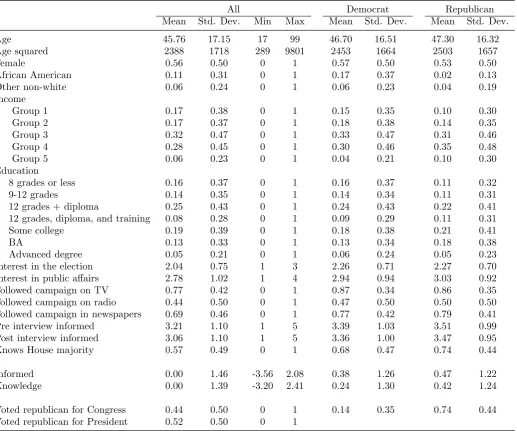
Table A-1: Descriptive statistics
All Democrat Republican
Mean Std. Dev. Min Max Mean Std. Dev. Mean Std. Dev. Age 45.76 17.15 17 99 46.70 16.51 47.30 16.32 Age squared 2388 1718 289 9801 2453 1664 2503 1657
Female 0.56 0.50 0 1 0.57 0.50 0.53 0.50
African American 0.11 0.31 0 1 0.17 0.37 0.02 0.13 Other non-white 0.06 0.24 0 1 0.06 0.23 0.04 0.19 Income
Group 1 0.17 0.38 0 1 0.15 0.35 0.10 0.30
Group 2 0.17 0.37 0 1 0.18 0.38 0.14 0.35
Group 3 0.32 0.47 0 1 0.33 0.47 0.31 0.46
Group 4 0.28 0.45 0 1 0.30 0.46 0.35 0.48
Group 5 0.06 0.23 0 1 0.04 0.21 0.10 0.30
Education
8 grades or less 0.16 0.37 0 1 0.16 0.37 0.11 0.32 9-12 grades 0.14 0.35 0 1 0.14 0.34 0.11 0.31 12 grades + diploma 0.25 0.43 0 1 0.24 0.43 0.22 0.41 12 grades, diploma, and training 0.08 0.28 0 1 0.09 0.29 0.11 0.31 Some college 0.19 0.39 0 1 0.18 0.38 0.21 0.41
BA 0.13 0.33 0 1 0.13 0.34 0.18 0.38
Advanced degree 0.05 0.21 0 1 0.06 0.24 0.05 0.23 Interest in the election 2.04 0.75 1 3 2.26 0.71 2.27 0.70 Interest in public affairs 2.78 1.02 1 4 2.94 0.94 3.03 0.92 Followed campaign on TV 0.77 0.42 0 1 0.87 0.34 0.86 0.35 Followed campaign on radio 0.44 0.50 0 1 0.47 0.50 0.50 0.50 Followed campaign in newspapers 0.69 0.46 0 1 0.77 0.42 0.79 0.41 Pre interview informed 3.21 1.10 1 5 3.39 1.03 3.51 0.99 Post interview informed 3.06 1.10 1 5 3.36 1.00 3.47 0.95 Knows House majority 0.57 0.49 0 1 0.68 0.47 0.74 0.44
Informed 0.00 1.46 -3.56 2.08 0.38 1.26 0.47 1.22 Knowledge 0.00 1.39 -3.20 2.41 0.24 1.30 0.42 1.24
Appendix D
Additional estimation results
Table A-2: The determinants of having political knowledge
(1) (2) (3) (4) (5)
Knows House majority
Pre interview informed
Post interview informed
Knowlege Knowledge
Income 0.140*** 0.149*** 0.112*** 0.190*** 0.190*** (16.96) (17.37) (15.87) (15.50) (15.32) 9-12 grades 0.274*** 0.402*** 0.368*** 0.552*** 0.545***
(8.91) (11.76) (12.57) (9.97) (9.82) 12 grades + diploma 0.577*** 0.732*** 0.708*** 0.961*** 0.961***
(19.68) (22.61) (25.64) (18.75) (18.67) 12 grades, diploma, and training 0.734*** 0.979*** 0.870*** 1.301*** 1.305***
(19.91) (25.19) (25.97) (22.23) (22.22) Some college 0.969*** 1.303*** 1.110*** 1.663*** 1.649***
(30.20) (37.21) (37.60) (31.14) (30.69) BA 1.269*** 1.734*** 1.391*** 2.075*** 2.062***
(34.91) (45.04) (43.08) (36.45) (36.03) Advanced degree 1.418*** 2.039*** 1.566*** 2.358*** 2.342***
(28.73) (42.15) (40.74) (34.90) (34.54) Age 0.0340*** 0.0250*** 0.0232*** 0.0406*** 0.0413***
(12.43) (9.15) (9.93) (9.92) (10.13) Age squared -0.000178*** -0.000131*** -0.000121*** -0.000238*** -0.000246***
(-6.43) (-4.72) (-5.11) (-5.79) (-6.00) Female -0.453*** -0.358*** -0.287*** -0.446*** -0.448***
(-28.19) (-21.61) (-20.81) (-18.54) (-18.66) African American -0.248*** -0.120*** -0.0902*** -0.288*** -0.285***
(-9.26) (-4.36) (-3.92) (-7.47) (-7.08) Other non-white -0.210*** -0.145*** -0.0675** -0.216*** -0.229***
(-6.36) (-4.60) (-2.51) (-5.00) (-5.17)
Year FE Yes Yes Yes Yes Yes
State FE Yes Yes Yes No Yes
Fit 0.175 0.128 0.0900 0.366 0.356
N 30707 17600 24252 9084 9082
Notes: Columns (1) and (2) are ordered probits, (3), (4), and (5) probits, and (6) and (7) ordinary regressions. All specifications include year fixed effects and all but (6) state fixed effects. “Fit” is McFadden’s ρ2 in Columns (1) to (5) and R2 in Columns (6) and (7).




![VIS3COS III: Environmental effects on [OII], Hdelta, and D n4000 and their consequence for the star formation histories at zZ0 8](data:image/gif;base64,R0lGODlhAQABAIAAAP///wAAACH5BAEAAAAALAAAAAABAAEAAAICRAEAOw==)