Penitentiary System: Criticism of Legislative Drafting Technique at
Three Levels
___________________________________________________________
Panagiotis, Giavrimis1
Xaris Salomidis2
Abstract
Both the organization of the penitentiary system -as structured within the legislative framework- and its practical implementation reflect society's representations of crime as well as perceptions of its prevention and combat. This work study will focus upon the Greek penitentiary system based on the prison officers’ views and perceptions. The sample of the present research consists of 37 guards serving in Greek penitentiary institutions. The findings of the research indicate the managerial quality of the reforms attempted in the country during the last two decades. The major problems of the penitentiary system are the following: insufficient organizational infrastructure, overcrowding of prisons, weaknesses in administrative organization and inefficient care system. Additionally, the education and training of prison officers is insufficient. State policies should aim at developing actions which will take into account both empirical data and scientific findings.
Penitentiary Policy
Within the frame of a community’s “responsive” procedures to crime and deviation, policy against crime also includes the legislative technique of prevention (Georgoulas 2003: 34). In the context of penitentiary policy, prevention is organized in two institutional stages concerning, firstly the social compliance of the prisoner -i.e. transformation of his antisocial behaviour by means of special measures “conforming to the rule of law”-and secondly the implementation of social policy measures to achieve prisoners’ social rehabilitation. In Greece, apart from the penitentiary establishments, the first stage also includes bodies conducting penitentiary policy, such as the Central Scientific Prison Council, the Central Council for Prisoners Transfer and the local Prison Council, which make up forms of official 2776/1999). Prison officers are the executive representatives of the Criminal Justice system.
Within this context, special measures are implemented aiming, in the first place, at tracing the social determinants responsible for the prisoners’ deviant or criminal behaviour (in contrast to former penitentiary policies, which mainly in the cases of physical or mental disorders followed “the cause and effect” pattern considering individual pathology to be the endogenous cause 3of crime.) In the second place, correctional intervention is carried out, so
1
Department of Sociology, University of Aegean (Greece), [email protected]
2
Department of Sociology, University of Aegean (Greece)
3
as to help transformation of unlawful to lawful conduct at the same time “reinforcing any of the prisoner's positive aspects” (Kourakis 2008: 79). Similarly oriented are the programmes of “social rehabilitation”, which follow the maintenance and “optional” practice of the State, in the wider context of the Welfare State social policy, pertaining to the vocational education and training of the prisoners4.
According to the “pivotal point” in the critical research of current penitentiary policy, responses to these measures can be classified into two categories: a) the effectiveness of the system in terms of “correction” and “compliance” (“development of a social responsibility sense”) and b) its potential for supporting the social rehabilitation of prisoners. On the grounds of a purely legal-technical level, averting any deterministic or operational interpretation of consequences or a search for teleological and programming corrective methods, the above mentioned responses depend on the managerial quality of (criminal) legislative procedure, either in terms of political reform (i.e. legislative foundation) or of practical application. Nevertheless, underlying this view is the decisive role of politics in the selective perception of the complex reality, which turns any conflicting interests into the subject of criminal legislation arrangements. (Lambropoulou 1994, 1999).
Penitentiary Codes implemented in Greece (actually the L. 1851/1989 and the last legislative change, L. 2776/1999), may have focused upon the basic remedial reform of prisoners' living conditions, but were not supported by a long-term design for infrastructure and systematic provision of prisoners' education. (Lambropoulou 2007: 56-61). On the contrary, to quote another “idiosyncratic feature” of Greek governmental policy and of the legislative process, certain provisions regarding the treatment of prisoners (actually the most essential ones) either -for lack of adoption of specific presidential decrees and relevant ministerial decisions- remained in the preliminary phase of application and never came into force or were soon abolished by new laws without even being evaluated.
Certainly this is a specific feature of the historical development of the penitentiary system, which paradoxically does not follow a programming sequence, so that the establishment of a penal detention system and the record of its possible failure would lead to a gradual stabilization of reform plans and the consistent definition of the penitentiary technique and, finally, would recognize the failure or success following implementation of the scheduled plan. Actually, these data were either inconsistent or fall under a different classification (Foucault 1989: 349).
Penitentiary Establishments
Penitentiary reforms intended to relieve prison congestion, regarding both the increase of prison population already noted in the 1990’s as well as its gradual shift, ended up having only a managerial quality both from a legislative and a practical point of view. It is indicative that it becomes increasingly easy for confinement penalties to be converted into financial ones, while the prerequisites for prisoners' release are gradually reduced -often under legal appearance or by illegal methods- following the prior issue of amnesty decrees (Alexiades 2007).
The same happens with the “construction project” of new detention establishments, -already announced in 1999- as well as the would be increase in prisons’ capacity, which would make the prisoners’ total number commensurate with each prison's capacity. By the end of 1999, the total number of detention establishments was 27 with a total capacity of 4,502 persons, while the detainees amounted to 7,280. In 2002 the total number of penitentiary establishments was 30, with a total capacity of 5,284 persons while the detainees amounted to 8,507 (Lambropoulou 2007). In the same period the prison in Corydallos -the largest Greek prison actually- had a capacity of 640 persons but accommodated 2,000 detainees. According to the official statistics by the Ministry of Justice, in 2006 the detainees in penitentiary establishments amounted to 9,964 (of which 4,346 –i.e. 45% of total prison
4
population- were serving prison sentences for drug law violations), with a prison capacity of 5,584 persons (Souliotis and Karanatsis 2006). According to an OSCE research -concerning the occupancy of penitentiary establishments, Greek prisons come first with an occupancy rate of 179%, when the mean of the results obtained is 109% (Hionis χχ).
Within this context, promotion and implementation of educational and -vocational training programmes are impossible, as the prison facilities provided for specific purposes, are inevitably used to accommodate prisoners. Similarly, activities (recreation, sport etc.) provided for by certain provisions are extremely limited, as lack of appropriate infrastructure and competent personnel prevents their implementation. It should be noted that in 1994 the total number of officers' posts was 3,477, while the personnel in service came up to 2,142 persons. Specifically, there were 969 vacancies out of 2,680 posts. Currently, out of 4,012 posts approximately 2,500 are filled (Spinellis and Kourakis 2001).
The above mentioned record of the conditions prevailing in Greek prisons during the last decades, as regards the deviation of the proportional relationship between the number of detainees and the offered capacity of penitentiary establishments, is indicative of the managerial policy of the Greek State's penitentiary system, which has always been based upon rhetorical advice urging either appeasing policy or proactive intervention. On the other hand, establishment of new penitentiary institutions may be assumed as positive for the improvement of the prisoners' living conditions, albeit not justifying the purpose of their existence. Examples such as the Special Juvenile Correctional Institution in Avlona and Volos, the Agricultural Juvenile Correctional Institution in Kassavetia and Koridallos Judicial Prison, have shown that establishment of new penitentiary institutions or creation of new posts lead to the gradual increase of the number of prisoners and reinforce arguments about the expansion of the security «industry» (Lambropoulou 2007).
Correctional Staff
Along with the legislative basis (i.e. the targets of penitentiary intervention) and the infrastructure of penitentiary houses, the correctional staff stands as the third pillar of organization and operation of the penitentiary system (Alexiades and Panousis 2002). According to the existing legislation, the correctional staff attempts to put together two conflicting parts: on the first hand, contribute to the normal life conditions of the prisoners and show an overall behaviour helping in their social rehabilitation; secondly, act as the repressive body of a criminal penal institution and impose disciplinary penalties upon prisoners who may commit disciplinary offences, so that the system’s smooth operation would be maintained. L.2776/1999). Nevertheless, in “cases of emergency”, measures have been laid down for maintaining order and security within penitentiary institutions. Among others practices, these measures include the use of cuffs, the prisoner's incarceration in a disciplinary cell and “any relevant measures appropriate for the particular circumstances”. The fact that enforcement of any additional measures for the prisoners' discipline is left to the personnel’s discretion, legitimizes all forms of authoritarian arbitrariness.
have chosen the profession in order to become civil servants, while unemployment is an essential factor for the men’s choice (Stergiou 2008).
According to Crawley (2004), correctional officers confess to the prison's inefficiency to deter prisoners from committing new crimes. Nevertheless, they deny any responsibilities resulting from the system’s failure and point to society, the Ministry of Justice and the prisoners themselves (Arfaras 2007: 423).
The purpose of this study is to consider the Greek penitentiary system based on the prison officers’ views and perceptions. The findings introduced are the primary results of a wider research pertaining to the penitentiary system. The research focuses upon the guards' representations, as they introduce especially useful data, actions and responses of the subject, which, in connection to the social context, create and control all human activities (Le Ny 1985).
Method
Sample
The sample of the present research consists of 37 guards serving in Greek penitentiary institutions, 34 of which (91.9%) are male and 3 (8.1%) are female (tab. 1). The average age of the sample is 38.1. The age range is 27 years, and the minimum age is 26. Concerning years of service, the mean is 12.1 years, the range is 23 years, and the minimum actual service time is 2 years (tab. 2). In terms of education 27 subjects (73%) are secondary education graduates and 10 (27%) Higher/Technological Education Institution graduates (tab. 3.)
Table 1. Frequencies and relative frequencies of the gender penitentiary institutions
guards
Gender Frequency Percent
Male 34 91.9
Female 3 8.1
Total 37 100.0
Table 2. Mean, standard deviations, range, minimum and maximum length of service completed and of age.
Years of service Age
Mean 12.1622 38.1081
Standard Deviation 6.20266 6.85072
Range 23.00 27.00
Minimum value 2.00 26.00
Table 3. Frequencies and relative frequencies of the educational background of
penitentiary institutions guards.
Educational background Frequency Percent
Lyceio 27 73.0
Higher Education (University or Technological Institutions)
10 27.0
Total 37 100.0
Penitentiary institution guards were chosen as objects of this research for the following reasons:
a) they stand as the main mediators between society and the penitentiary system, b) being in touch with the prisoners for many hours during the week they have a more comprehensive picture of the penitentiary system,
c) they play a pivotal role in the function of the penitentiary system.
Psychometric instruments
The questionnaire used in the semi-structured interview is original and was based on international and Greek bibliography about penitentiary systems and their role in modern societies, on the findings of other international and Greek -albeit scarce- research, as well as on the results of methodology of research on vulnerable populations. The questionnaire consists of six thematic units with open and close questions about the following:
1. Problems inherent in the prison guard profession. 2. Problems faced by prison guards as individuals. 3. Skills required to be a prison guard
4. Hindering factors stemming either from the penitentiary system or the prisoners or their relatives.
5. Ways of tackling any arising problems. 6. Issues concerning prison officers’ training.
The first part of the questionnaire includes demographic information referring to gender, age, educational certification and their service position. The questionnaire consisted of 4-point Likert-type questions, (1 =Yes, 4 = No), multiple choice and open questions.
Findings
their “confinement” within the penitentiary system, are considered to be the minor problems pertaining to their profession. As a conclusion, the sample highlights the shortcomings of the penitentiary system prison's overcrowding, which cause problems in funding, education, lack of political support and living conditions.
Table 4. Answers to the open question about the problems of the penitentiary system.
Answers Frequency Percent
Organizational shortcomings of penitentiary system (building
infrastructure, lack of equipment and personnel)
18 46.1
Overcrowding 17 45.9
State financing 9 24.3
Education- training- 9 24.3
Lack of political intervention and of
meritocracy 6 16.2
Insecurity 5 13.5
Institutionalization 1 2.7
Total 69 186.5
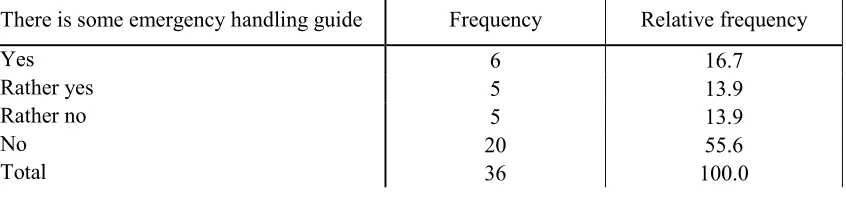
Another serious problem is that 55.6% of the sample ignore whether an emergency handling guide is available, 13.9% assume there is no such guide and only 16.7% are definitely sure of its existence.
Table 5 Frequencies and relative frequencies of answers to the question “Is there an emergency handling guide?”
There is some emergency handling guide Frequency Relative frequency
Yes 6 16.7
Rather yes 5 13.9
Rather no 5 13.9
No 20 55.6
Total 36 100.0
Table 6. Answers to the open question about their difficulties as individuals within the
penitentiary system.
Answers Frequency Percent
Weaknesses in administrative organization (insufficient number of established posts, irregular shifts, frequent transfers, partisanship and clientelism)
13 54.3
Inefficient penitentiary care system (lack of crises-handling measures, salary system)
12 49
Education-Training 4 16.7
Nonsegregation of prisoners
-Overcrowding 4 16.7
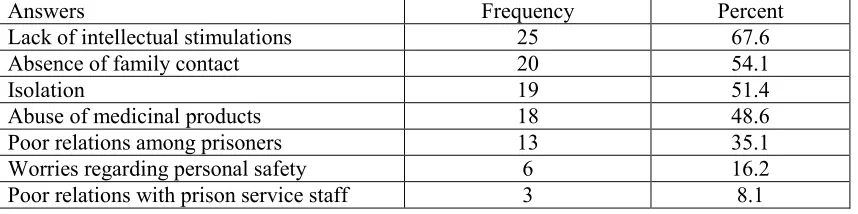
Afterwards the guards were asked about the problems prisoners are confronted with in connection to the penitentiary system. This was a multiple-choice question and the answers are shown in table 7. In order of precedence the prisoners' major problem is traced in lack of intellectual stimulations, as opposed to the bleak and institutionalized prison setting (67.6%). Absence of family contact (54.1%) is rated second in importance. Isolation is rated third (51.4%) while abuse of medicinal products comes forth (48.6%). Poor prisoners’ relations constitute a serious difficulty rated fifth (35.1%). According to the sample's reports, concerns about personal security (16.2%) and poor relations with prison officers (8.1%) are the least important problems. What most concerns them is to develop interpersonal relationships and maintain their mental clarity. Security issues and prisoners' interrelationships do not seem to be of great importance.
Table 7. Answers to the multiple choice questions about prisoners’ problems arising
from the penitentiary system.
Answers Frequency Percent
Lack of intellectual stimulations 25 67.6 Absence of family contact 20 54.1
Isolation 19 51.4
Abuse of medicinal products 18 48.6 Poor relations among prisoners 13 35.1 Worries regarding personal safety 6 16.2 Poor relations with prison service staff 3 8.1
Conclusion
In search of causal attributions for the inefficient application of correctional practice, i.e. failure in the reduction of recidivism rates within a “cause-effect framework”, in a programming and teleological direction, penitentiary reform has attempted in all legislative implementations to re-enact the penitentiary technique or method (see ‘punitive’, ‘welfare’ and “justice” models for the treatment of prisoners). The aim has been to avert the inherent failure of the specific penal institution and counterpoint the state's facade of efficiency against long-lasting criticism that “imprisonment will not lead to crime reduction” but, on the contrary, will “impel recidivism”, “produces criminals” and “institutionalize people”5.
5
Given the universal recognition of the justice penitentiary model, programmes of remedial treatment for prisoners have been implemented, in order to serve fair purposes and act as supportive measures for the prisoners' social rehabilitation. This is certainly undermined by the substance of legal provisions, which recall former utilitarian declarations about the need for manipulation of the prisoners. Nevertheless, the political and administrative system has never followed a long-term planning, either by funding the necessary material and technical infrastructure of the penitentiary system, or by offering systematic support for the prisoners, through educational and vocational training programmes.
The findings of the research indicate the managerial quality of the reforms attempted in Greece during the last two decades, including Acts sanctioned after implementation of the New Penitentiary Code (L. 2776/1999). A typical example is that the majority of prison officers admit that the major problem of the penitentiary system is the insufficiency of organizational infrastructure (insufficient officers posts, lack of equipment and building infrastructure.), overcrowding, weaknesses in administrative organization and inefficient care system. The issue of educating and training personnel in modern methods and techniques should also be mentioned. It is of equal importance that the majority of the prison guards ignore whether an emergency handling guide is available.
These data represent some of CPT6's findings during their fourth regular visit in Greek penitentiary institutions (27/08-9/09/2005) (Corydallos, Chios, Komitini): overcrowding of penitentiary institutions, need for improvement of medical care services for the prisoners and “miserable conditions” of the prisons (Lambropoulou 2007). The Greek penitentiary system stands under supervision after a complaint to the European Parliament by the Citizens’ Association for Human Rights, as regards the non-implementation of the Council of Europe’s relevant provisions (not ensuring compatibility of Greek with European Criminal Law and incorrect implementation of Framework Decision 2004/757/JHA in Greek law, L. 3727/2008). This comes as the capping stone on criticism of legislative drafting technique (Citizens League for Human Rights 2004). New penitentiary institutions may act as a measure of official social control to remedy prison overcrowding, but sooner or later these new accommodations will be also overcrowded, with the prisoners' increase perceived to be an increase in criminal acts (Hulsman and Bernat 1997).
Lack of political action and intervention, as exemplified by prison officers' answers, raises fundamental theoretical questions about the lawfulness of the penitentiary system, as well as practical ones, about the role of the bodies responsible for penitentiary policy –such as the Central Scientific Prison Council (K.E.S.F) or, more accurately, about the relative “autonomy” of these institutions regarding the main guidelines of governmental policy (Ministry of Justice). Nevertheless, the potential reversal of the situation would not necessarily entail efficacy of penal institutions.
In order of precedence, answers show that the prisoners' most important problems are lack of intellectual stimulations as opposed to the bleak and institutionalized prison setting, absence of family contact and isolation. Research findings indicate that psychotic illnesses affect 14% of female and 7% of male prison population. (Nurse et al. 2003). The provided for recreational activities do not exist in practice. Moreover, instead of offering prisoners an opportunity for self-representation, recreational activities come to be another “means” of legislative meddling, as their organization and implementation are left to the discretion of the Prison Council. Prisoners are thus deprived of the potential for “constructive” use of leisure time and development of their critical skills. At research level several published studies assert that recreation in correctional settings serves as an important preventative measure against delinquent or criminal acts or conversely, that non-work activities have a crime-generating impact on detainees (Stumbo and Little 1991). Nevertheless, according to studies which apart from an aetiological approach attempt a comparative criticism on practices of recreation and
Retrieved September 25, 2009 from
http://inconue.wordpress.com/tag/%CE%B1%CE%B3%CE%B3%CE%B B%CE%AF%CE%B1/
6
criminality, by introducing the issue of power and domination in the scientific formation of social relations, the repressive use of leisure time and the way it is managed by prison authorities in order to maintain discipline, surveillance and control of the prisoners' behaviour is identified as essential. (Georgoulas 2007). The fact rebuts any pronouncements on prisoners' self-determination and asserts the utilitarian grounds of former pronouncements.
It is not by accident that the anti-crime penitentiary policy prevailing in the scientific and legislative domain is self-centred and no preventive political intervention is applied, to lessen the reproduction of a specific population group by society. This is the group repugnant to both mass-media and social representation, consisting of “criminals” (i.e. “enemies of consent”), who in majority are not Orthodox Christians (for the Greek Orthodox-Christian religious context), are unemployed or belong to lower income classes.
Under such a consideration, any measures refuting the declared social-preventive character of criminal detention and enhancing the stigmatization of “ex-prisoners” should be abandoned. It should be noted that although prisoners who have attended educational or vocational training programmes are awarded relative certifications -albeit understandably not mentioned- regardless of their skills or qualifications, presentation of criminal record stereotypically excludes them from any employment relationship with the public sector, managed exclusively by the state (Chaidou 2002: 82).
State policies for management of the correctional issue should take into account both empirical data and scientific findings. It is absolutely imperative that scientists -especially criminologists- co-operate with the authorized state authorities, so that management of the complicated prison setting should keep up with the implemented policies. Their intervention should comply with the principles of heterogeneity, otherness and respect for individuality. Individuals should be supported by preventive action within their family settings both before deviant behaviour and after their discharge.
References
Alexiades, Stergios and Panousis, Giannis. 2002. Peitentiary Codes. Athens: Sakkoulas (in Gteek).
Alexiades, Stergios. 2007. “Criminology from yesterday to tomorrow” Pp. 19-34, in Criminology in Greece Today, edited by Ε. Georgoulas. Athens: ΚPSΜ (in Gteek). Arfaras, Αlexandros. 2007. “The role of correctional officers in social rehabilitation of
prisoners” P. 423, in Criminology in Greece Today, edited by Ε. Georgoulas. Athens: ΚPSΜ (in Gteek).
Chaidou, Αnthozoi. 2002. Penitentiary System. Theory and practice. Athens: Legal Library (in Gteek).
Citizens League for Human Rights. 2004. The judicial and penal system to supervision by the
European Parliament. Retrieved September 15, 2009 from
http://ctzleague.blogspot.com/2009/04/blog-post.html (in Gteek).
Crawley, Elaine. 2004. Doing Prison Work: The Public and Private Lives of Prison Officers. England, Devon, UK: Willan Publishing.
Foucault, Michel. 1989. Discipline and Punish: The Birth of the Prisonς (transl: K. Hatzidimos and Ι. Rallis). Athens: Rappas (in Gteek).
Georgoulas, Stratos. 2007. “Sketching out a critical criminology study on recreation”, in Criminology in Greece Today, edited by Ε. Georgoulas. Athens: ΚPSΜ (in Gteek). Georgoulas, Stratos. 2003. Juvenile delinquency. Athens: Ekkremes (in Gteek).
Hionis, Dionisis (xx). Overcrowding of Penitentiary Establishments. Is anybody out there? Retrieved August 19, 2009, from http://www.theartofcrime.gr/? pgtp=1&aid=1207150956 (in Gteek)
Hulsman, Louk and Bernat, Jacqueline. 1997. Peines perdues Le système pénal en question
Lambropoulou, Εfi. 1994. Social Control of Crime. Athens, Papazisis (in Gteek).
Lambropoulou, Εfi. 1999. Sociology of Criminal Law and Criminal Justice Institutions.
Athens: Ellinika Grammata (in Gteek).
Lambropoulou, Εfi. 2007. “Prison policy in the work of Professor Alexiades” Pp 56-61, in Criminology in Greece Today, edited by Ε. Georgoulas. Athens: ΚPSΜ (in Gteek). Le Ny, Jau. 1985. Comment (se) représenter les représentations», Psychologie Française,
30, 3/4: 231 – 237.
Nurse, Jo, Woodcock, Paul and Ormsby, Jim. 2003. Influence of environmental factors on mental health within prisons: focus group study. BMJ, 327: 480.
Official Gazette A΄122/16-5-1989, L. 1851, Code on Basic Principles for the Treatment of Prisoners (in Gteek).
Official Gazette A΄257/ 23-12-2008, L. 3727, Child protection (in Gteek). Official Gazette A΄291/24-12-1999. L. 2776, Penitentiary Code (in Gteek).
Panusis, Giannis. 2004. Prisoners as human beings and the Rights of Imprisoned human beings. Cooperation with the ministry of justice of the republic of Azerbaijan in the field of penal justice. Centre for European Constitutional Law-Themistocles and Dimitris Tsatsos Foundation. Retrieved September 15, 2009 from http://www.cecl2.gr/prj/Azerbaijan/ documentation/Book%20Manual.htm (in Gteek). Souliotis, Giannis and Karanatsis, Εlena. (2006). Annual turnover of €75 million from drugs
in prisons. Kathimerini (17/12/06). Retrieved July 15, 2009 from
http://news.kathimerini.gr/4Dcgi/4Dcgi/_w_articles_civ_13_17/12/06_209312 (in Gteek)
Spinellis, Κalliopi and Kourakis, Νestor. 2001. Penitentiary Law. Athens: Legal Library (in Gteek)
Stergiou, Anna. 2008. Correctional officers vs Correction. Eleftherotypia (09/06/08).
Retrieved July 10, 2009 from
http://archive.enet.gr/online/online_text/c=112.dt=09.06.2008,id=734024 (in Gteek) Stumbo, Norma and Little, Sandra. 1991. “Implications for leisure services with incarcerated