Research Journal
Volume 12, No. 3, September 2018, pages 126-133
DOI: 10.12913/22998624/92094 Research Article
PROPOSAL OF CONTENT MAINTENANCE OF CNC MACHINE
USING METHODS OF RELIABILITY CENTERED MAINTENANCE
Vladimír Stuchlý1, Roman Poprocký1, Nadežda Čuboňová1, Ivan Kuric1
1 University of Žilina, Faculty of Mechanical Engineering, Univerzitna 1, 010 26, Žilina, Slovakia
e-mail: [email protected], [email protected], [email protected], [email protected]
ABSTRACT
The paper presents the results of examination of the proposal content and the scope of maintenance of the machining center MCFV 1050 Basic through the RCM II - Reli-ability Centered Maintenance method. Based on the analysis of apriori and parametric reliability methods, it was decided to use the FMEA for analyze the causes and con-sequences of failure states using the software IQ-RM PRO 6. The structure, defined functions and fault functions were developed.The analyzed types of failure and types of maintenance tasks were processed in the RCM II Information and Decision Making Reports.The result is 10 proposed maintenance tasks performed in time intervals, 8 maintenance tasks performed as needed and 1 maintenance task performed after the specified performance.The end of the article discusses the suitability of the applied methods for the maintenance proposal and of the defined recommendations.
Keywords: maintenance, reliability, reliability centerd maintenance.
INTRODUCTION
In traditional maintenance approach the re-quirements on maintenance of each component were determined in accordance with its actual or assumed technical characteristics, without con-sidering its failure consequences. The resulting schedules were used to all similar objects without
considering different consequences coming from different operational contexts.
For utilization of reliability parameters in ma-chines and equipment maintenance it is necessary to answer also the questions such as:
• How can the reliability parameters be found out?
• Is there a reason for their determination?
• Is there a reason to investigate components or the whole systems?
• Which reliability parameters have the main importance for maintenance? And do they have any importance?
• How, when, where and in what extent should these reliability parameters be determined?
• How can the calculation of reliability param-eters help creating maintenance systems? Reliability of already operated machines and equipment (because these are in the focus of maintenance) was built in during the design and manufacture phase. Maintenance itself can not improve the built in (inherent) reliability. Then for overall quality of machines and equipment it should be distinguished [1].
From long-term experience in engineering it is evident that the machines reliability can be improved by:
• Selection of better (but more expensive) components,
• Increase of reliability of functionally linked components,
• Reducing the number of components that are functional in series (serial systems),
• By redundancy (component or total) of less reliable components,
• Running-in, avoiding the initial failures,
• By protection against damaging effects
(trained operators, suitable operational con-ditions etc.)
Reliability theory studies rules of failure in objects (in general of machines an equipment) and methods of their prediction, it searches pos-sibilities of increasing reliability of objects in all stages of their design and utilization. It deals with quantitative reliability parameters,
eco-nomic and effectiveness characteristics. Legát
et. al. [14]present a method for determining the optimal interval for preventive periodical maintenance and an optimal diagnostic param-eter for predictive maintenance/replacement [3, 20]. Additionally, the authors raise the question:
how does preventive maintenance influence the
probability of failure and the operational reli-ability of system elements that have undergone preventive periodical maintenance? They an-swer the question using analytical and simula-tion computing approaches. The results are in quantitative form, giving relationships between preventive maintenance intervals and reliability functions. Examples demonstrate suitability of the method for typical engineering objects using a three parameters Weibull distribution.
Appli-cation of the method is of substantial benefit to
both the manufacturer and the user of technical equipment.This methodology is also presented in [2, 7, 12, 17, 21].
Why it is not always correct and effective use methods posterior confidence? A surprising number of people believe that effective mainte -nance policy can be formulated only on the basis of historical information about failure. It leads also to put great emphasis on fault patterns de-scribed for examle in literature [4, 13, 16]. In terms of maintenance failure patterns are fraught
practical difficulties, riddles and contradictions.
Some are recapitulated in the following points: complexity - the majority of industrial enterpris-es consist of hundreds, if not thousands of dif-ferent objects. These are made up of dozens of
different components, which between them ex -hibit every extreme and intermediate of reliabil-ity behavior. This combination of complexreliabil-ity and diversity means that is simply not possible to develop a complete description of the reliabil-ity characteristics of an entire undertaking - or even any major asset in the enterprise. Reporting failure – the problem of analyzing failure data
is further complicated by differences in report -ing policy from one organization to another. One
area of confusion is the difference between the
potential and functional failures [5, 16]. Sample size and evolution - large industrial processes usually posses only one or two assets of any type. They also tend to be brought into opera-tion in series rather than simultaneously. This means that sample sizes tend to be too small for statistical procedures to carry much convic-tion. Final opposites - output, which introduced confusion into the whole problem of technical history is the fact that if you gather information about fault, fails to be so even preventing them. The solution is to use methods apriori reliability, extended the RCM II [9, 10, 15].
Reliability-centered maintenance (RCM) evolved in the airline industry during thr 1960s and 1970s from the original work of the methods origi-nators - F. Stanley Nowlan and Howard F Heap [16], but also [15]. Nowlan and Heap stated that the logic of RCM is based on three questions, viz.: 1. How does a failure occur?
2. What are its consequences for safety or oper-ability?
3. What good can preventive maintenance do? And they further emphasized that, in RCM:“The driving element in ail maintenance decisions is not the failure of a given item, but the consequence of that failure for the equipment as a whole”.
The RCM procedure
Fig. 1 outlines firstly, in Steps 1-4, the basic
structure of RCM analysis, viz.:
1. system definition and acquisition of operation -al and reliability information;
2. identification of maintenance significant items (MSIs) i.e. items whosefailure would signifi -cantly threaten safety or increase cost (be-cause of loss of productionand/or high direct repair cost);
3. for each MSI, determination of the significant
failure modes, their likely causes, and whether they can be detected (and if they can be, the ways in which this might be done);
4. for each significant failure mode, selection of
the maintenance task, or tasks most appropri-ate for reducing its likelihood of occurrence or mitigating its consequences.
The analysis has to be followed by:
5. the formation of the task list into a workable plant-wide schedule;
It can be seen that Steps 1-4 is a similar
proce-dure to FMEA. The main difference is that failure modes and effects analysis (FMEA) is used in -
Step 3 to analyze the item into its failure modes. Much of the analysis is a rational ordering of techniques that have long been well established and routine in reliability engineering. For exam-ple: Step 1 is basically system partitioning
(sepa-ration into identifiable units) and reliability block
diagram analysis.
Although Step 2, identification of the MSIs,
might well beaccomplished just by reviewing his-tory records, operator’s logs and cost data to pick out the unreliable or maintenance-costly items (an activity facilitated by Pareto analysis’, which is lit-tle more than sorting out the worst performers into a ranked list. e.g. of the “top ten”). Fault tree analy-sis might be needed, if the plant is a complex one.
It is important that any RCM procedure used
should clearly define MSIs in terms of their size
and complexity. If the MSIs are too large, the myriad of failure modes become unmanageable.
Step 3 is nothing more than a failure mode,
effect and criticality analysis (FMECA), a
step-by-step procedure for the systematic evaluation
of the failure effects and the criticality of poten -tial failure modes in equipment and plant.
In Step 4 the logical task-selection decision tree is added. It has been specially developed for
RCM and is regarded by some as the kernel of the whole approach. In this, the question repeatedly
posed, in order to filter out various maintenance
options, is as follows:
Is the task under consideration both appli-cable (Could it be done? Would it work?) and worthwhile (Would its cost, direct and indirect, be lowerthan that of just allowing the failure to occur?)?
The decision tree begins, however, with a consequence analysis, which is based on the par-ticular form recommended by Nowlan and Heap.
By its means, significant failure modes are cat -egorized according to their consequences, which, as regards their processing in the subsequent task analysis part of the tree are prioritized, as below: 1. Hidden (or unrepealed). Increase risk from
other failures (applies mostly to non-fail-safe protective equipment).
2. Safety-related or environmental. Threaten life, health or environment.
3. Operational: Threaten output, or quality of service.
4. Non-operational: Incur only direct cost of repair. Having been categorized by consequence in the upper pan of the task selection tree, each failure mode is then subject, in the lower pan, to
a decision logic [11, 14]. This leads to identifi -cation of an appropriate maintenance task or, if none can be found, to the suggestion that redesign be considered.
Note that the effect of the decision tree is to rank the task options in a definite order of prefer
-ence. The analyst is directed to look firstly for a
condition-based task, only secondly for a resto-ration (repair) task, and so forth. Implicit in the method is therefore the assumption that, where both options are viable, the condition-based one will be the more appropriate (and likewise the re-pair option as compared with replacement,etc.). Now, while this may well be true in most practi-cal cases it is by no means obvious that it will be one of them. In some forms of the decision tree that have been developed the analyst (before
making his final selection) is, in fact, directed to finish with a comparison of all the types of task that have been identified as viable.
RELIABILITY CENTERED MAINTENANCE
Vertical machining center MCFV 1050 Ba-sic (Fig. 2) is a highly productive machine for complex machining of molds, dies and
compo-nents of flat-shaped or box-shaped of steel, cast
iron and light metal alloys clamped on the work table machine [5, 8].
It allows to carry out milling operations on three orthogonal coordinate axes X, Y, Z and the drilling, reaming and threading operations.
In case of CNC machine tool,the maintenance is focused on building components and modules of the machine tool (construction, actuators, ma-chine control and sensors) for which required emergency of the maintained machine can be en-suredby the following steps and methods, by pre-ventive inspections. These inspections are aimed
at atcheckingof individual functional knots of the machine, such as guidance and linear axes of mo-tion, of hydraulic system, of lubrication system and the like [18].
Practical example
Because of inaccessibility of the data from op-eration CNC machine (but in general all machines) it is not possible to use fully the methods of a pos-teriori reliability for creation of content and extent of maintenance [6]. So for the determination of Fig. 2.Vertical machining center MCFV 1050 Basic and Control system HEIDENHAIN [6]
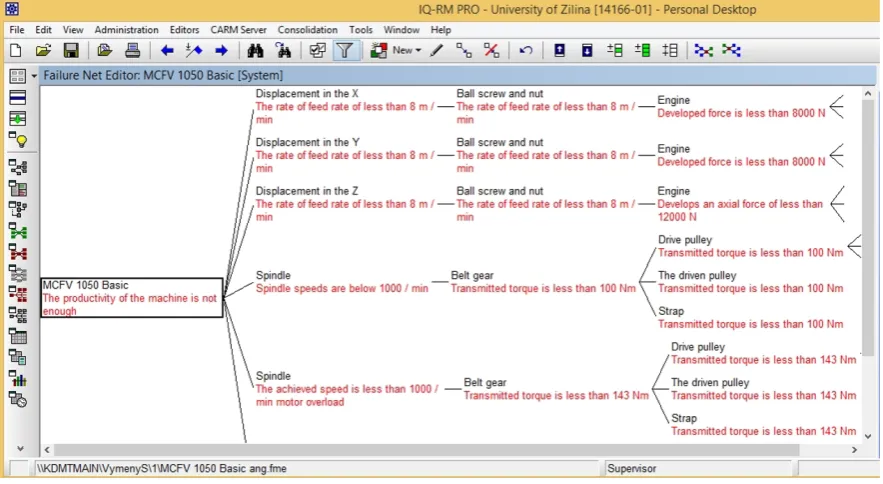
Fig. 4. Functional network for assessing the productivity of the machine
content and extent of CNC MCFV 1050 Basic we used the method RCM II [7, 8, 13, 15, 19].
We have worked-out FMEA of CNC MCFV 1050 Basic in the software APIS PRO 6.0 with the criticality analysis, including functional and failure nets. (The software is being used at the De-partment of transport and handling machines), in
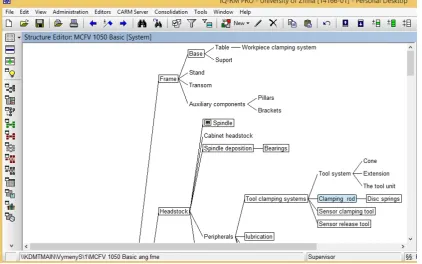
five steps: create system elements, system struc
-ture (Fig. 3), functions and function struc-tures (Fig. 4), failure analysis (Fig. 5), risk evaluation.
The RCM were created information sheets RCM II for belt driven transmission, auto-matic tray tools, pneumatic motor tool magazine CNC control system. Reports ob-exceed functions, functional failures, fault causes and consequences of failure.
In total 26 failure modes of CNC MCFV 1050 Basicwere analysed (faults - formally failure causes and consequences) using the RCM II decision sheets. From the analyses it is concluded that during the func-tional loss caused by failure under operafunc-tional condi-tions have operational consequences(evaluation in column Fig. 6). All faults are evident.
Further on, within the RCM decision sheets the preventive tasks were analysed in column H1/S1/01/N1 used for an analysis whether
ap-propriate task for technical condition identifica -tion can be used, which enables early predic-tion of failure occurrence and by that avoiding its consequences. We found 17 tasks technically feasible (suitable) for prediction (65,4%) and 9which are not technically feasible (34,6%) out of 142 failures considered in this analysis.
Preventive tasks in column H2/S2/02/N2 is technically feasible (suitable) for 1 task, and preventive tasks in column H3/S3/03/N3,is not technically feasible. In complementary ques-tions in column H4 in RCM II decision sheet, is technically feasible task that is reasonable to carry it out in 9 task (Fig. 7).
Based on FMEA analysis of MCFV 1050 Ba-sic and evaluation of RCM sheets for individual
components of the MCFV 1050 Basic, the techni-cal evaluation points in some case at insubstanti-ality of maintenance tasks during predetermined maintenance carried out according to current regulations given by the výrobca stroja MCFV 1050 Basic. According to the FMEA and RCM II evaluation, safe operation ofMCFV 1050 Ba-sic provides space for extending the time between executions or maintenance tasks. This fact may
significantly enable better utilisation of compo -nents of MCFV 1050 Basic to their limit values and from the economic point of view can reduce costs for maintenance CNC machine.
The result is thefolowing proposal: 6 main-tenance tasks are performed daily, 2 mainmain-tenance tasks are performed weekly, 2 maintenance tasks are carried out at intervals of six months and 8 maintenance tasks are performed as required.The exchange of spindle bearing is estimated after per-formance from 8,000 to 12,000 operating hours.
Reliability, in the general concept is seen as
stability of performance over a specified time
and under given conditions of use. Dependabil-ity in the narrower concept (Fig.8) is an emer-gency as determined by three factors: reliability, maintainability and maintenance support. With Fig. 6. Distribution of failure modes of CNC machine tool MCFV 1050
the addition of security are referred to as RAMS [1, 13, 22, 23].
Great attention is dedicated to reliability and availability, maintenance, evaluation, maintain-ability, less maintenance and maintenance sup-port. The big downside is the assessment of these country-ness posteriori. Built negative values in the product cannot be improved maintenance.
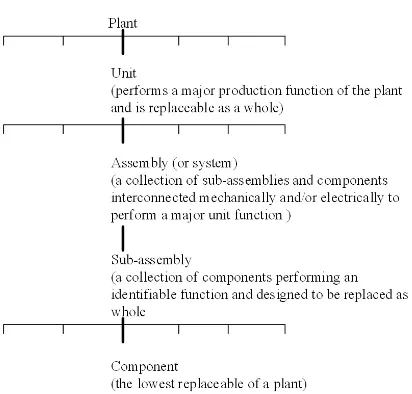
Another problem that must be solved in de-signing of the content and extent of maintenance is the solution of comprehensiveness in the re-lationship between individual devices and with whole manufacturing enterprise in a hierarchical structure as is shown in Fig. 9. A structured model of an industrial plant can be invisaged as a hierar-chy of parts, ranked according to their functional dependencies into units, assemblies, sub-assem-blies and components.
It is equally necessary in designing of mainte-nance to give more attention to the consequences
of failures (even in a hierarchical structure), than to try always ensure reliability, i.e. try to prevent failures as such.
CONCLUSIONS
Basing on the performed investigation, the following conclusions can be formulated:
• Design of optimal machine and equipment maitenance systems is not possible only on the basis of the theoretical data from the ma-chine operation and its reliability process-ing (by the methods of apriori reliability), a combination of apriori reliability (especially FMEA) extended to the Reliability Centered Maintenance (RCM) method, is appropriate.
• The RCM method is documented on the MCFV 1050 Basic CNC machine example. The FMEA analysis was performed using the IQ-RM PRO 6 software. In the RCM process
26 of failure modes were defined (after the machine structure, defining functions and er -ror functions -Fig. 3, Fig. 4, Fig. 5), which were divided into failure modes (Fig. 6), and 26 maintenance tasks were found (Fig. 7).
• The result is the folowing proposal: 6 main-tenance tasks are performed daily, 2 mainte-nance tasks are performed weekly, 2 main-tenance tasks are carried out at intervals of six months and 8 maintenance tasks are per-formed as required. The exchange of spindle bearing is estimated after performance from 8,000 to 12,000 operating hours.
• It turns out that it is equally necessary in de-signing of maintenance to give more atten-tion to the consequences of failures (even in Fig. 8. Dependabilityin the narrow and broadest definition
a hierarchical structure), than to try always ensure reliability, i.e. try to prevent failures as such (Fig 9).
Acknowledgements
This article was made under the support of
KEGA projects - 024ŽU-4/2016 Improving of
education level and its international for students from technical study programmes based on WEB
Based Trainingand 022ŽU-4/2017 - Implemen -tation of on-line education in the area of precise technologies with an impact on educational
pro-cess to increase skills and flexibility of students of engineering fields of study.
REFERENCES
1. Barlow R. E., Proschan, F. Mathematical Theory of Reliability. John Wiley & Sons, New York 1965. 2. Burduk A, Chlebus, E. Evalua-tion of the risk in pro-duction systems with a parallel reliability struc-ture. Eksploatacja i Niezawodność - Maintenance and Reliability, 2(42), 2009, 84-95.
3. Čuboňová, N. Genetic algorithms implemented for optimization of technological processes. In: Chosen applications of computer modelling in mechanical engineering. Pearson Education Limited, 2015. 4. Čuboňová, N., Kuric, I. Software Program for
Training of Control System Sinumerik 840D.In: Academic Journal of Manufacturing Engineering, 9(3), 2011, 80-83.
5. Dodok, T., Čuboňová, N., Kuric, I. Workshop Pro -gramming as a Part of Technological Preparation of Production. Advances in Science and Technol-ogy Research Journal. 11(1), 2017, 111-116. 6. Galar, D, Gustafson A, Tormos B, Berges L. Main
-tenance Decision Making based on different types of data fusion. Eksploatacja i Niezawodnosc - Maintenance and Reliability, 14(2), 2012, 135-144. 7. Gao, W., Zhang, Z., Ji, H., Zhou, J., Liu, Q. Optimal quasi-periodic preventive maintenance policies for a repairable system with stochastic maintenance interval. Eksploatacja i Niezawodnosc - Mainte-nance and Reliability, 17(3), 2015; 389-397. 8. Gajdošík, M, Stuchlý, V. Regulation for the
main-tenance of the CNC machine tool using a priori and ateriori reliability methods.EDIS University of Žilina, 2016.
9. Golmakani, H. R., Fattahipour, F. Age-based in-spection scheme for condition-based maintenance. Journal of Quality in Maintenance Engineering,
17(1),2011, 93-110.
10. Jasiulewicz-Kaczmarek, M. Sustainability: Ori-entation in Maintenance Management-Theo-retical Background. In: P. Golinska. et al. Eco-Production and Logistics. Emerging Trends and Business Practices. Springer, Verlag Berlin Hei-delber, 2013, 117-134.
11. Jasiulewicz-Kaczmarek, M. Sustainable Mainte-nance - the next generation of mainteMainte-nance manage-ment. Proc. of International Conference on Innovative Technologies IN-TECH, Budapest, 2013, 193-196. 12. Jurča, V., Hladík, T., Aleš, Z. Optimization of pre
-ventive maintenance intervals. Eksploatac-ja i Niezawodnosc - Maintenance and Reliability 3, 2008, 41-44.
13. Kelly, A. Strategic Maintenance Planning, Elsevier Ltd., 2006.
14. Legát, V., Mošna, F., Aleš, Z., Jurča, V. Preventive maintenance models - higher operational reliabili-ty. Eksploatacja i niezawodnosc - Maintenance and reliability, 19 (1), 2017, 134 -141.
15. Moubray, J.: Reliability Centred Maintenance II. Industrial Press, New York NY, 2002.
16. Nowlan, F. S., Heap, H. Reliability Centred Main-tenance, National Technical Information Service, Springfield, 1978.
17. Ostachowicz, W., Mcgugan, M., Schröder-Hin-richs, J., Luczak, M. New materials and reliability in offshore wind turbine technology.
18. Rudawska, A., Reszka, M., Warda, T., Miturska, I., Szabelski, J., Stančeková, D., Skoczylas, A. Mill -ing as a method of surface treatment in adhesive bonding. Journal of Adhesion Science and Tech-nology, 30(23), 2016, s. 2619-2636.
19. Rudawska, A., Čuboňová, N., Pomaranska, K., Stančeková, D., Gola, A. Technical and Organi -zational Improvements of Packaging Production Process. Advances in Science and Technology-Research Journal, 10(30), 2016, 182-192.
20. Sága, M., Vaško, M., Čuboňová, N., Piekarska, W. Optimisation Algorithms in Mechanical Engineer-ing Applications. Pearson, 2016.
21. Stuchlý, V., Poprocký, R., Kaczmarek, M. Reli-ability evaluation as a means of increasing the ef-ficiency of equipment maintenance. Advances in Science and Technology Research Journal, 10(32) 2016, 40-46.
22. Stuchlý, V., Grenčik, J. Calculation of preventive maintenance tasks using RCM method.Euromain-tenance XX International Mainmethod.Euromain-tenance Confer-ence, Fiera di Verona, Italy, 2010, 207- 209. 23. Stuchlý, V., Poprocký, R. Maintenance of machines
![Fig. 1. Basic structure of RCM [13]](https://thumb-us.123doks.com/thumbv2/123dok_us/8806108.1774642/3.595.79.286.71.342/fig-basic-structure-of-rcm.webp)