169
LSB Based Watermarking of Digital Images against Various Attack
Abhishek Ray1, Prof. K. K. Tiwari2
Satyam Education & Social Welfare Society Group of Institute Bhopal, India 1
[email protected], [email protected]
Abstract: - With the increase in the digital media transfer and modification of image is very easy. This
independency generate proprietorship problem of the
user. So this paper focuses on this problem of
increasing the robustness of the image against various
attacks. In this work embedding of data is done in edge
as well as non-edge region of the image. Here
embedding data get invisible in the original image. By
embedding in LSB portion of the pixel proposed work
is robust against various attacks. Experiment is done
real dataset images under attack as well as ideal
condition. Results shows that proposed work is better as
compare to previous approaches.
Keywords— Color Format, Digital Watermarking,
Frequency domain, LSB.
I. INTRODUCTION
A digital world is growing drastically people are
moving towards different services provide by it. Some
of this service is social network, online market but this
technology give rise to new problem of piracy or in
other words proprietary get easily stolen. So to
overcome these different techniques are used for
preserving the proprietary of the owner. One of such
digital approach is watermarking which is a subsection
of hiding information that is used to put some
information in the original image which will specify the
originality of the digital data like photographs, digital
music, or digital video [1, 2, 4]. One of the basic causes
of the copyright issue is the ease available of the
internet and some software that can modify the content
as per the user requirement. In [1] privacy of image and
watermark is concern by inclusion of third party where
a Compressive sensing matrix is developed. In this
matrix some pixel positions are selected. Now selected
pixels are analyzed for watermark information carrier.
If fit then embedded otherwise reject. Now at
extraction side image is evaluate under a calculation
where it simply accept or reject image base on the
obtain values. Here work has not taken measures for
attacks. Watermark is broadly divide into two
categories first is visible watermarking and other is
invisible watermarking. Here watermark information
seen by naked eyes is considered as visible
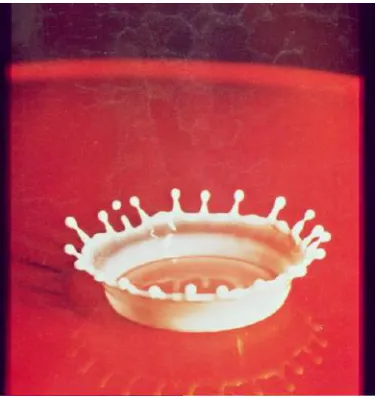
watermarking as shown in fig. 1. While in case of
invisible watermark data is not visible by naked eyes as
shown in fig. 2, although watermark data is present in
the original data. Data may be of any digital
information like text file, image, video file, etc.
Requirement of invisible watermark is popular in
photography, movies, etc. So putting the signature in
the image for validating the data is done. Although
invisible embedding in carrier image is complex and
challenging task but different techniques are working in
this field. Proposed work will increase the hiding
capacity and preserve carrier as well as watermark
170 Fig. 1 Visible watermark in image data.
Fig. 2 Visible watermark in image data.
A successful watermarking system should have the
following characteristics:
1) Imperceptibility: In language of watermarking,
imperceptibility means that later than adding the
watermark information, wrap medium should not
rework much. In different terms, the presence of the
watermark data should not affect the cover medium
being protected. If a watermarking scheme does not
ensure this requirement, it may happen that after
inserting a watermark data in a cover medium (say an
image), image quality may alter which the owner of the
image will never like that a protecting mechanism
modifies his work.
2)Robustness: Robustness of the watermark data means
that the watermark data should not be destroyed if
someone performs the common manipulations as well
as malicious (nasty) attacks. It is additional of a
property as well as a requirement of watermarking and
its applicability depends on the application area.
3) Fragility: Fragility way that the watermark
information (data) is altered or disturbed up to a certain
extent when someone performs the common
manipulations & malicious attacks. Some application
areas like temper detection may require a fragile
watermark to know that some tempering is done with
his job. A little application May require semi-fragility
too. The semi-fragile watermark comprises a fragile
watermark component and a robust watermark
component i.e. semi-fragile watermarks are robust to
some attacks but fragile to others attacks.
4) Resilient to common signal processing: The
watermark should be retrievable even if common signal
processing operations are applied to the watermarked
cover medium data. These operations include
digital-to-analog and digital-to-analog-to-digital conversion (i.e. taking the
printout of an image and then scan it to create another
digital copy of the image), re-sampling, re-quantization
(including dithering and recompression), plus general
(common) indicator enhancements such as picture
171 and treble adjustment, high pass and low pass filtering,
histogram equalization of an image and format
conversion (BMP image to JPEG image, MPEG movie
to WMV movie, mp3 song to mp4 etc.)
5) Resilient to common geometric distortions (image
and video data): Watermarks in image and video data
should also be immune from geometric image
operations such as rotation, translation, cropping and
scaling. This material is not necessary for audio
watermarking.
6) Robust to subterfuge attacks (collusion and forgery):
In adding up, the watermark should be robust to
conspiracy attack. Many individuals, who have a
watermarked duplicate copy of the information (data),
might colluded their watermark duplicates (copies) to
finish the watermark presence plus can produce a copy
of the main copy. Advance, if a digital watermark is to
be used in litigation, it should be not possible for
colluders to join their picture to create a different valid
watermark.
II. RELATED WORK
In [7] watermark information is hide in the edge portion
of the image and for finding the exact edge pixels in the
image this paper adopt DAM and BCV technique.
Whole work is done for the binary image only as the
DAM is based on the binary image. So here in this
method image has to be in binary form and watermark
information is also in binary format. With this
limitation it is found that that robustness of the
algorithm is quite good against different attacks of
noise, filter. In [8] the extension of the paper [7] is done
where hiding is done at the edge region only using same
technique of DAM and BCV but here edge selecting
region is increase by searching surrounding region of
the evaluating pixel. It has shown in the result that with
this new approach robustness increases and the
watermark information can be increase in the original
image. In [10] new concept is develop by the paper
which is term as content reconstruction using
self-embedding, here watermark image is embedded in the
original image using fountain coding algorithm, where
multiple packets are designed for the network. So if
some of the packet gets corrupt by the attack then rest
of the packets are used for regenerating the original
watermark. As this method cover different attacks on
the image and recover watermark in original condition
up to few level of attack. One problem is that after
embedding image get transformed in fountain codes
packet but embedded image is not available for the user
to display and it get reconstruct into original only by
decoding the fountain codes. So this algorithm is
beneficial for data transferring purpose only. In [13]
instead of embedding the external watermark image,
original image is so utilize in the algorithm that it will
generate its own watermark bits for the image. This
paper focus on the image expansion where spatial
domain is use for embedding and supporting
information is store for the image which is required
during extraction. Robustness of the image is done
against compression attack and scaling is also cover.
But to cover both intra-code block and inter-code block
method is utilize. In [14] during embedding the
algorithm uses DWT technique and modulus method
for the pixel position selection. At the extraction end
embedded image with some supporting information is
172 bits. This recovery of original watermark is reversible
watermarking scheme. In [12] spatial common
technique is use for the watermarking, here image is
divide into Red, Green and Blue matrix then whole
embedding is done at the blue matrix of the image
where some of the LSB’s are replace by the watermark bits while rest of the MSB’s remain same. It has
observed that image quality has not affected by the
embedding of watermark. This paper work is robust against compression attack as it most affects the MSB’s while LSB’s remain unaffected during attack.
III. PROPOSED METHODOLOGY
This paper focuses on the digital image invisible
watermarking techniques. Then two steps are explained
first is embedding and other is extraction in case of
embedding digital watermark is hide in the original data
such that visibility of the watermark by naked eyes is
not possible. In case of extraction watermark should be
successfully retrieve from the received data without any
information loss of the original data as well as
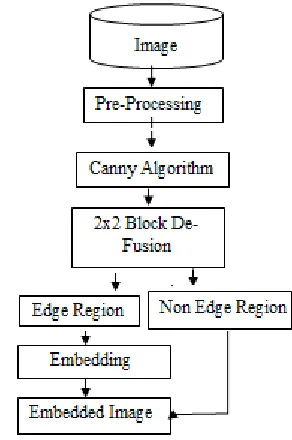
watermark [7, 8]. In Fig. 3 whole embedding work
block diagram is explained.
31. Pre-Processing
Here as the image is the collection of pixels where each
pixel is representing a number that are reflecting a
number over there now for each number depend on the
format it has its range such that for the gray scale
format it is in the range of 0-255. So read an image
means making a matrix of the same dimension of the
image then fill the matrix correspond to the pixel value
of the image at the cell in the matrix.
3.2 Edge Detection
In order to find the edges in the image convert it into
gray format then apply the canny algorithm. This is the
method to convert a gray scale image into binary image.
For this analysis of each pixel is done.
Fig. 3. Block diagram of proposed Embedding Work.
3.3 Embedding
Here as the block contain edge pixel are identified and
then put the message binary value at the edges pixels of
LSB position so that message is Embedding at that
position, in this way all the binary values of the
message are Embed in the different pixels of the pixel.
In order to remember the pixel position where changes
has been done or data is hidden one should get the
modulus function that generate some keys accordingly
where all the position can be extract by de-modulus
function at the receiving end. Let Edge_x_key contain
the X axis position and Edge_y_key contain the y axis
173 in the image and cons content any big constant value.
Then by Row major Order
X = Edge_X
Y = Edge_Y
a = (Y-1)*Image_Total_Rows
RMO = a + X
Hash_Value = K + RMO // K is Key
Proposed Encryption Algorithm
Input: O [Original Image], M [Watermark], K [Key]
OutPut: EI [Encrypted Image], Hash_Key OPre_Processing (O)
EdgesCanny (O) // Edges contain pixel position of
edges
Loop n = 1: M Binary M (n)
EndLoop
Hash_key = Modulus (Edges, K)
Loop n=1: M*2
TempBinary (Edges (count))
Temp (LSB) Binary (n) // LSB = last four bit EI (count) Decimal (Temp)
Count = Count +1
EndLoop
3.4 Extraction
It is same like as done in the embedding step except
here the working start with the embedded image while
result will be extracted watermark. As hash keys are
generate in the encryption part of the work which is
utilize to find the pixel position of the image where
changes has been done or data is hidden. Reverse
process for modulus values:
RMO = mod (hash_key, K)
B = mod (RMO, Image_size)
RMO = RMO - A
A = RMO / Image_size
Y = A+1
X = B
From above steps embedded positions are identified
now LSB 4-bits are extracting from the pixel. This is
act as the watermark information. So all the values
obtain from those pixel positions are consider as the
watermark information. Now
IV. EXPERIMENT AND RESULT
This section presents the experimental evaluation of the
proposed Embedding and Extraction technique for
privacy of image.
Table 1 Dataset representation.
All algorithms and utility measures were implemented
using the MATLAB tool. The tests were performed on
a 2.27 GHz Intel Core i3 machine, equipped with 4 GB
of RAM, and running under Windows 7 Professional.
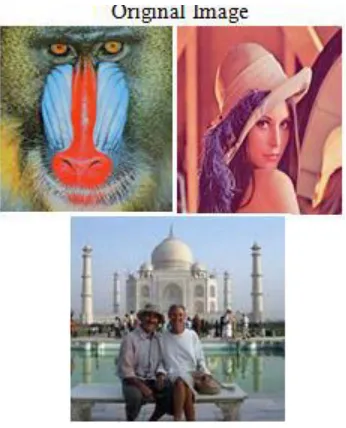
Dataset: Experiment done on the standard images such
174 conditions first is without attack and other is at
compression attack. Evaluation Parameter: Peak Signal
to Noise Ratio
Here nc is number of pixels which are true. Here na is total number of pixels present in watermark.
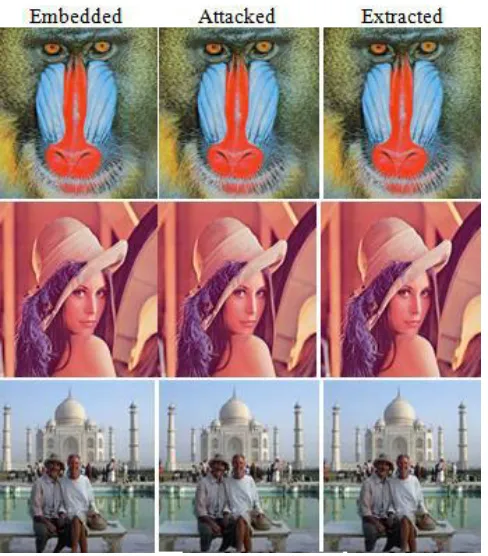
Table 2. Images obtain after Embedding and extraction.
From table 3, 4 and 5 it is seen that proposed method
works better than previous work in [8]. It is obtained
that use of edge for randomization has increase the
robustness of the image against different attacks.
Table 3. Comparison of results between previous work
[2] and proposed work under no attack.
Table 4. Comparison of results between previous work
[2] and proposed work under noise attack.
Table 5. Comparison of results between previous work
175
V. CONCLUSION
In this paper a new approach of privacy is done where
watermark data is hazed. Based on human view, edges
are not identifiable so it makes an invisible
watermarking technique base on hash-canny
combination at LSB part. Results shows that the
proposed work is producing the results which maintain
the image quality as well as robustness against the noise
filter attack of images. In future, work can be improved
for other attacks such as geometry of image.
REFERENCES
[1]. Hanieh Khalilian, Student Member, IEEE, And Ivan V.
Bajic Video “Watermarking With Empirical PCA-Based
Decoding” IEEE Transactions On Image Processing,
Vol. 22, No. 12, December 2013.
[2]. Key Dependent Image Steganography Using Edge
Detection Shahzad Alam, Vipin Kumar, Waseem A
Siddiqui And Musheer Ahmad. 2014 Fourth
International Conference On Advanced Computing &
Communication Technologies.
[3]. Tamanna Tabassum, S.M. Mohidul Islam “A Digital
Image Watermarking Technique Based On Identical
Frame Extraction In 3-Level Dwt” Vol. 13, No. 7, Pp.
560 –576, July 2003.
[4]. Frank Hartung, Jonathan K. Su, And Bernd Girod
“Spread Spectrum Watermarking: Malicious Attacks
And Counterattacks”. Of Multimedia Contents”
International Journal Of Research In Engineering And
Technology ISSN: 2319-1163.
[5]. “Chapter 2. Wavelet Transforms On Images” Sundoc.
Bibliothek. Uni-Halle. De / Diss-Online /02 /03h033
/T4.Pdf
[6]. Priya Porwal1, Tanvi Ghag, Nikita Poddar, Ankita
Tawde Digital Video Watermarking Using Modified
LSB and DCT Technique. International Journal Of
Research In Engineering And Technology ISSN:
2319-1163.
[7]. Kazuki Yamato, Madoka Hasegawa, Yuichi Tanaka‡
And Shigeo Kato. “Digital Image Watermarking Method
Using Between-Class Variance”. 978
-1-4673-2533-2/12/$26.00 ©2012 IEEE.
[8]. Angela Piper1, Reihaneh Safavi-Naini. “Scalable Fragile
Watermarking For Image Authentication”. Published In
Iet Information Security, On 31st December 2012.
[9]. Mr Mohan A Chimanna, S. R. Kho “Digital Video
Watermarking Techniques For Secure Multimedia
Creation And Delivery” Vol. 3, Issue 2, March -April
2013, Pp.839-844839.
[10]. Paweł Korus, Student Member, IEEE, And Andrzej
Dziech. “Efficient Method For Content Reconstruction
With Self-Embedding”. IEEE Transactions On Image
Processing, Vol. 22, No. 3 March 2013.
[11]. Ioan-Catalin Dragoi, And Dinu Coltuc,
Local-Prediction-Based Difference Expansion Reversible
Watermarking, IEEE Transactions On Image Processing,
Vol. 23, No. 4, April 2014.
[12]. L. M. Vargas And E. Vera, “An Implementation Of
Reversible Watermarking For Still Images” IEEE Latin
America Transactions, Vol. 11, No. 1, Feb. 2013.
[13]. Angela Piper1, Reihaneh Safavi-Naini. “Scalable Fragile
Watermarking For Image Authentication”. Iet Inf.
Secur., 2013, Vol. 7, Iss. 4, Pp. 300–311.
[14]. Ioan-Catalin Dragoi, Member, IEEE, And Dinu Coltuc.
“Local-Prediction-Based Difference Expansion
Reversible Watermarking”. IEEE Transactions On