Mobile Application Ecosystems from the Application
Developers' Perspectives: the Cases of App Store and
Android Market
International Business Master's thesis
Maryam Roshan Kokabha 2012
Department of Management and International Business Aalto University
AALTO UNIVERSITY SCHOOL OF ECONOMICS ABSTRACT
INTERNATIONAL BUSINESS MAY 11, 2012 Master’s Thesis
Maryam Roshan Kokabha
MOBILE APPLICATION ECOSYSTEMS FROM THE APPLICATION DEVELOPERS’ PERSPECTIVES: THE CASES OF APP STORE AND ANDROID MARKET
Objectives
The study provides an insight into the mobile application ecosystems which are shaped around the novel phenomenon of app stores. It investigates the important factors that application developers perceive in their interactions with these ecosystems. The motivation for the study stems from scarcity of earlier research on the app stores despite their considerable impact on restructuring of the global mobile industry. The aim is to understand the current structure of the ecosystems, and to find out the factors that application developers find important during their activities on these ecosystems.
Methodology
The study undertakes a multiple-case study approach by focusing on the application ecosystems that have shaped around the two largest market players (i.e. App Store by Apple, and Android Market by Google). The empirical data are collected by an original data gathering method on the Internet with is supported by concurrent data analysis. The method allows for collecting immediate, in-depth qualitative data from a large number of developers all across the world.
Findings
Findings are twofold: 1) The study shows that in the current structure of mobile application ecosystems, platform providers, as the keystones, hold most of the traditional roles of the industry into their app stores’ technological settings. As a critique to the current literature on business ecosystems, the study indicates that the platform providers can apply high entry barriers to the ecosystem for developers even at the early stages of evolution if assured of their app stores’ benefits. Additionally, the study contributes to the current literature by introducing a new strategy for integration of application distribution process (semi-integration) which is applied by Google. 2) The study finds that application developers are highly influenced by the network effects on the app stores, and suggests that the cross-side network effect has a stronger effect on developers’ behaviors. The study contributes to the current research on app stores via empirically supported findings on developers’ perspectives. It outlines developers’ requests for: a reasonable entry barrier to the ecosystem that allows the qualified developers in; a comprehensive documentation affording the expectations of beginner to advanced developers; a flawless development platform with facilities for memory management and fast testing of applications; and a fast review process for quality control of the published applications. It also confirms that the potential for the global economy of scale of a platform is highly acknowledged by developers in their attitudes towards the application ecosystem.
Keywords
Business Ecosystem, Mobile Application Ecosystem, Application developer, app store, Application Store, App Store, Android Market, Apple, Google.
TABLE OF CONTENTS
TECHNICAL ABBREVIATIONS AND DEFINITIONS ... 5
1. INTRODUCTION... 1
1.1. The New Structure of Mobile Application Market ... 2
1.2. Research Gap ... 6
1.3. Research Goals and Questions ... 7
1.4. Thesis Outline ... 8
2. THEORETICAL FRAMEWORK ... 9
2.1. Business Ecosystem ... 9
2.1.1. The Core of a Business Ecosystem ... 11
2.1.2. The Participants and Composition of a Business Ecosystem ... 12
2.1.3. The Health of a Business Ecosystem ... 14
2.1.4. The Life and History of an Ecosystem ... 15
2.1.5. Business Ecosystems and Competition ... 15
2.1.6. The Holistic View of the Discussed Analysis Factors ... 16
2.2. Two-Sided Markets ... 17
2.2.1. Dynamics of Two-Sided Markets ... 18
2.2.2. Challenges for a Platform Provider in a Two-Sided Market ... 19
2.2.3. Two-Sided Market and ICT Intensive Service Innovation ... 21
2.3. Mobile Ecosystem ... 21
2.4. A Revision of Moore’s Model... 27
2.5. Conceptual Framework ... 30 3. METHODOLOGY ... 33 3.1. Research Philosophy ... 33 3.2. Research Design ... 35 3.3. Data Collection ... 36 3.4. Data Analysis ... 40 4. CASE STUDIES ... 42 4.1. Apple ... 42
4.2. Apple App Store ... 43
4.3. Google... 52
4.4. Google Android Market ... 52
5.1. Ecosystems in the Case Companies ... 60
5.2. Composition of the Ecosystems ... 64
5.2.1. The Structure of the Ecosystems ... 65
5.2.2. The Roles of Participants ... 68
5.3. Comparing the Attributes of the Ecosystems ... 71
5.3.1. Joining the Ecosystem ... 71
5.3.2. Documentation and Application Development ... 74
5.3.3. Publishing the Applications ... 84
5.3.4. Marketing and Sales ... 87
6. MOBILE APPLICATION ECOSYSTEMS FROM THE LENS OF INTERNATIONAL BUSINESS ... 93
7. CONCLUSION ... 94
7.1. Main Findings and Contributions ... 94
7.1.1. Structure of Mobile Application Ecosystems ... 95
7.1.2. Important Factors Perceived by Developers ... 98
7.2. Managerial Implications ... 100
7.3. Method Reflection ... 102
7.4. Validity and Reliability ... 104
7.5. Research Limitations ... 105
7.6. Suggestions for Future Research ... 105
8. REFERENCES ... 107
LIST OF FIGURES Figure 1. Business Ecosystem Participants (Moore, 1996) ... 12
Figure 2. The Holistic View of the Discussed Analysis Factors ... 17
Figure 3. Mobile Commerce Value Chain (Barnes, 2002) ... 22
Figure 4. Mobile Value Chain (Buellingen & Woerter, 2004) ... 23
Figure 5. The Ecosystem of Mobile Multimedia Development (Karvonen &Warsta, 2004)... 23
Figure 6. Segments in Converging Mobile Ecosystem (Basole, 2009)... 24
Figure 7. Mobile Ecosystem Participants – adapted from Moore (1996, 27) ... 27
Figure 9. Platform Integration Strategies (Holzer & Ondrus, 2010) ... 29
Figure 10. A Simplified Mobile Ecosystem Model – adapted from Moore (1996, 27) ... 31
Figure 11. Conceptual Framework for the Factors Considered by Developers ... 32
Figure 12. A Representative Range of Methodologies and their Related Paradigms (Healy & Perry, 2000) ... 34
Figure 13. The Study Architecture... 36
Figure 15. Apple Mobile Application Ecosystem ... 66
Figure 16. Google Mobile Application Ecosystem ... 68
LIST OF TABLES Table 1. Worldwide Installed Base of Mobile Phones by Operating System ... 4
Table 2. Worldwide Smartphone Sales to End Users by Operating System ... 5
Table 3. Application Stores Provided by Main Mobile OS Developers ... 5
Table 4. Participants of a Mobile Ecosystem and/or Value Chain ... 26
Table 5. The Forums Used in Data Collection ... 39
Table 6. Apple Developer Programs ... 45
TECHNICAL ABBREVIATIONS AND DEFINITIONS API (Application Programming Interface)
A particular set of rules (codes), protocols, and tools for developing an application. API serves as an interface between different software programs, and facilitates their interaction.
Application
A software product that helps users to perform specific tasks - for example a software product for playing music on a device is an application.
Fragmentation
Here it refers to device fragmentation, i.e. diversity of mobile devices due to factors including but not limited to hardware and software specifications. Device fragmentation can cause an application to show different behaviors than intended on different devices. For instance an application which is developed for a big size mobile screen might function inappropriately on a device with small screen.
Freemium
A business model in which a product or service is provided for free, but a premium is charged for advanced feature, functionalities or related products and services.
GPS: Global Positioning System
A satellite-based navigation and location determination system.
IDE (Integrated Development Environment)
An application that provides the programmers with the facilities for software development, and usually consists of a source code editor, compiler/integrator, build automation tools and debugger.
Platform
In a technological system: The underlying hardware or software which defines the standards for developing applications for the system.
In business ecosystem and two-sided markets: a shared collaborative environment. SDK (Software Development Kit)
A set of software development tools that enables the development of an application for a specific platform. It might include APIs, IDE, programming tools, and supporting documentation. Usually the SDK is offered to a developer by the development platform.
Wi-Fi
A mechanism that enables an electronic device to connect to a wireless network and exchange data on it; using Wi-Fi, a mobile phone can connect to wireless internet.
1 1. INTRODUCTION
During the past few years, the world has witnessed a dramatic growth in the field of telecommunication and mobile technology. The number of global-mobile subscriptions had been estimated to reach six billion by the end of 2011 from 2.7 billion in 2006 (International Telecommunication Union, 2011c). It means that only within the last five years, the number of mobile connections has doubled. Furthermore, the sales of mobile sets to end-users reached 1.6 billion units in 2010, a 32 percent increase from 2009 (Gartner, 2011a).Along with the growth in the penetration of mobile phones, the mobile sets have been continuously advancing with regard to their technological capacity. They have changed from simple call-making devices in their early phase of introduction to so-called smartphones, which enjoy a combination of features such as high-resolution touchscreens, web browsers, Wi-Fi, GPS, and the typical features of digital cameras and portable music and video players. Additionally, users can install and run applications on them.
Smartphones have become dramatically popular in recent years. According to a leading IT research company, 297 million units of smartphones were sold in 2010, which represents a 72 percent increase compared to 2009 sales (Gartner, 2011a). Gartner expects over 500 million smartphones to be sold in 2012 (Computerworld, 2009). By 2015, the worldwide sales of smartphones is expected to total 2.5 billion units with a compound annual growth rate of 24 percent (Cellular-News, 2010). It is expected that smartphones will comprise 45 percent of total mobile phone shipments in 2015 (International Telecommunication Union, 2011c).
The increase in the number of smartphones indicates the change of users’ demand from their mobile phones. Users want much more than a humble call possibility and are interested in the wider range of features that a smartphone can offer. The ability to install and run desired applications is one of the features. The International Telecommunication Union (ITU) reports the download of eight billion applications in 2010 (International Telecommunication Union, 2011a) and expects the downloads to reach nearly 48 billion in 2015 (International Telecommunication Union, 2011b). A study on 2100 smartphone users in the US and UK during January 2011 points out that
2
each of the users on average spends 667 minutes per month using applications, just a little less than 671 minutes messaging, and quite ahead of 531 minutes voice calling and 422 minutes web browsing (Wireless Intelligence, 2011).
The trend of the market indicates the evolution of an economy based on mobile applications, built mainly on top of smartphone capabilities. It is estimated that the market for mobile application development services - which includes the services related to creation, management, and distribution of applications – will reach US 100 billion dollars by 2015 (Read Write Mobile, 2011). Many players have taken an initiative to be part of the market, from application developers, to application development platform providers, to the companies who have considered the benefits of using mobile applications to connect with their consumers. In fact, the application market has affected the businesses and has created new opportunities for application developers and entrepreneurs. A study by Tech Net, the industry network, shows that since 2007, approximately 466 thousand new jobs have been created in the US based on the application economy (BBC News Technology, 2012).
1.1. The New Structure of Mobile Application Market
The evolution of the application economy coincides with the structural changes of mobile application market. For many years mobile services were developed and controlled mostly by mobile network operators, mobile device manufacturers, and some mobile content providers and application developers (Holzer & Ondrus, 2010) where each was responsible for only part(s) of the process. Mobile operators, who had a strong relation with mobile manufacturers, had a strict control on the mobile services (Ibid), and benefitted from the gatekeeping power that they had by having application providers on one side and the mass of consumers on the other. Further, the mobile technological platforms were closed and only a limited number of application providers had access to platform sources (Le Bodic & Lennartz, 2009). The structure started to change with the launch of open mobile platforms through which developers could get access to the device resources in less restricted ways (Ibid), and could develop advanced applications. With the direct access of developers to the mobile platform resources,
3
mobile operators lost part of their controlling power (Holzer & Ondrus, 2010). Their roles became limited, and the mobile development platform providers took their positions by offering application portals as anticipated by Basole (2009).
The concept of app store was the next step in restructuring of the market. It was initiated by Apple in July 2008 when it set up its application store for its devices that were running on iOS operating system (i.e. iPhone, iPod touch and iPad). Apple took control of the entire process from application development to application distribution in a seamless way. In other words, it provided a shared platform between the application developers and application consumers through App Store on top of its operating system. Consumers were connected to the platform by their iOS-based devices, and developers could reach the consumers simply by developing iOS-based applications and distributing them on App Store. Apple motivated the third-party and freelance developers to provide applications on App Store via a revenue sharing business model. Apple’s new business model soon attracted some other large software companies and mobile manufacturers who followed it either on their own or in partnerships, and provided application stores (generally known as app store). In August 2008, Google Internet company introduced its Android Market for the Android-based mobile phones (Chu, 2008). Less than a year later in April 2009, Research in Motion (RIM) took its
BlackBerry App World online for the BlackBerry devices (Mashable Tech, 2009). A
month later in May 2009, Nokia entered the application market through its Ovi Store for Symbian-based mobile phones (Engadget, 2009). Other large firms such as Microsoft (The Telegraph, 2012) and Amazon (Techcrunch, 2012) joined the competition recently. The competition among application stores has expanded to other areas such as tablet computers and desktop systems. For instance, Microsoft announced its plan to launch its Windows 8 app store in February 2012 for Windows-based devices (ZDNet, 2012).
Nowadays large global networks of mobile services shape the structure of mobile domain competition (Tuunainen et al., 2011). The networks comprise of individuals and firms of various types and sizes coevolving and aiming for survival, both independently and as a network (Moore, 1993). Such networks simulate the behavior of an ecosystem
4
in which different species exist (Ibid). The species compete and cooperate, emerge and disappear, and yet try to keep the entire network robust and resilient towards competitors (Ibid). Large global firms lead these ecosystems by providing the platform around which the ecosystems shape. The firms engage freelance developers from all across the world to the platform; provide them with the development tools and the distribution channel to sell their applications to the mass of consumers who use platform-compatible devices. In return the developers get a share from the generated revenue.
The platform-based environment indicates the existence of a typical two-sided market (Zhu & Iansity, 2011), where developers and consumers are attracted to each other. Thus, the platform provider needs to take the appropriate strategies to motivate the developers and consumers to join the platform and retain them.
The platform is defined on the basis of mobile operating system. As mentioned earlier, consumers join the platform by buying mobile phones running on the operating system and developers join the platform through developing applications with the development tools compatible with the operating system specifications. At the moment, there are four main mobile operating systems in the market: Android by Google, Symbian by Nokia, iOS by Apple, and Blackberry by RIM (Ahonen, 2011). The global installed base of each operating system is shown in Table 1. The Installed base column represents the number of devices that run on the operating system in the market.
Table 1. Worldwide Installed Base of Mobile Phones by Operating System (Ahonen, 2011)
Operating System Installed base (million) Market share (percent) Android 190 31 Symbian 190 31 iOS 114 17 Blackberry 93 14 Others 62 7 Total 649 100
5
To understand the level of competition among the market players, it is useful to have a look at the sales rates of each player thru the last three years (Table 2). In 2009, Symbian had a market share of 47 percent, and Android had a market share of only four percent. Nowadays, Android has grown its share to 53 percent and Symbian has seen a reduced market share to only 17 percent. Meanwhile, iOS has almost maintained its market share throughout the years.
Table 2. Worldwide Smartphone Sales to End Users by Operating System (Gartner, 2011a, 2011b)
Operating System 2009 Units Sold (million) 2009 Market Share (%) 2010 Units Sold (million) 2010 Market Share (%) 3Q11 Units Sold (million) 3Q11 Market Share (%) Android 6.8 3.9 67.2 22.7 60.5 52.5 Symbian 80.9 46.9 111.6 37.6 19.5 16.9 iOS 24.9 14.4 46.6 15.7 17.3 15.0 Blackberry 34.3 19.9 47.5 16.0 12.7 11.0 others 25.5 14.9 23.7 8.0 5.2 4.6 Total 172.4 100 296.6 100 115.2 100
The four main operating systems, as can be seen in table 3, have their exclusive app stores, namely App Store (iOS), Android Market (Android), Ovi Store (Symbian), and BlackBerry App World (BlackBerry).
Table 3. Application Stores Provided by Main Mobile OS Developers (Distimo, 2011)
App store Operating
System
Launch Date Number of Apps (thousand)
App Store iOS July 11, 2008 459
Android Market Android Oct. 22, 2008 380
Ovi Store Symbian May 26, 2009 117
BlackBerry App World Blackberry April 1, 2009 51
The novelty of the significant structural changes in the mobile application market and the ever increasing global competition among the players, as well as the emergence of new competitors has opened up a new horizon for the attention of research community.
6
The competition exists at different levels. The platform providers try to attract more developers and consumers to their platforms. The content providers and application developers take the opportunity to reach a global market by joining the ecosystems. They try to monetize their products and services and maximize their profits. Many businesses use mobile applications as the engagement platforms for their consumers to co-create value. By October 2011, 90 of the top 100 global brands (defined by Interband 2011 best global brands) published an application in at least one app store - an enormous increase from 50 percent at the beginning of 2010 (Spriensma, 2011).
What makes these application stores even more interesting is their global scale of operations. The application stores enable the distribution of applications from any part of the world to another, as long as the shared technological platform among the consumers and developers exists.
1.2. Research Gap
The phenomenon of the application stores in their new formats has gained a significant attention of market research and consulting firms, yet in academia the research on it has been scarce.
Some researchers undertake the mobile application ecosystems and tackle the issue from various aspects, such as: the ecosystem nature of the mobile domain (Basole, 2009; Tarnacha & Maitland, 2006a; Peppard & Rylander, 2006), the converging structure of the market (Basole, 2009; Holzer & Ondrus, 2010).
Some researchers consider the new forms of application stores in their studies. Holzer & Ondrus (2010) focus on the market trends and the opportunities offered to developers. Tilson et al. (2012) study the paradox of control and change for the platform provider. Tuunainen et al. (2011) focus on the platforms of Apple and Nokia and describe the issues for consumers and developers based on the factors of their proposed ICT intensive service innovation model.
7
However, the current research on application stores is still in its infancy; yet the extremely heavy impact of the phenomenon on the global mobile industry calls for the attention of researchers from various fields.
1.3. Research Goals and Questions
Considering the novelty of the phenomenon of the app stores, this study is an attempt to provide an insight into the mobile application ecosystems which are shaped around these stores. It regards the important factors that application developers perceive in their interactions with these ecosystems.
Hence the main research question is formulated as following:
What factors do developers perceive as important (both positively and negatively) in a mobile application ecosystem?
And a sub-question is formulated as following:
What is the structure of a mobile application ecosystem?
To answer the research questions, the study combines three streams of literature (business ecosystems, two-sided markets, and mobile industry) to create a conceptual model. It then undertakes the cases of the two currently largest mobile application ecosystems and analyzes their structures. Further, it focuses on the factors that application developers tend to find important in these ecosystems. It investigates the developers’ perceptions of the case companies’ performances in regard to each factor, and accordingly derives conclusions on developers’ preferences.
The case ecosystems are the ones that have shaped around App Store by Apple, and Android Market by Google. At the time of the study, App Store contains about 460 thousand and Android Market contains about 380 thousand applications (Distimo, 2011a). Interestingly, Apple and Google have quite contradictory strategies in their businesses: Apple is famous for being a closed system while Google has got a reputation of being an open system.
8 1.4. Thesis Outline
This thesis is comprised of six chapters.
Following the introduction in the first chapter, the second chapter outlines the selected points from earlier research on business ecosystems, two-sided markets, and mobile industry. The chapter ends with a conceptual framework for this study.
The third chapter presents the research methodology. It is followed by the fourth chapter where the case studies and the empirical findings are outlined.
The fifth chapter analyzes and discusses the empirical findings.
The sixth chapter briefly looks at the global context of mobile application ecosystems in light of international business concerns.
The seventh chapter concludes the study in light of the earlier research and the empirical investigation. This chapter covers six sections: main findings, managerial implications, method reflection, validity and reliability, research limitations, and suggestions for future research.
9 2. THEORETICAL FRAMEWORK
In this chapter a review of the earlier research is presented. The newness of the research area and the scarcity of earlier research call for an investigation into three relevant research streams: firstly a review of the business ecosystem concept and the most important topics related to its analysis are presented. Secondly, the concept of two-sided market and their dynamics are discussed. Thirdly, the existing literature on mobile ecosystems and value chains are covered. Finally, a compilation of the literature is provided, and the conceptual framework is presented.
2.1. Business Ecosystem
Generally, it was the modern computer business in the mid-20th century that shed a new light onto the concept of networked business, and developed it into an advanced ecosystem level (Moore, 2006, 10; Iansity & Levien, 2004, 7). The paradigm was shifting from establishment of hierarchical organizations (Moore, 1998) to integrating into loosely connected (Iansity & Levien, 2004, 31), complex (Moore, 1998; Iansity & Levien, 2004, 35), and evolving (Moore, 1998) networks.
Business ecosystem concept came into life by Moore’s (1993) study of business
networks in the light of a biological ecosystem metaphor. He indicates that in an ecosystem, several species cohabit, influence each other, and the evolution of a species is related to the evolution of other species; meanwhile the entire system tries to survive against external threats. He argues that survival in the new way of competition necessitates the creation of similar business networks with a variety of firms that cohabit. The main difference between a business ecosystem and a value network is that the concept of simultaneous cooperation and competition among the members is stronger in a business ecosystem; while in a value network members cooperate more strictly and competition is mainly limited to the stage of joining the network (Peltoniemi, 2004).
Nevertheless, Moore (1993) highlights a remarkable difference between a business ecosystem and a biological ecosystem with regard to the attributes of their composing
10
players. In a business ecosystem, unlike a biological ecosystem, the players are intelligent (Iansity & Levien, 2004, 38) beyond their mere instincts, and the leading players are able to see the big picture and understand the dynamics (Moore, 1996, 11). In order to create value for the customers, they come together to access complementary resources as they establish relationships (Iyer et al., 2006). For any member to evolve into its full capacity, the supportive evolution of other members is necessary (Hearn & Pace, 2006). A combination of competitiveness and cooperativeness exists among the members, which is a result of the impact that members receive from both their internal capabilities and from the interactions with other members (Iansity & Levien, 2004, 35). Several scholars elaborate on the concept of business ecosystem. Some of them provide general definitions (e.g. Moore, 1993, 1994, 1996; Iansity & Levien, 2004; Hagel et al., 2008; Hearn and Pace, 2006), and some define it in their research context (e.g. Power & Jerjian, 2001; Jansen et al., 2009a, 2009b; Bosch, 2009; Iyer et al., 2006). Moore (1993; 1996, 26; 1998) provides the first definition of a business ecosystem by describing it as an economic community that includes all the stakeholders who coevolve, are mutually supportive, and are ready to align themselves with the strategies of the key stakeholders (who might substitute or change over time) in order to reach their shared vision. Iansity & Levien (2004, 35) describe the business ecosystem as a network of entities that are loosely connected and have complex interactions with each other and the health and performance of each individual firm rests on the health and performance of the entire ecosystem. Both Moore (1996, 11) and Iansity & Levien (2004, 23) highlight the complex interactions of the members of a business ecosystem - the concept of
coevolution which means the simultaneous combination of competition and cooperation (Moore, 1996, 11). Hagel et al. (2008) recognize the business ecosystem as a deep structure of a shaper and the participants that create and capture value, and learn from each other while sharing risks together. Hearn & Pace (2006) go beyond the definition of a mere ecosystem, and argue that time requires the shift from a business ecosystem concept to a value creating ecology concept which they call a value ecosystem. They highlight that their view to value in an ecosystem differs from Moore’s (1996) in the sense that they do not see the criticality of the value creation only at the establishment of the ecosystem, but throughout the entire life of the ecosystem. Power & Jerjian
11
(2001, 13) define the business ecosystem in the context of e-business and explain that a business ecosystem is comprised of websites and real world entities interacting with them. Some other scholars address the concept of business ecosystems in the software industry, refer to it as software ecosystem (SECO) (e.g. Jansen et al., 2009a, 2009b; Bosch, 2009; Iyer et al., 2006), and define it specifically in their context. For example, Jansen et al. (2009b) defines a software ecosystem as the functioning of actors as a unit and their relations to serve a service and software shared market, and emphasizes on the role of a technological platform for underpinning the actors.
For the purpose of this study, the definition of a business ecosystem in the mobile application context is formulated as following:
A large network of loosely connected stakeholders (individuals, companies and organizations) who have gathered around a technological platform (specifically mobile application store). These members interact with each other in a complex way to constantly create and deliver value to the customers, who are the members of the ecosystem too. The fate of the members is highly dependent on the survival of the technological platform.
In the next sections, the key factors in analyzing a business ecosystem are presented.
2.1.1. The Core of a Business Ecosystem
The core of an ecosystem can be based on four concepts: market, technology, platform, and firm. (Jansen et al., 2009b) In a market-based ecosystem (e.g. the market for portable music players), the members provide similar products to customers, and they have a competitive position towards each other. In a technology-based ecosystem (e.g. a programming language), members are from different related fields, but the one who holds the intellectual property right can usually benefit from a superior position, and acquire a leading role in the ecosystem (Moore, 1998; Iansity & Levien, 2004). In a platform-based ecosystem (e.g. an operating system platform), members are from different related fields and that increases the functionality of the platform using the Application Programming Interfaces (APIs). Such ecosystems have enjoyed a
12
considerable attention recently due to the extensive usage of digital technology and growth in ICT. In a firm-based ecosystem, the ecosystem is shaped around a firm (e.g. Microsoft). The firm can play the role of the leader in several ecosystems and members follow its strategies. The firm-based ecosystem can be an equivalent to the platform-based ecosystem, if the platform provider has only one platform. (Jansen et al. 2009b)
2.1.2. The Participants and Composition of a Business Ecosystem
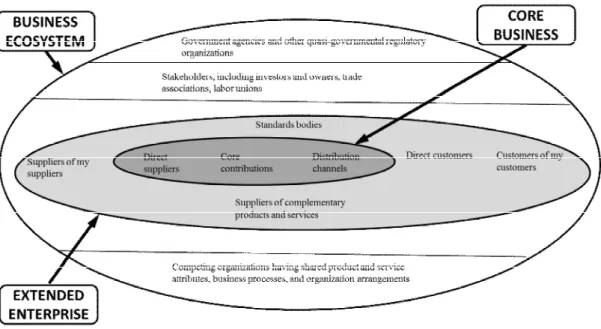
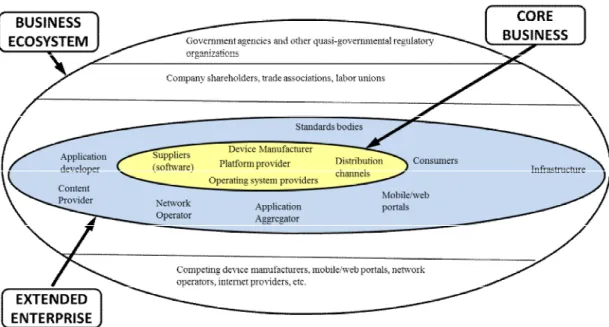
The participants of an ecosystem have a broad range (Figure 1) beyond the participants of the core business (i.e. core contributors, direct suppliers, and distribution channels), and the participants of the extended enterprise (i.e. the participants of the core business plus the suppliers of suppliers, suppliers of complementary products, standards bodies, direct customers and customers of direct customers). The business ecosystem participants also include the regulatory organizations, all stakeholders, and even the competing organizations that share the same attributes in their products and services, business processes, and organizational arrangements. (Moore 1996, 27)
13
The composition of an ecosystem explains about the actors in the ecosystem and their interactions. An ecosystem is basically structured by a central hub, a platform for the interaction of the members, and other participants who create and share value using the platform. To have a thorough understanding of the composition, it is useful to map the participants of the ecosystem and see how they connect to each other to access resources. (Iyer et al., 2006)
Although researchers (e.g. Iansity & Levien, 2004; Iyer et al., 2006; Hagel et al., 2008) agree on the basic structure of an ecosystem, yet they use different terminologies to address the same concepts. For example, in the case of the central hub, Iansity & Levien (2004, 68) call it “keystone” [and see it as an equivalent to “hub”]; Moore (1993) names it as “central contributor”; Hagel et al. (2008) address it as the “shaper”; and Iyer et al. despite calling it as “keystone”, see it only as part of the “hub” (which in their definition includes “dominators” and “niche players”, as well).
A keystone shapes the strategies (Hagel et al., 2008) and has a significant impact on the health of the ecosystem. It tries to increase the stability, diversity and productivity of the ecosystem through creating and sharing value on the ecosystem platform with other participants (Iansity & Levien, 2004, 70). In fact, the keystone creates value by providing the means and motivation for participants’ value creation. A keystone should be alert not to turn into a dominator. A dominator intends to occupy a big share of the ecosystem and extract as much value as possible. Dominators are in two types: classic dominators, and landlords. A Classic dominator aims for vertical and horizontal integration in the ecosystem and tries to bring other participants under its umbrella. A landlord only withdraws the value from the ecosystem without creating any value or facilitating the value creation. The behavior of a landlord results in killing the incentives of member firms. An ecosystem occupied by dominators will lose its diversity and robustness over time. (Iansity & Levien, 2004, 116)
Besides the hub (or keystone), the niche players exist in an ecosystem (Iyer et al. 2006; Iansity & Levien, 2004, 76). Niche players collectively create the bulk of the ecosystem and usually have a limited number of relationships to others compared to the keystones (Iansity & Levien, 2004, 76). They possess specialized capabilities through which they
14
create value and complement other participants. Niche players are the critical drivers of innovation and their diversity increases the robustness of the ecosystem (Ibid, 126). Hagel et al. (2008, 85) further categorize the participants [niche players] into three types: influencer, hedger, and disciple. The influencer “commits early and prominently to one shaping [or keystone’s] strategy”. The hedger “develops its products and services to support multiple shaping [or keystone’s] platforms”. The disciple “commits exclusively to one shaping [or keystone’s] platform” and unlike the hedger, does not invest in competing platforms.
Besides the keystone (and/or dominators) and niche players, in a research on software networks, Iyer et al. (2006, 44) introduce two other roles: a broker and a bridge. The broker “makes connections between two sets of firms”. The bridge is “a link critical to
the overall connectedness within the network” and is played by the firms who have
developed a middleware; therefore, interoperate across multiple or disconnected applications. However, these roles seem to be very much related to the context of software networks, and might not be found in all types of business ecosystems.
The participants’ activities in the ecosystem are mainly orchestrated by the keystone’s strategies. Proper orchestration can provide the motive for the members firstly to be willing to join, and secondly, to stay loyal to the ecosystem and increase its stability. (Jansen et al, 2009b)
2.1.3. The Health of a Business Ecosystem
The performance and development of an ecosystem is tightly related to its health. Iansity & Levien (2004, 46) define three health aspects for an ecosystem: productivity, robustness, and niche creation. Productivity shows how active the ecosystem is (Jansen et al., 2009b) and is measured by three factors: 1) factor productivity (i.e. the level to which the factors of production are converted into useful work), 2) change in the productivity over time, and 3) delivery of innovation (Iansity & Levien 2004, 47-50). Robustness shows how well the ecosystem can recover from major shocks (Jansen et al., 2009b) and is measured through survival rate of the participants, persistence of
15
ecosystem structure, predictability of changes, limited obsolescence in response to perturbation, and continuity of use experience and use cases (Iansity & Levien 2004, 50-54). The niche creation shows the ability of an ecosystem to create opportunities for both new and old actors (Jansen et al., 2009b) and is measured through growth in the diversity of firms and products, as well as technical variety in the ecosystem. (Iansity & Levien, 2004, 54-55)
2.1.4. The Life and History of an Ecosystem
The life and history of an ecosystem can be divided into four stages (Moore, 1996, 83):
pioneering, expansion, authority, and renewal. In the pioneeringstage, the ecosystem is born and tries to create value around the core innovation (new offer), while trying to protect the innovation from rivals and to attract the critical customers and suppliers. In the expansionstage, the ecosystem brings the new offer to a large market. It tries to gain the maximum market share and become a standard in the market by creating a critical mass. In the authority stage, the ecosystem develops a promising vision to encourage the suppliers, partners and customers to collaborate on improving the offer. Meanwhile, it tries to preserve its bargaining power against such customers, partners and suppliers. In the renewalstage, the ecosystem works with innovators to develop new ideas. In the meantime, it tries to retain its innovators and customers by developing high switching costs and high barriers to entry, respectfully.
2.1.5. Business Ecosystems and Competition
There are three foundations that shape the concept of competition in a business ecosystem: architecture, integration, and market management. Architecture and integration, in respect, refer to the way that boundaries are set between technologies, products and organizations, and the way that members of the ecosystem are collaborating across these boundaries to share their capabilities. Market management shapes the way in which firms are pursuing the fulfillment of their transactions across the defined boundaries and rules of the ecosystem. (Iansity & Levien, 2004, 145)
16
The architecture and integration of an ecosystem are shaped through the platform. The platform does not refer to a technological platform, but as a shared collaborative environment. A set of process points or interfaces are defined in the platform to help the members of the ecosystem to enjoy the capabilities of the ecosystem. The platform performs as “the package” used by the keystone for sharing the value across the ecosystem (Ibid, 148) and consists of two components: the implementations and the interface. Implementations are the invisible layer of a platform, and make its foundation by proprietary approaches to solving problems and bridging the technological gaps of the ecosystem. Interface, on the other hand, is the visible component and is the access point that ecosystem members use to create and share value. (Ibid, 150) A keystone’s challenge in maintaining a distinguished platform is to preserve the strength of the implementations and the dramatic power of the interface (Ibid, 156). Therefore, the competition among ecosystems can be, in fact, the competition among the platforms.
2.1.6. The Holistic View of the Discussed Analysis Factors
Figure 2 combines the factors that have been discussed in previous sections and connects them in order to provide a holistic view towards the various concepts of a business ecosystem.
The business ecosystem platform locates in the center. On the left side, the different layers of the participant categories (as realized by different researchers) are shown. They connect to the ecosystem platform. On the right side, the results of the activities of the ecosystem participants are shown in the form of the health of the ecosystems and its life and history.
17
Figure 2. The Holistic View of the Discussed Analysis Factors
2.2. Two-Sided Markets
Two-sided markets have been in practice for a long time, connecting diverse groups of suppliers and customers to each other. Examples include the markets for credit cards (connecting cardholders and merchants), operating systems (connecting end-users and developers), TV channels (connecting advertisers and watchers), video games (connecting game developers and gamers), newspapers (connecting journalists and readers), etc.
In two-sided markets, the members of each side take benefit from the number of members on the other side (Armstrong, 2006). Therefore, a main struggle for the provider of a two-sided market is to bring both sides “on board” (Rochet & Tirole, 2006). The market provider, in fact, provides a shared platform for the transaction. Same as in business ecosystems, the platform concept is not limited to a technological platform, but to an environment. However, in the field of information and communication technology, the platform can refer to the technological platform. For
18
example in the case of app stores, the platform provider offers a technological platform and tries to attract a larger number of developers and consumers to it to make its app store profitable.
The two-sided markets are different from traditional markets in two ways. Firstly, unlike a traditional market where the value is moving from left to right - from costs to revenues, in a two-sided market the value exists on both sides. This is due to the existence of a distinct group on each side; therefore, the costs and revenues are present on both sides (Rochet & Tirole, 2006). The provider of the market can charge both groups appropriately to maximize the value. (Eisenmann et al., 2006) Secondly, the volume of transactions in these markets depends on the structure of the market, not the overall level fee that the provider is charging each side (Rochet & Tirole, 2006).
The provider brings more efficiency to the market transactions by facilitating the cross-side interactions. For this purpose, it defines the design of the platform and its set of rules. The design refers to the architecture and infrastructure for product and/or service delivery, and the set of rules refers to the protocols, rights, and pricing terms that govern the transactions (Eisenmann et al., 2008) as named under architecture and integration,
respectively, by Iansity & Levien (2004, 145) in section (2.1.5).
2.2.1. Dynamics of Two-Sided Markets
The sides of a two-sided market are attracted to each other (Eisenmann et al., 2006) and experience “network externalities” (or “network effect”). Network externalities (or effect) occur when a user finds the value of a product depending on the number of other users of the product (Shapiro & Varian, 1999, 13). For example, a phone user enjoys a higher number of other phone users on the network as more calling possibilities are available.
In a two-sided market, the network effect can happen on the same-side or cross-side. In the same side network effect, an increase in the number of users on one side, can increase or decrease the value of the network for the users on the same side. In the
19
decrease the value of the network for the users on the other side. From another perspective, the network effect can be either positive or negative. The positive or negative network effect can happen either in one side or in cross-side. (Eisenmann et al., 2006) For instance, in the online videogame playing platforms, the larger the number of game players, the more game developers will be willing to join the platform (positive cross-side network effect). Similarly, a larger number of game developers on the platform would attract a larger number of game players to the platform, since game players might find a richer variety of games on the platform (positive cross-side network effect). Meanwhile, a larger number of game players might attract a larger number of game players to join the network, since they can have more alternatives in finding co-players or opponents and find more excitement on the platform (positive same-side network effect). Simultaneously, the larger number of game developers will bring more competition among them; therefore, might decrease their tendency to join the platform (negative same-side network effect).
Considering the network effect, the dynamics of a two-sided market can be quite complicated. Therefore, thoughtful strategy choices by the provider of the market are needed. In the next section some of the main challenges of providers are discussed.
2.2.2. Challenges for a Platform Provider in a Two-Sided Market
Eisenmann et al. (2006) define three challenges in a two-sided market: pricing, winner takes-all dynamics, and the threat of envelopment by an adjacent platform.
Pricing deals with the decision of the platform provider about charging each side based on the impact that the charge might have on the growth of the other side. Usually one side is subsidized in order to create a mass of users thanks to the money side which is ready to pay extra to have access to the critical mass. (Ibid) For example, in case of a software solution such as Adobe Acrobat, the software is provided free of charge for anyone who likes to use a file in the Adobe Acrobat format (PDF). Yet, those who want to use Adobe Acrobat to create a PDF file need to purchase the PDF maker version.
20
The winner-takes-all challenge finds its roots in the scale concept, and that the platform owner needs to decide whether to share its platforms with rivals or just keep it as a
stand-alone platform and gets the economy of scale for its exclusivity. The general idea for the platform provider is to tip the market and make its platform “the standard” among the public. For example, VHS tapes took all against Betamax and became the standard of the video tapes; or the QWERTY keyboard became the standard of the market and did not allow any other types of keyboard to take its position afterwards. In order to make these decisions, the platform provider should consider the cost of multi-homing for the users on each side. Homing refers to the user’s preference and possibility to be on one or more platforms. For example, the multi-homing for users of mobile phones is not very common and they usually have only one device. If multi-homing costs are high, the platform owner should take proper strategies to keep the vulnerable side on the platform through different initiatives such as: building strong relationships, creating a positive reputation based on past experiences, and improving the performance of the platform through better orchestration and technology (Ibid). For instance, in case a mobile phone manufacturer fails to provide the desired value that a consumer expects in its product, the consumer might completely migrate to another manufacturer, as he/she intends to have only one phone.
The threat of envelopment by an adjacent platform is very likely to happen if the functionality of the so-called platform is provided by another more powerful platform and as part of a bundled package. As such, the users can probably get the same features at a lower cost. In technology-based markets, such a threat exists at a high level as the boundaries of markets are quite blurred. Therefore, a platform provider might decide to either sell out the business to the enveloper or find a way out of it through innovative strategies. (Ibid) For example, Microsoft attacked the Real Player market. Real Player had made the two sided market for video streaming, with consumers as the subsidized side and content providers as the money side. Microsoft preformed an envelopment attack by offering the streaming video option through its Media Player on its Windows operating system, causing the migration of many content providers from Real Player to Microsoft.
21
2.2.3. Two-Sided Market and ICT Intensive Service Innovation
In a two-sided market, the desired value for each side of the market often differs from that of the other side (Tuunainen et al., 2011) and should be analyzed separately.
Tuunainen et al. (2011) propose a model for the analysis of ICT intensive service innovation in n-sided markets. The model takes into account the service innovation in the field of ICT, and defines dimensions that should be analyzed for each player on this market.
They analyze the platform provider through three factors: organizational factor, technology factor and market environment. Organizational factors include the way in which the platform provider company is managed and also its financial structure. Technology factors include the type of the technology that is used by the platform provider, and the market environment includes the whole market setting, such as customers, as well as direct and indirect competitors.
For each side, they analyze three dimensions of service innovation: 1) service concept, 2) client interface, and 3) delivery system. The service concept refers to the new value that is proposed to the market by the service. Client interface refers to the interface which is used between the service provider and its customers. It should be noted that the client interface is not about the technological interface of the system. The service delivery regards the link of the service provider and its client, which is usually done electronically in the field of ICT. (Ibid)
2.3. Mobile Ecosystem
Mobile industry has fitted very well into an ecosystem type of business (Basole, 2009; Tarnacha & Maitland, 2006a; Peppard & Rylander, 2006). The ecosystem has been shaped due to the shaping of networks (Basole, 2009; Li & Walley, 2002) where a variety of firms from different segments are functioning and complementing each other to create value for customers.
22
In research on mobile related issues, majority of researchers have taken the value chain perspective instead of business ecosystem perspective (e.g. Barnes, 2002; Buellingen & Woerter, 2004; Karvonen &Warsta, 2004; Tarnacha & Maitland, 2006a). This has been in sometimes due to the simplification (e.g. Tarnacha & Maitland, 2006a) and sometimes (e.g. Karvonen & Warsta, 2004) a mobile ecosystem has been modeled in the end.
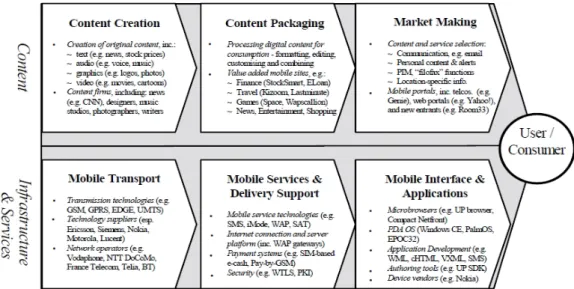
By using the value chain perspective, researchers define the key functions and players that create value for end-users. Barnes (2002) takes a functional approach. He recognizes the processes required in the value creation, but has less focus on the operators of the processes. His illustration of the mobile commerce value chain (Figure 3) considers both technical and commercial sides of the value creation. He categorizes the functions into two areas: 1) content (content creation, content packaging, and market making), and 2) infrastructure and services (mobile transport, mobile services and delivery support, and mobile interface and application).
Figure 3. Mobile Commerce Value Chain (Barnes, 2002)
Buellingen & Woerter (2004) - in their two-dimensional value chain approach (Figure 4) – highlight the participants through the combination of a functional and an institutional perspective. In the functional dimension, they outline the functions that should be taken care of as infrastructure, customer acquisition, transmission,
m-23
commerce content and portals, and customer management billing. On the institutional dimension, they outline the responsible participants for each function.
Figure 4. Mobile Value Chain (Buellingen & Woerter, 2004)
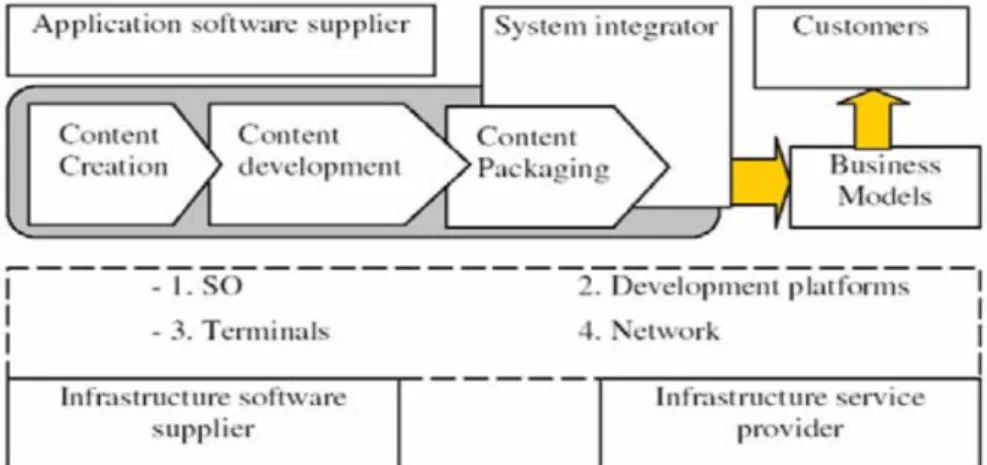
Karvonen & Warsta (2004) use Barnes’ (2002) value chain perspective and model the ecosystem for mobile multimedia development (Figure 5). In their model, the participants of the ecosystem need to consider the operating system, terminals, development platform, and the network during the process of multimedia application development.
Figure 5. The Ecosystem of Mobile Multimedia Development (Karvonen &Warsta, 2004)
Basole (2009), unlike the other researchers takes a business ecosystem perspective from the very beginning. He provides an illustration of the segments in mobile ecosystem as
24
shown in Figure 6, and shows the emerging participants [in his time of research] by dark and the already existing ones by light circles. His defined participants include device manufacturers, network operators, infrastructure providers, silicon vendors, platform providers, system integrators, software providers, application developers.
Figure 6. Segments in Converging Mobile Ecosystem (Basole, 2009)
A review of the earlier research shows that researchers define the mobile value chain and/or ecosystem participants and/or functions in two main categories: content-related, infrastructure-related. Tarnacha & Maitland (2006a) define such categories as
downstream and upstream in their research in the domain of mobile applications.
Compiling the work of various researchers on mobile application ecosystems and/or mobile value chains (Barnes, 2002; Karvonen & Warsta, 2004; Buellingen & Woerter, 2004; Tarnacha & Maitland, 2006a; Basole, 2009; Nyika, 2010) the main participants in the mobile ecosystem and/or value chain are presented in Table 4, and listed as follows. Some authors have provided definition of the roles, while others have just used them on the basis of a common knowledge.
25
Content provider: Creates, aggregates and distributes mobile content (Tarnacha & Maitland, 2006a).
Application developer: Packages the content into a mobile application for execution on mobile devices (Ibid).
Platform provider: Provides the necessary implementation tools for deploying
mobile applications (Ibid)
Devicemanufacturer: Manufactures information-processing mobile devices (Ibid)
Network operator: Sets up the network and provides the consumers’ access to the network (Ibid)
Internetserviceprovider
Serviceand billingprovider: Provides software systems necessary for provisioning, billing, and customer service (Basole, 2009)
Mobile/web portals: Place for selling of applications
Operatingsystemprovider
Network andinfrastructureprovider: Provides network technologies
Application aggregator: Manages the distribution of the applications through
application stores and/or gateway websites (Nyika, 2010)
Consumer: The end-user of mobile services
Mobile component provider: Provides chips, processors, screens, power, etc.
26
Table 4. Participants of a Mobile Ecosystem and/or Value Chain
Participants Mentioned by Other names used
Content provider Tarnacha & Maitland (2006a) Karvonen & Warsta (2004) Nyika (2010)
Basole (2009)
Buellingen & Woerter (2004)
content creator and developer (Karvonen & Warsta, 2004) content creator and/or content owner (Nyika, 2010)
Media enterprise, whole-sellers, banks, e-commerce (Buellingen & Woerter, 2004)
Application developer Tarnacha & Maitland (2006a) Barnes (2006)
Nyika (2010)
Karvonen & Warsta (2004)
application developer (Tarnacha & Maitland, 2006a; Barnes, 2006; Nyika, 2010)
Content packager (Karvonen & Warsta, 2004)
Application and software provider (Basole, 2009)
Platform provider Basole (2009) Channel owner (Nyika, 2010) Device manufacturer Buellingen & Woerter (2004)
Tarnacha & Maitland (2006a) Basole (2009)
Buellingen & Woerter (2004) Barnes (2002)
Channel owner (Nyika, 2010) Device vendor (Barnes, 2006) Mobile phone (Karvonen & Warsta, 2004)
Infrastructure provider (Buellingen & Woerter, 2004) Technology suppliers (Barnes, 2002)
Network operator Tarnacha & Maitland (2006a) Buellingen & Woerter (2004) Barnes (2006)
Nyika (2010)
Karvonen & Warsta (2004) Basole (2009)
Internet service provider Basole (2009)
Buellingen & Woerter (2004) Barnes (2002)
Internet portal provider (Buellingen & Woerter, 2004) Internet connection and server platform (Barnes, 2002) Service and billing provider Basole (2009)
Buellingen & Woerter (2004) Barnes (2002)
Payment systems and security (Barnes, 2002)
Mobile/web portals Barnes (2002)
Operating system providers Karvonen & Warsta (2004) Barnes (2002)
Technology platform vendors (Barnes, 2002)
Network and infrastructure
provider Basole (2009) Buellingen & Woerter (2004) Barnes (2002)
Application aggregator Nyika (2010)
Consumer Barnes (2009)
Nyika (2010)
Karvonen & Warsta (2004)
Mobile application user (Nyika, 2010)
Customers (Karvonen & Warsta, 2004)
Mobile component provider
27 2.4. A Revision of Moore’s Model
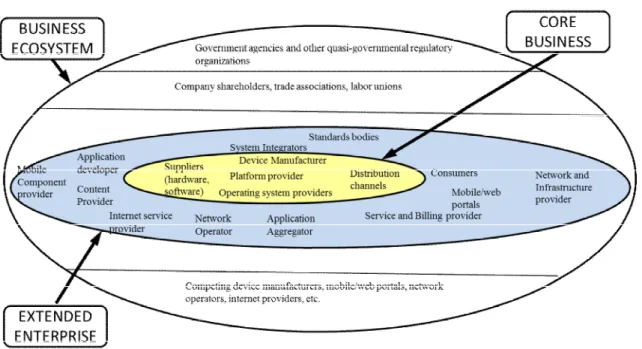
Based on the literature review on business ecosystems and mobile ecosystems, Moore’s model is adapted to take into account the mobile ecosystem participants (Figure 7). The core of the business, as earlier defined by Jansen et al. (2009b), is assumed to be based on a firm or platform. Therefore, the device manufacturer, platform provider, and operating system provider are located at the heart of the model. There is a strong link among them since they constitute the foundation of the mobile service by providing a mobile device to the consumer. The device manufacturer gets the necessary hardware equipment from direct suppliers such as component providers, silicon provider, etc. Meanwhile it is served by software suppliers such as operating system provider, application providers for the basic applications on a mobile device, and the platform provider that offers the necessary implementation tools for deploying mobile applications. The mobile device is distributed to the consumers through distribution channels.
28
During the past years, the mobile ecosystem has been converging (Basole, 2009). For example, Apple decided to join the ecosystem by introduction of its iPhone in 2007, or Nokia has extended its business by transforming from a device manufacturer to a software services company (Ibid). Additionally, with the increase in the capabilities of mobile phones, content providers have become more actively involved in the ecosystem, as was anticipated by Basole (2009). Consequently, the roles of mobile ecosystem participants have changed, combined and exchanged (Holzer & Ondrus, 2010).
Visualizing the mobile ecosystem relations, Basole (2009) remarks that there appeared to be no central segment (hub) in the ecosystem at the time of his research; yet mobile network operators had the most central role in the mobile ecosystem with larger numbers of connections to other participants. He found out that the platform providers had a strong tie with the application and software providers. Basole (2009) anticipated that in future, due to the convergence, the platform providers would become a central segment (hub) in the ecosystem. He explained the role of the platform providers as the drivers and enablers of the integration of applications and software products, as well as content (media, gaming, entertainment). According to him, the content provision was the emerging segment of the mobile ecosystem.
Following the importance of the applications in the new structure of mobile market and the introduction of app stores, Holzer & Ondrus (2010) study the mobile application market and emphasized on the role of the platform provider –which is in line with Basole’s (2009) anticipation. They illustrated the mobile application distribution process (Figure 8). In this process, the developer makes the application through the development tools offered by a specific platform, and publishes it on the application portal. The consumer, on the other side, purchases the application from the portal through his or her device. The payment stream goes from consumer to the application portal to the developer.
29
Figure 8. Mobile Application Distribution Process (Holzer & Ondrus, 2010)
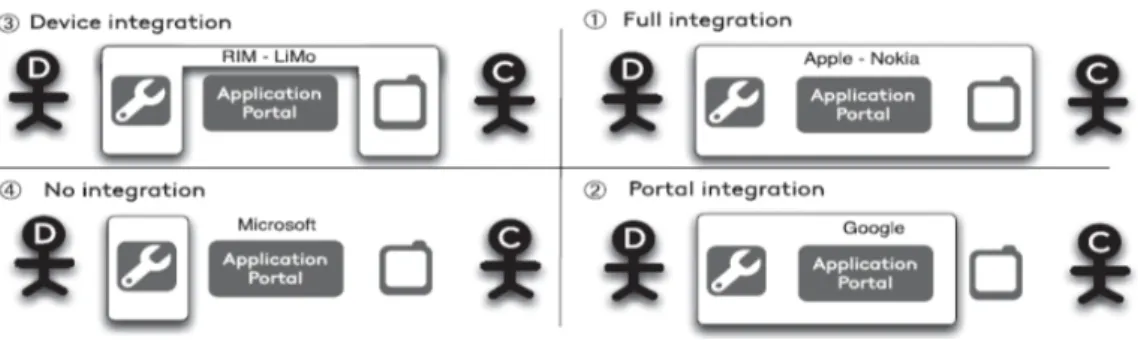
Holzer & Ondrus (2010) explain that the provider of the platform (or portal) can take different roles in the application market. Some are interested in full integration and control of the entire distribution process, while others might take responsibility in some parts only. They introduce four different possibilities and locate their exampled app- store providers in each: full-integration, portal integration, device integration, and no integration (Figure 9). In full-integration approach, the provider of the platform has strict control over device manufacturing, platform, and application sale on its app store (e.g. Apple, Nokia). In platform integration approach, the platform provider concentrates on the application development and application sales on its app store (e.g. Google). In device integration approach, the platform provider manufactures the devices but is not providing the app store (e.g. RIM). In no integration approach, the focus is only on providing the app store (e.g. Microsoft).
Figure 9. Platform Integration Strategies (Holzer & Ondrus, 2010)
The differences in the platform types and platform provider strategies result in different working situations for developers. Developers are creating value through developing mobile applications and distributing them via the application store provided for their
30
chosen platform. They need to decide which platform(s) they want to develop their applications for, or if they want to consider multi-homing strategy as described in section 2.2.2.
2.5. Conceptual Framework
Although the entire mobile ecosystem can be considered as a meta-ecosystem, for the simplicity of analysis the smaller ecosystems that exist within it have been considered. The border of the smaller ecosystems can be defined based on the degree that the offered value (product) is compatible and complementary (den Hartigh & Tol, 2008). By this definition, in case of the mobile application ecosystem, each application store and the network shaped around it can be considered as an ecosystem as it is offering value to only a specific group of users, without the need for dependency on other application stores. This border line setting is in line with how Jansen et al. (2009b) have defined a firm-based ecosystem (or in this case both firm-based and platform-based). Considering the increasing importance of the mobile applications in the convergent market, a simplified diagram of mobile ecosystem with its focus on the new structure of the market is illustrated in Figure 10. In this demonstration, the network reduction approach (Basole, 2009) has been taken into account to reach a contextual overview on the mobile application ecosystem. The participants that are associated with merely technological infrastructures and have connection to all other participants (i.e. mobile component provider, hardware supplier, network and infrastructure provider, system integrator, internet service provider, and service and billing provider) are grouped under “infrastructure”.
31
Figure 10. A Simplified Mobile Ecosystem Model – adapted from Moore (1996, 27)
Using Figure 10, the ecosystems of the case companies are analyzed, and the findings help to understand how the ecosystems create value for developers. Compliance of the value created by the ecosystem with the value that developers expect to receive from the ecosystem shapes the rationale for approaching the main research question.
Therefore, the study is comprised of two steps:
1) The first step aims to answer the sub-question (What is the structure of a mobile application ecosystem?). Here, the participants and their arrangements are illustrated, and the compositions of the ecosystems are discussed.
2) The second step aims to answer the main research question (What are the factors that developers perceive to be important (both positively and negatively) in a mobile application ecosystem?). Here, the factors that developers consider in the process of application development are discussed. These factors are basically derived from the empirical data, which are then investigated into a further depth. (For more details see section 3.3)
32
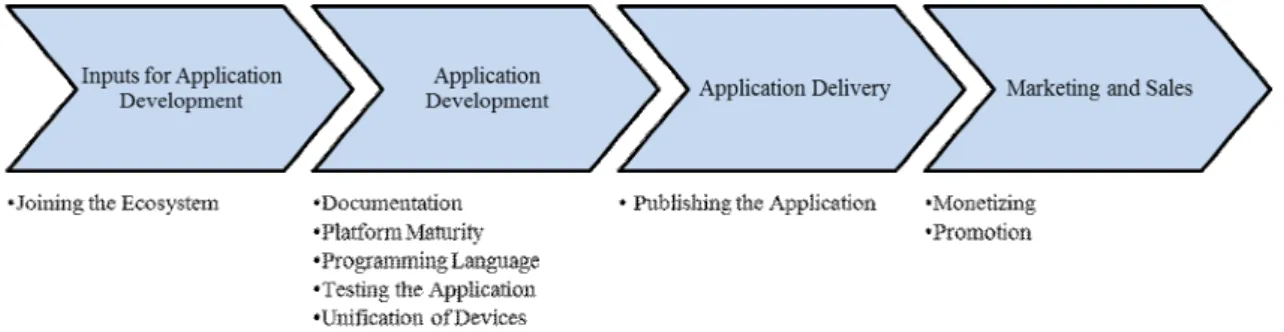
Figure 11 contains the factors which are considered by developers (i.e. joining the ecosystem, documentation, platform maturity, programming language, testing the application, unification of devices, publishing the application, monetizing, and promotion). As shown in Figure 11, the factors can fit into wider categories which almost follow Porter’s value chain (i.e. inputs for application development, application development, application delivery, and marketing and sales). (See section 3.4 for more details on data analysis)
33 3. METHODOLOGY
The methodology chapter is comprised of four sections: 1) Research philosophy, 2) Research design, 3) Data collection, and 4) Data analysis.
3.1. Research Philosophy
The paradigm of the researcher shapes the research philosophy. As Healy & Perry (2000, 118) note, the paradigm is “the overall conceptual frameworks within which
some researchers work.” Thus, paradigm consists of the beliefs, assumptions, and
perceptions that a researcher has, which obviously can influence the way that the research question is approached.
Among the four categories of paradigm that Guba & Lincoln (1994) define (i.e. positivism, realism, critical theory, and constructivism), realism seems to best suit the nature of this study. Realism paradigm believes in the existence of a real world which needs to be discovered (Ibid). It locates between the purely objective world in positivism and the purely subjective world in the constructivism and critical theory. (Healy and Perry, 2000)
The application ecosystem exists as a real world with some real attributes that are demonstrated through the human-ecosystem interactions. The attributes of the ecosystem cannot be fully discovered without considering these interactions. Therefore, humans’ perceptions of the attributes, shaped throughout the interactions, help in comprehending the attributes. This is far from objectivism. However, taking into account the human perceptions only and without the belief in the existence of some
reality for the attributes might provide a false insight into the ecosystem due to this purely subjectivist approach. Consequently, the understanding of the real attributes can happen somewhere between subjectivism and objectivism. It means that humans’ perceptions of those attributes can be analyzed to get an insight into the real attributes. The paradigm of realism can be defined by its elements: ontology, epistemology, and methodology. Healy & Perry (2000, 118) note:
34
Ontology is the “reality” that researchers investigate, epistemology is the relationship between the reality and the researcher, and methodology is the technique used by the researcher to investigate that reality.
In ontology of realism, “the reality is “real” but only imperfectly and probabilistically apprehensible.” Further, in the epistemology of realism, the researcher believes that the findings are probably true, giving room to uncertainty. The methodology of realism can include case studies or convergent interviews with consideration of the triangulation techniques through qualitative and quantitative methods. (Ibid, 118)
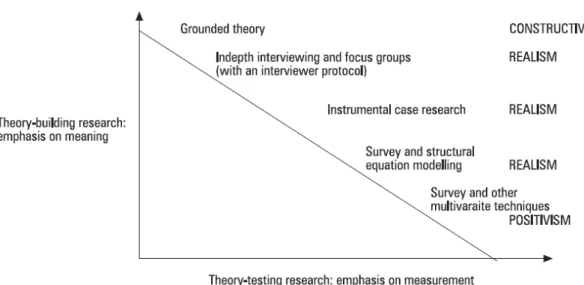
The realism approach is a combination of theory-building and theory-testing (Figure 12). The theory building research can be highly seen in grounded theory in which the theory is systematically generated from the data; an inductive approach. On the other hand, theory testing is about testing the propositions which are developed from existing theory in the real world; a deductive approach. The constant mixture of inductive and deductive approaches is abductive approach. (Dubois & Gadde, 2002)
Figure 12. A Representative Range of Methodologies and their Related Paradigms (Healy & Perry, 2000)
This study locates between deductivism and inductivism, having the characteristics of both approaches partially. The empirical findings, as well as the existing theories feed each other during the research process, in line with previously defined realism