Boise State University
ScholarWorks
Computer Science Graduate Projects and Theses Department of Computer Science
12-1-2012
Object Oriented Implementation of the Parallel
Toolkit Library
Sandhya Vinnakota
OF
THE PARALLEL TOOLKIT LIBRARY
by
Sandhya Vinnakota
A project
submitted in partial fulfillment of the requirements for the degree of Master of Science in Computer Science
Boise State University December 2012
c
°2012 Sandhya Vinnakota ALL RIGHTS RESERVED
DEFENSE COMMITTEE AND FINAL READING APPROVALS
of the project submitted by Sandhya Vinnakota
Project Title: Object Oriented Implementation of the Parallel Toolkit Library Date of Final Oral Examination: 12 December 2012
The following individuals read and discussed the project submitted by student Sand-hya Vinnakota, and they evaluated their presentation and response to questions during the final oral examination. They found that the student passed the final oral examination.
Amit Jain, Ph.D. Chair, Supervisory Committee
Jim Buffenbarger, Ph.D. Member, Supervisory Committee
Jyh-haw Yeh, Ph.D. Member, Supervisory Committee
The final reading approval of the project was granted by Amit Jain, Ph.D., Chair, Supervisory Committee. The project was approved for the Graduate College by John R. Pelton, Ph.D., Dean of the Graduate College.
ACKNOWLEDGMENTS
I would like to express gratitude to a lot of people for support during this work. I would like to especially thank my husband and my son Vibodh Ayyapureddi without whose support I would not have finished this project. I also thank my parents for their support and sacrifice .
I would also like to thank my advisor Dr Amit Jain for his wonderful support and patience throughout the project.
With manufacturing efficiencies and technological innovation the computing power of commodity machines has been increasing accompanied by decreasing costs. With the very favorable price/performance ratio the computing community has shifted from monolithic machines to networked machines.
This has created the need for software to manage the parallelism of the net-work. One such work has been the Parallel Toolkit Library. The Parallel Toolkit Library provides support for common design functionalities used throughout parallel programs.
This work extends the PTK C library for C++ parallel programs. The motivation for the current project stems from the need to let parallel programs reap the benefits of a library with an object oriented programming approach. This also fits well with the introduction of C++ bindings in MPI. The library has been structured on object-oriented concepts. The functionality of the PTK-C has been encapsulated into various classes. Individual functionalities have also been split into multiple classes leading to modularity and reusability of code.
Template programming has been used to ensure type safety. The testing results are consistent with expectations in that the PTK-C++ is very much comparable to the PTK-C in terms of performance. In most cases, it would be more efficient to use the toolkit than to rewrite the code to recreate the efficiencies already present in the library.
TABLE OF CONTENTS
ABSTRACT . . . v LIST OF TABLES . . . ix LIST OF FIGURES . . . x 1 Introduction . . . 1 1.1 Problem Statement . . . 1 1.2 Prior Work . . . 11.2.1 Existing work in object-oriented PTK like libraries . . . 1
1.3 Parallel functionality implemented . . . 2
2 The Tool Kit Implementation . . . 4
2.1 Introduction . . . 4 2.1.1 Template Programming . . . 4 2.1.2 Exception Handling . . . 4 2.1.3 Memory Handling . . . 5 2.1.4 Namespace . . . 5 2.2 Implementation Discussion . . . 6 2.2.1 Init . . . 6 2.2.2 CommonVarHelper . . . 6 2.2.3 Exit . . . 6 vi
2.2.6 DistributedWorkpool . . . 8 2.2.7 SendSets . . . 9 2.2.8 SendTaskSets . . . 9 2.2.9 SendResultSets . . . 9 2.2.10 WorkpoolData . . . 9 2.2.11 DualPassTokenRing . . . 10 2.2.12 CentralizedWorkpool . . . 11 2.2.13 Scatter1d . . . 11 2.2.14 Scatter2d . . . 12 2.2.15 Gather1d . . . 12 2.2.16 Gather2d . . . 12 2.2.17 AllToAll1d . . . 13 2.2.18 AllToAll2d . . . 13 2.2.19 Multicast . . . 14 2.2.20 Filemerge . . . 14
3 Using The Toolkit: Examples . . . 15
3.1 Example using the ShortestPathCentralWorkpool . . . 16
3.2 Example using the ShortestPathDistributedWorkpool . . . 19
4 Testing and Benchmarking . . . 22
4.1 Testing coverage of toolkit classes . . . 22
4.2 Graphs comparing the performance of C vs C++ . . . 23
4.3 Simulation notes . . . 26 vii
5 Conclusions . . . 27
5.1 What have we done so far? . . . 27
5.2 Design Patterns . . . 28
5.3 What have we learned . . . 28
5.4 Potential Future work . . . 28
5.4.1 Complex Datatypes . . . 28
5.4.2 Multi-threading . . . 29
REFERENCES . . . 30
A MPI Datatypes . . . 31
B Installing the PTK Library . . . 32
3.1 PTK examples and corresponding classes (Part 1) . . . 15
3.2 PTK examples and corresponding classes (Part 2) . . . 16
4.1 Testing coverage of toolkit classes (Part 1) . . . 22
4.2 Testing coverage of toolkit classes( Part 2) . . . 23
LIST OF FIGURES
2.1 Diagram depicting the relationship between the workpool classes . . . 7 4.1 C versus C++:Shortest Path Central (Simple) - with granularity = 1.
Vertices in K‘s . . . 23 4.2 C versus C++:Shortest Path Central:Granularity=200, Vertices per
task=100 . . . 24 4.3 C versus C++:Shortest Path Distributed (Simple) - with granularity
= 1 . . . 25 4.4 C versus C++:Shortest Path Distributed:More Efficient,Granularity=200 26
CHAPTER 1
INTRODUCTION
1.1
Problem Statement
With the introduction of the C++ bindings in Message Passing Interface(MPI)-2, and the existing Parallel Tool Kit(PTK) library being implemented in C, there was a need for C++ version of the PTK. This project addresses that need by converting the PTK-C library to PTK-C++.
As this work is an extension of the PTK [1], the scope of the project will be limited by the work done in original PTK C-library [1].
1.2
Prior Work
1.2.1 Existing work in object-oriented PTK like libraries
The most recent work is the work carried out in [1], which implemented the PTK library in C.
A rigorous literature search has failed to unearth any progressive work being done in the area of work pool management for parallel programs. The literature survey is consistently pointing to the work carried out by Sachs and McGough [3]. There is no code or any additional documentation available for [3].
2 The literature survey has indicated that the most pertinent body of work at present is the MPI Boost Library [4], which provides a C++ friendly interface to the standard MPI. However the library does not have any support for workpool management.
1.3
Parallel functionality implemented
The following common parallel functionalities are implemented in this project.
• Scatter describes the sending of data from a central coordinator process to
a number of worker processes. Given a data set of size n, and a number of processes p, the data is generally divided into sets of size n/p. The ith set is then sent to the ith process.
Main classes : Scatter1d, Scatter2d
• Gather describes an action that is essentially the opposite of scatter. After data
is scattered, the processes each perform some application specific computations. The coordinator then gathers the data from each of the worker processes. The coordinator may then perform some computation on the gathered data.
Main classes : Gather1d,Gather2d
• All-to-all communication happens when all of the processes need to send and
receive data to and from all of the other processes. Main classes : AllToAll1d, AllToAll2d
• Distributed file merge is a variation of gather. This is necessary when a number
of files are distributed over the cluster and also need to be merged and stored centrally at the coordinator process.
Main classes: FileMerge
• Centralized workpool. In the centralized model, the coordinator process
main-tains a pool of tasks that need to be performed. It sends each process a task. When the process is finished, it tells the coordinator it is done and is ready for a new task. The coordinator then sends another task. This is repeated until all the tasks are completed.
Main classes: CentralizedWorkpool
• Distributed workpool. In the distributed model, each process maintains a pool
of tasks that need to be performed. If a process runs out of tasks it can ask other processes for a task. Tasks are passed back and forth until they are all completed.
4
CHAPTER 2
THE TOOL KIT IMPLEMENTATION
2.1
Introduction
The following subsections deal with the implementation details common to all classes. The classes will be discussed in the subsequent section.
2.1.1 Template Programming
C++ template-style programming has been used in the PTK C++ toolkit. This allows us to use generic datatypes and also ensures typesafety.
Most of the classes in the PTK-C++ use the following styletemplate <typename
TaskType, typename ResultType> The general convention followed is: TaskType
refers to the task datatype and ResultType refers to the result datatype.
2.1.2 Exception Handling
To provide custom exception handling, a new classptkExceptionhas been defined in PTK-C++. All the classes in PTK-C++ make use of ptkException class to throw exceptions. When a process throws an exception, it is the responsibility of the user to handle the exception and terminate the program accordingly.
2.1.3 Memory Handling
In PTK C version, memory allocation, in most cases, is managed by the library user. However the PTK-C++ toolkit ended up allocating memory to the resulting data buffers whenever the size of the buffer can be calculated by the library. This is a benefit of using template programming.
2.1.4 Namespace
All the PTK-C++ classes have been added to a new namespace, ptk. To access the C++ code, the library user has to either use using namespace ptk or use the scope operator :: to access the C++ classes and methods.
6
2.2
Implementation Discussion
2.2.1 Init
The library user should access the methods getInstance() and initialize() at the outset, before proceeding, as these methods initialize the variables like group size, current process number and communicator handler. The previously global variables for group size, current process number and communicator handler are no longer global and have been made private members of the Init class. This class is a Singleton, to avoid creating multiple copies of all these variables at runtime.
2.2.2 CommonVarHelper
This class is inherited by all the PTK-C++ classes. The CommonVarHelper provides a method to access the private variables of the Init class by calling their respective get methods.
However, it is the responsibility of the inheriting class to ensure that the values are available in its class by calling the populatePtkVariables() method inherited
fromCommonVarHelper.
2.2.3 Exit
The exitProgram() method in this class calls MPI::Barrier and MPI::Finalize.
Similar to the Init class, only one instance of this class should exist, so the Exit
2.2.4 Workpool
This is an abstract class which provides some common variables and an interface for all the workpool implementation classes. This class is inherited by theCentralizedWork
-pool and DistributedWorkpool classes.
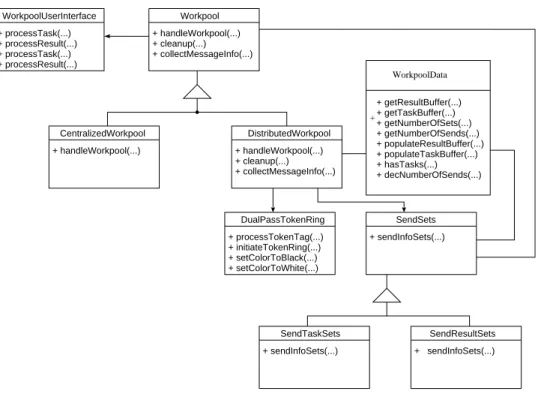
The Figure 2.1 depicts the relationship between the various workpool classes which are described in the subsequent paragraphs.
CentralizedWorkpool + handleWorkpool(...) Workpool + handleWorkpool(...) + cleanup(...) + collectMessageInfo(...) DualPassTokenRing DistributedWorkpool + cleanup(...) + handleWorkpool(...) + collectMessageInfo(...) + initiateTokenRing(...) + setColorToBlack(...) + setColorToWhite(...) + sendInfoSets(...) SendTaskSets + sendInfoSets(...) SendResultSets + sendInfoSets(...) + processResult(...) WorkpoolUserInterface + processTask(...) + processTask(...) + processResult(...) + processTokenTag(...) + getResultBuffer(...) + getTaskBuffer(...) + getNumberOfSets(...) + getNumberOfSends(...) + populateResultBuffer(...) + populateTaskBuffer(...) + hasTasks(...) + decNumberOfSends(...) SendSets + WorkpoolData
Figure 2.1: Diagram depicting the relationship between the workpool classes
2.2.5 WorkpoolUserInterface
In workpool management, the main pieces of data that are passed around are tasks and results. A workpool needs to only know the task/result datatype and their size in bytes. The workpool classes have no knowledge of how to process these tasks and results. It is the responsibility of the library user to process the tasks and results.
8
The WorkpoolUserInterfaceis an abstract class that defines methods to process
tasks and results. All the methods in the WorkpoolUserInterface are implemented to return exceptions.
All the workpool classes expect a reference to theWorkpoolUserInterface. When-ever tasks/results are to be processed, the workpool calls the corresponding method using theWorkpoolUserInterfacereference it received. The library user wanting to use the workpool classes should create a class which inherits from theWorkpoolUser
-Interface. As all the default methods inWorkpoolUserInterfacethrow exceptions,
the library user is forced to overide to these methods.
2.2.6 DistributedWorkpool
In the distributed version of the workpool, all the nodes are workers. Distributed workpool imlementation mainly carries out the following:
• probes the network for tasks/results.
• receives tasks/results and calls the library-user methods to process Results/Tasks
• sends out tasks/results by grouping them based on the receiver
• detects termination
In PTK-C++, the object-oriented concept of abstraction is used. Instead of including all the above listed functionalities in the same class, only the main essence of the distributed workpool is encapsulated in the DistributedWorkpool class. The implementation details for termination detection, and sending out of tasks/results, have been moved to separate classes. By doing so, we achieve abstraction and reusability.
2.2.7 SendSets
SendSetsis an abstract class which provides the common interface to send tasks and
results. This class includes some common variables and a method sendInfoSets. In PTK-C++, this class is inherited bySendTaskSets and SendResultSets.
2.2.8 SendTaskSets
TheSendTaskSetsclass inherits from theSendSetsclass and implements thesendInfoS
-ets() method. This class mainly deals with the implementation details of sending
out tasks. sendInfoSets(...) loops through the incoming stream of tasks and packs tasks into one buffer until it encounters a new sendTo receiver. If the sendTo
variable equals -1, then the tasks are sent to all the nodes in the group.
2.2.9 SendResultSets
TheSendResultSetsclass inherits from theSendSetsclass and implementssendInfoS
-ets() method. This class mainly deals with the implementation details of sending
out results. sendInfoSets(...) loops through the incoming stream of results and packs results into one buffer until it encounters a newsendTo receiver. If the sendTo
variable equals -1, then the results are sent to all the nodes in the group.
2.2.10 WorkpoolData
The WorkpoolData class was created to abstract the multiple parameters during the
10
2.2.11 DualPassTokenRing
In PTK-C++, termination detection has been separated from the workpool logic and implemented in a new class, DualPassTokenRing. This enables reusability of the termination logic. DualPassTokenRingclass uses the dual-pass token-ring algorithm, originally developed by Djikstra, Feijen, and van Gasteren [5].
The main methods of this class are described briefly.
• setColorToWhite() Sets the color of the token to white.
• setColorToBlack() Sets the color of the token to black.
• processToken(....) This method decides how to modify the process color
and token based on the incoming token value. If the received token is white and the process color is white, it passes on the white token. If the received token is white and the process color is black, it turns the token black and passes it on. It the token is black, it will be passed on as is, regardless of the color of the process. After a process passes on the token, it changes its color to white. If the root receives a white token, then it sets the incoming type variable to
DONETAG. Now it is the responsibility of the calling process to parse theDONETAG
and decide on the next course of action. In the DistributedWorkpool class, the root sees that the type is set to DONETAG and sends out DONETAGto all the workers.
• initiateTokenRing() The root from the workpool calls this method to start
2.2.12 CentralizedWorkpool
CentralizedWorkpoolis the subclass of theWorkpoolclass. The library user wanting
to use the centralized workpool, invokes the handleWorkpool(...) method of the
CenralizedWorkpool class.
The implementation logic in the PTK-C++ version has been divided into multiple methods, as opposed to one single function in PTK-C version. TherootProcess(...)
method takes care of the coordinator‘s functionality.
The coordinators‘ (root process) responsibility is to maintain a pool of tasks, distribute them to the workers, process results, and terminate the function when all the tasks have been completed. Tasks are stored in a vector. The coordinator is given an initial set of tasks to begin with, called the startingObjects.
The coordinator then enters a loop, waiting for messages from the workers. The received message may be a request for a task, or a result. If the request is for a task, and the task list is not empty, the coordinator sends the worker a task. If the request is a result, the coordinator calls the processResults(...) method.
The workers also enter a loop. They send a request for a task to the coordinator and then receive the task. The processTask(...) method is called and the result is sent back to the coordinator. The loop is terminated when the worker receives a
DONETAGmessage from the coordinator.
2.2.13 Scatter1d
The Scatter1d class is the C++ implementation of the scatter functionality.
The scatter operation in the Scatter1d class is mainly carried out by
12
scatterRootOperation(...) sends out data to the receiving nodes. InscatterN
-onRootOperation(...), the library allocates memory to the receiving buffer and
populates it with the data received from the root.
2.2.14 Scatter2d
Scatter2d class is the C++ implementation of the scatter2d functionality.
The scatter operation in the Scatter2d class is mainly carried out by
scatterRootOperation(...) and scatterNonRootOperation(...).
In the scatterRootOperation(...) the root distributes the data in a two-dimensional array to all the receiving nodes. In thescatterNonRootOperation(...)
the non-root process allocates memory for an one-dimensional array and populates it with data received from the root.
2.2.15 Gather1d
The gather operation in the Gather1d class is mainly carried out by
gatherRootOperation(...) and gatherNonRootOperation(...).
In gatherRootOperation(...) the root gathers data from other process nodes
and stores it in a one-dimensional array. In gatherNonRootOperation(...) the nodes send an array of size sendCount, with the exception of the last process which sends an array of size lastCount.
2.2.16 Gather2d
The gather operation in the Gather2d class is mainly carried out by
IngatherRootOperation(...) the root allocates memory to the two-dimensional array and then fills it up with the data coming from the other nodes. In the resulting two dimensional array, each row corresponds to data from one node. The number of rows in the two-dimensional array at root equal the number of processes in the group.
IngatherNonRootOperation(...), the process in the group sends a one-dimensional
array to the root.
2.2.17 AllToAll1d
Using theAllToAll1dclass, each process node can send and receive the same amount of data to and from the other processes.
In the sendAllToAll(...) method, each process loops with the number of iterations equal to the group size. At each iteration, each process sends data to the process in the ith position to the right, and receives from the process i.
2.2.18 AllToAll2d
Using the AllToAll2d class, each process node sends and receives a variable amount of data from all the other processes. The communication pattern is the same as that of the AllToAll1d. The sendAllToAll(...) method implements the main logic for the AllToAll2d. This method receives a two dimensional array as input. Each row in this array corresponds to a process in the group. The result from
AllToAll2dcommunication is a two-dimensional array. The toolkit allocates memory
14
2.2.19 Multicast
Using the mcast(...) method of the Multicast class, a sending node can send a collection of data to all the other nodes in the group.
2.2.20 Filemerge
CHAPTER 3
USING THE TOOLKIT: EXAMPLES
Snippets of code pertaining to the shortestpath calculation, using theCentralizedWo
-rkpool and DistributedWorkpool, are presented here. The full code can be found
at
$PTK HOME/examples/ShortestPathCentralizedImpl.cpp.
$PTK HOME/examples/ShortestPathDistributedImpl.cpp.
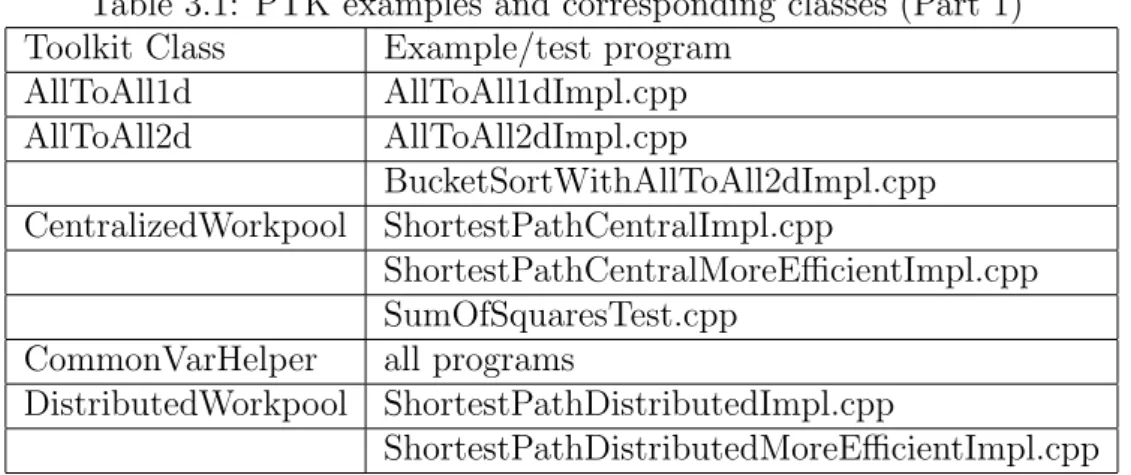
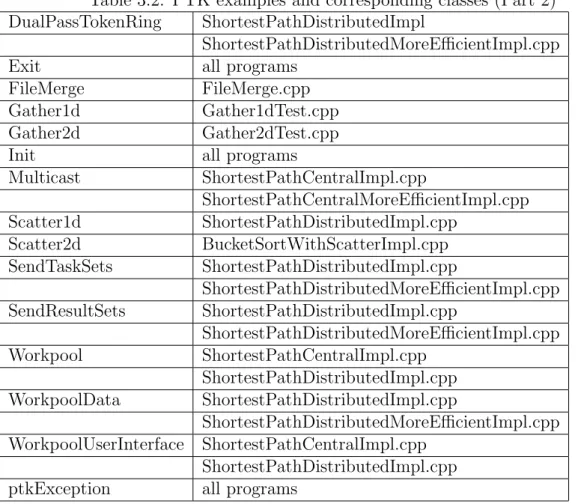
Other examples, which show the usage of the various PTK-C++ classes can be found in$PTK HOME/examples. Please refer to Table 3.1 and Table 3.2 for the list of examples.
Table 3.1: PTK examples and corresponding classes (Part 1) Toolkit Class Example/test program
AllToAll1d AllToAll1dImpl.cpp AllToAll2d AllToAll2dImpl.cpp BucketSortWithAllToAll2dImpl.cpp CentralizedWorkpool ShortestPathCentralImpl.cpp ShortestPathCentralMoreEfficientImpl.cpp SumOfSquaresTest.cpp
CommonVarHelper all programs
DistributedWorkpool ShortestPathDistributedImpl.cpp
16
Table 3.2: PTK examples and corresponding classes (Part 2) DualPassTokenRing ShortestPathDistributedImpl
ShortestPathDistributedMoreEfficientImpl.cpp
Exit all programs
FileMerge FileMerge.cpp
Gather1d Gather1dTest.cpp
Gather2d Gather2dTest.cpp
Init all programs
Multicast ShortestPathCentralImpl.cpp ShortestPathCentralMoreEfficientImpl.cpp Scatter1d ShortestPathDistributedImpl.cpp Scatter2d BucketSortWithScatterImpl.cpp SendTaskSets ShortestPathDistributedImpl.cpp ShortestPathDistributedMoreEfficientImpl.cpp SendResultSets ShortestPathDistributedImpl.cpp ShortestPathDistributedMoreEfficientImpl.cpp Workpool ShortestPathCentralImpl.cpp ShortestPathDistributedImpl.cpp WorkpoolData ShortestPathDistributedImpl.cpp ShortestPathDistributedMoreEfficientImpl.cpp WorkpoolUserInterface ShortestPathCentralImpl.cpp ShortestPathDistributedImpl.cpp
ptkException all programs
3.1
Example using the ShortestPathCentralWorkpool
The shortest path example has been divided into two classes ShortestPaths ,
ShortestPathImpl1 and one main programShortestPathCentralImpl.cpp.
Shortestpath logic common to both centralized and distributed workpool examples has been included in the ShortestPaths class.
The library user should create a class that inherits from theWorkpoolUserInterf
-aceand provide implementations for the inherited methods,processTask(...) and
class ShortestPathImpl1: public WorkpoolUserInterface<int,int> { int processTask(int *task, int **ptkResult, int *returnSize);
int processResult(int *results, int **ptkNewTasks, int *numNewTasks); }
The task in this example is composed of a vertex, represented as an int, followed by an array of ints, which represent the current best set of distances from the source. The
processTask(...) method of the ShortestPathImpl1 class, copies the incoming
task values into a local vertex value and adistances array. distances is a member of the ShortestPaths class.
The processTask(...) method then traverses the distances array, checking to
see if there are any new distances that are better than the current one. If it finds a better distance, it stores the new information. The first value it packs is the array index, which represents the path through which the new distance comes. The second value is the vertex, and the third is the new distance. These can be thought of as sets of results. These results are packed into a global array so that we are not incurring the overhead of frequent memory allocation and deallocation. The function returns values appropriate to whether or not it found any new results.
The processResult(...) method of the ShortestPathImpl1 class, handles the
incoming new results. The number of results in the results array is the first element in that array, represented as an integer. This value is extracted and assigned to a value named size. The results array is iterated sizetimes. At each iteration, the vertex, the vertex the new distance is through (the fromVertex), and the new distance are considered. If the new distance is better than the distance we have stored for this vertex, the new information is stored. If new information is stored, a flag is set to indicate that there is new data for that vertex. Then the array of flags is looped
18 through, and new tasks for vertices are created if there is new information to handle.
The main pieces of code in ShortestPathCentralImpl.cpp :
As Init and Exit are Singleton classes, getInstance() methods need to be invoked.
Init &init1 = Init::getInstance(); Exit &exit1 = Exit::getInstance();
The initialize() method from the Init class initializes the PTK environment.
Failure to invoke this method will result in malfunction of the code.
init1.initialize(argc, argv);
The current process number (me) and group size (gsize) values need to be retreived in the following manner.
me = init1.getMyProcessNumber(); gsize = init1.getGroupSize();
An instance of theCentralizedWorkpoolclass is created by passing in a reference
toShortestPathImpl1, a subclass of the WorkpoolUserInterface.
ShortestPathImpl1 *sPathImpl = new ShortestPathImpl1(....); wpool = new CentralizedWorkpool<int, int>(sPathImpl,
root, verbose);
In order to trigger the centralized workpool logic, the handleWorkpool(...)
method is called. try { messagesSent = wpool->handleWorkpool(A, taskSize, resultSize, 1); // arraylen } catch (ptkException* e) {
cout << "Exception caught" << endl; cerr <<e->getMessage() << endl; }
exitProgram() needs to be called at the end of every MPI program as it invokes
MPI::Finalize().
exit1.exitProgram();
3.2
Example using the ShortestPathDistributedWorkpool
The shortestpath example using theDistributedWorkpoolis similar to the above ex-ample. This section deals with those pieces that differ from theShortestPathCentraliz
-edWorkpool example.
The ShortestPath example has been divided into two classes ShortestPaths ,
20 The library user should create a class that inherits from theWorkpoolUserInterface
and provide implementation to the inherited methods,processTask(...) and
processResult(...). This is illustrated in the snippet below.
class ShortestPathImpl: public WorkpoolUserInterface<int,int> {
int processTask(int *dataToProcess, int tasksToProcess, int **ptkNewTasks, int *numTasks,
int **ptkResults, int *numResults); int processResult(int *result);
.... }
In this example, each process is responsible for (total vertices / number of processes in group) number of vertices. As each process keeps its own current set of best results, the entire distance array does not need to be sent as part of the task.
The processTask(...) method picks up the vertex, path, and distance
infor-mation from the incoming task. It iterates through its current best distances array to see if the new vertex information creates any new tasks. As it finds new tasks it stores them up. Each new task contains information about the process to send the new task to, the vertex, the path, and the new distance.
The processResult(...) method is triggered at each node and it iterates
through the new distances received, compares them to the nodes’ own current best data, and replaces any values that are better than the current one.
Main pieces of code in ShortestPathDistributedImpl.cpp :
An instance of the DistributedWorkpool class is created by passing in a reference
toShortestPathImpl, a subclass of the WorkpoolUserInterface.
ShortestPathImpl *sPathImpl = new ShortestPathImpl(....);
Workpool<int> *wpool = new DistributedWorkpool<int, int>(sPathImpl, granularity, root, verbose);
In order to trigger the distributed workpool logic, the handleWorkpool(...)
method is called. try { messagesSent = wpool->handleWorkpool(A, taskSize, resultSize, 1); // arraylen } catch (ptkException* e) {
cout << "Exception caught" << endl; cerr <<e->getMessage() << endl; }
22
CHAPTER 4
TESTING AND BENCHMARKING
4.1
Testing coverage of toolkit classes
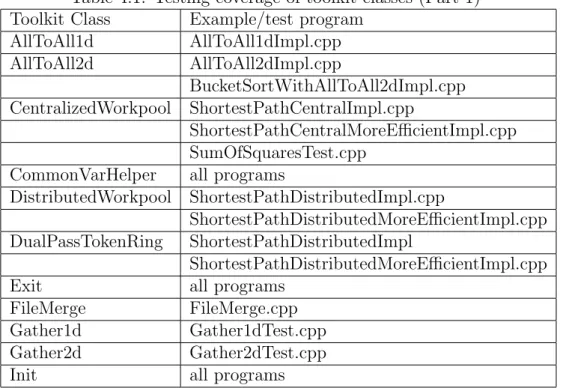
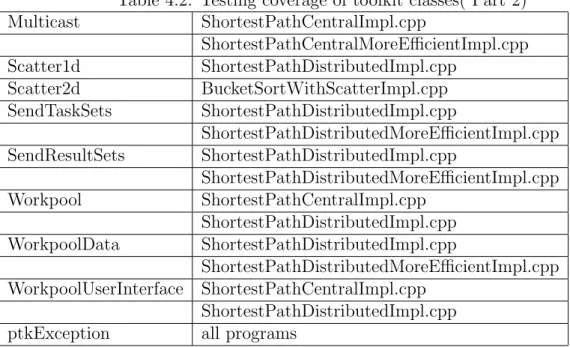
The tables 4.1 and 4.2 list out the various classes and their corresponding test programs.
Table 4.1: Testing coverage of toolkit classes (Part 1) Toolkit Class Example/test program
AllToAll1d AllToAll1dImpl.cpp AllToAll2d AllToAll2dImpl.cpp BucketSortWithAllToAll2dImpl.cpp CentralizedWorkpool ShortestPathCentralImpl.cpp ShortestPathCentralMoreEfficientImpl.cpp SumOfSquaresTest.cpp
CommonVarHelper all programs
DistributedWorkpool ShortestPathDistributedImpl.cpp
ShortestPathDistributedMoreEfficientImpl.cpp DualPassTokenRing ShortestPathDistributedImpl
ShortestPathDistributedMoreEfficientImpl.cpp
Exit all programs
FileMerge FileMerge.cpp
Gather1d Gather1dTest.cpp
Gather2d Gather2dTest.cpp
Table 4.2: Testing coverage of toolkit classes( Part 2) Multicast ShortestPathCentralImpl.cpp ShortestPathCentralMoreEfficientImpl.cpp Scatter1d ShortestPathDistributedImpl.cpp Scatter2d BucketSortWithScatterImpl.cpp SendTaskSets ShortestPathDistributedImpl.cpp ShortestPathDistributedMoreEfficientImpl.cpp SendResultSets ShortestPathDistributedImpl.cpp ShortestPathDistributedMoreEfficientImpl.cpp Workpool ShortestPathCentralImpl.cpp ShortestPathDistributedImpl.cpp WorkpoolData ShortestPathDistributedImpl.cpp ShortestPathDistributedMoreEfficientImpl.cpp WorkpoolUserInterface ShortestPathCentralImpl.cpp ShortestPathDistributedImpl.cpp
ptkException all programs
4.2
Graphs comparing the performance of C vs C++
0 200 400 600 800 1000 1200 1400 1600 0 2 4 6 8 10 12 14 16 18 20
Ti
me
in
sec
on
ds
Vertices C++ CFigure 1: C versus C++:Shortest Path Central (Simple) - with granularity = 1.
i
Figure 4.1: C versus C++:Shortest Path Central (Simple) - with granularity = 1. Vertices in K‘s
Figure 4.1 illustrates the difference in performance between the C and the C++ version. The performance is comparable and shows that there is not much overhead
24 from the object oriented approach. The C version of the PTK stops functioning after 6000 vertices. This is an artifact of malloc() which is used in the memory allocation. The C version uses a growable array which doubles its size, on the fly, whenever the original array runs out of memory. malloc() has a limitation where it cannot allocate memory beyond a certain value depending on the compiler. On onyx the limit is 2Gig. Once the program gets to a point where more than 2Gig needs to be allocated,malloc() returns a NULL pointer and the program exits.
This can be surmounted in other ways, like using linked lists. This, however, resulted in significant performance degradation and was not very practical when implemented. The C++ version uses vectors, which are available in C++. The memory allocation is handled by C++ libraries. As a result, the C++ version was able to run upto 20000 vertices.
0 50 100 150 200 250 0 2000 4000 6000 8000 10000 12000 T im e in se co n d s Vertices C++ C i
Figure 4.2: C versus C++:Shortest Path Central:Granularity=200, Vertices per task=100
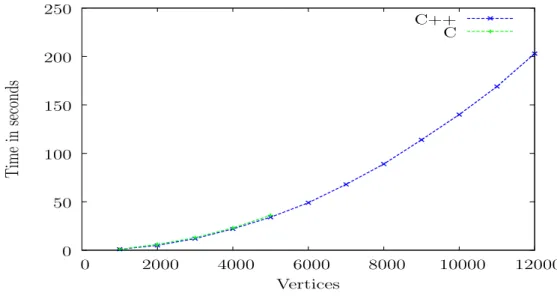
Figure 4.2 illustrates the performance of the C and C++ versions for the more efficient case of the ShortestPathCentralized example. As in the previous graph, the C version exhibits the limitation of malloc()and stops functioning at 6000 vertices.
0 50 100 150 200 250 300 350 400 450 500 0 2000 4000 6000 8000 10000 12000 14000 16000 T im e in se co n d s Vertices C++ C i
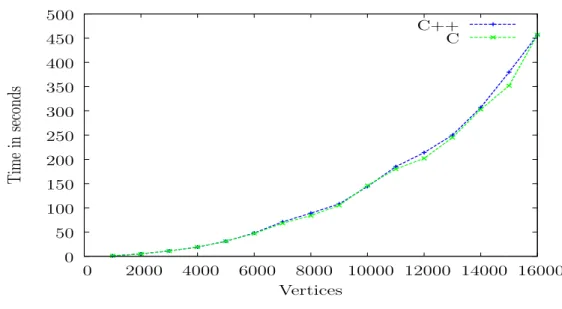
Figure 4.3: C versus C++:Shortest Path Distributed (Simple) - with granularity = 1
Figure 4.3 illustrates the performance of the C and C++ versions for the simple case of the ShortestPath example, which uses the Distributed Workpool. The per-formance is very similar. The memory allocation constraint for distributed workpool is much more relaxed than the centralized workpool, as memory is allocated across multiple machines.
26 0 20 40 60 80 100 120 0 2000 4000 6000 8000 10000 12000 14000 16000 T im e in se co nd s Vertices C++ C i
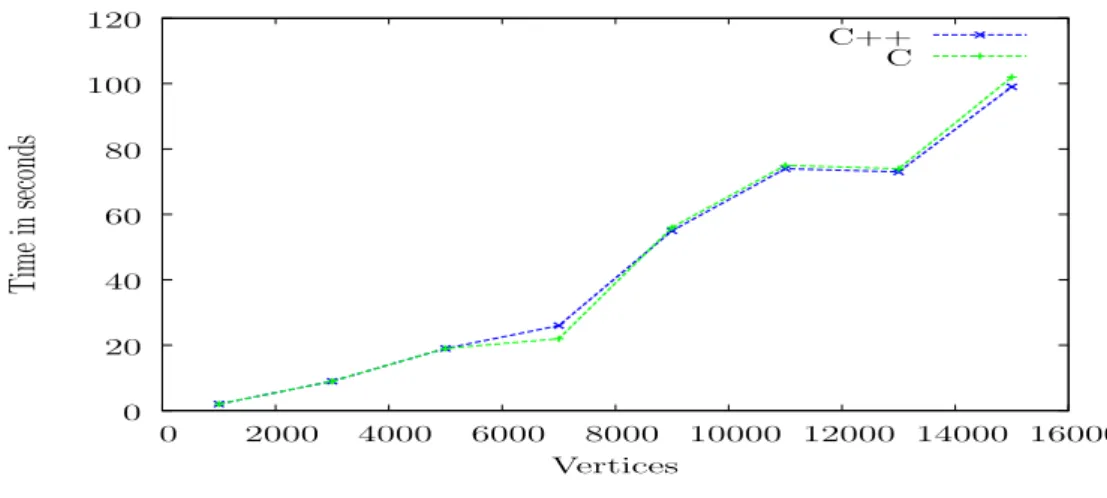
Figure 4.4: C versus C++:Shortest Path Distributed:More Efficient,Granularity=200 Figure 4.4 illustrates the performance of the C and C++ versions for the more efficient case of the ShortestPath example, which uses the Distributed Workpool. The performance is very similar.
4.3
Simulation notes
All the graphs were generated with the number of processors = 20. Testing was performed on two department clusters, onyx and beowulf.
CHAPTER 5
CONCLUSIONS
5.1
What have we done so far?
PTK-C++ provides an object-oriented version of PTK-C. PTK-C++ now allows the user to fully reap the benefits of the MPI C++ bindings.
PTK-C++ provides support for common design tasks used throughout parallel programs. The examples given help a user understand how to use the library classes. The data-sharing patterns of gather, scatter, and all-to-all allow users the flex-ibility of having odd amounts of data that are not evenly divisible by the number of processes. The two-dimensional versions allow the user to share “ragged” arrays of data. These elements are not provided by MPI. The file-merging functionality automates a common cluster task.
The workpools remove a significant layer of detail from writing workpool code. The user of the workpool needs to provide the library with functions for processing tasks and results. The library takes care of sending and receiving tasks and results. Most importantly it handles termination detection, which can be quite cumbersome to design and write.
The testing results are consistent with expectations in that PTK-C++ is compa-rable to PTK-C in terms of performance.
28 In most cases it would be more efficient to use the toolkit than to rewrite the code to incorporate the efficiencies already present in PTK.
5.2
Design Patterns
The Singleton pattern has been used for imlementing the Init and Exit classes as they fit the criterion for the Singleton.
The project has a few instances where the code was implemented based on inspi-ration from the Strategy pattern. For example, the Workpool abstract class defines
two(CenralizedWorkpool and DistributedWorkpool) sets of algorithms. Each of
the set encapsulates its own algorithm and the user is given the choice of picking the algorithm at run-time.
5.3
What have we learned
• Object Oriented Design: A project cannot be started with the preconceived notion of using Design patterns. It involved thinking in terms of classes and object oriented approach. The design started of by investigating the required functionality rather than by translating the C code into C++.
• Had to learn the details of MPI-C++ to use them in the PTK.
5.4
Potential Future work
5.4.1 Complex Datatypes
The PTK-C and PTK-C++ implementations function with simple datatypes. The PTK-C++ classes could be easily enhanced to work for complex datatypes.
5.4.2 Multi-threading
Experimenting with multi-threading, particularly in the centralized workpool, would be worth while doing. There may be a bottleneck in the root being able to hand out tasks quickly enough. Creating separate threads for communication and computation might solve this problem. The decision was made to avoid any threading, to make the code as universal and portable as possible.
30
REFERENCES
[1] Kirsten Allison. PTK: A PARALLEL TOOLKIT LIBRARY M.S. Thesis, Computer science department, Boise State university, 2007
[2] William Gropp, Ewing Lusk, Anthony Skjellum.Using MPI: Portable Paral- lel
Programming with the Message-Passing Interface. The MIT Press, Cambridge,
Massachusetts, 1999.
[3] Sachs, N, McGough, J. A Hybrid Process Farm/Work Pool Implementation in a Distributed Environment Using MPI. Conference Proceedings, Midwest
Instructional Computing Symposium , Duluth, MN, April 2003
[4] Douglas Gregor, Matthias Troyer. Boost.MPI.
http://www.boost.org/doc/libs/1 46 1/doc/html/mpi.html#stylefiles
[5] Edsger W. Dijkstra, W.H.J Feijen, A.J.M van Gasteren. “Derivation of a Ter-mination Detection Algorithm for a Distributed Computation.” Information Processing Letters, vol. 16(5), pp. 217-219.
[6] Jason Man and Amit Jain.PRAND: A Parallel Random Number Generator. Oct 2008. http://cs.boisestate.edu/~amit/research/prand.
APPENDIX A
MPI DATATYPES
The datatypes supported in the MPI version of the PTK-C++ toolkit are defined as follows: MPI::CHAR MPI::SHORT MPI::UNSIGNED_SHORT MPI::INT MPI::UNSIGNED MPI::LONG MPI::UNSIGNED_LONG MPI::FLOAT MPI::DOUBLE MPI::LONG_DOUBLE MPI::LONG_LONG_INT
32
APPENDIX B
INSTALLING THE PTK LIBRARY
The library is available to download athttp://cs.boisestate.edu/~amit/research/ptk. You can either download the library as tarballs or as RPM files. You will need MPICH version 2 (or some other MPI-2 supporting libary). You will also need the prand library [6] to run some of the examples.
To install MPI version of the PTK library from the tarball, use the following commands:
tar xzvf ptk-mpi.tar.gz cd ptk-mpi/src
su