BEHAVIOURAL SAFETY APPLICATION GUIDE
Final Version
Prepared by
by Tony Fishwick, Tim Southam and Dan Ridley, John Ormond Management Consultants Ltd,
Blackpool, Lancashire, England. Tel 01253 792992
Fax 01253 314234
www.john-ormond.co.uk
PROCESS INDUSTRIES SAFETY MANAGEMENT (PRISM) THEMATIC NETWORK ON HUMAN FACTORS
BEHAVIOURAL SAFETY APPLICATION GUIDE DATE April 2004
by Tony Fishwick, Tim Southam and Dan Ridley, John Ormond Management Consultants Ltd,
Blackpool, Lancashire, England.
CONTENTS
Chapter Title
1 Overall Aims, Objectives and Target Users of the Guide 2 Summary of the Contents of the Guide (page 3).
3 Review of Behavioural Safety Modification (page 5).
4 Some Available Behavioural Safety Modification Programmes (page 20).
5 Does it Work? (page 29).
6 Advice on User Application of the Guide ( page 32). 7 Case Studies (page 40)
8 Conclusions (page 46) References (page 48)
Appendices (page 51).
1 A Directory of Some Behavioural Safety Modification Programme Providers
CHAPTER 1
OVERALL AIMS, OBJECTIVES AND TARGET USERS OF THE GUIDE This Behavioural Safety Application Guide (the Guide) is one of the documents forming part of the Process Industries Safety Management (PRISM) Thematic Network on Human Factors coordinated by the Project Co-ordinator, the European Process Safety Centre (EPSC).
The overall aim of the Guide, as stated in EPSC’s proposal (Ref 1) is to:
“produce an Application Guide on Behaviour Modification Programmes, including case studies of existing applications of a range of behaviour modification programmes, from at least three European Community countries. The Guide is to be suitable for use by industry, educational establishments and commercial organisations, and to take special account of the needs of small and medium sized enterprises (SMEs).”
It is supported by an Appreciation Training Package in Powerpoint format. This will focus on the advice on User Application (Chapter 6), and draw from other Chapters as appropriate.
The special focus of the Guide (the needs of SMEs) recognises that SMEs form an important part of the industry within Europe, and are often in particular need of guidance on how to improve their safety standards and performance. This is not because they are inherently poorer at safety management than larger organisations, but because they do not always have the resources to seek, establish and implement solutions, particularly novel ones, that are, or become, available. The Guide sets out to provide guidance on how this barrier might be overcome and enable SMEs to use tools to improve their safety performance. This aspect is considered in more detail in Chapter 5. Despite this emphasis, it is intended that the Guide will also be useful to a range of companies, right up to the very largest. The tools and techniques described are applicable to systems of improvement aimed at activities ranging from the most commonly encountered, such as moving around or handling heavy loads, right up to specific, high-risk tasks such as dealing with large quantities of hazardous materials, although in this last case, many other factors also play an important part as described in Chapter 6.
CHAPTER 2
SUMMARY OF THE CONTENTS OF THE GUIDE
In this chapter, a brief summary of the contents of each succeeding chapter and appendix is given,
Chapter 3-Review of Behavioural Safety Modification Programmes
A brief overview is provided of some of the basic principles which underpin the application of ‘Behavioural Safety Modification’. This subject is presented in a narrative, discussion style, drawing information from particular providers or types of programme as appropriate. Information is presented and discussed initially in a general manner, without any attribution to individual providers. This is so as to present information in a totally objective, unbiased way.
Chapter 4-Some Available Behavioural Safety Modification Programmes
Information about available programmes has been drawn from a variety of sources. Sources of information include providers’ and others’ websites, the open literature, advertising material, conference proceedings, network members’ own experience and knowledge, information gained from potential users and other sources.
By the nature of the exercise, it is not a totally comprehensive review, but every effort has been made to include key points from as many programmes as possible.
A range of “tools” that might be of particular interest to SMEs is highlighted briefly. Here it is necessary in some cases to name the originator of the tool but it is made very clear that this does not imply any preference or recommendation for any particular provider.
Chapter 5-Does it Work?
A number of examples are given of the benefits which companies have obtained from the implementation of ‘Behaviour Improvement”. These are drawn from a range of industries.
Chapter 6-Advice on User Application of the Guide
In this chapter, all the foregoing contents of Chapter 3, 4 and 5 are drawn together and presented in a “menu-style” format intended to allow users to select a programme, or aspects of different programmes, that might suit their individual needs. Cross-reference to the Case Studies, described in Chapter 7, is made as appropriate.
Chapter 7-Case Studies
The applicability, and viability, of some of the safety behaviour modification techniques described in the Guide is illustrated by the Case Studies in this chapter. The studies have been carried out with 6 different companies across 3 EC countries and are chosen with a view to looking at different techniques so as to support the “menu” principle of Chapter 6.
Chapter 8-Conclusions
It is not the purpose of this Guide to draw firm conclusions as to which is (or are) the best, or better, of the many available safety behavioural providers and techniques. Rather, it is for the users to be able to select, from the Guide, a programme to suit their needs and, thereby, draw their own conclusions. Nevertheless, some totally objective observations are included in this chapter with the intention of assisting users in this selection process.
Appendix 1
This is a directory of some of the providers of behavioural safety modification programmes. As for the information in Chapter 3, there is no claim that this directory is comprehensive and no comment is made about any provider’s programme. It is merely intended to allow users to begin a process of identifying, and communicating with, potentially useful providers either in this Directory or identified as a consequence of using it.
CHAPTER 3
REVIEW OF BEHAVIOURAL SAFETY MODIFICATION
3.1 What is behavioural safety modification?
In simple terms, “behavioural safety” can be spelt out as a process of getting ahead of accidents by
being proactive
visualising the potential worst consequences of a particular activity or behaviour
working out what might be done to avoid those consequences
putting that into effect in the behaviour, so as to avoid those consequences In other words, a simple, but effective, form of mental risk assessment. The modification of behaviour is then the integration of this new improved behaviour into standard best practice to form a critical part of “How business is done”.
Behavioural safety can also be looked upon as a range of techniques whose aims are to reduce the number and severity of injuries and accidents by increasing the frequency of safe behaviours and decreasing the frequency of unsafe behaviours. Such techniques of behavioural safety are based on proven and validated principles of behavioural psychology.
The well-established principles that underpin the modification of human behaviour (Refs 2 and 3) include the following important features:
- Behaviour can be measured – but first, it has to be defined so that everybody understands what is being measured and, crucially, observable and observed. Key safe (and unsafe) behaviour (KSB) lists or Critical Behaviour Lists (CBL) are a vital starting point in the process of modifying behaviour.
- Behaviour is a function of its known, or perceived, consequences-people will behave in a certain way until the consequences change and become unfavourable (an accident) or they become convinced that they will change so that their beliefs and values change. The Antecedents – Behaviour – Consequences (ABC) analysis is one technique that can be used to develop a plan to recognise, and change consequences and antecedents (triggers) in such a way as to increase desired behaviours.
This can be illustrated by a couple of simple examples. The first relates to the workplace. Operators using cutting oil often failed to wear protective gloves even though they knew that there was a long-term possibility of contracting dermatitis. It was much easier to work with bare hands, i.e. short-term benefit (consequence). Management conducted a structured, supportive campaign to convince their workforce of the benefits to their own health of wearing gloves. More comfortable gloves were provided, and made easily available. Praise for using them was given. A high profile publicity campaign highlighted the discomfort of dermatitis. Gradually, a
change in the perceived consequences was brought about and glove wearing become the norm.
The second is from every day life and is potentially more dramatic. A person lives on one side of a busy road. On the other side, right opposite, is the shop at which he buys his daily newspapers every morning. Fifty metres away is a designated pedestrian crossing. To save time, he dodges the traffic every time he crosses the road immediately outside where he lives. He perceives that the small but certain benefit of getting his newspaper quickly outweighs the small possibility of being knocked down by a car. One morning, he sees a much younger, fitter person do the very same thing but very narrowly avoid having an accident. He realises that he has been exposing himself to that same risk every day for years. Ever after, he crosses the road at the pedestrian crossing. His perception of the “risk” of his actions has been positively changed.
- Behaviour can be changed by providing positive reinforcement – thanks, acknowledgment of, and praise for safe behaviour and support from colleagues and management will encourage behavioural change. All too often, organisations will reward good behaviour for the production, technical or commercial activities but fail to reward good safety behaviour. They prefer to use discipline and punishment of poor safety behaviour, which actually reinforces the taking of short cuts. The results of behaviour measurement need to be clearly available to everybody involved so as to publicise the benefits of changing from unsafe, to safe, working practices.
- Goal setting – the setting of realistic and achievable targets for increasing the percentile change to safer behaviours by both management and other employees, is critical to achievement of the safety vision.
Further discussion of these, and other related aspects can be found in reference 3. 3.2 Why is safe behaviour so important?
There are many good reasons for targeting safe behaviour as a means of reducing injury and occupational ill health to form part of an integrated safety management system. A considerable amount of research, coupled with practical experience, has demonstrated that safety behaviour modification, when implemented well, results in many business benefits including fewer injuries, cost savings increased production and improvements in employee attitudes to safety. This is also demonstrated by a study carried out by the UK Health and Safety Executive which indicates that the real cost of accidents, including production losses, insurance and legal costs, re-training, etc. ranges up to £25,000 for a lost time accident. (Ref. 6). The accident triangle (Ref 4) and Figure 1, below, shows that there are consistent relationships across very wide statistical databases, between the numbers of injuries, of all degrees of severity, and unsafe behaviours or near misses that may, or may not, lead to injury. A number of experts in the field (Ref. 34 is a good example) can be referred to for further additional reading on the subject.
Observations of unsafe behaviour have shown that, although a particular unsafe act can be committed many times (certainly at least 99% of occasions) without injury being a consequence, there is no way of knowing in advance the occasion when injury will occur – only that sometime it will. Thus, by carrying out unsafe acts, people are actually “gambling” with their own, and others’ safety and lives. Analysis of the causes of injury shows that, in modern times, almost all (at least 96%) of all injuries could have been prevented either by the individual who was injured or by someone else. This is in sharp contrast to earlier times, such as the 19th century when most
injuries were caused by faulty machinery (Ref 4).
From all this, it can be concluded that reducing unsafe behaviour will naturally lead to reductions in the size of the upper parts of the triangle right up to fatalities. Practical results have validated the conclusions and shown significant reductions in the number, and severity, of reportable injuries.
However, it must be strongly emphasised that the behavioural approach is not in itself a panacea for all safety problems in the workplace. It must be supported by a strong, conventional safety management system, equipment which is safe and fit for purpose, and trained and competent staff. Conversely, safety approaches that do not involve the consideration of human factors, including behavioural improvements, will fail to deliver the full potential benefit. (Ref 48 and 49).
There is often a debate between whether it is beneficial to try to change “safety attitude” before “safety behaviour” or vice versa. A psychological approach shows that the causal link between behaviour and attitude is the stronger. After some time (approximately 18 months) humans seek alignment between their internal mental models, and their external behaviour and tend to change their attitudes permanently so that they become consistent with the newly adopted behaviour. For these reasons, proponents of behaviour modification recommend changing behaviour first, not attitude. On the other hand, if attitude is considered to be just one of a range of emotions contributing to a total safety culture, then there is evidence that culture (including things such as attitudes, values and beliefs) needs to be modified before real inroads into permanent behaviour change can be made. Both of these approaches are discussed in more detail later in this chapter.
Thus, it can be seen that the theories of behavioural change process advocated by many of the consultancy practices engaged in behavioural safety are largely based on the principles of behavioural psychology. Defining psychology as ‘the scientific study of behavioural’, it must be pointed out that the behaviourist approach is only one of the seven major perspectives of psychology. Whilst some psychologists would have us to believe that this way of conceptualising human behaviour is the only ‘true’ perspective, to take such an exclusive view is to belittle the complexity of humanity and psychology itself. Each perspective allows us to observe human behaviour from a different standpoint and to develop a range of interventions that can assist people to adopt different behaviours.
3.3 Types of behavioural safety modification programmes
There are many organisations that market and provide behavioural safety modification programmes and all will claim (often rightly) a degree of uniqueness of their own product and its effectiveness. It is not the purpose of this guide to recommend, or advise against, any one of these. Rather, it will set out to describe principles and practicalities in a way that will allow potential users to make their own choice. A very good summary of the advantages, and potential pitfalls, of behaviour – based safety was produced in 1996 (Ref. 5). Most of what it contains, including a definition of behaviour-based safety for a “workforce led” system, is relevant today.
There are a number of basic features of behavioural safety modification programmes, including those that also incorporate safety culture change, and these are now listed with brief comment to set the scene for more detailed discussion to follow:
(i) ownership – without doubt, the best results are obtained when there is a clear management commitment to support the process stemming right from the top level in the organisation. Nevertheless, full employee involvement, right to the most junior levels, is equally important.
(ii) safety culture – as stated above, there is evidence that, unless managers and workforce accept that there is a need to change, no lasting changes will be made.
(iii) who leads the programme – this can be external consultants or in-house specialists or a combination of both.
(iv) definition of safe and unsafe behaviours – an essential starting point, or marker, on the road to improvement. These definitions can be generated from previous injury, or accident data, or from risk assessment.
(v) training – includes training in the need to follow existing safe practices and in techniques (probably new to the organisation) for improving behaviour.
(vi) observation – what should be observed, and by whom, is covered here. (vii) establishing baselines – these will include accident statistics but will also
incorporate the important area of “input” or preventive measurements such as audits and safety inspections.
(viii) feedback and reinforcement – all real and perceived barriers to people providing feedback about injuries and “near misses” need to be broken down. Positive management support, trust, respect, general concern and encouragement are vital to this. It is also important to get workforce, and trades union, endorsement and “buy in” – vital to development of a “no blame” culture.
(ix) targets and goals – should be set participatively between management and workforce and should be realistic and achievable. They should be changed as time proceeds to enable progressive attainment of the long term vision. (x) audit and review – the results of the programme, against the targets that
have been set and other features, should be reviewed, audited and, if necessary amended on a scheduled basis.
(xi) when does the programme end? – the simple answer is “never”. Even the very best (world class) organisations, in safety management terms, are always seeking further improvement.
These features are each now discussed and described in more detail. 3.4 Ownership
The most senior managers, up to director level, must be committed to support and visibly lead, any process of safety behaviour change for it to have any chance of success. This can be difficult. Very few, if any managers, will be unaffected by an injury to one of their employees but, nevertheless, they are traditionally motivated by other factors such as meeting production targets and business profitability. They sometimes see these as conflicting with safety. In fact, these issues go hand in hand with safety. In the UK, the true cost of an injury that results in more than three days lost time (the so-called Lost Time or Reportable injury) is around £25000 (about 40K euro), (Ref 6) so good safety performance saves real money.
Critical examination of accident, injury and occupational health data, using the accident triangle, and real life experiences, can be used to firstly persuade managers that there is a safety problem to be addressed then, secondly, to “kick start” a process of gaining their commitment.
The way managers behave in their everyday working life is equally important. Do they set a good safety example or not? Is there a culture in which achievement of production targets is regarded more highly than working safely? What do their employees perceive as being the things most important on their agenda? All these things will influence the way that the workforce behaves. One technique used to
assess these factors is Upward Appraisal (Ref 7). In this technique, a range of questions on safety practices, attitudes and commitment to safety, and safety leadership is posed. Managers are invited to assess themselves, then workforce teams and individuals assess the management.
Some form of independent assessment, or survey, of the existing safety management and culture, and employee perceptions of it, should be carried out before starting on any type of behaviour modification programme, so as to establish baselines to work from and targets to aim for. A range of such survey tools is available and a summary is given in Ref 8. An additional one is the UK Health and Safety Executive Climate Survey (Ref 9) and the HSE have also commissioned a review of available tools for measurement of safety climate (Ref 10). Some programme providers augment these with safety questionnaires on key points chosen to identify attitudes/behaviours in critical areas.
Employees, and their representative organisations, must be fully involved with all of the above. In addition, they need to constructively examine their own codes of safety behaviour. Not all risks are taken due to management “pressure”. There are many other factors like peer pressure, wishing to appear “macho”, rushing so as to finish a job quickly, unwillingness to use protective measures etc. Some providers recommend modification programmes that depend on the workforce, rather than management, taking ownership of the modification programme. Whether this type of programme, or one in which management ownership is integrated with full employee involvement, is chosen, both should make some form of visible commitment to the success of the programme, and their part in it.
3.5 Safety culture
Although most behaviour modification providers would advise that changing behaviour, rather than attitude, is the key to improving safety performance, (Ref 3) a few argue that the overall safety culture must be changed before any lasting improvement can be maintained. Safety culture can be described as the combination of attitudes, beliefs and values about safety, stemming right from the top of an organisation, that go towards determining how people in the organisation behave in the field of safety. Thus, it is argued that the two components, culture and behaviour, are inextricably linked. Some of these intervention techniques are described in refs 4 and 8. A complimentary application guide to this one, on the subject of safety culture, deals in detail with all these issues (Ref 38).
It is inevitable that measures to improve the work or task environment will, during implementation initially increase demands on individuals. As time goes on, these demands will reduce as changes become permanent and accepted as part of every day business life. Improved managerial communication, attitudes to safety and employee welfare, and safer workforce practices, will be encouraged and developed. Greater understanding of the collective, and changing demands in the workplace will decrease stress factors and reduce the likelihood of accident. Many of the factors referred to below, in particular in areas of programme leadership, training and reinforcement are features of culture change just as much as of behaviour modification. An important aspect of safety culture is where an organisation’s culture stands at any point in time.
The Safety Culture Maturity Model, referred to later and described more fully in Ref 26, provides guidance on this.
3.6 Who leads the programme?
There are essentially three choices here but noting that whichever is chosen, the ultimate responsibility lies with management:
(i) led throughout by external specialist consultants
(ii) led by internal specialists or other “in house” employees
(iii) led by some combination of both internal, and external, personnel
There are advantages and disadvantages to all of these and some are now outlined and discussed.
3.6.1 External specialist leading
The experienced external specialists will bring with them a range of tools and experiences that are very valuable to an organisation embarking on a programme for the first time. They can be equally useful to organisations that have worked in the field for some time, made safety improvements already but, perhaps reached a “plateau”. That is, they are experiencing difficulty in moving their safety performance further along the road. Different techniques, and the fresh approach brought by an outside body, can help to bring about further improvements. The main disadvantages for use of external specialists are firstly, gaining and keeping acceptability with the workforce and secondly, particularly for SMEs, cost. It may also lead to an “opt out” by line management.
3.6.2 Internal specialist leading
The internal specialists will know the details of the existing safety record, management system, features of safety behaviour and other factors and, therefore, should be ideally placed to put a programme of behaviour modification in place. There is good evidence that they can promote significant improvements particularly when the existing safety performance is only average or worse, provided they are allowed sufficient autonomy from line managers who may be seen to have conflicting priorities. Disadvantages include absence of that very autonomy, being part of the existing organisational, political and cultural structure, and institutional insularity which can tend to inhibit them from identifying, and dealing with, some of the key issues. A major barrier that can sometimes exist, is an unwillingness to accept that the workforce have ideas that are just as good as management’s. However, if these matters are addressed constructively, significant improvements can be made, and success achieved. Some providers have addressed this problem by offering systems of workforce ownership of behaviour modification programmes to recognise the great value of contributions from the workplace. A difficulty for SMEs may be that they do not always have identified in-house safety specialists or the facility to train them.
3.6.3 A combination of external specialist and in-house personnel
This is a combination that has gained most favour with a range of organisations. It has the advantage of using the specialist consultant experience in the early stages then, by coaching and mentoring selected people and assisting the development of internal expertise, moving on to the lower cost option of in-house personnel using, and developing, the techniques themselves. Most providers will offer the option of formally training and validating in-house personnel in the techniques to be used. Careful selection of in-house trainers, trained by the specialist, can be a powerful means of communicating commitment to the chosen process. This method may be most use to SMEs because of its combination of identifying in-house champions and relatively low cost. Disadvantages include “tailing off” of commitment because there is no external impetus and, sometimes, choice of in-house trainers for the wrong reasons. The provider will normally address these, and other issues, by systems of follow-up and audit.
Whichever process is chosen, it is important to remember that, in order to ensure success in improving safety performance, the “organisation” owns the programme, not the “consultant specialist”. This should be demonstrated by appointment of a company “champion” to front the company’s involvement and by supporting the champion with an effective infrastructure of trainers, working groups and safety committees, and management back up. The importance of the role of the company management, whatever choice is made, is also emphasised here. They must be fully committed to any safety cultural, or behavioural, change and be prepared to demonstrate this in their everyday actions and attitudes (see Ch. 6 and Ref 53).
3.7 Definition of safe, and unsafe, behaviours
The internal specialists, other company employees and external specialists (if any) should work together to establish lists of important (key) safe and unsafe behaviours. This might be co-ordinated by a multi-disciplinary, joint management/workforce working party or steering group. The objective of drawing up such lists is to enable a focus to be made on the main areas to target in the drive to improve safety and, also to allow safe behaviour to be continued and encouraged. Percentage safe behaviour should be monitored, as time proceeds, against type of job, different areas of the workplace, different sections of the workforce and so on. Improvement can thus be measured or, where improvement is still needed, the behaviours to concentrate on can be identified.
Typical sources for generation of behaviour lists include accident and injury reports, near miss reports and unsafe acts records, risk assessments, regulatory body codes of practice and other information (particularly useful for generic types of behaviour) and workforce job safety analyses.
Systems for gathering information about the key behaviours include managerial observations, worker-to-worker (peer) observation, supervisory completion of checklists, self-regulation and others.
Some specific methods are:
- observation of unsafe acts and conditions so that these can be eliminated before they result in accidents
- concentrating on accident and incident investigations to identify root causes and corrective actions
- reinforcement of known “good” behaviours - goal setting and feedback on key behaviours
- identification of safety related behaviours with a high potential for incident free performance as well as those that are likely to lead to incidents
All systems and techniques require a general acceptance that some form of recording, in a “no blame” fashion, is necessary as a basis for continuing analysis and improvement.
Some providers use these techniques to develop “safety performance measures” that identify contributory factors in the chain of events causing accidents and produce lists of unsafe behaviours and situations. From these, checklists for safety audit are developed.
All of these systems depend for their success on the behaviour(s) being observable and measurable and on the regime of observation used. Fairly obviously, people will tend to improve their behaviour if they know that they are being watched or about to be watched. This is the “fixed interval” regime and it is very poor for establishing a sustained improvement in behaviour. Once the observer goes away, often the worker reverts to old habits. Once the “good” behaviour has been established by frequent observation and reinforcement, the most effective observation regime is one of random observation based on a fixed average frequency.
For example, a steady rate for example once per week but with variable times and places.
3.8 Training
Training will need to cover recognised standard training in safe methods of working, in key areas identified above and others, and, in addition, training in the specific techniques of behaviour modification. Thus, for example, organisations should develop training packages for generic activities such as ladder work, manual handling, correct use of personal protective equipment, working in confined spaces and many others. A large fund of information shows that a large percentage of injuries, in all organisations, regardless of their type of business, occurs whilst one of a small range of common activities is being carried out. These activities include misuse of personal protective equipment, manual handling, trapping of fingers and other parts of the body, items falling on people (stored energy) and, often most common of all, simply walking or moving around. Generic training packages should include all these unless there is clear evidence that they do not apply to a particular organisation. Organisation, or site-specific packages should also be developed using key safe behaviours as the starting point. All packages should be developed jointly, by management, employees and their representatives and consultants if used. Safety representatives can play a key role here in identifying, and prioritising, key behaviours that need to be the subject of a training package. All people in the organisation, from most senior management down, should be clear that the safety
training packages, and their application, apply to them as well as to everyone else. There will need to be well defined, and co-ordinated, methods of disseminating the information and increasing its profile in the workplace. These could include videos, PC packages, group training sessions, site rules and newsletters etc and are often best managed by a cross-disciplinary, joint management/workforce steering group. In summary, a massive communications exercise will need to form part of the means of improving safety culture.
The other vital area is training in the specific techniques of behaviour modification that an organisation has chosen to use. This is done either by a consultant specialist or by employees trained by a consultant.
Training will be given in the basic principles of behaviour modification. People behave in a particular way largely because of their perception that the consequences of that behaviour in the past has not led to injury. If they behave unsafely, is it because they are “rewarded” for so doing? For example, are they rushing to meet production targets or to finish a job quickly in order to have more free time? They need to be convinced, that they are putting themselves at risk of potential injury as a consequence of rushing. Linked closely with this is people’s affinity with “early” rather than “late” consequences of an activity. Humans all tend to like to see some rapid outcome (soon) of their actions and often ignore the longer term consequences (later) for the short term gain even when they know about them. A classic example is smoking. Smokers get an immediate good feeling from smoking. They know about the possible long term effects but often push them to the back of their minds until it is too late. A very good way of starting the process of change is to utilise mental imaging techniques. Ask people to imagine the worst thing that could happen to them as a result of a particular activity and what it would cost them to ensure that it does not happen. Almost always, the answer is very little. The visualisation of the accident that has not yet happened forms the basic mental risk assessment that is desirable before undertaking each activity or task. Even on the macro scale, if we only reduce the potential for injury by a small percentage, there are major savings to be made from safe behaviour when the real costs of accidents are calculated.
Behaviour can be measured then changed by providing immediate, regular, specific feedback with reinforcement of “good” aspects. Reinforcement is considered in more detail separately below. Employees will need to be trained in methods of behaviour observation and feedback. Using key behaviour lists as the baseline, checklists would be drawn up and information on behaviours on these lists gathered by peer observation. Alternatively, a series of structured one-to-one discussions would be used to construct a picture of behaviour patterns. Whatever method is chosen, the consultant would provide training in methods of observation, data analysis and use of that data to promote safe behaviour. For discussion techniques, interactive conversational, listening and feedback skills would be developed. In some of these discussion techniques, a method of identifying an immediate, positive benefit of safer behaviour is included. Other methods of providing feedback would be group discussions, notice boards, workplace posters etc. It is important that the recipients of feedback understand and accept it. Otherwise, they will not be committed to changing their behaviours. All this forms part of the training process. Most specialist providers will include packages covering the subject of gathering observational data and using it in the best possible way to improve safety behaviour. This is a recognition of the
importance of this part of the process and of the danger that it can go wrong if not properly managed. Scoring formulae, and methods, are available for calculation of behavioural safety indices to use as a benchmark for improvement and comparison between sites and industries.
3.9 Observation
Training in methods of observation has been covered above. This section deals with the kinds of parameters that it is useful to observe and who should do it.
With regard to who should do it, the answer is fairly simple. Managers, the workforce and their representatives, or external independent observers can all function equally well provided they have been adequately trained in the methods to be used and provided they apply them properly.
As far as what should be observed is concerned, the answer is more variable and dependent on the prevailing circumstances.
Items to consider are:
- key safe/unsafe behaviours and acts - unsafe conditions
- poor housekeeping, untidy workplaces - environmental matters
- productivity matters - quality matters.
Other, more formal, aspects of workplace observations are: - safety inspections and audits
- incident reporting criteria and practices - monitoring near misses.
Decisions on which areas to target in individual organisations will be based on the advice of providers and the use of tools such as the UK Health and Safety Executive’s Safety Climate Survey. As a general rule, organisations starting with “good” safety performances (see Establishing baselines, below) would be able to start by concentrating on the “input” measures like audits, inspections and near misses (but not forgetting the other items), while those with “poorer” performances would need to target the “output” measures like unsafe acts and conditions right from the start as well.
3.10 Establishing baselines
There are a number very important but related, subjects to be considered under this heading.
3.10.1 Recognising the problems
Very often, at the outset of a programme, managers and others in an organisation have difficulty defining what their safety problem (or problems) is (or are) or, indeed, that
they have a problem at all. The first task to be addressed, is to gain recognition of that difficulty as the baseline to move forward from. There are a number of ways in which this can be done but they all depend essentially on consideration of the existing safety performance and what it means in “human effect” terms. In particular, is the current performance unsatisfactory? Accident statistics can be used to illustrate the probability of actual individuals suffering a serious accident (or death). The accident triangle is a powerful tool in this respect. In organisations that have very few injuries, the same discussion can be used to show that unsafe acts and near misses (which actually occur in all organisations) will, eventually, become injuries if they are not eliminated. In some cases, this part of the process may be quite emotional – deliberately – to try to get people to imagine how they would feel if their actions (or inaction) caused someone to be seriously hurt or killed. Those who have had a serious injury themselves or witnessed one, will already be someway along this journey. Once the process of recognition has begun, it will be possible to build on it by demonstrating where an organisation lies within a safety league table. Generally accepted statistics exist for this kind of thing, particularly accident and injury figures. An organisation can actually rate itself on a scale of “world class” to “very poor”. 3.10.2 Setting initial baselines and targets
Once the overall position has been established, numerical, and other, baselines and targets can be defined. These would be used as markers of progress, or areas for further action, as the programme proceeds. In practice, the organisation sets these itself depending on its current safety performance, how many resources it has available to put into the programme and how quickly it wishes to change. Clearly, organisations which feel they need to make big, quick changes will want, and be advised, to set tough targets. Whatever the position, the targets should be challenging but realistic and achievable, and should be generally accepted within the organisation. Often it is useful to set them down in some form of “vision”. They can include the obvious, numerical baselines of reducing numbers of accidents, improving the visibility and recording of near misses etc as well as the more subjective ones of increasing genuine management support for safety. They can be drawn from lists and observations of key behaviours and from the range of items that are observed and can be for specific areas or tasks or for the organisation as a whole.
Individual workplace, and total organisation, behavioural safety indeces are another form of baseline that will change with time as the application of the process starts to change safety for the better.
3.10.3 Selection of the specialist consulter/provider
This is a vital first step in the programme and in Chapter 6 general, and where possible specific, guidance on choosing a provider to match various requirements is given. The choice will be very much influenced by the safety record and ambitions of the organisation concerned, the size of budget that they can afford to allocate to the programme, and the type of provider, and programme, that best suits their needs from the extensive range available. Detailed discussion of this topic is thus deferred to Chapter 6.
3.11 Feedback and reinforcement
Feedback of information about safe and unsafe behaviours, near misses, accidents and injuries and all other features of a behavioural safety improvement programme, to the participants, is vital to the programme’s success. This information should go a long way to providing an understanding of the reasons for unsafe behaviours. Root causes may include management and workforce, priorities, poor workplace and equipment condition, lack of, or misuse of, personal protective equipment, and many others. There are many ways in which this can be done and the following would feature in most currently available programmes:
- individual feedback, either face-to-face at the time, or later to report on commitments made at the time.
- team meetings
- information co-ordinated and disseminated by a steering group
- display of posters, charts, tables etc at prominent places in the workplace - written feedback
- management feedback of the results of observations and other features of the programme
- peer group feedback
- joint management/workforce meetings aimed at establishing the workforce knowledge, and perception, of reporting of injuries and unsafe acts and other potential barriers to progress.
Most providers market packages containing detailed advice on ways of monitoring, recording, analysing, and providing feedback on, the observations made during a programme.
Linked very closely to feedback is the subject of reinforcement. It is important that this is done in a positive manner – always supporting and praising except in the very extreme cases where criticism is essential to the promotion of safety. Even then, the criticism must be objective and constructive. Management should encourage, not condemn and this example should be followed, and also reflected, in peer behaviour. Tangible methods of recognition such as prizes, free holidays, vouchers, trading stamps, time off work and the like, have found favour with some users and providers and they do often have a dramatic effect in the short term. The problem that sometimes occurs with these methods is that the reward starts to assume a greater significance than the improvement in safety so people find ways of gaining the reward without actually behaving more safely. This can be particularly so of financial reward systems. A useful methodology is to move from such reward methods to ones in which groups of workers achieving the best improvement in safety nominate a charity to which the company makes a donation. If this is coupled with some form of public recognition, for example a press release, a feeling that some good to others has resulted from improved safety is generated.
Many people feel embarrassed by giving praise and in consequence, the recipient feels that the praise is insincere. There are behavioural techniques designed to help overcome this barrier. One is the “XYZ” method. This is a simple, but effective, technique comprising:
(ii) saying whY it is so important to safety
(iii) demonstrating the sinS(Z)erity of your feelings by, for example, a friendly smile and the strict avoidance of continuing by saying “…but, you could have done better by…”
At the end of the day, a genuine, visible improvement in safety is, in itself, the best reward of all and many people will truthfully say that all they want is a simple, sincerely meant “thank you” for safe behaviour expressed in a non-condescending way, rather than being criticised for behaving safely if that is perceived to be slowing the job down.
3.12 Targets and goals
It is important that targets for improvements are set at the start of a programme and reviewed, and amended, appropriately as the programme proceeds. They are the “milestones” by which progress along a journey to better safety performance can be measured. They can be numerical, non-numerical or a combination of both. It is vital that they are set in a joint, participative way between management, the workforce and their representatives in unionised organisations so that everyone “buys into” them. Numerical targets are the most easily recognisable though not always the best. Most providers will produce evidence that their products have led to significant improvements in lost time, and other, injuries, occupational health detriments and environmental disturbances. It is normal, particularly at the start of a programme, to have at least one numerical target, particularly if the current safety performance in these respects is not very good. Providers will advise on what constitutes “good”, “poor” etc if users do not already know. In the United Kingdom a typical parameter is the lost time injury reportable by law to the Health and Safety Executive regulatory body (one which results in more than three days lost time). A time-related improvement in this measure would be one goal. Similar measures, in principle, are used in many other countries, for example “recordable case rate” in the Netherlands. Non-numerical targets are sometimes harder to measure but are equally useful and important.
A few that often recur are:
- an organisation noted for its excellent production methods, but perhaps not so much for its safety record, sets the goal of becoming a place that others visit to learn excellent safety management techniques.
- managers set themselves the goal of being recognised by the workforce as “safety excellent”
- workforce teams set themselves the goal of ridding themselves of the tag of “macho men”
- managers and workforce commit themselves to never knowingly ignoring an unsafe act, and to trying to establish the root cause of the act at the time (if possible).
It is common to embody these targets and goals into an integrated “vision” for improvement set, and endorsed, by management and agreed with the workforce.
Individuals can be encouraged to feel that they are a real part of this process by asking them each to think of some simple action that they could carry out (or stop doing) to improve safety – a sort of personal action plan. They must be specific not general if they are to be effective. One man took it upon himself to make sure that all his workmates’ factory-issue shoes had laces in them each day. The number of injuries due to people slipping or tripping over was reduced in that area. Another person decided to ensure that the supply of safety glasses was always sufficient and clean. Management noticed that everyone in that area started to wear the glasses without being reminded.
3.13 Audit and Review
The way in which the programme is being implemented, and the success of the programme should be reviewed and audited regularly. This should be by a combination of internal self audit and audit by external specialists. Many providers include a structured audit package in their programme. Items to be audited should include progress against any targets and goals that have been set, and compliance with the features of the programme that the user has committed itself to.
These might include:
- numbers of people trained in observation techniques - numbers of observations carried out
- preparation, and use of, key safe behaviour lists - numbers of safety inspections carried out
- percentage conformance with key safe behaviours
- changes in significant perception parameters, of management by workforce and vice versa and many others.
It will be for a user, in consultation with the provider, if any, to select the appropriate criteria for audit. An overall compliance index would be calculated by some providers.
It is then important to act on the results of the audit, to review and, if necessary, amend the programme accordingly. Audit actions that are not acted upon will be seen as a lack of management commitment to the programme.
3.14 When does the programme end
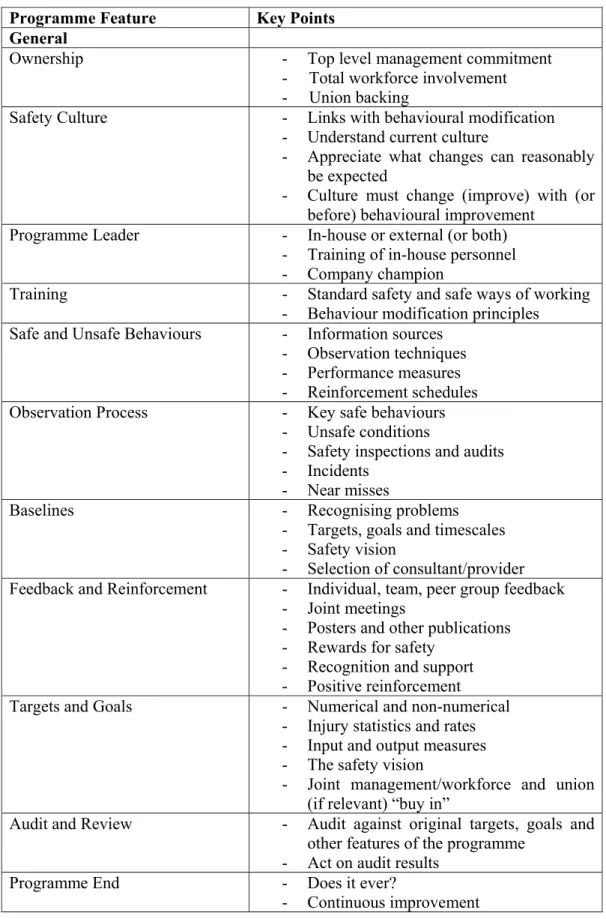
Probably the most dangerous assumption to make about a safety improvement programme is that it is complete. Even the very best of organisations are always seeking continuous further improvement even though their safe practices have become “the way we do it here”. On the other hand, and realistically, it is true that a point of diminishing returns can eventually be reached. The vital thing is to always recognise that further benefits – often at relatively low cost – can be usually made. It’s a bit like being the best football team in the world. If you just sit back and glory in that fact, rather than try to be even better, you will slip back and be overtaken by another team. Table 1, Chapter 4 summarises these general features, and the more specific tools described in that chapter.
CHAPTER 4
SOME AVAILABLE BEHAVIOUR MODIFICATION PROGRAMMES 4. Some specific “tools”
During the course of this project, a number of individuals and organisations have suggested some specific behavioural modification tools that might, by their nature be of particular use to SMEs. The sources of such suggestions have included Focus Group members and their work colleagues, other PRISM Network members, SMEs and behavioural safety providers themselves. Although all of these tools are incorporated into the general review above, a brief specific description of each of them now follows. It is again emphasised that this does not imply any preference for any of these tools on the part of the authors of this document.
4.1 Time out for safety (TOFS)
TOFS is a tool developed by BP Amoco, initially for their drilling teams, but subsequently used by their entire platform crew. TOFS is effective because it enables employees to modify behaviour directly and immediately by stopping the job if they have safety concerns. The concern(s) are then discussed by the team, with full supervisory and management support, and the job only resumed when all are satisfied of its safety. It is simple, easily learned and implemented, and does not require completion of forms. Its effectiveness, and further details, are presented in Case Study 1, and Ref 33.
4.2 Take 2
Exxon introduced ‘Take 2’ at the Fawley (Hampshire UK) site in the early 1990’s. The supervisor and his/her team, take two minutes at the start of each work activity to discuss, and think through, the various aspects of the activity. Access, potential hazards, tools, the weather and others, and what could go wrong, are discussed. Any preventative actions are implemented.
4.3 Recovery behaviour
Recovery behaviour is a process whereby people pause to check their last, or next, action(s), before proceeding further with a job, in order to ensure that they will not result in incident, accident or other adverse condition. Discussions are usually done by workers operating in pairs, for example one giving, and the other receiving, an instruction or two (or more) people working together on a job. A specific example can be drawn from communications between airline pilots and air traffic controllers. The pilot is requested to acknowledge key instructions by repeating them back and, only if he repeats them correctly, is he given authority to proceed. This tool can be developed for use by individuals working alone, into “mental imaging” techniques. 4.4 Mental Imaging
This is a focussing of the old adage of “look before you leap”. People are trained to imagine or visualise in their minds the worst accident that could happen to them as a
result of what they plan to do. This visualisation is stored in our memory as a mental representation. The use of past experiences to deal with new experiences is a fundamental feature of the way the human mind works. To picture the potential accident before it has occurred, enables the making of a permanent change to the core values and beliefs, this avoiding the pain, trauma and suffering of real accidents. By use of examples, this can be developed into a powerful means of getting people to modify their actions for the better and safer.
4.5 Advanced Safety Audit (ASA)
ASA is designed to enhance the ability of managers and supervisors to engage in positive interactions with the workforce about safety and, therefore tackles the other overall barrier (in addition to the workforce-related one) to improving safety behaviour. It aims to get managerial recognition of, and encouragement for, safe behaviour and to identify, and gain commitment to, behavioural change. ASA was originally developed in the UK coal mining industry but has, more recently, been used by BP Amoco and is also described in more detail in Case Study 2 and Ref 33.
4.6 Safe and Unsafe Acts Discussion (SUSATM)
SUSA is a trademarked product of John Ormond Management Consultants Ltd. It is a “one-to-one” discussion tool aimed at praising safe behaviour and identifying actual, or potential, unsafe behaviours. It goes on to use a structured, questioning approach to understanding the reasons for doing the task in that particular way. Discussion of these reasons, using the mental imaging process, is used to develop corrective (safe) actions, an implementation plan and a commitment to change behaviour. It can be extended to use by individuals as a form of “self SUSA” which could be helpful to lone workers. It is used as the basis for building up an organisation-wide data bank of unsafe behaviours and corrective actions and their outcome (Ref 4) against the background of a holistic approach to improvement of both safety culture and behaviour (Ref 11).
There is evidence that the structured use of SUSA is beneficial to an organisation’s safety performance. The “SUSA contact rate” defined as Number of SUSA discussions per head of organisation population, is seen to be directly related to lost time injury rate. The higher the contact rate, the lower the injury rate. (Ref 37 and 43). 4.7 Safety Training and Observations Programme (STOP)
STOP is a tool originally developed by Du Pont but since used by many organisations (Ref 12). It is a five-stage process of deciding to make observations, stopping to make those observations, observing people and situations to identify unsafe behaviours, acting upon those observations and reporting, reviewing and collating the observations and corrective actions.
4.8 Crew resource management
Crew Resource Management (CRM) is a tool developed initially by the United States aviation industry, and also used by shipping, and other, industries to utilise the collective input of all members of a crew, from the ship, or aircraft, captain down, to
improve safety, and other, behaviours by avoidance of error and error management. It is primarily aimed at emergency situations, for example in-flight failures of key equipment, shortage of fuel etc and it has been demonstrated that, in such situations, it saves a large number of lives when compared with not using it. However, another important feature of CRM is team working and recognition of the dangers of relying solely, or too much, on the knowledge of one, defined team leader, however competent he or she may be – in this case, the captain. The input of all members of the crew is invaluable, because they may see something from a different perspective. As such, it would have applicability in all sizes of organisation but, possibly for SMEs, where managerial systems may be steeply hierarchical in nature rather than team-based, it may be of particular use. Further information is given in Ref 13 and 44.
Research on the above subject (Refs 14, 15 and 16) has shown that airline pilots (as many as 97% in the study referenced) reject steep hierarchies in favour of open discussion between all members of the crew (team). Much the same is true of hospital intensive care staff (94% rejection rate) where a large majority of the team feel perfectly comfortable about asking questions when there is something they do not understand. Surgeons, on the other hand, are much more in favour (55% rejection rate) of steep hierarchies in which junior staff do not question their seniors’ decisions very much if at all. Despite these differences, all these three groups, historically, have been expected to function without error. In fact, only one-third of medical personnel in the study believed that errors were handled appropriately and intensive care staff did not even acknowledge that they made errors. This is in sharp contrast to the understanding, and management, of error in the aviation industry. For example, effective air crews will use as much as one-third of their communications to discuss potential threats and errors and solutions to them.
4.9 Safety self-management, particularly for lone workers
Self-management methods and tools were initially developed to address a range of “non-safety” human activities such as stress, weight loss, over eating, time management, smoking, depression and others but they are very easily applicable to safety. They are very well described in Ref 17 (and others referenced therein) and include the following:
- self-observation, recording and follow-up
- use of self-observation checklists of safe, and at risk, behaviours
- activator management, or identifying factors that precede safe and unsafe behaviours then evolving strategies to eliminate negative factors and strengthen positive ones
- self statements to prompt good behaviour and prevent at risk actions for example “I must not climb this ladder until it is properly secured”
- mental imagery as above
- self rewards for safe behaviour but remember – if you cheat, you are the only loser!
- setting goals which should be Specific, Motivational, Achievable, Recordable, and Trackable acronym SMART.
- social support – encouragement and praise from colleagues, co-workers, supervisors, managers and friends; sharing of commitments or “contracts” with others
4.10 An alternative approach
Although not a tool or technique as such, Ref 18 details an approach that, in the words of the author “questions the accepted wisdom” about the subject of human error. The view of the author is that it is extremely difficult to change people’s tendency to make errors and more beneficial to change the work environment for the better by engineering, design and managerial means. Many examples of accidents, causes and solutions, across a wide range of scenarios, are discussed and the probability of human error is addressed.
4.11 A practical guide for behavioural change
The Behavioural Issues Task Group of the UK oil and gas industry has produced a review of the available information on behavioural issues and related topics and a guide on how to select and implement suitable programmes for various situations (Ref 7). This review discusses the importance of behavioural issues and presents a model for safety improvement (using a safety culture maturity model combined with a total quality management approach). It then goes on to provide a toolkit and guidance on implementation of safety culture improvement processes. This is drawn upon in providing advice on user application in Chapter 6 of this Guide.
4.12 B-SHARP
B-SHARP, developed by ABB Eutech (Ref 19) is primarily a tool designed to assess, and aid the improvement of, safety culture. However, it incorporates a range of behavioural modification techniques and processes including problem solving, presentation skills, observation and feedback skills, and others. It is a three-stage process comprising:
- diagnosis, itself subdivided into overview, structured confidential employee interviews and a report.
- delivery, based on a cascaded system of workshops, beginning with senior management and continuing, through middle management, to the workforce. It is at this stage that various behavioural modification techniques are identified and implemented in the workplace on a day-to-day routine basis. - evaluation, of the results of the delivery stage, typically 12-18 months after the
start of the programme. 4.13 Self-managing teams (SMTs)
The concept of self-management has been extended into operation by small teams of workers (Ref 20 and 21). SMTs are typically high-performing teams of 5-15 people, with the technical skills, knowledge and authority to make decisions that would formerly have been made by a supervisor. They are appointed to mange themselves because the team members are the most familiar with the task that they perform. Therefore, they are best placed to make improvements. SMTs have been used in coal
mining, chemicals, offshore oil and other industries as well as in health care and various service industries. It is important that responsibilities and accountability for safety are clearly defined and implemented but, provided this is done, case studies have shown that safety management benefits from greater member involvement in risk assessment, safety auditing, observation of safe and unsafe acts and a range of other features. There are potential pitfalls to be managed, such as more demanding jobs and assumptions that safety is for someone else to control but the overall effect, as judged by case studies in chemical, and offshore gas applications, is favourable. Other examples of methodologies for, and the successful application of, team working can be found in Refs 22 and 23.
4.14 The role of safety culture
Whatever particular view is taken of the role that safety culture plays in the process of improvement of safety performance, there is a general consensus that it is of vital importance in the “triumvirate” comprising culture, behaviour and team-working. Most safety practitioners, managers and consultant service providers will agree that there can be no lasting improvement in behaviour (safety or other) without substantial change for betterment of the underpinning culture. This is particularly true of large organisations where different departments will have different priorities, responsibilities and organisational approaches, and lines of control from senior management to the working level can be long and not always clearly defined. There is however some evidence that the absence of these factors in the smaller SMEs can result in an ability to implement behaviour change, successfully, after which a change in culture will follow. In very large organisations, including the larger SMEs, this is often not the case. There is a need to understand the organisation’s safety culture before (or at least concurrently with) attempting to make changes in behaviour. This section briefly describes some tools that are available for assessment of safety culture. However, it should be noted that the subject of safety culture is being addressed in detail, within the PRISM project, by the Keil Centre, Edinburgh, and they will produce an application guide, complementary to this one, on that subject.
4.15 The UK Health and Safety Executive Safety Climate Survey
This survey tool comprises a 71 Statement Questionnaire supported by guidelines on its usage and on taking resultant issues forward. It includes software and a user manual to enable organisations to customise the survey, analyse the results and produce standard reports. All significant factors incorporated into culture and influencing safety performance, are assessed. These include organisational commitment , supervisor, personal and workmate roles, risk taking, accident reporting and others. Further information can be found in Refs 7, 9, 24 and 25. The tool has been used successfully across a wide range of industries.
4.16 Safety Culture Maturity ™
The Safety Culture Maturity Model (SCMM) was developed by the Keil Centre (Ref 26) and has been used successfully by oil, gas, petrochemical, rail, healthcare, chemical and steel industries in the UK and other countries. It comprises five levels of safety “maturity” each of which has ten elements. The process enables a site’s
level of maturity to be assessed as one of five levels ranging from “emerging” to “continually improving”. Action plans for improving the maturity level are evolved from the results of the assessment.
The three main strengths of this tool are:
(i) ability to compare results, site-by-site and at different times (ii) provision of an excellent “snapshot” of cultural issues (iii) participants propose solutions to issues that they identify.
The two main weaknesses are that it is resource intensive (series of workshops) and the group workshop format can inhibit confidentiality.
4.17 A Safety Culture Questionnaire
This questionnaire was developed by John Ormond Management Consultants Ltd and is used to provide a series of “snapshot” views, from management, supervisors, and workforce, of their organisation’s safety culture. It comprises five questions on perceptions of management attitudes to safety, preventability of injuries, role models and risk taking and it has been used successfully across a wide range of UK, and other European, industries. It has been shown that responses to the questionnaire can be correlated with injury rates (Ref 11).
4.18 Benchmarking Safety Culture
A technique for benchmarking of safety culture was developed, and used in the offshore oil and gas industries, by the University of Aberdeen (Refs 27 and 28). Safety management, and offshore personnel, questionnaires are used to assess culture. The process is repeated one year later to identify trends which are acted upon. Significant correlations were identified between lost time injury rates and health surveillance, dangerous occurrences and auditing and others. There were clear indications that management safety practices improved with time. The benchmarking feature is used to measure both improvement with time and to compare installations with each other to establish, and share, best practices.
4.19 Organisational Functioning Survey
Behavioural Science Technology (BST) has developed an Organisational Functioning Survey to assist organisations that are planning to use behaviour – based methods to improve safety performance. This processes starts by assessing CAUSES of key organisational, team-based, and safety specific factors, moves on to EFFECTS on such matters as organisational commitment, openness to change and communication and then to OUTCOMES on injury rate, safe behaviours, quality, customer service and others. This approach, and its use in a major oil refinery, is described in Ref. 49. 4.20 A Human Factors Toolkit for Assessing Human Involvement
DNV Consulting (See Appendix 1) together with CIBA Speciality Chemicals, developed an assessment toolkit for use at CIBA’s UK sites. It was done against the background that the COMAH Regulations require human factors to be taken into account in risk management. It is described in detail in ref. 50 and allows an
evaluation of the safeguards in place to prevent a major accident hazard. The tool comprises six key steps viz:
(i) identify major accident hazard scenarios (ii) identify safety critical tasks
(iii) qualitatively assess critical tasks and potential errors (iv) evaluate the safeguards
(v) identify risk control measures
Table 1 – Safety Behavioural Modification Programmes – Key Points Programme Feature Key Points
General
Ownership - Top level management commitment
- Total workforce involvement - Union backing
Safety Culture - Links with behavioural modification - Understand current culture
- Appreciate what changes can reasonably be expected
- Culture must change (improve) with (or before) behavioural improvement
Programme Leader - In-house or external (or both) - Training of in-house personnel - Company champion
Training - Standard safety and safe ways of working - Behaviour modification principles Safe and Unsafe Behaviours - Information sources
- Observation techniques - Performance measures - Reinforcement schedules Observation Process - Key safe behaviours
- Unsafe conditions
- Safety inspections and audits - Incidents
- Near misses
Baselines - Recognising problems
- Targets, goals and timescales - Safety vision
- Selection of consultant/provider Feedback and Reinforcement - Individual, team, peer group feedback
- Joint meetings
- Posters and other publications - Rewards for safety
- Recognition and support - Positive reinforcement Targets and Goals - Numerical and non-numerical
- Injury statistics and rates - Input and output measures - The safety vision
- Joint management/workforce and union (if relevant) “buy in”
Audit and Review - Audit against original targets, goals and other features of the programme
- Act on audit results
Programme End - Does it ever?
Specific
TOFS - Stop job for safety concern
- Discuss/resume work when concern dealt with
Take 2 - Discussion of job safety, and other
aspects before work starts
Recovery Behaviour - Cross checking of actions between (usually) two individuals
Mental Imaging - Imagining the worst that could happen and acting to avoid it
Advanced Safety Audits - managerial/supervisory interaction with workforce on safety matters
SUSA® - One-to-one interactive discussion
- Identifying of and implementation of safe(r) methods
STOP - Five-stage process of observation, action
and review
Crew resource management - Utilises collective input of all team members in a non-hierarchical way
Safety self-management - Combines a number of techniques e.g. mental imaging, self observation, personal goal-setting and others
- Useful for lone workers
B-Sharp - Assessment/improvement of safety
culture
- Includes behavioural modification approaches
Self-managed teams - Knowledgeable, high-performing teams - Make their own decisions on safety, and
other, features
Safety Climate/Culture Surveys - Separate guide will cover this in detail - Safety Climate Survey
- Safety Culture Maturity Model™ - Safety Culture Questionnaire - Safety Culture Benchmarking