IFFAT H. KAZI, HOWARD H. CHEN, BERDENIA STANLEY, AND DAVID J. LILJA
Minnesota Supercomputing Institute, University of Minnesota
This survey describes research directions in techniques to improve the performance of programs written in the Java programming language. The standard technique for Java execution is interpretation, which provides for extensive portability of programs. A Java interpreter dynamically executes Java bytecodes, which comprise the instruction set of the Java Virtual Machine (JVM). Execution time performance of Java programs can be improved through compilation, possibly at the expense of portability. Various types of Java compilers have been proposed, including Just-In-Time (JIT) compilers that compile bytecodes into native processor instructions on the fly; direct compilers that directly translate the Java source code into the target processor’s native language; and bytecode-to-source translators that generate either native code or an intermediate language, such as C, from the bytecodes. Additional techniques, including bytecode optimization, dynamic compilation, and executing Java programs in parallel, attempt to improve Java run-time performance while maintaining Java’s portability. Another alternative for executing Java programs is a Java processor that implements the JVM directly in hardware. In this survey, we discuss the basic features, and the advantages and disadvantages, of the various Java execution techniques. We also discuss the various Java benchmarks that are being used by the Java community for performance evaluation of the different techniques. Finally, we conclude with a comparison of the performance of the alternative Java execution techniques based on reported results. Categories and Subject Descriptors: A.1 [General Literature]: Introductory and Survey; C.4 [Computer Systems Organization]: Performance of Systems; D.3 [Software]: Programming Languages
General Terms: Languages, Performance
Additional Key Words and Phrases: Java, Java virtual machine, interpreters, just-in-time compilers, direct compilers, bytecode-to-source translators, dynamic compilation
1. INTRODUCTION
The Java programming language that evolved out of a research project started by Sun Microsystems in 1990 [Arnold and Gosling 1996; Gosling et al. 1996] is one of the most exciting technical develop-ments in recent years. Java combines
sev-Authors’ addresses: I. H. Kazi, Dept. of Electrical and Computer Engineering, Minnesota Supercomputing Inst., Univ. of Minnesota, 200 Union St., SE, Minneapolis, MN 55455; H. Chen, Dept. of Computer Science and Engineering; B. Stanley, Dept. of Electrical and Computer Engineering; D. J. Lilja, Dept. of Electrical and Computer Engineering.
Permission to make digital/hard copy of part or all of this work for personal or classroom use is granted without fee provided that the copies are not made or distributed for profit or commercial advantage, the copyright notice, the title of the publication, and its date appear, and notice is given that copying is by permission of the ACM, Inc. To copy otherwise, to republish, to post on servers, or to redistribute to lists, requires prior specific permission and/or a fee.
c
°2001 ACM 0360-0300/01/0900-0213 $5.00
eral features found in different program-ming paradigms into one language. Fea-tures such as platform independence for portability, an object-orientation model, support for multithreading, support for distributed programming, and automatic garbage collection, make Java very ap-pealing to program developers. Java’s
“write-once, run anywhere” philosophy captures much of what developers have been looking for in a programming lan-guage in terms of application portabil-ity, robustness, and security. The cost of Java’s flexibility, however, is its slow per-formance due to the high degree of hard-ware abstraction it offers.
To support portability, Java source code is translated into architecture neutral bytecodes that can be executed on any platform that supports an implementa-tion of the Java Virtual Machine (JVM). Most JVM implementations execute Java bytecodes through either interpretation or Just-In-Time (JIT) compilation. Since both interpretation and JIT compilation require runtime translation of bytecodes, they both result in relatively slow ex-ecution times for an application pro-gram. While advances with JIT compilers are making progress towards improving Java performance, existing Java execu-tion techniques do not yet match the per-formance attained by conventional com-piled languages. Of course, performance improves when Java is compiled directly to native machine code, but at the expense of diminished portability.
This survey describes the different exe-cution techniques that are currently being used with the Java programming lan-guage. Section 2 describes the basic con-cepts behind the JVM. Section 3 discusses the different Java execution techniques, including interpreters, JIT and static com-pilers, and Java processors. In Section 4, we describe several optimization tech-niques for improving Java performance, including dynamic compilation, bytecode optimization, and parallel and distributed techniques. Section 5 reviews the exist-ing benchmarks available to evaluate the performance of the various Java execution techniques with a summary of their per-formance presented in Section 6. Conclu-sions are presented in Section 7.
2. BASIC JAVA EXECUTION
Basic execution of an application written in the Java programming language begins with the Java source code. The Java source
code files (.javafiles) are translated by a Java compiler into Java bytecodes, which are then placed into.classfiles. The byte-codes define the instruction set for the JVM which actually executes the user’s application program.
2.1. Java Virtual Machine
TheJava Virtual Machine(JVM) executes the Java program’s bytecodes [Lindholm and Yellin 1997; Meyer and Downing 1997]. The JVM is said to bevirtualsince, in general, it is implemented in software on an existing hardware platform. The JVM must be implemented on the tar-get platform before any compiled Java programs can be executed on that plat-form. The ability to implement the JVM on various platforms is what makes Java portable. The JVM provides the interface between compiled Java programs and any target hardware platform.
Traditionally, the JVM executes the Java bytecodes by interpreting a stream of bytecodes as a sequence of instructions. One stream of bytecodes exists for each method1in the class. They are interpreted and executed when a method is invoked during the execution of the program. Each of the JVM’s stack-based instructions con-sists of a one-byteopcodeimmediately fol-lowed by zero or more operands. The in-structions operate on byte,short, integer, long,float,double,char,object, andreturn addressdata types. The JVM’s instruction set defines 200 standard opcodes, 25quick variationsof some opcodes (to support ef-ficient dynamic binding), and three re-served opcodes. The opcodes dictate to the JVM what action to perform. Operands provide additional information, if needed, for the JVM to execute the action. Since bytecode instructions operate primarily on a stack, all operands must be pushed on the stack before they can be used.
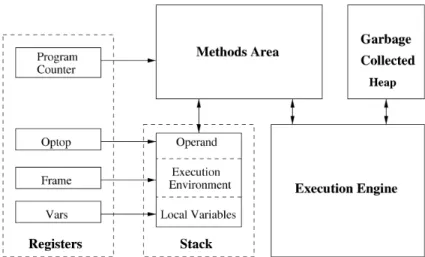
The JVM can be divided into the five ba-sic components shown in Figure 1. Each of the registers, stack, garbage-collected heap,methods area, andexecution engine
1Amethodroughly corresponds to a function call in
Fig. 1. Basic components of the Java Virtual Machine.
components must be implemented in some form in every JVM. The registers compo-nent includes aprogram counterand three other registers used to manage the stack. Since most of the bytecode instructions op-erate on the stack, only a few registers are needed. The bytecodes are stored in the methods area. Theprogram counterpoints to the next byte in themethods areato be executed by the JVM. Parameters for byte-code instructions, as well as results from the execution of bytecode instructions, are stored in the stack. The stack passes parameters and return values to and from the methods. It is also used to maintain the state of each method invocation, which is referred to as the stack frame. The op-top,frame, andvarsregisters manage the stack frame.
Since the JVM is a stack-based machine, all operations on data must occur through the stack. Data is pushed onto the stack from constant pools stored in the methods area and from the local variables section of the stack. The stack frame is divided into three sections. The first is the local variablessection which contains all of the local variables being utilized by the cur-rent method invocation. Thevarsregister points to this section of the stack frame. The second section of the stack frame is the execution environment, which maintains the stack operations. The frame register points to this section. The final section is
theoperand stack. This section is utilized by the bytecode instructions for storing pa-rameters and temporary data for expres-sion evaluations.
The optop register points to the top of the operand stack. It should be noted that the operand stack is always the topmost stack section. Therefore, theoptopregister always points to the top of the entire stack. While instructions obtain their operands from the top of the stack, the JVM requires random access into the stack to support instructions likeiload, which loads an in-teger from the local variables section onto the operand stack, oristore, which pops an integer from the top of the operand stack and stores it in the local variables section. Memory is dynamically allocated to executing programs from the garbage-collected heapusing thenewoperator. The JVM specification requires that any space allocated for a new object be preinitialized to zeroes. Java does not permit the user to explicitly free allocated memory. Instead, the garbage collection process monitors existing objects on the heap and periodi-cally marks those that are no longer being used by the currently executing Java pro-gram. Marked objects are then returned to the pool of available memory. Implementa-tion details of the garbage collecImplementa-tion mech-anism are discussed further in Section 2.2. The core of the JVM is the execu-tion engine, which is a “virtual” processor
that executes the bytecodes of the Java methods. This “virtual” processor can be implemented as an interpreter, a compiler, or a Java-specific processor. Interpreters and compilers are software implementa-tions of the JVM while Java processors implement the JVM directly in hardware. The execution engine interacts with the methods area to retrieve the bytecodes for execution. Various implementations of the Java execution engine are described in subsequent sections.
2.2. Garbage Collection
In Java, objects are never explicitly deleted. Instead, Java relies on some form of garbage collection to free memory when objects are no longer in use. The JVM specification [Lindholm and Yellin 1997] requires that every Java runtime imple-mentation should have some form of au-tomatic garbage collection. The specific details of the mechanism are left up to the implementors. A large variety of garbage collection algorithms have been developed, including reference counting, mark-sweep, mark-compact, copying, and noncopying implicit collection [Wilson 1992]. While these techniques typically halt processing of the application pro-gram when garbage collection is needed, incrementalgarbage collection techniques have been developed that allow garbage collection to be interleaved with normal program execution. Another class of tech-niques known asgenerationalgarbage col-lection improve efficiency and memory lo-cality by working on a smaller area of memory. These techniques exploit the ob-servation that recently allocated objects are most likely to become garbage within a short period of time.
The garbage collection process imposes a time penalty on the user program. Con-sequently, it is important that the garbage collector is efficient and interferes with program execution as little as possible. From the implementor’s point of view, the programming effort required to imple-ment the garbage collector is another con-sideration. However, easy-to-implement techniques may not be the most
execution-time efficient. For example, conservative garbage collectors treat every register and word of allocated memory as a potential pointer and thus do not require any addi-tional type information for allocated mem-ory blocks to be maintained. The draw-back, however, is slower execution time. Thus, there are trade-offs between ease of implementation and execution-time per-formance to be made when selecting a garbage collection technique for the JVM implementation.
3. ALTERNATIVE EXECUTION TECHNIQUES FOR JAVA PROGRAMS
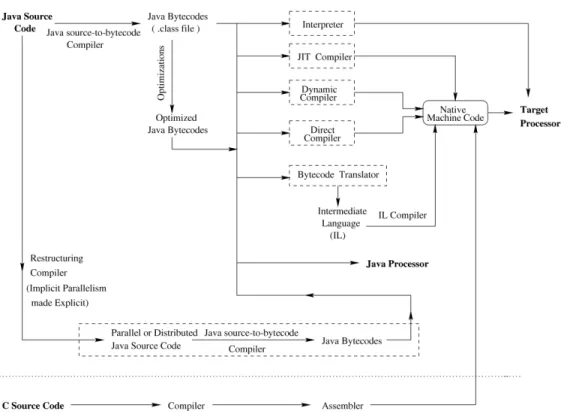
In addition to the standard interpreted JVM implementation, a variety of execu-tion techniques have been proposed to re-duce the execution time of Java programs. In this section, we discuss the alterna-tive execution techniques summarized in Figure 2.
As shown in this figure, there are nu-merous alternatives for executing Java programs compared to the execution of programs written in a typical program-ming language such as C. The standard mechanism for executing Java programs is through interpretation, which is discussed in Section 3.1. Compilation is another al-ternative for executing Java programs and a variety of Java compilers are available that operate on either Java source code or Java bytecodes. We describe several differ-ent Java compilers in Section 3.2. Finally, Java processors, which are hardware im-plementations of the JVM, are discussed in Section 3.3.
3.1. Java Interpreters
Java interpreters are the original method for executing Java bytecodes. An inter-preter emulates the operation of a pro-cessor by executing a program, in this case, the JVM, on a target processor. In other words, the running JVM pro-gram reads and executes each of the bytecodes of the user’s application pro-gram in order. An interpreter has several advantages over a traditional compiled execution. Interpretation is very simple,
Fig. 2. Alternatives for executing Java compared to a typical C programming language compilation process.
and it does not require a large mem-ory to store the compiled program. Fur-thermore, interpreters are relatively easy to implement. However, the primary dis-advantage of an interpreter is its slow performance.
There are several existing Java inter-preters. The Sun Java Developers Kit (JDK) [Sun Microsystems] is used to develop Java applications and applets that will run in all Java-enabled web browsers. The JDK contains all of the necessary classes, source files, applet viewer, debug-ger, compiler, and interpreter. Versions ex-ist that execute on the SPARC Solaris, x86 Solaris, Windows NT, Windows 95, and Macintosh platforms. The Sun JVM is it-self implemented in the C programming language. The Microsoft Software Devel-opment Kit (SDK) also provides the tools to compile, execute, and test Java applets and applications [Microsoft SDK Tools]. The SDK contains the Microsoft Win32 Virtual Machine for Java (Microsoft VM),
classes, APIs, and so forth for the x86 and ALPHA platforms.
3.2. Java Compilers
Another technique to execute Java pro-grams is with a compiler that translates the Java bytecodes into native machine code. Like traditional high-level language compilers, a direct Java compiler starts with an application’s Java source code (or, alternatively, with its bytecode) and trans-lates it directly into the machine language of the target processor. The JIT compil-ers, on the other hand, are dynamically-invoked compilers that compile the Java bytecode during runtime. These compil-ers can apply different optimizations to speed up the execution of the generated native code. We discuss some common Java-specific compiler optimizations in Section 3.2.1. The subsequent sections de-scribe the various Java compilers and their specific features.
3.2.1. Java Compiler Optimizations
Due to the unique features of the JVM, such as the stack architecture, dynamic loading, and exception handling, Java na-tive code compilers need to apply different types of optimizations than those used in traditional compilers. Some commonly im-plemented optimizations include mapping stack variables to machine registers, mov-ing constant stack variables into native in-structions, increasing the efficiency of ex-ception handling, and inlining of methods. Mapping variables to machine regis-ters increases native code performance since registers are much faster to ac-cess than memory. Registers can also be used to reduce the amount of stack du-plication in Java. Specifically, each Java bytecode instruction consumes stack vari-ables. Therefore, if a bytecode operand is used by multiple bytecode instructions, it must be duplicated on the stack. Reg-ister operands can be used over mul-tiple instructions, however, eliminating the stack duplication overhead for those instructions.
Stack activity also can be reduced by moving constants on the stack into native instructions as immediate operands. Java bytecode instructions must receive constant operands from the stack. Since most architectures support instructions with immediate operands, this optimiza-tion eliminates the overhead of loading the constant into a register or memory location.
Exception overhead can be reduced by eliminating unnecessary exception checks and increasing the efficiency of the excep-tion checking mechanism. For example, arrays are often used in iterative loops. If an array index value remains bounded inside of a loop, array bounds checks can be eliminated inside of the loop, which can produce significant performance ad-vantages for large arrays.
Inlining of static methods is useful for speeding up the execution of method calls. However, the Java to bytecode compiler can only inline static methods within the class because static methods in other classes may be changed before actual
ex-ecution. The implementation of any sin-gle class instantiation is stable at runtime and can therefore be inlined. The JIT com-pilers described in Section 3.2.2 can make use of this fact to inline small static meth-ods to thereby reduce the overall number of static method calls. Dynamic methods can be converted to static methods given a set of classes using class hierarchy analy-sis [Dean et al. 1995]. If a virtual method has not been overloaded in the class hier-archy, dynamic calls to that method can be replaced by static calls. However, class hi-erarchy analysis may be invalidated if a new class is dynamically loaded into the program.
3.2.2. Just-In-Time Compilers
A Just-In-Time(JIT) compiler translates Java bytecodes into equivalent native ma-chine instructions as shown in Figure 2. This translation is performed at runtime immediately after a method is invoked. In-stead of interpreting the code for an in-voked method, the JIT compiler translates a method’s bytecodes into a sequence of native machine instructions. These native instructions are executed in place of the bytecodes. Translated bytecodes are then cached to eliminate redundant translation of bytecodes.
In most cases, executing JIT compiler generated native code is more efficient than interpreting the equivalent byte-codes since an interpreter identifies and interprets a bytecode every time it is en-countered during execution. JIT compi-lation, on the other hand, identifies and translates each instruction only once—the first time a method is invoked. In pro-grams with large loops or recursive meth-ods, the combination of the JIT compila-tion and native code execucompila-tion times can be drastically reduced compared to an in-terpreter. Additionally, a JIT compiler can speed up native code execution by optimiz-ing the code it generates, as described in Section 3.2.1.
Since the total execution time of a Java program is a combination of compilation time and execution time, a JIT compiler needs to balance the time spent optimizing
generated code against the time it saves by the optimization. Code optimization is fur-ther limited by the scope of compilation. Since compilation occurs on demand for one class or one method at a time, it is diffi-cult for a JIT compiler to perform nonlocal optimizations. Due to the time and scope restrictions of JIT compilation, JIT opti-mizations are generally simple ones that are expected to yield reasonably large per-formance gains compared to the optimiza-tion time.
Although JIT compilers are generally more efficient than interpreters, there are still advantages to using an inter-preter. One advantage is that interpreters are better suited to debugging programs. Another advantage is that JIT compila-tion compiles an entire method at once, while interpretation translates only the instructions that actually are executed. If only a small percentage of the byte-codes in a method are ever executed and the method is rarely executed, the time spent on JIT compilation may never be recouped by the reduction in execution time.
Current JIT compilers offer a variety of target platforms and features. The Symantec Cafe JIT is included in the Java 2 runtime environment for Win-dows 95/NT and Netscape Navigator [Symantec].Microsoftincludes a JIT with Internet Explorer for Windows 95/NT and Macintosh [Just-In-Time Compila-tion]. No published information is avail-able about the implementation details of these JIT compilers.
IBM includes an optimizing JIT compiler in its IBM Developer Kit for Windows [Ishizaki et al. 1999; Suganuma et al. 2000]. This JIT compiler performs a variety of optimizations including method inlining, exception check elimination, common subexpression elimination, loop versioning, and code scheduling. The com-piler begins by performing flow analysis to identify basic blocks and loop struc-ture information for later optimizations. The bytecodes are transformed into an internal representation, called extended bytecodes, on which the optimizations are performed.
The optimizations begin with method inlining. Empty method calls originating from object constructors or small access methods are always inlined. To avoid code expansion (and thus, the resulting cache inefficiency) other method calls are inlined only if they are in program hotspots such as loops. Virtual method calls are handled by adding an explicit check to make sure that the inlined method is still valid. If the check fails, standard virtual method invocation is performed. If the referenced method changes frequently, the additional check and inlined code space adds addi-tional overhead to the invocation. How-ever, the referenced method is likely to remain the same in most instances, elimi-nating the cost of a virtual method lookup and invocation.
Following inlining, the IBM JIT com-piler performs general exception check elimination and common subexpression elimination based on program flow infor-mation. The number of array bound excep-tion checks is further reduced using loop versioning. Loop versioning creates two versions of a target loop—a safe version with exception checking and an unsafe version without exception checking. De-pending on the loop index range test at the entry point of the loop, either the safe or the unsafe version of the loop is executed. At this point, the IBM JIT compiler generates native x86 machine code based on the extended bytecode representation. Certain stack manipulation semantics are detected in the bytecode by matching byte-code sequences known to represent spe-cific stack operations. Register allocation is applied by assigning registers to stack variables first and then to local variables based on usage counts. Register allocation and code generation are performed in the same pass to reduce compilation time. Finally, the generated native code is sched-uled within the basic block level to fit the requirements of the underlying machine.
Intel includes a JIT compiler with the VTune optimization package for Java that interfaces with the Microsoft JVM [Adl-Tabatabai et al. 1998]. The Intel JIT compiler performs optimizations and gen-erates code in a single pass without
generating a complete internal represen-tation of the program. This approach speeds up native code generation while limiting the scope of the optimizations to extended basic blocks only. The Intel JIT compiler applies common subexpression elimination (CSE) within basic blocks, lo-cal and global register allocation, and lim-ited exception optimizations.
The compiler first performs a linear scan of the bytecodes to record stack and vari-able information for use in later stages. This is followed by a global register al-location, code generation, code emission, and code patching pass. The compiler uses two alternative schemes for global register allocation. The first scheme allocates the 4 callee-saved registers to the variables with the highest static reference counts for the duration of the method. The sec-ond scheme iterates through all of the variables in order of decreasing static ref-erence counts, allocating a register to a variable if the register is available in all of the basic blocks that the variable is ref-erenced.
CSE is implemented by matching nonoverlapping subsequences in ex-pressions. Basic blocks are represented as a string of bytes where common subexpressions are detected as duplicate substrings in the string. Any two matched substrings of less than sixteen bytecodes is considered as a candidate for elimina-tion. If the value calculated during the first expression instance is still available during the second instance of the expres-sion, the previous value is reused and the duplicate expression is eliminated. In this scheme, transitivity of expressions is not considered. Therefore, the expression “x+y” would not match with “y+x.”
Unnecessary array bounds checks are detected by keeping track of the maxi-mum constant array index that is bounds checked and eliminating index bound checks for constant values less than the maximum constant array index check. For example, if array location 10 is accessed before location 5, the bounds check for ar-ray location 5 is eliminated. This optimiza-tion is useful during array initializaoptimiza-tion since the array creation size is considered
a successful bounds check of the highest array index. This eliminates bound checks for any initialization of array values us-ing constant array indices. However, elim-ination of bounds checks does not apply to variables nor does it extend beyond the scope of a basic block.
Code for handling thrown exceptions is moved to the end of the generated code for a method. By placing exception handling code at the end of the method, the static branch predictor on Pentium processors will predict the branches to be not taken and the exception handling code is less likely to be loaded into a cache line. Since exceptions do not occur frequently, this is well-suited for the common case execution. The OpenJIT project [Matsuoka et al. 1998] is a reflective JIT compiler writ-ten in Java. The compiler is reflective in the sense that it contains a set of self-descriptive modules that allow a user pro-gram to examine the internal state of the compiler’s compilation and modify the state through a compiler-supplied inter-face. This interface allows user programs to perform program-specific optimizations by defining program-specific semantics. For instance, defining properties of com-mutivity and transitivity for a user object provides the compiler with more informa-tion to perform useful optimizainforma-tions.
The open-source Kaffe project provides a JIT compiler for the Kaffe JVM that supports various operating systems on the x86, Sparc, M68k, MIPS, Alpha, and PARisc architectures [Wilkinson, Kaffe v0.10.0]. The Kaffe JIT compiler uses a machine-independent front-end that con-verts bytecodes to an intermediate repre-sentation called the KaffeIR. The KaffeIR is then translated using a set of macros which define how KaffeIR instructions map to native code.
TheAJIT compilation systemgenerates annotations in bytecode files to aid the JIT compilation [Azevedo et al. 1999]. A Java to bytecode compiler generates annotations that are stored as additional code attributes in generated class files to maintain compatibility with existing JVMs. These annotations carry compiler optimization-related information that
allow the JIT compiler to generate op-timized native code without extensive runtime analysis. An example of a gen-erated attribute in the AJIT system is the mapping of variables to an infinite virtual register set. This virtual register allocation (VRA) annotation is used by an annotation-reading JIT compiler to speed up register allocation and to identify un-necessary duplication of stack variables.
CACAO is a stand-alone JIT compiler for the DEC ALPHA architecture [Krall and Grafl 1997]. The CACAO compiler translates bytecodes to an intermedi-ate representation, performs register al-location, and replaces constant operands on the stack with immediate instruction operands.
Fajita [FAJITA] is a variation of a JIT compiler that runs as a Java compila-tion server on a network, independent of the Java runtime. The server compiles Java bytecode as a pass-through proxy server, allowing class compilation to be cached and shared among different pro-grams and machines. Since the lifetime of compiled code in this environment is gen-erally much longer than a standard JIT, this compiler has more time to perform advanced optimizations.
3.2.3. Direct Compilers
A direct compiler translates either Java source code or bytecodes into machine in-structions that are directly executable on the designated target processor (refer to Figure 2). The main difference between a direct compiler and a JIT compiler is that the compiled code generated by a di-rect compiler is available for future exe-cutions of the Java program. In JIT com-pilation, since the translation is done at run-time, compilation speed requirements limit the type and range of code optimiza-tions that can be applied. Direct compi-lation is done statically, however, and so can apply traditional time-consuming op-timization techniques, such as data-flow analysis, interprocedural analysis, and so on [Aho et al. 1986], to improve the per-formance of the compiled code. However, because they provide static compilation,
direct compilers cannot support dynamic class loading. Direct compilation also re-sults in a loss of portability since the gen-erated code can be executed only on the specific target processor. It should be noted that the portability is not completely lost if the original bytecodes or source code are still available, however.
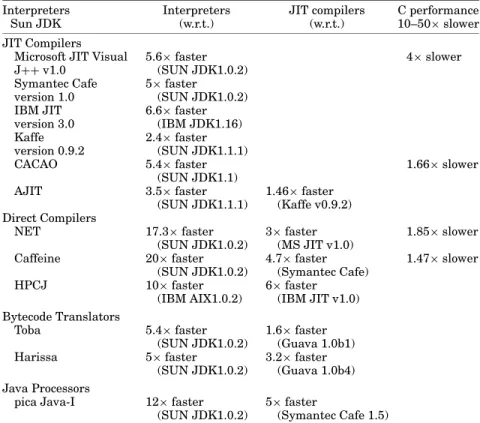
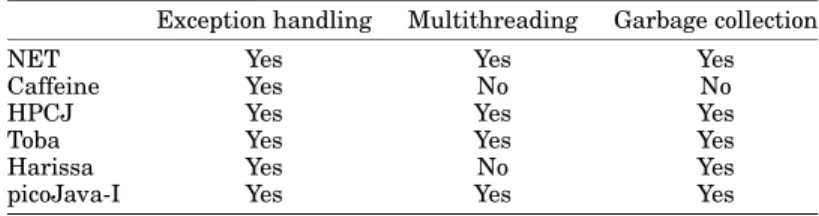
Caffeine [Hsieh et al. 1996] is a Java bytecode-to-native code compiler that gen-erates optimized machine code for the X86 architecture. The compilation pro-cess involves several translation steps. First, it translates the bytecodes into an internal language representation, called Java IR, that is organized into functions and basic blocks. The Java IR is then converted to a machine-independent IR, called Lcode, using stack analysis, stack-to-register mapping, and class hierarchy analysis. The IMPACT compiler [Chang et al. 1991] is then used to generate an optimized machine-independent IR by applying optimizations such as inlining, data-dependence and interclass analysis to improve instruction-level parallelism (ILP). Further, machine-specific optimiza-tions, including peephole optimization, in-struction scheduling, speculation, and reg-ister allocation, are applied to generate the optimized machine-specific IR. Finally, optimized machine code is generated from this machine-specific IR. Caffeine uses an enhanced memory model to reduce the overhead due to additional indirec-tions specified in the standard Java mem-ory model. It combines the Java class in-stance data block and the method table into one object block and thus requires only one level of indirection. Caffeine sup-ports exception handling only through ar-ray bounds checking. It does not support garbage collection, threads, and the use of graphics libraries.
The Native Executable Translation (NET) compiler [Hsieh et al. 1997] extends the Caffeine prototype by supporting garbage collection. It uses a mark-and-sweep garbage collector which is invoked only when memory is full or reaches a predefined limit. Thus, NET eliminates the overhead due to garbage collection in smaller application programs that have
low memory requirements. NET also sup-ports threads and graphic libraries.
The IBM High Performance Compiler for Java (HPCJ) [Seshadri 1997] is an-other optimizing native code compiler tar-geted for the AIX, OS/2, Windows95, and WindowsNT platforms. HPCJ takes both Java source code and bytecodes as its input. If the Java source code is used as an input, it invokes the AIX JDK’s Java source-to-bytecode compiler (javac) to produce the bytecodes. Java bytecodes are translated to an internal compiler in-termediate language (IL) representation. The common back-end from IBM’s XL fam-ily of compilers for the RS/6000 is used to translate the IL code into an object mod-ule (.o file). The object modmod-ule is then linked to other object modules from the Java application program and libraries to produce the executable machine code. The libraries in HPCJ implement garbage col-lection, Java APIs, and various runtime system routines to support object creation, threads, and exception handling.
A common back-end for the native code generation allows HPCJ to apply vari-ous language-independent optimizations, such as instruction scheduling, common subexpression elimination, intramodular inlining, constant propagation, global reg-ister allocation, and so on. The bytecode-to-IL translator reduces the overhead for Java run-time checking by performing a simple bytecode simulation during basic block compilation to determine whether such checks can be eliminated. HPCJ re-duces the overhead due to method indirec-tion by emitting direct calls for instance methods that are known to be final or that are known to belong to a final class. It uses a conservative garbage collec-tor since the common back-end does not provide any special support for garbage collection.
3.2.4. Bytecode-to-Source Translators
Bytecode-to-source translators are static compilers that generate an intermediate high-level language, such as C, from the Java bytecodes (see Figure 2). A standard compiler for the intermediate language is
then used to generate executable machine code. Choosing a high-level language such as C as an intermediate language allows the use of existing compiler technology, which is useful since many compilers that incorporate extensive optimization tech-niques are available for almost all plat-forms.
Toba [Proebsting et al. 1997] is a bytecode-to-source translator for Irix, So-laris, and Linux platforms that converts Java class files directly into C code. The generated C code can then be compiled into machine code. Toba describes itself as a Way-Ahead-of-Time compiler since it compiles bytecodes before program execu-tion in contrast to JIT compilers which compile the bytecodes immediately before execution. All versions of Toba provide support for garbage collection, exceptions, threads, and the BISS-AWT, an alterna-tive to the Sun AWT (Abstract Window Toolkit). In addition, the Linux version of Toba also supports dynamic loading of classes using a JIT compiler. The Toba C code generator naively converts each byte-code directly into equivalent C statements without a complex intermediate represen-tation, relying on the C compiler to even-tually optimize the code.
Harissa[Muller et al. 1997, Welcome to Harissa] is a Java environment that in-cludes both a bytecode translator and an interpreter for SunOS, Solaris, Linux, and DEC Alpha platforms. The Harissa com-piler reads in Java source code and con-verts it into an intermediate representa-tion (IR). It then analyzes and optimizes the structure of the Java code and out-puts optimized C files. Since existing C compilers can be used to perform more generalized optimizations, Harissa’s com-piler focuses on IR optimizations such as static evaluation to eliminate the stack, elimination of redundant bounds checks, elimination of bounds checks on array in-dices that can be statically determined, and transforming virtual method calls into simple procedure calls using class hi-erarchy analysis. A complete interpret-ing JVM has been integrated into the runtime library to allow code to be dy-namically loaded into previously compiled
applications. Since data structures are compatible between the compiled code and the interpreter, Harissa provides an envi-ronment that cleanly allows the mixing of bytecodes and compiled code.
TurboJ is a Java bytecode-to-source translator [TurboJ Java to Native Com-piler] that also uses C as an intermediate representation. The generated code re-tains all of the Java run-time checks, al-though redundant checks are eliminated. TurboJ is not a stand-alone Java runtime system. Instead it operates in conjunction with a Java runtime system and uses the native JDK on a given platform for mem-ory allocation, garbage collection, and ac-cess to the standard thread package.
Vortex is an optimizing compiler that supports general object-oriented lan-guages [UW Cecil/Vortex Project, Dean et al. 1996]. The Java, C++, Cecil, and Modula-3 languages are all translated into a common IL. If the Java source code is not available, this system can use a modified version of the javap bytecode disassembler to translate the bytecodes into the Vortex IL. The IL representation of the program is then optimized using such techniques as intraprocedural class analysis, class hierarchy analysis, re-ceiver class prediction, and inlining. An enhanced CSE technique is also provided. Once optimization is complete, either C code or assembly code can be generated.
3.3. Java Processors
To run Java applications on general-purpose processors, the compiled byte-codes need to be executed through an interpreter or through some sort of com-pilation, as described in the previous sections. While a JIT compiler can pro-vide significant speedups over an inter-preter, it introduces additional compila-tion time and can require a large amount of memory. If the bytecodes can be di-rectly executed on a processor, the mem-ory advantage of the interpreter and the performance speedup of the JIT compiler can be combined. Such a processor must support the architectural features spec-ified for the JVM. A Java processor is
an execution model that implements the JVM in silicon to directly execute Java bytecodes. Java processors can be tailored specifically to the Java environment by providing hardware support for such fea-tures as stack processing, multithreading, and garbage collection. Thus, a Java pro-cessor can potentially deliver much bet-ter performance for Java applications than a general-purpose processor. Java proces-sors appear to be particularly well-suited for cost-sensitive embedded computing applications.
Some of the design goals behind the JVM definition were to provide portabil-ity, securportabil-ity, and small code size for the executable programs. In addition, it was designed to simplify the task of writing an interpreter or a JIT compiler for a spe-cific target processor and operating sys-tem. However, these design goals result in architectural features for the JVM that pose significant challenges in developing an effective implementation of a Java pro-cessor [O’Connor and Tremblay 1997]. In particular, there are certain common char-acteristics of Java programs that are dif-ferent from traditional procedural pro-gramming languages. For instance, Java processors are stack-based and must sup-port the multithreading and unique mem-ory management features of the JVM. These unique characteristics suggest that the architects of a Java processor must take into consideration the dynamic fre-quency counts of the various instructions types to achieve high performance.
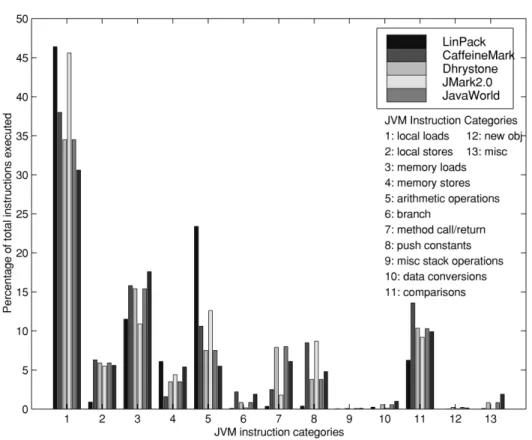
The JVM instructions fall into sev-eral categories, namely, local-variable loads and stores, memory loads and stores, integer and floating-point compu-tations, branches, method calls and re-turns, stack operations, and new object creation. Figure 3 shows the dynamic fre-quencies of the various JVM instruc-tion categories measured in the Java benchmark programs LinPack, Caffeine-Mark, Dhrystone, Symantec, JMark2.0, and JavaWorld (benchmark program details are provided in Section 5). These dynamic instruction frequencies were ob-tained by instrumenting the source code of the Sun 1.1.5 JVM interpreter to count
Fig. 3. Dynamic execution frequency of JVM bytecode instructions measured for several common benchmark programs.
the number of times each type of bytecode was executed.
As seen in this figure, the most fre-quent instructions are local variable loads (about 30–47% of the total instructions ex-ecuted), which move operands from the local variables area of the stack to the top of the stack. The high frequency of these loads suggests that optimizing lo-cal loads could substantially enhance per-formance. Method calls and returns are also quite common in Java programs. As seen in Figure 3, they constitute about 7% of the total instructions executed. Hence, optimizing the method call and return process is expected to have a relatively large impact on the performance of Java codes. Since method calls occur through the stack, a Java processor also should have an efficient stack implementation.
Another common operation supported by the JVM is the concurrent execution of multiple threads. As with any
mul-tithreading execution, threads will of-ten need to enter synchronized critical sections of code to provide mutually ex-clusive access to shared objects. Thus, a Java processor should provide architec-tural support for this type of synchro-nization. A Java processor must also pro-vide support for memory management via the garbage collection process, such as hardware tagging of memory objects, for instance.
PicoJava-I [McGham and O’Connor 1998; O’Connor and Tremblay 1997] is a configurable processor core that sup-ports the JVM specification. It includes a RISC-style pipeline executing the JVM instruction set. However, only the most common instructions that most directly impact the program execution are imple-mented in hardware. Some moderately complicated but performance critical in-structions are implemented through mi-crocode. The remaining instructions are
trapped and emulated in software by the processor core. The hardware de-sign is thus simplified since the complex, but infrequently executed, instructions do not need to be directly implemented in hardware.
In the Java bytecodes, it is common for an instruction that copies data from a lo-cal variable to the top of the stack to pre-cede an instruction that uses it. The pico-Java corefoldsthese two instructions into one by accessing the local variable directly and using it in the operation. Thisfolding operation accelerates Java bytecode exe-cution by taking advantage of the single-cycle random access to the stack cache. Hardware support for synchronization is provided to the operating system by using the low-order 2-bits in shared objects as flags to control access to the object.
The picoJava-2 core [Turley 1997], which is the successor to the picoJava-I processor, augments the bytecode in-struction set with a number of extended instructions to manipulate the caches, control registers, and absolute memory ad-dresses. These extended instructions are intended to be useful for non-Java applica-tion programs that are run on this Java ex-ecution core. All programs, however, still need to be compiled to Java bytecodes first, since these bytecodes are the processor’s native instruction set. The pipeline is ex-tended to 6 stages compared to the 4 stages in the picoJava-I pipeline. Finally, the fold-ing operation is extended to include two local variable accesses, instead of just one. Another Java processor is the Sun microJava 701 microprocessor [Sun Microsystems. MicroJava-701 Proces-sor]. It is based on the picoJava-2 core and is supported by a complete set of software and hardware development tools. The Patriot PSC1000 microproces-sor [Patriot Scientific Corporation] is a general-purpose 32-bit, stack-oriented architecture. Since its instruction set is very similar to the JVM bytecodes, the PSC1000 can efficiently execute Java programs.
Another proposed Java processor [Vijaykrishnan et al. 1998] provides architectural support for direct object
ma-nipulation, stack processing, and method invocations to enhance the execution of Java bytecodes. This architecture uses a virtual address object cache for efficient manipulation and relocation of objects. Three cache-based schemes—the hybrid cache, the hybrid polymorphic cache, and the two-level hybrid cache—have been proposed to efficiently implement virtual method invocations. The processor uses extended folding operations similar to those in the picoJava-2 core. Also, simple, frequently executed instructions are directly implemented in the hard-ware, while more complex but infrequent instructions are executed via a trap handler.
The Java ILP processor [Ebcioglu et al. 1997] executes Java applications on an ILP machine with a Java JIT com-piler hidden within the chip architecture. The first time a fragment of Java code is executed, the JIT compiler transpar-ently converts the Java bytecodes into op-timized RISC primitives for a Very Long Instruction Word (VLIW) parallel archi-tecture. The VLIW code is saved in a por-tion of the main memory not visible to the Java architecture. Each time a frag-ment of Java bytecode is accessed for exe-cution, the processor’s memory is checked to see if the corresponding ILP code is already available. If it is, then the ex-ecution jumps to the location in mem-ory where the ILP code is stored. Other-wise, the compiler is invoked to compile the new Java bytecode fragment into the code for the target processor, which is then executed.
While Java processors can deliver sig-nificant performance speedups for Java applications, they cannot be used effi-ciently for applications written in any other language. If we want to have bet-ter performance for Java applications, and to execute applications written in other languages as well, Java processors will be of limited use. With so many appli-cations written in other languages al-ready available, it may be desirable to have general-purpose processors with en-hanced architectural features to support faster execution of Java applications.
4. HIGH-PERFORMANCE JAVA EXECUTION TECHNIQUES
Direct compilers or bytecode-to-source translators can improve Java performance by generating optimized native codes or intermediate language codes. However, this high performance may come at the expense of a loss of portability and flex-ibility. JIT compilers, on the other hand, support both portability and flexibility, but they cannot achieve performance compa-rable to directly compiled code as only limited-scope optimizations can be per-formed. A number of execution techniques have been developed that attempt to im-prove Java performance by optimizing the Java source code or the bytecodes so that portability is not lost. Some techniques ap-ply dynamic optimizations to the JIT com-pilation approach to improve the quality of the compiled native machine code within the limited time available to a JIT com-piler. Some other techniques improve var-ious features of the JVM, such as thread synchronization, remote method invoca-tion (RMI), and garbage collecinvoca-tion, that aid in improving the overall performance of Java programs. In this section, we de-scribe these high-performance Java exe-cution techniques.
4.1. Bytecode Optimization
One technique for improving the execu-tion time performance of Java programs is to optimize the bytecodes. The Briki com-piler applies a number of optimizations to bytecodes to improve the execution time performance [Cierniak and Li 1997a,b]. The front-end of the offline mode of the Briki compiler [Cierniak and Li 1997a] re-constructs the high-level program struc-ture of the original Java program from the bytecodes. This high-level view of the in-put bytecodes is stored in an intermedi-ate representation called JavaIR. A num-ber of optimizations can then be applied to this JavaIR. Finally, the optimized JavaIR is transformed back into Java source code and executed by a Java compiler.
Converting Java bytecodes to JavaIR is very expensive, however, requiring an
order of magnitude more time than the time required to perform the optimiza-tions themselves. In an on-line version of Briki [Cierniak and Li 1997b], the same optimizations are performed while recovering only as much of the structure information as needed and using faster analysis techniques than those used in traditional compilers. This on-line version of Briki is integrated with the Kaffe JIT compiler [Wilkinson, Kaffe v0.10.0], using Kaffe to generate an IR. The compiler an-alyzes and transforms the Kaffe IR into an optimized IR which the Kaffe JIT back-end then translates into native code.
One optimization in Briki attempts to improve memory locality by data remap-ping. Briki groups together similar fields within objects onto consecutive memory locations, increasing the probability that fields will reside on the same cache line. However, the specific criterion used by the Briki compiler to determine similar fields has not been described [Cierniak and Li 1997a,b]. Briki also attempts to remap ar-ray dimensions when dimension remap-ping will improve memory access time. For example, in a two-dimensional array A, location A[i][j] might be remapped to A[j][i] if such a remapping is advanta-geous. However, this remapping poses a number of problems. First, Java arrays are not standard rectangular arrays but rather are implemented as an array of ar-rays. Therefore, array elements in a given dimension are not guaranteed to be of the same size. A[i] might reference an ar-ray of size 2 while A[j] references an ar-ray of size 3, for instance. Since arar-ray remapping is valid only for rectangular arrays, Briki constrains remapping to cases where all dimensions of the array are accessed. Second, subscript expres-sions in arrays can have potential side-effects. For instance, the calculation of a subscript may, as a side-effect, assign a value to a variable. Remapping the array dimensions may cause problems since the renaming changes the evaluation order of these expressions. To remedy this prob-lem, Briki evaluates subscript expressions in the correct order before the arrays are actually referenced.
The DashO Pro [DashO Pro] bytecode optimizer applies several optimization techniques to improve runtime perfor-mance and reduce the size of the Java executable. These techniques include shortening the names of all the classes, methods, and fields, removing all unused methods, fields, and constant-pool entries (both constants and instance variables), extracting classes from accessible third-party packages or libraries, and so on. DashO produces one file that contains only the class files needed for the Java program resulting in smaller and faster Java byte-code files.
Krintz et al. [1999] proposed a Java class file splitting and prefetching tech-nique to reduce the transfer delay of bytecodes sent over the Internet. Class file splitting partitions a Java class file into separate hot and cold class files to eliminate transferring code in the cold class file that is very rarely (or never) used. Class file prefetching inserts special prefetch instructions into the Java class file to overlap bytecode transfer with ex-ecution. These optimizations use compile-time analysis and profiling to select code to split and to insert prefetch instructions. Experimental results showed that class file splitting was able to reduce startup time for Java programs by 10% while prefetching combined with splitting re-duced the overall bytecode transfer delay by 25% on average.
The Java application extractor Jax [Tip et al. 1999] applies several techniques, such as the elimination of redundant methods/fields and class hierarchy spe-cialization [Tip and Sweeney 1997], to re-duce the size of a Java class file archive (e.g., zip or jar files). Jax performs a whole-program analysis on a Java class file to determine the classes, methods, and fields that must be retained to preserve pro-gram behavior. It then removes the un-necessary components of the class files to reduce the archive size. Additionally, Jax applies a class hierarchy transformation that reduces the archive size by eliminat-ing classes entirely or by mergeliminat-ing adjacent classes in the hierarchy. It also replaces original class, method, and field names
with shorter names. Once methods are re-moved from a class file, some entries in the constant pool may appear to be redun-dant. Thus, when the archive is rewrit-ten after all the transformations are ap-plied, a new constant pool is created from scratch to contain only the classes, meth-ods, fields, and constants that are refer-enced in the transformed class file. Using Jax on a number of Java archives resulted in a 13.4–90.2% reduction in size [Tip et al. 1999].
4.2. Parallel and Distributed Execution Techniques
A number of techniques parallelize Java source code or bytecodes to improve the execution-time performance of the ap-plication. The parallelization typically is achieved through Java language-level support for multithreading. Thus, these techniques maintain the portability of the transformed parallel Java programs. Most of these techniques exploit implicit paral-lelism in Java programs for parallel ex-ecution on shared-memory multiproces-sor systems using Java multithreading and synchronization primitives. Some ap-proaches extend the Java language itself to support parallel and distributed Java programs. The performance improvement obtained when using these techniques depends on the amount of parallelism that can be exploited in the application program.
TheHigh Performance Javaproject [Bik and Gannon 1997; Bik and Gannon 1998] exploits implicit parallelism in loops and multiway recursive methods to generate parallel code using the standard Java multithreading mechanism. The JAVAR [Bik and Gannon 1997] tool, which is a source-to-source restructuring compiler, relies on explicit annotations in a quential Java program to transform a se-quential Java source code into a corre-sponding parallel code. The transformed program can be compiled into bytecodes using any standard Java compiler. The JAVAB[Bik and Gannon 1998] tool, on the other hand, works directly on Java byte-codes to automatically detect and exploit
implicit loop parallelism. Since the par-allelism is expressed in Java itself using Java’s thread libraries and synchroniza-tion primitives, the parallelized bytecodes can be executed on any platform with a JVM implementation that supports native threads.
The Java Speculative Multithreading (JavaSpMT) parallelization technique [Kazi and Lilja 2000] uses a speculative thread pipelining execution model to exploit implicit loop-level parallelism on shared-memory multiprocessors for general-purpose Java application pro-grams. Its support of control specula-tion combined with its run-time data-dependence checking allows JavaSpMT to parallelize a wide variety of loop constructs, including do–while loops. JavaSpMT is implemented using the standard Java multithreading mecha-nism. The parallelism is expressed by a Java source-to-source transformation.
The Do! project [Launay and Pazat 1997] provides a parallel framework embedded in Java to ease parallel and distributed programming in Java. The parallel framework supports both data parallelism and control (or task) paral-lelism. The framework provides a model for parallel programming and a library of generic classes. Relevant library classes can be extended for a particular applica-tion or new framework classes can be de-fined for better tuning of the application.
Tiny Data-Parallel Java [Ichisugi and Roudier 1997] is a Java language ex-tension for data-parallel programming. The language defines data-parallel classes whose methods are executed on a large number of virtual processors. An exten-sible Java preprocessor, EPP, is used to translate the data-parallel code into stan-dard Java code using the Java thread libraries and synchronization primitives. The preprocessor can produce Java code for multiprocessor and distributed sys-tems as well. However, the Tiny Data-Parallel Java language does not yet have sufficient language features to sup-port high-performance parallel programs. DPJ [Ivannikov et al. 1997] defines a parallel framework through a Java class
library for the development of data-parallel programs.
4.3. Dynamic Compilation
Since the compilation time in JIT compila-tion adds directly to the applicacompila-tion’s total execution time, the quality of the code op-timization is severely constrained by com-pilation speed. Dynamic comcom-pilation ad-dresses this problem of JIT compilation by optimizing only the portions of the code that are most frequently executed, i.e., program hotspots. Most programs spend the majority of the time executing only a small fraction of their code. Thus, opti-mizing only the hotspot methods should yield a large performance gain while keeping the compilation speed relatively fast.
Sun’s Hotspot JVM [The Java Hotspot Performance Engine Architecture] uses dynamic compilation to generate opti-mized native machine code during run-time. The Hotspot engine contains both a run-time compiler and an interpreter. The first time a method is executed, it is inter-preted using a profiling interpreter that gathers run-time information about the method. This information is used to de-tect hotspots in the program and to gather information about program behavior that can be used to optimize generated native code in later stages of program execution. After the hotspot methods are identified, they are dynamically compiled to gener-ate optimized native machine code. Infre-quently executed code continues to be in-terpreted, decreasing the amount of time and memory spent on native code gen-eration. Because a program is likely to spend the majority of its execution time in the hotspot regions detected by the in-terpreter, the compiler can spend more time optimizing the generated code for these sections of the program than a JIT-compiler while still producing an over-all improvement in execution time. Dur-ing code generation, the dynamic compiler performs conventional compiler optimiza-tions, Java specific optimizaoptimiza-tions, and in-lining of static and dynamic methods. The inlining optimizations are designed to be
reversible due to the problems associated with dynamic class loading.
IBM’sJalapenoJVM [Burke et al. 1999] includes an adaptive dynamic optimizing compiler that generates optimized ma-chine code as the program is executed. The Jalapeno JVM does not use an interpreter. Instead, the first execution of a method is handled by quickly compiling a method into an unoptimized executable code. The dynamic optimizing compiler later gener-ates optimized executable code from the bytecodes of the hotspot (i.e., frequently executed) methods as determined by run-time profile information.
The Jalapeno optimizing compiler first compiles Java bytecodes into a vir-tual register-based high-level intermedi-ate representation (HIR). It then gener-ates a control flow graph for the method. After applying compiler optimizations on the HIR, the intermediate executable is converted to a low-level representation (LIR) that includes references to spe-cific implementation details, such as pa-rameter passing mechanisms and object layouts in memory. The LIR is then opti-mized further and converted to a native code representation using a Bottom-Up Rewrite System [Proebsting 1992] ap-proach. Finally, this machine specific representation (MIR) is optimized and assembled into machine executable code. The optimizing compiler performs inlin-ing both durinlin-ing bytecode-to-IR translation and during HIR optimization. Inlining of virtual functions is handled by predicting the type of the virtual function and per-forming a run-time check to determine the validity of the prediction. If the predic-tion is incorrect, the program performs a normal virtual function invocation. Oth-erwise, the program proceeds with the inlined function.
The program adaptation in Jalapeno starts with the instrumentation and re-compilation of executable code. The ex-ecutable code is instrumented to gather context sensitive profile information to aid optimization. The profile informa-tion is used to detect program hotspots. When a certain performance threshold is reached, the dynamic optimizing
com-piler is invoked to recompile the hotspot methods using context specific optimiza-tions at all levels of representaoptimiza-tions (HIR, LIR, and MIR). The unoptimized code is then replaced by optimized code based on the collected profile information. Program adaptation continues in this cycle, with ex-ecutable code being improved on every op-timization iteration.
4.4. Improved JVM Features
The underlying implementation of vari-ous JVM features, such as thread synchro-nization, RMI support, and garbage collec-tion, often has a significant effect on the execution time performance of Java ap-plication programs. While these features make Java more powerful as a program-ming language, they tend to add delays to a program’s execution time. Hence, it is important to efficiently implement these features to improve Java performance. Furthermore, Java, as it is now, is not suitable for high-performance numerical computing. To support numerical applica-tions, Java should include features that al-low efficient execution of floating point and complex numbers.
4.4.1. Thread Synchronization
Thread synchronization is a potential per-formance problem in many Java programs that use multithreading. Since Java li-braries are implemented in a thread-safe manner, the performance of even single-threaded applications may be degraded due to synchronization. In Java, synchro-nization is provided through monitors, which are language-level constructs used to guarantee mutually-exclusive access to shared data-structures [Silberschatz and Galvin 1997]. Unfortunately, monitors are not efficiently implemented in the cur-rent Sun JDK. Since Java allows any ob-ject to be synchronizable (with or with-out any synchronized methods), using a lock structure for each object can be very costly in terms of memory. To minimize memory requirements, the Sun JDK keeps monitors outside of the objects. This re-quires the run-time system to first query each monitor in a monitor cache before it
is used, which is quite inefficient. Further, the monitor cache itself needs to be locked during these queries to avoid race condi-tions. Thus, this monitor implementation approach is not scalable.
CACAO, in contrast, is a system that implements monitors using a hash table indexed by the address of the associated object [Krall and Proebst 1998]. Because only a small number of objects that re-quire mutually-exclusive access (called a mutexobject) are locked at any given time, this approach generally leads to decreased memory usage. Each of these objects main-tains a count of how many lock operations have been performed on it without any cor-responding unlock operations. When the count goes to zero, the lock is not owned by any thread. A mutex object, however, is not destroyed when its count reaches zero under the assumption that the mu-tex object will be reused again soon. The mutex object is destroyed only when a new mutex object collides with it in the hash table. This memory allocation approach has the advantage of requiring less code to implement lock and unlock operations. Since the hash table entries will be free only at the beginning of the program and will never be freed again, the code to lock the mutex need not check if the entry is free. The unlocking code also does not need to check whether the hash entry should be freed.
Thethin locksapproach in IBM’s JDK 1.1.2 for AIX improves thread synchro-nization by optimizing lock operations for the most common cases [Bacon et al. 1998]. Thin locks, which require only a partial word per object, are used for objects that are not subject to any contention, do not have wait/notify operations performed on them, and are not locked to an excessive nesting depth. Objects that do not meet the criterion usefat locks, which are mul-tiword locks similar to those used in the standard Java implementation. To min-imize the memory required for each ob-ject’s lock, 24 bits in the obob-ject’s header are used for the lock structure. The other values stored in the header are compacted using various encoding schemes to make the 24 bits available for this lock
struc-ture. This 24-bit field stores either a thin lock directly, or a pointer to a fat lock. The dedicated lock for each object allows the lock/unlock operations on the thin locks to be performed using only a few machine instructions. This approach also elimi-nates the need to synchronize the monitor cache.
4.4.2. Remote Method Invocation
The Java Remote Method Invocation (RMI) [Remote Method Invocation Spec-ification] mechanism enables distributed programming by allowing methods of re-mote Java objects to be invoked from other JVMs, possibly on different physical hosts. A Java program can invoke methods on a remote object once it obtains a reference to the remote object. This remote object reference is obtained either by looking up the remote object in the bootstrap-naming service provided by RMI, or by receiving the reference as an argument or a return value. RMI uses object serialization to marshal and unmarshal parameters.
The current Java RMI is designed to support client-server applications that communicate over TCP-based networks [Postel 1981]. Some of the RMI design goals, however, result in severe perfor-mance limitations for high-perforperfor-mance applications on closely connected environ-ments, such as clusters of workstations and distributed memory processors. The Applications and Concurrency Working Group (ACG) of the Java Grande Forum (JGF) [Java Grande Forum Report] as-sessed the suitability of RMI-based Java for parallel and distributed computing based on Java RMI. JGF proposed a set of recommendations for changes in the Java language, Java libraries, and JVM imple-mentation to make Java more suitable for high-end computing. ACG emphasized im-provements in two key areas, object seri-alization and RMI implementation, that will potentially improve the performance of parallel and distributed programs based on Java RMI.
Experimental results [Java Grande Fo-rum Report] suggest that up to 30% of the execution time of a Java RMI is spent
in object serialization. Accordingly, ACG recommended a number of improvements, including a slim encoding technique for type information, more efficient serializa-tion of float and double data types, and enhancing the reflection mechanism to al-low fewer calls to be made to obtain infor-mation about a class. In the current RMI implementation, a new socket connection is created for every remote method invo-cation. In this implementation, establish-ing a network connection can take up to 30% of the total execution of the remote method [Java Grande Forum Report]. The key recommendations of JGF to reduce the connection overhead include improved socket connection management, improved resource management, and improved sup-port for custom transsup-port.
4.4.3. Java for High-Performance Numeric Computation
The current design and implementation of Java does not support high-performance numerical applications. To make the per-formance of Java numerical programs comparable to the performance obtained through programming languages such as C or Fortran, the numeric features of the Java programming language must be im-proved. The Numerics Working Group of the Java Grande Forum assessed the suitability of Java for numerical pro-gramming and proposed a number of improvements in Java’s language fea-tures, including floating-point and com-plex arithmetic, multidimensional arrays, lightweight classes, and operator over-loading [Java Grande Forum Report].
To directly address these limitations in Java, IBM has developed a special library that improves the performance of numerically-intensive Java applica-tions [Moreira et al. 2000]. This library takes the form of the Java Array package and is implemented in the IBM HPCJ. The Array package supports such FORTRAN 90 like features as complex numbers, mul-tidimensional arrays, and linear algebra library. A number of Java numeric appli-cations that used this library were shown to achieve between 55% and 90% of the
performance of corresponding highly opti-mized FORTRAN codes.
4.4.4. Garbage Collection
Most JVM implementations use conserva-tive garbage collectors that are very easy to implement, but demonstrate rather poor performance. Conservative garbage collectors cannot always determine where all object references are located. As a result, they must be careful in marking objects as candidates for garbage collec-tion to ensure that no objects that are potentially in use are freed prematurely. This inaccuracy sometimes leads to mem-ory fragmentation due to the inability to relocate objects.
To reduce the negative performance impacts of garbage collection, Sun’s Hotspot JVM [The Java Hotspot Perfor-mance Engine Architecture] implements a fully accurate garbage collection (GC) mechanism. This implementation allows all inaccessible memory objects to be re-claimed while the remaining objects can be relocated to eliminate memory fragmen-tation. Hotspot uses three different GC algorithms to efficiently handle garbage collection. A generational garbage collec-tor is used in most cases to increase the speed and efficiency of garbage collection. Generational garbage collectors cannot, however, handle long-lived objects. Conse-quently, Hotspot needs to use an old-object garbage collector, such as amark-compact garbage collector to collect objects that accumulate in the “Old Object” area of the generational garbage collector. The old-object garbage collector is invoked when very little free memory is available or through programmatic requests.
In applications where a large amount of data is manipulated, longer GC pauses are encountered when a mark-compact col-lector is used. These large latencies may not be acceptable for latency-sensitive or data-intensive Java applications, such as server applications and animations. To solve this problem, Hotspot provides an alternative incremental garbage collec-tor to collect objects in the “Old Object” area. Incremental garbage collectors can
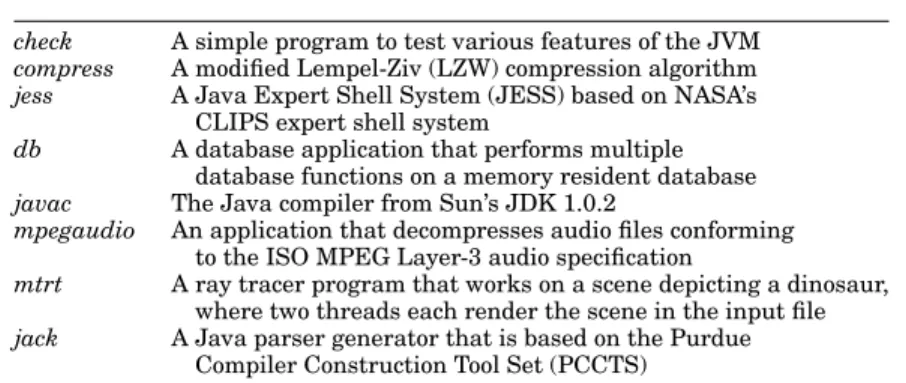
Table 1. The Benchmark Programs in SPEC JVM98 Benchmark Suite check A simple program to test various features of the JVM
compress A modified Lempel-Ziv (LZW) compression algorithm
jess A Java Expert Shell System (JESS) based on NASA’s CLIPS expert shell system
db A database application that performs multiple database functions on a memory resident database
javac The Java compiler from Sun’s JDK 1.0.2
mpegaudio An application that decompresses audio files conforming to the ISO MPEG Layer-3 audio specification
mtrt A ray tracer program that works on a scene depicting a dinosaur, where two threads each render the scene in the input file
jack A Java parser generator that is based on the Purdue Compiler Construction Tool Set (PCCTS)
potentially eliminate all user-perceived GC pauses by interleaving the garbage col-lection with program execution.
5. BENCHMARKS
Appropriate benchmarks must be identi-fied to effectively evaluate and compare the performance of the various Java execution techniques. A benchmark can be thought of as a test used to measure the performance of a specific task [Lilja 2000]. As existing execution techniques are improved and new techniques are developed, the benchmarks serve as a vehicle to provide consistency among evaluations for comparison purposes. The problem that exists in the Java research community is that no benchmarks have been agreed upon as the standard set to be used for Java performance analysis. Instead, researchers have used a variety of different benchmarks making it very difficult to compare results and determine which techniques yield the best perfor-mance. In this section, we identify some of the popular benchmarks that have been used to compare various Java execution techniques.
Application benchmarks are used to evaluate the overall system performance. Microbenchmarks, on the other hand, are used to evaluate the performance of in-dividual system or language features, such as storing an integer in a local variable, incrementing a byte, or creating an object [Java Microbenchmarks, UCSD Benchmarks for Java].
The Open Systems Group (OSG) of the Standard Performance Evaluation Corporation (SPEC) [SPEC JVM98 Benchmarks] developed a Java bench-mark suite,SPEC JVM98, to measure the performance of JVMs. The benchmarks in this suite are expected to serve as a standard for performance evaluation of different JVM implementations to pro-vide a means for comparing the different techniques using a common basis. SPEC JVM98 is a collection of eight general-purpose Java application programs, as listed in Table 1.
SYSmark J [SYSmark] is another benchmark suite that consists of four Java applications: JPhoto Works, which is an image editor using filters, the JNotePad text editor, JSpreadSheet, which is a spreadsheet that supports built-in func-tions in addition to user-defined formulas; and theMPEGvideo player.
A series of microbenchmark tests, known as CaffeineMark [CaffeineMark], has been developed to measure specific aspects of Java performance, including loop performance (loop test), the execu-tion of decision-making instrucexecu-tions (logic test), and the execution of recursive func-tion calls (method test). Each of the tests is weighted to determine the over-all CaffeineMark score. However, since the CaffeineMark benchmark does not em-ulate the operations of real-world pro-grams [Armstrong 1998], there is a ques-tion as to whether this benchmark makes reliable measurements of performance. The Embedded CaffeineMark benchmark