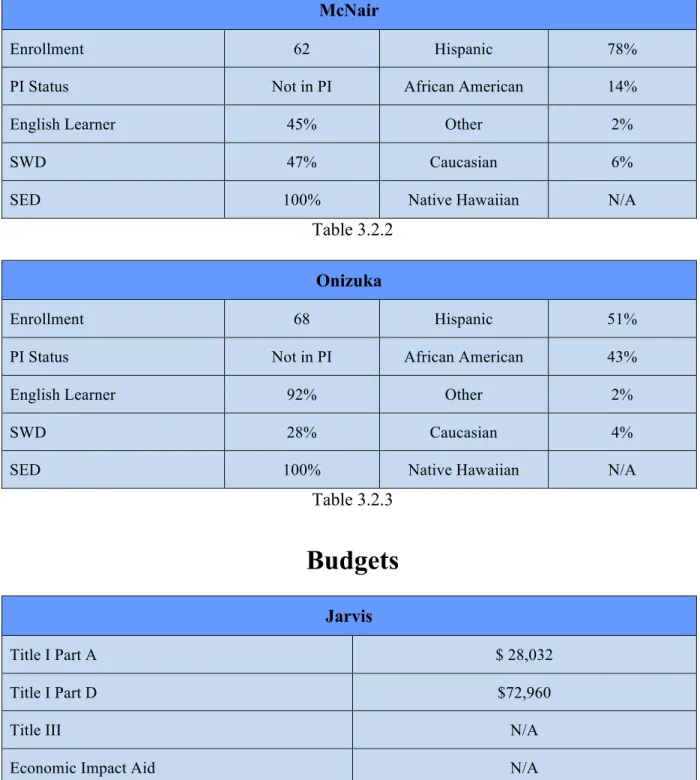
2012
Educational Programs
Division of Student Programs
Comprehensive Report
Juvenile Court Schools &
Community Day Schools
October 2012
9300 Imperial Highway Downey, California 90242-2890 Phone: (562) 922-6111 www.lacoe.edu
Arturo Delgado, Ed.D., superintendent
Cuauhtémoc Avila, Ed.D., assistant superintendent, Educational Programs
Perry Wiseman, Ed.D., director, Student Programs Los Angeles County Board of Education
Rudell S. Freer, president
Rebecca J. Turrentine, vice president
Douglas R. Boyd Katie Braude Gabriella Holt Maria Reza Thomas A. Saenz Publication No. 2013-04-11-1105-RC-16
TABLE OF CONTENTS
SECTION 1: DIVISION OF STUDENT PROGRAMS 1-1
Overview 1-1 Demographics 1-2 Budgets 1-2 Curriculum 1-3 Professional Development 1-5 Program Evaluation 1-8 School Sites 1-10
Student Performance Data 1-12
Transition Special Needs Unit 1-14
SECTION 2: JUVENILE HALLS 2-1
Overview 2-1
School Sites 2-2
Student Performance Data 2-2
Barry J. Nidorf PAU 2-4
Overview 2-4
Demographics 2-5
Budget 2-5
Sites 2-5
Curriculum Information 2.6
Student Performance Data 2-8
Staffing 2-9 Central PAU 2-10 Overview 2-10 Demographics 2-10 Budget 2-11 Site 2-11 Curriculum Information 2-11
Student Performance Data 2-14
Staffing 2-15
Los Padrinos PAU 2-16
Overview 2-16
Demographics 2-16
Budget 2-17
Site 2-17
Curriculum Information 2-17
Student Performance Data 2-19
SECTION 3: CAMPS 3-1
Overview 3-1
Sites 3-2
Student Performance Data 3-3
Angeles Forest PAU 3-4
Overview 3-4 Afflerbaugh/Paige 3-4 Glenn Rockey 3-5 Dorothy Kirby 3-6 Sites 3-8 Curriculum Information 3-8
Student Performance data 3-11
Staffing 3-12
Christa McAuliffe PAU 3-14
Overview 3-14
Demographics 3-14
Budgets 3-15
Sites 3-16
Curriculum Information 3-16
Student Performance Data 3-22
Staffing 3-23 Munz/Mendenhall PAU 3-24 Overview 3-24 Demographics 3-25 Budgets 3-26 Sites 3-26 Curriculum Information 3-27
Student Performance Data 3-29
Staffing 3-30
Road to Success Academy PAU 3-31
Overview 3-31
Demographics 3-32
Budgets 3-33
Sites 3-33
Curriculum Information 3-33
Student Performance Data 3-36
Staffing 3-37
Santa Monica Mountains PAU 3-38
Overview 3-38
Demographics 3-38
Sites 3-42
Curriculum Information 3-42
Student Performance Data 3-46
Staffing 3-47
SECTION 4: COMMUNITY DAY SCHOOLS 4-1
Overview 4-1
Sites 4-1
Student Performance Data 4-2
East LA PAU 4-3
Demographics 4-3
Budget 4-4
Sites 4-4
Curriculum Information 4-7
Student Performance Data 4-9
Staffing 4-10 Renaissance PAU 4-11 Overview 4-11 Demographics 4-11 Budget 4-11 Sites 4-12 Curriculum Information 4-13
Student Performance Data 4-16
Staffing 4-19
SECTION 5: ACTION PLAN 5-1
Priorities for 2012-2013 5-1
Special Education Program 5-1
English Learner Program 5-1
Student File Center 5-2
Multi Disciplinary Team Meetings 5-3
EPIC Student Information System 5-3
Career Technical Information 5-3
Casey A. Settlement 5-4
Principal and Assistant Principal Professional Development 5-5
SECTION 1: DIVISION OF STUDENT
PROGRAMS
Chapter 1
Overview
The Los Angeles County Office of Education (LACOE) is the largest intermediate educational agency in the United States. LACOE provides classroom instruction to 81 K–12 school districts in Los Angeles County. The Office of Education also serves as an intermediate administrative agency between districts and the California Department of Education. In addition to overseeing its 81 districts, LACOE currently provides direct programs and services to students through several education programs in the Division of Student Programs (DSP), which includes juvenile court schools and alternative schools.
LACOE is governed by seven board members and a superintendent appointed by the Los Angeles County Board of Supervisors. The superintendent works with a cabinet comprised of a deputy superintendent, three assistant superintendents, a chief business officer, a director of personnel commission, a director of communications, and a chief technology officer.
DSP serves approximately 5200 students throughout Los Angeles County who are “at risk” of academic failure. DSP provides students with alternative educational settings in 3 juvenile halls, 14 camps, 28 community day schools (CDS), and 7 independent studies (IS) programs. All school sites offer a common core curriculum and a variety of supplemented services intended to address the learning needs of individual students. Additionally, school personnel work closely with the Probation Department and Department of Mental Health to provide comprehensive educational services for all students.
Road To Success Academies
LACOE will improve the quality of educational programs at all camp schools through a competitive grant intended to assist schools pursue the implementation of a core instructional program and a comprehensive set of educational best practices recognized as the components of the Road To Success Academies. Schools that successfully implement all elements of the Road To Success Academies will be eligible for a rigorous site review from a visiting committee. The visiting committee will determine if the school receives the coveted Road To Success Academies
certification.
Core Instructional Program
• Core Subjects: English, Math, Science, Social Studies, Reading, P.E. • Interventions: Reading and Math
• Credit Recovery: AdvancePath or APEX • Positive Behavior Intervention Support (PBIS) • Career and Technical Education (CTE)
Road To Success Academies
• Thematic Instructional Framework
• Project-Based Learning/Interdisciplinary Curriculum • Professional Learning Communities (PLCs)
• Community Partnerships (CTE Certification and Pathways to Higher Education) • Coaching
Recent changes to state-operated facilities for juvenile offenders and specialized student populations have impacted LACOE-operated juvenile court schools. The California Youth Authority (CYA) reduced its population of incarcerated youth from 8,000 in 1995-96 to 1,423 in 2008-09, meaning that 73 percent of the most serious juvenile offenders that were served in CYA programs are currently housed and educated in County programs. Additionally, there has been a gradual increase in required services for students with special needs.
What follows is a profile summary of demographic data for DSP and its Principal Administrative Units (PAUs) by halls, camps, and CDS sites. This report includes a list of recommendations or next steps for continued improvement for our educational programs.
Demographics
Division of Student ProgramsADA N/A Hispanic 75% PI Status Year 3 African American 12% English Learner 49.93% Other 4% SWD 15% Caucasian 7% SED 90% Native Hawaiian 1%
Table 1.1
Budget
Division of Student Programs
Title I Part A $ 6,574,899 Title I Part D $7,551,599
Title II $125,000
Title III $375,000
Economic Impact Aid $602,000 Part C: Instructional Materials and Office Supplies $834,765
Curriculum
All schools within DSP offer a comprehensive, standards-based, Western Association of Schools and Colleges (WASC) accredited high school curriculum. LACOE students who complete 220 credits and pass both sections of the California High School Exit Exam (CAHSEE) earn and receive their high school diploma
Each semester, pacing calendars are created for existing benchmark assessments. Curriculum guides have also been written in all subject areas for all grade levels. Teachers administer the assessments to determine whether or not students are mastering the targeted standards and if the curriculum and instruction have been effective.
DSP English Language Arts (ELA) classes include English 9-12, Strategic ELA Support, ELA Intensive (the READ 180 program) and English Language Development (ELD) 1-5. Math offerings feature Math Basics, Algebra I and II, and Geometry; History/Social Science courses consist of World History, U.S. History, Government, and Economics; and Science courses include Earth Science, Life Science, Chemistry, and Physics. Computer classes, physical education classes, career technical education classes, and other elective classes are offered at all DSP sites.
Career Technical Education
Students attending DSP schools have a variety of career technical education (CTE) courses available to them. Students have the opportunity to acquire skills that prepare them for successful career entry, advancement, and/or continuing education. These skills are designed to be transferable, as well as job-specific, and basic to their general education to provide them with the foundation for life-long learning. The primary objectives for career and technical education programs are: to give students the specific skills needed for job-entry positions now and broad transferable skills, allowing students further employment/education flexibility; to acquire an awareness of the structure and future trends within high skill, high wage industries to increase students' options for occupational choice in the pursuit of a career as well as providing a cognitive base for post-secondary education; to provide both school and work-based learning experiences; and to bridge the gap between education and the work field. Some of the courses offered at the different sites include:
• Forestry Work Experience • Culinary Arts
• Paxton/Patterson Building Skills and Trade • Paxton/Patterson Health Science
• Regional Occupational Program (ROP) Landscaping Design • ROP ServSafe Certification
• ROP Woodshop • Bicycle Repair • Animal Care
• Culinary Arts with Mission College credit • Solar Cup Boat Building Project
• Automotive with LA Trade Tech • Electrical Construction
Intervention Programs
Many students who are enrolled in DSP programs do not read, write, or have a conceptual understanding of mathematics at their grade level. In order to support these students, differentiated instructional strategies are demonstrated and used in the classroom. Beyond that, there are specific, research-based intervention programs that are designed to deliver grade-level curriculum standards to students in a comprehensible, meaningful way. These interventions are focused on the subject areas of ELA, Math, and ELD.
In addition to the traditional core curriculum and intervention classes, DSP students are served with other co-curricular programs. The following programs are designed to identify and address learning gaps that are not found in the core curriculum. These gaps may be occurring in reading, math, or credit deficiency:
• ELA intensive intervention: READ 180
• ELD
• Strategic ELA • Achieve 3000
• Math Intervention: Think Through Math (TTM) • Credit recovery
• After-School Extended Learning Opportunities (ELO) program Assessment Program
DSP students are regularly assessed. They participate in all required state testing programs. Additionally, students are assessed upon enrollment and throughout their enrollment period. Local assessments are used to determine if students are mastering the state standards and if teacher instruction is effective.
Assessment Programs
• Northwest Evaluation Association (NWEA) Measure of Academic Progress (MAP)
Testing
• California Standards Test (CST)
• California High School Exit Exam (CAHSEE) • General Educational Development (GED) Test
• California English Language Development Test (CELDT) • Scholastic Reading Inventory (SRI)
• Curricular Benchmark (Common) Assessments (ELA, Math, H/SS, Science) • ELD curriculum-embedded assessments (Edge Program)
• Physical Fitness Testing (PFT) Other Programs
DSP students are offered a variety of choices and programs to enhance their educational experiences. Due to our students’ diversity and that they represent a wide variety of backgrounds, we offer enrichment programs to address our students’ wide needs and interests, which include:
• Dialectical Behavior Therapy (DBT) • Project-Based Learning Environment
• Total Educational Systems Support (TESS)/RISE Educational Services • Library
• Guitar Therapy
• Fluent Love of Words (FLOW) • Mobile Science Labs
• Inspiration 52 (offered at McAuliffe) • Bytes and Chips newspaper
• Career Essentials • Learning for Life • Boy Scouts
• Follow Your Dreams • YouthBuild • New Earth • LA Dads • Theatre of Hearts • New Roads • Sports Program • Solar Energy
Professional Development
English Learner Development Professional Development OverviewDuring the 2011-2012 school year, the English Learner (EL) Institute was created based on District Assistance and Intervention Team (DAIT) recommendation. The EL Institute consists of a three-day training that focuses on 30 teacher participants from the three juvenile halls: B.J. Nidorf, Central and Los Padrinos. The institute provides a firm foundation for understanding EL students’ needs and offers research-based, Specially Designed Academic Instruction in English (SDAIE) strategies. Teachers learn the basis of language and learning theory as it applies in the content areas of Language Arts and Math. Teachers learn how to utilize ELD standards, differentiate instruction, and link them to their content standards to develop language objectives for EL success. Teachers are provided with modeling of best practices for ELs and learn how to scaffold their text to support ELs in the classroom. Training for the 2012-2013 school year has been expanded to include all camp teachers as well as teachers representing the three halls that were not yet trained. In an effort to assist participants, two follow-up days are scheduled to provide support, feedback, and coaching. The first follow-up day provides teachers with more in-depth training in EL best practices, including a demonstration lesson with students in a classroom. The second follow-up day is a non-evaluative observation of their implementation of strategies from the institute where constructive feedback is provided.
English Language Arts
In 2010, a new course was developed to address the needs of students who are in the strategic range of instruction, i.e., performing within two years of grade-level standards. This class is a companion to the core Language Arts class and is titled Strategic ELA Support. It is an elective class and is blocked with the core ELA class to ensure cohesive instruction.
In order to equip teachers with the skills and tools necessary to provide effective instruction in this new course, the ELA Strategic Support Institute was created. The institute was a four-day training (non-successive dates throughout the school year) held in three different locations across the County to enable all ELA teachers in the system to attend. Teachers were provided with
research-based instructional strategies that would assist struggling readers in accessing core content. Each strategy was modeled and practiced in the training. In addition, video demonstrations were shown each day of the training to demonstrate teachers using these strategies with our particular student population. Teachers then worked in groups to plan lessons using the district curriculum guide and applying the new strategies they had learned.
Year two of the institute followed a similar approach. Its a focus was to deepen the range of strategies in preparing teachers for the complex work of common core standards, focusing more on aligning instructional strategies to assessments.
This year, teachers are working toward the shift to common core standards. Day one of this year’s institute was an overview of the common core initiative, as well as learning to unpack the new standards. Subsequent days of the training will focus on the rewriting of our district’s pacing guide, aligning the common core standards, and including strategic lesson plans for each reading selection.
Northwest Evaluation Association (NWEA) Measure of Academic Progress (MAP) Testing Professional Development
District and site administrators, teachers, and paraeducators have gone through extensive training to ensure the success of this computer-based adapted assessment program. DSP administrators participated in two full days of NWEA training prior to the professional development for teachers. Tier II of the training consisted of the NWEA program manager working in the morning with the individual PAU leadership teams and in the afternoon with the teachers and paraeducators. During Tier III, NWEA technical support worked hand-in-hand with teachers and administrators to begin the actual testing of students.
Datawise
Teachers and administrators continue to receive training in the Datawise student data system for DSP. Each site has identified “data teams,” and each member of the team has received six full days of training. The training included strategies on how to create, administer and interpret the results of common and benchmark assessments. Additional, the training introduced strategies on how to use these results to drive instructional and curricular decisions. Professional development opportunities are provided on an ongoing basis to all PAUs.
Educational Programs Information Connection (EPIC) Training
Traditionally, training for the EPIC student information system has been ongoing. Teachers and counselors new to LACOE receive individual or small-group training to maximize usage of the system. During spring of 2012, all DSP personnel participated in EPIC training with a concentration on its pertinence to their specific duties.
Think Through Math (Math Intervention Program) Training
Think Through Math (TTM), DSP’s math intervention program, delivers engaging digital content at the student’s instruction math level. This program was successfully piloted at McAuliffe, Road to Success Academy, and Munz/Mendenhall. All math teachers and site administrators received full group and individualized professional development in all aspects of the program. During September of 2012, all math teachers and site administrators received a full day of training in this math intervention program, which included instruction on strategies to integrate TTM content into the core curriculum.
Achieve 3000 delivers expository text to students at their personal, independent reading level. Site administrators were trained on the program, followed by all DSP teachers receiving training. The Achieve 3000 representative delivers ongoing full-group, small-group, and one-on-one instruction to all DSP teachers.
Verification Process for Special Settings (VPSS)
VPSS is a statewide program designed to assist secondary teachers who are teaching multiple subjects in special settings to meet the requirements of “No Child Left Behind Highly Qualified Teacher” requirements. The online classes are facilitated by an instructor over a period of five weeks (36 hours) to build content knowledge and a repertoire of effective instructional strategies to enable students to meet secondary level content standards.
DSP teachers completed the following VPSS courses during the 2011-2012 school year. The program was funded through Title II monies, and services were provided through LACOE’s Division of Curriculum and Instructional Services Center for Distance and Online Learning (CDOL). Teachers are able to purchase credit through UCLA Extension, in conjunction with university classes. The number of teachers and administrators that completed courses as of August 2012 is listed below:
Verification Process for Special Settings (VPSS)
English Language Arts Tier I 33 teachers and 3 Administrators English Language Arts Tier II 21 Teachers and 2 Administrators Math Tier I 36 Teachers and 3 Administrators Math Tier II 18 Teachers and 1 Administrator
Table 1.3
Cross and Joftus Focused Classroom Walkthrough Training
The Focused Classroom Walkthrough is an effective tool supporting quality instructional planning and delivery strategies, classroom environment issues, levels of student engagement, and thinking level of learning tasks. All district and site administrators participated in a two-day training and are currently receiving small-group coaching and observation classroom calibration on an ongoing basis.
Site and District Leadership Training
The monthly principals’ meetings have become a powerful and engaging leadership institute. All Educational Programs site administrators are being trained on effective, research-based educational leadership strategies, including Reframing Organizations (Bolman and Deal), Seven Correlates of Effectiveness (Edmonds, Lezotte, Marzano), and Turning Research into Results
(Clark and Estes).
DSP principals have received powerful professional development on building effective Professional Learning Communities (PLCs). Collaborative structures to create buy-in and staff efficacy and build strong relationships with staff members are some additional benefits of the Professional Development.
Program Evaluation
DSP students are exposed to a variety of academic intervention programs. There is a need to evaluate each intervention program to determine the level of implementation and effectiveness. To that end, this Intervention Program Evaluation process will be used with each of the student intervention programs.
A thorough “gap analysis” examination will be conducted for each of the following programs: READ 180, NWEA MAPs testing, AdvancePath, Think Through Math, Achieve 3000, and the English Language Development (ELD) Edge program. A committee to evaluate each of these programs has been formed, and a chairperson has been selected for each committee. Some of the activities each committee is involved in to determine level of program implementation and effectiveness are:
• Initial meeting to communicate goals of the committee • Reviewing/devising a classroom rubric to guide the analysis • Observation of the program/intervention
• Formal interviews and surveys with teachers and students
• Analysis of all available student achievement data germane to the program • Final report and analysis of program effectiveness
Chair (1 point)
The chair will be the program expert and provide the necessary leadership within the committee to ensure that all elements of the program are implemented to their highest level with consistency, fidelity, and accountability. The primary tasks associated with this responsibility are the following:
• Become familiar with every detail and feature of the program
• Form a learning community of key stakeholders to oversee the program
• Foster knowledge acquisition, commitment and focus with all learning community
members Criteria Chair Learning
Community
Training Implementation Program Data
Other Data
Analysis Evaluation
Evidence Name List of
Names
Calendar CBAM Results
Program Test Results Other Reading Scores, Grades, etc. Review All Data Scoring
Learning Community (1 point)
Under the guidance of the program chair, the Learning Community will collectively promote and guide the implementation of the program. The primary tasks associated with this responsibility are as follows:
• Become familiar with current leading research in the field related to the program • Become collective experts in the program
• Establish a timetable for program implementation
• Identify all key positions that require training for program implementation • Establish a training calendar for all stages of program implementation • Establish the criteria to be used for program implementation
• Establish the criteria to be used for program evaluation • Establish metrics to measure criteria for program evaluation • Establish a calendar for program evaluation
Training (1 point)
• A training calendar has been developed and is being or has been implemented as
evidenced by a calendar, sign-in sheets and training materials
Implementation Criteria (10 Points)
• Evidence that program is being or has been implemented according to program
specifications as measured by the Concerns-Based Adoption Model
Program Data Criteria (12 Points)
• Sample of student performance data based on program specifications (0 points) • Evidence of student improvement based on program proclamations (8 points)
Other Related Criteria (5 Points)
• Comparison to related student performance data (e.g., CAHSEE, NWEA, grades, etc.) to
substantiate student performance growth
Data Analysis
• Conduct classroom walkthroughs and determine level of program
implementation
• Review student performance data (program, other related programs, related
courses, etc.)
• Conduct survey interviews Evaluation
• Assign program a numeric value to determine program effectiveness • Quantitative Evaluation Metric:
30 Highly Effective 25 Moderately Effective 20 Effective
15 Below Effective 10 Ineffective
School Sites
Camps 14
Juvenile Halls 3 Community Day Schools 25
Table 1.4
Camps
Afflerbaugh/Paige Camp School
6621 North Stephens Ranch Road La Verne, CA 91750
Scott, Joseph Camp School
28750 North Bouquet Canyon Road Saugus, CA 91350
Rockey, Glenn Camp School
1900 North Sycamore Canyon Road San Dimas, CA 91733
Scudder, Kenyon Camp School
28750 North Bouquet Canyon Road Saugus, CA 91350
Kirby, Dorothy Camp School
1500 South McDonnell Avenue Los Angeles, CA 90022
Miller, Fred C. Camp School
433 South Encinal Canyon Road Malibu, CA 90265
Mendenhall, William Camp School
42230 North Lake Hughes Road Lake Hughes, CA 93532
Gonzales, David Camp School
1301 North Las Virgenes Road Calabasas, CA 91302
Munz, John Camp School
42230 North Lake Hughes Road Lake Hughes, CA 93532
Kilpatrick, Vernon Camp School
427 South Encinal Canyon Road Malibu, CA 90265
Table 1.5
Juvenile Hall Sites
B.J. Nidorf PAU
16350 Filbert Street Sylmar, CA 91342
Los Padrinos PAU
7285 East Quill Drive Downey, CA 90242
Central PAU
1605 Eastlake Avenue Los Angeles, CA 90033
Pacific Lodge Residential CEC**
4900 Serrania Avenue Woodland Hills, CA 91364
Community Day Schools
East LA PAU
Mujeres y Hombres Nobles CDS 1260 Monterey Pass Road
Monterey Park, CA 91754
Boyle Heights Technology Academy CDS
1600 East 4th St.
Los Angeles, CA 90033
Bermudez CDS 9055 Bermudez Street Pico Rivera, CA 90660
Destiny’s Girl Academy CDS
8601 South Broadway Los Angeles, CA 90003
Destiny’s Girl Academy CDS
8601 South Broadway Los Angeles, CA 90003
Eggleston/Pomona Academic Centre CDS (PAC) 1650 West Mission Road
Pomona, CA 91766
Mujeres y Hombres Nobles CCS-IS
1260 Monterey Pass Road Monterey Park, CA 91745
Bermudez CCS-IS
9055 Bermudez Street Pico Rivera, CA 90660
Destiny Girls Academy CCS-IS
8601 South Broadway Los Angeles, CA 90003
Eastern CCS-IS
1650 West Mission Boulevard, Suite 107 Pomona, CA 91766
Valley CCS-IS
13460 Van Nuys Boulevard Pacoima, CA 91331
Arleta Cal SAFE
8932 Woodman Avenue Arleta, CA 91331
Azusa Cal SAFE
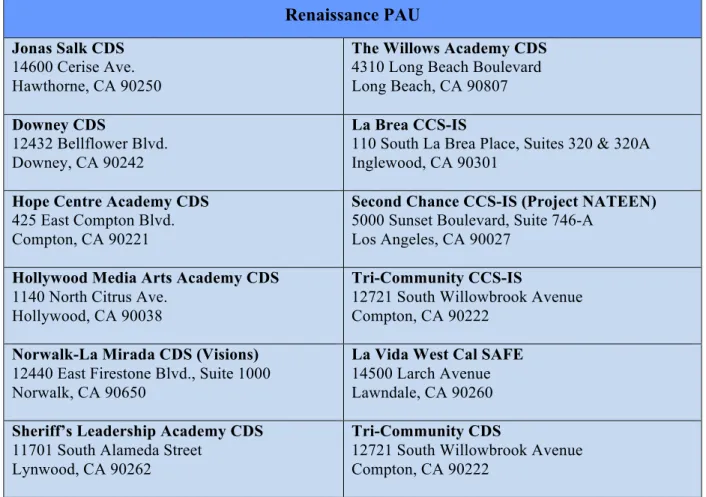
340 West Fifth Street Azusa, CA 91702 Table 1.7 Renaissance PAU Jonas Salk CDS 14600 Cerise Ave. Hawthorne, CA 90250
The Willows Academy CDS
4310 Long Beach Boulevard Long Beach, CA 90807
Downey CDS
12432 Bellflower Blvd. Downey, CA 90242
La Brea CCS-IS
110 South La Brea Place, Suites 320 & 320A Inglewood, CA 90301
Hope Centre Academy CDS
425 East Compton Blvd. Compton, CA 90221
Second Chance CCS-IS (Project NATEEN)
5000 Sunset Boulevard, Suite 746-A Los Angeles, CA 90027
Hollywood Media Arts Academy CDS
1140 North Citrus Ave. Hollywood, CA 90038
Tri-Community CCS-IS
12721 South Willowbrook Avenue Compton, CA 90222
Norwalk-La Mirada CDS (Visions)
12440 East Firestone Blvd., Suite 1000 Norwalk, CA 90650
La Vida West Cal SAFE
14500 Larch Avenue Lawndale, CA 90260
Sheriff’s Leadership Academy CDS
11701 South Alameda Street Lynwood, CA 90262
Tri-Community CDS
12721 South Willowbrook Avenue Compton, CA 90222
Student Performance Data
Annual Performance Report 2012Division of Student Programs
Site Met All ELA
Prof ELA Part Math Prof Math Part API Grad Rate PI Status 2012
LACOE No Yes Yes Yes No Yes No Year 3
Afflerbaugh-
Paige No Yes Yes No No NA NA Year 1
Central No Yes Yes Yes No NA NA Year 1
Gonzales Yes Yes Yes Yes Yes NA NA No
Jarvis No Yes Yes No No NA NA Year 1
Kilpatrick Yes Yes Yes Yes Yes NA NA No
Kirby NO Yes Yes No No NA NA No
Los Padrinos No Yes Yes Yes Yes NA No No
McNair Yes Yes Yes Yes Yes NA NA No
Mendenhall Yes Yes Yes Yes Yes NA NA No
Miller Yes Yes Yes Yes Yes NA NA No
Munz Yes Yes Yes Yes Yes NA NA No
Barry J. Nidorf No No No Yes No NA NO Year 1
Onizuka Yes Yes Yes Yes Yes NA NA No
Pacific Lodge Yes Yes Yes Yes Yes NA NA No
Phoenix Academy Yes Yes Yes Yes Yes NA NA No
Rockey Yes Yes Yes Yes Yes NA NA No
Scott Yes Yes Yes Yes Yes NA NA No
Scudder Yes Yes Yes Yes Yes NA NA No
Westside CDS Yes Yes Yes Yes Yes NA NA No
East LA CDS No No Yes No Yes No No Year 5
Renaissance CDS No No Yes No Yes No NO Year 5
Annual Performance Report 2012
Division of Student Programs
Site 2010 API 2011 API 2012 API 2012
API 2012 Made Subgroups
LACOE 619 641 667 Afflerbaugh-Paige NA NA NA Central NA 374 NA Gonzales NA NA NA Jarvis NA 379 NA Kilpatrick NA 467 NA Kirby NA 258 NA Los Padrinos NA 351 NA NA NA McNair NA NA NA Mendenhall NA 542 NA Miller NA NA NA Munz NA 349 NA
Barry J. Nidorf NA 311 467 Yes Yes
Onizuka NA 463 NA Pacific Lodge NA 372 NA Phoenix Academy NA NA NA Rockey NA NA NA Scott NA NA NA Scudder NA NA NA Special Ed 616 631 NA Westside CDS 437 599 NA East LA CDS 551 621 579 No No Renaissance CDS 566 536 520 No No Table 1.10
Transition Special Needs Unit
The Transition Special Needs Unit (TSN) provides school to career related services for at-risk youth in DSP. TSN is the umbrella unit for the Transition Partnership Program (TPP), Workability I (WAI), Workforce Investment Act (WIA) Program, and Carl D. Perkins Programs. Additionally, the TSN oversees the annual Operation Graduation activities.
Transition Partnership Program
TPP is a partnership between the California Department of Rehabilitation (DOR) and the Los Angeles County Office of Education (LACOE) that provides a holistic approach to assisting 225 at-risk youth between the ages of 16 to 19 in our Court Schools, Alternative Education, and SEA Charter Schools with a successful transition from school to work. Students identified with disabling conditions through LACOE school staff (special education service providers and/or classroom teachers) and community-based organizations are referred to the TPP School to Career Transition Specialist, who conducts an orientation session that explains the requirements of the program. Students participate in self-assessment, employment readiness skills training, and job search activities.
The TPP program staff monitors students for up to two years after they have exited their high school program. Monitoring services include support with transition into college and/or vocational school, support with clothing and/or uniforms for employment, transportation funds to assist with job search and/or employment-related activities, and support with completion of financial aid and/or scholarship applications. In 2011-2012, the TPP Program successfully placed 97 students in employment for 180 days or longer with the contract amount of $1,130,130.
Workability I
Workability I (WAI) is a grant awarded by the California Department of Education (CDE) to promote the involvement of key stakeholders including students, families, educators, employers, and other agencies in planning and implementing an array of services that will culminate in successful student transition to employment, lifelong learning, and overall quality of life.
WAI is a training program for special education students in DSP between the ages of 16-19. It is designed to promote career awareness and exploration while students complete their secondary education program, providing students with opportunities for job shadowing, paid and non-paid work experience, and ongoing support and guidance from school-to-career transition specialists. The grant award is $274,000.
Workforce Investment Act Youth Program
The Workforce Investment Act (WIA) Program is aimed at providing approximately 200 County-wide at-risk youth, between the ages of 14-21, with job readiness, career exploration, leadership development, education planning, and work experience to better prepare them for their future educational and career endeavors. Assessment in work readiness as well as basic skills is performed to determine which of their skills are exemplary and which are in need of support. Based off these assessments, an Individual Service Strategy (ISS) is developed to determine specialized interests and long-term goals. Once enrolled, participants receive specifically designed workshops and trainings to address their ISS as well as a hands-on work experience opportunity in an industry or field of their interest.
The work experience component was designed to introduce participants to different areas of the workforce, as well as give them the opportunity to utilize the skills they have learned while enrolled in the WIA program. A year-long follow-up is conducted on all WIA participants after leaving the program to ensure that they continue down a successful career or educational pathway.
A Summer Work Experience Program during the months of July through September is an extension of the WIA Program that provides additional funding to serve an additional 300 to 500 students. The Summer Program strictly provides 120–150 hours of work experience to qualifying students. The grant award formula WIA (year-long) is $1,007,994 and Waiver WIA (summer) is $137,904.
Carl D. Perkins Career and Technical Education (CTE) Program
The Perkins Act concentrates on the improvement of secondary and postsecondary courses and programs that are intended to build the knowledge, skills, attitudes, and experiences needed to enter and succeed in the workforce.
The Perkins CTE Program provides monetary support to career-specific and/or technical education courses conducted by industry professionals within non-traditional high school settings. The intention of these courses is to introduce high school youth to high demand industry jobs that are available for hire with a high school diploma and an industry recognized certification, which can be successfully attained upon completion of all CTE coursework. The grant award is $117,953.
Operation Graduation
Operation Graduation is the annual LACOE commencement ceremony for over 600 Division of Student Programs and Division of Special Education students per year. Planning and coordinating Operation Graduation begins in August of each fiscal year and ends the second week of July. Activities include the planning and coordinating of the entire commencement ceremony with internal and external partners. Discussions with deputies from the Board of Supervisors office begin in September to ensure a five-star production event. This project is done in collaboration with the Los Angeles County Probation Department and requires extensive coordination and planning throughout the fiscal year.
SECTION 2: JUVENILE HALLS
Chapter 2
Overview
DSP schools at the juvenile halls and camps focus on academics, student growth, parent involvement, and transition services. Each juvenile hall offers unique opportunities for parent involvement through parent meetings and weekly visitation. During the school year, each juvenile hall hosts an Open House event and provides multi-lingual resources for parents regarding school activities as well as parenting issues. All sites utilize parent education and problem solving as models for meetings. Parent involvement monies from Title I are used to provide refreshments for parent meetings and special activities planned throughout the year for parents and students. Transition Counselors also make contact with parents through court visits and support. Each juvenile hall offers unique activities for parents.
At Los Padrinos Juvenile Hall, parents are involved in the School Site Council (SSC) as well as in the English Learner Advisory Committee. In addition, a parent newsletter is sent periodically to parents and guardians. They participate in monthly parent meetings held on weekends to accommodate busy schedules. At Los Padrinos, the Transition Counselor also facilitates The Parent Project, a research-based program co-facilitated with Probation. The Parent Project provides parents a safe learning environment to discuss student needs and also training in dealing with issues related to parenting. The Parent Project is a seven-week program held weekly in the evenings for a cadre of parents. Parents are also included in all IEP meetings.
At Barry J. Nidorf Juvenile Hall, parent meetings are also held on weekends and during visiting hours to accommodate parents’ schedules. Barry J. Nidorf’s parent group recently received national recognition by the Parent Teacher Association. During 2010-2011, Barry J. Nidorf was also awarded the Connected for Kids membership award, and on March 26, 2012, Barry J. Nidorf was awarded the Teachers Matter Award, by the First District PTA. Both awards recognized Barry J. Nidorf staff for 100 percent enrollment in the Parent Teacher Group. Barry J. Nidorf also includes active parents on the School Site Council and English Learner Advisory Committee and hosts an annual meeting for parents.
At Central Juvenile Hall, a parent resource center is available for parent perusal as they wait to visit their children. Resources include parent involvement resources as well as information on local academic and vocational programs and social agencies. Central Juvenile Hall recently funded a parent position through their School Site Council. This person works directly with parents to provide resources, engagement, and problem solving. Central Juvenile Hall also has an active parent participation in the School Site Council and the English Language Advisory Committee as well as special activities.
In addition, camps and halls focus on after-school classes, which are designed to support student academics in the areas of Math and English as well as GED. Vocational and career education programs are aimed to provide career readiness for students. Student transcripts are evaluated by academic counselors as students enter the juvenile hall facility. Students are then placed in appropriate courses. After adjudication, students are placed in various camps. Each camp provides different options for the student’s social-emotional and academic needs. A detailed
placement process, completed in collaboration with Probation and LACOE, ensures that students are placed in the best possible location for growth while incarcerated.
Juvenile halls house both long-term and short-term students of both genders. In addition to full academic programs, the facilities host Parent Resource Centers and parent involvement activities. Students are provided transition services to include referrals to outside agencies, Multi-Disciplinary Team (MDT) meetings as they transition back to their home schools and homeless and foster youth services. Family needs are also addressed during MDT meetings. A variety of after-school programs provide intervention for students and career readiness is also a focus. DSP and Probation personnel collaborate with agencies located in the facility, which include the Department of Health, the Department of Mental Health, and the Superior Court Juvenile Court Division to provide specialized services for students to meet their needs.
School Sites
B.J. Nidorf PAU
16350 Filbert Street Sylmar, CA 91342
Los Padrinos PAU
7285 East Quill Drive Downey, CA 90242
Central PAU 1605 Eastlake Avenue Los Angeles, CA 90033
Table 2.1
Student Performance Data
Annual Performance Report 2012
Juvenile Halls
Site Met All ELA
Prof ELA Part Math Prof Math Part API Grad Rate PI Status 2012
Central No Yes Yes Yes No NA NA Year 1
Los Padrinos No Yes Yes Yes Yes NA No No
B.J. Nidorf No No No Yes No NA NO Year 1
Phoenix Academy Yes Yes Yes Yes Yes NA NA No
Table 2.2
Annual Performance Report 2012 Juvenile Halls Site 2010 API 2011 API 2012 API 2012
API 2012 Made Sub Groups?
Central NA 374 NA
Los Padrinos NA 351 NA NA NA
B.J. Nidorf NA 311 467 Yes Yes
Phoenix Academy NA NA NA
Barry J. Nidorf PAU
Overview
Barry J. Nidorf PAU consists of two schools contained within Probation Department facilities. Phoenix Academy is a specialized camp that houses students for long-term placement and Barry J. Nidorf is a juvenile hall that houses boys and girls for both long- and short-term placement. Phoenix Academy will be discussed in the Camps section of this document. Barry J. Nidorf Juvenile Hall is a Probation Department facility that houses minors, ages 9-18, that are awaiting adjudication or transfer to placement or camp. The average stay for these students is 10-14 days. In addition, the facility houses students awaiting transfer to Department of Juvenile Justice or the California Department of Corrections and Rehabilitation (CDCR). A six-month to one-year stay for these students is typical. Adult students (18 years of age) attend school in a classroom within the living unit to continue their education, given Probation Department guidelines to not mix adult and minor students. In conjunction with Mission College, the PAU is able to provide adult-charged students at Barry J. Nidorf Juvenile Hall and students at Phoenix Academy after-school college courses. Participating in these college classes is another motivation for students to stay in school. In addition, long-term students benefit from after-school intervention classes and GED classes, as well as a standards-based school curriculum.
Parental involvement is strong at Barry J. Nidorf PAU. With the support of the Probation Department, two regular teachers conduct the “outreach” to share school information, programs and activities with parents and provide an avenue for them to let the school know of their concerns. Barry J. Nidorf Juvenile Hall school is the only court school in the nation that has a state registered, formally organized, Parent Teacher Association (PTA). Parents are invited to attend the regular Title 1 update/PTA meetings that are held prior to student visitation throughout the year. Through these meetings, parents are involved in an ongoing basis in the planning, review and improvement of the school programs, including the parental involvement policy and the school-wide Title 1 plan. Though it is difficult to enlist parent support due to a myriad of factors, the PAU continues to make the effort. This effort was recognized by the California State PTA with the “CONNECTED FOR KIDS” 100 percent connected award for 2010-2011 for membership equal to or exceeding their school enrollment.
The PAU also oversees the Pacific Lodge Residential Community Education Center (CEC), a treatment facility for students undergoing substance abuse rehabilitation and medicated students who require 24-hour supervision. The program currently has four classrooms operated by DSP staff.
Demographics
B. J. Nidorf Juvenile HallEnrollment 237 Hispanic 67% PI Status Year 1 African American 27% English Learner 64% Other 2% SWD 26% Caucasian 4% SED 100% Native Hawaiian N/A
Table 2.1.1
Budget
B.J. Nidorf Juvenile Hall
Title I Part A $302,784 Title I Part D $76,504
Title III N/A
Economic Impact Aid N/A Part C: Instructional Materials Office Supplies $91,652
Table 2.1.2
Sites
Barry J. Nidorf PAU
16350 Filbert Street Sylmar, CA 91342
Pacific Lodge Residential CEC
4900 Serrania Avenue Woodland Hills, CA 91364
Curriculum Information
All schools within the Barry J. Nidorf PAU offer a comprehensive, standards-based, WASC accredited high school curriculum. LACOE students who complete 220 credits and pass both sections of the CAHSEE earn and receive their high school diploma.
Each semester, pacing calendars are created for existing benchmark assessments. Curriculum guides have also been created in all subject areas for all grade levels. Teachers administer the assessments to determine whether or not students are mastering the targeted standards and if the curriculum and instruction have been effective.
DSP ELA classes include English 9-12, Strategic ELA Support, ELA Intensive (READ 180) and ELD 1-5. Math offerings feature Math Basics, Algebra I and II and Geometry. History/Social Science courses consist of World History, U.S. History, Government and Economics. Science courses including Earth Science, Life Science, Chemistry and Physics. Computer classes, physical education classes, career technical education classes and other elective classes are offered at all DSP sites.
Intervention Programs
English Language Arts Intensive Intervention: READ 180
READ 180 is a reading program designed for students in elementary through high school whose reading achievement is below the proficient level. The goal of READ 180 is to address gaps in students’ skills through the use of a computer program, literature and direct instruction in reading skills. The software component of the program aims to track and adapt to each student’s progress. In addition to the computer program, the READ 180 program includes workbooks designed to address reading comprehension skills, paperback books for independent reading and audiobooks with corresponding CDs for modeled reading.
Math Intervention: Think Through Math
Think Through Math (TTM) delivers engaging, digital content at each student’s instructional level. TTM targets the most critical foundations for algebra, and provides rigorous instruction and meaningful practice designed to develop understanding of mathematical concepts. Students are given an on-line assessment to place them at their precise instructional level in the program. Students receive immediate feedback at every step, as well as access to live, certificated math teachers. As students finish activities and assessments, they progress through the content to improve their math skills and fill in “gaps” in their math knowledge.
English Language Development
DSP offers an ELD program. Services are provided to students whose proficiency levels range from beginner to advanced. Newcomer classes are available at Barry J. Nidorf, Central, and Christa McAuliffe PAUs. Newcomer students having a proficiency level of 1 or 2 are provided with the basic fundamentals of the English language through the Edge curriculum. In addition, these students are provided an additional period of language development and receive primary language support. In this course, other supplementary programs to assist in the acquisition of the English language are available, such as Inside Phonics, Inside the U.S.A, Rosetta Stone and the Achieve 3000 programs. All ELD courses offer research-based curriculum (Edge), the use of SDAIE strategies, ELD standards, and teachers who are EL certified to appropriately serve this
population. In all educational settings, ELs have full access to additional intervention programs if appropriate to their needs.
Strategic English Language Arts
The Strategic ELA Support course is designed to provide simultaneous support for students enrolled in grade-level English courses. The course is aligned to the corresponding grade-level California content standards for ELA. The courses provide strategic intervention to improve skills in word analysis, fluency, systematic vocabulary development, reading comprehension, literary response and analysis, writing strategies and applications, written and oral English language conventions and listening and speaking strategies and applications. If the student scores below basic on the CST, has an instructional reading level between 5.0 and 6.9 on the NWEA MAP assessment and a core text placement score of 5.0 to 7.0, the student is assigned one course in grade-level English and one course in Strategic ELA Support.
Achieve 3000
Achieve 3000 is a reading intervention program that not only improves students’ reading level but also delivers content aligned with state content standards and common core standards. Students are given an online assessment to determine reading (lexile) level. Daily, digital articles are provided to each student and matched precisely to the individual’s reading level. Text is 100 percent informational and high interest to motivate learners. Ongoing assessments are built into the daily instructional routine, enabling continual progress monitoring and data-driven decision-making.
After School Extended Learning Opportunities (ELO) Program
Students may extend their learning beyond the school day in the after-school ELO Program. This program includes a small student-to-teacher ratio. Students are offered CAHSEE Prep, GED Prep, math (Numeracy), and Language Arts intervention (Bridges to Literature) curriculum.
Career Technical Education (CTE)
Paxton/Patterson Building Skills and Trade Courses
Students learn the vocabulary, tools, materials and skills needed for various construction trades. Each trade is covered on a 10-day rotation, which includes basic hands-on instruction.
Assessment Program
• NWEA MAP testing is a computerized, adaptive assessment. This assessment will be
administered to DSP students every 45 days for the purpose of progress monitoring. The assessment also provides staff with detailed information needed to build curriculum, make instructional decisions, and meet our students’ needs, one student at a time. DSP staff test students in reading and math, and the test is aligned to national and state standards. MAP testing dynamically adapts to student responses as the test is taken. In this way, the test narrows in on a student’s learning level, engaging them with content that allows them to be successful. Teachers can immediately access their students’ data though the on-line reporting system and begin planning instruction. These reports will allow teachers to precisely determine which concepts a student has grasped and which areas to focus on for academic growth. In addition, teachers will be able to access reports that will allow them to track academic growth over the school year or over several years, even if the student changes school sites or PAUs within the DSP schools.
• CST
• GED
• California English Language Development Test (CELDT) • Scholastic Reading Inventory (SRI)
• Curricular Benchmark (common) assessments (ELA, Math, H/SS, Science) • ELD curriculum-embedded assessments (Edge Program)
• Physical Fitness Test (PFT)
Student Performance Data
Annual Performance Report 2012B.J. Nidorf PAU
Site Met All ELA
Prof ELA Part Math Prof Math Part API Grad Rate PI Status 2012
Barry J. Nidorf No No No Yes No NA NO Year 1
Phoenix
Academy Yes Yes Yes Yes Yes NA NA No
Table 2.1.4
Annual Performance Report 2012
Juvenile Halls Site 2010 API 2011 API 2012 API 2012
API 2012 Made Subgroups
Barry J. Nidorf NA 311 467 Yes Yes
Phoenix Academy NA NA NA
Staffing
Staffing - Barry J. Nidorf PAU
Certificated Principal 1 Assistant Principal 2 School Psychologist 3 Academic Counselor 1 Transition Counselor 1 Generally Funded Teachers 22 Special Education Teachers 8 Categorically Funded Teachers 2
Total Certificated 36
Classified
Para Educator 8
School Administrative Secretary 1 Senior School Clerk 4
School Clerk 0 Counselor Assistant 1 Custodian 3 Total Classified 17 Table 2.1.6
Salaries and Benefits
Barry J. Nidorf
Certificated Salaries $1,423,936.00 Classified Salaries $298,723 Benefits $556,205.00
Phoenix Academy Certificated Salaries $453,296.00 Classified Salaries $0 Benefits $127,295.00 Total $580,591.00 Table 2.1.7
Central PAU
Overview
Central Juvenile Hall is located in East Los Angeles, which is comprised predominantly of low socioeconomic-status Latino students. The daily population of Central Juvenile Hall generally ranges between 350-400 students. Of these, girls make up approximately 15 percent. The largest proportion of students includes those between the ages of 16 and 17 years. During 2011, Central Juvenile Hall School serviced approximately 450 to 500 students per day. The average class size for general education teachers is 15 to 18 students. With a consistent staff, Central Juvenile Hall School is able to offer academic and social education to students through a standards-based curriculum. In addition, transition services are provided for students and Central Juvenile Hall houses medical services for LA County Probation wards. After-school programs include GED and intervention courses. Central Juvenile Hall offers literacy services to all students through site Title I funds, which prepare students for the CAHSEE test and other academic challenges.
Demographics
Central Juvenile HallEnrollment 316 Hispanic 58% PI Status Year 1 African American 31% English Learner 59.47 Other 3% SWD 29% Caucasian 8% SED 100% Native Hawaiian N/A
Budget
Central Juvenile HallTitle I Part A $96,652 Title I Part D $302,784
Title III N/A
Economic Impact Aid N/A Part C: Instructional Materials Office Supplies 72,236
Table 2.2.2
Site
Central PAU 1605 Eastlake Avenue Los Angeles, CA 90033Curriculum Information
Central Juvenile Hall offers a comprehensive, standards-based, WASC accredited high school curriculum. LACOE students who complete 220 credits and pass both sections of the CAHSEE earn and receive their high school diploma.
Each semester, pacing calendars are created for existing benchmark assessments. Curriculum guides have also been created in all subject areas for all grade levels. Teachers administer the assessments to determine whether or not students are mastering the targeted standards and if the curriculum and instruction have been effective.
DSP ELA classes include English 9-12, Strategic ELA Support, ELA Intensive (READ 180) and ELD 1-5. Math offerings feature Math Basics, Algebra I and II and Geometry. History/Social Science courses consist of World History, U.S. History, Government and Economics. Science courses including Earth Science, Life Science, Chemistry and Physics. Computer classes, physical education, career technical education and other elective classes are offered at all DSP sites.
Intervention Programs
English Language Arts Intensive Intervention: READ 180
READ 180 is a reading program designed for students in elementary through high school whose reading achievement is below the proficient level. The goal of READ 180 is to address gaps in students’ skills through the use of a computer program, literature and direct instruction in reading skills. The software component of the program aims to track and adapt to each student’s progress. In addition to the computer program, the READ 180 program includes workbooks designed to address reading comprehension skills, paperback books for independent reading and audiobooks with corresponding CDs for modeled reading.
Math Intervention: Think Through Math (TTM)
Think Through Math (TTM) delivers engaging, digital content at each student’s instructional level. TTM targets the most critical foundations for algebra and provides rigorous instruction and meaningful practice designed to develop understanding of mathematical concepts. Students are given an online assessment to place them at their precise instructional level in the program. Students receive immediate feedback at every step as well as access to live, certificated math teachers. As students finish activities and assessments, they progress through the content to improve their math skills and fill in gaps in their math knowledge.
English Language Development
DSP offers an ELD program. Services are provided to students whose proficiency levels range from beginner to advanced. Newcomer classes are available at Barry J. Nidorf, Central, and Christa McAuliffe PAUs. Newcomer students have a proficiency level of 1 or 2 and are provided with the basic fundamentals of the English language through the Edge curriculum. In addition, these students are provided an additional period of language development and receive primary language support. In this course, other supplementary programs to assist in the acquisition of the English language are available such as Inside Phonics, Inside the U.S.A, Rosetta Stone and the Achieve 3000 program. All ELD courses offer research-based curriculum (Edge), the use of SDAIE strategies, ELD standards, and teachers who are EL certified to appropriately serve this population. In all educational settings, ELs have full access to additional intervention programs if appropriate to their needs.
Strategic English Language Arts
The Strategic ELA Support course is designed to provide simultaneous support for students enrolled in grade-level English courses. The course is aligned to the corresponding grade-level California content standards for ELA. The courses provide strategic intervention to improve skills in word analysis, fluency, systematic vocabulary development, reading comprehension, literary response and analysis, writing strategies and applications, written and oral English language conventions, and listening and speaking strategies and applications. If the student scores below basic on the CST, has an instructional reading level between 5.0 and 6.9 on the NWEA MAP assessment and a core text placement score of 5.0 to 7.0, the student is assigned one course in grade-level English and one course in Strategic ELA Support.
Achieve 3000
Achieve 3000 is a reading intervention program that not only improves students’ reading level, but it also delivers content aligned with state content standards and common core standards. Students are given an on-line assessment to determine reading (lexile) level. Daily, digital articles are provided to each student and matched precisely to the individual’s reading level. Text is 100 percent informational and high interest to motivate learners. Ongoing assessments are built into the daily instructional routine, which enable continual progress monitoring and data-driven decision-making.
After-School Extended Learning Opportunities (ELO) Program
Students may extend their learning beyond the school day in the after-school ELO program. This program includes a small student-to-teacher ratio. Students are offered CAHSEE prep, GED prep, math (Think Through Math), and Language Arts intervention (Achieve 3000 and or READ 180) curriculum.
Career Technical Education
Paxton/Patterson Building Skills and Trade Courses
Students learn the vocabulary, tools, materials and skills needed for various construction trades. Each trade is covered on a 10-day rotation, which includes basic hands-on instruction.
Assessment Program
• NWEA MAP testing is a computerized, adaptive assessment. This assessment will be
administered to DSP students every 45 days for the purpose of progress monitoring. The assessment also provides staff with detailed information needed to build curriculum, make instructional decisions, and meet our students’ needs, one student at a time. DSP staff test students in reading and math, and the test is aligned to national and state standards. MAP testing dynamically adapts to student responses as the test is taken. In this way, the test narrows in on a student’s learning level, engaging them with content that allows them to be successful. Teachers can immediately access their students’ data though the on-line reporting system and begin planning instruction. These reports will allow teachers to precisely determine which concepts a student has grasped and which areas to focus on for academic growth. In addition, teachers will be able to access reports that will allow them to track academic growth over the school year or over several years, even if the student changes school sites or PAUs within the DSP schools.
• California Standards Test (CST)
• California High School Exit Examination (CAHSEE) • General Education Development Test (GED)
• California English Language Development Test (CELDT) • Scholastic Reading Inventory (SRI)
• Curricular Benchmark (Common) Assessments (ELA, Math, H/SS, Science)
• English Language Development (ELD) Curriculum Embedded Assessments (Edge
Program)
Other Programs
Project-Based Learning Environment
Project-based learning is an instructional approach built upon authentic learning activities that engage student interest and motivation. These activities are designed to answer a question or solve a problem and generally reflect the types of learning and work people do in the everyday world outside the classroom. Project-based learning is synonymous with learning in-depth. A well designed project provokes students to encounter and struggle with the central concepts and principles of a discipline.
TESS/RISE
Explicit, direct instruction model and professional development on effective instructional practice for teachers and support staff. Administrators receive training in systems to sustain improvements and coaching in instructional leadership.
Library
Unique to the other juvenile halls and camps, Central Juvenile Hall has a Los Angeles County Public Library housed within the school. The library is staffed by a full-time librarian and full- time librarian assistant. Students visit the library weekly and are able to check out one paperback book at a time. Teachers often collaborate with the librarian and use the services of the library as a resource for specific classroom projects.
LA Dads
LA Dads program teaches much needed parenting skills to the boys at Central who are fathers. The curriculum includes infant care like diapering and feeding through the use of life-like dolls. This program also allows the fathers to bond with their children once a month during visiting hours.
Student Performance Data
Annual Performance Report 2012Juvenile Halls
Site Met All ELA
Prof ELA Part Math Prof Math Part API Grad Rate PI Status 2012
Central No Yes Yes Yes No NA NA Year 1
Annual Performance Report 2012 Juvenile Halls Site 2010 API 2011 API 2012 API 2012
API 2012 Made Subgroups
Central NA 374 NA Table 2.2.4
Staffing
Staffing - Central Certificated Principal 1 Assistant Principal 2 School Psychologist 3 Academic Counselor 2 Transition Counselor 1 Generally Funded Teachers 20 Special Education Teachers 7 Categorically Funded Teachers 5Total Certificated 40
Classified
Paraeducator 6
School Administrative Secretary 1 Senior School Clerk 2
School Clerk 0
Counselor Assistant 1
Custodian 3
Total Classified 13
Salaries and Benefits - Central Certificated Salaries $1,901,300.00 Classified Salaries $238,687.00 Benefits $629,072 Total $2,769,059 Table 2.2.6
Los Padrinos PAU
Overview
Los Padrinos PAU is located at 7285 E. Quill Drive, Downey, CA 90242 and is administered by the Los Angeles County Office of Education (LACOE). Los Padrinos PAU services youth that are wards of the County Superior Court’s Juvenile Division. The Los Angeles County Probation Department operates the facility at Los Padrinos and is a primary partner in providing care and supervision of students. School is in session 12 months of the year for 247 instructional days, and each school day is 300 minutes long. The school follows LACOE’s Division of Student Programs Goals and the Curriculum Pacing Guide, which is aligned with the California State Content Standards. The school’s Vision and Mission statements along with the Expected Schoolwide Learning Results (ESLRs) provide further guidance in driving instruction throughout the school. Los Padrinos Juvenile Hall services approximately 15,000 students per year.
Demographics
Los Padrinos Juvenile HallEnrollment 345 Hispanic 59% PI Status Not in PI African American 30% English Learner 70% Other 3% SWD 16% Caucasian 8% SED 100% Native Hawaiian N/A
Budget
Los Padrinos Juvenile Hall
Title I Part A $98,988 Title I Part D $302,784
Title III N/A
Economic Impact Aid N/A Part C: Instructional Materials Office Supplies 69,736
Table 2.3.2
Site
Los Padrinos PAU7285 East Quill Drive Downey, CA 90242
Curriculum Information
Los Padrinos Juvenile Hall offers a comprehensive, standards-based, WASC accredited high school curriculum. LACOE students who complete 220 credits and pass both sections of the CAHSEE earn and receive their high school diploma.
Each semester, pacing calendars are created for existing benchmark assessments. Curriculum guides have also been created in all subject areas for all grade levels. Teachers administer the assessments to determine whether or not students are mastering the targeted standards and if the curriculum and instruction have been effective.
DSP ELA classes include English 9-12, Strategic ELA Support, ELA Intensive (READ 180) and ELD 1-5. Math offerings feature Math Basics, Algebra I and II and Geometry. History/Social S