Interpreting Document Collections with Topic
Models
A Thesis submitted to the University of Sheffield
for the degree of Doctor of Philosophy in the Faculty of Engineering
by
Nikolaos Aletras
Department of Computer Science
The University of Sheffield
Acknowledgments
First of all, I would like to express my gratitude to my supervisor, Mark Steven-son. It was a good fun working together. Mark provided me with invaluable advice and help throughout my PhD from high-level ideas to small text polishing issues. Mark also helped me comprehend the right research practice making these three years of study a real pleasure.I am very grateful to my PhD panel committee members, Kalina Bontcheva and Steve Maddock, for their invaluable advice at the early stages of my studies. Many thanks to my collaborators in various research projects: Trevor Cohn, Bill Lampos and Daniel Preot¸iuc-Pietro in social media analysis; Eneko Agirre, Paul Clough, Samuel Fernando, Aitor Gonzalez-Agirre, Mark Hall and German Rigau in PATHS project; Tim Baldwin and Jey Han Lau in topic labelling. It was an honour to have a chance to work together with such great people and brilliant researchers that helped me broaden my research interests.
I would also like to thank all of my colleagues in the Natural Language Pro-cessing group for making such a nice working environment. I really appreciated helpful discussions, much needed coffee breaks and after-work drinks.
Finally, I would like to thank my family for the unreserved support and love all these years.
abstract
This thesis concerns topic models, a set of statistical methods for interpreting the contents of document collections. These models automatically learn sets of topics from words frequently co-occurring in documents. Topics learned often represent abstract thematic subjects, i.eSports orPolitics. Topics are also associated with relevant documents.These characteristics make topic models a useful tool for organising large dig-ital libraries. Hence, these methods have been used to develop browsing systems allowing users to navigate through and identify relevant information in document collections by providing users with sets of topics that contain relevant documents. The main aim of this thesis is to post-process the output of topic models, making them more comprehensible and useful to humans.
First, we look at the problem of identifying incoherent topics. We show that our methods work better than previously proposed approaches. Next, we propose novel methods for efficiently identifying semantically related topics which can be used for topic recommendation. Finally, we look at the problem of alternative topic representations to topic keywords. We propose approaches that provide textual or image labels which assist in topic interpretability. We also compare different topic representations within a document browsing system.
Table of Contents
Acknowledgements iii Abstract iv 1 Introduction 1 1.1 Contributions . . . 4 1.2 Thesis Overview . . . 5 1.3 Published Material . . . 7 2 Background 8 2.1 Modelling Document Collections . . . 92.2 Probabilistic Topic Models . . . 11
2.2.1 Notation . . . 13
2.2.2 Probabilistic Latent Semantic Analysis . . . 14
2.2.3 Latent Dirichlet Allocation . . . 15
2.2.4 Correlated Topic Model . . . 18
2.3 Organising Document Collections . . . 19
2.3.1 Limitations of Current Topic Browsers . . . 23
2.4 Topic Coherence . . . 23
2.5 Topic Similarity . . . 26
2.5.1 Metrics . . . 26
2.5.2 Applications of Topic Similarity . . . 27
2.6 Automatic Labelling of Topics . . . 28
2.7 Distributional Semantics . . . 30
2.7.1 Constructing Distributional Models . . . 31
2.8 Summary . . . 33
3 Evaluating Topic Coherence 35 3.1 Methodology . . . 36
3.1.1 Topic Coherence . . . 37
3.1.2 Computing Topic Word Similarity . . . 37
3.1.3 Constructing the Semantic Space . . . 38
3.2 Evaluation . . . 40
3.2.1 Data . . . 40
3.2.2 Human Evaluation of Topic Coherence . . . 41
3.2.3 Evaluation Metric . . . 42
3.3 Results . . . 44
3.4 Discussion . . . 46
3.5 Summary . . . 46
4 Measuring Topic Similarity 48 4.1 Methodology . . . 49
4.1.1 Topic Word Probability Distribution Similarity . . . 50
4.1.2 Topic Model Semantic Space . . . 50
4.1.3 Reference Corpus Semantic Space . . . 50
4.1.4 Training Corpus Semantic Space . . . 51
4.1.5 Knowledge-based Methods . . . 53
4.1.6 Feature Combination Using Support Vector Regression . . 54
4.2 Evaluation . . . 54
4.2.1 Data . . . 55
4.2.2 Generating Pairs of Topics . . . 55
4.2.3 Human Judgements of Topic Similarity . . . 57
4.2.4 Evaluation Metric . . . 58
4.2.5 Baseline . . . 58
4.3 Results . . . 59
4.4 Summary . . . 63
5 Automatic Labelling of Topics Using Text 64
5.1 Methodology . . . 65
5.1.1 Generating Candidate Labels . . . 65
5.1.2 Retrieving and Processing Text Information . . . 66
5.1.3 Creating a Text Graph . . . 66
5.1.4 Identifying Important Terms . . . 67
5.1.5 Ranking Labels . . . 67
5.2 Evaluation . . . 68
5.2.1 Data . . . 68
5.2.2 Evaluation Metrics . . . 68
5.2.3 Model Parameters . . . 69
5.3 Results and Discussion . . . 69
5.3.1 Experimenting with the Number of Search Results . . . 72
5.4 Summary . . . 73
6 Automatically Labelling of Topics Using Images 74 6.1 Methodology . . . 75
6.1.1 Selecting Candidate Images . . . 75
6.1.2 Feature Extraction . . . 75
6.1.3 Ranking Candidate Images . . . 78
6.2 Evaluation . . . 80
6.2.1 Data . . . 80
6.2.2 Human Judgements of Image Relevance . . . 81
6.2.3 Evaluation Metrics . . . 82 6.2.4 Baselines . . . 82 6.2.5 Human Performance . . . 84 6.3 Results . . . 84 6.4 Discussion . . . 86 6.5 Summary . . . 88
7 Comparing Topic Representations using an Exploratory Task 89 7.1 Methodology . . . 90
7.1.1 Document Collection . . . 90
7.1.2 Topic Modelling . . . 90
7.1.3 Topic Browsing Systems . . . 92
7.1.4 Exploratory Search Task . . . 94
7.1.5 Subjects and Procedure . . . 95
7.2 Results . . . 96
7.2.1 Number of Retrieved Documents . . . 96
7.2.2 Precision . . . 98
7.2.3 Post-task . . . 100
7.3 Summary . . . 101
8 Conclusions 103 8.1 Summary of Thesis . . . 103
8.2 Evaluation of Thesis Goals . . . 105
8.3 Future Directions . . . 106
Bibliography 108
Chapter 1
Introduction
Vast amounts of information are now available on-line in digital libraries, collec-tions and archives. Much of this information is stored in unstructured formats (such as text) and is not organised using any automated system. That is of-ten overwhelming for users in a way that makes it very difficult to find specific information or even explore such collections.This thesis deals with the application of a set of statistical methods, namely topic models (Blei et al., 2003; Hofmann, 1999) for analysing and organising large document collections. Topic models have been integrated into document browsing systems allowing humans to navigate through and identify relevant information on a large scale (Chaney and Blei, 2012; Gretarsson et al., 2012; Hinneburg et al., 2012).
Given a document collection, topic models learn a set of latent variables called topics. Topics are probability distributions over a vocabulary of words where fre-quently co-occurring words in the collection are associated with high probability. In addition, each document is represented as a distribution over topics. Table 1.1 shows a sample of topics learned from a collection of news articles represented by lists of the top-10 words with highest marginal probability in the topic.
Topic modelling is now widely used in Natural Language Processing (NLP) and has been applied to a range of tasks including word sense disambiguation (Boyd-Graber et al., 2007), multi-document summarisation (Haghighi and Van-derwende, 2009), information retrieval (Wei and Croft, 2006), and image labelling
2
Topic Topic Words
1 oil, louisiana, coast, gulf, orleans, spill, state, fisherman, fishing, seafood 2 north, kim, korea, korean, jong, south, il, official, party, son
3 model, wheel, engine, system, drive, front, vehicle, rear, speed, power 4 drink, alcohol, indonesia, drinking, indonesian, four, nokia, beverage,
mc-donald, caffeine
5 privacy, andrews, elli, alexander, burke, zoo, information, chung, user, regan
Table 1.1: A sample of topics generated by a topic model over a corpus of news articles. Topics are represented by top-10 most probable words.
(Feng and Lapata, 2010b).
Topic models have also proved to be a useful way to represent the content of large document collections. Visualisation interfaces (topic browsers) based on topic models have been developed in recent years (Chaney and Blei, 2012; Ganguly et al., 2013; Gretarsson et al., 2012; Hinneburg et al., 2012; Snyder et al., 2013). These systems enable users to navigate through the collection by presenting them with sets of topics. Therefore, processing and improving the output of topic models will enhance the development of document visualisation interfaces.
This thesis aims to make topic models more comprehensible and useful to humans. There are a number of challenges to overcome when applying these statistical methods to organise document collections:
• One main challenge is that topics need to present a coherent and inter-pretable thematic subject. There is no guarantee that each topic will be coherent. In Table 1.1, topics 1, 2 and 3 represent concrete thematic sub-jects. On the other hand, it is difficult to identify the underlying subjects of topics 4 and 5. Imagine how confusing these two topics would be if they are presented to users searching for specific information. Thus, providing users only with interpretable topics is an essential part of improving access to document collections organised using topic models. Finally, identifying coherent topics is required as a pre-processing step in algorithms for au-tomatically generating topic labels (see below). That is, for a topic which
3
might be difficult to interpret by humans, it would be difficult to assign it an unambiguous label.
• It seems intuitively plausible that some automatically generated topics will be similar while others are dis-similar. For example, a topic about bas-ketball (team, game, james, season, player, nba, play, knicks, coach, league) is more similar to a topic about football (world, cup, team, soccer, africa, player, south, game, match, goal), and
golf (golf, woods, hole, open, course, shot, round, tour, player, th) than one about the global finance (fed, financial, banks, federal, reserve, bank, bernanke, rule, crisis, credit). Methods for
auto-matically determining the similarity between topics have several potential applications, such as analysis of corpora to determine topics being discussed (Hall et al., 2008) or within topic browsers to decide which topics should be shown together (Chaney and Blei, 2012).
• Another challenge is to assist in the interpretation of the lists of words representing the topics by providing alternative representations. Interpret-ing such lists may not be straightforward, particularly since background knowledge may be required and there may not be access to documents in the source collection used to train the model. Therefore, informative labels could assist with the interpretations of topics. For example, topic 1 could be represented by a textual label, e.g. Mexican Gulf Oil Spill, while
topics 2 and 3 could be associated with the labels North Korean Pol-itics and Cars respectively. Moreover, other media such as images could
be used as labels for topics.
• Intuitively, labels, i.e. sets of keywords, textual phrases or images, represent topics in a more accessible manner than the standard keyword list approach. However, there has not been any empirical validation of this intuition. This thesis seeks to address this shortcoming. It aims to understand the impact of different topic representation modalities in finding relevant information in document collections, and also measure the level of difficulty in interpreting the same topics through different representation modalities.
1.1. CONTRIBUTIONS 4
1.1
Contributions
This thesis presents novel methods tackling the challenges mentioned in the pre-vious section. Its contributions are as follows:
• Introduces novel approaches for computing topic coherence based on dis-tributional semantics by representing words which outperform previously used methods.
• Describes a publicly available data set to evaluate topic coherence.
• Explores the problem of measuring similarity between topics by introducing topic similarity metrics including ones based on distributional semantics and knowledge-based measures. We show that the proposed metrics perform better than previously used methods.
• Introduces a publicly available data set consisting of pairs of topics together with human judgements to evaluate topic similarity.
• Proposes an unsupervised graph-based approach to associate textual labels with topics. Evaluation on a standard data set shows that the performance of the proposed graph-based method is consistently superior to previously reported methods.
• Introduces an alternative approach in which topics are represented using images. Results obtained show that the proposed approach significantly outperforms several baselines and can provide images that are useful to represent a topic.
• Describes a publicly available data set of topics and candidate image labels. • Finally, it compares different representations for automatically-generated topics, i.e. keyword lists, textual phrases and images, within an exploratory browsing interface. Results indicate that automatically generated labels are a promising approach for representing topics within browsing interfaces.
1.2. THESIS OVERVIEW 5
1.2
Thesis Overview
The remainder of this thesis is organised as follows:
Chapter 2 describes the notion of topic model and introduces different types of topic models. In addition, work on organising collections of documents using topic models is introduced. Previous work on improving the output of topic models is described including methods for computing topic coherence, labelling topics and measuring topic similarity.
Chapter 3 explores methods for automatically determining the coherence of topics. It proposes a novel approach for measuring topic coherence based on the distributional hypothesis (Harris, 1954). Each topic word is represented as a bag of highly co-occurring context words that are weighted using a range of word association measures and numbers of context terms. All methods are evaluated by measuring correlation with human judgements on three different sets of top-ics. Results indicating that the measures proposed outperform state-of-the-art methods.
Chapter 4 explores methods for computing semantic similarity between topics. Approaches to computing topic similarity have been described in the literature but they have been restricted to using information from the word probability dis-tribution to compare topics and have not been directly evaluated. The work in this chapter addresses these limitations by providing a systematic evaluation of a range of approaches to computing similarity between topics. It also introduces a data set consisting of pairs of topics together with human judgements of simi-larity to evaluate the proposed approaches. The data set has been made publicly available. Results demonstrate that the proposed methods perform better than those used previously.
Chapter 5 introduces a graph-based approach to labelling topics with textual labels. It makes use of topic keywords to form a query and retrieve relevant information from a search engine. A graph is generated from the words contained
1.2. THESIS OVERVIEW 6
in the search results and these are then ranked using a graph-based algorithm. Evaluation on a standard data set shows that the proposed method consistently outperforms the best performing previously reported method, which is supervised (Lau et al., 2011).
Chapter 6 presents a novel approach to labelling topics with appropriate im-ages. The approach utilises the vast amount of pictures existing on the Web to generate a set of candidate images for each topic. Candidate images are retrieved by querying an image search engine with the top n topic terms. The most suit-able image is selected by using a graph-based approach that makes use of both textual and visual information. The ranking method makes use of textual infor-mation from the metadata associated with each image as well as visual features extracted from the analysis of the images themselves. The method is evaluated using a data set created for this study that was annotated by crowdsourcing. The data set consisting of topics and candidate images has been made publicly available. Results of the evaluation show that the proposed method significantly outperforms three baselines.
Chapter 7 compares different representations for automatically-generated top-ics within an exploratory browsing interface. The representations are: (1) lists of keywords, (2) textual labels, and (3) image labels. Three versions of the browsing interface were created, each using a different topic representation. An experiment is carried out in which users are asked to retrieve relevant documents using the interface. Results indicate that automatically generated labels are a promising approach for representing topics within browsing interfaces. They have the ad-vantage of being more compact than the lists of keywords that are normally used which provides more flexibility in the creation of interfaces. Retrieval perfor-mance is comparable to when keywords are used and is likely to increase with improved topic labelling methods.
Chapter 8 summarises the main conclusions of this thesis and suggests possible avenues for future work.
1.3. PUBLISHED MATERIAL 7
1.3
Published Material
Work contributing to this thesis has been published in the following peer reviewed conferences:
• The work presented in Chapter 3 has been published in the proceedings of the 10th International Conference on Computational Semantics (IWCS 2013) (Aletras and Stevenson, 2013a).
• The work presented in Chapter 4 has been published in the proceedings of the 14th Conference of the European Chapter of the Association for Computational Linguistics (EACL 2014) (Aletras and Stevenson, 2014a).
• The work presented in Chapter 5 has been published in the proceedings of the 52nd Annual Meeting of the Association for Computational Linguistics (ACL 2014) (Aletras and Stevenson, 2014b).
• The work presented in Chapter 6 has been published in the proceedings of the 2013 Conference of the North American Chapter of the Association for Computational Linguistics: Human Language Technologies (NAACL-HLT 2013) (Aletras and Stevenson, 2013b).
• The work presented in Chapter 7 has been published in the proceedings of the International Digital Libraries Conference (DL 2014) (Aletras et al., To Appear).
Chapter 2
Background
This chapter describes how document collections can be modelled using statistical approaches. It gives a detailed description of various topic models that will be employed in the experiments presented in later chapters and systems that make use of them to organise document collections. In addition, it presents how word meaning can be modelled by the context which occurs in high dimensional vector spaces where each point represents a contextual element.In the introduction, we informally introduced topic models and their main characteristics that make them appropriate for organising large collections of text documents. We also indicated the main problems of applying such statistical methods, namely: (1) identifying topics that are difficult to interpret by humans, (2) summarising the main thematic subject of topic keywords in a condensed form (i.e. textual label) and (3) identifying semantically similar topics. We argued that tackling these problems can improve the output of topic models making them easier to use.
The chapter begins by presenting methods to modelling document collections in Section 2.1. Section 2.2 introduces the mathematical formulation of topic mod-els. Next, Section 2.3 describes systems that make use of topic models to organise and visualise document collections. Also, we discuss previous approaches on mea-suring topic coherence (Section 2.4), summarising topics using labels (Section 2.6) and identifying semantically similar topics (Section 2.5) in the following three sec-tions. Section 2.7 introduces vector space models of word meaning. Finally, a
2.1. MODELLING DOCUMENT COLLECTIONS 9
summary (Section 2.8) highlights the key points of this chapter.
2.1
Modelling Document Collections
A fundamental problem in NLP is finding ways to represent large amounts of text in a compact way. One of the most common semantic representations of a document collection is the Vector Space Model (VSM) (Salton et al., 1975). In a VSM, also referred as asemantic space orbag-of-words representation, documents and terms are represented as points in a Euclidean space. The term-document matrix (Salton and McGill, 1983; Salton et al., 1975; Turney and Pantel, 2010) C is a type of a semantic space. It is a W×D matrix that contains information about the occurrence (frequency) of W terms in D documents. Elements, cij in
C represent theithword in thejthdocument and are usually weighted by the raw
frequency of terms in documents or using the tf-idf (term frequency - inverted document frequency) weighting (Salton and McGill, 1983).
A well-known problem with the term-document VSMs is the high dimension-ality caused by the large number of unique terms1 that can exist in a corpus.
High dimensional spaces are often also sparse, i.e. many documents contain only a few unique terms or some terms appear only in a few documents. This makes it difficult, for example, to accurately compute the similarity between two docu-ments or terms. In addition, VSMs do not cope with polysemy since ambiguous words are represented as a single vector in the semantic space. For example, the term python may occur in documents about either snakes or programming languages, however there is only one instance of that vector which contains the co-occurrence of that word with all the documents in the collection.
Statistical methods such as Latent Semantic Analysis (LSA) (Deerwester et al., 1990; Landauer and Dumais, 1997) have been used to reduce the dimen-sionality of semantic spaces. LSA applies Singular Value Decomposition (SVD) to the matrix C. This is a form of factor analysis where C is decomposed into
2.1. MODELLING DOCUMENT COLLECTIONS 10
three other matrices:
C =UΣVT (2.1)
where U is aW ×W matrix of word vectors where its columns are eigenvectors of CCT, Σ is a diagonalW ×Dmatrix containing the singular values and V is a D×D matrix of document vectors where its columns are eigenvectors of CTC. The multiplication of the three component matrices results in the original matrix, C. Any matrix can be decomposed perfectly if the number of singular values is no smaller than the smallest dimension of C. When fewer singular values are used then the matrix product is an approximation of the original matrix. LSA reduces the dimensionality of the SVD by deleting coefficients in the diagonal matrix Σ starting with the smallest. This method achieves high compression of the original vector space which is useful in large document collections. The approximation of matrix C retaining theK largest singular values is then given by:
C ≈UKΣKVKT (2.2)
where UK is a W ×K matrix of word vectors, ΣK is a K×K diagonal matrix
with singular values and VK is a K×D matrix of document vectors.
LSA can be considered as a type of topic model (Stevens et al., 2012) since it learns a set of topics, TK, by multiplying the word vectors, UK, and the diagonal
matrix ΣK:
TK =UKΣK (2.3)
In addition, matrixVT
K corresponds to the assignment of topics in each document.
LSA has been shown to capture linguistic notions such as synonymy and pol-ysemy (Landauer and Dumais, 1997). However, Stevens et al. (2012) showed that topics learned by LSA are not easily interpretable. Vectors in T are linear com-binations of the term-document frequencies and consist of positive and negative values. Therefore, it is not possible to identify important terms that characterise the main thematic subject of the topics. On the other hand, topics learned by an alternative type of topic model, described in the following section, are more
2.2. PROBABILISTIC TOPIC MODELS 11
descriptive and often represent a coherent subject.
2.2
Probabilistic Topic Models
Probabilistic topic models (Blei et al., 2003; Hofmann, 1999), often referred to simply as topic models, are generative models that learn a set of latent variables called topics. The main assumption of topic models is that documents are gener-ated by a mixture of topics while topics are probability distributions over words. The input of a topic model is a set of documents and its output is a set of topics together with topic assignments to documents.
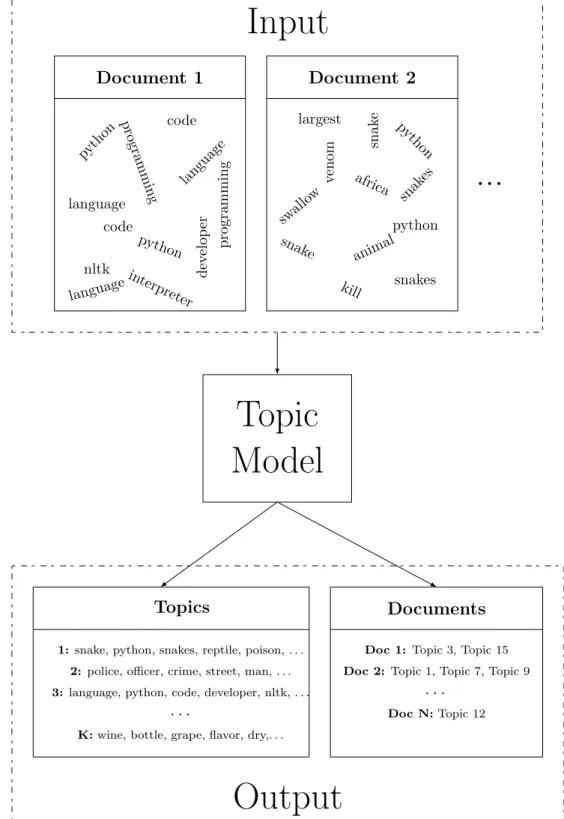
Figure 2.1 shows an overview of a topic modelling pipeline including input and output. In the input, each document is represented as a bag-of-words. Each document is often tokenised (split up) into words and normalised (converted to lower case) while word order is ignored. The only information relevant to the model is the number of times a word appears in each document. The input section in Figure 2.1 shows documents represented as bag-of-words. Document 1 contains information about Python (programming language) while document 2 contains information about pythons (snakes).
The output of a topic model is a set of topics and a set of topic assignments for each document. Each topic is a probability distribution over all the unique words in the collection. Topics are often represented by the words with the highest probability in the topic (see the output in Figure 2.1). In the rest of the thesis, the term topic words refers to the set of n words with highest probability in a given topic. Words assigned high probability in some topics frequently appear together in documents and are likely to represent a coherent subject or theme.
A document is represented as a probability distribution over topics with only a few topics assigned with high probability. In Figure 2.1 showing the output, topic 1 which is about snakes is assigned with high probability to document 2. On the other hand, topic 2 which represents information about programming is assigned to document 1.
2.2. PROBABILISTIC TOPIC MODELS 12 Document 1 python programming language code dev elop er nltk interpreter python code language programming language Document 2 largest snak es africa python python snak e v enom snakes kill animal swallo w snak e
...
Input
Topic
Model
Topics1: snake, python, snakes, reptile, poison, . . .
2: police, officer, crime, street, man, . . .
3: language, python, code, developer, nltk, . . .
. . .
K:wine, bottle, grape, flavor, dry,. . .
Documents
Doc 1:Topic 3, Topic 15
Doc 2:Topic 1, Topic 7, Topic 9
. . . Doc N:Topic 12
Output
2.2. PROBABILISTIC TOPIC MODELS 13
Topic models have appealing characteristics for organising document collec-tions. They can be used for clustering documents under topics enhancing brows-ing and improvbrows-ing information access. In addition, topic models soft cluster terms into topics dealing with polysemy (e.g. topics 1 and 2 represent different senses of the word python) and therefore, users can retrieve different sets of documents relevant to a given search term (e.g. python).
2.2.1
Notation
We introduce topic modelling notation following a similar approach as Blei et al. (2003):
• Aword or term represents a unique word type of a fixed length vocabulary indexed by {1, ..., W}. Each word is represented as unit-basis vector of length W that has a single element equal to one and all other elements equal to zero. The k-th word in the vocabulary is represented by a vector w such thatwk = 1 and wi = 0 for i6=k.
• Adocument ofN words is represented as a sequence byd= (w1, w2, ..., wN),
where wi is the i-th word in the sequence. Note that this is also a
bag-of-words representation since the word sequence does not need to match the original word order of the document.
• A corpus is a collection of D documentsD ={d1,d2, ...,dD}.
Lets consider an example vocabulary, v = {be,not,or,to}with indices{1,2,3,4}. The word be is represented as w3 = h1,0,0,0i. The document d =“to be or not to be” will be represented as wd = (w14, w21, w33, w42, w54, w61), using the notation
described above. Note that any permutations of the word order in wd do not have any effect and result in equal representations of the document.
We will also use P(z|d) to denote a document’s distribution over topics, P(w|z) the probability distribution over words w given the topic z and P(w|d) the distribution over words within document D. For a corpus withDdocuments and W words, a topic model learns a relation between words and topics, T, and a relation between topics and documents as:
2.2. PROBABILISTIC TOPIC MODELS 14
χ y
N
Figure 2.2: Example of plate notation.
• aT×W matrix, Φwith elements φij denoting the probabilityP(wi|z =j),
and
• aD×T matrix,Θ, with elements θij denoting the probabilityP(z =j|di).
Probabilistic generative models can conveniently be represented using plate notation. In these graphical models, observed variables are indicated using shaded nodes while latent variables are denoted by unshaded nodes. Arrows between nodes indicate conditional dependency while plates (boxes) surrounding nodes indicate repetitions of sampling steps. The number in the bottom right corner of the plate indicates the number of samples (repetitions). Figure 2.2 shows an example of plate notation of a simple graphical model where χ is an observed variable and y is a latent variable.
2.2.2
Probabilistic Latent Semantic Analysis
Hofmann (1999) proposed the probabilistic Latent Semantic Analysis (pLSA) as an alternative to LSA. The pLSA models each word in a document as a sample of a mixture model. The mixture model is a set oftopics in the form of multinomial random variables.
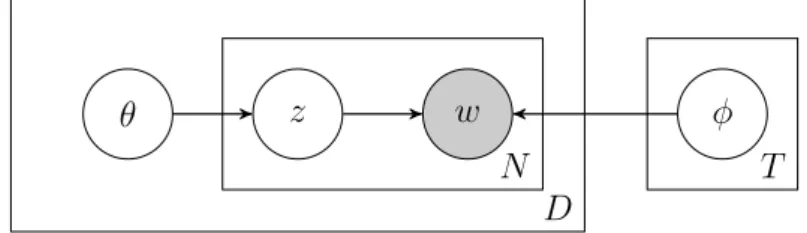
Given T topics, the aim is to find the probability distribution of words in a topic and the probability distribution of topics in a document. Words are the observed variables while topics are the latent variables. The generative process, illustrated in Figure 2.3, is as follows:
1. For each document d∈ D with probability P(θd),
(a) select a latent topic z with probability P(z|d), (a) generate a word w with probabilityP(w|z).
2.2. PROBABILISTIC TOPIC MODELS 15 w z θ φ D N T
Figure 2.3: Graphical model representation of pLSA.
The above process is defined by the following expression as a joint probability between a word and a document:
P(θd, w) = P(θd)P(w|θd), (2.4) P(w|θd) = X z∈Z P(w|z)P(z|θd) (2.5) =P(θd) X z∈Z P(w|z)P(z|θd). (2.6)
The pLSA model satisfies the main assumption of topic models, namely that a document consists of multiple topics. The probabilityP(z|θd) contains the weight
of each topic z ∈ Z given a document d. However, representing each document as a list of topic weights without a generative probabilistic model for them leads to two main problems (Blei et al., 2003): (1) the number of parameters grows linearly with the number of documents in the corpus causing overfitting problems, and (2) it is not possible to assign topic probabilities to any unseen documents, i.e. not in the training corpus.
2.2.3
Latent Dirichlet Allocation
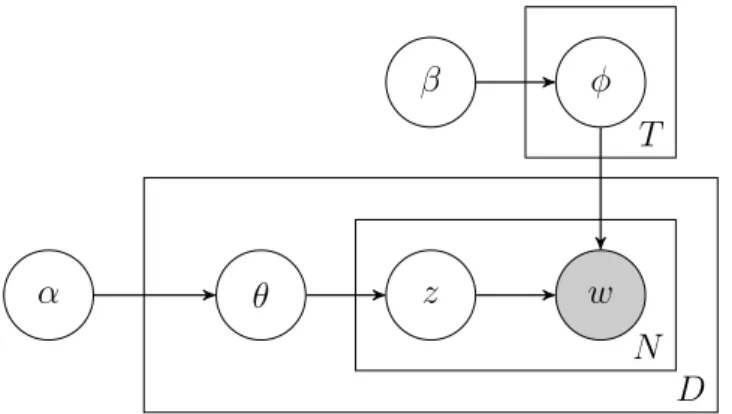
Latent Dirichlet Allocation (LDA) (Blei et al., 2003) is an extension of pLSA which introduces symmetric Dirichlet priors on the distribution over topics for a particular document,θ, and the distribution over words for a particular topic,φ. That addresses the problems with pLSA mentioned above by treating the topic weights in each document as a hidden random variable of sizeT, where T is the number of topics. A graphical representation of LDA is shown in Figure 2.4.
2.2. PROBABILISTIC TOPIC MODELS 16
1. For each topic
(a) Choose a distribution over words φ ∼ Dir(β) 2. Choose N
A document d in a corpus D is represented by latent topics using the following generative process:
3. Chooseθ ∼Dir(α)
4. For each of theN words wn
(a) Choose a topic zn ∼ Multinomial(θ)
(b) Choose a word wn fromp(wn|zn, β), a multinomial probability
condi-tioned on the topic zn
where:
• N is the number of words in a document. • zn is the n topic for the wordwn.
• θ is the topic distribution for a document.
• α is the parameter of the Dirichlet prior on the per-document topic distri-butions.
• β is the parameter of the Dirichlet prior on the per-topic word distribution. The joint probability of the corpusD given the hyperparametersα andβ is given by the following equation:
P(D|α, β) = T Y t=1 D Y d=1 N Y n=1 P(φt|β)P(θd|α)P(zdn|θd)P(wdn|φzdn) (2.7)
The main variables need to be estimated in the model are the per-topic word distributions φ and the per-document topic distributionsθ. Inferring direct esti-mates from Equation 2.7 is intractable.
Hofmann (1999) used the expectation-maximisation (EM) algorithm to es-timate φ and θ directly. However the EM algorithm may get stuck in local
2.2. PROBABILISTIC TOPIC MODELS 17 w z θ α β φ D N T
Figure 2.4: Graphical model representation of LDA.
maxima. Approximation methods have been used to avoid this problem such as Bayesian variational inference (Blei et al., 2003) and Gibbs sampling (Griffiths and Steyvers, 2004).
Gibbs sampling is a specific type of Markov Chain Monte Carlo model (MCMC) for obtaining sample values from complex multivariate probability distributions. It starts by assigning every word w with a random topic t ∈ {1, ..., T} for every document in corpus D. Then, for each word, it estimates the probability of as-signing the current word in each topic, given the topic assignments of all of the other words. Griffiths and Steyvers (2004) calculated this probability by:
P(zi =j|z−i, wi, di,·)∝ CwW Tij +β W P w=1 CW T wj +W β CdDTij +α T P t=1 CDT dit +T α (2.8)
where zi = j represents the topic assignment of word wi in topic j, z−i are
the topic assignments of all of the other words, and “·” represents all the other information from word, documents and hyperparameters α and β. In addition, the elementCwjV T of the matrixCV T,V ×T, contains the number of times wordw assigned to topicj. The matrix CDT,D×T, contains the counts of each topic is
assigned to words of each document ; CDT
dj represents the number of times topic
j is assigned to words in documentd.
The Gibbs sampling algorithm estimates the probability of each topic for every word. The elements of matrices Φ and Θ, containing the per-topic word
2.2. PROBABILISTIC TOPIC MODELS 18
distributions and the per-document topic distributions, can be obtained by:
φij = CijW T +β PW k=1C W T kj +W β θjd = CDT dj +α PT k=1C DT dk +T α (2.9)
where φij is the probability of word wi in topic j and θjd is the probability of
topic j in document dd.
2.2.4
Correlated Topic Model
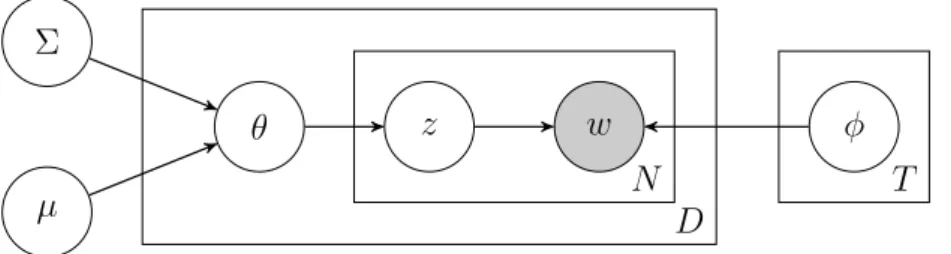
LDA assumes that topics are independent and does not attempt to capture cor-relations between them. The Correlated Topic Model (CTM) (Blei and Lafferty, 2006) overcomes this limitation by capturing topic correlation via the logistic nor-mal distribution. Let {µ,Σ} be a K-dimensional mean and covariance matrix, and let topics φ1:T be T multinomials over a vocabulary of size W. An N-word
document is generated by the following process shown in Figure 2.5:
1. Chooseθ|{µ,Σ} ∼ N(µ,Σ) 2. For each of theN words wn
(a) Choose a topic Zn|η from Mult(f(θ))
(b) Choose word wn|{zn, φ1:T}from Mult(φzn)
In CTM, the distribution over topics for a document is drawn from a logistic normal distribution. The covariance matrix for parametrising the logistic normal distribution can be used to identify correlations between topics and form a topic graph in which each node represents a topic and each edge denotes the correlation between them.
Apart from the fact that CTM identifies correlations between topics which LDA does not capture, it has also been shown to achieve higher predictive like-lihood than LDA (Blei and Lafferty, 2006). On the other hand, training LDA models is less computationally intensive. In addition, Chang et al. showed that LDA produces topics that are more coherent and easy to interpret by humans than those produced by CTM.
2.3. ORGANISING DOCUMENT COLLECTIONS 19 w z θ φ Σ µ D N T
Figure 2.5: Graphical model representation of CTM.
2.3
Organising Document Collections
So far, we have shown that topic models decompose a document collection into a per-document topic matrix, Θ, and a per-topic word matrix, Φ. Θ can be con-sidered as a soft-clustering of documents under topics. Each column vector in it contains the probability of a particular topic in each document. Therefore, topic models can be naturally used to automatically organise and visualise document collections as sets of topics. Users can access documents by navigating through topics. The remainder of this section describes various document collection visu-alisation and analysis tools based on topic modelling.
Topic Browser (Gardner et al., 2010) is a topic-based browsing system which provides visualisation of a document collection by presenting topics and associated documents. Apart from the information from the topic model, Topic Browser provides a broad range of metrics such as the number of words labelled with a particular topic or the spread of topics across documents. The system also computes topic coherence and similarity, as well as similarity between documents. Newman et al. (2010a) proposed a different approach to the visualisation of a topic model using maps. The topic mapping tool, Topic Maps, takes as an input the matrix Θ which contains the per-document topic distributions and applies further dimensionality reduction techniques to project it onto a two-dimensional space. Each topic is mapped to a colour while documents are represented by the colour of the most probable topic given the document. In that way, similar docu-ments appear close together on the projected space. Users can browse docudocu-ments accessing the map or by clicking on text links on the right side of the map.
2.3. ORGANISING DOCUMENT COLLECTIONS 20
is a system designed to visualise the topics in a document collection. Users can interactively view, explore, and analyse text through plots of topic evolution over time. Topics are represented by sets of keywords and users can access text of specific documents under each topic.
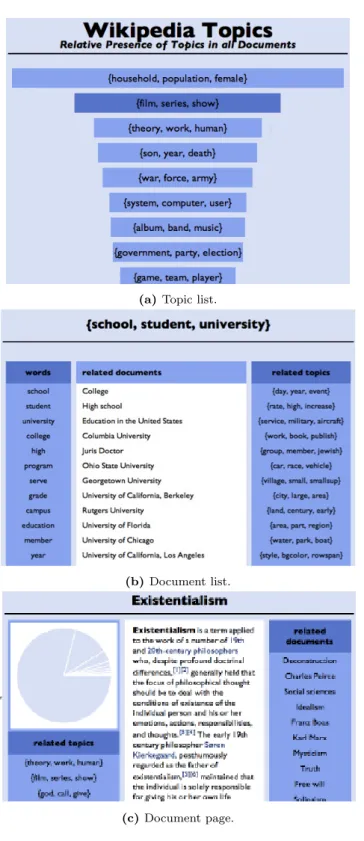
Chaney and Blei (2012) presented TMVE (Topic Model Visualisation Engine), a document collection visualisation tool based on LDA. Given a set of documents and a trained LDA model, the tool generates an interface with the following main components: a main page showing a list of topics, topic pages and document pages. The main page contains the list of generated topics represented by a set of keywords. Each topic page is associated with a list of documents with the highest marginal probability given that topic. Document pages show the content of a document together with its topic distribution. Figure 2.6 shows parts of TMVE’s interface.
Another web-based system providing analysis and visualisation capabilities using topic models is TopicNets (Gretarsson et al., 2012). TopicNets represents documents and topics as nodes of different types in an interactive graph. Edges connecting document and topic nodes are weighted by the probability of the topic given the document, θtd while edges connecting topics are weighted by the
similarity of their word distributions.
Hinneburg et al. (2012) developed a system called TopicExplorer. It allows exploration of a collection of Wikipedia documents and offers search and visu-alisation capabilities. Topics are presented by sets of keywords together with image thumbnails extracted from documents that have high probability given the topic. Topics are presented in a linear order, mapped to colour scale with similar topics placed close. Documents are also associated with colours based on their per-topic distribution. In addition, users can retrieve documents and create a shortlist. Given the average topic mixture of the shortlist, the system pro-vides recommendations of potentially relevant documents. Figure 2.7 shows the TopicExplorer interface showing topics and documents retrieved for the keyword
football.
Chuang et al. (2012) developed the Stanford Dissertation Browser, a visual analysis tool for exploring PhD theses from 75 departments in Stanford Uni-versity. It follows a similar approach to topic maps (Newman et al., 2010a)
2.3. ORGANISING DOCUMENT COLLECTIONS 21
(a)Topic list.
(b)Document list.
(c)Document page.
2.3. ORGANISING DOCUMENT COLLECTIONS 22
Figure 2.7: TopicExplorer (Hinneburg et al., 2012)
projecting departmental and thesis relationships into a two-dimensional space. It supports multiple views by measuring similarity of topic distributions of theses or departments given an LDA model.
TopicVis (Ganguly et al., 2013) is a system for topic-based navigation. It retrieves a set of relevant documents given a user query and applies LDA over that set. The obtained per-topic word distribution φ is used to create a pie chart of the topic distribution of the retrieved documents. Each topic is represented by the 10 most probable words given the topic. Furthermore, each document in the retrieved list is associated with a bar chart showing the distribution of topics given the document.
Snyder et al. (2013) presented MetaToMATo, a web-based system for topic browsing. It combines automatically generated topics from a topic model with a metadata-based system. The system offers topic management, document filter-ing by topic and summarised views which contain metadata together with topic graphs.
in-2.4. TOPIC COHERENCE 23
terface for topic visualisation using R2 and D33 while Smith et al. (2014b)
de-scribed a relationship-enriched visualisation system to help users explore topic models through word and topic correlations. In addition, Smith et al. (2014a) presented, Hierarchy, a tool for visualising hierarchical topic models.
2.3.1
Limitations of Current Topic Browsers
A common characteristic of the majority of the systems described above is that they do not remove incoherent topics (the only exception is the Topic Browser (Gardner et al., 2010)). Therefore, it is likely that users are provided with mean-ingless sets of words making navigation difficult. In addition, none of the systems provide alternative representations of topics. Topics are presented by sets of key-words. Finally, some of the systems identify similar topics, however using naive methods such as computing the similarity of the per-topic word probability dis-tributions without empirically evaluating the similarity metrics. The following sections describe previous work on dealing with these problems.
2.4
Topic Coherence
There is no guarantee that all of the topics generated by a topic model will rep-resent a coherent subject. It is likely that some of them will be meaningless or “junk”. The systems described in the previous section that do not consider topic coherence may provide users with junk topics, which could make navigation an un-pleasant experience. Let’s consider two topics, t1 = {africa, south, mobutu,
african, zaire, kabila, president, mandela, kinshasa, congo}andt2 =
{think, like, one, going, get, good, re, time, ve, back}. Topic t1 can
easily be interpreted as “Africa” or “African Affairs”. Conversely, t2 consists of
words which are difficult to interpret as a coherent unit. Methods for automat-ically identifying coherent and incoherent topics can dramatautomat-ically improve the output of a topic model in a visualisation interface.
Automatically computing topic coherence has been also proved a standard
2
http://www.r-project.org/
3
2.4. TOPIC COHERENCE 24
way of evaluating topic models (Chang et al.). In early research on topic models evaluation, extrinsic methods were used and the model’s performance measured by applying it to a specific task. For example, topic models have been evaluated by measuring their accuracy for information retrieval (Wei and Croft, 2006). Statistical methods have also been applied to measure the predictive likelihood of a topic model in held-out documents by computing their perplexity (Wallach et al., 2009).
However, these approaches do not provide any information about how in-terpretable the topics are to humans. AlSumait et al. (2009) describe the first attempt to automatically evaluate topic coherence. Three criteria are applied to identify junk or insignificant topics. The criteria are in the form of probability distributions over the highest probability words. For example, topics in which the probability mass is distributed approximately equally across all words are considered likely to be difficult to interpret. Chang et al. showed that humans find topics generated by models with high predictive likelihood, i.e. CTM, to be less coherent than topics generated from others with lower predictive likelihood, i.e. LDA. Following Chang’s findings, recent work on evaluation of topic models has focused on automatically measuring the coherence of generated topics and, incorporating such methods into the topic models.
Newman et al. (2010b) proposed a method for automatically computing topic coherence which has been shown to be highly correlated with human evalua-tion. It is assumed that a topic is coherent if all or the most of its top-10 words are related. Results showed that word relatedness is better predicted using the distribution-based Pointwise Mutual Information (PMI) (Church and Hanks, 1989). PMI was computed using Wikipedia as an external reference corpus and proved to work better than knowledge-based measures. Mimno et al. (2011) showed that available co-document frequency of words in the training corpus can be used to measure semantic coherence. Topic coherence is defined as the sum of the log ratio between co-document frequency and the document frequency for the N most probable words in a topic. The intuition behind this metric is that the co-occurrence of words within documents in the corpus can indicate semantic re-latedness. On the other hand, Musat et al. (2011) associated words in a topic with WordNet concepts thereby creating topical subtrees. The method relies on
Word-2.4. TOPIC COHERENCE 25
Net’s hierarchical structure to find a common concept that best describes as many words as possible. It is assumed that the higher the coverage and specificity of a topical subtree, the more semantically coherent the topic. Experimental results showed high agreement with humans in the word intrusion task where humans were presented with lists of keywords representing topics and asked to find the word which is less relevant to the others (intruder). In contrast, Newman et al. (2010b) concluded that WordNet is not useful for evaluation of topic models. In a similar fashion, topic words can be mapped onto the Wikipedia page-links graph and graph-centric features can be extracted from the sub-graph defined by the articles corresponding to topic words (Chan and Akoglu, 2013). Topic coherence is computed using graph-based features in a supervised approach.
The metrics proposed above can be used to compute the coherence of complete topic models, i.e. coherence of the entire set of topics generated by a topic model. Stevens et al. (2012) evaluated complete topic models by computing the coherence of each individual generated topic. They integrated the methods proposed by Newman et al. (2010b) and Mimno et al. (2011) into aggregated metrics. Results showed that LDA generates more coherent topics than LSA.
Researchers have also made efforts to improve existing topic models or de-velop new ones that generate more coherent topics. Andrzejewski et al. (2009) proposed a method for generating coherent topics which use a mixture of Dirich-let distributions to incorporate domain knowledge. Their approach prefers words that have similar probability (high or low) within all topics and rejects words that have different probabilities across topics. Other researchers incorporated topic coherence metrics into topic models to produce more interpretable topics (Chen et al., 2013; Mimno et al., 2011; Newman et al., 2011).
Recent work by Ramirez et al. (2012) analyses and evaluates the semantic coherence of the results obtained by topic models rather than the semantic co-herence of the inferred topics. Each topic model is treated as a partition of document-topic associations and evaluated using metrics for cluster comparison. Identifying coherent topics is an important stage in post-processing the output of topic models. Its importance are twofold: (1) provides topic model evaluation and (2) improves visualisation interfaces by filtering out topics that cannot be interpreted by humans.
2.5. TOPIC SIMILARITY 26
2.5
Topic Similarity
It seems intuitively plausible that some automatically generated topics will be similar while others are dis-similar. Topic similarity can be used for topic recom-mendation. For example, users accessing a topic about cinema may be interested in a topic about television series. In the same fashion, similar documents can be identified and recommended. On the other hand, topic similarity can be used for comparing large corpora to automatically identify semantic overlaps.
2.5.1
Metrics
Per-topic word distributions in Φ can be naturally used to measure topic similar-ity. Previous work on measuring similarity between topics relied on approaches that compare the topics’ word probability distributions. A common function to measure the difference of two probability distributions,P andQ, is the Kullback-Leibler (KL) divergence (Kullback and Kullback-Leibler, 1951):
DKL = X i P(i)log2 P(i) Q(i) (2.10)
The KL-divergence is asymmetric. Jensen-Shannon Divergence (JSD) is a symmetric measure that computes the distance between two probability distri-butions as the distance from each one to the mean distribution. JSD is defined as follows: JSD(P kQ) = 1 2DKL(P kM) + 1 2DKL(QkM) (2.11) DKL(P kQ) = X i P(i)log2 P(i) Q(i) (2.12)
where M = P+Q2 is the mean of distributions P and Q.
2.5. TOPIC SIMILARITY 27
two topics can be defined as follows:
SimJSD(φi, φj) =
(
1−JSD(φi kφj) if JSD(φi kφj)6= 0
0 (2.13)
whereφi and φj is the word probability distribution of the topicsi,j respectively
where φi, φj ∈Φ.
2.5.2
Applications of Topic Similarity
Li and McCallum (2006) generated a set of pairs of similar topics consisting of one LDA topic and one topic generated using the Pachinko Allocation Model. The aim of the experiment was to determine which of the two models generates more semantically coherent topics by asking human subjects to select the most coherent topic from a given pair. Similarity between topics is measured as the KL-divergence between their word distributions. Wang et al. (2009) proposed a model that relied on random initialisation and also used KL-divergence to compare the topics that were generated by different runs to determine how similar they were. Newman et al. (2009) introduced distributed topic models which are trained on multiple processors. The topics created on each processor are merged by computing their similarity. Topic similarity is defined as the symmetric KL-divergence between two topics. Note that the symmetric KL-KL-divergence is slightly different to JSD and is computed as 12(DKL(P k Q) +DKL(Qk P)). The same
approach has been followed by Gretarsson et al. (2012) to create a topic-similarity layout for a text visual analysis tool called TopicNets (see Section 2.3).
He et al. (2009) computed similarity between two topics as the cosine of the angle of their word distributions. This measure of topic similarity was used to monitor the evolution of topics in scientific literature. Ramage et al. (2009) used the same measure to compute the similarity of topics learned by supervised and unsupervised models (Labelled-LDA and standard LDA) generated over the same corpus.
Chaney and Blei (2012) computed similarity between topic distributions using a formula similar to the average Log Odds Ratio and applied it in their topic browser.
2.6. AUTOMATIC LABELLING OF TOPICS 28
The similarity metrics used in the work described above have not been directly evaluated. Kim and Oh (2011) measured similarity between topics by applying LDA to news articles in different time frames. The main aim of that work was to identify topic chains which monitor the time a topic is in the news. They applied six measures of similarity between the word distributions obtained from pairs of topics: Cosine Similarity, Jaccard’s Coefficient, Kendall’s τ coefficient, Discount Cumulative Gain, KL-Divergence and Jensen Shannon Divergence (JSD). Results shown that JSD provides the best estimates of topic similarity. However, their evaluation was indirect and involved substituting similar topics from one model to another then evaluating the new model.
The metrics described above have not been formally evaluated against human judgements. Chapter 4 compares a broad range of metrics for estimating topic similarity against human judgements.
2.6
Automatic Labelling of Topics
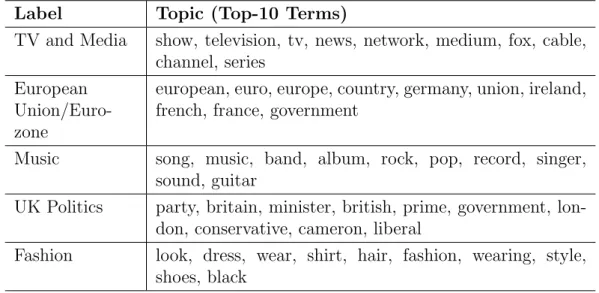
It is often useful to present topics in a summarised form. One common approach is to automatically generate textual labels. These labels summarise topics’ main thematic subject and provide a more convenient representation compared to a list of keywords. In early research on topic modelling topics were represented as lists of keywords with the highest probability and textual labels were sometimes manually assigned to topics for convenient presentation of research results (Mei and Zhai, 2005; Teh et al., 2006). Table 2.1 shows examples of topics represented by lists of keywords and textual labels.
The first attempt at automatically assigning labels to topics is described by Mei et al. (2007). In their approach, a set of candidate labels is extracted from a reference collection using noun chunks and statistically important bigrams. A relevance scoring function is defined which minimises the distance between word distribution in a topic and word distribution in candidate labels. Candidate labels are ranked according to their relevance and the top ranked label chosen to represent the topic.
Magatti et al. (2009) introduced an approach to labelling topics that relies on two hierarchical knowledge resources labelled by humans, the Google Directory
2.6. AUTOMATIC LABELLING OF TOPICS 29
Label Topic (Top-10 Terms)
TV and Media show, television, tv, news, network, medium, fox, cable, channel, series
European Union/Euro-zone
european, euro, europe, country, germany, union, ireland, french, france, government
Music song, music, band, album, rock, pop, record, singer, sound, guitar
UK Politics party, britain, minister, british, prime, government, lon-don, conservative, cameron, liberal
Fashion look, dress, wear, shirt, hair, fashion, wearing, style, shoes, black
Table 2.1: A sample of topics generated by a topic model over a corpus of news articles together with appropriate labels. Topics are represented by top-10 most probable words.
and the OpenOffice English Thesaurus. A topics tree is a pre-existing hierarchi-cal structure of labelled topics. The Automatic Labelling Of Topics algorithm computes the similarity between LDA inferred topics and topics in a topics tree by computing scores using six standard similarity measures. The label for the most similar topic in the topic tree is assigned to the LDA topic.
Lau et al. (2010) proposed selecting the most representative word from a topic as its label. The label is selected by computing the similarity between each word and all others in the topic. Several sources of information are used to identify the best label including Pointwise Mutual Information scores, WordNet hypernymy relations and distributional similarity. These features are combined in a reranking model to achieve results above a baseline (the most probable word in the topic). In more recent work, Lau et al. (2011) proposed a method for automatically labelling topics by making use of Wikipedia article titles as candidate labels. A set of candidate labels is generated in four phases. First, primary candidate labels are generated from Wikipedia article titles by querying using topic terms. Then, secondary labels are generated by chunk parsing the primary candidates to identify n-grams that exist as Wikipedia articles. Outlier labels are identified using a word similarity measure (Grieser et al., 2011) and removed. Finally,
2.7. DISTRIBUTIONAL SEMANTICS 30
the top-5 topic terms are added to the candidate set. The candidate labels are ranked using information from word association measures, lexical features and an Information Retrieval technique. Results showed that this ranking method achieves better performance than a previous approach (Mei et al., 2007).
Mao et al. (2012) introduced a method for labelling hierarchical topics which makes use of sibling and parent-child relations of topics. Candidate labels are generated using a similar approach to the one used by Mei et al. (2007). Each candidate label is then assigned a score by creating a distribution based on the words it contains and measuring the Jensen-Shannon divergence between this and a reference corpus. Results show that incorporating information about the relations between topics improves label quality.
Hulpus et al. (2013) make use of the structured data in DBpedia4 to label
topics. Their approach maps topic words to DBpedia concepts and identifies the best ones by applying graph centrality measures assuming that words co-occurring in text likely refer to concepts that are closer in the DBpedia graph.
More recently, Cano Basave et al. (2014) presented a method for labelling LDA topics trained on social media streams, i.e Twitter, using summarisation techniques. Their method generates labels which exist in the Twitter stream rather than relying on external knowledge sources.
Topic labelling methods summarise topics into a condensed form. Usually, la-bels are unique words, bigrams, keyphrases or Wikipedia article titles. Chapter 5 presents an approach to labelling topics which achieves state-of-the-art perfor-mance. Previous work on the task has been entirely focused on generating labels from only one medium. Chapter 6 proposes an alternative representation of topics using images while Chapter 7 compares the effectiveness of various topic representations.
2.7
Distributional Semantics
Intuitively, one can often guess the meaning of a word from its context. This has been formally defined as the distributional hypothesis which states that words
2.7. DISTRIBUTIONAL SEMANTICS 31
with similar meanings tend to occur in similar context (Firth, 1957; Harris, 1954). Distributional models represent words as vectors of co-occurrence counts in con-texts, i.e. words, sentences, paragraphs, documents, syntactic patterns or visual attributes (Clark, 2012; Erk, 2012; Turney and Pantel, 2010). This is also known as a term-context matrix.
Section 2.1 presented the term-document matrix, C, for modelling document collections. MatrixCcan also be seen as special case of a word-context matrix, i.e. by looking at row vectors, where each context feature is an entire document. The term-context matrix is an extension of the term-document matrix to represent words in high dimensional vector spaces.
Erk (2012) presents a wide range of NLP tasks where distributional seman-tics have been applied. Clark (2012) and Erk (2012) describe compositionality where the meaning of a phrase can be represented as a vector by combining its constituent word vectors. In the rest of the thesis, we make use of distributional semantics to represent topic words in various semantic spaces. For example, we compute topic coherence (see Chapter 3) and similarity (see Chapter 4) by mea-suring distributional similarity of topic words.
2.7.1
Constructing Distributional Models
Constructing a word-context matrix requires the definition of various parameters. The main parameters are a basis, a weighting function, a similarity metric and a transformation (Lowe, 2001).
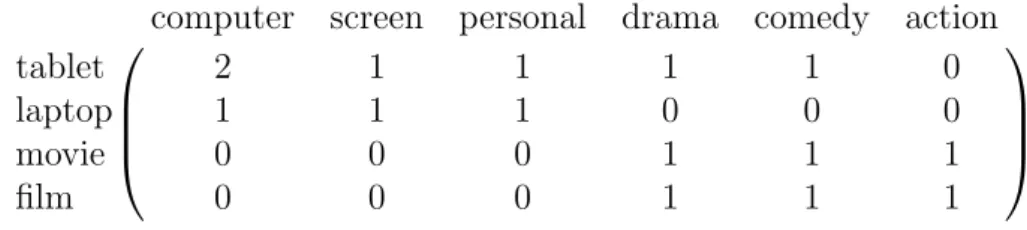
The basis of a term-context matrix contains the vector elements, also known as context features, which represent the context where the co-occurrences are observed. The basis often consists of a set of words. When words are used as context features, a context window of specific length around the target word is defined. This can a be a fixed number of words on either sides of the target word or an entire sentence, paragraph or document. Apart from using words, more recent work attempted to represent words using visual features extracted from images occurring naturally with text (Bruni et al., 2011; Feng and Lapata, 2010a; Kiela et al., 2014; Lazaridou et al., 2014). Figure 2.8 shows a small toy corpus, a context vocabulary and the resulting vector space of the words tablet, laptop,
2.7. DISTRIBUTIONAL SEMANTICS 32
movie and film.
The weighting function transforms the raw co-occurrence counts to word asso-ciation weights to reduce noise. Weighting is used to assign less weight to words co-occurring by chance or less informative very frequent words, i.e. stop words. A popular word association measure which will be used extensively in the rest of the thesis is the Pointwise Mutual Information (PMI) (Church and Hanks, 1989). It computes the variation between the probability of the co-occurrence of two words given their joint distribution, p(wi, wj), and their individual distributions,
p(wi) and p(wj), assuming independence. PMI is computed as follows:
PMI(wi, wj) =log2 p(wi, wj) p(wi)p(wj) (2.14) =log2 c(wi, wj)×N c(wi)c(wj) (2.15)
where c(wi, wj) is the number of co-occurrences of wi and wj, c(wx) is the
fre-quency ofwx inC and N is the size of C. In addition, vectors are also weighted
usingNPMI (Normalised PMI). This is an extension of PMI that has been used for collocation extraction (Bouma, 2009) and is computed as follows:
NPMI(wi, wj) =
P M I(wi, wj)
−log2(p(wi, wj))
(2.16)
A common practice in the distributional semantics literature is to convert to zero all the negative PMI and NPMI values (Clark, 2012; Erk, 2012; Turney and Pantel, 2010).
The transformation usually transforms the whole vector space, i.e. by ap-plying dimensionality reduction techniques. For example, SVD (Section 2.1) or non-negative matrix factorisation (Clark, 2012; Turney and Pantel, 2010).
Finally, semantic similarity between words is computed using a similarity metric between a pair of vectors. Popular metrics include the cosine of the angle of the word vectors, Dice and Jaccard coefficients (Manning et al., 2008).
2.8. SUMMARY 33
A tablet computer is a mobile personal computer that is primarily operated by touching the screen .
A laptop is a portable personal computer with a clamshell form factor, suitable for mobile use .
The movie streaming option will work on tablets allowing users watching the latest dramas and comedies .
Comedy is a genre of film in which the main emphasis is on humour . George’s favourites are dramas and action films .
According to critics, Snatch is one of the best action - comedy movies of 00s .
Context vocabulary: computer, screen, personal, drama, comedy, action
computer screen personal drama comedy action
tablet 2 1 1 1 1 0 laptop 1 1 1 0 0 0 movie 0 0 0 1 1 1 film 0 0 0 1 1 1
Figure 2.8: A small toy corpus of six sentences, a context vocabulary with the corre-sponding term-context matrix. Each vector element represents the raw co-occurrence frequency between target words and context features using sentence boundaries as the context window.
2.8
Summary
This chapter presented methods for modelling document collections using statisti-cal approaches. Topic models are statististatisti-cal methods that summarise the content of document collections into a set of latent variables called topics. In addition, types of popular topic models have been described, i.e. LSA, pLSA, LDA and CTM.
Topic models have appealing characteristics for organising and visualising doc-ument collections. Topics can be used to cluster docdoc-uments that share a common subject. A variety of interfaces have been developed for that purpose, however these systems usually do not deal with well-known problems of topic models. We presented previous work on tackling these three problems: (1) identifying inco-herent topics, (2) identifying similar topics, and (3) representing topics using an alternative representation than lists of keywords.
2.8. SUMMARY 34
Finally, we described distributional semantic representations of words which will be later used in the thesis for computing topic coherence and similarity.
Chapter 3
Evaluating Topic Coherence
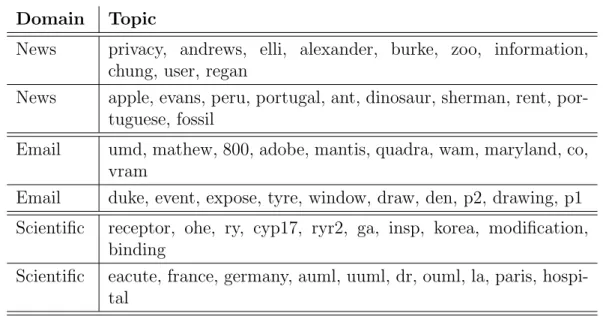
As presented in Section 2.4, topic models can output topics that are difficult to interpret. Table 3.1 shows a sample of incoherent topics identified by humans in three different domains. Providing humans with these topics in a search interface can lead to a poor browsing experience. Filtering out these topics can improve browsing interfaces for exploring the content of document collections. In addition, identifying incoherent topics can be a useful pre-processing step for topic labelling algorithms (Lau et al., 2011) (see Section 2.6). Intuitively, labelling algorithms would fail at assigning labels to topics that do not represent a coherent thematic subject. Measuring topic coherence can also be utilised in topic model evaluation. Chang et al. showed that humans find topics generated by models with high predictive likelihood to be less coherent than topics generated from others with lower predictive likelihood. Following Chang’s findings, recent work on evaluation of topic models has been focused on automatically measuring the coherence of generated topics by comparing them against human judgements (Mimno et al., 2011; Newman et al., 2010b).This chapter explores methods for automatically determining the coherence of topics. It proposes a novel approach for measuring topic coherence based on the distributional hypothesis which states that words with similar meanings tend to occur in similar context (Harris, 1954). Wikipedia is used as a reference corpus to create a distributional semantic model (Erk, 2012; Turney and Pantel, 2010). Each topic word is represented as a bag of highly co-occurring context
3.1. METHODOLOGY 36
Domain Topic
News privacy, andrews, elli, alexander, burke, zoo, information, chung, user, regan
News apple, evans, peru, portugal, ant, dinosaur, sherman, rent, por-tuguese, fossil
Email umd, mathew, 800, adobe, mantis, quadra, wam, maryland, co, vram
Email duke, event, expose, tyre, window, draw, den, p2, drawing, p1 Scientific receptor, ohe, ry, cyp17, ryr2, ga, insp, korea, modification,
binding
Scientific eacute, france, germany, auml, uuml, dr, ouml, la, paris, hospi-tal
Figure 3.1: A sample of less coherent topics generated by a topic model in three different domains (news articles, newsgroup emails and scientific articles). Topics are represented using the top-nmost probable words.
words that are weighted using either the Pointwise Mutual Information (PMI) or a normalised version of PMI (NPMI). It also explores creating the vector space using differing numbers of context terms. All methods are evaluated by measuring correlation with human judgements on three different sets of topics. Results indicate that measures on the fuller vector space are comparable to the state-of-the-art proposed by Newman et al. (2010b), while performance consistently improves using a reduced vector space.
The chapter is organised into five sections. Section 3.1 describes the method-ology of computing topic coherence using distributional semantics. Section 3.2 presents the experimental set-up while Section 3.3 discusses the results obtained. Section 3.4 presents a discussion of the results. Finally, Section 3.5 summarises the chapter.
3.1
Methodology
Previous work on identifying incoherent topics is based on computing the average pairwise similarity between topic words using word association measures (Mimno
3.1. METHODOLOGY 37
et al., 2011; Newman et al., 2010b) (see Section 2.4 for a detailed description of previous work).
This thesis proposes a method for determining topic coherence based on com-puting distributional similarity between the top-n words in the topic. Following previous work, each topic is represented by a list of 10 words.
3.1.1
Topic Coherence
LetT ={w1, w2, ..., wn}be the top-nmost probable words from a topic generated
from a topic model. Newman et al. (2010b) assume that the higher the average pairwise similarity between words in T, the more coherent the topic. Given a symmetric word similarity measure, Sim(wi, wj), topic coherence is defined as
follows: CoherenceSim(T) = P 1≤i≤n−1 i+1≤j≤n Sim(wi, wj) n 2 (3.1) where wi, wj ∈T.
3.1.2
Computing Topic Word Similarity
Each topic word is represented as a vector in a semantic space. Let w~1, w~2, ...,
~
wn be the vectors which represent the top n most probable words in the topic.
Also, assume that each vector consists of N elements and w~ij is the jth element
of vector w~i.
The similarity between the topic word vectors, and therefore coherence of the topic, is computed using the following standard measures used in work on distributional semantics (Curran, 2003; Grefenstette, 1994):
• The cosine of the angles between the vectors: Simcos(w~i, ~wj) =
~ wi·w~j
kw~ikkw~jk
3.1. METHODOLOGY 38
• The Dice coefficient:
SimDice(wi, wj) = 2×PN k=1min(w~ik, ~wjk) PN k=1(w~ik+w~jk) (3.3)
• The Jaccard coefficient:
SimJ accard(wi, wj) = PN k=1min(w~ik, ~wjk) PN k=1max(w~ik, ~wjk) (3.4)
Each of these measures estimates the similarity between a pair of topic word vectors and can be substituted into equation 3.1 to produce a topic coherence measure based on distributional semantics.
Alternatively, the coherence of a set of topic words can be estimated with a single measure by computing the average similarity between the top-n topic word and the centroid:
Simcentroid=
P
t∈T simcos(Tc, t)
n (3.5)
where Tc is the centroid of the vectors for topicT. For the experiments reported
below the distance of each vector to the centroid is computed using the cosine measure1.
3.1.3
Constructing the Semantic Space
Vectors representing the topic words are constructed from a semantic space con-sisting of information about word co-occurrence. The semantic space was created using Wikipedia2 as a reference corpus and a window of ±5 words3.
Weighting Vectors
Using the co-occurrence information to generate vectors directly does not produce good results. Therefore, the vectors are we