Reducing the Cost of Operating a
Datacenter Network
by
Andrew R. Curtis
A thesis
presented to the University of Waterloo in ful llment of the
thesis requirement for the degree of Doctor of Philosophy
in
Computer Science
Waterloo, Ontario, Canada,
I hereby declare that I am the sole author of this thesis. is is a true copy of the thesis, including any required nal revisions, as accepted by my examiners.
I understand that my thesis may be made electronically available to the public.
is work is licensed under a Creative Commons A ribution-NonCommercial-ShareAlike . Un-ported License. For details of this license, seehttp://creativecommons.org/licenses/by-nc-sa/ 3.0/.
Abstract
Datacenters are a signi cant capital expense for many enterprises. Yet, they are difficult to manage and are hard to design and maintain. e initial design of a datacenter network tends to follow vendor guidelines, but subsequent upgrades and expansions to it are mostly ad hoc, with equipment being upgraded piece-meal a er its amortization period runs out and equipment acquisition is tied to budget cycles rather than changes in workload. ese networks are also bri le and in exible. ey tend to be manually managed, and cannot perform dynamic traffic engineering.
e high-level goal of this dissertation is to reduce the total cost of owning a datacenter by improving its network. To achieve this, we make the following contributions. First, we develop an automated, theo-retically well-founded approach to planning cost-effective datacenter upgrades and expansions. Second, we propose a scalable traffic management framework for datacenter networks. Together, we show that these contributions can signi cantly reduce the cost of operating a datacenter network.
To design cost-effective network topologies, especially as the network expands over time, updated equipment must coexist with legacy equipment, which makes the network heterogeneous. However, heterogeneous high-performance network designs are not well understood. Our rst step, therefore, is to develop the theory of heterogeneous Clos topologies. Using our theory, we propose an optimization framework, called LEGUP, which designs a heterogeneous Clos network to implement in a new or legacy datacenter. Although effective, LEGUP imposes a certain amount of structure on the network. To deal with situations when this is infeasible, our second contribution is a framework, called REWIRE, which using optimization to design unstructured DCN topologies. Our results indicate that these unstructured topologies have up to - more bisection bandwidth than a fat-tree for the same dollar cost.
Our third contribution is two frameworks for datacenter network traffic engineering. Because of the multiplicity of end-to-end paths in DCN fabrics, such as Clos networks and the topologies designed by REWIRE, careful traffic engineering is needed to maximize throughput. is requires timely detection of elephant ows— ows that carry large amount of data—and management of those ows. Previously proposed approaches incur high monitoring overheads, consume signi cant switch resources, or have long detection times. We make two proposals for elephant ow detection. First, in the Mahout frame-work, we suggest that such ows be detected by observing the end hosts’ socket buffers, which provide efficient visibility of ow behavior. Second, in the DevoFlow framework, we add efficient stats-collection mechanisms to network switches. Using simulations and experiments, we show that these frameworks reduce traffic engineering overheads by at least an order of magnitude while still providing near-optimal performance.
Acknowledgements
First and foremost, I thank my advisers S. Keshav and Alex L´opez-Ortiz. eir advice and guidance over the years has shaped me into the researcher I am today. eir lessons will forever change the way I think and act. is dissertation could not have been wri en without their mentorship. I espe-cially appreciate Keshav’s detailed comments on all my work. is feedback has greatly improved my research. I thank Alex for his guidance bridging the gap between theory and systems, for pushing me to understand networks from both theoretical and systems perspectives. Chapters and describe work done in collaboration with Alex and Keshav.
Praveen Yalagandula at HP Labs, Palo Alto, also mentored me during much of this research. Many others at HP Labs also played a role in this thesis, including: Jeff Mogul, Jean Tourrilhes, Puneet Sharma, and Sujata Banerjee. is group of people taught me how to nd research problems in practical, operational issues. Crucially to this dissertation, they helped me understand how real datacenters operate. Chapter presents work I did in collaboration with this group. Chapter was also wri en during my time at HP Labs. It presents the results of a collaboration between Praveen Yalagandula, Wonho Kim, and myself.
Others have played a role in this research as well. I am indebted to Tommy Carpenter and Mustafa Elsheikh, who also collaborated on the results described in Chapter . I appreciate the many discus-sions on this work I’ve had with others, especially other graduate students at Waterloo. I am espe-cially grateful to my fellow students in the ISS E group for bene cial discussions and comments.
I thank my commi ee members Ant Rowstron, Jochen Koenemann, Ken Salem, and Bernard Wong. ese people pushed me to improve this dissertation by clarifying details and developing a deeper understanding of the theory behind network design and routing.
I thank Bryan Shader for introducing me to research during my undergraduate studies. I had not considered a ending graduate school before my experience conducting research under his guidance.
is opportunity put me on the path to this dissertation.
Finally, I thank my partner Bryanne Myers for her continued support over the years. anks for helping me through this journey!
e results that make up this dissertation have been previously published. Chapter was originally published as reference [ ]. Chapter was published as [ ]. Chapter was published as [ ]. And, chapter was published as [ ].
Table of Contents
List of Tables ix List of Figures x Introduction . Introduction . . . . . Datacenter Applications . . . . . . Interactive applications . . . . . . Batch jobs . . . . . . Distributed le systems . . . . . Datacenter Network Goals . . . . . Contributions . . . . Related work. Workloads in datacenter networks . . . . . Topology design . . . . . . Clos network and the fat-tree . . . . . . HyperX . . . . . . DCell . . . . . . BCube . . . . . . MDCube . . . .
. . Heterogeneous topology constructions . . . . . Load balancing. . . . . . Oblivious load balancing. . . . . . Reactive ow scheduling . . . . . . Online scheduling . . . . . . End-host-based load balancing . . . . . Con guration . . . . . . Automatic assignment of addresses . . . . . . Reducing cabling complexity . . . . . OpenFlow . . . . LEGUP: Designing Heterogeneous, Tree-like Datacenter Networks
. Introduction . . . . . De ning the Problem . . . . . . Workload assumptions . . . . . . Switches, links and end-hosts . . . . . . DCN performance: what’s important to applications? . . . . . . Cost model . . . . . . Placing equipment in a datacenter . . . . . LEGUP Overview . . . . . . Optimization goals . . . . . . Inputs, Constraints, and Outputs . . . . . . e LEGUP optimization algorithm . . . . . . Why naive solutions aren’t enough . . . . . eory of Heterogeneous Clos Networks . . . . . . e Clos network . . . . . . Constructing heterogeneous Clos networks . . . . . LEGUP Details . . . .
. . Bounding a candidate solution . . . . . . Finding a set of core switches . . . . . . Mapping aggregation switches to racks and ToR switches . . . . . . Computing the performance of a solution . . . . . Evaluation . . . . . . Input . . . . . . Alternative upgrade approaches . . . . . . Upgrading the datacenter . . . . . . Expanding the datacenter . . . . . Discussion . . . . REWIRE: Designing Unstructured Datacenter Networks
. Introduction . . . . . REWIRE Algorithm . . . . . . Optimization problem formulation . . . . . . Local Search Approach . . . . . . Adding switches to the network . . . . . Evaluation . . . . . . Inputs . . . . . . Comparison approaches . . . . . . REWIRE se ings. . . . . . Green eld networks . . . . . . Upgrading . . . . . . Expanding . . . . . . Quantitative results . . . . . Operating an Unstructured DCN. . . . . Discussion . . . . vii
Datacenter Network Traffic Engineering with Mahout
. Introduction . . . . . Background . . . . . . Datacenter traffic . . . . . . Identifying elephant ows . . . . . Our Solution: Mahout. . . . . . Detecting Elephant Flows . . . . . . In-band Signaling. . . . . . Mahout Controller . . . . . . Discussion . . . . . Analytical Evaluation . . . . . Experiments . . . . . . Simulations . . . . . . Prototype & Microbenchmarks . . . . Traffic Engineering with DevoFlow
. Introduction . . . . . OpenFlow Overheads . . . . . DevoFlow . . . . . . Mechanisms for devolving control . . . . . . Efficient statistics collection . . . . . . Using DevoFlow for ow scheduling . . . . . Evaluation . . . . . . Simulation methodology . . . . . . Performance . . . . . . Overheads . . . . Conclusions References viii
List of Tables
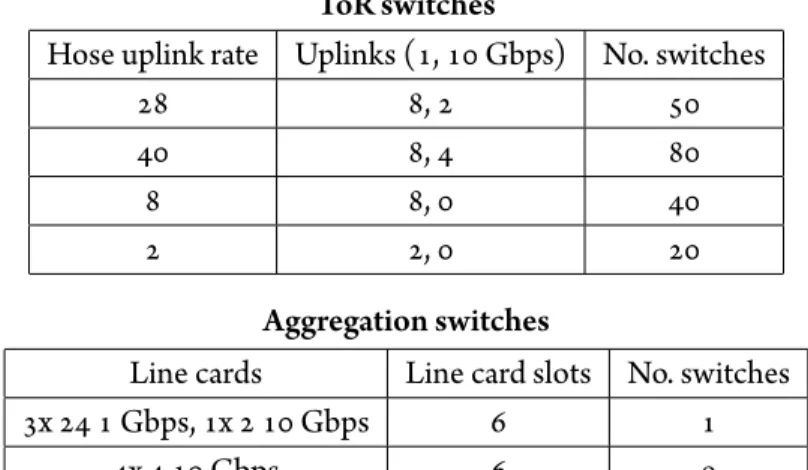
. Cost breakdown the components of a datacenter. ese numbers are taken from [ ]. . Existing switches in the scaled-up SCS datacenter model. . . . . Switches used as input in our evaluation. Prices are street and power draw estimates
are based on a typical switch of the type for the generic models or manufacturers estimates, except for the HP line cards, which are estimates based on the wa s used per port on the other switches. . . . . Existing switches in the SCS datacenter model. . . . . Prices of cables and the cost to install or move cables. . . . . Switches used as input in our evaluation (prices are the same as in Section . ).
Prices are representative of street prices and power draw estimates are based on a typical switch of the type according to manufacturers’ estimates. . . . . Parameters and typical values for the analytical evaluation . . . .
List of Figures
. Taxonomy of datacenter network solutions. Our contributions are shown in bold typeface. . . . . A + redundant tree. . . . . At le is a -stage, unfolded Clos network. At right is a foldedl-stage Clos network.
Each IO switch is a subnetwork withl−2stages. . . . .
. A -dimensional HyperX topology withI ≡(5,3). . . . .
. A BCube( ) construction withn = 4. . . . . e LEGUP optimization algorithm. . . . . Anl-stage Clos network. Each IO node here is a subnetwork withl−2stages. In
(b), each logical edge representsmphysical links and the logical root representsm switches, each withrports. . . . . ree optimal logical topologies for the given IO nodes. e numbers in the IO
nodes indicate the rate of each node. We have shown one optimal edge capacity as-signment for each topology; however, Figures (b) and (c) each have many optimal edge capacity assignments that are not shown. . . . . Examples of physical realizations of the logical topologies shown in Figure . .
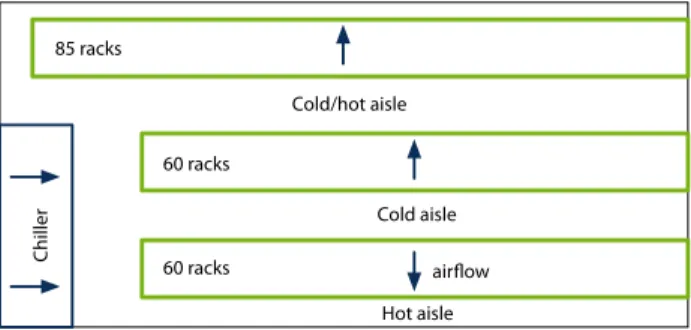
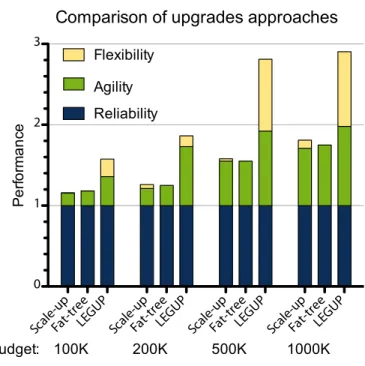
Here, the thickness and color of each link indicates its capacity, which is shown in the legend next to each network. . . . . Layout of the SCS datacenter. Arrows show the direction of air ow . . . . . Performance of the upgrade approaches for various budgets. Here, we haveαa =
αf =αr = 1andδ= 0.10. . . .
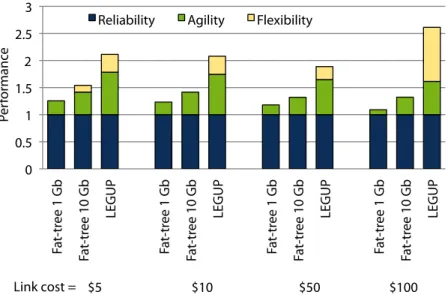
. Performance of a fat-tree built with Gbps or Gbps links compared to LEGUP with a budget of$ K and various link costs. roughout, the prices of switches
are xed, and the cost to install a link is varied from – dollars. . . . . Agility as additional racks of servers are added to the datacenter. Each point is
found by increasing agility as much as possible given a budget of$ , and the previous iteration as the existing network. . . . . Results of designing green eld networks for servers using a fat-tree, random
graph and REWIRE for two ToR switch types. e results on the le used ToR switches with Gbps ports and the results on the right used ToR switches with Gbps ports and Gbps. Missing bars for the random graph indicate that the network is expected to be disconnected. A network with agility has full agility, and a network with diameter is fully connected. . . . . Results of upgrading the SCS topology with different budgets and algorithms. . . . Results of upgrading the SCS topology with different REWIRE modes and two
budgets. . . . . Results of iteratively expanding the SCS datacenter. . . . . Results of iteratively expanding a green eld network. . . . . Mahout architecture. . . . . Amount of data observed in the TCP buffers vs. data observed at the network layer
for a ow. . . . . An example ow table setup at a switch by the Mahout controller. . . . . roughput results for the schedulers with various parameters. Error bars on all
charts show con dence intervals. . . . . Number of packets sent to controller by various schedulers. Here, we bundled
sam-ples together into a single packet (there are samples per packet)—each bundle of samples counts as a single controller message. . . . . Average and maximum number of ow table entries at each switch used by the
schedulers. . . .
. roughput achieved by the schedulers for the shuffle workload withn = 800and
k = 5. OpenFlow-imposed overheads are not modeled in these simulations. All
error bars in this paper show con dence intervals for runs. . . . . Aggregate throughput of the schedulers on the Clos network for different
work-loads. For the MSR plus shuffle workloads, of the MSR workload-generated ows are inter-rack. . . . . Aggregate throughput of the schedulers on the HyperX network for different
work-loads. . . . . e number of packet arrivals per second at the controller using the different
sched-ulers on the MSR workload. . . . . e average and maximum number of ow table entries at an access switch for the
schedulers using the MSR workload. . . . . e control-plane bandwidth needed to pull statistics at various rates so that ow
setup latency is less than ms in the thand thpercentiles. Error bars are too
small to be seen. . . .
Chapter 1
.
Introduction
e scale of today’s datacenters is unprecedented. Large datacenters contain , – , servers and consume up to MW of power. Applications running on these datacenters operate at massive scale by distributing their workloads across the many available servers. For example, distributed le systems such as Google File System (GFS) [ ] and Hadoop Distributed File System (HDFS) [ ] provide efficient, scalable, and reliable access to data and applications like MapReduce [ ] and Dryad [ ] allow one to distribute computation across thousands of servers. Because these systems are distributed, they all rely on the network. However, network architectures have previously not been designed to interconnect hundreds of thousands of high-performance hosts.
First-generation datacenter network (DCN) architectures were based primarily on enterprise network architectures. ese proved to be inadequate for large-scale datacenters, because of scaling and performance issues [ ]. A DCN must connect hundreds of thousands of end-hosts and provide up to petabits of bisection bandwidth between them. Guidelines from equipment vendors, such as Cisco [ ], arrange the DCN topology as a + redundant tree . Doing so results in underprovi-sioned networks—Microso researchers [ ] have found links with a : oversubscription ratio in their datacenters! Such high levels of oversubscription are appropriate for enterprise networks, but not for high-performance networks like DCNs. Oversubscribed links limit server utilization be-cause they restrictservice agility—the ability to assign any server to any service [ ]. Underprovi-sioned networks also are a bo leneck in modern distributed applications such as MapReduce [ ], Dryad [ ], partition-aggregate applications such as search [ ], and scienti c computing.
Because of these high-performance demands, researchers have proposed DCN architectures, that provide up to full bisection bandwidth and can scale to hundreds of thousands of servers, e.g., [ , , , , , ]. ey achieve this by using high-performance topology constructions and custom addressing, routing, and load-balancing schemes. For example, VL [ ] requires a Clos topology, CamCube [ ] requires a D torus topology, and BCube [ ] requires a BCube topol-ogy. (Details are in Chapter .) e topologies used by these DCN architectures are prescriptive
Abisectionof a network is a partition of its nodes into disjoint sets of equal size, say(S, S′). is is also called acut. ebandwidthacross this cut is the sum of link bandwidths for links with one endpoint inSand the other in S′. A network where the bandwidth of all bisections is equal to half the number of servers is said to havefull bisection
bandwidth.
A1+1 redundant treeis a topology that consists of two identical, disjoint trees. e second tree provides connec-tivity in the event of a single failure
constructions, that is, the topology is de ned by a small set of inputs, typically the switch radix (i.e., the number of ports per switches) and a number of recursive levels. Additionally, the load balancing schemes used by some of these architectures (such as VL ’s randomized load balancing, which ran-domly selects a path for a ow), are not effective for some workloads. For example, Al-Fares et al. [ ] found that dynamic load balancing can improve aggregate throughput up to versus VL ’s ran-domized load balancing for some workloads on a fat-tree topology.
Because these architectures rely on custom topologies, they are best suited for “green eld”, or new, datacenters. Even if a DCN was built for a speci c architecture, it can be challenging to expand or upgrade these networks since they are regular, prescribed constructions. erefore, we investigate new DCN topologies—ones that support heterogeneous switch radices and link rates. To support heterogeneous switch types, we developed the theory of heterogeneous Clos networks, which gen-eralizes the Clos network. To automate the design of these topologies, we developed an optimiza-tion framework called LEGUP (Chapter ). Because the heterogeneous Clos network still imposes structure on the topology, we then initiated the study of unstructured DCN topologies. We present our optimization framework for unstructured DCN design, called REWIRE, in Chapter . Overall, we nd that unstructured networks can signi cantly outperform networks that are based on regular topology constructions.
A DCN needs a large bisection bandwidth to increase service agility, but it also needs load bal-ancing to enable the use of the full bisection bandwidth. Because DCN topologies contain numer-ous end-to-end paths for each pair of endpoints, traffic engineering can o en improve the aggregate throughput by dynamically pinning ows to paths. In prior work, Al-Fares et al. proposed a system for dynamic DCN traffic engineering called Hedera [ ]. ey showed that Hedera can improve net-work performance signi cantly; however, their approach relies on OpenFlow [ ], which has scal-ing issues as summarized in Section . . erefore, we study low-overhead DCN traffic engineering. We study the problem from two angles. First, we introduce a traffic engineering framework, named Mahout, that uses a low-overhead shim in the end-host’s network stack to classify elephant ows, which are long-lived, high-throughput ows. ese elephant ows are then dynamically monitored and routed by a centralized controller. Mahout is described in Chapter . Finally, we evaluate the effectiveness of using DevoFlow [ , ], a modi cation of the OpenFlow framework that reduces OpenFlow’s overheads. ese results are described in Chapter .
LEGUP and REWIRE signi cantly reduce datacenter capital expenses. Recent estimates peg the capital cost of networking equipment—switches, routers and load balancers—at – of the total
monthly budget of a typical datacenter [ , ]. erefore, reducing network capital expenditure can signi cantly reduce a datacenter’s total cost of ownership. For example, REWIRE can save up to $ million per year in a typical datacenter with K servers.
Further, increasing datacenter service agility allows for a higher peak server utilization. If a K-server datacenter has a peak K-server utilization of and this could be improved to by providing be er load balancing in the network or upgrading it, then the datacenter operator could cut the number of servers they deploy in half. As servers represent – of the datacenter’s overall cost, reducing their expense is crucial to overall cost reduction.
Before discussing related work in the next chapter, we describe ( ) typical datacenter applica-tions, ( ) the characteristics of an ideal DCN, and ( ) the contributions of this dissertation.
.
Datacenter Applications
To understand the requirements of a datacenter network, we rst need to understand the load appli-cations place on the network. Appliappli-cations in the datacenter broadly fall into two categories: inter-active or batch. Both are typically built on top of a distributed le system, which we describe below.
1.2.1 Interactive applications
Interactive application need fast response times to keep users engaged. Examples of interactive ap-plications include: search, web, games, and messaging. Adding s of milliseconds of latency to response times has been shown to decrease website usage [ ]; therefore, interactive datacenter applications need to respond to queries as quickly as possible.
To minimize response times, it is common for computation-heavy applications (such as search) to use a partition-aggregate computation model. Under this model, computation is partitioned across many end-hosts (up to thousands of servers), and then their responses are aggregated by a few ma-chines. To satisfy end-user SLAs, a typical query resolved by a partition-aggregate computation must be answered within a deadline of ms or less [ ]. To achieve this, an aggregator partitions the query and assigns a task to each worker. Each worker is given a deadline of – ms to complete their task. If a deadline is missed, the aggregator ignores that response, lowering the quality of the result .
Other common interactive applications include web and data-transfer services. Both are well-suited to distributed implementations. Because modern web services are typically implemented with a tiered architecture, they create intra-datacenter network traffic as well as egress traffic that leaves the datacenter. ese egress ows tend to consist of mostly “mice” ows, that is, very short-lived ows, and have few “elephant” or long-short-lived ows [ ]. Data-transfer services, such as video and music streaming services, tend to create elephant ows; however, it is o en acceptable for these ows to have have a relatively low throughput. is happens if, for example, the bit rate of an au-dio le is Kb/s. In this case, the le only needs to be sent at Kb/s since the user listens in real-time to the audio.
1.2.2 Batch jobs
Many datacenter applications are batch jobs. at is, their results are not needed within a strict time limit. For example, an application that analyzes log les to learn user behavior characteristics is a batch job, because its results are not immediately needed by a user. A few other types of batch jobs include:
• Analytics
• Analyzing user behavior • Machine learning • Data mining
• Natural language processing • Log analysis
• Image analysis
e use of distributed, data- ow computation frameworks (such as [ , , ]) make it easy to implement these types of jobs at huge scale.
For example, frameworks that implement MapReduce [ ] require that developers implement a “map” function and a “reduce” function. When the job is executed, the MapReduce system divides the input across workers and executes the map function in parallel. Once complete, the results of the map phase are sent to all the reduce-phase workers, where the reduce function is executed in
many workers reply simultaneously to an aggregator. is behavior has prompted the study of DCN-speci c TCP
parallel. Doing so puts a high load on the network, and if the network does not have enough bisection bandwidth, it can be a bo leneck in a job’s run-time [ ]. In general, batch jobs can create huge amounts of network traffic, because they may process terabytes, or more, of data.
1.2.3 Distributed le systems
To provide high availability and scalability, storage in the datacenter is o en provided by a dis-tributed le system (DFS), which allows any server to access the data stored at any other server in a transparent, scalable way. Google has described their proprietary DFS, called the Google le system [ ], and the Hadoop distributed le system (HDFS) [ ] is a popular open source imple-mentation.
Because a DFS allows servers to access remote data, this type of le system can heavily utilize the network if applications do not take data locality into account when making scheduling decisions. Additionally, a DFS can place load on the network when replicating data. Typical DFS implementa-tions maintain at least three copies of each data block, so if one of these copies fails, the DFS creates another replicate.
.
Datacenter Network Goals
An ideal DCN should be agile, scalable, exible, resilient, manageable and cost-effective. We now describe each of these traits in detail.
Agile
e switching fabric is never the limiting factor in the transmission rate between end-hosts in an ideal DCN. e end-hosts’ network interface cards (NICs) are the only limitation on transmission rates in such a network. erefore, we would like to de ne network agility so that it measures a network’s ability to handle any possible workload. A network withfull agilitycan handleanytraffic matrix feasible under the server NIC rates. A more precise de nition is given shortly.
At rst blush, this goal sounds extreme. However, it is motivated by the available DCN measure-ment studies. From them, we know that DCN workloads exhibit a high degree of variance [ , , , ]. In a hour time period, there can be an order of magnitude difference between the peak
and minimum load in the DCN [ ]. e network needs enough capacity to handle the peak load, and it needs to be exible enough to cope with future workloads. DCN traffic is also unpredictable over short periods [ , ]. Full details of DCN traffic are given in Section . .
To precisely de ne network agility, we need to introduce a couple of terms. A network can fea-sibly routea traffic matrix (TM) if there exists a routing of the traffic demands such that no link’s utilization is greater than . Note that we assumemultipath routing, which means that the traffic from nodesto nodetcan be split across multiple paths. Mathematically, if the NIC rate of serveri
is given byr(i), then a hose TMT has: ∑ j∈V tij ≤r(i) and ∑ j∈V tji ≤r(i)
whereV is the set of all servers andtijis thei-jentry in the TMT. e set of all hose TMs is known
as the set ofhose traffic matrices and this model is known as thehose model [ ]. e hose traffic matrices form a polyhedron, and we denote them byT. Now, we can de ne a network with full agility as one that can feasibly route all hose traffic matrices.
Some networks may only be able to route a scaled version of the worst-case TM. erefore, the agilityof a networkGis the maximal valueλsuch thatλ·T can be feasibly routed for allT ∈ T,
whereT is the hose traffic matrices forG. An ideal network in our se ing hasλ ≥1, meaning that it can feasibly route all hose TMs without over-utilizing any link. e hose model was introduced in the context of provisioning virtual private networks and the intuition is that each node has set ingress and egress rates, but we do not have any additional insight as to the amount of traffic one node will send another, so the network should be designed to feasibly routeanypossible traffic matrix possible given the nodes’ ingress/egress rates [ ].
De ning agility in terms of cuts. A result of this dissertation is to prove that agility can be equiv-alently described in terms of network cuts. is is a generalization ofbisection bandwidth[ ]. A
bisectionof a network is a segmentation of the network into two parts, saySandS, such that each
set contains the same number of nodes. e capacity of a bisection is the available link bandwidth across the bisection (i.e., the sum of link rates for links with one endpoint inSand the other inS). en, the bisection bandwidth of a network is the worst-case capacity of any bisection of the net-work’s nodes. Note that this de nition does not account for node rates, because it only depends on the link bandwidth, not the amount of traffic that may be sent across those links. Because of this limitation, bisection bandwidth is not a good metric for networks with heterogeneous node rates.
We generalize this notion to measure the worst-case bandwidth across any cut and to account for node rates. Acutis a partition of a network’s nodes into two sets, denoted bySandS. A network’s
normalized cut bandwidthis then the worst-case bandwidth across any network divided by the max-imum amount of ow that may cross that cut, and is denoted by bw(G). Let the bandwidth of a link
ebe denoted byw(e). en, the normalized cut bandwidth of a networkG= (V, E), whereV is its
nodes andEis its links and we assumeGis connected, is:
bw(G) = min S⊆V ∑ e∈δ(S)w(e) min{∑i∈Sr(v), ∑ i∈Sr(v)}
whereδ(S)is the set of edges with one endpoint inS and another in S = V − S. We always
deal with the normalized version of cut bandwidth in this dissertation, because it takes into account heterogeneous node rates.
A result of this dissertation is to show the equivalence of normalized cut bandwidth and agility. is is proved in eorem , which shows that there is a form of a min-cut, max- ow theorem that exists for the hose traffic model.
As an example of agility, consider a network consisting of two switches, each a ached to servers at Gbps and a single Gbps port that connects the switches. e agility of this network is 10/48. More generally, if we havenservers a ached to the rst switch andma ached to the second,
then we have the agility of the network is10/min{n, m}. Here, we divide by the minimum of the two values because the hose TMs do not allow any server to send orreceivemore than Gbps of traf-c, that is, even if there are servers a ached to one switch and server a ached to the other, the maximum receiving rate of lone server is Gbps so no more than that will ever cross the connecting
Gbps link.
Scalable
e network should not be the limiting factor in determining the number of servers deployed in a datacenter. An ideal DCN architecture and topology should enable connection of up to hundreds of thousands of servers.
Flexible
Most datacenters grow and evolve over time . e network should be exible enough to accommo-date this. At short time scales, servers may be turned on or off to match variable workloads. As a re-sult, virtual machines (VMs) need to transparently migrate across servers [ ]. Over longer time pe-riods, an operator may need to add or remove servers and other IT equipment. e network should permit this constant evolution.
Flexibility reduces costs because it improves agility, can reduce energy cost by shu ing off under-utilized equipment, and provides a cost-effective growth strategy to expand the datacenter. To enable exibility, venders have started selling container datacenters, which house up to a couple thousand servers in a standard – ’ shipping container. Containers provide exibility—it is easy to grow a datacenter by deploying new containers.
Resilient
Failures are common in large datacenters. e network should therefore be able to withstand mul-tiple port/switch failures, and failures should have minimal impact on the network. A recent study found that half of all DCN failures involve four or more devices [ ]; therefore, traditional + re-dundancy is not enough in the datacenter, because more than a single failover path is needed.
As a numerical example, consider a situation where a row of servers is partitioned from the network, which results in$ million worth of servers being disconnected until the failure is resolved. is may take under an hour ( of the time) or over days ( . of the time) [ ]. If it takes days to bring this row of servers back online, then the datacenter operator would lose at least$ , in lost server time (assuming a three year amortization period for the servers). A resilient network lowers the cost of failures, because it prevents servers from being disconnected as a result of a network failure.
Beyond physical resiliency, in se ings where multiple tenants share a switching fabric, the net-work should be resilient to malicious users that launch DoS a acks. At the same time, the netnet-work should not punish legitimate users with network-intensive workloads. Both can be achieved if the network provides isolation. erefore, a resilient cloud DCN architecture provides performance isolation between tenants.
As an example, James Hamilton said that Amazon adds compute capacity to their datacenters every day [ ]
Amortized Cost Component Sub-components
∼ Servers CPU, memory, storage systems
∼ Infrastructure Power distribution and cooling
∼ Power draw Electrical utility costs
∼ Network Links, transit, equipment
Table . : Cost breakdown the components of a datacenter. ese numbers are taken from [ ].
Manageable
Large-scale DCNs have thousands of network devices. is scale makes them difficult to manage, especially if devices have to be manually con gured. Manual management of such a network is error-prone and expensive [ ]. Instead, the network should be easy to manage and switches should sup-port “plug-and-play” functionality. erefore, an ideal DCN is self-managed and does not require any manual con guration. A manageable network can reduce operation costs, as it allows cloud dat-acenter owners to employ fewer employees.
Cost-effective
A datacenter network should minimize capital and operational costs. Network equipment is respon-sible for slightly under of the capital cost of a typical datacenter (from [ ]; see Table . ).
Capital costs:is the money spent on infrastructure and equipment. is money goes to buildings, servers, network equipment, power distribution and cooling infrastructure.
Operational costs:are incurred while operating the datacenter. Here, the most expensive costs come from power draw and management.
.
Contributions
We make three major contributions in this dissertation:
• We introduce the datacenter network upgrade and expansion problem and design and imple-ment an optimization framework, called LEGUP , that designs network topology upgrades for
legacy datacenter networks. We show that, for our test scenarios, it is twice as effective at de-signing high-bandwidth networks than previous approaches.
• We propose a framework, named REWIRE, that uses optimization to designunstructured data-center networks. We explore the design space of unstructured topologies, and we nd that un-structured networks have up to an order of magnitude more bisection bandwidth than networks designed by previous approaches, including those found by LEGUP.
• We analyze the overheads of ow management in the datacenter, and nd that such function-ality has high implementation overheads. We propose two low-overhead datacenter traffic en-gineering frameworks: Mahout and DevoFlow. Both solutions use a centralized controller to dynamically orchestrate the paths taken by elephant ows. ey differ, however, on how to de-tect elephant ows. Mahout uses the end-hosts for this task, while DevoFlow is an entirely in-network solution. Both frameworks can increase aggregate throughput up to depending on the workload, while sending up to two orders of magnitude fewer control messages than a naive OpenFlow-based implementation.
Together, these contributions signi cantly reduce the cost of operating a datacenter network. e graph theory and algorithms behind LEGUP and REWIRE enable the physical network infras-tructure to be agile, scalable, exible, resilient, and cost-effective. Our ow management frameworks Mahout and DevoFlow help with the management of the non-standard network designs found by these frameworks, and help maximize agility by increasing network performance. We describe these results in Chapters – . ey were originally published as references [ , , , , ]. However, before introducing these results, we survey the work others have published on datacenter networks in Chapter to help clarify where our work ts in the taxonomy of DCN research.
Chapter 2
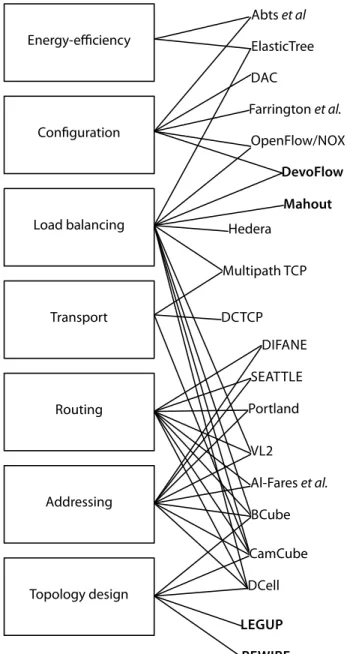
We can divide the DCN design space in a layered hierarchy as shown in Figure . . Most DCN ar-chitecture proposals affect multiple layers in this hierarchy. For example, arar-chitectures like VL [ ] and BCube [ ] propose novel solutions for topology design, addressing, routing and load balanc-ing. Because a DCN is under control of a single entity, widespread changes like this are acceptable in a DCN architecture. is is in contrast to the Internet at large, where modi cations to even a single layer are extremely difficult.
We now motivate the DCN design problem by describing their workloads. en, we describe the related work for the layers in the taxonomy that are related to the results presented in this disser-tation. at is, we describe the related work on topology design, load balancing, and con guration. We end this chapter by providing an overview of the OpenFlow protocol, because we base our traffic engineering solutions in Chapters and on OpenFlow.
.
Workloads in datacenter networks
To motivate the design of DCN topologies, we survey measurement studies of DCN workloads. Overall, DCN workloads exhibit a high degree of variance. In a hour time period, there is gener-ally at least an order of magnitude difference between the peak and minimum load in the DCN [ ]. e network needs enough capacity to handle the peak load, and it should permit increases in ca-pacity to meet future demand. As a result, DCNs tend to be lightly utilized on average [ ]. Addi-tionally, under-provisioned networks constrain job placement schedulers. Such networks do not have enough bandwidth to quickly move jobs to idle servers. As a result, there have been many recent proposals for high-bandwidth DCNs, and especially for networks with full bisection band-width [ , , , , , ].
DCN traffic is unpredictable over short time periods. Few detailed studies of datacenter traffic have been published; however, the studies to date indicate that DCNs can exhibit highly variable traffic [ , , , ], that is, the traffic matrix (TM) in a DCN shi s frequently and its overall volume (i.e., the sum of its entries) changes dramatically in short time periods.
In Chapters and , we consider centralized ow management. Such a routing controller in a DCN needs to respond to traffic uctuations quickly and effectively. A study by Kandula et al. found that the median inter- ow arrival time of a ows in a -server datacenter was105 ows per second [ ], so a centralized scheduler must route ows every millisecond.
Topology design Addressing Routing Transport Load balancing Configuration Portland BCube DCell VL2 Al-Fares et al. DCTCP Multipath TCP DAC Farrington et al. SEATTLE DIFANE Hedera OpenFlow/NOX ElasticTree Energy-efficiency Abts et al LEGUP REWIRE Mahout DevoFlow CamCube
Figure . : Taxonomy of datacenter network solutions. Our contributions are shown in bold type-face.
. . . Aggregation Core ToR Internet . . . S er vers
Figure . : A + redundant tree.
.
Topology design
e study of interconnection network topologies dates back to telephone switching networks, where the goal was to interconnect telephone circuits. A variety of topologies have been proposed over the years. Generally, these constructions aim to interconnect hundreds of thousands of endpoints with high bisection bandwidth. For example, the following constructions have been proposed: Clos [ ], Beneˇs [ ], de Bruijn [ ], a ened bu er y [ ], HyperX [ ], hypercube [ ], DCell [ ], and BCube [ ]. e general theme of work in this area is to “scale-out”, that is, use multiple commodity switches in place of a single high-end switch. e goal of this design pa ern is to reduce the cost of the network, since commodity switches are inexpensive.
e traditional DCN topology is a1+1 redundant tree. It consists of two disjoint trees, and thus provides a primary as well as a backup path between each pair of servers. e leaves of the trees are calledtop-of-rack(ToR) switches, which connect to – servers per rack. A typical ToR switch has Gbps and – Gbps ports. It uses its Gbps ports to a ach to servers, and uses its Gbps ports to connect to twoaggregation switches. Each aggregation switch connects to ToR switches and “up” to twocore switches. A + redundant tree is shown in Figure . . e core switches con-nect the switching fabric to border routers for Internet concon-nectivity. In this dissertation, we deal only with intra-datacenter communication, and so we ignore the border routers in our analysis.
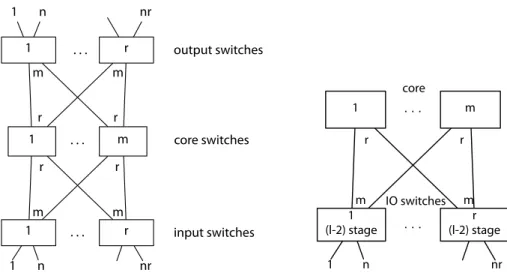
Al-r 1 m 1 input switches 1 n nr m r r m . . . . . . r 1 . . . core switches output switches m m r r 1 n nr r (l-2) stage 1 (l-2) stage m 1 core IO switches 1 n nr m r r m . . . . . .
Figure . : At le is a -stage, unfolded Clos network. At right is a foldedl-stage Clos network. Each
IO switch is a subnetwork withl−2stages.
though widely deployed, especially in enterprise networks, this architecture has two major draw-backs—poor reliability and insufficient bisection bandwidth—besides many other minor problems, as detailed by Greenberg et al. [ , ].
Although researchers agree that the + tree is inadequate, determining the ideal DCN topology is still a open research challenge. e ideal topology depends not only on the expected workload, but also the cost structure of switches and cables. Both of these quantities change rapidly over time. e leading candidate, however, is the the Clos network [ ], which was proposed in by Charles Clos to wire telephone switching networks. e HyperX topology is interesting from a theoretical perspective because it generalizes the hypercube and a ened bu er y networks [ ]. Several other novel topology constructions have been proposed for the design of DCNs [ , , , , , ]. We describe these topologies below.
2.2.1 Clos network and the fat-tree
e Clos network [ ] and its fat-tree con guration [ ] have been proposed as DCN topologies by Al-Fares et al. [ ] and Greenberg et al. [ ]. e bene ts of a Clos topology are that all paths between ToR pairs have the same length and it is inexpensive to build using commodity switches.
Figure . : A -dimensional HyperX topology withI ≡(5,3).
In addition, the Clos topology structure is well-suited torandomized load balancing, where the path selected for a ow is selected randomly.
Mathematically, a -stage Clos network [ ], denoted byC(n, m, r), is an interconnection net-work where nodes are partitioned intostages. e goal of the network is to interconnectinletsand
outlets. e Clos network has three stages as shown in Figure . . . e rst stage is called the in-put switches; it consists ofrswitches, each withninlets andmuplinks. eradixof a switch is the number of ports it has. e radix of each input switch must be at least n +m. e second stage
is called thecore. Switches in the core do not connect to any inlets or outlets; instead, there arem
core switches, each with radix2r. Each core switch connects to each input and output switch. e
third stage consists of theoutputswitches. ere areroutput switches, each withnoutlets andm
downlinks. We refer to the links from a stage to a higher stage asuplinksand the links from a stage to a lower stage asdownlinks.
Afolded Clos networkplaces input and output layers top of each other, which we use throughout this dissertation. In a folded Clos network, the input and output switches are the same devices, so we refer to them as input/output (IO) switches. Because IO switches do not directly a ach to each other, the Clos network is called anindirect network.
e recursive nature of Clos network means that we can limit our study to -stage Clos net-works. Anl-stage Clos network is recursively composed of -stage Clos networks. In anl-stage Clos
network, each input and output switch is replaced by an(l − 2)-stage network. An example of a recursive, folded Clos topology is shown in Figure . (b).
2.2.2 HyperX
HyperX [ ] is adirect-connect topology, that is, IO switches connect to other IO switches. is differs from the Clos network, where ToR switches only connect to aggregation switches—not to each other. HyperX is designed to take advantage of high radix switches (i.e., switches with hundreds of ports), and it generalizes both Hypercubes and a ened bu er y networks, which makes it exible. Mudigonda et al. have compared the cost of building a HyperX network against the cost to build a Clos network [ ]. ey found that the two topologies have similar costs, and the lowest-cost option depends on the size of the datacenter and the cost of switches and links.
A HyperX network is constructed as follows. Each HyperX IO switch connects toT inlets/outlets.
e switches are arranged in anL-dimensional integer la ice. Each dimensionkcontainsSkpoints.
en, each switch is identi ed by a coordinate vector in this space,I ≡ (I1, . . . , IL)where0 ≤ Ik < Skfor eachk = 1, . . . , L. Switches in each dimension form a clique. We show a5×3HyperX
topology in Fig. . .
HyperX has some support for heterogeneous link rates. All links in dimensionihave rateKi,
and so the link rates are described byK ≡K1, . . . , KL. HyperX also supports some level of switch
radix heterogeneity because of its support for heterogeneous link rates; however, one cannot have arbitrarily heterogeneous switches—their port speeds and radices are prescribed by the topology.
2.2.3 DCell
e DCell [ ] topology aims to interconnect a huge number of servers, up to a couple million, with low radix switches (for example, switches with ports). e DCell construction is recursive.DCell(0) is de ned asnservers connected to ann-port switch. A DCell(k)is constructed fromn+1DCell(k−
1)networks. When each subnetwork is treated as a single logical node, DCell(k)forms a clique, that is, each logical node (a subnetwork) has a single edge to each other logical node. ese links are re-alized physically as follows. Assign each server an ID:< sk, . . . , s0 >wheresiis thelevel-IDof the
server or subnetworksi. A level-ID is an ordering on the servers (for a DCell(0)network) or the
logical subnetworks of a DCell(k). en, at leveli, connections are added between servers such that
a level-ilink connects to a different DCell(i−1), but within the same DCell(i).
A DCell topology typically has twice the bisection bandwidth than a tree, but is unclear how well it performs or much it costs compared to other topologies. In particular, the DCell topology does not provide as much bisection bandwidth as a Clos network.
<1,0> <1,1> <1,2> <1,3>
<0,0> <0,1> <0,2> <0,3>
00 01 02 03 10 11 12 13 20 21 22 23 30 31 32 33
Figure . : A BCube( ) construction withn = 4.
2.2.4 BCube
BCube [ ] is a DCN architecture targeted at datacenters with up to a few thousand servers. is architecture uses a novel topology, called the BCube topology. An example is shown in Figure . . e BCube topology is a recursive construction. A BCube(0)isnservers connecting to ann-port
switch. A BCube(k)is construction fromnBCube(k−1)networks andn n-port switches. Switches in the BCube topology only connect to servers, and servers only connect to switches, so BCube is an indirect topology. e switches act as dumb crossbars, and servers relay traffic for each other. is construction provides multiple edge-disjoint end-to-end paths between each server. One side effect is that paths between end-hosts in a BCube network have varying lengths.
is design point of BCube was selected because shipping containers make excellent hous-ing for about – servers. A number of commercial container datacenters are available on the market today, for example, Sun’s Modular Datacenter [ ], HP’s POD [ ], and IBM’s mod-ular datacenter [ ]. Because it is common to combine multiple modmod-ular datacenters to form a larger datacenter, the authors later extended BCube to network a few dozen container datacenters together [ ]. e BCube design point makes many practical issues easier, for example, cabling is less an issue in a40×10×10 box.
2.2.5 MDCube
MDCube [ ] extends BCube to interconnect multiple containers. It uses BCube as the intra-container architecture and MDCube as an inter-intra-container architecture. MDCube interconnects the containers with a generalized hypercube topology.
e MDCube architecture is interesting for a number of reasons. First, it interconnects contain-ers using Gbps ports on BCube’s commodity switches. Such switches (with Gbps ports and
Gbps ports) are commodity switches today, and an estimated street price for such a switch is $ , . MDCube connects the Gb ports in a hypercube topology. Second, MDCube’s design creates clusters of – servers with a very high capacity network interconnected by a net-work with less bandwidth. is is similar toslimminga fat-tree [ ]. Such a provisioning scheme is bene cial because very few jobs need more than a servers [ ].
2.2.6 Heterogeneous topology constructions
e only construction we are aware of that can connect a heterogeneous set of switches while guar-anteeing optimality is that of Rasala and Wilfong [ ], who gave a strictly nonblocking construc-tion for networks with heterogeneous IO switches. is traffic model is not applicable to datacenter networks because DCNs are packet switched and buffers prevent “blocking”. In their approach, each ow has a unit rate, but ows can be rearranged across crossbars. is model is generalized by the primary traffic model used in this dissertation—the hose model (details were given in Section . ). Another limitation of their work is that their topology constructions only connect IO switch sets with two types of switches and they do not support heterogeneous switch port speeds.
.
Load balancing
To provide high bisection bandwidth with commodity switches, DCN topologies provide a mul-tiplicity of end-to-end paths. is brings about a challenge: how should ows be scheduled across these multiple paths?
2.3.1 Oblivious load balancing
One load balancing approach is to assign each ow randomly to a path. is zero-overhead approach is known asoblivious routingorrandomized routing. e path taken by a ow from nodeito nodej
is randomly selected from a probability distribution over allitojpaths. Kodialam et al. have shown
ere is, however, a premium for the the Gbps ports. A -port Gbps switch costs a mere$ , on the
street as of this writing.
A network withninputs andnoutputs isstrictly nonblockingif it can setup anyncalls independent of the call arrival order. is differs from a network which isrearrangeably nonblocking, which can supportsncall setups if all calls can be rearranged (i.e., re-routed through the network) when a new call setup is requested.
that oblivious routing can achieve at least of the optimal dynamic routing in the worst-case for any topology [ ]. eir model, however, assumes that all end-to-end ows can be fractionally split across multiple paths. is type of multipath routing is not possible on today’s switching hardware. Even if it is possible, it may cause out of order delivery problems and interfere with TCP’s conges-tion control mechanisms. In fact, it has been shown that oblivious routing performs poorly on a fat-tree topology when the traffic mix contains many elephant ows. Al-Fares et al. found their ow scheduler, Hedera [ ], can increase throughput compared to oblivious routing by performing dynamic ow scheduling.
roughout this dissertation, we assume the multipath form of oblivious routing. is is one of many models studied in the oblivious routing literature. For example, the celebrated “VPN eo-rem” of Goyal et al. assumes single-path routing [ ]. See [ ] for more details.
2.3.2 Reactive ow scheduling
Hedera [ ] introduces a centralized controller that dynamically schedules ows to maximize their aggregate throughput. e controller periodically pulls ow statistics from each switch, which it uses to identify the set of elephant ows (that is, ows which could use more than of server network interface card (NIC) bandwidth if they were not constrained by the network). Such ows are identi ed using an iterative demand estimation algorithm that uses statistics on all ows as input. An optimized routing of elephant ows is found using simulated annealing. e controller modi es forwarding table entries at the switches to re-route all elephant ows on optimized paths. ere are two critical problems with Hedera’s architecture. First, they rely on OpenFlow switches. We [ , ] pointed out that OpenFlow does not scale well, and is ill-suited for current datacenters. Second, their reactive mechanism requires timely statistics to be effective. Hedera’s evaluation assumed that DCN ow sizes follow a Pareto distribution, which is not the case in practice—DCN ow sizes actually follow a power law according to recent measurements [ ]. We found that Hedera’s control loop needs to be faster than ms to achieve near-optimal results . Achieving such a short control loop is not currently possible: it takes too long to pull the statistics from switches and to update the forwarding tables.
2.3.3 Online scheduling
Another approach to ow scheduling is to use an online scheduler, that is, the path for each ow is selected when the ow is started. An example of online scheduling is to greedily route a ow along the path with least congestion. A challenge here is to process each ow quickly. Flows arrive very quickly in a datacenter with thousands of end-hosts and many ows are latency-sensitive. For exam-ple, ow installation using the NOX OpenFlow controller can take up to ms [ ]. Recall that, partition-aggregate jobs have deadlines of – ms [ ], so a ms ow setup delay can consume the entire time budget. erefore, online scheduling is not suitable for latency-sensitive ows.
2.3.4 End-host-based load balancing
An alternative approach is to expose all end-to-end paths to end-hosts, and then adaptively nd the best path for a ow. at is, if an end-hostsneeds to send a ow to end-hostt, thensis aware of the
available paths (by any mechanism) and sosselects a path at random from the available options. If
the selected path does not provide enough bandwidth, thenscan probe the other available paths, andadaptthe ow’s routing to place it on the highest-throughput path.
e BCube architecture [ ] uses this form of load balancing. End-hosts can compute the avail-able end-to-end paths, because they are encoded in the addressing scheme. Each server is addressed by a label of the form< l, sk−1, . . . , s0 >where0 ≤ l ≤ k is the level of the switch andsj ∈ [0, n−1]forj ∈[0, k−1]. For serversAandB, the Hamming distance of their addresses indicates the length of the shortest paths between them, and the maximum shortest path distance between two servers isk+ 1.
Another architecture that utilizes end-hosts for load balancing is SPAIN [ ]. SPAIN provides multipath routing over arbitrary topologies by dividing the network into a set of spanning trees. e set of spanning trees is selected by an algorithm, and each one is implemented by a VLAN. End-hosts then perform adaptive routing over the VLANs.
OpenFlow is described in Section . . e network “operating system” NOX is an open-source, extensible
.
Con guration
Con guring a large DCN is expensive and error-prone. ere has been some recent work to simplify this process, which we now describe.
2.4.1 Automatic assignment of addresses
e scale of DCNs forces the use of compact routing schemes, which is usually implemented by encoding locality and topology information into the addresses of switches and servers (e.g., [ , , , ]). is creates a management challenge: how to automatically con gure network addresses? Chen et al. [ ] proposed DAC: a generic and automatic Datacenter Address Con guration sys-tem. DAC automates the assignment of IDs to network devices. It begins with a network blueprint which speci es the logical ID (e.g., IP addresses in many architectures encode locality information) of switches and servers. DAC then automatically learns devices IDs (e.g., MAC addresses), and then nds a mapping of logical to device IDs. is mapping is found by modeling the problem as a graph isomorphism problem. e graph isomorphism problem is not known to be in P or NP, but is be-lieved to be a computationally challenging problem. erefore, Chen et al. propose some heuristics to speed the graph isomorphism search.
An interesting side effect of Chen et al.’s design of DAC is that it can programmatically identify mis-wirings. is is a real problem in todays DCNs because thousands of wires are installed by hand. Unfortunately, in their approach, all servers and switches must be shut off and then turned back on in order for DAC to learn the device IDs. is limitation means that their solution is likely to be of limited use, since production datacenters can rarely turn off all equipment.
2.4.2 Reducing cabling complexity
Cabling is a major issue in datacenter networks. For instance, consider the architecture proposed by Al-Fares et al. [ ]. ey suggest building a non-oversubscribed DCN for K servers using com-modity -port GbE switches. is network provides . Tb/s of bisection bandwidth. When one considers only the cost of the switches, this network seems like a bargain at$ . million ; how-ever, it is nearly impossible to build because it would require , separate cable bundles [ ]. Each
bundle is manually routed and installed. Farrington et al. calculate that this would require , m of cable, which weighs in at over , kg [ ]. If each link costs$ to install (which is reason-able based on published link prices [ ]). is means that this network costs over$ million to wire—or of the cost of the network is cabling.
To solve the cabling problem, Farrington et al. [ ] argue that the ideal DCN topology has all ToR switches connected to a single nonblocking switch. ey realize this by designing a switch with , -ports running at Gbps using merchant silicon ASICs (i.e., very low cost ASICs) as their basic building block. Today, ASICs containing -ports at Gbps can be purchased for as li le as $ . Now, this ASIC is not a fully featured switch—it is only the data-plane and lacks a control-plane. Farrington et al. arrange these ASICs as a fat-tree to build their switch architecture. ey nd this network architecture costs less than a comparable fat-tree built from commodity switches. e big reduction in costs comes from cabling: Farrington et al.’s design uses only long, cum-bersome cables, as compared to the , such cables used in the fat-tree built from commodity switches.
Another approach to reducing cabling complexity is to build the network with high bandwidth links. For example, VL uses Gb NICs on the servers, and Gb links in the switching fabric [ ]. Since a single Gb link aggregates ten gigabit links without any oversubscription, the switching fabric can be built with an order of magnitude fewer links. e drawback of this approach is that high bandwidth links are typically more expensive than slower links.
.
OpenFlow
OpenFlow [ ] is a protocol that aims to separate a network’s data-plane from its control-plane. Its goal is to open traditionally closed designs of commercial switches to enable network innovation. OpenFlow has been the basis for many recent research papers (e.g., [ , , , , , , , ]), as well as for hardware implementations and research prototypes from vendors such as HP, NEC, Arista, and Toroki.
OpenFlow switches form the network’s data-plane, and the control-plane is implemented as a distributed system running on commodity servers. A switch’s data-plane maintains a ow table where each entry contains a pa ern to match and the actions to perform on a packet that matches that entry. OpenFlow de nes a protocol for communication between the controller and an
Open-Flow switch to add and remove entries from the ow table of the switch and to query statistics of the ows. In OpenFlow, the control-plane is centralized, unlike traditional networking, which uses a distributed control-plane, with the data-plane and control-planes operating on the same hardware. Upon receiving a packet, if an OpenFlow switch does not have an entry in the ow table or TCAM that matches the packet, the switch encapsulates and forwards the packet to the controller over a secure connection. e controller responds back with a ow table entry and the original packet. e switch then installs the entry into its ow table and forwards the packet according to the actions speci ed in the entry. e ow table entries expire a er a set amount of time, typically seconds. OpenFlow switches maintain statistics for each entry in their ow table. ese statistics include a packet counter, byte counter, and duration. e OpenFlow . speci cation [ ] (the only widely implemented version of OpenFlow currently) de nes matching over elds of packet header. e speci cation de nes several actions including forwarding on a single physical port, forwarding on multiple ports, forwarding to the controller, drop, queue (to a speci ed queue), and defaulting to traditional switching. To support such exibility, current commercial switch implementations of OpenFlow use TCAMs to store the ow table.
TCAM is an acronym forternary content-addressable memoryand is a type of high-performance memory that
Chapter 3
LEGUP: Designing Heterogeneous,
Tree-like Datacenter Networks
.
Introduction
As described in the previous chapter, most current datacenter networks use + redundancy in a three-level tree topology. is approach cannot provide full agility. is reduces server utilization, because servers cannot be assigned to services rapidly enough. at is, a server is assigned to a spe-ci c service, and it is underutilized if load on that service is not high enough. Recent work has ad-dressed this problem by providing enormous bisection bandwidth for up to hundreds of thousands of servers [ , , , , , ]. is allows services to be assigned to servers dynamically. How-ever, these architectures use topologies that assume identical switches, each with a prescribed num-ber of ports. erefore, adopting these solutions in a legacy datacenter o en comes at the cost of replacing nearly all switches in the network and rewiring it. is is wasteful and usually infeasible due to sunk capital costs, downtime, and a slow time to market.
In this chapter, we present LEGUP, an optimization framework to help operators increase net-work agility and reliability without needing to throw out their existing netnet-work devices. However, this results in the creation of heterogeneous datacenter network topologies, which have not been suf-ciently studied in the past. erefore, we rst develop the theoretical foundations of heterogeneous Clos networks, that is, we generalize the Clos network [ ] to allow support for multiple link rates and switches with differing port counts. Our topology is provably optimal in that it uses the minimal amount of link capacity to feasibly route all hose TMs. Previous work has only considered hetero-geneous interconnection networks under a different traffic model [ ], which is not applicable to datacenter networks, as discussed in Section . . . To our knowledge our topology construction is the rst topology that achieves optimality under the hose traffic model while supporting switches with heterogeneous rates and numbers of ports.
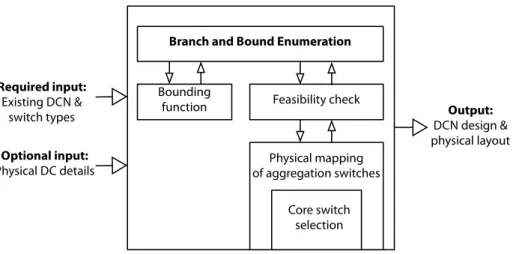
We then present an optimization framework, called LEGUP, to design network upgrades and expansions for existing datacenters. LEGUP nds networks that are realizable in a highly constrained datacenter. ese networks maximize performance by implementing a heterogeneous Clos network from both existing and new switches. Supporting heterogeneous switches allows LEGUP to design upgrades with signi cantly more agility than existing techniques for the same dollar cost, which includes the cost of new switches and the cost of rewiring the network.
Our key contributions in this chapter are:
• Development of theory to construct optimal heterogeneous Clos topologies (§ . ).
existing networking equipment when possible, minimizes rewiring costs, and selects the loca-tion of new equipment.
• We evaluate LEGUP by using it to nd network upgrades for a , server datacenter based on the University of Waterloo’s School of Computer Science datacenter (§ . ). LEGUP nds a network upgrade with nearly three times more bisection bandwidth for the same dollar cost as a fat-tree or traditional scale-up upgrades. LEGUP outperforms a fat-tree upgrade even when LEGUP spends half as much money. We also nd that when adding servers to a datacenter in an iterative fashion, the network found by LEGUP has more bisection bandwidth than a similarly upgraded fat-tree a er the number of servers is doubled.
Before describing these results, we de ne the problem (§ . ). We end this chapter with a dis-cussion of this work (§ . ).
.
De ning the Problem
Designing a datacenter network is a major undertaking. e solution space is enormous due to the huge number of variables, and an ideal network maximizes many objectives simultaneously. Our goal is to automate the task of designing the best network possible given a operator’s budget and a model of their datacenter. Ideally, a user of our system need only hire staff to wire the DCN according to the system’s output. For the remainder of this section, we describe the datacenter environment and state our assumptions.
3.2.1 Workload assumptions
roughout this chapter, we assume that an ideal DCN has full agility, as described in Section . . Recall that a network with full agility can feasibly route all hose TMs, which are denoted byT.
roughout this chapter and the next, we nd it more convenient to deal with the ToR-to-ToR traffic matrix, which aggregates the servers connected to a ToR switch into a single entry. rough-out, we use symmetric ingress and egress rates, and we denote the ingress/egress rate of a ToR switch
ibyr(i). is is called therateof the switch.
Finally, we are primarily concerned with thedesignof high-performance networks, rather than the operation of these networks. erefore, we assume that the routing and load-balancing schemes
can make full use of a network’s available bandwidth, regardless of the TM. In practice, this assump-tion does not hold, since load-balancing mechanisms are not perfect; however, there are several pro-posals that provide nearly optimal DCN load-balancing. We defer a detailed discussion of these so-lutions until Section . .
3.2.2 Switches, links and end-hosts
Most datacenters today run on commodity off the shelf (COTS) servers and switches, which reduces costs. ere are many such switches to choose from, each with different features. We allow operators to de ne the speci cations of switches available to add to their datacenter. ese speci cations must include the number of ports and their forwarding rates for each switch type. ey can also include input details about line cards for modular switches. Operators can also specify aprocessing delayfor each switch, which indicates the amount of time it takes the switch to forward a packet when it has no other load. is is used to estimate the end-to-end delay over a proposed path.
Links can be optical or copper and can use incompatible connector types. Currently, we do not model the difference in link medium or connectors; instead, we assume that all Gb ports use the same connector and all Gb ports use the same connector and that a Gb port can also operate at Gb. Copper links can pose a problem because they are limited to runs of less than – m when operating at Gbps [ ]. It would not be difficult to check for link medium and connector types; however, we do not currently do so.
We assume that the datacenter operator has full control over end-hosts. at is, they can install custom multipath routing protocols, like Multipath TCP [ ] and SPAIN [ ], on all end-hosts. is assumption does not hold in cloud se ings where customers can run their own OS installa-tions. Here, the cloud provider could release a set of OS images that have the required end-host modi cations installed. Or, the provider could integrate the changes into their hypervisor.
3.2.3 DCN performance: what’s important to applications?
e two most important characteristics of DCN performance are high end-to-end bandwidth and low latency. Because of this, it is important to build a network with high agility, so that the network performs well for all TMs. High agility also keeps end-to-end latencies across the network low, be-cause links will be lightly loaded, and hence queuing delays will be minimal. Minimizing end-to-end latency is important for interactive datacenter jobs, such as search and other partition-aggregate jobs,
where up to hundreds of worker servers perform jobs for a service. As previously described, mini-mizing latency is critical for this type of service because responses from workers that arrive a er a deadline are not included in the nal results.
3.2.4 Cost model
Estimating the cost of implementing a proposed DCN design is very challenging. ere are two major obstacles to overcome: ( ) determining prices of switches—street prices are o en a fraction of retail prices and can be difficult to obtain. Further, vendors offer discounts for bulk purchases, so the price of a switch o en decreases with volume. And, ( ) it is difficult to estimate the cost of cabling a DCN. Bundling cables together in long runs also reduces the cost of wiring long-distance links [ , ], though we are not