Effective and Efficient Reuse
with Software Libraries
Institut für Informatik
der Technischen Universität München
Effective and Efficient Reuse
with Software Libraries
Lars Heinemann
Vollständiger Abdruck der von der Fakultät für Informatik der Technischen Universität München zur Erlangung des akademischen Grades eines
Doktors der Naturwissenschaften (Dr. rer. nat.)
genehmigten Dissertation.
Vorsitzender: Univ.-Prof. Dr. Daniel Cremers Prüfer der Dissertation:
1. Univ.-Prof. Dr. Dr. h.c. Manfred Broy 2. Prof. Martin Robillard, Ph.D.
McGill University, Montréal, Kanada
Die Dissertation wurde am 26.07.2012 bei der Technischen Universität München eingere-icht und durch die Fakultät für Informatik am 20.11.2012 angenommen.
Abstract
Research in software engineering has shown that software reuse positively affects the competitive-ness of an organization: the productivity of the development team is increased, the time-to-market is reduced, and the overall quality of the resulting software is improved.
Today’s code repositories on the Internet provide a large number of reusable software libraries with a variety of functionality. To analyze how software projects utilize these libraries, this thesis contributes an empirical study on the extent and nature of software reuse in practice. The study results indicate that third-party code reuse plays a central role in modern software development and that reuse of software libraries is the predominant form of reuse. It shows that many of today’s software systems consist to a considerable fraction of code reused from software libraries.
While these libraries represent a great reuse opportunity, they also pose a great challenge to de-velopers. Often these libraries and their application programming interfaces (APIs) are large and complex, leading to cognitive barriers for developers. These obstacles can cause unintended reim-plementation in a software system. This negatively affects the system’s maintainability due to the unnecessary size increase of the code base and may even compromise its functional correctness, as library functionality is often more mature.
To investigate the applicability of analytic methods for finding missed reuse opportunities, this work presents an empirical study on detecting functionally similar code fragments. It reports on the considerable challenges of the automated detection of reimplemented functionality in real-world software systems. The results of the study emphasize the need for constructive approaches to avoid reimplementation during forward-engineering.
Motivated by these results, this thesis introduces an API method recommendation system to support developers in using large APIs of reusable libraries. The approach employs data mining for extract-ing the intentional knowledge embodied in the identifiers of code bases usextract-ing the APIs. The knowl-edge obtained is used to assist developers with context-specific recommendations for API methods. The system suggests methods that are useful for the current programming task based on the code the developer is editing within the integrated development environment (IDE). It thereby makes reuse of software libraries both more effective and efficient. As opposed to existing approaches, the proposed system is not dependent on the previous use of API entities and can therefore produce sensible recommendations in more cases. We evaluate the approach with a case study showing its applicability to real-world software systems and quantitatively comparing it to previous work. In addition, we present an approach that transfers the idea of API recommendation systems to the field of model-based development. We introduce a recommendation system that assists develop-ers with context-dependent model element recommendations during modeling. We instantiate and evaluate the approach for the Simulink modeling language. To the best of our knowledge, this is the first work to adopt recommendation systems to the field of model-based development.
Acknowledgements
I am grateful to all the people that supported me on the way to this thesis. First, I want to thank Manfred Broy for providing me with the opportunity to work at his chair and for supervising this thesis. Working at the chair in teaching and research has both extended and sharpened my view on computer science in a way I did not expect. The professional environment at his chair is outstanding in many ways, in particular with respect to the challenging research projects involving key players from both industry and academia. I am also grateful to Martin Robillard for co-supervising this thesis and his valuable feedback on my work.
In addition, I want to express my gratitude to the complete staff at the chair of Prof. Broy. I very much enjoyed working with all of you in the last three and a half years. I especially thank Silke Müller for the organizational support, the IT department for always providing me with all I needed in terms of hardware and software resources, Florian Deißenböck for the most direct and honest review feedback I ever received, Elmar Jürgens for being a great example regarding his remarkable writing skills, Benjamin Hummel for a constantly open door for discussing research ideas, Veronika Bauer for sharing an office with me, and Andreas Vogelsang for his numerous and always helpful paper reviews.
My scientific work in the last years included the publication of a number of research papers. I am thankful for the co-authorship in joint paper projects of Veronika Bauer, Florian Deißenböck, Mario Gleirscher, Markus Herrmannsdörfer, Benjamin Hummel, Maximilian Irlbeck, Elmar Jür-gens, Klaus Lochmann, Daniel Ratiu, and Stefan Wagner.
I also worked in interesting and challenging research projects at the chair of Prof. Broy together with a number of fellow researchers. I want to express my gratitude to Veronika Bauer, Sebastian Eder, Benedikt Hauptmann, Markus Herrmannsdörfer, Benjamin Hummel, Maximilian Junker, Klaus Lochmann, and Daniel Méndez-Fernández for being great colleagues during research projects. Further thanks go to the proof-readers of this thesis for insightful discussions and valuable feedback: Veronika Bauer, Jonas Eckhardt, Sebastian Eder, Henning Femmer, Bendikt Hauptmann, Benjamin Hummel, Maximilan Junker, Elmar Jürgens, Klaus Lochmann, Birgit Penzenstadler, and Andreas Vogelsang.
Last but not least I want to thank my family and friends for their support during my entire education and especially this thesis project.
Contents
1 Introduction 9 1.1 Problem Statement . . . 11 1.2 Contribution . . . 11 1.3 Outline . . . 12 2 Preliminaries 13 2.1 Why Software Reuse? . . . 132.2 Software Reuse Approaches . . . 13
2.3 Obstacles for Software Reuse . . . 16
2.4 Perspective of this Thesis . . . 17
2.5 Data Mining Background . . . 18
2.6 Recommendation Systems in Software Engineering . . . 21
2.7 Model-Based Development . . . 22
2.8 ConQAT: Continuous Quality Assessment Toolkit . . . 23
3 State of the Art 25 3.1 Quantifying Reuse in Software Projects . . . 25
3.2 Detection of Functional Similarity in Programs . . . 27
3.3 Developer Support for Library Reuse . . . 31
3.4 Recommendation Systems for Model-Based Development . . . 37
4 Empirical Study on Third-Party Code Reuse in Practice 39 4.1 Terms . . . 40
4.2 Study Design . . . 40
4.3 Study Objects . . . 41
4.4 Study Implementation and Execution . . . 43
4.5 Results . . . 46
4.6 Discussion . . . 52
4.7 Threats to Validity . . . 55
4.8 Summary . . . 57
5 Challenges of the Detection of Functionally Similar Code Fragments 59 5.1 Terms . . . 59
5.2 Dynamic Detection Approach . . . 61
5.3 Case Study . . . 68
5.4 Threats to Validity . . . 80
5.6 Discussion . . . 82
5.7 Summary . . . 83
6 Developer Support for Library Reuse 85 6.1 Motivation . . . 85 6.2 Terms . . . 86 6.3 Approach . . . 86 6.4 Case Study . . . 92 6.5 Discussion . . . 104 6.6 Threats to Validity . . . 105 6.7 Summary . . . 106
7 Beyond Code: Reuse Support for Model-Based Development 107 7.1 Approach . . . 108 7.2 Case Study . . . 109 7.3 Discussion . . . 113 7.4 Threats to Validity . . . 113 7.5 Summary . . . 114 8 Tool Support 115 8.1 API Method Recommendation . . . 115
8.2 Model Recommendation . . . 118
9 Conclusion 121 9.1 Third-Party Code Reuse in Practice . . . 121
9.2 Detection of Functionally Similar Code Fragments . . . 122
9.3 Developer Support for Library Reuse . . . 123
9.4 Reuse Support for Model-Based Development . . . 124
10 Future Work 125 10.1 Analysis of Third-Party Code Reuse . . . 125
10.2 Detection of Functionally Similar Code Fragments . . . 126
10.3 API Recommendation . . . 126
10.4 Model Recommendation . . . 127
1 Introduction
Software reuse addresses the use of existing artifacts for the construction of new software. Research in software engineering has shown that it positively affects the competitiveness of an organization in multiple ways: the productivity of the development team is increased, the time-to-market is reduced, and the overall quality of the resulting software is improved [46, 66].
While software reuse can take many forms, a particularly attractive form are externally developed artifacts, for which the complete development and maintenance is outsourced to third parties. Fueled by both the free/open source movements and commercial marketplaces for software components in combination with the evolution of the Internet as a commodity resource in software development, a large number of reusable libraries and frameworks is available for building new software [101]. The Internet itself has become an interesting reuse repository [43] and is emerging as “a de facto standard library for reusable assets” [26]. For example, the Java library search enginefindJAR.com1
indexes more than 140,000 Java class libraries2and the Apache Maven repository3contains about 40,000 unique artifacts4.
To effectively use a software library, and thus achieve high reuse rates, profound knowledge about the library’s content is required. Unfortunately, recent research indicates that developers still rein-vent the wheel and reimplement general purpose functionality in their code instead of reusing ma-ture and well-tested library functionality [52, 57]. While there are conscious and valid reasons not to reuse a certain artifact (e.g., legal constraints), unconscious obstacles cause reuse opportunities to be missed inadvertently. For instance, Kawrykow and Robillard analyzed 10 open source systems and found 400 reimplemented methods that would have been available in the included libraries of the project [57]. Such reimplementation is problematic for multiple reasons. First, it is a waste of development resources. Second, more code has to be maintained due to the unecessary size increase of the software. Finally, the home-grown solution to a problem may exhibit bugs not present in the library implementation [52].
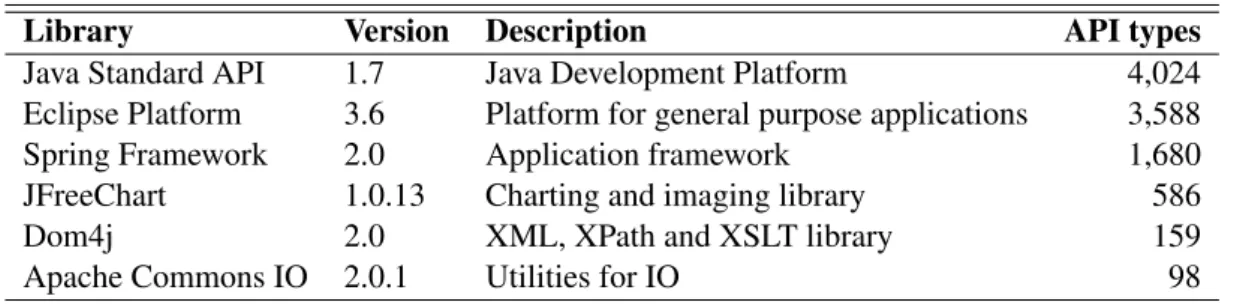
Unfortunately, the sheer number of libraries included by many software projects, as well as the size and complexity of their application programming interfaces (APIs) make it difficult for developers to find the right library element for a given programming problem and can thus cause reimplemen-tation of library functionality. Recent research shows that finding relevant API elements is one of the major difficulties faced by developers using unfamiliar APIs [21]. As an illustration for this problem, Table 1.1 shows six widely-used Java libraries and frameworks with different types of functionality. The rightmost column shows the number of API types5in each of these libraries. For
1 http://www.findjar.com/ 2 as of May, 2012 3http://search.maven.org/ 4as of May, 2012 5
Table 1.1: Common Java libraries/frameworks and number of API types
Library Version Description API types
Java Standard API 1.7 Java Development Platform 4,024 Eclipse Platform 3.6 Platform for general purpose applications 3,588 Spring Framework 2.0 Application framework 1,680 JFreeChart 1.0.13 Charting and imaging library 586 Dom4j 2.0 XML, XPath and XSLT library 159 Apache Commons IO 2.0.1 Utilities for IO 98
instance, the Apache Commons IO library, which is solely concerned with IO functionality con-sists of almost 100 types. Application frameworks such as Eclipse can contain as much as several thousand types.
Furthermore, even developers who are familiar with these libraries and their APIs are still chal-lenged by their evolution because successful libraries are often continuously enhanced with new functionality. An illustrative example is given by the Java Standard API, which is used by virtually every Java program. The number of types listed in its reference documentation grew by 160% over the last six releases, as shown in Figure 1.1. In other words, even a developer who is familiar with the complete API in version 1.2, but now has to switch to the latest version, does not even know half of the API. These numbers document the challenges faced by developers using these libraries and their APIs.
0
1000
2000
3000
4000
1.2 (1998) 1.3 (2000) 1.4 (2002) 1.5 (2004) 1.6 (2006) 1.7 (2011)
Number of API types
Java API version
1.1 Problem Statement
1.1 Problem Statement
Code repositories on the Internet provide a large amount of reusable code with a variety of function-ality. However, it remains largely unknown to what extent software projects make use of these reuse opportunities and how third-party code contributes to software projects. Thus, the reuse potential exhibited by these code repositories cannot be determined and we cannot adequately judge the role of third-party reuse in practice.
While the available third-party code represents a great reuse opportunity, it also poses a great chal-lenge to developers. Often, reusable libraries and their APIs are large and complex, creating cog-nitive barriers for developers [25, 92]. For successful reuse of a library element, a developer has to (1) anticipate the existence of a solution to his current problem and (2) actively search for a suitable solution. If these challenges are not overcome, reuse opportunities are missed and thus the benefits of reuse are lost.
Reimplementation in software can be considered a quality defect. It negatively affects maintain-ability due to the unnecessary size increase of the code base and may even compromise functional correctness, as library functionality is often more mature [52]. In the course of quality assurance measures it is thus desirable to detect such reimplementation. However, manual detection of this type of redundancy is infeasible due the number and size of the libraries as well as the size of the including software systems. It is unknown whether analytic methods can help to automatically de-tect such reimplementation in real-world software systems. Ideally, reimplementation is avoided during the development of software. To ensure effective and efficient reuse of libraries, proper sup-port is required that assists developers using the available artifacts during the construction of new software.
Recently, model-based development has gained increased attention in software engineering due to its promise of productivity improvements. The development activities shift their focus from code to models, which become the primary artifacts created and maintained by the developers. Data flow and processing languages often have a notion of reuse and libraries of reusable model elements are used to construct models from existing parts. The challenges exhibited by these modeling libraries are similar to those in code-based development. It remains unclear if methods to support library reuse can be adopted to model-based development.
1.2 Contribution
To characterize third-party code reuse in practice, this thesis contributes an empirical study showing how open source projects achieve reuse and to what extent they utilize the reuse opportunities on the Internet. The study results indicate that reuse of software libraries is the predominant form of reuse and that almost half of the analyzed projects reuse more code than they develop from scratch, thus providing evidence for the central role of third-party code reuse in modern software development.
To investigate the applicability of analytic methods for finding missed reuse opportunities, this work presents an empirical study on detecting functionally similar code fragments. It reports on the considerable challenges of the automated detection of reimplemented functionality in real-world
software systems. The results of the study emphasize the need for constructive approaches to avoid reimplementation during forward-engineering.
Motivated by these results, this thesis introduces an API method recommendation system to support developers in using large APIs of reusable libraries. The approach employs data mining for extract-ing the intentional knowledge embodied in the identifiers of code bases usextract-ing the APIs. The knowl-edge obtained is used to assist developers with context-specific recommendations for API methods. The system suggests methods that are useful for the current programming task based on the code the developer is editing within the integrated development environment (IDE). It thereby makes reuse of software libraries both more effective and efficient. As opposed to existing approaches, the proposed system is not dependent on the previous use of API entities and can therefore produce sensible recommendations in more cases. We evaluate the approach with a case study showing its applicability to real-world software systems and quantitatively comparing it to previous work. To address the challenge of working with large modeling libraries, we present an approach that transfers the idea of API recommendation systems to the field of model-based development. We introduce a recommendation system that assists developers with context-dependent model element recommendations during modeling. We instantiate and evaluate the approach for the Simulink modeling language. To the best of our knowledge, this is the first work to adopt recommendation systems to the field of model-based development.
1.3 Outline
The remainder of this document is structured as follows. Chapter 2 presents the foundations for this thesis and sets this work into the context of different reuse approaches. The current state of the art is discussed in Chapter 3. Chapter 4 presents the empirical study on code reuse in open source projects. Chapter 5 presents the study on the automated detection of functionally similar code fragments. The API method recommendation system is presented in Chapter 6 and the recommendation system for model-based development is described in Chapter 7. Chapter 8 discusses the tool support that was developed in the context of this thesis. Finally, Chapter 9 discusses the conclusions that can be drawn from this work and Chapter 10 highlights directions for future work.
Previously Published Material
Parts of the contributions presented in this thesis have been published in the proceedings of interna-tional workshops and conferences [17, 33–36].
2 Preliminaries
This chapter introduces the preliminaries for this thesis. First, it motivates software reuse, presents different approaches to software reuse, discusses potential obstacles to reuse, and explains how this thesis integrates into that context. It then lays the required foundation in the area of data mining and outlines the fields of recommendation systems in software engineering and model-based development.
2.1 Why Software Reuse?
Reusing existing code for the development of new software provides a number of benefits for soft-ware development which are listed in the following.
Increased Productivity Studies have shown that software reuse has a positive effect on pro-ductivity [10, 56, 66]. Less code has to be developed from scratch and thus the ratio between input and output of the development process is increased.
Improved Overall Quality Reusing mature and well-tested software elements can increase the overall quality of the resulting software system [56, 66]. Reusable software elements are often used multiple times and are therefore proven solutions that can provide better quality characteristics compared to newly developed code. A user of a mature software module can benefit from the collective experience of previous users of the module, as many bugs as well as deficiencies in the documentation have already been discovered [10].
Reduced Time-To-Market In dynamic markets where multiple companies offer similar prod-ucts, the time in which a product can be brought to the market is an important factor influencing the competitiveness of an organization. Reusing software can help to significantly reduce the time-to-market [56, 66]. In case the software is used in-house, the earlier completion results in an earlier payback of the development efforts [10].
2.2 Software Reuse Approaches
To set the contributions of this thesis into perspective, this section presents different approaches to software reuse. First, we discuss the dimensions along which reuse can be categorized and then briefly describe several reuse approaches.
2.2.1 Dimensions of Software Reuse Approaches
Karlsson classifies software reuse approaches along the three dimensionsscope,targetand granu-larity[56]. We briefly repeat them here.
Scope Reuse can have differentscopes: General reuseaims at reusing domain-independent ar-tifacts in a broad variety of application domains. Domain reuse has the goal of reusing artifacts specific to a certain application domain (e.g.,accounting).Product-linereuse tries to reuse artifacts between multiple applications of the same type within a product family.
Target The target reuser can be eitherinternal,i.e., the artifact is created and reused within the same organization orexternal,i.e., the reused artifact is created outside the organization. In case of the latter, the development and maintenance of the artifact are “outsourced” to third parties.
Granularity Software reuse can occur at different levels ofgranularity. A simple classification of granularity is fine-grained and coarse-grained. Examples for fine-grained reuse are general purpose and domain-independent utility functions (e.g., file handling). Coarse-grained reuse means reusing larger artifacts such as a database.
2.2.2 Reuse Approaches
A number of different approaches to achieve reuse in software projects have been proposed in the literature. We list them and briefly discuss their individual characteristics as well as their intent in this section.
Design and Code Scavenging Design and code scavenging is an ad hoc approach to software reuse. Developers take parts from existing software and integrate them into the new software. Typically, individual code fragments are reused by copying and adapting them as necessary. In case of design scavenging, large fragments are copied and internals are removed until only the underlying design remains [61]. The act of reusing artifacts in which the internals are revealed and may be modified is also referred to aswhite-box reuse.
Software Libraries Software libraries are collections of code entities, typically with well-defined and documented interfaces, intended to be reused. In contrast to reuse by design and code scaveng-ing, software libraries are reused “as is”. The internals are hidden to the reuser and no modifications are applied to the reusable artifact. This form of reuse is also referred to asblack-box reuse.
2.2 Software Reuse Approaches
Software Frameworks Software frameworks are incomplete applications that can be reused by completing them to a custom application through the implementation of designated extension points (orhook methods) [23]. A major underlying principle of framework reuse is theinversion of control, meaning that the framework calls the code that is written by developers instead of the other way around (as with library reuse). A popular example is the Eclipse Framework1for building rich client applications.
Component-based Development The idea of components which are assembled to larger ap-plications was first introduced by McIlroy in 1968 [72]. In component-based development, compo-nents are exclusively developed with the intention to be reused. There exist a multitude of different notions of a component. It can be given by a programming language unit such as a package, sub-system or class [61].
Application Generators Application generators transform a specification of a program into an executable application [15]. The input specification is typically formulated in a domain specific language (DSL). Reuse is achieved by running the generator multiple times on different input spec-ifications. Application generators thereby “reuse complete software system designs” [61]. Similar to software product lines, the commonalities of applications are exploited to achieve reuse. Applica-tion generators contain these commonalities and are built only once but used repeatedly to generate multiple applications [61].
Design Patterns Design patterns are solutions to common recurring design problems in object-oriented programming [28]. Reuse occurs by applying a pattern repeatedly to instances of the general problem. Patterns describe the objects involved in a design and how they collaborate. A design pattern can be viewed as a “reusable micro-architecture” [29].
Product Lines Software product lines are a systematic approach to achieve reuse within a family of similar products. A strong need for software product lines has been growing in the area of embedded systems where the demand for variability of products is steadily increasing. Product line engineering involves planning for reuse, creating reusable parts and reusing them. The wish for mass customization is addressed with the concept ofmanaged variability. Thereby, commonality and variability of the applications are explicitly modeled [85]. A common way to model applications in a product line are so-calledfeature models. A feature model consists of a feature hierarchy and a set of constraints between the features [7]. A constraint could, for instance, prescribe that for feature
Ato be present in an application, featureB is required as well. Product lines can only be applied within an organization and typically involve significant education efforts for developers [56].
1
2.3 Obstacles for Software Reuse
Successfully reusing a software artifact requires three principal steps [56]:
1. searching for candidate artifacts
2. determining the most suitable artifact
3. potentially adapting the chosen artifact to individual needs
Despite the known benefits of software reuse regarding productivity and quality, various obstacles within these steps can inhibit successful reuse. Some of these issues are conscious while others are unconscious. This section discusses obstacles from both of these categories.
2.3.1 Conscious Obstacles
Developers can deliberately decide not to reuse a certain software artifact for multiple reasons, which are discussed in the following.
Not Invented Here Thenot invented herephenomenon denotes the situation where a developer dislikes to use an artifact created by a third party and prefers to implement the artifact herself. A possible reason is the lack of trust in the solution from others [89] or a personal interest for the programming task at hand. According to Leach, one way to address this problem is for management to reward reuse and make developers aware that they can focus their creativity on more challenging problems [64].
Licensing/Legal Issues Licensing and legal issues can prevent the reuse of an artifact if the license of the provided artifact is in contradiction with the situation in the reusing organization. For instance, a license may prohibit employment of the artifact in certain application areas (e.g., safety-critical applications). Moreover, licenses can require the integrating organization to release the software reusing the artifact under a certain license (e.g., so-called viral licenses). Finally, commercial organizations often provide some warranty for their products. When integrating third-party artifacts, control over them is limited. However, the integrating organization may be held responsible for any harm caused by the artifact integrated in the product.
Non-Functional Requirements Not Met Another important reason not to reuse an artifact is given, if it provides the desired functional behavior but fails to meet certain non-functional require-ments (e.g., performance, resource utilization).
Problems Adapting Solution Reuse may also be prevented if the existing solution cannot be adapted to the context where it is to be employed. The adaptation effort may exceed the effort for developing the functionality from scratch.
2.4 Perspective of this Thesis
Loss of Control By reusing third-party artifacts, the development organization looses control over parts of the software system. As an example, during maintenance, changes to the reused parts may be difficult or impossible.
2.3.2 Unconscious Obstacles
Besides the conscious reasons not to reuse an artifact, there are also unconscious factors that can inhibit reuse, although it would be desirable.
Existence of Solution Unanticipated A necessary prerequisite for reuse to occur is that the developers anticipate the existence of a solution. If an artifact is not assumed to exist for a given problem, the developer will not search for it and reuse cannot happen.
Problems Finding Solution Another hurdle is the task of finding an existing solution to a given problem. The developer may assume that there is likely an artifact useful for the problem but she may fail to locate a suitable artifact in a reuse repository,e.g., due to weaknesses in search capabilities.
2.4 Perspective of this Thesis
This thesis addresses theunconscious obstaclesthat are inhibitive for successful reuse in practice. The goal is to foster reuse during the construction of software and thus limit the negative effects of these obstacles. Reuse is assisted by supporting developers in searching for reusable artifacts which is a necessary prerequisite for successful reuse.
With regards to the dimensions of reuse as identified by Karlsson (see Section 2.2.1), this thesis is positioned as follows:
Scope The focus of this thesis is on general reuse as the code repositories on the Internet provide a large amount of freely reusable general purpose code.
Target As external reuse of free third-party code is particularly attractive, we focus on this target. However, many aspects of the work in this thesis also apply to internal reuse.
Granularity We focus onfine-grainedreuse on the level of methods as the most basic form for black-box reuse of existing code.
Due to the prominent role of object-oriented languages in many application areas of modern soft-ware development, the code-centric considerations and contributions are specifically targeted at object-oriented systems, however, where appropriate, it is stated if and how the findings or princi-ples apply to other programming paradigms or could be adapted for them.
Within the software development life cycle, the work in this thesis is targeted at the module imple-mentation phase. We assume, that in the module design phase, appropriate libraries for reuse are identified and integrated into the overall system design. The goal of the contributions in this thesis is to make the usage of software libraries during development and maintenance of a software system more effective and efficient.
2.5 Data Mining Background
This section introduces the background in the field of data mining as a foundation for the contribu-tions on recommendation systems presented in this thesis. We give a brief overview and discuss the specific techniques this work is based on.
2.5.1 Overview
Data mining is an integral part of knowledge discovery—the process of discovering new and ideally useful information from data. The purpose of data mining is to discover patterns within the analyzed data. The obtained knowledge can then be used for decision support. Application areas are diverse and include financial forecasting, medical diagnosis and targeted marketing. A well-known example is the shopping cart analysis to optimize the alignment of the business to customer needs [11].
2.5.2 Recommendation Systems
Recommendation systems aim at giving sensible recommendations to users for items they might like [98]. These systems have been introduced in response to the information overload buyers face in many markets. The basic idea is “to harness the opinions of millions of people” in order to “help all of us find more useful and interesting content“ [47]. A well-known form of a recommendation is the phrase “Customers who bought this item also bought these items” [47]. A famous application is the recommendation functionality on the Amazon Online bookstore2. When browsing books, recommendations are displayed for other books that may be of interest. Different techniques are employed for implementing recommendation systems, including association rules and collaborative filtering, which are introduced in the following.
2
2.5 Data Mining Background
2.5.3 Association Rules
In data mining, association rules are typically employed for shopping basket analysis [11]. The goal is to identify regularities in shopping transaction data (i.e., detailed information on purchases) which can then be used, for instance, to identify cross-selling potential3or better align the business to customer needs. A common form of such a regularity is the fact that certain items are often purchased together [47]. A transaction (or shopping basket) is typically given as a set of purchased items where quantities are abstracted. An example is:
{paper, envelope, stamp}
Association rules are of the formI →j, whereIis a set of items andjan item. An example is:
{paper, envelope} →stamp
In the example, customers who bought paper and envelopes “typically” also bought stamps.
The quality of association rules is expressed in terms ofsupportandconfidence. The support of an association ruleI → jcorresponds to the fraction of baskets which contain all elements ofI ∪j
with respect to the number of all baskets. The confidence of an association ruleI →jis given by the ratio between the number of baskets containing all elements ofI∪jand the number of baskets that contain all elements ofI. More formally, this can be written as follows:
support(I →j) = baskets containing all elements of I∪j
overall number of baskets
confidence(I →j) = baskets containing all elements of I∪j
baskets containing all elements of I
The Apriori algorithm [1] mines association rules from a given set of shopping baskets. It computes frequent item sets in the shopping baskets that have a certainsupport threshold. From the frequent item sets, association rules are built that have a desiredconfidence threshold.
The mined association rules can then be used to recommend additional items for shopping baskets that they are applicable to. An association ruleI → j isapplicableto a given shopping basketB
iff all elements inI are contained inB. More formally, this can be expressed as follows:
applicable(I →j, B)⇔I ⊆B
The threshold parameters of the algorithm influence the number and quality of the obtained associ-ation rules.
3Cross-selling refers to the sale of products which complement each other. The potential lies in selling an additional
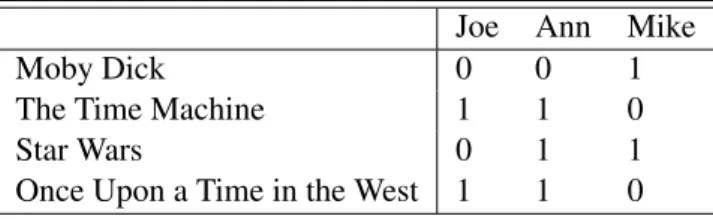
Table 2.1: Example data base for users and movies
Joe Ann Mike
Moby Dick 0 0 1
The Time Machine 1 1 0
Star Wars 0 1 1
Once Upon a Time in the West 1 1 0
2.5.4 Vector Space Model
Thevector space modelis used in data mining to represent items. The items are encoded as an n-dimensional vector. An important data mining problem is to find similar items. This can be mapped to the problem of finding nearest neighbors in the vector space model, for which algorithms exist. As an example, in information retrieval, natural language documents are represented as vectors where the components of the vector denote the weight of a term. The weight can, for instance, be computed by the number of occurrences of the term within that document [11].
2.5.5 Collaborative Filtering
The basic idea of collaborative filtering (CF) is that users with similar preferences regarding items will rate other items similarly as well [102]. CF uses a database of users, items and alike-relation between users and items, to recommend items to users. Based on what a user already likes, similar users are searched and additional items which the similar users like are returned as recommenda-tions.
As an example, let us assume that we have data about which movies users bought (i.e., binary ratings). The content of the data base is illustrated in Table 2.1. A “1” indicates that a user bought a particular movie and a “0” denotes that a user has not bought that movie yet. Imagine, we want to produce a recommendation for Joe. In the database, the user Ann is most similar to Joe, as she bought two movies which Joe bought as well. Consequently, we can recommend the movieStar Warsto Joe, which he has not bought yet.
A common approach for implementing a CF-based recommendation system is to encode the items which a user likes as a vector and define similarity among users as the similarity between the cor-responding vectors in the vector space (see Section 2.5.4). A vector similarity measure that is often used is thecosine similarity, which corresponds to the cosine of the angle between the vectors. It is computed as follows:
cosine_similarity(~a,~b) = ~a·~b |~a| × |~b|
To obtain recommendations, thek-nearest-neighbor algorithm can be used. The k most similar users are determined according to the similarity measure. Their item preferences are aggregated and the set of recommended items is derived. The value ofkinfluences the number and quality of the recommendations.
2.6 Recommendation Systems in Software Engineering
2.5.6 Data Mining in Software Engineering
During software development, a number of repositories are used to store a variety of data. Examples include source code in version control systems, bug data bases and communication logs (e.g., e-mails). The field ofMining Software Repositories(MSR) which has gained increased interest in the past years tries to leverage this data for understanding software evolution and for decision support in software projects [32, 54]. An example is the detection of change coupling patterns, where the goal is to determine which artifacts often change together. If during maintenance, a developer changes one artifact, she may be notified to consider other artifacts that have been changed along with this artifact in the past [120].
2.6 Recommendation Systems in Software Engineering
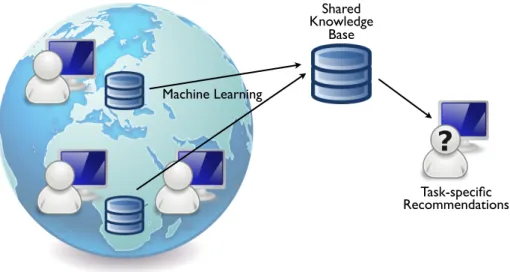
The basic idea of recommendation systems in software engineering is to leverage the collective wisdomof developers to assist individual developers in their daily work. The knowledge of many developers is utilized with the help of machine learning to create a shared knowledge base, which is then used to give task-specific recommendations to individual developers. This principle is illus-trated in Figure 2.1. Shared Knowledge Base Task-specific Recommendations Machine Learning
Figure 2.1: Recommendation systems in software engineering
The knowledge used by recommendation systems can be obtained in different ways. A common ap-proach is to perform data mining on software repositories such as version control systems and bug databases (cf., Section 2.5.6) and extract knowledge from them. The major advantage is that this process can be performed completely automatically. Moreover, it is not relevant where the devel-opers are located physically. The type of knowledge that can be used is diverse and many different objects can be recommended by recommendation systems. The goal of the recommendations is to help developers in decision making within their tasks. Often, recommendation systems aim at as-sisting developers who seek for certain information [93]. The types of objects recommended include code, artifacts, people (e.g., theidealassignee for a bug [4]), tools [31], and refactorings [106].
Robillard et al. [93] identified the following three principal design dimensions for recommendation systems in software engineering:
The nature of the context defines the query input of the recommendation system. It can be explicit (e.g., entering text or selecting graphical elements), implicit (e.g., recorded developer interaction with the IDE) or a combination of both.
The design of the recommendation engine determines which additional data the recommen-dation system uses, besides the context, to produce recommenrecommen-dations. Examples include a project’s source code and the change history stored in the version control system. Very com-mon is also a ranking mechanism that orders recommendations with regards to their expected relevance for the user.
The output mode of a recommendation system can be either pull mode (recommendations are made in response to an explicit user request) orpush mode(recommendations are made proactively). Moreover, theoutput presentationcan be eitherbatch, in which case a list of rec-ommendations is presented in a separated IDE view, orinline, in which case recommendations are presented as annotations directly on top of the artifacts the developer is working with.
In addition, Robillard et al. identified cross-dimensional features of recommendation systems in software engineering: Explanations, affecting both the recommendation engine and the output mode, give information to the userwhya certain recommendation was made in order to improve transparency of the system. User feedback, influencing all three dimensions, can for instance be used to allow users to flag recommendations as inappropriate in order to exclude them from future recommendations.
A comprehensive overview of recommendation systems in software engineering is provided by Ro-billard et al. in [93]. The focus of this thesis is the recommendation of API elements to developers. A detailed discussion of existing work in the area of code recommendation systems is given in Chapter 3.
2.7 Model-Based Development
Model-based development has recently gained increased attention due to its promise of improved productivity. As opposed to code-based development, where the focus is on source code, models become primary development artifacts and, in order to obtain a running system, the models are interpreted or executable code is generated from them. The main development and maintenance activities thus shift their focus from code to models. Instead of writing code, developers create and maintain models represented in a domain specific language.
Mathworks Simulink4 is a development environment for modeling and simulating dynamic sys-tems which utilizes a block diagram notation [16]. Simulink has become a prevalent technology in the embedded systems domain, especially in the automotive field. With TargetLink5, a C code generator for Simulink models, executable code can be generated automatically. Simulink models
4http://www.mathworks.com/products/simulink/ 5
2.8 ConQAT: Continuous Quality Assessment Toolkit
are constructed from so calledblocks, the atomic functional units of the Simulink language, which compute output signals from input signals.
As an illustration, Figure 2.2 shows a Simulink subsystem for an air condition (A/C) control. The subsystem has four inputs for data from different sensors in a vehicle. The output of the subsystem is the temperature control of the A/C which is computed from the inputs using several blocks. The subsystem thus implements a control loop for the temperature in the vehicle.
Figure 2.2: A/C control subsystem (Source: http://www.mathworks.com)
2.8 ConQAT: Continuous Quality Assessment Toolkit
ConQAT6is a flexible open source toolkit for the quality analysis of software systems. Within this thesis, it is used as a basis for various analyses and the tool support. ConQAT employs a modular architecture that supports the extension with new analysis capabilities by a plug-in mechanism. Its graphical user interface is built on top of the Eclipse Platform which also allows for an extension of its user interface with additional features in the form of plug-ins.
Figure 2.3 shows a high-level overview of the main parts of ConQAT. TheConQAT Engine imple-ments a large variety of analysis capabilities for source code written in diverse programming lan-guages as well as models. TheDashboard Constructionis the graphical editor for editing quality analysis configurations. Clone DetectionandArchitecture Analysisrefer to user interface capabili-ties specific to the detection of duplicated code and conformance analysis of software architectures. In the course of this thesis, we will build on both theConQAT Engineand theDashboard Construc-tion. Dashboard Construction Architecture Analysis Clone Detection ConQAT Engine
Figure 2.3: Overview of ConQAT
6
3 State of the Art
This chapter presents existing work in the research areas of this thesis organized according to the structure of this thesis. We first discuss related work regarding the quantification of software reuse in open source projects in Section 3.1. Section 3.2 presents related work on the detection of func-tional similarity in programs. In Section 3.3, we summarize previous work on developer support for software reuse. Finally, Section 3.4 discusses existing approaches related to recommendation systems in model-based development.
Each of the sections describes existing work, identifies their limitations and points to the chapters of this thesis that provide contributions to the identified problems.
3.1 Quantifying Reuse in Software Projects
Several authors have worked on quantifying the extent of software reuse in real-world software projects with varying intent.
In [99], Sojer and Henkel investigate the usage of existing open source code for the development of new open source software by conducting a survey among 686 open source developers. They analyze the degree of code reuse with respect to several developer and project characteristics. They report that software reuse plays an important role in open source development. Their study reveals that the share of functionality that is based on reused code, as estimated by the developers, ranges between 0% and 99% with a mean of 20% and a median of 30%. Since Sojer and Henkel used a survey to analyze the extent of code reuse, their results may be subject to inaccurate estimates of the respondents.
Haefliger et al. [30] analyzed code reuse within six open source projects by performing interviews with developers as well as inspecting source code, code modification comments, mailing lists and project web pages. Their study revealed that all sample projects reuse software. Moreover, the authors found that by far the dominant form of reuse within their sample was black-box reuse. In their sample of 6 MLOC project code (excluding reused code), 55 components, which in total account for 16.9 MLOC, were reused. Of the 6 MLOC, only about 38 kLOC were reused in a white-box fashion. The developers also confirmed that this form of reuse occurs only infrequently and in small quantities. The authors treated whole components as reusable entities. However, in practice not always the whole component may be actually reused, since only parts of its functionality might be used by the integrating program. This may result in an overestimation of the actual reuse rate. Since they use code repository commit comments for identifying white-box reuse, their results are sensitive with regards to the accuracy of these comments.
In [80], Mockus investigates large-scale code reuse in open source projects by identifying compo-nents that are reused among several projects. The approach looks for directories in the projects that
share a certain fraction of files with equal names. He investigates how many of the files are reused among the sample projects and identifies what type of components are reused the most. In the stud-ied projects, about 50% of the files were used in more than one project. However, libraries reused in a black-box fashion are not considered in his study. While Mockus’ work quantifies how often code entities are reused, the reuse rates achieved in the reusing projects are not analyzed. Moreover, reused entities that are smaller than a group of files are not considered.
In [65], Lee and Litecky report on an empirical study that investigates how organizations employ reuse technologies and how different criteria influence the reuse rate in organizations using Ada technologies. They surveyed 500 Ada professionals from the ACM Special Interest Group on Ada with a one-page questionnaire. They found a broad spectrum of reuse rates from under 10% to over 80% whereas the majority of the projects (about 55%) exhibited a reuse rate below 20%. The authors determined the amount of reuse with a survey. Therefore their results may be inaccurate due to subjective judgement of the respondents.
In [111], von Krogh et al. report on an exploratory study that analyzes knowledge reuse in open source software. The authors surveyed the developers of 15 open source projects to find out whether knowledge is reused among the projects and to identify conceptual categories of reuse. They analyze commit comments from the code repository to identify accredited lines of code as a direct form of knowledge reuse. Their study reveals that all the considered projects do reuse software components. Like Haefliger et al., von Krogh et al. rely on commit comments of the code repository with the aforementioned potential drawbacks.
Basili et al. [6] investigated the influence of reuse on productivity and quality in object-oriented systems. Within their study, they determine the reuse rate for 8 projects developed by students with a size ranging from about 5 kSLOC to 14 kSLOC. The students had to implement a management information system and were provided with existing libraries containing GUI functionality, general utilities and a data base implementation. The reuse rates ranged between 0% and about 46% with a mean of 26%.
Ma et al. [69] studied how the Java Standard API is used by a corpus of 76 open source software projects. They employ a tool called Jepends to find API usages, i.e., static use dependencies of API classes or methods. The authors analyze the used entities regarding their usage frequency. In particular, they present the most used and unused entities of the Java Standard API. The analyzed projects combined used about 52% of the classes in the Java Standard API and 21% of the methods, which means that about half of the classes in the Java API are not used at all by the projects in the corpus. The goal of their approach is to assess the utilization and thereby judge the effectiveness of an API.
Lämmel et al. [63] analyzed API usage in a corpus of 1,476 open source Java projects to inform API migration research. They found that the studied projects use between 1 and 27 different APIs with a median of 4. The projects used from 1 to 10,850 distinct API methods from all APIs (median 199.5).
Raemaekers et al. [86] analyzed the usage frequency of third-party libraries within a corpus of 106 open source and 178 proprietary Java systems. The authors present the top 10 of the most frequently used libraries for the analyzed systems. Based on the usage frequency, they propose a risk assess-ment of library usage for a project, whereby the assumption is that an ’uncommon’ (less frequently used) library exposes a higher risk than a commonly used library.
3.2 Detection of Functional Similarity in Programs
Problem Many existing studies use either interviews or surveys for quantifying reuse and there-fore their results are sensitive with regards to the subjective judgement of the interviewees. Other studies either do not analyze real-world software projects or analyze reuse at a coarse level (e.g., groups of files). Other studies focus on the API producers’ view on reuse by investigating what fraction of a library is reused by a project corpus.
We currently lack detailed and accurate empirical data on the extent of software reuse in real-world software projects. We do not know what reuse rates can be achieved with the reusable artifacts that are available in code repositories on the Internet.
Contribution Chapter 4 presents an empirical study providing quantitative data on the extent and nature of software reuse in open source Java projects. It thereby sheds light on the question whether reuse of open source code is successful in practice.
3.2 Detection of Functional Similarity in Programs
Duplicated functionality within or among software systems can have two causes. First, code may be copied and pasted, which is known ascloning, or functionally similar code may be developed independently. While in the first case the copying and pasting of code is typically a conscious act, the second case may be caused due to unawareness of the existing solution.
Research in software maintenance has shown that many programs contain a significant amount of cloned code. Such cloned code is considered harmful for two reasons: (1) multiple, possibly unnecessary, duplicates of code increase maintenance costs [59, 95] and, (2) inconsistent changes to cloned code can create faults and therefore lead to incorrect program behavior [53]. The negative impact of clones on software maintenance is not due to copy&paste but caused by the semantic coupling of the clones. Hence, functionally similar code, independent of its origin, suffers from the same problems clones are known for. In fact, the reimplementation of existing functionality can be seen as even more critical, since it is a missed reuse opportunity.
The manual identification of functionally similar code is infeasible in practice due to the size of today’s software systems. Tools are required to automatically detect such similar code. A study by Juergens et al. [52] showed that existing clone detection tools are limited to finding cloned code,
i.e., they are not capable of finding redundant code that has been developed independently. As a consequence, we do not know to what degree real-world software systems contain similar code beyond the code clones originating from copy&paste programming. Manual analysis of sample projects [52] as well as anecdotal evidence, however, indicate that programs indeed contain many similarities not caused by copy&paste.
The problem of detecting functionally similar code is related to various research areas. This sec-tion first discusses theoretical work and then focuses on different practical approaches related to detecting functionally similar code fragments in real-world software.
Theoretical Work The problem of functional program equivalence,i.e., deciding whether two programs compute the same function, is undecidable in general, which follows from Rice’s theo-rem [115]. Thus, we can conclude that it is not possible to build a tool that is capable of detecting functionally equal programs with 100% precision.
Equivalence of programs has been discussed in terms of operational semantics by Pitts [83] and Raoult and Vuillemin [87] as well as input/output behavior by Zakharov [114] and Bertran et al. [8]. Pitts introduces a contextual preorder on expressions of ML programs which is used as a basis for defining a contextual equivalence. The focus is on a method for proving contextual equivalence of ML functions. Raoult and Vuillemin prove that two different notions of program equivalence,i.e., fixed-point semantics and operational semantics coincide for recursive definitions. Zakharov defines the functional equivalence of Turing machines. Bertran et al. introduces a notion of input/output equivalence of distributed imperative programs with synchronous communications. The goal of the approach is to allow for the decomposition of distributed program simplification proofs via communication elimination.
In [78], Milner introduces a simulation relation between programs. It abstracts from the data repre-sentation and sequence controlling of a program. He proposes a technique for proving simulation between programs. The goal of his work is twofold: First, the notion of simulation leads to a closer definition of what an algorithm is. Second, proving simulation between programs can simplify the task of proving the correctness of a program.
In [45], Ianov introduces so-calledprogram schemata, which are formal abstractions of programs. These schemata abstract away the details of the operations of the program while preserving the se-quential and control properties. He defines equivalence on these schemata and presents a method for deciding the equivalence of program schemata. The notion of equivalence is not defined with respect to the computed function of the program but rather represents a very strong notion of equiv-alence [96].
The basic idea ofprogram transformationis to transform a program into a semantically equivalent one by applying only semantic-preserving transformations. A possible application is the use for program optimizers. In program optimization, the goal is to find resource intensive parts of the program and to replace them with semantically equivalent calls to libraries that are more efficient. Since program equivalence is undecidable, the more specific notion ofalgorithmic equivalenceis introduced. Two programs are algorithmically equal if one can be obtained from the other by ap-plying transformations like variable renaming, semantic-invariant statement reordering or operand permutations of commutative operators [74].
Code Retrieval In the field of software reuse, behavior-based retrieval approaches are used to find reusable software entities. The search query is represented by a semantic abstraction of the software entity to be retrieved. The semantic abstraction can be for instance given in the form of formal specifications or input-output tuples.
Based on contracts (i.e., formal models of functional behavior), Fischer et al. [24] define plug-in compatibility denoting whether a component can be safely reused in a given context without modification. The basic idea of the reuse approach is that a component satisfies a query with
pre-3.2 Detection of Functional Similarity in Programs
and postcondition if the precondition of the query implies the precondition of the component and the postcondition of the component implies that of the query.
In [84], Podgurski and Pierce introduce a method calledbehavior samplingfor the automated re-trieval of software components from a software component library with the goal of reuse. The search query is specified by supplying the required target interface, input samples as well as the expected outputs. Candidate functions are identified and executed with the given inputs and the outputs are compared to those provided by the searcher. The authors discuss the probabilistic basis for behavior sampling based on the operational distribution of the input. They argue that with this approach it is “very unlikely” that a routine is retrieved that does not satisfy the searcher’s needs.
A similar approach is employed by Mittermeir [79] for classifying components on the basis of tuples with a characteristic pair of input and output. The components are organized in a classification tree according to the I/O-tuples. The user is subsequently prompted with a choice between two tuples requiring to choose according to the desired behavior. The search process ends when only components remain that provide the requested effect.
Static Similarity Detection There has been significant research dedicated to detecting syn-tactically similar code fragments (calledcode clones). An overview of the research in the area of program representation based clone detection can be found in the survey from Koschke [59]. Clone detectors, such as CCFinder [55], CloneDetective [51] and Deckard [48] are effective in finding clones created bycopy&paste programming. However, in [50], Juergens et al. showed that code with similar behavior from independent origin cannot be detected with clone detection.
A number of approaches have been proposed that aim at statically detecting similarity of code which was not caused by copy&paste. These similarities of independent origin are also referred to assemantic clones[60] ortype-4 clones[94].
In [97], Sager et al. propose an approach for detecting similar Java classes using tree algorithms for understanding software evolution steps,e.g., how classes changed between two releases. The com-parison of classes is based on an intermediate representation. For this purpose, the abstract syntax tree of a class is constructed and converted into a language-independent information interchange model. These tree structured models are then compared with tree similarity analysis. They evaluate various tree similarity algorithms, from which the tree edit distance yielded the best results.
In [58], Kim et al. use a semantic-based static analyzer for detecting semantic clones. Their ap-proach compares abstract memory states for identifying semantic clones. An abstract memory state maps abstract memory addresses to guarded values. Thereby, a guarded value is a set of pairs with a guard and a symbolic value. The guard represents the condition under which the address has that value. The clone detection process consists of clone candidate identification, the computation of abstract memory states for all candidates, and the computation of the similarity between memory states.
In [57], Kawrykow and Robillard propose a method for detecting “imitations” of API methods. Their approach detects client code that reimplements methods available in the API of the types the code is using. A method is represented by the set of program elements it is using. More specifically, for each method, it is determined, which fields, methods and types are referenced by its body. On
this abstraction, they define a potential replacement relation that allows them to automatically detect code that could be replaced with calls to existing library methods.
Kuhn et al. [62] introduced an approach for identifying “topics” in source code. They uselatent se-mantic indexingand analyze linguistic information in identifiers and comments for grouping source code artifacts that are semantically related. Their heuristic is to cluster artifacts that use similar vocabulary. They call this techniqueSemantic Clusteringand their goal is to support program com-prehension activities. As the result of their case study they conclude that their approach “provides a useful first impression of an unfamiliar system”.
McMillan et al. [73] suggested a method for detecting similar software applications. They use the concept ofsemantic anchorsgiven by calls to API methods to precisely define the semantic charac-teristics of an application. The authors argue that the method calls to widely-used APIs have precise semantics and can thus effectively be used to determine the degree of similarity between programs. Similar to Kuhn et al., they use latent semantic indexing to reduce the number of dimensions in the similarity space.
Dynamic Similarity Detection In [49], Jiang and Su employ random testing to find func-tionally similar code fragments, where the term functional similarity is based on input and output behavior. Therefore, program states are not considered. Their approach uses a code chopper that extracts code fragments as candidates for function comparison. A code transformer turns the code fragments into compilable and executable units. An input generator generates random values for all input variables of a code fragment. The code fragments are clustered by separating fragments with different outputs for the same input. Finally, a code filter reduces false-positives,e.g., by filtering code fragments with too much overlap in source code lines. The authors applied their approach to the Linux kernel and detected 32,996 clusters of functionally similar code fragments which in total account for 624,000 lines of C code.
Problem Existing theoretical work provides valuable insights into the problem of program equiv-alence and the theoretical limitations associated with its undecidability. However, it provides little guidance on how functional similarity could be detected automatically in real-world software sys-tems. Other related work focuses either on different use cases (e.g., code retrieval), is limited to representation-based similarity (classic clone detection or specific cases of imitated API methods) or targets high-level similarity. The only dynamic approach is targeted at procedural C systems.
We currently do not know if and how functional similarity in object-oriented systems can be detected automatically. It is unclear if the existing approach proposed for procedural systems can be adapted to detect functionally similar code in object-oriented systems.
Contribution Chapter 5 presents the transfer of an existing approach for detecting functional similarity in procedural programs to the field of object-oriented programs. It reports on a case study with 5 open source systems and an artificial set of highly similar programs and discusses the challenges faced with the approach. It identifies potential causes for the low detection rates and gives important directions for future research.
3.3 Developer Support for Library Reuse
3.3 Developer Support for Library Reuse
The use of large software libraries poses a considerable cognitive challenge to software develop-ers [25]. An illustrative example is shown in Figure 3.1, which shows how the state-of-the-art Java IDE Eclipse1allows browsing the Java Standard class library. As can be seen, the developer faces an overwhelming number of API entities.
Two major directions have been proposed to increase API accessibility, thus fostering reuse: classic code retrieval and code recommendation systems. Code retrieval allows querying code entities from code repositories. Prominent examples are keyword-based code search engines on the Internet such as Koders2. Advanced code retrieval approaches use signatures [116], specifications [24], test cases [43], or combinations thereof [90] to search for reusable entities. These methods, however, require users “to derive abstractions of what they actually want in order to find the artifacts that are potentially useful” [76]. On the language level, thevocabulary problem[27] often hampers the effectiveness of the listed tools, as developers unfamiliar with an API may formulate their query in a terminology differing from the one employed by the API. Recent approaches address this issue by enabling free-form natural language queries. SNIFF [14], a Java search engine, enriches the API with its documentation. Apatite [22] provides an interface for associative browsing of the Java and Eclipse APIs and supports the developer by additionally providing API items frequently related to their query. Hill et al. [38] propose an approach for contextual code search, which enriches query results with natural language phrases drawn from the context of the proposed method.
Despite their increase in effectiveness, code retrieval approaches fail to overcome a considerable obstacle: the user has to abandon the current task to actively formulate a query, which disrupts his workflow. Code recommendation systems address this issue by using the current development context to automatically extract queries and recommend code entities that may be useful for the task at hand. This can even happen proactively,i.e., without the user anticipating the existence of a relevant code entity. A general introduction to recommendation systems in software engineering is given by Robillard et al. in [93]. While the recommended objects of recommendation systems in software engineering can be very diverse, including people and tools [31], we mainly focus on the recommendation of code.
In the remainder of this section, we summarize approaches that assist developers in using libraries and their APIs more effectively.
Classic IDE Code Completion Code completion tools (or code assists) offer a list of available variables, types and methods during code editing in an IDE as illustrated in Figure 3.2, which shows the code assist of the Eclipse IDE. Partially entered names are used to narrow down the proposed completions. The focus is on syntactical applicability and visibility of the suggestions. The order of the proposals is usually regarding the type of item (e.g., method, variable, type) and furthermore al-phabetical. The quality of the suggestions heavily depends on the programming language. Strongly typed languages typically enable better suggestions, since the type system allows inferring what suggestions are syntactically applicable.
1http://www.eclipse.org/ 2
3.3 Developer Support for Library Reuse
Figure 3.2: Eclipse code assist
Enhanced Code Completion Enhanced code completion approaches aim at improving “clas-sic” code completion systems by producing more relevant completion proposals and help developers find the “right” API entity more quickly. This is usually achieved by sorting the proposals by their relevance to the current programming task instead of alphabetically.
In [12], Bruch et al. introduce an example-based code completion system. They enhance current code completion systems by making context-sensitive method recommendations. Their approach is based on mining knowledge from an example code base. They present three different methods for using the information in the code repository: frequency of method calls, association rule mining and a modification of the k-nearest-neighbor algorithm. As the approach is based on classic code completion, they recommend only methods applicable to an expression of a class type.
Robbes and Lanza [91] developed an approach that utilizes recorded program histories to improve code completion. They use different information from change-based software repositories to im-prove the order of completion proposals. As an example, they rank recently changed methods higher in a list of proposals, assuming that a programmer is likely to employ a method recently defined or modified.
Code Example Recommendation Systems Code example recommendation systems sug-gest complete code examples or snippets that illustrate the usage of an API.
Bajracharya et al. [5] proposedstructural semantic indexingwhich utilizes API usage similarities extracted from code repositories to associate words with source code entities. Their goal is to improve the retrieval of API usage examples from code repositories by addressing the vocabulary
problem. This is done by sharing terms among code entities that have similar usage of APIs and are thus functionally similar.
Mapo, developed by Zhong et al. [119], mines API usage patterns from existing source code. The patterns are given by methods that are frequently called together and that follow certain sequen-tial rules. The patterns are used for answering queries for methods by returning example snippets illustrating the usage of that method.
Holmes and Murphy introduced Strathcona [40], a tool for retrieving useful code snippets from a repository of code examples. It extracts the structure of the code under development and matches it to the code in the repository and returns code snippets similar to the code being edited. The repository can be created automatically from existing software systems. The authors developed several heuristics for structure matching of code, including inheritance and call/use relations.
Hill and Rideout [39] developed a plug-in for the Java Editor jEdit that completes a partial method by searching the code base for syntactically similar code fragments and suggesting to replace it with the best match. The search for similar code fragments is a clone detection which uses the k-nearest-neighbor algorithm based on a feature vector taking into account—among others—the length, complexity and tokens of a method.
Takuya and Masuhara [104] introduced Selene, a code recommendation tool based on an associative search engine. It uses as the query all tokens in a file being edited and searches for files with similar tokens in a code repository. The similarity measure used is based on the cosine similarity taking into account term frequencies and inverse document frequencies. Moreover, the tokens near the cursor position obtain a higher weight. In the IDE, the system then displays for each of the similar files, the code segment with a length of 20 lines that has the highest similarity with the edited code.
API Recommendation Systems API recommendation systems propose API elements, e.g., methods or types, based on different aspects of the development context.
CodeBroker [113], introduced by Ye and Fischer, infers queries for reusable components from Javadoc comments and signatures of the code currently being developed. It matches the comments in the code against those of repository code. Signature matching is used to ensu