Knowledge-Sharing Adoption in Saudi
Universities’ E-learning Communities
Full paper
Abdullah Alammari
University of Technology Sydney,
Australia; and Umm Al-Qura University,
Saudi Arabia
[email protected]
Daniel Chandran
University of Technology Sydney,
Australia
[email protected]
Abstract
Technology revolution in recent years has increased the demand for the provision of e-learning. However, academic staff lack the knowledge-sharing attitude in e-learning communities. The aim of this research is to investigate the various factors of knowledge-sharing adoption for e-learning communities in Saudi Arabia. Therefore, a framework aimed at sharing knowledge within the e-learning communities is developed. Data has been collected from public universities in Saudi Arabia. Partial Least Square approach has been applied to analyse the data. The results shows knowledge-sharing individual factors (such as openness in communication, interpersonal trust), technology acceptance factors (perceived usefulness and perceived ease of use) significantly influence knowledge-sharing attitude while the relationship between people self-motivation and knowledge-sharing attitude is insignificant. Among other factors, subjective norm and attitude significantly impact behavioural intention toward knowledge-sharing adoption in Saudi universities’ e-learning communities.
Keywords
E-learning, knowledge-sharing, TAM, TPB, TRA.
Introduction
There is a demand for the provision of electronic learning (e-learning) due to technological innovations. E-learning is defined as the process of delivering educational programs and training using the electronic devices (Cooper et al. 2004). Knowledge management is often inadequate when it comes to knowledge-sharing, particularly between staffs that work in universities (Alotaibi et al. 2007). There is a clear lack of studies regarding the academics perspective on knowledge-sharing process and their use in the Saudi Arabia universities (Alammari & Chandran 2014; Fullwood et al. 2013). Knowledge-sharing practices within the academic context is still a new area for research within the Arab world in general and Saudi Arabia in particular. Saudi Arabia has prioritized the process to transform from its oil petroleum based economy to an innovative knowledge-based-society and consequently to a knowledge-based-economy (Alammari & Chandran 2014). Recently, Saudi Arabia has begun to aggressively plan and invest to build ‘world-class knowledge centers’ in order to diversify its economy resources from natural resource production reliance only to a knowledge-based economy (Shin, Lee, and Kim 2012). E-learning communities denotes the educational environment that address the learning needs of its members through computer-mediated communication. Saudi Ministry of Education (MOE) has launched ‘Maknaz’, a national Learning Objects Repository (LOR) project. It serves as an Open Educational Resources (OER) repository in in the educational sector to support the national strategic plans towards the enrichments in e-learning resources and knowledge contents growth (Alammari & Chandran 2014). It is needed to effectively populate this knowledge contents repository ‘Maknaz’ with massive digitalized contents and e-learning electronic materials (Almegren and Yassin, 2013). E-e-learning communities in Saudi universities lack an integrated e-learning LOR or OER and knowledge management framework that can lead to the process of knowledge contents creation, knowledge management processes and practices adoption based on an online learning environment approach. Moreover, there is a noticeable unawareness about
e-learning LOR, OER or knowledge contents by academics staff and students in the Saudi universities. Nevertheless, integrating knowledge-sharing practices and tools in e-learning communities can offer Saudi e-learning environments with the processes of knowledge contents creating, sharing, filtering and reusing (Alammari & Chandran 2014). Accordingly, academic participants in the e-learning communities will start to populate and share the knowledge and learning contents of the national LOR repository ‘Maknaz’ with constant digitalized knowledge contents effectively. Knowledge-sharing is acknowledged as a positive force behind the effective functioning of academic institutions. Unfortunately, the factors which help to ensure effective knowledge-sharing in the Saudi universities’ e-learning communities are not researched well (Alammari & Chandran 2014). It is well-understood that the factors that significantly motivate learners as well as staff in different settings to share knowledge of any nature need to be identified for the growth of these institutes (Smith and Farquhar 2000). However, Universities are lacking in management technology system for the academic process, in particular in Saudi Arabia universities (Alotaibi et al 2007). Thus, knowledge-sharing adoption in e-learning communities can be used as effective tool for developing the Saudi educational institutions.
Problem Statement
This research focuses on knowledge-sharing practices adoption in e-learning communities from the perspective of academic staff so as to provide a competitive advantage in the Saudi universities. Therefore, a framework aimed at retaining knowledge within the e-learning communities is developed. This research seeks to add value to its research area, as there is a clear demand to improve the environment of e-learning communities in Saudi universities. The purpose of this study is to propose a model and investigate various factors that influence the adoption of knowledge-sharing activities in Saudi e-learning communities. In particular, this study investigates the following research question: What are the factors that influence the adoption of knowledge-sharing among staff in e-learning communities in Saudi Arabia?
Literature Review
Knowledge-sharing
In today’s increasingly information-dependent world, knowledge has become a powerful resource. Communities need to manage and develop knowledge resources in order to sustain their competitive edge. As Griffith and Sawyer (2010) argue, organizations can only gain and accumulate knowledge through individuals that is subsequently transferred to others. However, knowledge must not be confused with information as information only becomes knowledge once it is contextualized. In the organizational context specifically, knowledge is developed through social practices and interaction as individuals engage in knowledge-sharing. Correspondingly, Knowledge Management is one of the main concerns of global organizations these days. Organizations can greatly benefit from knowledge management systems and the most important aspect in this scenario in ‘knowledge-sharing’ because when it comes to knowledge that deals with ‘how things are run’ as opposed to academic knowledge, most of this knowledge has to be learnt from people. Apart from that, without established knowledge-sharing practices, new employees can face problems in getting the required information, which can affect their performance in the long run (Lin, 2007). To increase the efficiency of knowledge-sharing resources, many organizations today rely on information technology. Web and Internet technology is one of the most effective tools used today for knowledge management – especially for sharing of knowledge. Web technology allows the users to share and interact with one another using the social media. E-learning programs also provide tremendous help to employees who work in universities and other academic settings. Knowledge-sharing is acknowledged as a positive force behind the effective functioning of academic institutions as well as professional organizations. Unfortunately, the factors which help to ensure or hinder effective knowledge-sharing through e-learning are not researched well (Alammari & Chandran 2014). Among these is the attitude that people have regarding knowledge-sharing in organizational and university settings that is scarcely found among literature.
behavioural usage intention, which in turn depends on the users’ attitude and the subjective norms (Barnesand Huff, 2003 in Matayong and Mahmood, 2013). Fishbein (1975) views behavioral intention in the form of a simple statistical parameter. According to him if behavioral intention (BI) is considered, the precursor of a certain behavior (B) can be determined by the attitude (or the point of view) which the individual views that behavior and also with the help of subjective norm (SN) that is the way in which the individual is affected by the social pressures regarding that behavior. As Yeo and Gold (2014) espouse knowledge-sharing is heavily influenced by how individuals perceive about themselves which shapes their views about the reality they experience and their attitude towards it. Seba et al. (2012) contend that attitude towards knowledge-sharing influence the behavioral intentions of individuals. Davidson and Jaccard (1975) have revealed in their research that attitudes and subjective norms can predict the behavior as well as the behavioral intention very accurately in a wide variety of fields. The technology acceptance model (TAM) was developed based on the TRA (Davis, 1989). TAM presupposes that two particular constructs determine the user’s acceptance of a technology. The two main constructs in TAM influencing attitude are perceived usefulness and perceived ease of use. Various researches confirm that if a system has a high extent in its perceived usefulness by its users, that system is believed to have a positive relationship between user’s acceptance and its ‘usability-performance’ degree (Kanchanatanee et al. 2014). The literature shows that people are more likely to accept and use a new technology or system if they practically perceive that the system is easy to use.
Theoretical Background and Research Model
The aim of this research is to investigate the factors and propose a model of knowledge-sharing adoption for e-learning communities in Saudi Arabia. Therefore, the relevant literature on most frequently cited theoretical models on knowledge-sharing factors, attitude and behavioural intention are reviewed. Therefore, this study deals with widespread models related to knowledge-sharing, attitude and behavioural intentions such as Theory of Reasoned Action (TRA) (Ajzen and Fishbein, 1980), Theory of Planned Behaviour (TPB) (Ajzen 1991; Fishbein and Ajzen 1975) and Technology Acceptance Model (TAM) (Davis 1989). Fishbein and Ajzen (1975) proposed Theory of Planned Behavior (TPB). This theory provides a framework to predict individual behavior. This model has been based on the theory of Reasoned Action (TRA). According to TPB, three important elements are proposed to have an impact on human decision-making process. These include, just as proposed in the TRA, attitudes and behavior, subjective norm and external factors including the perceived behavioral control. Technology Acceptance Model (TAM) is frequently employed in knowledge-sharing research in order to analyze the acceptance of technology by individuals. TAM was proposed by Davis (1989) on the basis of TRA and attempts to elucidate a broader range of behaviors in relation to specific situations and individual attitudes and beliefs. This model has been revised and extended largely since it was proposed. The original model has been proven to hold in a number of setting including websites and how people use the web (Noor et al 2005).
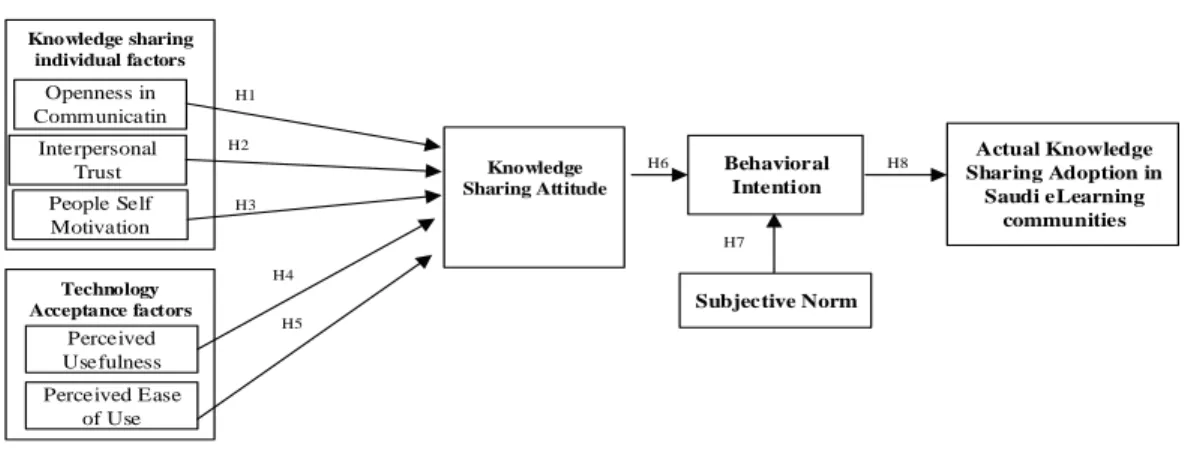
Knowledge originates within individuals or social systems (groups of individuals). Previous researchers have classified knowledge management into individual and organisational dimensions. Most frequently discussed factors in individual dimensions are: trust, openness in communication, and people-self motivation (Bijlsma and Koopman, 2003; Davenport and Prusak, 1998). Knowledge-sharing is a key aspect of knowledge management because it supports the depository codification of available knowledge in an organisation. The literature reveals that the availability of several different knowledge management factors and the richness of these factors influence the effectiveness of knowledge-sharing attitude and behavior. For-example, Yeo and Gold (2014) present some of the commonly used factors are openness, trust, and self-motivation. Gupta and Govindarajan (2000) discussed six knowledge management success factors that interact with each other, rather than a random collection of unrelated essentials. These factors include people motivation and trust. These factors received strong emphasis from the researchers in influencing the success of knowledge-sharing (Al-Alawi et al. 2007). The organisation leaders set the social norm that sets staff’s knowledge-sharing behaviour, and model their behaviour by affecting staff to imitate. Figure 1 shows the research model.
Knowledge Sharing Attitude Behavioral Intention Actual Knowledge Sharing Adoption in Saudi eLearning communities Subjective Norm H6 H8 H7 Interpersonal Trust Openness in Communicatin People Self Motivation Perceived Usefulness H1 H2 H3 H4 Perceived Ease of Use H5 Knowledge sharing individual factors Technology Acceptance factors
Figure 1. Research model
Hypotheses Development
Knowledge-sharing Individual Factors
Openness in Communication: it is defined as the ease of individuals’ conversation and the level of
understanding gained when they try to communicate to each other (Schiller & Cui 2010). When it comes to knowledge-sharing attitude, openness is an essential factor. Openness in communication not only facilitates the process of knowledge-sharing but also encourages the other person to interact more fully. Liu and DeFrank (2013) contend that by sharing knowledge a boundary of reciprocal relationship is established whereby the other person is also expected to contribute something in return leading to a loop of knowledge-sharing. Individuals are more open to sharing knowledge if the community encourages knowledge-sharing amongst its participants (Yu et al. 2010). Hence, knowledge-sharing is expected to be more in communities where there is a culture of openness amongst the individuals. Yu et al. (2010) argue that an open and ethical culture is crucial for knowledge-sharing. The more open individuals are to one another, the more is the likelihood of the knowledge loop that ensures that the knowledge flows. This way people become more willing to interact with each other and share knowledge (Yu et al. 2010). If the knowledge-sharing experience has a positive impact, openness also increases. Therefore, openness can be considered an individual propensity that leads to positive attitudes regarding knowledge-sharing. Therefore, the following hypothesis is developed:
H1: Openness in Communication has a significant positive influence on staff attitude in e-learning communities in Saudi Arabia.
Interpersonal Trust: Gambetta (2000) defined it as the willingness of individuals to associate positive
expectation with the actions of other. The successful sharing of knowledge requires that the management encourages positive social interaction, trust among the members of teams and thus effective knowledge-sharing (Kharabsheh, 2007). In order to be functional, communities need to develop an atmosphere of trust where the participants dispense their doubts about the willingness of others to work for the benefit of the groups. Trust leads to increased knowledge-sharing and enhances the likelihood that the knowledge will be understood and applied. Trust is directly tied to the level of psychological safety in knowledge-sharing – the more trust amongst participants, the more will be knowledge-sharing of tacit knowledge (Lin 2006). There is a positive relationship between trust and knowledge-sharing (Al-Alawai et al., 2007). Therefore, the following hypothesis is developed:
H2: Interpersonal Trust has a significant positive influence on staff attitude in e-learning communities in Saudi Arabia.
knowledge management literature in relation to self-motivation is the notion of ‘self-efficacy’. Self-efficacy refers to a person’s belief in his or her own capabilities. In other words, it means how much trust the participants have in their own ability to succeed. This belief is central to how people think and behave. In order to achieve a goal, a person has to believe that it can be possible and s/he can attain it. However, in order to share knowledge it is not enough that the participants have an intrinsic desire to share knowledge, the knowledge producer must also perceive that the knowledge can be successfully applied. The more self-efficacy people have, the more confidence they will have about their own knowledge and their expertise (Al-Alawai et al., 2007). The intrinsic motivation and belief, thus leads to increased productivity and encourages the participants of the community to share more knowledge. Therefore, the following hypothesis is developed:
H3: People Self-Motivation has a significant positive influence on staff attitude in e-learning communities in Saudi Arabia.
Technology Acceptance
Perceived Usefulness (PU) and Perceived Ease of Use (PEOU): According to Davis (1989), PU is
“the degree to which a person believes that using a particular system would enhance his or her job performance”; whereas PEOU is “the degree to which a person believes that using a particular system would be free of effort”. If the users perceive the technology to be useful, it will positively impact their attitude towards technology acceptance. Furthermore if the users perceive ease of use, it will positively impact their attitude towards technology acceptance. Attitude leads to positive impact on the users’ intention to use the technology (Cheung & Vogel, 2013). PU and PEOU have significant effects on a user’s attitude towards use of the e-learning system (Lee et al. 2013). Also previous studies revealed that perceived usefulness and perceived ease of use have strong correlation attitude across various information systems (Sivo et al. 2007; Lau and Woods 2008). Therefore, the following hypotheses are developed: H4: PU has a significant positive influence on staff attitude in e-learning communities in Saudi Arabia. H5: PEOU has a significant positive influence on staff attitude in e-learning community in Saudi Arabia.
Attitude, Subjective Norm and Behavioral Intention
Empirical researches have shown that attitude is the strongest predictor of behavioral intention (Kolekofski & Heminger 2003; Ajzen & Fishbein 1980; Sivo et al. 2007). Davis’s (1989) argues that individual attitudes are the co-determinants of any behavioural intention to adopt a technology. It is important to note that attitude towards knowledge-sharing is largely formed from behavioral beliefs (Lin 2007). The results show that persons attitude regarding knowledge-sharing reflect their willingness to be involved in the sharing adoption. Seba et al. (2012) contend that attitude towards knowledge-sharing influence the behavioral intentions of individuals. It leads to the conclusion that positive attitudes lead to positive behavioral intentions, thus ensuring that the participants of any community share knowledge with the aim of mutual benefit.
Previous research has identified that subjective norm has impact on an individual’s behaviour (Ajzen, 1991; Rogers, 1995, 1995; Venkatesh and Davis, 2000; Karahanna, 2006). Greater the subjective norm to share knowledge, more intense would be the intention to carry out the actual behavior. Subjective norm impacts the intention to share knowledge while proving itself significant influencing factor in the spread of knowledge (Chow and Chan 2008).
According to TRA and TPB, the stronger the intention of the individual to engage in a behavior, the more likely the individual will be to perform it (Chow and Chan 2008; Lin, Lu and Liu 2013). Therefore, the following hypotheses are developed:
H6: Staff attitude has a significant positive influence on staff behavioral intention in e-learning communities in Saudi Arabia.
H7: Subjective Norm has a significant positive influence on staff behavioral intention in e-learning communities in Saudi Arabia.
H8: Behavioral intention has a significant positive influence on staff knowledgsharing adoption in e-learning communities in Saudi Arabia.
Methodology
This study has applied quantitative research method to survey respondents in Saudi Universities. Data has been collected from academic staff from various public universities in Saudi Arabia. Criteria of recruiting staff were who adopted the e-learning system in their teaching process. Previously validated instruments were adopted in order to ensure the survey items are validated. The survey has been originally developed in English; however translated Arabic version has been also included in the survey. The five point Likert scale (1=strongly disagree to 5=strongly agree) has been used. Survey has been sent to 500 participants and 400 participated in the survey. After removing incomplete responses, a total of 350 responses have been used for data analysis. Partial Least Squares- Structural Equation Modelling (PLS-SEM) statistical method using SmartPLS version 3 is used to test the hypotheses. PLS approach is a well-known technique used to test theoretical models and to understand the simultaneous modelling of relationships among various independent and dependent constructs.
Data Analysis
Descriptive analysis shows that the majority of the respondents’ are male 255 (73%) and 145 (27%) are female. This distribution of male and female is fairly representative of the population of staff in the selected Saudi Universities. 43% respondents are 26-35 years old, followed by 26% respondents are 36-45 years old. 14% of the respondents are 18-25 and 45-60 years old, followed by 3% respondents are above 45 years old. The majority of respondents hold doctorate degree with 52%, followed by Master’s degree with 34% and 14% of the respondents had bachelor level. 47% of respondents had 3-5 years of work experience, followed by more than 5 years (33%). Then 17% of respondents had work experience of 1-3 years, followed by 3%, less than one year of experience. This high percentage shows clearly that all respondents are experienced in the academic. 47% are lecturers followed by 30% other academic staffs (such as teaching assistants). 23% are professors (assistant, associate and full professors).
Partial Least Squares (PLS) approach allows to simultaneously evaluate structural path coefficients and measurement model parameters. It allows formative and reflective factors to be tested together (Chin, et al. 2003). In our research model all factors except subjective norms are modelled as reflective indicators because they are viewed as effects of latent variables. The subjective norms is formative in nature (Eckhardt et al. 2009), which is not interchangeable because it is a multidimensional variable, which is consistent with prior research studies.
Reliability and Validity Assessment
Measurement scales analysis has been performed to determine reliability assessment, exploratory factor analysis (EFA) and confirmatory factor analysis (CFA) to validate and test the factor structures of the model construct. The measurement model is assessed by internal consistency, convergent validity and discriminant validity. Convergent and discriminant validity are calculated using items loadings were at least 0.70 and the square root of the average variance extracted (AVE) from its factor indicators, which was at least 0.70 and was greater than that factor correlation with other factors. Table 1 shows measurement scales analysis.
AVE Calpha CR OIC IPT PSM PU PEOU SN ATT BI KSA
OIC 0.79 0.86 0.71 0.89 IPT 0.81 0.87 0.65 0.83 0.90 PSM 0.80 0.77 0.61 0.51 0.31 0.89 PU 0.77 0.75 0.70 0.50 0.01 0.23 0.87 PEOU 0.80 0.86 0.76 0.42 0.08 -0.13 0.15 0.89 SN 0.78 0.70 0.26 0.33 0.70 0.26 0.21 0.13 0.87
BI 0.81 0.80 0.56 0.53 0.08 0.18 0.02 0.43 -0.11 0.55 0.90
KSA 0.80 0.86 0.28 0.41 0.14 0.11 0.37 0.22 0.30 0.28 0.67 0.89
Notes: 1. AVE: Average Variance Extracted, CR: Composite Reliability, C Alpha: Cronbachs Alpha
2. OIC: Openness in Communication, IPT: Interpersonal Trust, PSM: People Self Motivation, SN: Subjective Norm
PU: Perceived Usefulness, PEOU: Perceived Ease of Use, ATT: Attitude, BI: Behavioural Intention, KSA: Knowledge-sharing Adoption,
3. Diagonal elements are the square root of AVE.
Table 1. Reliability, Correlation, and Discriminant Validity of Constructs Structural Model Testing
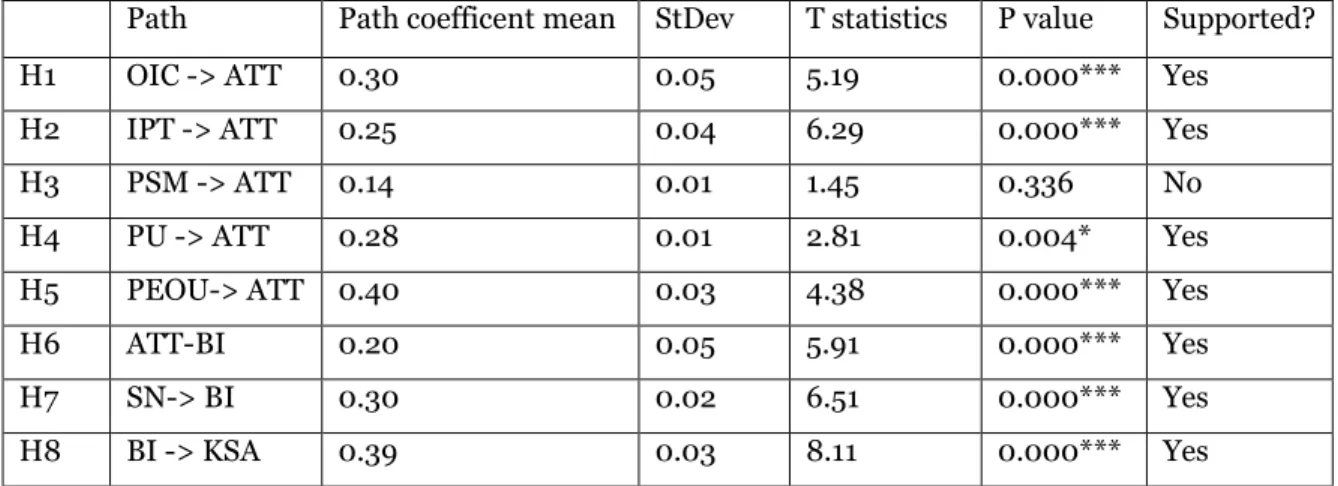
After the acceptable measurement model assessment, the structural model testing is performed to test the hypotheses proposed in this study. The significance of the paths between factors is analysed by t-test calculated with the bootstrapping technique at a 5 percent significance level. The coefficients of the causal relationships between factors are determined by the significance of the path coefficients and the (R²) variance of the dependent factor. Table 2 shows the path co-efficient mean, standard deviation and t-statistics and p-value for each of the proposed hypotheses. The recommended t-values are t >1.96 at p < 0.05, t > 2.576 at p < 0.01, t > 3.29 at p < 0.001 for two-tailed tests. Figure 2 shows the path testing.
Path Path coefficent mean StDev T statistics P value Supported? H1 OIC -> ATT 0.30 0.05 5.19 0.000*** Yes
H2 IPT -> ATT 0.25 0.04 6.29 0.000*** Yes H3 PSM -> ATT 0.14 0.01 1.45 0.336 No H4 PU -> ATT 0.28 0.01 2.81 0.004* Yes H5 PEOU-> ATT 0.40 0.03 4.38 0.000*** Yes H6 ATT-BI 0.20 0.05 5.91 0.000*** Yes H7 SN-> BI 0.30 0.02 6.51 0.000*** Yes H8 BI -> KSA 0.39 0.03 8.11 0.000*** Yes Notes: *Significant at 0.05 level **, Significant at 0.01 level, *** Significant at 0.001 level
Table 2. Hypotheses Testing
Knowledge Sharing Attitude Behavioral Intention R2=0.41 Actual Knowledge Sharing Adoption in Saudi eLearning communities R2=0.29* Subjective Norm R2=0.37 0.21* 0.39* 0.30** Interpersonal Trust Openness in Communicatin People Self Motivation Perceived Usefulness 0.31* 0.24** 0.14 0.29* Perceived Ease of Use 0.41**
Figure 2. Path Testing
As shown in Table 2, the results confirm the significant relationship for all hypotheses at p<0.05, except H3 where the relationship between people self-motivation and attitude is insignificant. In figure 2, R²=0.37 indicates 37 percent variance in knowledge-sharing attitude. For the behavioural intention R²=0.41 indicates 41 percent variance. R²=0.29 indicates 29 percent variance in actual knowledge-sharing adoption in Saudi e-learning communities.
Finding and Discussion
The findings show the order of significance among knowledge-sharing individual factors. The highest impact is ‘openness in communication’ followed by ‘interpersonal trust’ and then ‘People self-motivation’. This indicates ‘openness in communication’ and ‘interpersonal trust’ is more likely to be associated with staff attitude towards knowledge-sharing adoption. This indicates knowledge-sharing is expected to be more in e-learning communities where there is a culture of openness amongst the staff members. The findings are consistent with (Yu et al. 2010; Liu and DeFrank 2013). Also, when the staff trust each other, they are likely to contact more and share knowledge, which leads to the generation of more knowledge. The results are consistent with (Lin 2006; Al-Alawai et al., 2007). In addition, technology acceptance factors such perceived usefulness and perceived ease has the potential to determine the staff attitude towards knowledge-sharing adoption in Saudi e-learning communities. The findings show that attitude and subjective norm has the significant effect towards behavioral intention towards knowledge-sharing adoption in Saudi e-learning communities. This is because of the Saudi Arabia is considered a high collectivistic culture (Hofstede, et al., 2010) and hence in collectivistic country the staff behavior is influenced by social norms received from people (such as friends and family) who are important to them. This is consistent with previous studies (Lee et al. 2013; Davis 1989; Cheung and Vogel 2013; Sivo et al. 2007; Lau and Woods 2008), which revealed that ‘perceived usefulness’ and ‘perceived ease of use’ positively impact individual attitude towards technology acceptance.
The results confirm that staff attitude and subjective norm is the key factor of behavioral intention to adopt actual knowledge-sharing adoption in Saudi e-learning communities. The results are aligned with work of (Sivo et al. 2007; Lin 2007; Seba et al. 2012). The literature discussed the widespread models related to attitude, subjective norm and behavioural intentions such as Theory of Reasoned Action (TRA) (Ajzen and Fishbein, 1980), Theory of Planned Behaviour (TPB) (Ajzen 1991; Fishbein & Ajzen 1975). These theories suggest that a person’s behaviour is predicted by his/her behavioural intention, which is influenced by his/her attitude and subjective norm towards the behaviour, among other factors (Venkatesh and Davis, 2000; Matayong and Mahmood, 2013). In the context of the current study, the actual use of knowledge-sharing adoption in Saudi e-learning communities is influenced by the staff behavioural usage intention, which in turn depends on the users’ attitude and the subjective norms.
Conclusion and Implications
The study has fulfilled its main aim that was to examine the key factors that influence the adoption of knowledge-sharing activities in Saudi universities’ e-learning communities. A conceptual model has been developed based on existing theories and extensive literature review. The proposed model integrates the key concepts adopted from TRA, TPB and TAM. The results shows knowledge-sharing individual factors (such as openness in communication, interpersonal trust), technology acceptance factors (perceived usefulness and perceived ease of use) significantly influence knowledge-sharing attitude while the relationship between people self-motivation and knowledge-sharing attitude is insignificant. Among other factors, subjective norm and attitude significantly impact behavioural intention toward knowledge-sharing adoption in Saudi universities’ e-learning communities.
This study provides both theoretical and practical implications of the knowledgsharing adoption in e-learning communities in Saudi universities. The implications are discussed as follows. This research has valuable theoretical implications for academic researchers. Firstly, this study contributes and offers evidence to the body of knowledge in that it is the first to explore the knowledge-sharing adoption success factors in Saudi context. Second contribution of this research is the development of a conceptual model that can be used in future studies. Therefore, this research contributes to the existing knowledge by proposing knowledge-sharing adoption model based on TAM, TPB and TRA. In particular, this study addresses the shortcomings in the existing literature; by applying knowledge-sharing success factors within the Saudi universities’ e-learning communities.
networking site, blogs and online chat etc. These features could create a compelling platform to adopt knowledge-sharing. In addition, a significant set of motivational success factors for knowledge-sharing adoption identified in this research can be a list of factors for top management to concentrate on when planning, applying and developing knowledge-sharing practices within the universities for e-learning communities.
Limitation and Future Research
This study has few limitations like any other research. First, the data collection was restricted to public universities in Saudi Arabia, which may affect the generalization of the study. In addition, having a larger base of survey respondents and interviewees size would have been more useful to examine the dependability of the findings. Second, this study did not cover all aspects of knowledge-sharing adoption. Future studies can include others factor, such as culture that is likely to influence knowledge-sharing adoption in Saudi e-learning communities. Third, this study did not consider the type of knowledge-sharing. Future studies could investigate what specific type of knowledge-sharing is more effective, such as tacit or explicit knowledge-sharing in e-learning communities?
REFERENCES
Ajzen, I. 1991, 'The theory of planned behavior', Organizational behavior and human decision processes, vol. 50, no. 2, pp. 179-211.
Ajzen, I. and Fishbein, M. 1980, Understanding attitudes and predicting social behavior, Prentice-Hall, Englewood Cliffs, NJ.
Al-Alawi, A.I., Al-Marzooqi, N.Y. and Mohammed, Y.F. 2007, Organizational culture and knowledge-sharing: critical success factors, Journal of Knowledge Management, 11, 2, pp.22-42.
Alammari, A. M., & Chandran, D. 2014, ‘Populating Contents of the Saudi eLearning Objects Repository “Maknaz” from Information Technology & Knowledge Management Perspective’, In 2nd Asia-Pacific Conference on Computer Aided System Engineering–APCASE 2014, Bali, Indonesia - 10-12 February 2014, APCASE Foundation, pp. 10-13.
Alammari, A.M. & Chandran, D. 2013, 'The Adoption of Knowledge Management and Net Generation characteristics in E-Learning Communities in Saudi Arabia', Vision 2020: Innovation, Development Sustainability, and Economic Growth, Vienna, Austria 27-28 June 2013, June 2013 in Proceedings of the 21st International Business Information Management Association Conference (IBIMA), IBMA Publishing, Norristown, PA USA, pp. 818-823.
Almegren, A. and Yassin, S. Z. 2013. Learning Object Repositories in e-Learning: Challenges for Learners in Saudi Arabia. The European Journal of Open, Distance and E-Learning, June, 26.
Alotaibi, Hanan, Crowder, Richard and Wills, Gary (2014) Investigating factors for E-knowledge-sharing amongst academic staff. In, Sixth International Conference on Information, Process, and Knowledge Management eKNOW 2014, Barcelona, ES, 4pp.
Bijlsma, K. and Koopman, P. 2003, Introduction: trust within organizations, Personnel Review, 32, 5, pp.543-555.
Cheung, R., & Vogel, D. 2013, Predicting user acceptance of collaborative technologies: An extension of the technology acceptance model for e-learning. Computers & Education, 63, 160-175. http://dx.doi.org/10.1016/j.compedu.2012.12.003
Chin, W.W., Marcolin, B.L. and Newsted, P.R. (2003) ‘A partial least squares latent variable modelling approach for measuring interaction effects: results from a Monte Carlo simulation study and an electronic-mail emotion/adoption study’, Info. Sys. Research, Vol. 14, No. 2, pp.189–217.
Chow, W.S. and Chan, L.S. 2008, 'Social network, social trust and shared goals in organizational knowledge-sharing', Information and Management, vol. 45, no. 7, pp. 458-65.
Cooper, C., Taft, L.B. & Thelen, M. 2004, 'Examining the role of technology in learning: An evaluation of online clinical conferencing', Journal of Professional Nursing, vol. 20, no. 3, pp. 160-6.
Davenport, T.H., De Long, D.W. and Beers, M.C. 1998, Successful knowledge management projects, Sloan Management Review, 39, 2, pp.43-58.
Davidson, A.R. and Jaccard, J.J. 1975, 'Population psychology: A new look at an old problem', Journal of Personality and Social Psychology, vol. 31, no. 6, p. 1073.
Davis, F.D. 1989, 'Perceived Usefulness, Perceived Ease of Use, and User Acceptance of Information Technology', MIS Quarterly, vol. 13, no. 3, pp. 319-40
Eckhardt, A. Laumer, T. Weitzel, T. (2009), “Who influences whom? Analyzing workplace referents’ social influence on IT adoption and non-adoption,” Journal of Information Technology, vol.24, pp. 11–24 Fishbein, M. and Ajzen, I. 1975, Belief, attitude, intention, and behavior, Addison-Wesley, Reading, MA. Fullwood, R. Rowley, J. and Delbridge. R. 2013, “Knowledge-sharing amongst academics in UK
universities” Journal of Knowledge Management, vol. 17, pp. 123 – 136.
Griffith, T.I. and Sawyer, J.E. 2010. ‘Multilevel knowledge and team performance’. Journal of Organizational Behavior, Vol. 31, No. 7, 1003–1031.
Gupta, A.K. and Govindarajan, V. 2000, Knowledge Management's Social Dimension: Lessons From Nucor Steel, MIT Sloan Management Review, 42, 1, pp.71-80.
Hofstede, G., Hofstede, G.J., and Minkov, M. (2010). Cultures and Organizations, McGraw-Hill Publishing: New York, NY.
Kanchanatanee, Kanokwan, Nuttida Suwanno, and Anu Jarernvongrayab (2014). "Effects Of Attitude Toward Using, Perceived Usefulness, Perceived Ease Of Use And Perceived Compatibility On Intention To Use E-Marketing". jmr 6.3.
Kharabsheh, R.A. 2007, 'A model of antecedents of knowledge-sharing', Electronic Journal of Knowledge Management, vol. 5, no. 4, pp. 419-26.
Kolekofski, K.E. and Heminger, A.R. 2003, 'Beliefs and attitudes affecting intentions to share information in an organizational setting', Information and Management, vol. 40, no. 6, pp. 521-32.
Lau, S. & Woods, P.C. 2008, 'An investigation of user perceptions and attitudes towards learning objects', British Journal of Educational Technology, vol. 39, no. 4, pp. 685-99.
Lee, S. 2013, "Technology Leadership in Saudi Higher Education", 3rd International Conference For e-learning & Distance Education, Riyadh, Saudi Arabia.
Lin, C. 2006, To Share or Not to Share: Modeling Tacit Knowledge-sharing, Its Mediators and Antecedents. J Bus Ethics, 70(4), 411-428. http://dx.doi.org/10.1007/s10551-006-9119-0.
Lin, H. 2007, Effects of extrinsic and intrinsic motivation on employee knowledge-sharing intentions. Journal Of Information Science, 33(2), 135-149. http://dx.doi.org/10.1177/0165551506068174. Liu, Y., & DeFrank, R. 2013, Self-interest and knowledge-sharing intentions: the impacts of
transformational leadership climate and HR practices. The International Journal Of Human Resource Management, 24(6), 1151-1164. http://dx.doi.org/10.1080/09585192.2012.709186
Noor, N. L. M., Hashim, M., Haron, H., & Aiffin, S. (2005). Community acceptance of knowledge-sharing system in the travel and tourism websites: an application of an extension of TAM. ECIS 2005 Proceedings, 71.
Schiller, S.Z. & Cui, J. 2010, 'Communication Openness in the Workplace: the Effects of Medium (F2F and IM) and Culture (U.S. and China)', Journal of Global Information Technology Management (Ivy League Publishing), vol. 13, no. 2, pp. 37-75.
Seba, I., Rowley, J., & Lambert, S. (2012). Factors affecting attitudes and intentions towards knowledge-sharing in the Dubai Police Force. International Journal Of Information Management, 32(4), 372-380. http://dx.doi.org/10.1016/j.ijinfomgt.2011.12.003
Shin, J., Lee, S. & Kim, Y. 2012, 'Knowledge-based innovation and collaboration: a triple-helix approach in Saudi Arabia', Scientometrics, vol. 90, no. 1, pp. 311-26.
Sivo, S.A., Cheng-Chang Pan & Hahs-Vaughn, D. 2007, 'Combined longitudinal effects of attitude and subjective norms on student outcomes in a web-enhanced course: A structural equation modelling approach', British Journal of Educational Technology, vol. 38, no. 5, pp. 861-75.
Smith, R.G. and Farquhar, A. 2000, 'The road ahead for knowledge management: an AI perspective', AI magazine, vol. 21, no. 4, p. 17.
Sureena Matayong & Ahmad Kamil Mahmood 2013, 'The review of approaches to knowledge management system studies', Journal of Knowledge Management, vol. 17, no. 3, pp. 472-90.
Venkatesh, V. and Davis, F.D. 2000, 'A theoretical extension of the technology acceptance model: Four longitudinal field studies', Management science, vol. 46, no. 2, pp. 186-204.
Yeo, R., & Gold, J. 2014, Knowledge-sharing attitude and behaviour in Saudi Arabian organisations: why trust matters. International Journal Of Human Resources Development And Management, 14(1/2/3), 97. http://dx.doi.org/10.1504/ijhrdm.2014.068082.