What is the optimal distance to the port of Rotterdam for a n inland container terminal?
Bachelor thesis
Erasmus University Rotterdam Erasmus School of Economics
Department of Applied Economics – Urban, Port and Transport Economics Arnout van der Houwen (302723) [email protected]
2
Summary
Containers which arrive in the large international port of Rotterdam are transported all over Europe and vice versa. Intermodal transportation should improve transportation of goods over longer distances. The port of Rotterdam and the use of intermodal transportation is the central topic of this paper. This extensive topic is converted into the following research question: what is the optimal distance to the port of Rotterdam for an inland container terminal? In order to develop an accurate answer on this question, various research papers, books, data and newspapers are used.
Good hinterland connections to and from a port are of main importance for fast and reliable delivery of cargo flows. A ports hinterland has several characteristics, for instance the area where a port has a monopolistic position. Port hinterland can be determined by looking at generalized transport costs, in which transport costs and external costs are included. As a port handles a lot of different products, each product has other destinations, which is important for further transportation of the goods. There are economic effects of port hinterlands in terms of competition and commercial activity. Containers are usually transported by road, rail or inland barges into the large hinterland of Rotterdam.
With the information about port hinterlands in mind, it is easier to understand intermodal transportation. Intermodal transportation is defined as a person or freight transported over a certain distance with the use of at least two different modes of transport. Intermodal transportation refers to a multimodal chain of container transportation services. Together with the importance of intermodal transportation in global supply chains, there are also challenges to face, such as costs, liability and regulatory issues. A company’s choice of transport mode depends on several factors, which one can roughly convert in terms of costs. The most used mode of transport for containers from Rotterdam into the hinterland is for years dominated by truck, but road, rail and inland shipping are all gaining in terms of containers transported.
Inland container terminals provide facilities to transship containers between the different modes of transport. Intermodal transportation will be improved when using inland terminals. Loading and unloading ships, storage facilities and loading of other modes of transport are the operations processed at container terminals. The process can be executed in reverse order as well. There are some major services that an inland container terminal should provide, under which belong intermediate storage between the various transport modes and collecting and delivery from containers and general cargo. Determining optimal inland terminal locations is not easy. Theoretical
3 econometric models can test whether a location is good or not. Several input variables are tested in order to get a possible set of locations as output. Factors of influence are, for instance, environmental impact and transport costs. These factors were important when ECT decided where to locate their inland terminals. Other factors of influence are infrastructural feasibilities or government regulations.
After having gathered information from models and the current situation, it should be possible to determine six factors which influence the location for an inland container terminal. Infrastructural facilities, characteristics of the surrounding area, main directions of containers transported into the hinterland of the port of Rotterdam, environmental impact, costs, social environment and government regulations have a significant effect on the location decision. These factors are applied to two inland container terminal projects: MTC Valburg and Container Terminal Alblasserdam, in the Netherlands, in order to compare the projects and to prove that the factors are broadly applicable.
With the six factors of influence in mind, it should be possible to find an answer on the main research question. The best solution, based on the information gathered in this paper, is to develop two inland container terminals in the hinterland of Rotterdam. Then, one terminal can focus on the eastern container flows, and the other terminal on the containers heading south. The terminals should be located around Gorinchem and Moerdijk, which is the main conclusion of the paper.
4
Table of Contents
Summary ...2 Table of Contents...4 1. Introduction ...5 2. Port hinterland ...72.1 Definition of port hinterland ...7
2.2 Different products ...9
2.3 Economic effects of port hinterland ...9
2.4 Hinterland of Rotterdam... 10
3. Intermodal transportation ... 14
3.1 Intermodal transportation defined ... 14
3.2 Challenges in intermodal transportation ... 15
3.3 Factors influencing the modal split decision ... 17
3.4 Modal split containers in Rotterdam ... 18
4. Inland container terminals ... 19
4.1 Why inland container terminals? ... 19
4.2 Inland container terminals defined ... 20
4.3 Determining intermodal transport terminal locations ... 22
4.3.1 Models to define optimal terminal locations ... 22
4.3.2 Current inland container terminals ... 25
5. The optimal location for an inland container terminal ... 29
5.1 Factors influencing the optimal location for an inland container terminal ... 29
5.2 Case studies... 31
Case study: Multimodal Transport Centrum Valburg ... 31
Case study: Container Terminal Alblasserdam ... 34
Comparison Valburg and Alblasserdam ... 36
6. The optimal distance to the port of Rotterdam for an inland container terminal ... 37
Conclusion ... 40
References ... 41
5
1.
Introduction
Handling all the freight that is imported and exported through a port requires a good network of transportation facilities. Since there are different forms of cargo which have to be transported further into and from the hinterland of the port, several forms of transport modes can be used. For liquid bulk, like gas and (crude) oil, pipelines seem to be the most logical way of transportation. However, inland shipping tankers can also carry this type of load. After the Second World War, traditional piece-goods disappeared in large metal boxes, which were easier to handle. Nowadays, this type of load is transported in containers. For container transportation, there are a lot of transportation possibilities. Transportation of containers can be done by rail, road, short-sea shipping or inland shipping. An intermodal transportation system makes use of various forms of transportation in order to realize quick door-to-door delivery of goods. Here, the actors in this transport chain should work together as efficient as possible in order to achieve short time handling of the cargo.
Every year, the port of Rotterdam handles a lot of containers coming from all over the world. The port of Rotterdam functions as big international hub, and has a large hinterland which it serves. An intermodal transport terminal is a center where cargo can easily switch to another mode of transport. A couple of years ago, several institutions were considering building such a modal split hub at Valburg, which is located close to Nijmegen in the Netherlands. The location seemed to be perfect, next to the river Rhine and Waal, the newly built railway Betuweroute and the interstate roads A73, A12 and A15. Containers could easily switch to another mode of transport and transported further into the hinterland. However, due to various reasons, the project was cancelled. Nowadays, locations for a new inland container terminal are discussed again, under which is also Alblasserdam; a small village, in the south-east of Rotterdam. Alblasserdam also lies next to railway, river and interstate roads, the strange thing is though, that Valburg is located about 130 kilometers from the port of Rotterdam and Alblasserdam just 45, so why this big difference in distance?
This paper will try to find out what factors have an influence the location for an inland intermodal transport terminal. Furthermore, it will look at the optimal distance to the port of Rotterdam for such a terminal for container transportation. The main question in this paper which will be answered is:
6 In order to develop an accurate answer on this main research question, the paper is divided into several parts. The first section deals with the term hinterland, where a definition and its characteristics are determined. Furthermore, the hinterland of the port of Rotterdam will be identified. Intermodal transportation is the topic of the second part. Its features will be described, were after the advantages and disadvantages are outlined. Moreover, the situation in the port of Rotterdam can be sketched. In the last sections of the paper, container terminals will be discussed. What actually is an inland container terminal and how does it work? Thereafter, some examples of current inland container terminals are given. This information together with the findings in some theoretical models should provide enough knowledge to identify a couple of factors that influence the location of an inland container terminal. The two cases of Valburg and Alblasserdam will be outlined and the factors of influence will be applied to the projects. Finally, the paper tries to find out the optimal distance to the port of Rotterdam. Research papers, books, company websites and newspapers will help in gathering the information needed for finding answers on the different questions.
7
2.
Port hinterland
The port of Rotterdam handled about 10.790 thousand containers in the year 20071, and for many years this amount is increasing. Most of those containers are transshipped in Rotterdam to other modes of transport and distributed further. Lots of containers are transported through short-sea shipping, to countries such as the United Kingdom, Ireland, Iceland or Sweden. Another significant share of the arrived containers is transported to the hinterland of Rotterdam, to countries such as Germany, France and even Italy. This implies that there are also cargo flows from these countries back to the port of Rotterdam, for goods with export purpose.
2.1Definition of port hinterland
Although port hinterland is a very important concept in the geography of transport, the exact meaning is actually a quite unclear and subjective term. The term hinterland is a derivative of the German word ‘hinderland’, which literally means land in the back of2. In this matter, port hinterland is defined as the land in the back of a port.
According to a paper of United Nations (2005), there are some general definitions of a port hinterland. They characterize the hinterland as the:
- Area where a port has a monopolistic position
- Origin and destination area of a port, that is, the inner region provided by a port - Land space over which a port sells its services and interacts with its clients - The market area served by a port and from where a port draws its cargo
- Market reach of the port, that is, the areas from which cargo originates, as well as the areas where cargo moving through the port is destined. Some ports will have hinterlands that extend across many states, while other ports will have smaller hinterlands.
1
Port of Rotterdam: haven in cijfers (2008) http://www.portofrotterdam.com/mmfiles/Haven_in_cijfers_2008_tcm26-60398.pdf
2
8
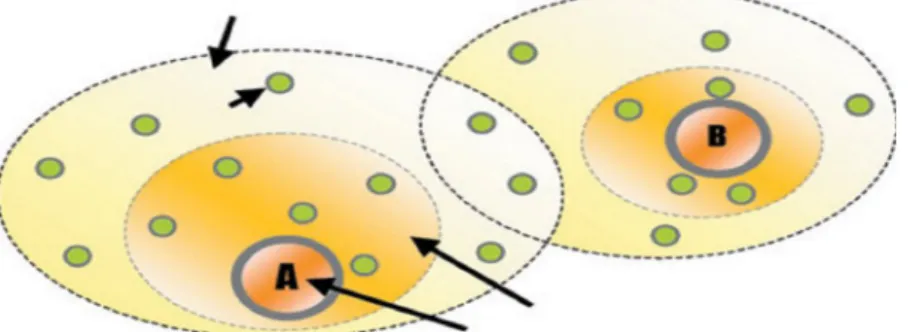
Figure 2.1: Port hinterland concept. Source: United Nations (2005)
Figure 2.1 shows that port hinterlands are composed of two different kinds of hinterlands. The smaller dark orange circles in the figure illustrate the main hinterland, which means the exclusive area where a port has a monopolistic position. The bigger circles show the competition area, where more ports compete for cargo. The green dots represent different cities. This figure can be applied to, for instance, the ports of Rotterdam, the Netherlands and Antwerp, Belgium. The ports of Antwerp and Rotterdam are not that far away from each other, which implies that they both serve an area that the other serves as well. Development of intermodal transportation changes the exclusive hinterland into a shared hinterland, where different ports share the facilities. From then on, the boundary of a hinterland between different ports will depend on the development of intermodal transport passages and no more on the exclusive market area of each port.
So, a seaport’s hinterland is defined as the interior region served by the port. According to van Klink and van den Berg (1998), one simple method to determine the hinterland of a port is to consider transport rates from the port to the interior. Here, those places served by the port cheaper than from other ports, simply belong to the port’s hinterland. However, direct monetary costs are not the only factor which identifies the competitiveness of the port towards a certain inland market, as costs of risk and time should also be considered. These costs are, together with direct monetary costs, included in the concept of generalized transport costs, which help defining a port’s hinterland. Generalized transport costs cover all costs, even external costs, relevant in bridging the distance between two places. As all costs are included in the concept of generalized transport costs, this tool is a good method in defining a port’s hinterland. Since the hinterland potential of a port is dynamic, it may change through changes in technology, economy and society. These factors do have an influence on the generalized transport costs.
9 2.2Different products
Ports handle many different forms of products and it is quite obvious that all those singular goods have other destinations. This implies that the hinterland of a port is different for each of the products which have to be transported. Besides that, goods are transported inbound or outbound, which also influences the shape of the hinterland. The main difference that can be made between the various products is bulk products, such as iron or crude oil and manufactured goods, which are mostly transported in containers. A different way of transportation counts for the transport for cars, cars are mostly transported on large special vessels, trucks and trains and will therefore not further be discussed in this paper.
In order to choose a port for bulk products, according to a report of Atlantic Transnational Network (2006), proximity between the port and the industrial processing is important. There are many refineries located in the port area of Rotterdam, which handle a lot of liquid bulk products. For manufactured goods, the situation is different. Here, the position changes with the unit, which can be either containers or trailer units. The trailer unit may be accompanied (used for shorter distances) or non accompanied for the sea transit. There has been greater focus on major ports with deep sea shipping making only one or two stops; this has changed the structure of the hinterland for many ports and thus for container transportation.
2.3Economic effects of port hinterland
Global ports are often regarded as engines for economic growth. On the other hand, there exists heavy competition between seaports in achieving or maintaining a good position in the market. Here, the quality of hinterland transport has become increasingly important. According to Konings (2007), shipping companies value the attractiveness of a port not only on the performance of the seaport itself, but look at the accessibility of the hinterland too. Since containers are transported in any direction from the port, this holds for the container transport market considerably. As stated before, the ports of Rotterdam and Anwerp share a bit of their hinterlands. This means that both ports are in competition to serve the same areas. This is the case in more regions in Northwest Europe, the port of Hamburg, for instance, is also a major container port which is not located that far away from Rotterdam and Antwerp. Therefore hinterland accessibility has become a strategic matter for seaports. Seaports want to transport the containers as efficient as possible to and from the hinterland, which implies that hinterlands (have to) invest, for instance, in infrastructural development. Konings (2007) stated that, due to the ever-increasing volumes in container transportation, hinterland transport capacity and performance became more important for seaports.
10 Cost reductions in deep-sea container transport pushed the interest of shipping operators to inland operations, because in many cases the hinterland services present the biggest amount of the total transport costs.
Although port competition is intense, ports are not perfect ‘substitutes’, since they are not interchangeable perfectly or without cost (OECD/ITF, 2008). Port hinterlands do overlap, but not completely. This means that gateway ports may still have a strong position in at least some of their service area. Furthermore, containerization may be muted by congestion in ports or in their hinterland transport networks. The competitive position of a port is weakened when a competitors port and hinterland facilities face less congestion. Finally, changing ports is costly for terminal operators, shipping lines or manufacturer-controlled supply chains, which implies that it is quite unimaginable that a port loses his competitive position in a short period of time.
The commercial activity in the port area and the hinterland may have a substantial impact on the employment level in the area.3 The strength of this connection varies between the ports, as there are also other factors of weight, like the nature of a port, either a privatized or public organization. As machines and computers have become more and more essential in transportation, the number of staff employed in ports has decreased significantly. Containers are nowadays handled by large cranes and automatic vehicles. This points out that ports will have a greater impact on employment opportunities done by added value activities related to the port, like warehousing and distribution facilities.
2.4Hinterland of Rotterdam
The port of Rotterdam serves a hinterland of more than 150 million consumers who live within a range of about 500 kilometers from Rotterdam. Furthermore, 500 million consumers all over Europe are served by the port of Rotterdam.4 Its location near the river Rhine and Maas make efficient and economical transport by inland shipping into the center of Europe possible. But also rail and road infrastructure provide companies easy transportation to Germany, Belgium, France and further.
3
Atlantic Transnational Network of Economic and Social Partners (2006), Intermodality in Freight Transport: Ports and Hinterland, Maritime
Transport including short sea shipping, p. 84 – 99.
4
Port of Rotterdam achterland verbindingen
11 The European market can be reached by five modes of transport: short-sea shipping, pipeline, inland shipping, road and rail. Since this paper focuses on container transportation to the hinterland of Rotterdam, only the last three modes and their connections will be presented.
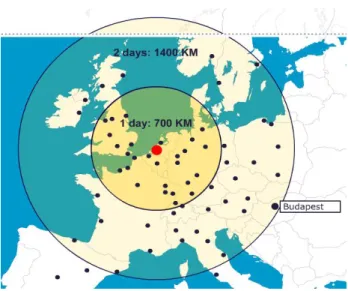
Goods which are transported from the port by road have plenty of possibilities. Figure 2.3 shows that in just two days, goods can be moved from Rotterdam to, for example, Budapest (Hungary), which is a distance covered of about 1400 kilometers.
Figure 2.2: Hinterland connections by road Source: Port of Rotterdam
The situation for rail is almost the same as that of road, that is, the connections into Europe are also very extensive. As shown in figure 2.4, containers arriving in the port of Rotterdam can be transported by rail to every country within Europe.
Figure 2.3: hinterland connections by rail Source: Port of Rotterdam
Lastly, opportunities for inland shipping operations are quite broad defined. As seen in figure 2.4, the same city of Budapest, which can be reached by road or rail as well, is accessible by inland waterways too.
Section 3 of this paper will take a look more closely at the different modes of transport and the reasons for choosing one above another.
Figure 2.4: hinterland connections by inland waterways Source:
12 Besides the connections from the port of Rotterdam to the hinterland, it might be interesting to look at the major industrial areas behind Rotterdam, because that may be a fundamental factor in defining a location for a modal split hub. In figure 2.5, it is seen that there exists a lot of industrial activity in the hinterland of Rotterdam. An area which has a great demand on the port of Rotterdam is the German ‘Ruhr’ area, indicated with a circle in the figure. Here, cities such as Dortmund, Essen, Cologne and Düsseldorf are located. The millions of people who live in this area do have a great demand for products and thus containers are transported to the Ruhr constantly.
Figure 2.5: Major industrial areas Source: Port of Rotterdam
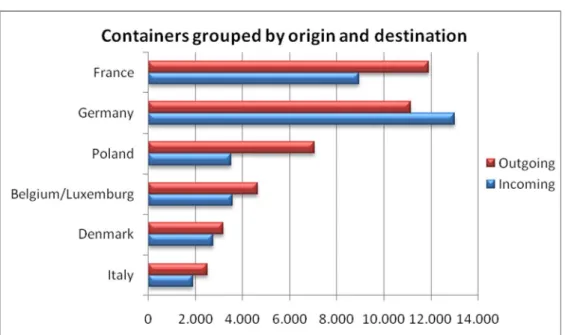
Figure 2.6: number of containers by origin and destination first half year 2008 Source: Port of Rotterdam
The graph in figure 2.6 shows the quantity of containers by origin and destination in the Rotterdam hinterland in the first half year of 2008. Quite obvious is that France and Germany have the largest
13 shares in this figure for both import and export of containers. This information might be useful when trying to define the optimal location for a modal split hub, since France and Germany do not lie in the same direction. Please note that countries such as Spain, Portugal, Greece, Norway and Sweden are not presented in this figure, since lots of containers which are transported to these countries do also make intensive use of short-sea or feeder shipping. Other countries in Europe which have a large share, but can only be served by short-sea shipping are the United Kingdom and Ireland. A figure which contains all countries to which the port of Rotterdam sends and receives containers from would look rather different for these reasons.
14
3.
Intermodal transportation
As seen in the previous chapter, the port of Rotterdam handles a lot of containers, which are transported further to various countries. In the case that the containers have a destination somewhere in the hinterland of Rotterdam, there are roughly three modes of transport available: road, rail and inland shipping. Each of these modes has its own characteristics, which makes it, in order to find the optimal solution to transport a container to its final destination, useful to compare them with each other.
3.1Intermodal transportation defined
Containers have some characteristics which make them preferable above other units of transport. Products transported within containers, for instance, cannot easily be stolen, have reduced labour costs and storage charges are saved.5 Over the last fifty years, containers have become a main unit of transport; which is also called containerization.
Transportation can either be singlemodal or intermodal. Freight is transported singlemodal when a transfer is made between two vehicles of the same mode, like a switch between two trucks. In contrast, intermodal transportation is defined as a person or freight transported over a certain distance with the use of at least two different modes of transport.6 Containers can easily be transported on all different modes of transport. They can, for instance, be transported by sea shipping from Shanghai to Rotterdam, followed by inland shipping to Basel (Switzerland) and by truck to its final destination in Bern. Generally, the switch between the modes is performed at an intermodal terminal, where containers can easily be transshipped. Container terminals will be discussed later on. Intermodal transportation refers to a multimodal chain of container transportation services. The aim of this chain is to create door-to-door delivery of containers, with the use of several modes of transport and their advantages, often provided by different carriers.7 Intermodal transportation has the advantage that it, in general, reduces cargo handling, which improves security, speed and availability and may reduce damages.
Intermodal transport has a long history and the ongoing growth of passenger and freight transport over the last 150 years has given companies and governments intentions to link separate mode systems more effectively. Moreover, the operational integration of sea and inland transport became
5
Lawrence R.J. (1972) Containerization: The new method for intermodal transportation, p. 7.
6
Muller, G. (1989) Intermodal Freight Transportation, p. 2.
7
15 visible through the earlier mentioned containerization and developments in technology. The use of intermodal transportation provided companies to take full advantage of the growing world markets from World War II onwards.8
Due to increasing problems in congestion and environmental considerations, freight transportation is becoming a main concern in logistics9. Partly because of that, governments may have intentions to stimulate intermodal transportation. Since a lot of the containers are transported by road into the hinterland, those trucks cause congestion problems. This is, for instance, the case on the interstate road A15, which is heading from the port of Rotterdam eastwards in the direction of Germany. There are plans to enlarge the interstate in order to give place to the growing amount of traffic.10 However, another way in achieving less traffic on this (and other) roads is to make use of intermodal transportation. If, for example, containers are transported by train to a certain hub and from there on transported by truck, fewer trucks have to make use of the A15 into the port. Less congestion also means less environmental damage that has to be taken care of.
As supply chains are becoming more and more globally oriented, logistics are of a main importance to companies. Supply chain management or business logistics involves managing the entire chain of processes, including raw material supply, manufacture, packaging and distribution to the end-customer11. Logistical costs do contain, for instance, inventory costs, freight handling costs and transportation costs. The last one can have an effect on all the different logistical costs and is therefore very important for companies. Since logistical costs and thus transportation costs are responsible for a very large share of the total costs in many companies, intermodal transportation offers a company the opportunity to deal with transportation costs as efficient as possible.12
3.2Challenges in intermodal transportation
Though intermodal transportation seems to have a lot of advantages, the use of different modes of transport also faces some challenges. According to Barthel and Woxenius (2004), intermodal transportation brings a lot of high fixed costs that, for instance, come along with terminals. Those costs have to be shared with much transshipment in order to be profitable. In their opinion, intermodal transport, with all the handling that comes along, is generally competitive at distances in excess of 500 km.
8
Muller, G. (1989), p. 3.
9
Vannieuwenhuyse, B., Gelders, L., Pintelon, L.. (2003) An online decision support system for transportation mode choice, p. 125 – 133.
10
Rijkswaterstaat http://www.rijkswaterstaat.nl/images/informatieblad%20a15_tcm174-148297.pdf
11
Harrison and van Hoek, logistics management and strategy, p 6
12
16
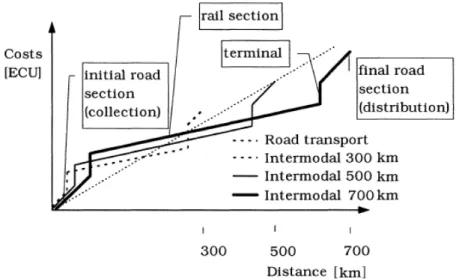
Figure 3.1 continental intermodal rail transport cost structure. Source: Rutten (1998)
In figure 3.1, the horizontal axes shows the distance covered and vertically the costs are presented. In this example long distance (700 km) intermodal transport is to be cheaper than road transport, relatively short (300 km) intermodal transport is more expensive and medium distance (500 km) transport has similar transport costs13. Though this paper is from 1998, distance and costs still are a large challenge when using intermodal transportation. Rutten (1998) argues that cutting train line-haul costs, terminal costs, and road feeder costs may reduce total intermodal costs of the whole transport chain. This supports the work of Barthel and Woxenius mentioned before. Please note that there can be shifts between the different cost lines in the figure, inland shipping may have become cheaper over the last decade, which may slightly change the costs for intermodal transport.
Besides that costs do have a substantial share in importance at intermodal transportation, there are some other difficulties in organizing the exchanges that should be taken into consideration. Here, questions such as “who does the customer deal with to get a rate for delivery across the modes?” and “how are liabilities shared?” should find an answer. According to Brewer, Button and Hensher (2001), there are five organizational challenges for intermodal transportation:
- Liability. Since the good is handled by different modes of transport and often different carriers, it is rather difficult to determine everyone’s liability in the agreement.
- Documentation; which contains the ability to provide shippers to find the location of their consignments at any time, and also the clearance of customs at international borders.
17 - Intermodal intermediaries. Deregulation and privatization over the last two decades have removed various obstacles in the field of intermodal ownership and operations, but there are still challenges.
- Regulatory issues. Which have made a large development over the last two decades; however, there are still many differences between various parts of the world. Equality in regulations is therefore another challenge in the field of intermodal transportation.
- Intermodal futures. Although the container is dominant in intermodal transportation, different units of transport may be attractive, like the use of pallets for small pieces. There are more fields that one has to be aware of in the future of intermodal transportation.
3.3Factors influencing the modal split decision
In many cases of container transport from the port of Rotterdam into its hinterland, a carrier can roughly choose between three modes of transport: road, rail or inland shipping. Each of these modes has its own advantages and disadvantages in, for instance, terms of costs, speed, availability and reliability. A company may face higher costs or provide lower quality of customer service when it fails to identify the most suitable mode of transport, which makes it useful to determine the main factors that influence the choice of transport mode.
A possible point of departure in determining these factors, is converting every single factor in terms of costs. If a company’s aim is to maximize its profit, costs are of main importance. Besides that, a company should be able to determine the size of the impact of transport in the whole distribution system. An analysis of, for instance, the current transport cost can give an insight in this. After that, a transport manager should be capable to identify the significance of the choice of the modal split.14
When a company has defined its aims with respect to its need for transportation and transportation costs, one can have a look at the factors that influence the choice of the transport mode. There have been several researchers who studied this field and there are therefore dissimilarities across them. Probably the most clear and comprehensible classification has been made by Blauwens, De Baere and van de Voorde (2002), since they have created it from an economic point of view. According to them, factors that determine the modal split in freight transportation may be divided into three categories:
18 - Aspects regarding the good. Here, the goods category in particular plays a determining role for the modal choice. Since this paper is focusing on container transportation, the possible modes of transport are already determined. An analysis in Europe has shown that rail transport and inland shipping have a main position in the transport of goods with relatively low value per unit, like ores or solid fuels. So the good that has to be transported plays a very significant role in the modal split decision.
- Characteristics of the trip, with distance as the most considerable factor. Here, one can look at the transport mode which covers the largest distance covered per tonne.
- Characteristics of the transport supply. Under this heading characteristics such as price, reliability and risks are situated.
As seen, the choice of mode depends on several factors, which makes it a complex decision to make. Furthermore, a company should be aware of its expectations and requirements for transportation of its goods. Finally, as transport activity increases, there will be a higher demand for transportation services, which implies rising prices, which probably forces a company to change its mode of transport.
3.4Modal split containers in Rotterdam
As Rotterdam has many possibilities to transport containers further, it may be interesting to see which mode of transport is dominating.
Figure 3.2 modal spilt of containers in Rotterdam, x1000 Source: Port of Rotterdam
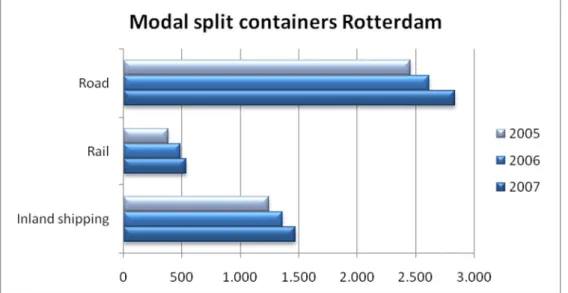
As figure 3.2 shows, all modes are gaining, but road transport has by far the largest amount of containers transported over the years showed.
19
4.
Inland container terminals
In order to provide companies and customers quick and reliable transportation services through the hinterland of a port, one can make use of intermodal transportation. Since intermodal transportation uses various modes of transport, containers have to be transshipped from one mode of transport to another. This process takes place at container terminals. According to Trip and Bontekoning (2002), the competitiveness of intermodal transport could be improved, making it attractive for short distances, if transshipment were faster and less expensive. However, transshipment costs still stay relatively high for short distances.
This chapter will first define the need for inland intermodal container terminals and shows briefly how a container terminal works. Furthermore, some theoretical models will be showed, in order to determine some factors that influence the location for inland container terminals. Moreover, some current inland container terminals will be presented.
4.1Why inland container terminals?
At container terminals, various forms of material handling equipment are used to transship the containers. Containers can be transshipped immediately between different transport modes, but can also be stored for a given period at a container terminal (Vis and Koster 2003).
Figure 4.1: Point-to-point bundling vs. complex bundling of cargo flows.
Source: Trip and Bontekoning (2002)
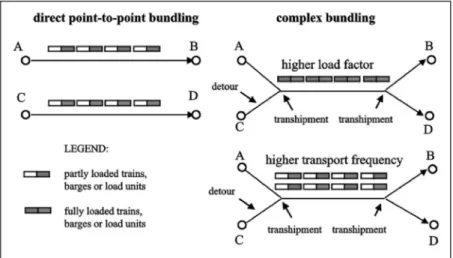
Figure 4.1 tries to compare traditional point-to-point bundling (transportation) with complex bundling. Consider a couple of containers that have to be transported from A to B and some others from C to D (where point A and C could be a seaport and B and D is a final destination). When making use of direct point-to-point bundling, each container is, in this example, transported only by train for
20 the whole trip. Since the containers are just moved by train, it can be possible that the train is not fully loaded at the moment of departure, which makes it relatively expensive to transport. When one makes use of complex bundling, the containers from A and C move from the port to an inland container terminal: the point of transshipment. Here, they are transshipped on the same transport mode (which can be either a train or an inland barge). The advantage is that after the transshipment, as shown in the figure, the train or barge has more change to be fully loaded. Of course it is still possible that trains are not totally loaded, but then they use still more capacity than with point-to-point bundling. According to Trip and Bontekoning (2002), three main advantages can be achieved when using complex bundling:
1) Higher load factor of transport units or load units 2) Higher transport frequency
3) Larger number of destinations from each begin terminal
Here, 1 refers to the reduction of costs, while 2 and 3 focus on improving the quality of intermodal services. However, as can be derived from the figure, complex bundling brings some disadvantages as well. First, additional transshipment costs time and money, since containers have to be handled more often. Furthermore, complex bundling is said to reduce the door-to-door reliability of a transport chain, as more handling gives more space for mistakes. Though, the overall effect of inland intermodal container terminals is likely to be positive, since quality of services, speed and costs can be improved. Later on, some examples of existing container terminals will be given.
4.2Inland container terminals defined
After having mentioned that inland container terminals are of main importance for efficient intermodal transportation of containers, the question ‘how does a container terminal actually work?’ arises. Since there are lots of container ports and terminals all over the world, there exist many differences in, for instance, size or geometrical layout. The main principle of a terminal is, however, roughly the same.
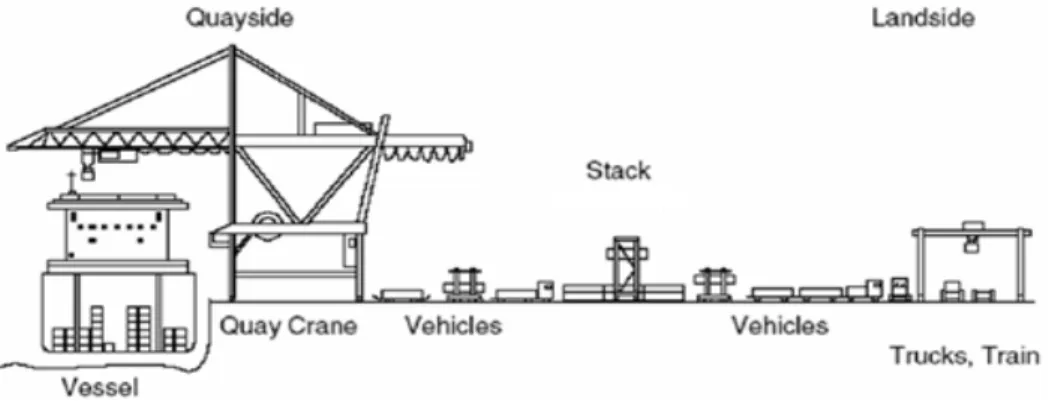
21 In figure 4.2, the unloading and loading process at a typical modern container terminal is showed. As seen, the process can be divided into several smaller activities. When a barge or train arrives at a terminal, the containers are regularly unloaded by large cranes. Take the example of figure 4.2, where containers are unloaded from a ship. A large quay crane unloads the containers and places them on vehicles which transfer them from ship to stack. This stack consists of a number of lanes, where containers can be stored for a certain period. After this period, which differs across containers, they can be moved another mode of transport, like trucks or trains. The whole process can also be executed in reverse order (Vis and Koster 2003).
There are several major differences between sea- and inland container terminals. Firstly, they differ in size. Sea container terminals are created to provide easy access and facilities to large container vessels, which requires more storage space and deep waterways. Furthermore, inland container terminals are usually smaller in terms of hectare used. As sea terminals are constructed as part of the already existing harbor, inland terminals are, in contrast, mostly created themselves. This means that the terminal needs to fit some requirements, such as good intermodal and infrastructural facilities. Moreover, the aim of a seaport terminal is to load and unload the vessels as quickly as possible. Inland terminals focus on the whole intermodal transport chain, in order to improve door-to-door transportation of the containers. Lastly, inland container terminals could not function without the existence of a seaport terminal. Inland terminals add value to the presence of the sea terminal. This implies that the seaport terminal functions as a main hub, whereas the inland terminals function as the additional stations in the network. Table 4.1 presents an overview of the main differences between sea- and inland container terminals.
Sea container terminal Inland container terminal Size Big --> provide facilities for deep sea
vessels and all other forms of transport
Medium/small --> provide facilities for inland barges, rail and road transport Ships Large sea vessels Medium/small sized inland barges Aim To function as an international hub To add value to the intermodal transport
chain and support the sea terminal
Table 4.1: Differences between sea- and inland container terminals
So far the differences between seaport- and inland container terminals should be clear. It is also interesting to have a look at the main operations and services provided by inland container terminals. According to Rijsenbrij and van Leeuwen (1986), the major services provided are rougly:
- Handling of containers from barges and/or rail wagons to storage area - Intermediate storage between the various transport modes
22 - Consolidation and distribution, if the container cannot be received or delivered directly at the
final consignee’s door
- Depot functions, basically the storage of empty containers
- Maintenance and repair services, not only containers, but also for handling equipment. Although the paper is from 1986, it was written through the initiative of ECT, a major container transshipment operator in the port of Rotterdam. This implies that they based the report on many empirical findings, which are still very significant. Therefore, this report is included in this paper.
4.3Determining intermodal transport terminal locations
Earlier on, chapter three stated that intermodal transportation can help reducing negative externalities of transportation, such as congestion and environmental damage. As seen in the previous sections, modal split hubs are quite necessary when one wants to achieve good performing intermodal transportation facilities. These terminals can provide economies of scale in transportation from a port into its hinterland and final destination, and vice versa. It is though, not easy to determine the optimal location for such a modal split hub, since a lot of factors and parties are involved in the decision making process, like land prices, local governments and inhabitants. Besides, huge investments come along with the development and creation of an intermodal terminal, which makes a careful evaluation of the alternatives and methods of main importance.
4.3.1 Models to define optimal terminal locations
Finding this optimal location starts often with developing or using an econometric model, in which several factors that have an influence can be incorporated. That is, however, not always sufficient since environmental, political and social considerations also have an influence on the final decision, and are hard to convert into numerical values. There has been much research in the field of optimal terminal location, but most of them are for a specific country or region, which does not make them broadly exchangeable. Still, as an econometric model usually works with dependent and independent variables, which together give an outcome, it is interesting to have a look at some models and see which variables the researchers chose.
Bergqvist and Tornberg (2008) created a model in order to determine possible optimal locations for an intermodal transport terminal in Sweden. Their aim was to develop a geographical approach for evaluating locations for intermodal terminals on the basis of economic, environmental and quality considerations with support of GIS (Geographical Information System)15. The model makes roughly
15
23 use of two types of input data, which are material flow and data related to infrastructure. Material flow is included, since the size of this flow determines how much goods will be transported and to which destination. Besides, the size of these flows makes it possible to combine different terminals. They did not include time as a variable, since there are different implications of time (i.e. shortest route, cheapest route or fastest route). After having defined some limits and implications of the idea, they have created a model. They divided the region in which the terminal should come into various different cells of 600 x 600 meters; so that a terminal could easily fit in. Dependent variables were distance and environmental impact. The last one is divided into emissions and noise, where emissions are supposed to be almost linear to transport distances and time and noise is an environmental impact which is measured in scope rather than scale. Besides, each of the location alternatives can be evaluated on the basis of total throughput-time for the transportation system. Bergqvist and Tornberg tried to create a model for determining hub locations. The most important factors that have an influence on the decision are costs, environmental impact and quality, with which they could find out the best location.
Rutten (1998) also studied the design of a terminal network for intermodal transport. Rutten was interested in extending the number of intermodal terminals in the Netherlands. His aim was to find out to which number the terminals could increase, without causing an uncompetitive level of total intermodal transport costs. The paper does not create a framework for determining the optimal location of a terminal, but it may present some other useful considerations. The outcome of the study consists of 7 main points, from which the following are of interest for this paper:
- The number of terminals to be built in the Netherlands depends on a number of factors: the target modal-shift from road to intermodal rail transport, the minimum economic length of trains used, the competitiveness of inland shipping and the political decision on whether to internalize external and infrastructure costs, partly or wholly, for each transport mode. - As, in theory, potential intermodal traffic is spread across the entire Netherlands; a dense
terminal network will be required to capture a large share of this traffic.
- The denser the terminal network, the shorter the trains will have to be in order to guarantee a daily service connection.
Another interesting study is the one of Limbourg and Jourquin (2008). The aim of their paper is to determine the optimal locations of European transfer terminals, embedded in a hub-and-spoke network. The paper deals with transport terminals in a hub-and-spoke network used by rail-road
24 transport.16 The point of departure is that intermodal transportation can reduce transportation costs, though it has to be efficient, which means finding optimal locations for the terminals. They refer to this problem as the ‘p-hub median’ problem. They mention also that decisions about new terminals are often taken at national or regional level, but should probably be made at a more global level. It is then more likely that global efficiency of the intermodal transport system increases. The study starts with defining the problem and achieving the needed inputs, where after the model is implemented in GIS. After that, they come up with a set of some good possible locations for terminals in Europe (figure 4.5).
Figure 4.5: possible terminal locations in Europe. Source: Limbourg and Jourquin (2008)
As seen in the figure, it is quite obvious that there should be a container terminal somewhere in the (close) hinterland of Rotterdam. The paper can be used as an optimization tool for policy makers, in order to develop an idea about an international hub-and-spoke network, which interfaces road and rail transport. The information gathered from this paper is too broad defined, but gives a point of departure in finding the optimal terminal location.
A study done by Sirikijpanichkul, Van Dam et al. (2007) aims at developing an agent based model for the evaluation of road-rail intermodal freight hub location decisions. In the paper, they distinguish between four agents that have an influence on the location decision: hub owners or operators, transport network infrastructure providers, hub users, and communities. They claim that the location
16
25 of hubs is one of the most crucial success factors, but it needs to be judged really careful, as it has impacts on many different stakeholders. The aim of the study is to develop an agent base model in order to evaluate road-rail intermodal terminal location choices. The model includes the four earlier mentioned agents. According to the paper, factors that influence hub location decisions can be either direct or indirect. Examples of direct supply factors are access to ports, airports or inland container depots. Direct demand factors can be proximity to industries or markets. Indirect factors of influence are the local environment and traffic and economic impacts. It is quite obvious that each agent is in favor of other factors. After having defined the agents and the factors of influence, the paper presents agent based modeling (ABM). They develop a model of the system by describing it in terms of agents and possible relationships between agents. By modeling components rather than the entire system, the structure of the system is not pre-defined. An ABM is very suitable for a bottom-up modeling approach, which is a system modeled by making models of small parts of the system. In the end, the system performance emerges from the behavior of the components of the model and their interactions.17 The paper showed how an ABM approach can be useful in decision making processes in which many actors are involved. Traditional optimization methods and transport models can be mixed with agent based models, in order to develop an adaptable model of the decision making involved in choosing a location for a new intermodal transport terminal. Though this paper did not outline the mathematical expressions, it should give an overview of the approach.
4.3.2 Current inland container terminals
So far, the previous sections addressed the need and use of container terminals. The paper focuses on intermodal container terminals, which are located at logical, profitable and useful places, where many companies are located and where intermodal transport facilities are provided. Up to now, that terminal does not really exist in the Netherlands. However, there are some private companies that have their own facilities. Furthermore, some cities (as well as in the Netherlands as abroad) have good inner port provisions.
ECT
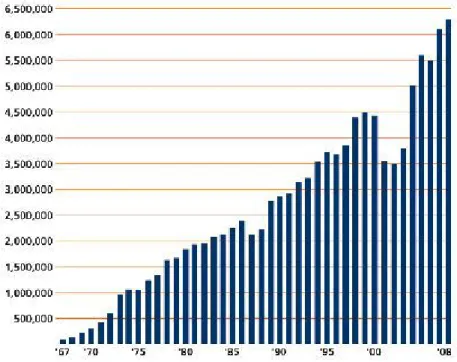
ECT (Europe Container Terminals) is a company which owns several container terminals in the port of Rotterdam. ECT opened its first terminal in 1967 in the ‘Eemhaven’ and expanded over the years. Nowadays they have three different terminals in Rotterdam which focus the whole year through on fast and reliable discharging and loading of containers. In figure 4.6, the growth of container handling
17 Sirikijpanichkul, A., Dam van, K.H., Ferreira, L., Lukszo, Z. (2007) Optimizing the location of intermodal freight hubs: An overview of the
26 at ECT terminals since the beginning is presented. Please note that the total volume of container handled in the port of Rotterdam in the year 2008 was about 10.500.000 TEUs, as ECT handles just under 6.500.000 TEUs, ECT is the major player in Rotterdam.
Figure 4.6: Development of volume (TEU) at the ECT terminals Source: ECT
Due to the ongoing increase in number of containers that have to be transported to any destination in Europe, ECT makes use of various inland terminals from which the majority have direct connections with the ECT-terminals in Rotterdam. Besides, ECT considered it necessary to create its own network of inland intermodal terminals for the efficient handling of (especially) trains and barges. ECT itself operates three inland terminals, which will now be discussed.
Trimodal Container Terminal (TCT) Venlo
TCT Venlo is located in the inner port of Venlo, close to the German border in the south-east of the Netherlands. Most important for this paper about this terminal are the connections from and to Rotterdam. There are three shuttle trains each workday to Rotterdam Maasvlakte and three shuttle trains a week to Rotterdam Waalhaven/Eemhaven. ECT is now working on an inland barge terminal at Venlo, which has to be realized in the second half of 2009. Then, inland barges can also be linked to Rotterdam and Antwerp. These connections bring the sea terminal of Rotterdam very quickly closer into the hinterland. From Venlo, the German Ruhr area is easy reachable, as Dusseldorf is only 55 kilometers away and Cologne 90 kilometers.
27 Trimodal Container Terminal (TCT) Belgium
ECT created another terminal in the Willebroek area in Belgium, just between Antwerp and Brussels. The terminal is connected by inland barges to Antwerp (three inland barge shuttles each workday), Zeebrugge (regular connections) and Rotterdam (one inland barge shuttle each workday). Furthermore, good connections to the motorways provide companies to transport containers quickly further into the hinterland.
DECETE Duisburg
The third terminal of ECT lies in the inner port of Duisburg (Germany) in the Ruhr area. A couple of years ago, the ECT Duisburg terminal and Duisburger Container-Terminalgeschell-schaft (DECETE) merged into DECETE Duisburg. The location of Duisburg is quite ideal for intermodal transport in the direction of Eastern and South-Eastern Europe. Due to the participation of DB (German Railways) Cargo, lots of rail connections within and outside Germany are easily accessible18. DECETE Duisburg provides inland barge shuttles to Rotterdam and Antwerp. Morover, rail shuttles also connect Rotterdam, Antwerp and Zeebrugge with Duisburg 4 to 6 times a week.
In a report of ECT (1986), Rijsenbrij and van Leeuwen give their view on factors that manipulate the location decision of an inland terminal. Although the report is quite old, the factors of influence may still be important in determining a good location for a terminal. This is proved by the fact that some of them are similar with some factors that came out of the econometric models presented earlier.
- Proximity of substantial industrial areas. Availability of substantial industrial areas will result in trade and industrial activities. In some cases, transportation can either make use of inbound as outbound cargo flows, when there are companies that produce finished products as well.
- Population characteristics of the area. It is quite obvious that the size and composition of the population determines the need for transport and the balance between inbound and outbound cargo flows.
- Infrastructural feasibilities. Inland intermodal terminals need good infrastructure available, which provides the terminals to offer a total package of activities for handling and controlling the container flows. Therefore, roads, waterways and rail connections are of major importance for a strategic terminal location.
- Technical conditions. This means investments in machinery, electricity (for railways), maintenance centers and storage areas.
28 - Social environment. Under which geography, politics and future expectations are classified. - Government regulations and investment policies.
Inner port of Duisburg
ECT is a major player in transportation of container terminals in the Netherlands, but there are also other ways to make efficient use of intermodal transportation, namely through inner ports. In the Netherlands, there are a few cities that have a significant inner port, like Nijmegen, Venlo and Dordrecht. Containers can easily be transported by inland barges from the port of Rotterdam to those inner ports, where they can be transshipped on rail or road transport facilities. However, these ports are initially not created to function as an efficient inland intermodal transport terminal.
Probably the inner port that comes very close to this ideal terminal is the inner port of Duisburg in Germany. The city of Duisburg is the largest commercial and transportation hub in the Rhine/Rhur region, where over 30 million people live and work. Many companies operate in this region and together with the presence of waterways, railways, highway and airway links, Duisburg seems to be a good location for transportation activities. Duisburg is connected with the Rhine river, which makes a lot of cities easy accessible. Furthermore, Rotterdam, Amsterdam and Antwerp are connected by inland waterways. Moreover, Duisburg has good railway facilities due to the German Railways. Daily shuttle trains to Antwerp and Rotterdam provide quick transportation services. Besides, shuttle trains to any direction within Germany and further, towards, for instance, Czech, Poland, Denmark and Hungary, offer many opportunities. Finally, many motorways give rise to trucks that (mostly) distribute containers to their final destination.
The inner port of Duisburg and the terminals of ECT provide good intermodal transportation facilities. But still, ECT is a private company and is not accessible for every company and the terminal(s) in Duisburg may probably be too far away from the port of Rotterdam. Besides, the Duisburg terminal focuses on Germany and countries in the East or North of the Netherlands, which makes it not the perfect solution for containers arriving in the port of Rotterdam. Finally, the inner port of Duisburg does not focus only on the port of Rotterdam, which makes Rotterdam dependent of Duisburg, instead of vice versa.
29
5.
The optimal location for an inland container terminal
The previous chapter came up with the need for inland container terminals when using intermodal transportation. Some models and current terminals were presented. This information, together with an economic perspective towards intermodal transportation, should give opportunities in defining the optimal distance to the port of Rotterdam for an inland container terminal.
Before one can determine this optimal distance, the factors that influence the location decision have to be identified. Below, six important factors that influence the optimal location will be determined. These six factors will thereafter be applied to the two case studies of Valburg and Alblasserdam. Each case will be presented, and the two projects will be compared through using the six factors of influence.
5.1Factors influencing the optimal location for an inland container terminal
Infrastructural facilities around an inland terminal need to be broadly available. Which means, short distances to major rail tracks, motorways and waterways. Sometimes, additional rail tracks can easily be constructed in order to connect the terminal with existing rail tracks. Motorways provide easy access for trucks to load and unload containers, without having many troubles due to congestion. Finally, waterways offer inland barges to get to the terminal, where cranes can load and unload the vessels.
Characteristics of the surrounding area are also an essential factor of influence. Here, proximity of industrial areas and population characteristics are incorporated. Industrial activity will lead to gains in terms of trade and transportation, which positively influence the terminal in terms of inbound and outbound cargo flows. The amount of inhabitants in the region also affects the quantity of transport flows needed in the area and is thus a main characteristic to consider. In finding a potential location, one also needs to look where the closest existing terminal or inner port is located, in order to avoid competition.
Since this paper focuses on the location for an inland container terminal connected to the port of Rotterdam, the throughput in this port is also of main importance. As seen in figure 2.6, containers arriving in Rotterdam which have to be transported into the hinterland, are mainly shipped to Germany/Poland and Belgium/France. This makes the location of an inland terminal even more
30 difficult, as the location should be able to serve both directions, but is it possible to find this optimal location?
As all operations at a container terminal cause a lot of noise and pollution for the region, another important feature is environmental impact. Selecting a terminal location requires knowledge about the region in which it might be located. Noise and pollution effects for the inhabitants of the region should be minimized in order to sustain a certain quality of living. So on the one hand, many inhabitants in a region, like in the Ruhr-area in Germany, give rise to much demand in terms of transportation, but on the other, also face the negative externalities of a close terminal. The optimal location finds the best of both. One should also take into account the amount of nature in the region and if it is worth to offer land for such a large project as a container terminal.
A potential location for an inland container terminal has to be profitable in terms of costs; otherwise it does not add value to the intermodal transport chain. There are different aspects that manipulate the costs of a terminal. First, the costs of investment have to be considered, where after one can predict whether or not the return on investment will be sufficient. Costs of investment are connected to the availability of land, which influences the price of land. Transportation itself can also change costs. One has to consider carefully, for instance, how many barge or train shuttles will be used per day, in order to provide optimal service. This is of course connected to the location of the terminal, close to the port means, for example, many small trains, while further away might mean less trains with more capacity.
The last factor of influence mentioned in this paper is that of social environment and government regulations. One needs to consider the political objectives in a specific region. Social environment also contains the institutions with large impact, such as local authorities and pressure groups. Besides, one should be aware of government regulations in the region and nationally.
As there are many different stakeholders involved in determining the optimal location for a modal split hub, each of them is in favour of other factors, which makes it even more difficult. However, if one carefully takes into account the six factors mentioned above and summarized below, it should be possible to find the optimal location for an inland container terminal.
- Infrastructural facilities
- Characteristics of the surrounding area
31 - Environmental impact
- Costs
- Social environment and government regulations.
5.2Case studies
Over the past decade there have been some plans for developing an inland container terminal in the Netherlands. Most concrete plans were made for Valburg, located between Arnhem and Nijmegen, and Alblasserdam, located just in the south-east of Rotterdam. In this paragraph these two cases will be outlined, where after the six identified factors of influence will be applied to both, in order to compare the two projects.
Case study: Multimodal Transport Centrum Valburg
The plans for this terminal originated in the end of the 1990’s. MTC Valburg was a project done by the ministry of transport, the district of Gelderland and Intersection Arnhem Nijmegen (KAN), a corporation which consisted of 25 municipalities out of the region.
The location of Valburg was selected due to several advantages. First, Valburg is located in between of the rivers Rhine and Waal, which makes inland barges easy accessible. Furthermore, the motorways A50, A12, A15 and A73 are quite close. Finally, the plans for the Betuweroute were already made at that time, and this special cargo railway from Rotterdam to the Ruhr-area in Germany would come right next to Valburg, almost parallel to the highway A15. Advantages of the Betuweroute were reducing the conflict between demands for passenger and freight transport capacity on the railway network. The intention is to transport as much cargo, with the direction Germany and further, via this new railway. It would not be smart not to make use of this new railway connection, since it drives through the region for sure19. Valburg is located about 130 kilometers from the port of Rotterdam.
19
32
Figure 4.7: Valburg, between highways and rivers Source: Google maps
Besides, during that time, the unemployment rate in the KAN-region was quite high; and a large intermodal transport terminal would help reducing this. According to Trip and Bontekoning (2002), MTC Valburg would also achieve a better connection with the rest of the Netherlands. Cargo coming from and going to, for instance, Groningen (upper Netherlands), could easier be transported to Valburg and join the train to Germany or Rotterdam. Aditionally, the market share of intermodal transport to and from the Netherlands could easily expand due to the terminal.
Of course there were already plans about what functions the terminal should fulfill. MTC Valburg would exist out of seven different infrastructural parts that were at least partially connected:
1) Business areas next to rail or waterway 2) Rail-service center
3) Inland barge service center 4) Inner port Valburg
5) Intern track
6) Electronic data transmission terminal; in order to provide consignors to trace their freight at any moment
7) Provision of road services20.
From an economic point of view, MTC Valburg would have delivered a change in cargo flows in the Netherlands, as Valburg would have been an extra competitor for other inland ports. Besides, cargo
20
33 from the port of Rotterdam could be transported to Valburg and distributed further from there on. There should also have existed spatial effects along with MTC Valburg. Creating a hub would be positive for, for instance, the port of Rotterdam, where the demand for land is high, which forces the price. As there is, in comparison with the west, space enough in the eastern part of the Netherlands, economic activity can move to Valburg, which gives Rotterdam the opportunity to focus more on the development of its core activities.21
Although the plans for MTC Valburg seem to be pretty good, the project has been cancelled because of various reasons. First, there is the disadvantage of environmental damage. Since the terminal should take in place about 400 ha, all the activities would cause much noise and pollution. Due to the large amount of land needed, nature and cultural value would disappear. Besides, traffic would grow in the region. A contra argument from economic point of view is that the inner port and its terminals of Duisburg are not that far away. MTC Valburg had to compete with Duisburg, but many containers that will be transported to Valburg will thereafter be transported in the direction of Duisburg, so is Valburg needed? Finally in August 2002, the Council of State refused further development of the project. Main arguments were that the plans for MTC Valburg may be too ambitious and some things were be inconsiderate. It was not obvious if all the parts of MTC Valburg could actually be realized later on. Besides, the project would have cost a lot of money and should require a large spatial impact on the region.22 These high costs would not be enough to compensate the small benefits for the environment, transport costs and efficiency.23
It seems to be that the project MTC Valburg fits the intermodal container terminal as defined in this paper. It contained facilities for inland barges, rail and road transport. The idea was to transport containers as quickly as possible out of the port of Rotterdam, so that this could focus on its core businesses. On the other hand, one could, apart from the costs and negative effects on the environment and nature, hesitate about the location of Valburg, since it is close to Germany and thus Duisburg. Containers that have to be transported to Belgium and beyond, cannot make use of the MTC Valburg facilities, so will it be profitable in the end? Furthermore, the plans for the terminal might have been too large and ambitious to realize.
21
TNO report (2001), p. 19 – 30.
22
Raad van State (2002) hhttp://www.raadvanstate.nl/pers/persberichten/persbericht/?pressmessage_id=12
23
34 Case study: Container Terminal Alblasserdam
A couple of years ago, after MTC Valburg had been cancelled, the port of Rotterdam Authority came up with other ideas for an inland container terminal. Unlike with the MTC Valburg project, where the initiative was mainly from local governments, it was the port of Rotterdam Authority who came up with new plans. The company focused on the location of Alblasserdam, which is located just in the south-east of Rotterdam, next to motorway A15 and river Rhine and Waal, as shown in figure 4.8. Alblasserdam is located just 40 kilometers from the port of Rotterdam.
Figure 4.8: Location of container terminal Alblasserdam Source: Google maps
The major argument for the location of Alblasserdam is that inland barge shuttles to and from the port of Rotterdam will decrease the number of trucks used on the motorways in the region, especially the A15. Containers can be transshipped at Alblasserdam from those inland barges to road or rail transport. The expectation is that the port of Rotterdam will grow over the next decades and with the coming Maasvlakte 2, container terminal Alblasserdam helps the port of Rotterdam in staying competitive in terms of accessibility and infrastructural development. Since it is allowed to locate companies that produce heavy environmental damage on reclaimed land, this was also a reason to choose Alblasserdam24. Another advantage is the easy access by inland barge from Germany. German ships can drop their containers at Alblasserdam, from where they can be transported to the port by inland barge shuttles25. The port of Rotterdam Authority notes explicitly that a container terminal in Alblasserdam is not an alternative for the existing inner port terminals in
24
(2009) “Containerterminal stuit op provincie”. AD Rotterdams Dagblad, May 12.
25