Data Augmentation Using Generative Adversarial
Techniques for Emotion Classification
著者
Zhang Zheng
出版者
法政大学大学院情報科学研究科
journal or
publication title
法政大学大学院紀要. 情報科学研究科編
volume
14
page range
1-6
year
2019-03-31
URL
http://doi.org/10.15002/00021921
Data Augmentation Using Generative Adversarial
Techniques for Emotion Classification
Zhang Zheng
Graduate School of Computer Information Science Hosei University
Tokyo 184-8584, Japan [email protected]
Abstract—In classification of a small number of labeled ex-amples with multiple labels, it is hard to get high accuracy in convolutional neural network if the category distribution is imbalanced. Especially for facial emotional expressions dataset, some kinds of facial emotional expression data are often lacking, however, neutral facial emotional expression data are abundant. Data augmentation is an effective way to improve generalization ability of models and greatly enrich the data distribution of samples. Many famous generative adversarial models such as Pix2Pix can implement the task of data augmentation. Pix2Pix solves the problem of image generation from one domain to another domain successfully. However, for some special dataset, such as facial emotional expression dataset, only one category of data is relatively easy to obtain, while other categories of data are relatively smaller. In this case, multi-domain model StarGAN can perform well over the time.
In this paper, we propose a data augmentation approach using generative adversarial technique StarGAN. We generate other seven categories of augmented data using neutral facial emotional expressions in StarGAN model. In two scenarios, where only one category are relatively lacking in eight categories including neutral facial emotional expression and the number of other seven categories are relatively smaller than neutral emotional expression, the results are evaluated using VGG-16 model. Compared with some conventional methods such as rotation and crop, the accuracy of emotional expression classification is enhanced using data augmentation of StarGAN method in both two situations. We confirm that data augmentation using generative adversarial techniques are more effective than other conventional approaches.
Keywords—data augmentation; StarGAN; facial emotional ex-pression
I. INTRODUCTION
A. Background
Facial emotional expression recognition is an important task for machine to understand the emotional changes in human beings. Recognition and analysis of facial expressions can help us understand human inner activities and emotional changes. Facial expression recognition has attracted wide attention because there are varies of potential applications in human-abnormal behavior detection, autonomous driving, health management, computer interfaces, and other similar tasks.
Supervisor: Prof. Kaoru Uchida
Basic facial emotional expressions that current techniques focus on include happiness, sadness, disgust, anger, surprise, fear, neutral and contempt. As we know, neutral facial expres-sions are easy to collect. However, it is so hard to get vast some kinds of facial emotional expressions. One of the major challenges in facial expression recognition domain is how to deal with the small datasets and limited number of annotated samples, especially when we employ supervised machine learning algorithms that need labeled data and more training examples. Collecting facial expression data is a complex and expensive procedure that requires professional photographic equipment and the collaboration of many volunteers.
With continuous development of deep learning, the structure of neural networks becomes more and more complex and the number of layers in the model is increasing [1]. Such neural network models have much larger capacity that require more training data. Imbalanced data even cause the problem that some neural networks are not easy to train.
This is a common problem both in machine learning and computer vision. An effective method of synthesizing images to supplement training set is helpful to enhance the accuracy of image classification. In image classification, it is considered a feasible way to enlarge training set by data augmentation in various researches. The performance of classifiers can be enhanced because the problem of insufficient data and imbalanced label distribution can be worked out by data augmentation. It can also improve generalization of models and greatly enrich the distribution of data.
B. Research purpose
A convolutional neural network can also roughly classify objects even if it is placed in various directions which are called invariance. More specifically, a CNN can be invariant to translation, size, viewpoint or illumination (Or combining the above).
This is essentially the premise of data augmentation. In real-world scenario, maybe we would obtain image datasets taken in limited conditions. However, our target applications may exist in different conditions, such as different orienta-tion, scale, brightness, locaorienta-tion, etc. We add some additional modified data to train our neural network for explaining these situations. Some conventional methods such as rotation, crop
and Gaussian noise can finish the task of data augmentation and increase the distribution of data.
However, these conventional methods can only finish the task of an image-level transformation at depth and scale and in fact, it is not conductive to distinguish the specific boundary between data manifolds. Such data augmentation does not improve data distribution determined by higher-level features. If there exists a big difference between the number of relatively small categories and the number of other categories, the effect of conventional methods such as crop and rotation is very limited.
In recent years, Generative Adversarial Networks have been extensively studied. Generative Adversarial Networks (GAN) which is an effective method to synthesize the vivid images according to training a generator, was first developed by Goodfellow et al. in 2014 [2]. The framework of GAN carries out an adversarial game with two players, a discriminator and a generator. The discriminator tries to distinguish the samples whether are from the generator or from the training data. Besides, the generator learns to the distribution of real samples and output samples and tries to confuse the discriminator as soon as possible.
Choi et al. [4] propose StarGAN, a unique adversarial network that can use only a single model to implement the target of image-to-image translations for multiple domains. A unified model architecture of StarGAN allows multiple data sets with different domains to be trained in a single network simultaneously. Compared to existing models, this leads to StarGAN’s excellent quality of translated images compared to existing models as well as the ability to flexibly translate an input image into any desired target domain. The validity of this approach is demonstrated on a facial expression synthesis tasks.
In our research, we propose a data augmentation approach using StarGAN aiming at facial expression classification. Data augmentation using StarGAN can improve the data manifold and solve the problem of imbalanced data. We compare our method with other conventional data augmentation methods.
C. Structure arrangement
The remain of this thesis is organized as follows: section II introduces some of the techniques that are related to our research and review the relevant research. In section III, we propose our approach of data augmentation using StarGAN. In section IV, we show our evaluation results using VGG16 classifier. In section V, we draw a conclusion and give the work we need to finish in the future.
II. RELATEDWORK
A. Generative Adversarial Networks(GANs)
Generative adversarial networks(GANs) [2] is a network which consists of two parts: a generative model G that synthesizes the fake image as lifelike as the original ones, and a discriminative model D that distinguish whether a sample came from the real original image or from the generator. The discriminator model tries to learn to the data distribution
of real data and judge whether the data is real or fake. A generative model tries to produce fake image that cannot be detected by the discriminator as soon as possible, while the discriminator model tries to implement detection of the counterfeit image. The target of this network corresponds to minimax target function including G and D. GANs show remarkable performance in different computer vision tasks such as image generation, image translation and facial image synthesis [3].
min
G maxD V(D, G) =Ex∼pdata(x)[logD(x)]+ Ez∼pz(z)[log(1−D(G(z)))]
(1)
B. Emotion Classification with Data Augmentation Using Cy-cleGAN
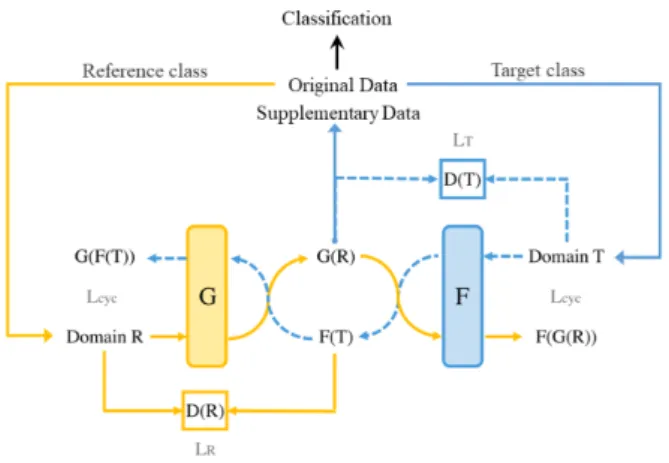
A framework, which uses a CNN model as the classifier and a cycle-consistent adversarial networks(CycleGAN) [12] as the generator, is designed by Xinyue Zhu et al. [5]. They validate the performance of CycleGAN using several benchmark datasets.
Fig. 1. The process of data augmentation using StarGAN and classification using a CNN classifier. [5]
However, Xinyue Zhu et al. [5] only use CycleGAN to generated augmented data. If more than one categories of data are missing or lacking, CycleGAN can only generate data from one domain to another domain and it will spend a lot time on training generative adversarial models. When we try to transfer and generate images from one of categories which are too small, CycleGAN can not perform well because of scarce train samples. Besides, they do not compare their method with other many conventional approaches.
C. Data Augmentation
In the field of image classification with deep learning, the scale and diversity of training data play an important role in the result of classification. Using data augmentation is an effective way to enlarge the training set. According to data augmentation, the problem of overfitting can be avoided as soon as possible. For most existing methods of data augmen-tation, there exists two major kinds of methods:
(a) geometric transformation: This is a kind of relatively general way and we can get more samples without too much computation. In this group, data augmentation approaches always focus on generating image data through maintaining linear transformations (rotation, scaling, translation, horizontal shearing) such as Affine [11], elastic deformations, RGB chan-nels intensities alteration and patches extraction. If we consider about these methods in depth, they just do the transformation on image level through depth and scale and in fact it is not conducive to the division of specific difference between data manifolds. Such data augmentation does not enhance data distribution coming from higher dimension abstract features. (b) methods of generating synthetic samples given corre-sponding labels [8] according to guided augmentation. There are more proposed complex manually-specified augmentation schemes. For examples, [7] proposed a method to learn multivariate normal distribution of each category in the entire mean manifold. In [8], the approach of data augmentation with guided attribute in feature space is proposed. The target of our method is solving similar task, but it is quite distinguishable with all these methods above. In our research, StarGAN learns high dimension features of original images and synthesizes augmented samples.
D. VGG16
K. Simonyan and A. Zisserman from the University of Ox-ford [9] proposed VGG that is a convolutional neural network model. In ImageNet, a dataset of over 14 million images including 1000 classes, top-5 test accuracy reached 92.7% using this model. VGG networks use very tiny convolutional cores(3 × 3) in the architecture of this model to evaluate networks of increasing depth, which displays that an important improvement in the configuration of the existing technnology can be achieved by pushing the depth to 16 to 19 weight layers. In our experiment, we use the pre-trained weights of ImageNet.
III. DATAAUGMENTATIONUSINGSTARGAN StarGAN is a framework for solving the problem of multi-domain image-to-image translation in a single dataset [8]. This unified model architecture of StarGAN allows multiple datasets with different domains to be trained within a single network simultaneously. Compared with existing models, Star-GAN can bring good quality of translated images compared to existing models as well as flexible ability to translate an input image into any target domain you desire. The effectiveness of their method is proved for the task of transferring facial attribute and synthesizing facial expressions.
Existing models are both inefficient and ineffective in such multi-domain image translation tasks. In order to learn all pairs mappings between all two domains,k(k−1)generators need to be trained. For one-to-one transfer models, the training effect is limited, because one domain transformation alone training can not make full use of data of other domains to increase generalization ability.
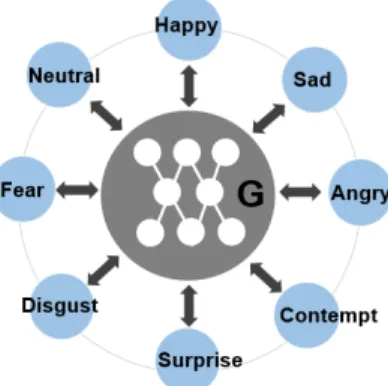
Fig. 2. StarGAN is capable of learning mappings among multiple domains using a single generator. The figure represents a star topology connecting multi-domains.
StarGAN is a generative adversarial network capable of learning mapping among multiple domains. This model takes in training data of multiple domains using only one generator. Instead of learning a fixed translation, the model takes in as inputs both image and domain information, and learns to flexibly translate the input image into the corresponding domain. A label is used to represent domain information. During training phase, A target domain label is generated randomly and the model is trained to flexibly translate an input image into the target domain. In this way, we can control the domain label and translate the image into any desired domain at testing phase.
Ladv=Ex[logDsrc(x)]+
Ex,c[log(1−Dsrc(G(x, c))]
(2) The target of StarGAN is to train a single generator G that learns mappings among multiple domains. To achieve this, we train G to translate an input image x into an output image
y conditioned on the target domain labelc, G(x;c)→y. We randomly generate the target domain label c so thatGlearns to flexibly translate the input image. We also introduce an auxiliary classifier [13] that allows a single discriminator to control multiple domains. That is, our discriminator produces probability distributions over both sources and domain labels,
D:x→ {Dsrc(x);Dcls(x)}.
The objective functions to optimize G and D as follows:
LD=−Ladv+λclsLrcls (3) LG =Ladv+λclsLfcls+λrecLrec (4) In this equation,Lrec means reconstruction loss, which is a cycle consistency loss [14]. Ladv is adversarial loss, making it difficult to distinguish between the generated images and the real images.Lfcls defines the loss function for the domain classification of fake images.
We construct an imbalanced facial emotional expression dataset as L-type or U-type distribution. According to train StarGAN using another part of expression dataset or other facial expression dataset, StarGAN learn the data distribution
Fig. 3. The process of our method
and features of every facial emotion. We use neutral images to generate other categories of facial expressions for reconstruct-ing a balanced data. This balanced trainreconstruct-ing set leads to good effect of classifying.
A. Generate images using StarGAN
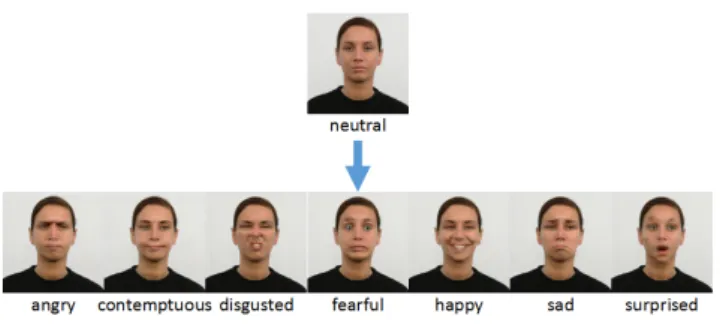
Fig. 4. Generated images from one category using StarGAN
We generate other seven categories of data from neutral facial emotional expression data using StarGAN. These images generated from neutral expressions can improved the manifold of relatively lacking categories and make each kind of data balanced.
IV. EXPERIMENTS
A. Benchmark Datasets
In our experiments, we use benchmark dataset to evaluation our results: Radboud Faces Database(RaFD) [10]. RaFD is a facial expression dataset consisting of 67 models ( Cau-casian females and males, children, including girls and boys, Moroccan Dutch males) showing emotional expressions. In this facial expression dataset, each model has facial emotional expressions including neutral, disgust, surprise, happiness, sadness, fear, contempt, and angry. For the same emotional expression of every person, we select images with three angles as our train dataset and test dataset. Besides, there are three images for the same angle of the same person.
B. Data processing
In RaFD dataset, the whole dataset is divided into four parts: I, II, III, IV. Part IV is 10% of the whole part which is used to evaluate VGG16 as VGG16 test set. Part I is used to train StarGAN. In every part, the number of every category is the same. In the first group experiment, we combine all the Part III with only neutral facial emotional expression in part II. We
call these data L-part. Because in actual circumstances, neutral facial emotional expressions are relatively easy to obtain. In the second group experiment, we merge part II and part III and remove one category such as sad in part II. We call these data U-part.
Fig. 5. The first group: U-part data
Fig. 6. The second group: L-part data
C. Conventional data augmentation methods
1) Augmentor: Augmentor is a Python kit that is designed to help the augmentation and artificial generation of image data for machine learning tasks. It is mainly a data augmentation tool, but will also include basic image pre-processing function. In principle, Augmentor consists of several classes for standard image manipulation functions, such as the Rotate class or the Crop class. Because image augmentation is often a multi-stage procedure, Augmentor uses a pipeline-based approach, where operations are added sequentially in order to generate a pipeline. Images are then passed through this pipeline, where each operation is applied to the image as it passes through. In our experiment, we use crop and rotate in Augmentor to generate some data as augmented data.
Fig. 7. Generated images using cropping
2) crop: Cropping is that a region of a size specified by the user is cropped at random from the original image. We use crop centre function in Augmentor to generate the lacking data from the same category. We crop 80% of original image and then resize it into 256×256 size, which confirms that the size of generated images is the same with original images.
3) rotate: Rotation is that the image is rotated at any angle specified by the user. When an image is rotated, and it is not a multiple of 90 degrees, the image must either be stretched to accommodate a now larger image, or some of the image must be cut. In our experiment, we choose 10 degrees as the maximum angle of rotation.
Fig. 8. Generated images using Rotation
D. Evaluation in VGG16
In our experiments, the parameters in the former 15 layers are fixed and the parameters only in output layers are updated. Because of the configuration of the computer, we set the number of batch size to 80 and the epochs to 200. We use pre-training model of VGG 16 without the top layer in Keras and use the weights of ImageNet. The number of total parameters is 23,105,608 and the number of trainable parameters is 15,470,344. The training ends before 200 epochs and the accuracy of training reaches almost 100% at the same time. In order to prevent overfiting in the model, we use early stopping to stop training ahead of time to enhance the generalization ability of the model. We set val loss as monitor and patience value to 10 epochs.
E. Results
In this experiment, the configuration of the computer that runs our programs is as follows: The memory is 32GB, the processor is Inter Core i7-7800X CPU @3.50GHz × 6, the graphics is GeForce GTX 1080 Ti/PCle/SSE2, and the operating system is ubuntu 17.04. We spend about more than 30 hours on the phase of training StarGAN to generate other seven categories of images. Although CycleGAN [12] also can implement the task of image generation, if we would like to generate many categories from one category, we need train the model many times and it costs a lot of time.
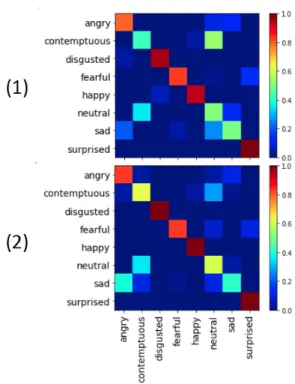
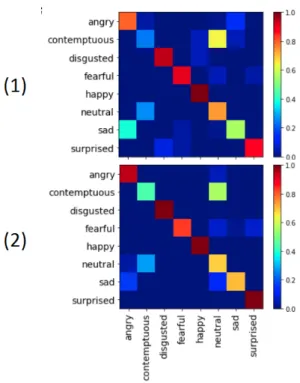
The column of confusion matrix represents the predicted class, and the row represents the instance of the actual class. We evaluate the accuracy and precision of the classifier using confusion matrix. In Fig. 9 and Fig. 10, the diagonal represents the accuracy of classification, the more red the color of the cell is. the higher the accuracy is. On the contrary, the more blue the color is, the lower the accuracy is. The colored bar represents the accuracy on the right side in Fig. 9 and Fig. 10. In U-type group, the data of sad category are lacking. Because of the influence of imbalanced data, the accuracy of the baseline in U-type group only reaches 74.77%. From Table 1,we can see that the accuracy of the classifier is improved by data augmentation. After using StarGAN to augment data, the accuracy rate is increased from 74.77% to 78.94%, which is better than using crop method.
Fig. 9. U-type group: (1) Confusion matrix and test accuracy without data augmentation in VGG16; (2) Confusion matrix and test accuracy with data augmentation using StarGAN in VGG16
In Fig. 9, we can see that the accuracy of every category is enhanced except for sad category in confusion matrix for test set. The VGG16 model can not classify angry class and sad class very indeed. However, for the classes of fearful, happy and surprised, the accuracy reaches 100%.
In L-type group, the situation of experiments is similar to the U-type group. After using data augmentation with StarGAN, the accuracy rate obtains 7% increase. However, the accuracy of data augmentation using cropping only increases 3%. In Fig. 10, after data augmentation using StarGAN, the accuracy of many categories is enhanced, especially for the class of sad, which reaches 70.37% from 55.5%.
Our method has a great advantage for L-type data. Common methods of solving data imbalance problem are down sam-pling for the majority or over samsam-pling for the minority. Using StarGAN to generate samples is the latter and it can improve the data manifold and data distribution which is determined by higher-level features. For L-type data, the increase in accuracy using our method that StarGAN generates other categories from neutral expressions is greater than using conventional methods of generating samples from the same class. Data augmentation based on multi-domain model StarGAN is more efficient than using other one-to-one domain GAN models. At the time of lacking samples in minority class, the gen-eralization ability of the model is very poor in one-to-one domain GAN models due to the lack of training data. To obtain good generated image whose data distribution is close to the data distribution of this class, enough training samples are necessary. The training effect is limited in other
one-to-Fig. 10. L-type group: (1) Confusion matrix and test accuracy without data augmentation in VGG16; (2) Confusion matrix and test accuracy with data augmentation using StarGAN in VGG16
one domain GAN models, because one domain transformation training can not make full use of the data in other categories to increase generalization ability. However, when data in several categories are lacking, our StarGAN-based approach can perform well.
TABLE I U-TYPE DATA GROUP
method accuracy original 74.77% data augmentation using crop 75.00% our method 78.94%
TABLE II L-TYPE DATA GROUP
method accuracy original 75.69% data augmentation using rotation 71.30% data augmentation using crop 78.70% our method 82.64%
V. CONCLUSION ANDFUTUREWORK
According to comparison experiments, conventional data augmentation methods such as crop and our method based on StarGAN are both effective to improve the accuracy of CNN classifier. We also confirm that data augmentation using our method can contribute to enhance generalization ability and
get better results than using other conventional methods. Our method is more efficient than using other one-to-one GAN models to augment data in multi-domain situation..
In the future, we will evaluate the results using more datasets and compare our methods with more other conven-tional methods. Furthermore, we will combine RaFD and other facial emotional expression dataset in train phase of StarGAN to enhance the generalization ability of the generative model. If possible, we will use varies of classifiers to evaluate the effectiveness of our method.
ACKNOWLEDGMENT
First of all, I would like to thank Professor Uchida for giving me much help and support. When I felt disappointed, he always encouraged me and gave me a lot of advice so that I can finish this paper.
And then, thank my high school classmate, Chaoyue Wang now in Sydney for giving me some suggestions about my research.
At last, I also thank Langner, O., Dotsch, R. et al. for pro-viding the facial expression dataset, Radboud Faces Database.
REFERENCES
[1] He, K., Zhang, X., Ren, S., Sun, J.: Deep residual learning for image recognition. In: Proceedings of the IEEE Conference on CVPR. pp. 770–778 (2016)
[2] Ian J. Goodfellow, Jean Pouget-Abadie, Mehdi Mirza, Bing Xu, David Warde-Farley, Sherjil Ozair, Aaron Courville and Yoshua Bengio, “Gen-erative Adversarial Networks,” 2014
[3] M. Li, W. Zuo, and D. Zhang. Deep identity-aware transfer of facial attributes. arXiv preprint arXiv:1610.05586, 2016. 2, 5, 8
[4] Yunjey Choi, Min-Je Choi, Munyoung Kim, Jung-Woo Ha, Sunghun Kim and Jaegul Choo, “StarGAN: Unified Generative Adversarial Networks for Multi-Domain Image-to-Image Translation,” CoRR, vol. abs/1711.09020, 2017
[5] Xinyue Zhu, Yifan Liu, Zengchang Qin, and Jiahong Li, “Emotion Classification with Data Augmentation Using Generative Adversarial Networks,” CoRR, vol. abs/1711. 00648, 2017
[6] J. Clerk Maxwell, A Treatise on Electricity and Magnetism, 3rd ed., vol. 2. Oxford: Clarendon, 1892, pp.68–73.
[7] Hauberg, S., Freifeld, O., Larsen, A.B.L., Fisher, J., Hansen, L.: Dream-ing more data: Class-dependent distributions over diffeomorphisms for learned data augmentation. In: Artificial Intelligence and Statistics. pp. 342–350 (2016)
[8] Dixit, M., Kwitt, R., Niethammer, M., Vasconcelos, N.: AGA: Attribute guided augmentation. arXiv preprint arXiv:1612.02559 (2016) [9] Karen Simonyan and Andrew Zisserman, “Very Deep
Convolu-tional Networks for Large-Scale Image Recognition,” CoRR, vol. abs/1409.1556, 2014
[10] Langner, O., Dotsch, R., Bijlstra, G., Wigboldus, D.H.J., Hawk, S.T., & van Knippenberg, A. (2010). “Presentation and validation of the Radboud Faces Database. Cognition & Emotion, 24(8),” 1377—1388. DOI: 10.1080/02699930903485076
[11] Cire¸san, D.C., Meier, U., Masci, J., Gambardella, L.M., Schmidhuber, J.: Highperformance neural networks for visual object classification. arXiv preprint
[12] Zhu, J.Y., Park, T., Isola, P., Efros, A.A.: Unpaired image-to-image translation using cycle-consistent adversarial networks. arXiv preprint arXiv:1703.10593 (2017) arXiv:1102.0183 (2011)
[13] A. Odena, C. Olah, and J. Shlens. Conditional image synthesis with auxiliary classifier gans. arXiv preprint arXiv:1610.09585, 2016. 3, 5 [14] T. Kim, M. Cha, H. Kim, J. K. Lee, and J. Kim. Learning to discover
cross-domain relations with generative adversarial networks. In Proceed-ings of the 34th International Conference on Machine Learning (ICML), pages 1857–1865, 2017.1, 2, 3, 4