Hongying Meng · Michael Freeman · Nick Pears · Chris Bailey
FPGA implementation of real-time human motion
recognition on a reconfigurable video processing
architecture
Received: date / Revised: date
Abstract In recent years, automatic human motion recog-nition has been widely researched within the computer vision and image processing communities. Here we pro-pose a real-time embedded vision solution for human motion recognition implemented on a ubiquitous device. There are three main contributions in this paper. Firstly, we have developed a fast human motion recognition sys-tem with simple motion features and a linear Support Vector Machine(SVM) classifier. The method has been tested on a large, public human action dataset and achieved competitive performance for the temporal template (eg. “motion history image”) class of approaches. Secondly, we have developed a reconfigurable, FPGA based video processing architecture. One advantage of this architec-ture is that the system processing performance can be reconfigured for a particular application, with the addi-tion of new or replicated processing cores. Finally, we have successfully implemented a human motion recog-nition system on this reconfigurable architecture. With a small number of human actions (hand gestures), this stand-alone system is performing reliably, with an 80% average recognition rate using limited training data. This type of system has applications in security systems, man-machine communications and intelligent environments.
1 Introduction
Ambient Intelligence (AmI) reflects an emerging and pop-ular field of research and development that is oriented to-wards the goal of “intelligent” or “smart” environments that react in an attentive, adaptive, and active way to the presence and activities of humans and objects in order to provide intelligent/smart services to the inhabitants of these environments.
H. Meng·M. Freeman·N. pears·C. Bailey
Department of Computer Science, University of York, Heslington, York, UK, YO10 5DD
Tel.: +44-1904-43-2730 Fax: +44-1904-43-2767
E-mail: [email protected]
An environment is said to be “perceptive” when it is capable of recognizing and describing things, people and activities within its volume. Input can be obtained from sensors for sound, images, and haptics. For exam-ple, video capture is low cost, widespread, and can be used for monitoring human events.
Event recognition is an important goal for building intelligent systems which can react to what is happening in a scene. Event recognition is also a fundamental build-ing block for interactive systems which can respond to gestural commands, instruct and correct a user learning athletics, gymnastics or dance movements, or interact with live actors in an augmented dance or theatre per-formance.
Recognizing motions or actions of human actors from image sequences is also an important topic in computer vision with many fundamental applications in video surveil-lance, video indexing and social sciences. Event detection in video is becoming an increasingly important appli-cation for computer vision, particular in the context of activity recognition [Aggarwal and Cai (1999)].
Model based methods are extremely challenging as there is a large degree of variability in human behaviour. The highly articulated nature of the body leads to high dimensional models and the problem is further compli-cated by the non-rigid behaviour of clothing. Compu-tationally intensive methods are needed for nonlinear modeling and optimisation. Recent research into anthro-pology has revealed that body dynamics are far more complicated than was earlier thought, affected by age, ethnicity, gender and many other circumstances [Farnell (1999)].
Appearance-based models are based on the extrac-tion of a 2D shape model directly from the images, to be classified (or matched) against a trained one. Motion-based models do not rely on static models of the person, but on human motion characteristics. Motion feature ex-traction and selection are two of the key components in these kinds of human action recognition systems.
In this paper, we propose a human motion recogni-tion system that is both fast and accurate. It is designed
for applications in security systems, man-machine com-munication, and other cases of Ambient Intelligence. It is implemented on our FPGA based reconfigurable video processing architecture, which we call “Videoware”. Ex-perimental results demonstrate the efficiency and relia-bility of the system.
The rest of this paper is organised as follows: In sec-tion 2, we give an introducsec-tion to our human mosec-tion recognition system and we evaluate the performance of the system on a challenging, large, public human action dataset. In section 3, we introduce the reconfigurable video processing architecture. In section 4, we introduce the implementation of the human motion recognition on the reconfigurable architecture and give some experimen-tal results for this real-time embedded vision system. Fi-nally, we present some discussion and the conclusions.
2 Human motion recognition system 2.1 Related works on human motion recognition
Aggarwal and Cai (1999) present an excellent overview of human motion analysis. Of the appearance based meth-ods, template matching has gained increasing interest recently. Moeslund et al (2006) have produced a review paper for the most recent advances.
Bobick and Davis (2001) pioneered the idea of tem-poral templates. They use Motion Energy Images (MEI) and Motion History Images (MHI) to recognize many types of aerobics exercise. Bradski and Davis (2002) also proposed the Motion Gradient Orientation (MGO) to explicitly encode changes in an image introduced by mo-tion events.
Davis (2001) presented a useful hierarchical exten-sion for computing a local motion field from the original MHI representation. The MHI was transformed into an image pyramid, permitting efficient fixed-size gradient masks to be convolved at all levels of the pyramid, thus extracting motion information at a wide range of speeds. The hierarchical MHI approach remains a computation-ally inexpensive algorithm to represent, characterize, and recognize human motion in video.
Ogata et al (2006) proposed Modified Motion His-tory Images (MMHI) and used an eigenspace technique to realize high-speed recognition. The experiment was performed on recognizing six human motions and the re-sults showed satisfactory performance of the technique.
We note that, in some of these methods [Schuldt et al (2004), Weinland et al (2005), Dalal et al (2006), Blank et al (2005), Oikonomopoulos et al (2006), Ke et al (2005)], the motion features employed are relatively complex, which implies significant computational cost on building the features. Some methods [Bobick and Davis (2001), Bradski and Davis (2002), Davis (2001), Wong and Cipolla (2005), Wong and Cipolla (2006),Ogata et al (2006), Blank et al (2005)] require segmentation,
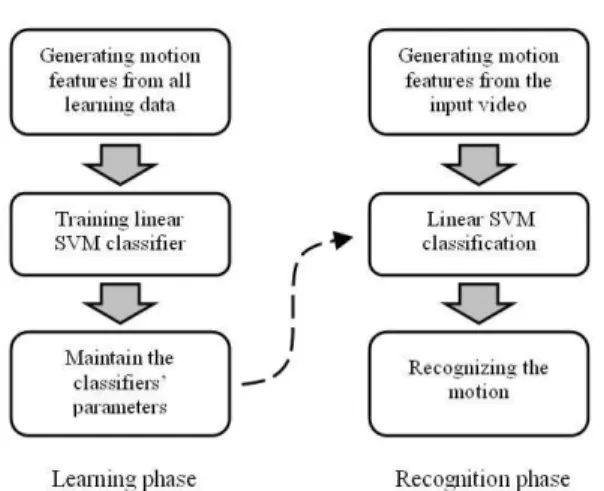
track-Fig. 1 SVM based human motion recognition system. In the learning part, the motion feature vector was used for training a SVM classifier, and the parameters computed were used in the recognition part.
ing or other prohibitive computational cost, that is not suitable for real-time embedded vision applications.
To our knowledge, there are no publications on the implementation of visual human motion recognition us-ing a FPGA platform, which is the main theme of this paper.
2.2 MHI/SVM based recognition system
We now propose a novel solution for fast human action recognition. This has been reported in our previous work [Meng et al (2006)]. In this approach, a linear SVM was chosen as the classifiere and the Motion History Image (MHI) provided our fundamental features.
There are two reasons for choosing a linear SVM as the classifier in the system. Firstly SVM is a classifier that has achieved very good performance in lots of real-world classification problems. Secondly, SVM can deal with very high dimensional feature vectors, which means that there is plenty of freedom to choose the feature vec-tors. Finally the classifier is able to operate very quickly during the recognition process.
A normal recognition system includes two parts: a learning part and a classification part. These two parts of our recognition system are showed separately in figure 1.
The feature vectors are to be obtained using motion information directly from the input video. It is expected that the feature extraction algorithms and dimension re-duction algorithms should be as simple as possible. The high dimensional feature vector can also be dealt with easily by the SVM.
The learning part is processed using video data col-lected off-line. After that, the computed parameters for the classifier can be used in a small, embedded com-puting device such as a field-programmable gate array (FPGA) or digital signal processor (DSP) based system,
which can be embedded in the application and can give real-time performance.
2.3 Motion features
The recording of human actions usually needs large amounts of digital storage space and it is time consuming to browse the whole video to find the required information. It is also difficult to deal with this huge amount of data in detec-tion and recognidetec-tion. Therefore, several modetec-tion features have been proposed to compact the whole motion se-quence into one image to represent the motion. The most popular ones are Motion History Image (MHI), Modified Motion History Image (MMHI) and Motion Gradient ori-entation (MGO). These three motion features have the same size as the frame of the video, but they maintain the motion information within them. In our experiments, it has been found that MHI achieved best performance. A motion history image (MHI) is a kind of temporal template. It is the weighted sum of past successive images and the weights decay as time lapses. Therefore, an MHI image contains past raw images within itself, where most recent image is brighter than past ones.
Normally, an MHIHτ(u, v, k) at timekand location (u, v) is defined by the following equation 1:
Hτ(u, v, k) ={τ if D(u, v, k) = 1
max{0, Hτ(u, v, k−1)−1}, otherwise(1) whereD(u, v, k) is a binary image obtained from sub-traction of frames, and τ is the maximum duration a motion is stored. In general,τ is chosen as constant 255 where MHI can be easily represented as a grayscale im-age. An MHI pixel can have a range of values, whereas the Motion Energy Image (MEI) is its binary version. This can easily be computed by thresholding Hτ >0 .
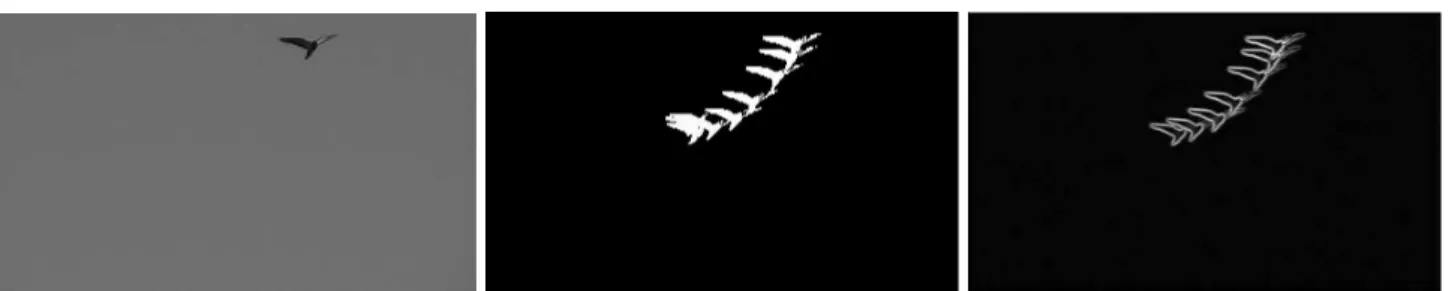
Figure 2 shows the motion features of MHI (b) and MMHI (c) of a bird flight in the sky (a). From these fea-tures, we can clearly determine how the bird flew in the sky even though we didn’t see the video clip, since these features retain the motion information within them.
From these motion images, some researchers have at-tempted to extract further low-dimensional feature vec-tors. In Bobick and Davis (2001), Hu moments (it is good at expressing shape discrimination) was used to extract the motion feature from the MHI. However, in order to keep the simplicity for hardware implementa-tion, we use the simplest method to transform a motion image MHI/MMHI into a plain vector based on the pixel scan order (pixel by pixel) to feed a SVM classifier. For a SVM classifier, the order of feature components should not affect the performance.
2.4 Support Vector Machines
Support Vector Machines are a state-of-the-art classi-fication technique with large application in a range of
fields including text classification, face recognition and genomic classification, where patterns can be described by a finite set of characteristic features.
We use the SVM for the classification component of our system. This is due to SVM being an outstand-ing classifier that has shown very good performance on many real-world classification problems. Using arbitrary positive definite kernels provides a possibility to extend the SVM capability to handle high dimensional feature spaces.
Orignally, SVM is binary classifier in a higher dimen-sional space where a maximal separating hyperplane is constructed. Two parallel hyperplanes are constructed on each side of the hyperplane that separates the data. The separating hyperplane is the hyperplane that maxi-mizes the distance between the two parallel hyperplanes. If we have a training dataset
xi|xi∈Rd , and its bi-nary labels are denoted as{yi|yi=±1}, the norm-2 soft-margin SVM can be represented as a constrained opti-mization problem min w,b,ξ 1 2||w|| 2+CX i ξi (2) s.t. hxi,wi+b≥1−ξi, yi = 1, hxi,wi+b≤ −1 +ξi, yi =−1, ξi≥0,
whereCis a penalty parameter andξiare slack variables. The vector w∈Rd points perpendicular to the separat-ing hyperplane. Addseparat-ing the offset parameterb allows us to increase the margin. It can be converted by applying Langrange multipliers into its Wolfe dual problem and can be solved by quadratic programming methods.
The primal optimum solution for weight vectorwcan be represented as
w=X
i
αiyixi. (3)
where 0≤αi ≤C. Obviouslty,w can be expressed as a linear combination of the support vectors for which αi>0. For a testing feature vectorx, the decision func-tionη and its estimated labelhare:
h(x) =sign(η(x)) =sign(hw,xi+b). (4) The original optimal hyperplane algorithm was a lin-ear classifier. However it has been suggested a way to create non-linear classifiers by applying the kernel trick [Aizerman et al (1964)]. The SVM can be generalized to the case where the decision function is a non-linear function of the data.
Multiclass SVMs are usually implemented by combin-ing several two-class SVMs. In each binary SVM, only one class is labelled as ”1” and the others labelled as ”-1”. The one-versus-all method uses a winner-takes-all strategy.
Fig. 2 In this video sample, a bird flys in the sky (left). The features MHI (middle) and MMHI (right) both have retained the motion information of the bird.
If there areMclasses, then the SVM method will con-struct M binary classifiers by learning. During the test-ing process, each classifier will get a confidence coefficient {ηj(x)|j= 1,2,· · ·, M} and the class kwith maximum confidence coefficient will be assigned to this samplex. h(x) =k, if ηk(x) =maxMj=1(ηj(x)). (5)
In our system, there are several classes. Several SVM classifier will be trained based on motion features such as MHI obtained from human action video clips in a training dataset. The motion image MHI is transformed into a plain vector based on the pixel scan order.
2.5 Performance evaluation
For the evaluation, we use a challenging human action recognition database recorded by Schuldt et al (2004). It contains six types of human actions (walking, jogging, running, boxing, hand waving and hand clapping) per-formed several times by 25 subjects in four different sce-narios: outdoors (s1), outdoors with scale variation (s2), outdoors with different clothes (s3) and indoors (s4).
This database contains 2391 sequences. All sequences were taken over homogeneous backgrounds with a static camera with 25fps frame rate. The sequences were down-sampled to the spatial resolution of 160x120 pixels and have a length of four seconds on average. To the best of our knowledge, this is the largest video database with se-quences of human actions taken over different scenarios. All sequences were divided with respect to the subjects into a training set (8 persons), a validation set (8 per-sons) and a test set (9 perper-sons).
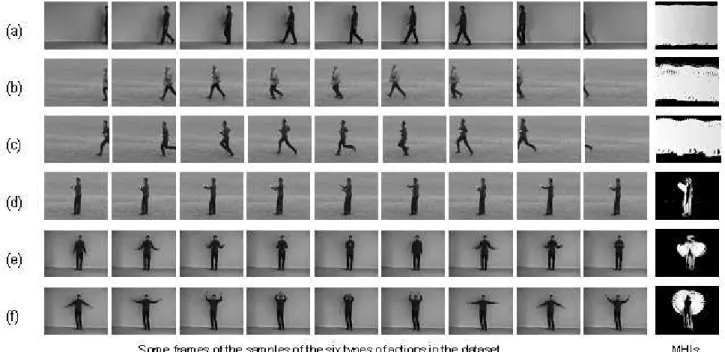
Figure 3 shows examples in each type of human ac-tion in this dataset and their associate MHI moac-tion fea-tures. In order to compare our results with those in pa-pers [Ke et al (2005),Schuldt et al (2004)], we use the ex-act same training set and testing set in our experiments. The only difference is that we did not use the validation dataset in training. Our experiments are carried out on all four different scenarios. In the same manner as paper [Ke et al (2005)], each sequence is treated individually during the training and classification process. In all the following experiments, the parameters were are the same.
In our system, SVM was trained based on features obtained from human action video clips in a training dataset. Generally, we can have several types of actions in a video dataset. These video clips have their own labels such as “walking”, “running” and so on. In classification, we actually get a six-class classification problem. At first, we create six binary SVM classifiers, and each of them is related to one of the six classes. For example, there is one SVM classifier related to the class “walking”. In the training dataset, the video with label “walking” will have a label “1” in SVM classifier while others have a label “-1” in SVM. Secondly, we will train these SVM classifiers on the learning dataset. The SVM training can be imple-mented using programs freely available on the web, such as SV Mlight by Joachims (1999). Finally, we obtained several SVM classifiers with the associated parameters.
Our experiments are carried out on the all four dif-ferent scenarios: outdoors, outdoors with scale variation, outdoors with different clothes and indoors. In the same manner as paper [Ke et al (2005)], each sequence is treated individually during the training and classification pro-cess. In all the following experiments, the parameters were chosen to be same.
For the whole dataset, the classification confusion matrix is a good measure for the overall performance in this multi-class classification problem. Tables 1 show the classification confusion matrix based on the method pro-posed in paper Ke et al (2005). Table 2 show the confu-sion matrix obtained by our system, which uses the MHI. The confusion matrices show the motion label (vertical) versus the classification results (horizontal). Each cell (i, j) in the table shows the percentage of classi action being recognized as class j. Thus the main diagonal of the matrices show the percentage of correctly recognized actions, while the remaining cells show the percentages of misclassification. The trace of our matrix is 381.2 while the trace of Kes matrix is 377.8. Our results are slightly better.
From these two tables, we can see that in this six classes human action classification problem, our method did very well in distinguishing the last three classes “box-ing”, “handclaping” and “handwaving”. But it is not efficient in distinguishing the first three classes “walk-ing”, “jogging” and “running”. The reason is that this dataset is really a challenging dataset. Some actions in
Fig. 3 Six types of human actions in the database: (a) walking, (b) jogging, (c) running, (c) boxing, (d) handclapping and (e) handwaving. The frames of the actions and their associate MHI features
these three classes “walking”, “jogging” and “running” are very difficult to classify even by human eyes. Some object’s “jogging” actions are even slower other object’s “running” action. However, in comparison with Ke’s method, we use simple MHI rather than volumetric features in which the dimension of feature vector might be a billion and our performance is little bit better.
Table 1 Ke’s confusion matrix, trace=377.8
Walk Jog Run Box Clap Wave Walk 80.6 11.1 8.3 0.0 0.0 0.0 Jog 30.6 36.2 33.3 0.0 0.0 0.0 Run 2.8 25.0 44.4 0.0 27.8 0.0 Box 0.0 2.8 11.1 69.4 11.1 5.6 Clap 0.0 0.0 5.6 36.1 55.6 2.8 Wave 0.0 5.6 0.0 2.8 0.0 91.7
Table 2 MHI’s confusion matrix, trace=381.2
Walk Jog Run Box Clap Wave Walk 53.5 27.1 16.7 0.0 0.0 2.8 Jog 46.5 34.7 16.7 0.7 0.0 1.4 Run 34.7 28.5 36.1 0.0 0.0 0.7 Box 0.0 0.0 0.0 88.8 2.8 8.4 Clap 0.0 0.0 0.0 7.6 87.5 4.9 Wave 0.0 0.0 0.0 8.3 11.1 80.6
It should be mentioned here that the system per-formance also depends on the number of classes. The smaller the number of classes is, the better the perofor-mance of the system will be.
3 Reconfigurable video processing architecture Developments in AmI and ubiquitous computing have lead to the concept of disappearing computing [Wejchert (2000)], with a user being unaware that they are interact-ing with a collection of computinteract-ing nodes. Such devices have been termed context aware applications [Schmidt and Laerhoven (2001)], smart devices that sense the real world they are operating in and use this information combined with a set of rules to enhance their opera-tion. To continue to expand the functionality available from such devices improved sensor technologies must be incorporated into these systems. The Amadeus Vide-oware project [Pears (2004)] aims to develop a hardware video processing architecture, which will support visually driven human interaction with a wide range of ubiquitous devices. These objectives require that computing tech-nology is seamlessly integrated into an environment. This has become a reality with the ever decreasing cost, size and power requirements of embedded processors. How-ever, an alternative approach to this traditional proces-sor based solution is considered in this research. Instead of using a general purpose processor, a more hardware biased solution is taken, with the development of applica-tion specific IP-cores for FPGA or ASIC devices that can be optimized for the desired application. The main aim
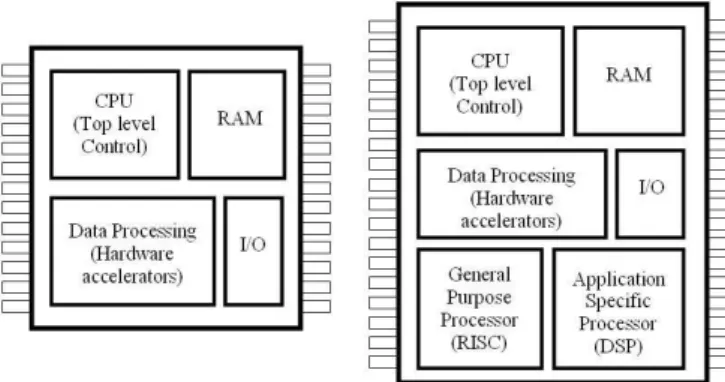
Fig. 4 Simple SOC (Left) and MPSOC designs (Right).
of this approach is to minimize power requirements and component costs by designing system on a chip (SOC) based systems. These reductions in power requirements and production costs are two of the main driving forces in current electronic system design, illustrated by the move away from board level design (standard compo-nents, ASIC, ASSP) to SOC architectures. This trend has continued within the FPGA and ASIC design flows. Following Moore’s law, the ever increasing amounts of resources available within these devices has allowed the designer to move away from “simple” SOC designs to multiprocessor SOC (MPSOC) and network on a chip (NOC) designs as illustrated in figure 4.
The traditional SOC design is based around a top level processor core, controlling the allocation of process-ing tasks to set of data processprocess-ing, hardware accelera-tors. These IP-cores are typically hardwired i.e. control structures are implemented as hard coded state machines with highly pipelined or replicated data paths to improve processing performance. The resulting IP-core can ob-tain very high levels of processing performance, however, they tend to be inflexible, being optimised for a specific application. The development of these IP-cores is very labour intensive, taking a significant amount of time to design and debug when compared to a software imple-mentation. With the increasing amounts of silicon area available to the designer, general purpose and applica-tion specific processor cores are replacing these hardware accelerator IP-cores, leading to the development of MP-SOC and NOC designs. The type and number of proces-sor cores chosen is highly dependent on the applications real time processing performance requirements, however, these can include RISC [ARM (2007)] [MIPS (2007)], DSP or configurable processor cores[ARC (2007)] [Ten-silica (2007)]. The per-unit processing performance of such systems when compared to a purely hardware im-plementation will of course be lower, however, the key advantage of this type of system is its flexibility, allow-ing a sallow-ingle design to be reconfigured for different ap-plications via firmware modifications. Therefore, mod-ern SOC designs will typically include multiple processor cores, each being allocated one or more tasks to improve
parallelism within the system. Those functions requiring very high levels of processing performance which can not be achieved by a software based implementation will of course still need to be implemented as hardware accel-erator IP-cores i.e. to allow the system to meet its real time processing deadlines.
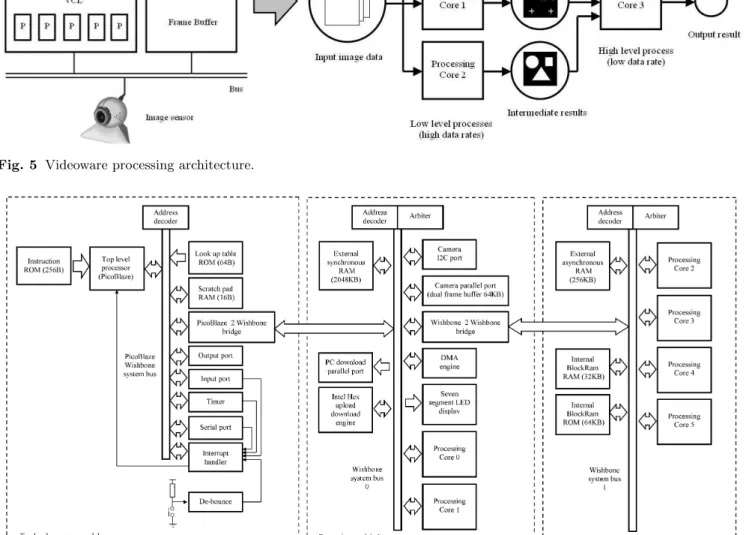
The aims of the Videoware project is to implement a video component library (VCL) of generic image pro-cessing, computer vision and pattern recognition algo-rithms in an FPGA based architecture. The low level, high bandwidth processes, such as smoothing and feature extraction, will be implemented as hardware IP-cores, whilst higher level, lower bandwidth processes, such as task-oriented combination of visual cues, will be imple-mented in a software architecture as shown in figures 5. The advantage of this modular approach is that a sys-tems processing performance can be reconfigured for a particular application, with the addition of new or repli-cated processing cores. This being simplified by using a MPSOC design with only those functions required for low level hardware interfacing or high levels of processing performance being implemented purely in hardware.
The hardware architecture shown in figure 5 has been implemented on a custom made FPGA board, the Amadeus ubiquitous system environment (USE) board [Amadeus (2004)]. This board is based on a Xilinx Spartan-III de-vice [Xilinx (2007c)], with 2MB of external RAM and 8MB of external ROM (this memory is also used to configure the FPGA via a CPLD configuration engine). The FPGA size can be selected to match a systems re-quirements, the board accepting three alternative de-vices: XC3S1500 (1.5M gates), XC3S2000 (2M gates) and XC3S4000 (4M gates). In addition to this a number of interface boards have also been developed to allow the easy connection of a camera [Kodak (2006)], com-munications interfaces e.g. LEDs, RS232 and additional external memory modules e.g. SDRAM and SRAM.
4 Implementation of human motion recognition on the reconfigurable architecture
4.1 System design and implementation
To minimise development time i.e. the number of dif-ferent hardware components that need to be developed, processor instruction sets and software developments tools that need to be learnt, each processing core is based on the same processor architecture. For the Xilinx Spartan-III device this means selecting from the Xilinx PicoBlaze (8bit) [Xilinx (2007a)], Xilinx MicroBlaze (32bit) [Xilinx (2007b)] or a third party processor IP-Core (not con-sidered due to size constraints). When selecting a pro-cessor core the data width, memory architecture and instruction set need to be matched to the application. In this case the majority of data sources use either an unsigned 8bit integer value i.e. grey scale images, or a
Fig. 5 Videoware processing architecture.
Fig. 6 System block diagram.
signed 8.8 fixed point representation (8bit integer, 8bit fraction). It was therefore decided that the 8bit Xilinx PicoBlaze processor would be used as a 32bit processor would require significant increases in both memory and logic requirements. This decision does reduce the pro-cessing performance of these cores e.g. operations requir-ing 16bit or 32bit operands require multiple instructions. The PicoBlaze processor is also not designed to be a raw ’number cruncher’ with an average performance of ap-proximately 50 MIPS. Therefore, to compensate for this a co-processor interface was added to the system bus al-lowing identified software bottlenecks to be moved into hardware e.g. signed 8.8 multiplication, signed 24.8 ac-cumulator etc. In addition to this, operand pointer man-agement has been moved out of software into dedicated
hardware within the processor-to-wishbone bridge. This functionality was identified from the convolution opera-tors required in a number of the video processing algo-rithms. Read and write pointers are now implemented in hardware being automatically updated when a value has been fetched from or written to memory. The pro-cessor can request either a single or block of data from a base address with a selected offset, greatly simplifying code structure and reducing code size. In general a soft-ware biased design approach was taken when developing each processing core i.e. a co-processor was only added if a software based implementation does not achieve the required processing performance.
The block diagram of the FPGA motion recognition system is shown in figure 6. Each functional unit being
implemented as hardware components written in VHDL. Control and IO tasks are centralised in the top level pro-cessor module. This module contains:
– PicoBlaze processor : top level control software, on boot-up initialises camera interface etc, synchronising and allocating tasks to processing cores to fulfil the systems processing requirements.
– Look up table ROM : configuration data used to ini-tialise the system e.g. camera control register values, frame size etc.
– Scratch pad RAM : temporary storage for interme-diate results. The inclusion of this memory is depen-dent on the variant of PicoBlaze processor used i.e. the PicoBlaze KCPSM3 includes 64Bytes of internal scratch pad memory within its architecture.
– PicoBlaze to Wishbone bridge : the PicoBlaze pro-cessor does not support wait states i.e. delayed read or write operations to memory, therefore, a bridge is required to interface the PicoBlaze to the Wishbone system bus [Silicore (2002)]. The processor requests read or write operations from the bridge, data being stored in internal FIFO buffers.
– Output port : used to drive a LED bank, indicating the programs status, debugging information etc. – Input port : simple push buttons used to start system
operations, DIP switch bank selects what configura-tion data should be used e.g. camera sensitivity etc. – Timer : periodic interrupt timer used to trigger
sys-tem events.
– Serial port : displays result and debug information on PC based serial terminal.
– Interrupt handler : controls servicing of multiple in-terrupts.
The functionality required to implement the motion recognition system is distributed between two processing modules, processing module 0 and 1. Processing module 0 is assigned low level, high bandwidth image capture and communication tasks. This module contains:
– Intel hex upload / download engine : allows data to be uploaded to and downloaded from the FPGA using the extended Intel hex format. This allows the con-tents of the status and control registers of the various components on the system bus to be read and writ-ten to, simplifying testing. This interface can also be used to replace the top level processor module, allow-ing the user to send configuration and control packets to the FPGA.
– DMA engine : direct memory access controller, can be configured to transfer blocks of data from memory to memory, FIFO to memory, memory to FIFO, or clear a block of memory.
– External synchronous SRAM : 2048 KB of memory used as a frame buffer storing image data and inter-mediate results.
Fig. 7 Processing core block diagram.
– Parallel port : primarily used to transfer image data back to the host PC for SVM training and hardware debugging.
– Camera I2C port : synchronous serial port allowing the FPGA to configure the camera’s control registers. – Camera parallel port : the camera is configured to constantly stream image data to the FPGA. This slave port captures image data, configured with dual 32KB frame buffers allowing the previous image to be processed whilst the current image is captured. This component also supports Bayer pattern to greyscale conversion and down sampling to lower image reso-lutions.
– Seven segment display : two seven segment LED dis-plays used to display the motion recognition result and debugging.
– Wishbone to Wishbone bridge : to enable different processing cores to operate in parallel without im-pacting on system bus bandwidth functionality can be spread across a number of system buses i.e. high bandwidth data accesses are isolated to the local sys-tem bus.
– Processing core 0 : difference operator, used to gen-erate the motion history image.
– Processing core 1 : sub-sample operator, used to down sample image data to lower resolutions, using pixel interpolation or selection.
Processing module 1 is assigned high level, lower band-width data processing tasks. To maximise system perfor-mance access to data is localised to the current system bus i.e. additional memory is attached to each bus
min-imise Wishbone to Wishbone bridge transfers. Alterna-tively, internal dual port BlockRam can also be used to transfers data across systems bus boundaries. This mod-ule contains :
– External asynchronous SRAM : edge detection frame buffers
– Internal RAM : intermediate result buffer used in the calculation of the motion history image
– Internal ROM : SVM classification data sets, inner product of this data and the motion history image is performed to identify motion.
– Processing core 2 : inner product, signed 8.8 multi-plication with a 24.8 accumulator.
– Processing core 3 : filter, Gaussian or mean smooth-ing of image data
– Processing core 4 : rotate, image orientation about its centre
– Processing core 5 : edge detector, Robert’s cross or Sobel edge detector operators
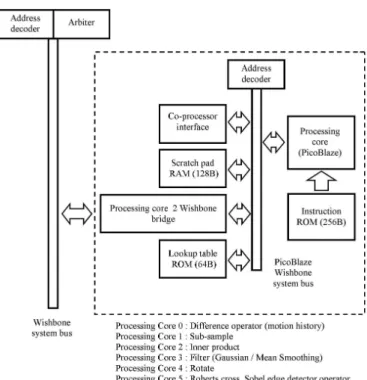
Note that processing cores 3 - 5 are not used in the motion recognition system, but have been developed as part of the VCL. The processing cores used in processing module 0 and 1 are based on the same hardware archi-tecture as shown in figure 7. This greatly simplifies hard-ware development and testing, allowing the same compo-nent to be used for a number of different tasks through firmware modifications. Each processing core contains :
– PicoBlaze processor : depending on the algorithm used (instruction code size), the KCPSM, KCPSM2 or KCPSM3 PicoBlaze processor core can be used. – Co-processor interface : a generic co-processor
inter-face supporting eight parameter registers, four result registers, control and status registers.
– Look up table ROM : system constants e.g. sine lookup table, size 16 - 64B.
– Scratch pad RAM : intermediate results, size 16 -128B
– Processing core to Wishbone bridge : this bridge has more functionality than the PicoBlaze to Wishbone bridge, supporting automatic read and write pointer updates and offset calculations from these base point-ers.
The Amadeus ubiquitous system environment (USE) board and motion recognition processing pipeline is shown in figure 8. A difference operator is performed on the current and previous frames, updating a motion history image. The inner product of the MHI and the SVM clas-sification data sets is then performed, the result of each accumulator then has a specific offset applied before a threshold is performed, selecting the stored action that most closely matches the observed motion. In the cur-rent implementation this process is operated in a one shot mode, however, this could be easily expanded to include motion detection to start and stop this process i.e. when the difference between two frames exceeds a threshold the motion history image is generated, when it
Fig. 9 System function processing requirements.
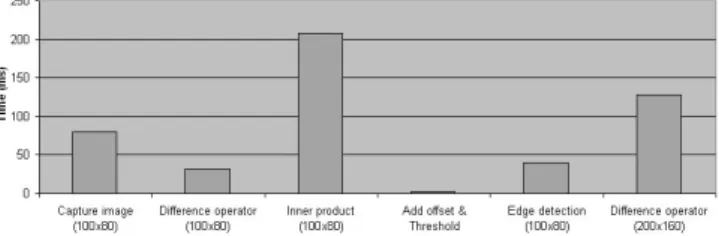
falls below this threshold the inner product and threshold phase are then performed. The processing performance for each of these system functions is shown in figure 9. These results are for a software only implementation i.e. no co-processor support is incorporated in any of the processing cores. The current hardware implementation can capture image data at twelve frames per second i.e. one frame every 80 ms. To allow the system to process data at this frame rate the inner product calculation performance must be improved. To achieve this level of performance the system can be reconfigured, replicating this processing core improving parallelism. Performance can also be improved through the use of co-processors e.g. moving the signed 8.8 multiplication operation out of software into dedicated hardware. The result of these improvements can be seen in figures 10 and 11. Figure 10 shows the processing performance of a software only im-plementation performing six inner product calculations using one to six processing cores i.e. one to six copies of processing core 2 are added to the system bus. Fig-ure 11 shows the processing performance of the same system but with hardware support through the inclu-sion of a co-processor in processing core 2. Using these techniques the required processing performance can be achieve, allowing a virtual pipeline to be constructed be-tween these processing cores. It should be noted that the number of processing cores that can be replicated is de-pendent on the system bus and memory bandwidth, as more processing cores are added a point will be reached where processing on these cores will be stalled until data bandwidth is freed. The performance of these processing core is also dependent on image size. In the present sys-tem the camera interface captures Bayer pattern images at a resolution of 640x480. This is then converted to a greyscale image and down sampled to either 200x160 or 100x80, defined via the camera’s control registers. The camera input frame rate is therefore constant, however, the image size can vary from 8KB to 32KB. This increase in data will of course effect the systems processing re-quirements e.g. 200x160 difference operator’s processing requirements increases by a factor of 4. To increase pro-cessing performance the difference operator propro-cessing core can be replicated. However, multiple image pairs can not be processed in parallel due to a data hazard (read after write) on the MHI i.e. the reader, writer problem. To remove this hazard, the current and previous motion history images are divided into segments, with a single
Fig. 8 Amadeus ubiquitous system environment (USE) board and motion recognition processing pipeline.
Fig. 10 Software inner product implementation.
processing core allocated to each segment, removing the data hazard problem, as shown in figure 12. The process-ing performance of this system for an image resolution of 200x160 with one to six processing cores is shown in figure 11. These results highlight the difference between task level parallelism (figures 10 and 11) and function level parallelism (figure 13) when using replicated pro-cessing cores. The parallel inner product system uses task level parallelism. In such systems the number of tasks can be greater than the number of processing cores with tasks being allocated to each processing core as they be-come available. As a result, processing performance is limited by the maximum number of tasks that can be allocated during each time slice e.g. with four process-ing cores and six tasks two time slices will be required, four tasking being processed in the first time slice and two in the second. This granularity is illustrated by the flat regions in figures 10 and 11 i.e. for a system with three to five processing cores. In these systems two time slices will be required, resulting in some processing cores remaining idle during these periods. The parallel differ-ence operator system uses function level parallelism. In such systems the number of tasks is equal to the num-ber of processing cores i.e. the numnum-ber of segments is matched to the number of processing cores available. As a result, processing performance shows a incremental im-provement with the number of processing cores added to the system.
Fig. 11 Co-processor inner product implementation.
Fig. 12 Allocation of replicated difference operators.
Table 3 Hand motion recognition average confusion matrix horizontal Vertical Others
Horizontal 94 2 4
Vertical 18 70 12
Others 4 18 76
This ability to scale a design to match an application allows the designer to trade off speed and area require-ments. In addition to this, each hardware component can also be optimized for speed, size and power considera-tions, giving a designer greater flexibility in distributing the required processing capabilities amongst the selected processing cores.
4.2 Performance testing on the stand alone system
In order to test the performance of the FPGA imple-mentation of our human motion recognition system. We recorded a hand motion dataset. In this dataset, there are only three type of hand motions: horizontal motion, vertical motion and “other motion”. We also recognise a no-motion case as a extra class.
For each class, we recorded 20 video samples, with the frame size set to 200x160 pixels. We recorded the video clips with a variety of backgrounds to test the sys-tem robustness to this variability. Figure 14 showed some samples in this dataset.
One of the simplest multiclass classification schemes built on top of real-valued binary classifiers is to train N different binary classifiers, each one trained to distin-guish the examples in a single class from the examples in all remaining classes. When it is desired to classify a new example, the N classifiers are run, and the classifier which outputs the largest (most positive) value is chosen. This scheme will be referred to as the “one-vs-all rule.
In our experiment, 15 samples were randomly chosen from each class for training and the other 5 were used for testing. We repeated the experiments 10 times. We carried out the training on computer by usingSV Mlight (the defalt values were used for all the parameters in this software). We extracted the MHI feature from each video clip firstly. Then we trained 3 binary linear SVM classifiers based on these features. So we got 3 parameter matrix (The weight vectorw) and biasb. We stored them in the internel memory of the FPGA chip for the classifi-cations. During the classification, 3 values were got from each SVM calssifier and the one with the largest (most positive) value is used to label the motion.
Table 3 shows the average classifiation rate. The av-erage rate of correct classification is 80%. Clearly this can be improved by using more training samples.
Using the system architecture shown in figure 6 two hardware configurations can be achieved through firmware modifications as shown in table 4. Both of these systems operate in a one shot mode, capturing approximately
five seconds of video i.e. 60 frames at 12 frames/seconds. The first of these is a test configuration, where each stage of the processing pipeline is performed sequentially i.e. video capture, difference operator, inner product, offset addition and thresholding. At each stage intermediate results can be downloaded using the Intel Hex upload / download IP-core and compared to results produced by a Matlab implementation running on a PC. As the results in table 4 show this implementation may not be suitable for some real time applications, having an output latency of approximately 2.5 seconds. To improve processing per-formance the system can be expanded to included four inner product and difference operator processing cores to form a true virtual pipeline as illustrated in figure 8. This allows the difference operator to be overlapped with video capture significantly reducing output latency.
Table 4 Hardware performance
Video capture Output latency Sequential 5 sec 2.514 sec Pipelined 5 sec 0.082 sec
5 Conclusions and discussion
In this paper, we proposed a system for fast human mo-tion recognimo-tion. It has applicamo-tions in security systems, man-machine communication, and other cases of Ambi-ent Intelligence. The proposed method does not rely on accurate tracking as most other works do, since most of the tracking algorithms may incur prohibitive com-putational cost for the system. Our system achieves a competitive performance with other temporal template (eg. MHI) based methods.
The use of standard processor cores to replace hard-ware accelerator IP-Cores greatly simplifies system de-sign i.e. both in terms of component development and debugging. When compared to equivalent systems test-ing times are significantly reduced, through the use of existing pre-tested processor and peripheral IP-cores and software simulators. The disadvantage of a multiple pro-cessor based design is the reduction in unit processing performance when compared to an optimized applica-tion specific IP-Core. To compensate for this, processing cores can be replicated to increase system performance. The advantage of this design approach is that the num-ber of new hardware components that need to be de-signed is greatly reduced, a common processing core can be used for a number of different tasks through firmware changes. These design advantages come at the cost of increased silicon area, however, with the ever increas-ing resources available to the designer within modern FPGAs this tradeoff is becoming more acceptable when compared to increasing development costs.
Fig. 14 Some samples in the hand motion dataset and their MHI features.
The human motion recognition system worked equally well in hardware and in software. It is also robust on the different types of background. Recognition performance may be improved by recording more data for training and the system worked as stand-alone unit, without any support from PC after training process was completed.
Our recent work [Meng et al (2007b,a)] has improved the system by introducing novel motion features and combinations of motion features. Implementation of these improved approaches on our reconfigurable video pro-cessing architecture is the focus of our future work.
Acknowledgements The authors would like to thank DTI and Broadcom Ltd. for the financial support for this research.
References
Aggarwal JK, Cai Q (1999) Human motion analysis: a re-view. Comput Vis Image Underst 73(3):428–440, DOI http://dx.doi.org/10.1006/cviu.1998.0744
Aizerman A, Braverman EM, Rozoner LI (1964) Theoreti-cal foundations of the potential function method in pat-tern recognition learning. Automation and Remote Con-trol 25:821–837
Amadeus (2004) Use - ubiquitous system explorer (fpga development platform). URL http://www.cs.york.ac.uk /amadeus/projects/centre-use/
ARC (2007) Products and solutions : Arc config-urable cpu/dsp cores. URL http://www.arc.com /config-urablecores/
ARM (2007) Processor overview. URL http://www.arm.com /products/CPUs/
Blank M, Gorelick L, Shechtman E, Irani M, Basri R (2005) Actions as space-time shapes. In: ICCV, pp 1395–1402 Bobick AF, Davis JW (2001) The recognition of human
move-ment using temporal templates. IEEE Trans Pattern Anal Mach Intell 23(3):257–267
Bradski GR, Davis JW (2002) Motion segmentation and pose recognition with motion history gradients. Mach Vis Appl 13(3):174–184
Dalal N, Triggs B, Schmid C (2006) Human detection using oriented histograms of flow and appearance. In: ECCV (2), pp 428–441
Davis JW (2001) Hierarchical motion history images for rec-ognizing human motion. In: IEEE Workshop on Detection and Recognition of Events in Video, pp 39–46
Farnell B (1999) Moving bodies, acting selves. Annual Review of Anthropology 28:341–373
Joachims T (1999) Making large-scale SVM learning practical. In: Advances in Kernel Methods -Support Vector Learning, MIT-Press, USA, URL http://svmlight.joachims.org/, oikonomopoulos, Anto-nios and Patras, Ioannis and Pantic, Maja eds.
Ke Y, Sukthankar R, Hebert M (2005) Efficient visual event detection using volumetric features. In: ICCV, pp 166– 173, beijing, China, Oct. 15-21, 2005
Kodak (2006) Kodak kac-9628 image sensor 648(h) x 488(v) color cmos image sensor. URL http://www.kodak.com/ezpres/business/ccd/global /plugins/acrobat/en/productsummary/CMOS /KAC-9628ProductSummaryv2.0.pdf
Meng H, Pears N, Bailey C (2006) Recognizing human actions based on motion information and SVM. In: 2nd IET In-ternational Conference on Intelligent Environments, IET, Athens, Greece, pp 239–245
Meng H, Pears N, Bailey C (2007a) A human action recog-nition system for embedded computer vision application. In: The 3rd IEEE workshop on Embeded Computer Vi-sion, Minneapolis,USA.
Meng H, Pears N, Bailey C (2007b) Motion information com-bination for fast human action recognition. In: 2nd In-ternational Conference on Computer Vision Theory and Applications (VISAPP07), Barcelona, Spain.
MIPS (2007) Architectures. URL http://www.mips.com /products/architectures/
Moeslund T, Hilton A, Kruger V (2006) A survey of advances in vision-based human motion capture and analysis. Com-put Vis Image Underst 103(2-3):90–126
Ogata T, Tan JK, Ishikawa S (2006) High-speed human mo-tion recognimo-tion based on a momo-tion history image and an eigenspace. IEICE Transactions on Information and Sys-tems E89(1):281–289
Oikonomopoulos A, Patras I, Pantic M (2006) Kernel-based recognition of human actions using spatiotemporal salient points. In: Proceedings of CVPR workshop 06, vol 3, pp 151–156, URL
http://pubs.doc.ic.ac.uk/Pantic-CVPR06-1/
Pears N (2004) Projects: Videoware - video process-ing architecture. URL http://www.cs.york.ac.uk /amadeus/videoware/
Schmidt A, Laerhoven KV (2001) How to build smart appli-ances. IEEE Personal Communications pp 66 – 71, URL citeseer.ist.psu.edu/schmidt01how.html
Schuldt C, Laptev I, Caputo B (2004) Recognizing human actions: a local SVM approach. In: ICPR, Cambridge, U.K
Silicore (2002) Wishbone system-on-chip (soc) inter-connection architecture for portable ip cores. URL http://www.opencores.org/projects.cgi/web/wishbone /wbspec b3.pdf
Tensilica (2007) Xtensa configurable processors -overview. URL http://www.tensilica.com/products /xtensa overview.htm
Weinland D, Ronfard R, Boyer E (2005) Motion his-tory volumes for free viewpoint action recogni-tion. In: IEEE International Workshop on model-ing People and Human Interaction (PHI’05), URL http://perception.inrialpes.fr/Publications/2005/WRB05 Wejchert J (2000) ”the disappearing computer”,
infor-mation document, ist call for proposals, european commission, future and emerging technologies. URL http://www.disappearing-computer.net/mission.html Wong SF, Cipolla R (2005) Real-time adaptive hand motion
recognition using a sparse bayesian classifier. In: ICCV-HCI, pp 170–179
Wong SF, Cipolla R (2006) Continuous gesture recognition using a sparse bayesian classifier. In: ICPR (1), pp 1084– 1087
Xilinx (2007a) Microblaze processor. URL http: //www.xilinx.com/ipcenter/processor central/picoblaze /picoblaze user resources.htm
Xilinx (2007b) Microblaze soft processor core. URL http://www.xilinx.com/xlnx/xebiz/designResources /ip product details.jsp?key=micro blaze
Xilinx (2007c) Spartan-3 fpga family complete data sheet. URL http://direct.xilinx.com/bvdocs /publica-tions/ds099.pdf