A Framework for Developing Mobile, Context-aware Applications
Gregory Biegel and Vinny Cahill
Distributed Systems Group
Department of Computer Science
Trinity College Dublin
{
Greg.Biegel, Vinny.Cahill
}
@cs.tcd.ie
Abstract
The emergence of truly ubiquitous computing, enabled by the availability of mobile, heterogenous devices that sup-ply context information, is currently hampered by the lack of programming support for the design and development of context-aware applications.
We have developed a framework which significantly eases the development of mobile, context-aware ap-plications. The framework allows developers to fuse data from disparate sensors, represent application con-text, and reason efficiently about concon-text, without the need to write complex code. An event based communica-tion paradigm designed specifically for ad-hoc wireless environments is incorporated, which supports loose cou-pling between sensors, actuators and application compo-nents.1
1. Introduction
Context awareness and mobility are core concepts in the vision ofubiquitous computing where networks of small computing devices are dispersed in the physical environ-ment, operating autonomously and independently of cen-tralised control. Context-aware applications are a large and important subset of the overall set of ubiquitous computing applications, and have already demonstrated the advantages gained from the ability to perceive the surrounding environ-ment [1], [2], [3]. Such applications however remain dif-ficult to develop and deploy, with no widely accepted pro-gramming model available. Programmers are often required to write large amounts of code and interact with sensor and
1 The work described in this paper was partly supported by the Future and Emerging Technologies programme of the Commission of the Eu-ropean Union under research contract IST-2000-26031 (CORTEX). The authors are grateful to the anonymous reviewers and our shep-herd, Roy Want, for their valuable contribution to improving this pa-per.
actuator devices at a low level in order to develop relatively simple applications.
The mobility of devices in the ubiquitous computing en-vironment also raises challenges in the areas of communi-cation and interaction due to factors such as dynamically changing network addresses and system configurations, sus-ceptibility to disconnection and low bandwidth [4].
The main components of a context-aware application are a set of sensors for capture of context data, a set of rules governing behaviour according to context and a set of actu-ators for generating responses. We have developed the sen-tient object modelfor the development of context-aware ap-plications in an ad-hoc mobile environment, which defines software abstractions for sensors and actuators, and pro-vides a framework for the specification of production rule driven behaviour. Sentient objects have a number of char-acteristics that are important in ubiquitous computing envi-ronments:
• Sentience- the ability to perceive the state of the envi-ronment via sensors
• Autonomy- the ability to operate independently of hu-man control in a decentralised hu-manner
• Proactiveness- the ability to act in anticipation of fu-ture goals or problems
The challenges introduced by mobile computing envi-ronments are addressed by anevent-basedcommunication mechanism, which does not rely on centralised control and provides loose coupling between objects, supporting object mobility and application evolution. The event-based com-munication model allows sentient objects to treat all input data, whether from sensors or other objects, in the same manner, providing a decoupled approach to interaction. The sentient object model incorporates the STEAM event ser-vice [5] to provide communication among components of the model.
fu-sion, context extraction and reasoning. We provide a frame-work that supports the application developer in the follow-ing key ways:
• It provides abstractions for sensors and actuators, thus relieving the developer of the burden of low level in-teraction with various hardware devices
• It provides a probabilistic mechanism for fusing multi-modal fragments of sensor data together in order to de-rive higher-level context information
• It provides an efficient approach to intelligent reason-ing based on a hierarchy of contexts
• It provides an event-based communication mechanism for interaction between sensors, objects and actuators
• It provides an easily accessible visual programming tool for developing applications reducing the need to write code
The framework fulfills the two major goals identified by Dey and Sohn [6] which are necessary for the success-ful development of ubiquitous, context-aware applications, namely:
1. Applications are easier to design, prototype and test, supporting a faster iterative development process
2. Designers and end-users are empowered to build their own applications
A number of other middleware proposals address the challenges of effectively developing context-aware applica-tions. Seminal work by Dey [7] provided a toolkit which en-abled the integration of context data into applications, but did not provide mechanisms for performing sensor fusion, reasoning about context, or dealing with mobility. Context acquisition and use was often tightly integrated into a sin-gle application [2], and could not easily be incorporated into other applications. Other work provided mechanisms for reasoning about context [1], [8], but still did not pro-vide a well defined programming model and did not address the challenges of mobility. Recent and ongoing work [6], [9] provides programmer support for the development of context-aware applications, but does not provide the ability to systematically specify and manage event filtering, sensor-fusion and rule-based inference in a mobile ad-hoc environ-ment, as our framework does.
2. The sentient object model
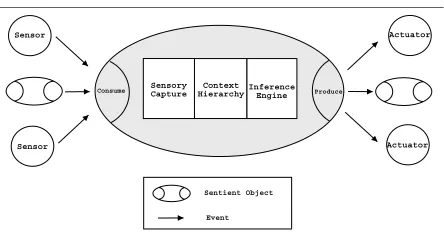
Essentially, asentient object is an encapsulated entity, with its interfaces being sensors and actuators. Actuation is controlled based on sensor input according to internal con-trol logic, consisting of event filtering, sensor fusion and
Sensory Capture
Context Hierarchy
Inference Engine
Consume Produce
Sentient Object Event
Actuator Sensor
Sensor
[image:2.612.325.547.67.186.2]Actuator
Figure 1. Sentient object model
intelligent inference, as illustrated in Figure 1. In the sen-tient object model, sensors are defined as entities that pro-ducesoftware events in reaction to a real world stimulus, whilst actuators are defined as entities whichconsume soft-ware events and react by attempting to change the state of the real world in some way via some hardware device.
2.1. Sentient object internals
The sentient object model is based on the notion of context-awareness, where context is defined as any infor-mation sensed from the environment which may be used to describe the situation of a sentient object. Context aware-ness depends on the accurate extraction, combination and interpretation of information from a variety of unreliable, multi-modal sensors and sentient objects are composed of 3 major internal components which provide these functions:
2.1.1. Sensory capture and context fusion The sensory
capture component of a sentient object performssensor fu-sionin order to manage uncertainty of sensor data and de-rive higher level context information from multi-modal data sources.
A probabilistic sensor fusion scheme is employed, based upon Bayesian networks [10], which provides a power-ful mechanism for measuring the effectiveness of deriva-tions of context from noisy sensor data. A Bayesian net-work graph allows us to manage the exponential increase in the size of a joint probability distribution over a set of ran-dom variables, by exploiting conditional independence. Us-ing Bayesian networks to model the uncertainty of sensor data and the dependencies between a set of sensors, gives us the ability to efficiently reason about the truth of a hy-pothesis, given evidence from a set of sensors.
2.1.2. Context hierarchy The overall context of a
Drive to point x
Cruise Avoid Obstacle Obey traffic light
Evasive
maneuver Decelerate Accelerate
Major Context Mission Context
[image:3.612.84.304.71.134.2]Sub Context
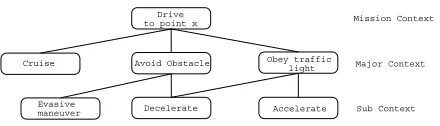
Figure 2. Subset of the context hierarchy for a simple sentient car
exist is represented as a hierarchy, based upon the Context-Based Reasoning (CxBR) paradigm [11].
This paradigm derives its name from the idea that the ac-tions taken by an entity are highly dependent on the entity’s current context, i.e., a recognized situation defines a set of appropriate actions and the identification of a future situa-tion is simplified if all possible acsitua-tions are limited by the current situation itself. CxBR is based on the following hy-potheses [11]:
1. Small, but important portions of all available environ-mental inputs are used to recognise and treat the key features of a situation
2. There are a limited number of things that can realisti-cally take place in any situation
3. The presence of a new situation will generally require alteration of the present course of action to some de-gree
The context hierarchy encapsulates knowledge about ac-tions to be taken and possible future situaac-tions into contexts. By defining a hierarchy of contexts in which a sentient ob-ject may exist and by associating specific actions to be un-dertaken in each context, a sentient object’s behaviour is in-fluenced by its context.
An example context hierarchy for a simple sentient model car is illustrated in Figure 2. The mission con-text captures actions common to all concon-texts whilst a major context captures actions common to a set of sub con-texts which in turn are usually actions with a short lifetime which change rapidly. Only one mission, ma-jor and sub context is active at any point in time which limits the actions possible and therefore the rules applica-ble and in need of evaluation. For example, in the sentient car when the major contextAvoid Obstacle, and sub
con-text Decelerate are active, rules and actions associated
with other major and sub contexts do not need to be eval-uated, which increases the efficiency of the inference pro-cess.
Treating context as a hierarchy helps to manage the com-plexity of development by reducing the problem to devel-oping a set of ’contexts’. Within each context only a sub-set of the overall rule-base of the system needs to be
spec-ified which in turn reduces the complexity of rule develop-ment.
2.1.3. Inference engine Sentient objects are made
context-aware by using conditional rules to specify ap-plication behaviour in different contexts, in other words the objects follow an Event-Condition-Action execu-tion model [8].
The inference engine component is responsible for changing application behaviour according to context and leverages the existing capabilities of the CLIPS (C Lan-guage Integrated Production System) production sys-tem language [12]. CLIPS contains an inference engine built into the language which given a set offacts, and pre-definedrules, is able to decide which rule to fire. Intelli-gence and the ability to react to changing contexts is added to the object through the specification of a set of produc-tion rules.
CLIPS’ suitability for integration into reactive sentient applications is explained by [8] as: (1) the expressive power of CLIPS permits specification of complex relations of event patterns; (2) its built-in inference engine implements the RETE [13] algorithm, a very efficient mechanism to solve the many-to-many matching problem; (3) CLIPS is designed for full integration and extensibility with procedu-ral languages such as C++ and Java.
The context hierarchy increases the efficiency of the in-ference engine by introducing the notion of anactive con-text. Within the context hierarchy, only one context is active at any point in time and within this context, only a subset of the overall rules governing the objects behaviour are active. This derives from the hypothesis that there are only a lim-ited number of things that can realistically take place in any situation, and by limiting the number of actions permitted in specific contexts, the efficiency of production-rule based inference is increased substantially. Rule based inference is typicallyO(n), wherenis the number of rules in the sys-tem but the introduction of the context hierarchy improves this toO(k)wherek is the average number of rules in an active context andk < n[11]. Experiments [14] demon-strated that the introduction of a context hierarchy reduces the overall number of rules needed for inference, as well as speeding up the process.
2.1.4. Sensor fusion and the context hierarchy The fact
that only a small portion of sensory input is relevant at any point in time is used to enhance the effectiveness of the probabilistic sensor fusion scheme by limiting the number of nodes in the sensor fusion network in each context.
Bayesian Network Mission Context
Major Context
Sub Context
Sensor 1 Sensor n
[image:4.612.81.302.69.215.2]Physical Environment Raw Data Context Fragments
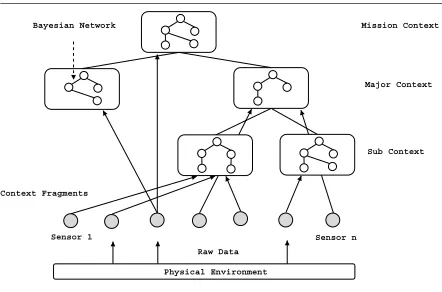
Figure 3. Sensor fusion in the context hierar-chy
fusion at the level of a context within the context hierar-chy. A context defines which sensors are relevant to that context as well as those which must be monitored in order to detect when transition to another context is indicated. A Bayesian network is constructed within each context in or-der to fuse the fragments of context information obtained from the sensors. The integration of Bayesian network frag-ments into the context hierarchy is illustrated in Figure 3. This figure shows how each context in the hierarchy is only interested in a subset of the sensor input, and Bayesian net-work fragments within each context act to fuse the context fragments obtained from the relevant sensors.
2.2. Event based communication
Event-based communication is well-suited for mobile applications where communication relationships amongst application components are established dynamically during the lifetime of the application [5]. STEAM (Scalable Timed Events And Mobility) is a location-aware event-based mid-dleware service designed specifically forad-hoc wireless networking environments. STEAM differs from other dis-tributed event middleware in that it does not depend on any fixed communication infrastructure and event notifications may be bounded based on geographical location.
STEAM contains no centralized components and pro-vides a number of types of filter to control propagation of events through the system. In addition to subject and con-tent filters, STEAM providesproximityfilters which define the geographical validity of an event.
3. The sentient object programming model
We provide a programming model, based on the sentient object model and incorporating the STEAM event service,
which provides abstractions for the development of mobile, context-aware applications.
3.1. Programming sensors and actuators
Sensors are developed as software abstractions that pro-duce STEAM events, whilst actuators are developed as ware abstractions that consume STEAM events. These soft-ware components encapsulate and act as wrappers for hard-ware and softhard-ware sensors and provide mappings between specific sensor protocols and proprietary data formats, and STEAM events. Sensors provide a uniform interface to sen-sory information through STEAM events, and hide details of the underlying sensing technologies.
Actuators extend from STEAMconsumerentities which export an API for subscription management. Actuators con-sume STEAM events according to active subscriptions and filters, and transform the information contained within these events, to specific hardware or software commands. Actua-torssubscribeto event types of interest based on a set of event filters.
In addition to the class file, each sensor and actuator also contains an XML description file, which contains infor-mation about the events produced or consumed, as well as probabilistic information regarding the uncertainty of each event.
3.2. Programming sentient objects
Sentient objects are developed using a graphical devel-opment tool which allows developers to specify relevant sensors and actuators, define fusion networks, specify con-text hierarchies and production rules, without the need to write any code.
3.2.1. Specifying inputs and outputs Specification of
in-puts to the object is done simply through ’drag and drop’ from libraries which contain XML descriptions of sensors and sentient objects. Each descriptor describes the name and type of each STEAM event produced by the sensor or ob-ject. Outputs are specified in the same way, with descrip-tors available describing the events consumed by the actu-ator or object. Much of the programming effort is concen-trated in the specification of the logic of the object.
3.2.2. Specifying contexts Specification of the context
In effect, a context acts as a composite event filter -whilst it is active, only those events which are defined as being of interest in that context are delivered to the object.
A context defines the behaviours which are appropriate within the context by specifying the set of production rules which are active, and consequently evaluated, in each con-text. The fact that only a subset of sensor inputs and produc-tion rules needs to be considered for each individual con-text aids in reducing the complexity of developing concon-text- context-aware applications.
3.2.3. Specifying fusion services Fusion services within
sentient objects are defined at the level of a context, using Bayesian networks. The tool allows the user to specify a Bayesian network for fusing fragments of context data on a per-context basis, via an intuitive graphical network builder. The network is constructed by defining the events of in-terest and their relationships by adding nodes and arcs in an interactive manner. The probabilities of all root nodes are then specified and a conditional probability table (CPT) is constructed for each non root node. These tables capture prior probabilities of events and rely on the a priori avail-ability of probavail-ability data. This may be determined through experimental evidence as was done for ultrasonic sensors in the development of our sentient model car, where the probability distribution that an arbitrary sensor reading was within a specified threshold was calculated based on exper-imental observation.
3.2.4. Specifying rules The complexity of specifying
ef-fective rules and knowledge bases is one of the greatest challenges in context-aware application development. Stient objects make use of an embedded CLIPS inference en-gine, but CLIPS syntax is complex and not easily assim-ilated by the majority of developers. We attempt to make knowledge capture more accessible to domain experts by providing a high level, graphical rule builder, allowing the definition of application behaviour at the level of a context, and hiding the complexities of CLIPS syntax from the user.
4. Conclusion
In this paper we have presented a framework, based on the sentient object model, for developing context-aware ap-plications in a mobile, ad-hoc environment. Our framework provides a systematic approach to context-aware applica-tion development, including the ability to fuse context frag-ments and deal with uncertainty in a probabilistic man-ner, the ability to represent context within the application, and the ability to easily compose rules to reason efficiently about context. This functionality is offered in a tool which is easily accessible to a wide range of developers, permitting the rapid design and development of applications, based on sentient objects, for ubiquitous computing environments.
We have successfully applied our framework to the develop-ment of a number of proof-of-concept applications, includ-ing a simple sentient model car application which drives and obeys traffic signals autonomously.
References
[1] Albrecht Schmidt, Kofi Asante Aidoo, Antti Takaluoma, Urpo Tuomela, Kristof Van Laerhoven, and Walter Van de Velde. Advanced Interaction in Contextin Handheld and Ubiquitous Computing Springer-Verlag, pp. 89-101, 1999.
[2] Mike Addlesee, Rupert Curwen, Steve Hodges, Joe Newman, Pete Steggles, Andy Ward, Andy HopperImplementing a Sen-tient Computing System IEEE Computer Magazine, Vol. 34, No. 8, pp. 50-56, August 2001.
[3] Diego L´opez de Ipi˜na, Paulo Mendona and Andy Hopper TRIP: a Low-Cost Vision-Based Location System for Ubiq-uitous Computing Personal and Ubiquitous Computing jour-nal, Springer, vol. 6, no. 3, pp. 206-219, May 2002.
[4] George H. Forman, John ZahorjanThe Challenges of Mobile ComputingIEEE Computer, 27(6), April 1994.
[5] Ren´e Meier and Vinny Cahill Exploiting Proximity in Event-Based Middleware for Collaborative Mobile Applications in Proceedings of the4thIFIP International Conference on Dis-tributed Applications and Interoperable Systems (DAIS’03). Paris, France: Springer-Verlag Heidelberg, Germany, 2003. [6] Anind K. Dey and Tim SohnSupporting End User
Program-ming of Context-Aware Applications Conference on Human Factors in Computing Systems (CHI) Workshop on Perspec-tives in End User Development, Fort Lauderdale, FL, April 5-10, 2003.
[7] Anind K. Dey, Daniel Salber and Gregory D. AbowdA Con-ceptual Framework and a Toolkit for Supporting the Rapid Prototyping of Context-Aware ApplicationsHuman-Computer Interaction (HCI) Journal, Volume 16 (2-4), pp. 97-166, 2001. [8] Diego L´opez de Ipi˜na An ECA Rule-Matching Service for Simpler Development of Reactive Applications in Proceed-ings, Middleware 2001 Vol. 2, No. 7, November 2001. [9] Manuel Rom´an, Christopher K. Hess, Renato Cerqueira,
Anand Ranganathan, Roy H. Campbell, and Klara Nahrstedt Gaia: A Middleware Infrastructure to Enable Active Spaces in IEEE Pervasive Computing, pp. 74-83, Oct-Dec 2002. [10] Judea Pearl Bayesian Networks Handbook of Brain Theory
and Neural Networks, MIT Press, 2001.
[11] Avelino J. Gonzalez, Robert Ahlers Context-Based Rep-resentation of Intelligent Behaviour in Training Simulations Transactions of the Society for Computer Simulation Interna-tional, Vol. 15, No. 4, March 1999.
[12] NASA CLIPS: A Tool for Building Expert Systems
http://www.ghg.net/clips/CLIPS.html [13] Forgy, C.L Rete: A Fast Algorithm for the Many Pattern/
Many Object Pattern Match Problem Artificial Intelligence 19, pp. 17-37, 1982.