Feature-Based Analyses to Guide Mobile Software Engineers
Afnan A. Al-Subaihin
A dissertation submitted in fulfilment of the requirements for the degree of
5
Doctor of Philosophy
of
University College London
University College London
Department of Computer Science
10
Centre for Research on Evolution, Search and Testing
Student funded by King Saud University, Saudi Arabia.
I, Afnan A. Al-Subaihin confirm that the work presented in this thesis is my own. Where information
15
has been derived from other sources, I confirm that this has been indicated in the thesis. Parts of this document have been published in the following papers:
• Chapter 3 is published as: A. A. Al-Subaihin, F. Sarro, S. Black, L. Capra and M. Harman, “App Store Effects on Software Engineering Practices," in IEEE Transactions on Software Engineering (TSE), 2019. (Early Access). DOI: 10.1109/TSE.2019.2891715.
20
• Chapter 4 is published in: A. A. Al-Subaihin, F. Sarro, S. Black, L. Capra, M. Harman, Y. Jia, and Y. Zhang, “Clustering mobile apps based on mined textual features," in Proceed-ings of the 10th ACM/IEEE International Symposium on Empirical Software Engineering and Measurement, ser. ESEM’16. New York, NY, USA: ACM, 2016, pp. 38:1-38:10. DOI: 10.1145/2961111.2962600.
25
• Chapter 5 is to appear as: A. A. Al-Subaihin, F. Sarro, S. Black and L. Capra, “Empirical Comparison of Text-Based Mobile Apps Similarity Measurement Techniques," in Empirical Software Engineering (EMSE). (To appear).
• Chapter 6 is part of this publication: F. Sarro, A. Al-Subaihin, M. Harman, Y. Jia, W. Martin, and Y. Zhang, “Feature Lifecycles as They Spread, Migrate, Remain and Die in App Stores," in
30
2015 23rd IEEE International Requirements Engineering Conference. IEEE, Aug. 2015. DOI: 10.1109/RE.2015.7320410.
This PhD thesis: the culmination of years of continuous learning and hard work, barely merits its
35
name without the tremendous effort of my supervisors, mentors, family and friends, to whom I would like to express my sincerest gratitude.
Supervisors guided me through this journey with generous support, gracious mentorship and extreme patience. A favourite writer of mine, Maria Popova, writes: “Few things reveal your intellect and your generosity of spirit - the parallel powers of your heart and mind - better than how you give
40
feedback," and I have been immensely lucky to have four mentors who possessed both. They have been role-models to whom I look up and whose academic path I aspire to follow: Federica Sarro, Mark Harman, Sue Black and Licia Capra. Thank you.
In times when this journey seemed more challenging, my family’s steadfast support kept me afloat. Their constant faith in me, even when mine was faltering, has been a rock on which I invariably
45
relied in times of self-doubt. My parents and my siblings: Thank you.
Finally, I would not have been able to do this PhD without the funding granted by King Saud University in Riyadh, Saudi Arabia. In addition to the the efforts of the staff at the Saudi Arabian Cul-tural Bureau in the UK who liaised with the financial sponsor and offered continuous aid to students. Thank you.
Mobile app stores are becoming the dominating distribution platform of mobile applications. Due to their rapid growth, their impact on software engineering practices is not yet well understood. There has been no comprehensive study that explores the mobile app store ecosystem’s effect on software engineering practices. Therefore, this thesis, as its first contribution, empirically studies the
55
app store as a phenomenon from the developers’ perspective to investigate the extent to which app stores affect software engineering tasks.
The study highlights the importance of a mobile application’sfeaturesas a deliverable unit from developers to users. The study uncovers the involvement of app stores in eliciting requirements, perfective maintenance and domain analysis in the form of discoverable features written in text form
60
in descriptions and user reviews. Developers discover possible features to include by searching the app store. Developers, through interviews, revealed the cost of such tasks given a highly prolific user base, which major app stores exhibit.
Therefore, the thesis, in its second contribution, uses techniques to extract features from un-structured natural language artefacts.
65
This is motivated by the indication that developers monitor similar applications, in terms of pro-vided features, to understand user expectations in a certain application domain. This thesis then devises a semantic-aware technique of mobile application representation using textual functional-ity descriptions. This representation is then shown to successfully cluster mobile applications to uncover a finer-grained and functionality-based grouping of mobile apps. The thesis, furthermore,
70
provides a comparison of baseline techniques of feature extraction from textual artefacts based on three main criteria: silhouette width measure, human judgement and execution time.
Finally, this thesis, in its final contribution shows that features do indeed migrate in the app store beyond category boundaries and discovers a set of migratory characteristics and their relationship to price, rating and popularity in the app stores studied.
This research inspects mobile app stores as a source of data mining to aid software engineering tasks. It furthermore focuses on software features as a unit of analysis when mining from app stores.
First, we bridge the gap between the software engineering research community and mobile
80
software engineering with regards to their interaction with mobile app stores. This has been accom-plished using a survey-based exploratory study employing first and second-degree data collection methods from mobile app developers. We summarise the findings under three main themes: en-hanced communication among developers and users, increased market transparency and altered mobile release strategies. This understanding enriches the empirical software engineering research
85
literature with better understanding of the ecosystem’s involvement in mobile software engineers’ practices. This can help guide future research in mining software repositories, requirements en-gineering and the business community as it provides a roadmap of practitioners’ needs from data found in app stores throughout the evolution of their mobile apps. The findings of the survey may also inform managers of app development projects and their developers.
90
Based on certain results of the previous exploratory study, this research employs a feature extraction technique that can be carried out over natural language and does not require access to the source code, as it is hard to be obtained from mobile app stores. The extracted features were then employed to carry out several software engineering research tasks guided by the needs of developers found in the aforementioned study.
95
Firstly, these features were used in app representation in order to find underlying, functionality-based clustering of mobile apps using a novel semantically-aware technique that enhances over the typical baseline. The devised algorithm provides both business and technical value as developers may use it to find similar applications, from which they can explore the application domain and inves-tigate desired supporting feature sets. Several feature extraction algorithms are further invesinves-tigated
100
to observe their applicability for detecting the similarity of mobile applications.
Secondly, These features’ migratory behaviour over app stores categories is then analysed to guide developers in making decisions of whether features carry any transitive value and therefore can be adopted.
1 Introduction 13 2 Literature Review 15 2.1 Introduction . . . 15 2.2 Software Features . . . 15 2.2.1 Feature Modelling . . . 17 110 2.2.2 Feature Location . . . 17
2.2.3 Feature Extraction from Natural Language . . . 19
2.3 Automatic Software Categorization . . . 24
2.3.1 Categorization of Software . . . 25
2.3.2 Categorization of Mobile Applications . . . 27
115 2.4 App Store Analysis . . . 33
3 App Store Effects on Software Engineering Practices 35 3.1 Introduction . . . 35 3.2 Related Work . . . 38 3.3 Methodology . . . 40 120 3.4 Study Design . . . 41 3.4.1 Research Questions . . . 42 3.4.2 Interviews . . . 43 3.4.2.1 Protocol . . . 43 3.4.2.2 Participants . . . 44 125 3.4.2.3 Data Analysis . . . 46 3.4.3 Questionnaire . . . 47 3.4.3.1 Design . . . 48 3.4.3.2 Participants . . . 49 3.4.3.3 Data Analysis . . . 49 130 3.5 Findings . . . 51
3.5.1 Interview Analysis Results . . . 52
3.5.2 RQ1: Lifecycle Processes . . . 53
3.5.2.1 Requirements Elicitation . . . 53
3.5.2.2 Testing . . . 54
135 3.5.2.3 Maintenance . . . 56
3.5.2.4 Release Management . . . 59
3.5.3 RQ2: Emerging Skill-sets and Best Practices . . . 60
3.5.4 RQ3: New Success Criteria and Performance Measures . . . 61
3.6 Discussion . . . 62
140 3.6.1 Developer-User Interaction . . . 62
3.6.2 Market Transparency . . . 63
3.6.3 Release Planning and Quality . . . 64
3.7 Threats to validity . . . 65 3.7.1 Construct Validity . . . 65 145 3.7.2 Internal Validity . . . 65 3.7.3 External Validity . . . 65 3.8 Conclusions . . . 66
4 Feature-Based Mobile App Categorization 67 4.1 Introduction . . . 67 150 4.2 Approach . . . 68 4.2.1 Feature Extraction . . . 69 4.2.2 Feature Clustering . . . 69 4.2.2.1 Feature Representation . . . 70 4.2.2.2 Selecting K . . . 71 155 4.2.2.3 Final Clustering . . . 71 4.2.3 App Clustering . . . 72 4.2.3.1 App Representation . . . 72
4.2.3.2 Selecting Clustering Technique . . . 72
4.3 Empirical Study Design . . . 72
160 4.3.1 Research Questions . . . 72 4.3.2 Dataset . . . 75 4.3.3 Evaluation Criteria . . . 75 4.4 Results Analysis . . . 76 4.5 Threats to Validity . . . 84 165 4.6 Conclusions . . . 84
5 Comparison of Feature Extraction Techniques for App Clustering 88 5.1 Introduction . . . 88
5.2 Empirical Study Design . . . 89
5.2.1 Text Representation Techniques . . . 89
170 5.2.1.1 Vector Space Model . . . 90
5.2.1.2 Latent Dirichlet Allocation . . . 90
5.2.1.3 Feature Vector Space . . . 91
5.2.2 Research Questions . . . 93
5.2.3 Dataset . . . 94
175 5.2.4 Evaluation Criteria . . . 94
5.3 Empirical Study Results . . . 95
5.4 Discussion . . . 100
5.5 Threats to Validity . . . 101
5.6 Conclusions . . . 101
180 6 Feature Migration in the Samsung App Store 103 6.1 Introduction . . . 103
6.2 Overview of Feature Migratory Behaviour . . . 104
6.3 Empirical Study Design . . . 105
6.3.1 Dataset . . . 105
185 6.3.2 Research Questions . . . 106
6.3.3 Methodology . . . 106
6.4 Results Analysis and Discussion . . . 107
6.4.1 RQ0. Feature Evolution . . . 107
6.4.2 RQ1. Feature Migration . . . 107
190 6.4.3 RQ2. Differences in Migratory Behaviours . . . 107
6.4.4 RQ3. Correlations among Price, Popularity and Rating . . . 110
6.5 Threats to Validity . . . 110
6.6 Conclusions . . . 116
7 Conclusion and Future Work 118
195
Appendices 120
A Questionnaire - App Store Ecosystems Effects 120
3.1 The various stages of the study. . . 36
200
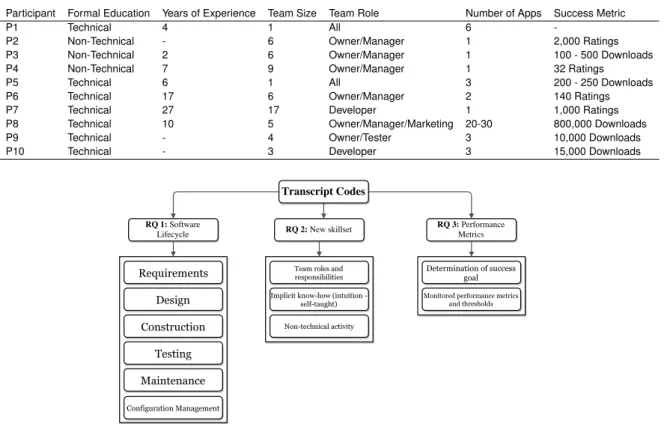
3.2 Interview design: The topics planned for discussion and the questions answered within. The dotted line resembles an example of topic flow in one interview. No struc-ture is enforced and the questions were discussed as the respondent moved freely from one topic to another. . . 44 3.3 Transcript raw data codes used to tag responses: These codes represent recurring
205
topics and certain responses of interest. This is the first stage of interview analysis. The codes and their content are then used to deduce themes in Figure 3.6 . . . 46 3.4 Histograms depicting the distribution of the various demographical information of the
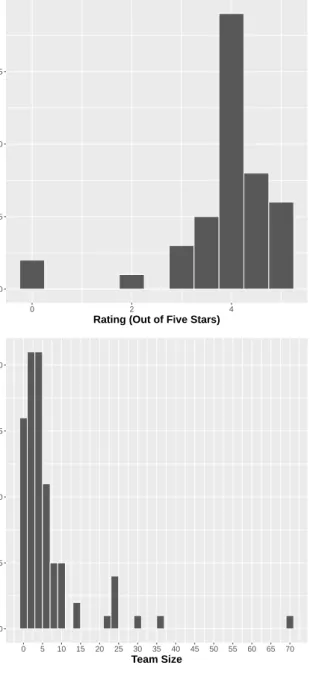
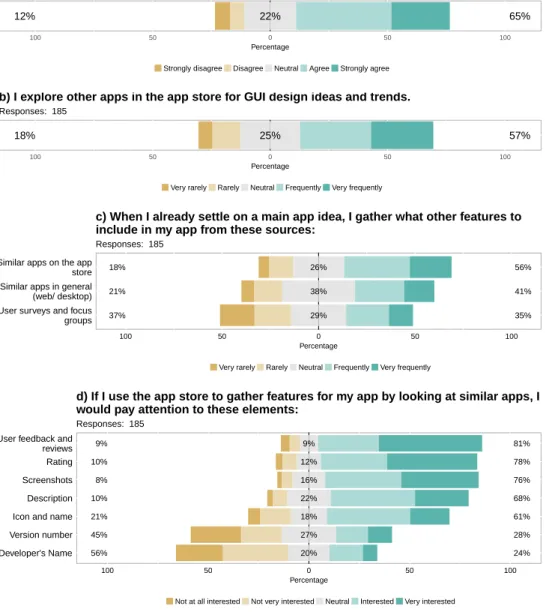
questionnaire’s respondents. . . 50 3.5 RQ1. Responses to questions regarding the initial phases of development. . . 51
210
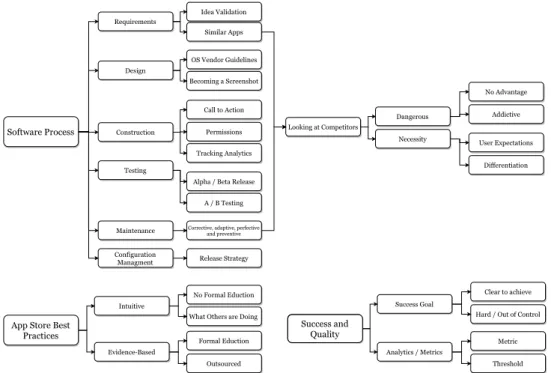
3.6 Thematic analysis findings in the form of a theme map. The theme map summarizes the data patterns found in the interview transcripts relating to the research questions. 53 3.7 RQ1. Responses to questions regarding the testing phase. . . 55 3.8 RQ1. Responses to questions regarding the usefulness of user feedback. . . 55 3.9 RQ1. Responses to questions regarding the usefulness of user feedback for
correc-215
tive maintenance. . . 56 3.10 RQ1. Responses to questions regarding the usefulness of user feedback for
perfec-tive maintenance. . . 58 3.11 RQ1. Responses to questions regarding the effect of app store to release strategy. . 59 3.12 RQ2. Responses to questions regarding the type of activities and skills required in a
220
development team. . . 60 3.13 RQ3. Responses to questions regarding the knowledge of success factors in the app
store. . . 62 4.1 Feature Extraction and the Two-Phase Clustering System Architecture . . . 69 4.2 Dendrogram of the resulting agglomerative hierarchical clustering using cosine
dis-225
similarity and Ward’s criterion. . . 73 4.3 RQ 1. The silhouette width for each category in the existing categorisation of the
BlackBerry and Google datasets. . . 77 4.4 RQ2.1 The average silhouette width for the different number of segments in
Black-Berry and Google dataset. . . 80
4.5 (Middle) The average silhouette score for each existing commercial category in the BlackBerry app store when measured using our app representation technique (RQ1). As an example, we zoom in the Utilities category (which exhibits a low current avg. silhouette) and the News & Magazines category (which has a relatively high current avg. silhouette). The left- and right-hand sub-figures illustrate how our approach can
235
be used to uncover the clustering within each category (RQ2.2). . . 82 4.6 RQ2.2. Refining the existing BlackBerry app store categorisation by sub-clustering
each category and observing how the average silhouette scores behaves as the gran-ularity increases. Thexaxis is the granularity whereas theyaxis is the achieved av-erage silhouette for that granularity. For each category, the dotted line is the current
240
average silhouette score for the category’s members in relation of the entire app store. 85 4.7 RQ2.2. Refining the existing Google app store categorisation by sub-clustering each
category and observing how the average silhouette scores behaves as the granularity increases. Thex axis is the granularity whereas the yaxis is the achieved average silhouette for that granularity. For each category, the dotted line is the current average
245
silhouette score for the category’s members in relation of the entire app store. . . 86 5.1 RQ2.1. Average silhouette score as the granularity (k) increases for each technique. . 98 6.1 The Feature Migration Subsumption Hierarchy. . . 105 6.2 RQ1. Observed Number of Features for each Migratory Behaviour for the Samsung
App Store. . . 108
250
6.3 RQ2. Boxplots of Mean Price, Rating and Popularity (Rank of Downloads) for each of the non-migratory behaviours. . . 109 6.4 RQ2. Boxplots of Median Price, Rating and Popularity (Rank of Downloads) for each
of the non-migratory behaviours. . . 109 6.5 RQ3. Scatterplot of Mean Price (P), Rank of Downloads (D) and Rating (R) for the
255
migratory behaviours (W)eak (M)igration and (N)o (M)igration . . . 112 6.6 RQ3. Scatterplot of Mean Price (P), Rank of Downloads (D) and Rating (R) for the
migratory behaviours (I)ntransitive and (S)trong (M)igration. . . 113 6.7 RQ3. Scatterplot of Mean Price (P), Rank of Downloads (D) and Rating (R) for the
migratory behaviours (W)eak e(X)tinction and (S)trong e(X)tinction. . . 114
260
6.8 RQ3. Scatterplot of Median Price (P), Rank of Downloads (D) and Rating (R) for all the features. Please, note that we grouped the points based on their median values. 114 6.9 RQ3. Scatterplot of Median Price (P), Rank of Downloads (D) and Rating (R) for the
non-migratory behaviours I, WX, SX. Please, note that we grouped the points based on their median values. . . 115
3.1 The set of interview questions. . . 45 3.2 Demographical data of the developers interviewed. . . 46 4.1 Examples of extracted featurelets representing each feature and the number of times
these features appear in the dataset (number of apps that boast the feature) for both
270
Blackberry and Google datasets. . . 70 4.2 RQ1. Summary measures (Min, Max, Mean and Median) of the silhouette widths of
existing categories and those achieved when applying our clustering approach using as granularity the number of existing categories in the stores considered. . . 78 4.3 RQ2.1. Comparing the individual element’s silhouette widths of: The current quality
275
of the existing categorisation, our clustering reusing existing coarse granularity, and our clustering using the maximum viable granularity. . . 78 4.4 RQ2.2. Categories, their size, and granularity level that provides the highest silhouette
width for each app store category when sub-clustered. . . 79 4.5 RQ3. App pair examples and the feature terms that they share selected from the
280
feature cluster prototype. . . 81 4.6 RQ3. The Spearman rank correlation coefficient (ρ) between each of the raters
sim-ilarity scores of pairs of apps and the finest granularity that these apps remain clus-tered together before they separate. All reported coefficients havep−values<0.001. 83 4.7 RQ4. Computation time of tasks in our framework. The first two tasks are up-front
285
costs. . . 83 5.1 Examples of extracted topics (represented by 4 terms) and the number of apps
asso-ciated with each topic (occurrences). . . 91 5.2 Examples of extracted featurelets representing each feature and the number of times
these features appear in the dataset (number of apps that boast the feature) for
290
collocation-based and dependency-based parsing. . . 93 5.3 RQ0. Jaccard similarity index between each of the clustering solutions of the studied
techniques for 24 clusters (the number of app store categories). . . 96 5.4 RQ1. Summary of silhouette width scores for each of the techniques when
consid-ering app store category as a cluster assignment (existing categorisation) and when
295
selectingk=24(same number of categories in the app store). . . 97 5.5 RQ2.1. For each technique, the maximum viable granularity and the generated
5.6 RQ3. Inter-rater agreement of the obtained goldset (8 raters) on the three rating
criteria using intra-class correlation. . . 99
300 5.7 RQ3. Spearman Rank correlation scores (p-value in brackets) between hierarchical sampling level (technique-assigned similarity) and human-assigned similarity scores. Scores are deemed statistically significant if p-value<0.01. . . 99
5.8 RQ4. Efficiency of each of the studied techniques. The technique’s run-time was mea-sured on a standard laptop with an Intel Core i7 3.1 GHz and 16 GB RAM; d=days, 305 h=hours, m= minutes, s=seconds. . . 100
6.1 Summary Data for the Samsung Apps Studied Between Two Time Intervals. . . 105
6.2 RQ0. Number of features contained in a given category in the Samsung app store; and Jaccard Similarity (JS) of the initial and final categories over the time period. . . . 108
6.3 Wilcoxon Test Results: mean price. . . 110
310 6.4 Wilcoxon Test Results: mean rating . . . 111
6.5 Wilcoxon Test Results: mean rank of downloads comparison among the migratory behaviours. . . 111
6.6 Wilcoxon Test Results: Median Price. . . 111
6.7 Wilcoxon Test Results: median rating. . . 111
315 6.8 Wilcoxon Test Results: median rank of downloads. . . 112
6.9 RQ3. Raw Value Correlations. . . 113
6.10 RQ3. Median Price Point Correlations. . . 116
Introduction
In the quest to increase the value and usability of software (i.e. operating systems, browsers and office suites), vendors detected the value of establishing software ecosystems around the software platform [1]. A software ecosystem is an environment that facilitates the extension and customisation of said platform by external and/or internal developers to attract and satisfy the requirements of a
325
wide user-base [2][3]. Mobile operating system-based ecosystems are currently the major portals for acquiring mobile software [4] manifesting in their online deployment portals, referred to as ‘app stores’ in relevant literature and hereafter.
App stores are now a common channel that facilitates app deployment for developers and discovery for users. They house a vast amount of applications belonging to diverse application
do-330
mains; consolidating business, customer and technical information. Additionally, app stores provide an environment for user-user in addition to user-developer interaction. App stores, therefore, hold the potential of being a new software repository with large and various types of software meta-data and related artefacts that can aid empirical software engineering research.
App stores’ dominance over the mobile application deployment market, gives grounds to
con-335
jecture that they may influence software engineering practices of mobile app developers. App stores’ effect on software development activities is not yet well understood due to their relative novelty. An understanding of app developers’ practices and goals when dealing with app stores, and how they influence decision making throughout the development process, promises to guide further analysis and mining of information contained therein. This prompted the study reported in Chapter 3 as
340
an initial exploration of app stores as a new avenue of software repository mining. This empirical study views app stores as a global phenomena motivating the study of its effects using first and second-degree data collection methods. By interviewing and surveying mobile app developers, then analysing the gathered data, the study reports how app stores are affecting software engineering practices. Among the many findings reported, the study highlights how important developers deem
345
monitoring other similar apps to support the evolution of theirs, especially in terms of thefeatures
they include.
This is not surprising as the concept of feature in software engineering research, as well as practice, is central to many of the software engineer’s activities. Features are the unit of a software system that connect the problem domain to the solution domain. It is in the successful transformation
350
of user requirements into software features that an application fulfils its purpose. Features enable the modular extension and customisation of software and therefore garner much of the mobile software
engineer’s attention throughout out the software development cycle as found by this thesis’ first study.
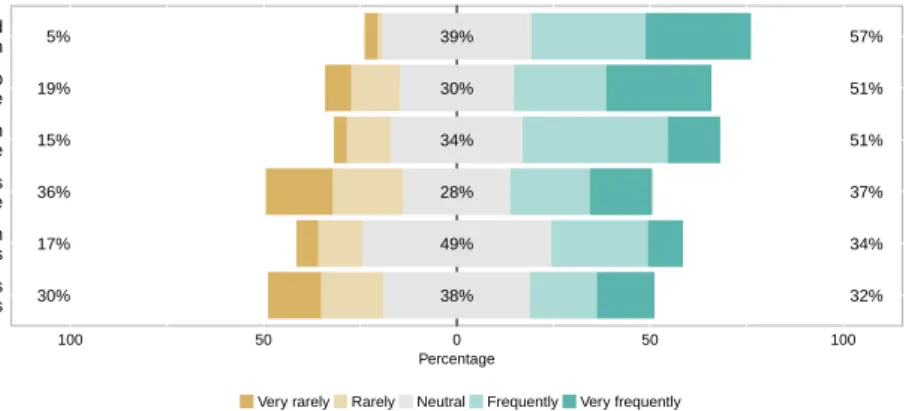
The study finds that 56% of surveyed developers elicit requirements from the features of other
355
similar apps in the app store (more so than other web/desktop applications or user surveys and focus groups). Furthermore, 68% of those respondents locate features by reading the app’s description. In the stage of perfective maintenance, the study reveals that 51% of respondents discover new fea-tures and enhancements by looking into similar apps. This highlights the integral role that feafea-tures play in the elicitation and design phases, in addition to the interaction between users and developers
360
in app stores. Subsequently, this thesis focuses on the analysis of features, extracted from natu-ral language, to aid in sevenatu-ral software engineering tasks; namely, app clustering based on those shared features (Chapter 4), how different feature extraction techniques perform for app represen-tation in the task of clustering (Chapter 5) and finally studying their migratory behaviours (Chapter 6).
365
This thesis, therefore, empirically studies mobile app stores and reveals their involvement in software engineering practices throughout the software life cycle, emerging new skill-sets and suc-cess metrics. Then, upon revealing how developers elicit requirements and perform perfective main-tenance from information available on the app store, this research embarks on quantifying the simi-larity between mobile apps for the task of clustering mobile application based on application features
370
expressed in natural language and studying feature movement behaviour in the app store.
The remainder of this document first presents a review of the literature pertaining to various aspects of this thesis (Chapter 2). Chapter 3 shall report an empirical study that observes the extent to which mobile app stores affect the practices of involved software engineers. Afterwards, Chapter 4 reports the design and evaluation of an investigation of whether apps can be clustered, based on
375
their textual features, to uncover hidden categorization of apps in app stores. Chapter 5 compares different common baseline feature extraction techniques from natural language and evaluate their adequacy for app similarity detection and clustering. Chapter 6 reports a study that classifies and detects feature migration behaviour in app store. Finally, Chapter 7 concludes the thesis.
Literature Review
2.1
Introduction
This chapter presents a report of the literature deemed related to various aspects of this thesis. Features (Section 2.2) appear in two main lines of research in software engineering. The first is their major role in capturing components of similarity and variability in domain analysis for product
385
line engineering (discussed in Section 2.2.1). Second is the feature location problem in software comprehension where features represent the unit of functionality in code that developers or system maintainers need to locate in order to enhance or fix the functionality (Section 2.2.2). After a brief overview of seminal work in these lines of research, a dedicated section (2.2.3) will revisit work that performed automatic feature extraction from various sources. Afterwards, a section is dedicated to
390
research on the problem of categorising software (Section 2.3). This research is related to this thesis as it involves a certain degree of comprehension of the underlying software or its artefacts to achieve an accurate classification and serves as a precursor to chapters 4 and 5. The final section briefly discusses app store analysis research with special emphasis on work that investigates software features (Section 2.4).
395
Conducting the literature review for each sub-section began with a few seminal papers relating with the respective sub-field. Then a snowballing technique was followed to identify related and similar research works. The author only selected the papers that extend, improve, and/or transfer the proposed technique in a way deemed relevant to this thesis; in addition to publications that proposed novel techniques to solve a similar problem. This literature review, aims to provide sufficient review of
400
related works to all several aspects of this thesis, though they may not strictly relate to one another. The literature review prioritises breath coverage over in-depth and therefore, the following sections are not comprehensive. However, Section 2.3 is exempt as the author aimed to review all literature concerned with categorising software. This has been conducted by using related look up terms on Google Scholar coupled with snowballing.
405
2.2
Software Features
A software feature is a concept understood by engineers, customers and end-users. This ubiquity of understanding caused a substantial attention in software engineering research.
However, the termfeatureitself is multi-faceted and may refer to slightly different things depend-ing on the research context. In the reviews of definitions mentioned in relevant literature presented
410
domain that represents a cohesive set of system functionality. The disagreement is observed with regard to its origin, whether it encapsulates non-functional requirements, the level of granularity of a feature towards functionalities, and the level of visibility to the user in the end product. These ulti-mately are implicitly agreed-upon depending on the software engineering line of work. For example,
415
in feature modelling, a feature is usually user-centric functionality that originates from the problem domain; whereas in feature location, a feature is exhibited in the solution domain and is typically a functional requirement that has a specific collection of statements that implement it.
One aspect of conflict in the definition of the termfeature is the origin and location in which it is observed. The origin of a feature maybe either in the problem domain or the solution domain [5].
420
Different lines of research adopt either of these views. In the line of work concerned with feature-oriented software engineering, features are a subset of system requirements. On the other hand, in the literature concerned with feature identification and location, features are assumed to be a subset of system implementation.
In defining the relationship between features and requirements, we observe two different
defini-425
tions as to whether a feature also represents non-functional requirements. The Institute of Electrical and Electronics Engineers (IEEE) defines the term feature in their829 Standard for Software and System Test Documentation[6] as “A distinguishing characteristic of a software item (e.g., perfor-mance, portability, or functionality)." Which draws a one-to-one mapping between a feature and both a functional or a non-functional requirement. On the other hand, the Guide to the Software
Engi-430
neering Body of Knowledge(SWEBOK) [7] synonymises it with functional requirementsas they
both represent a software capability that can be tested and verified. This particular definition is used in feature identification and location line of work, as it aims to identify the set of statements that implement a certain feature which can be impossible for non-functional requirements.
Another possible implicit constraint on the usage of the term ‘feature’ is its user-centrality. Turner
435
et al., surmises that features, as opposed to functionalities, are visible properties of a software system: They represent the set of functionalities that are specifically user-centric [5]. This particular aspect of the definition of features is observed when reading works pertaining to feature modelling. On the other hand, work on feature identification, not only disregards this aspect, but adds its own: a feature is a unit of functionality that is optional or incremental to the system [8].
440
This thesis views features as a unit of an application’s behaviour, expressed in natural lan-guage, that is both understood by developers and end users; regardless of the terminology used to communicate that feature.
Many advocate the use of features as first-class objects of the software development process. This can be found indomain engineering research where feature models are used to represent the
445
collective functionalities of applications in a certain application domain. Features also are the unit of analysis in theconcept assignment and identificationline of research which aims to reverse engineer code segments into their semantic feature counterparts. A point of interest to this research, in both these lines of work, is how features are extracted from existing software artefacts, automatically or otherwise.
450
In addition to a brief overview of publications in both previous research paradigms, this section will look into various feature extraction methodologies done in previous work.
2.2.1
Feature Modelling
Features play a main role in domain analysis and engineering. The use of features as first class objects in software development was first promoted by Kang et al. when they proposed Feature
Ori-455
ented Domain Analysis (FODA) and Feature Oriented Reuse Method (FORM) [9][10]. In their work, they view features as “distinctively identifiable functional abstractions that must be implemented, tested, delivered and maintained". They argue the need to give features more emphasis when analysing and designing domain specific applications. Their proposed method: FORM, is a method used to facilitate code re-use and minimize time to market in software product lines via the
construc-460
tion of feature models.
The goal of Feature modelling is to discover and model software similarity and variability in an application domain. It is the activity of constructing a hierarchical graph representing feature AND/OR relationships. Where an AND relationship conveys a mandatory feature and OR is for alternative features [11].
465
This method has been developed and extended resulting in Feature-Oriented Product Line Engineering [12] and Feature-Oriented Software Development (FOSD) [13]. Where defining an application via a unique collection of features is not only apparent in the design phase, but also carried out in subsequent system development stages [14]. In FOSD, software features are the first class entities when analysing, designing, implementing, or maintaining a software system. With the
470
maturity of these methods, the term ‘feature’ reaches a consensus in definition [13][15], where it is viewed to carry three distinctive characteristics:
1. A feature is a logical grouping of a set of requirements, 2. it is prominent and user-visible, and
3. has an incremental quality and usually used to extend a system’s functionality.
475
Constructing feature models, although highly rewarding, proved to be a difficult and costly task. Due to its relation with the domain at large, it is highly time consuming. Additionally, research shows that it is susceptible to the engineer’s experience and background. Consequently, subsequent efforts shifted towards facilitating the formation of feature models from existing software. These efforts looked into automatic extraction of features and their relationships from different software artefacts.
480
Extraction sources include requirements documentation [16][17][18][19], use cases [20] and product descriptions [21][22][23][24].
2.2.2
Feature Location
Feature location(also known as concept location) is the activity of identifying the subset of code that implements a certain functionality. Essentially, it is a problem of linking system modules, expressed
485
in code, to human-oriented, context-rich form expressed in natural language (usually known in ad-vance) [25]. Naturally, this line of work views a feature as user-viewable realization of a functional requirement; excluding non-functional requirements due to the nature of the problem. Feature lo-cation is an important step for code maintenance as every code modifilo-cation starts with locating the code that needs to be changed. Establishing this mapping aims to enhance practitioner’s
un-490
derstanding of the system which greatly facilitates subsequent system maintenance and evolution tasks [26].
Feature identification and location is closely related toreverse engineeringwhich aims to anal-yse a system to uncover its components and their interdependence to finally synthesize alternate forms of representations [27]. Another closely related research area is requirements traceability,
495
which aims to link features in several design artefacts. Feature location, the focus of this section, is only concerned with linking source code sections with the functionality they implement. It mainly enhancessoftware comprehension by providing faster and more reliable way of finding code than basic text searching techniques such asgrep; which has been found by Sim et al. [28] to be very commonly used for searching code.
500
Methods proposed, thus far, to carry out feature location employ static or dynamic code analy-sis. Other methods look into historical data such as mining version control systems. These methods also vary in terms of the type of user input required to carry out the task. This can be: a natural language query describing the feature, an execution scenario proposed by the developer to run a feature, or a source code point that is used as a starting point for the location process [8]. The
505
returned result also varies in terms of granularity. Approaches available return location either at the file/class, method/function or statement level.
One of the earliest efforts towards feature location is Software Reconnaissance by Wilde et al. [29][30]. Their work provide adynamic analysisof code to identify features using two sets of test cases: Test cases that exercise this feature, and test cases that do not. Then they formally
510
define sets of components according to their relationship to the feature to be located. The sets in-clude: common components, potentially involved components, indispensably involved components and unique components. Common components are those components invoked by most features. Potentially involved components are components that were executed in at least one test case involv-ing that feature. An indispensably involved component is a more specific type where the component
515
is called in every test case that covers the feature. Lastly, a unique component is a component that is exercised only in test cases that exhibit the feature. This method has many shortcomings, mainly its failure to identify main features that are present in all system procedures since it can be impossible to generate test cases that do not include that feature. Furthermore, this method cannot guarantee the identification of all locations associated with the feature. However, it succeeds in reducing the
520
search space for the developer. This work sets the foundation of using execution traces from test scenarios which is heavily extended in subsequent research [31][32].
The majority of dynamic analysis techniques takes as input ascenario. A scenario is the set of steps taken by the user to trigger a certain feature [33].
Feature location was also attempted using static analysis methods. These methods do not
525
require the execution of any of the code, making it possible to perform feature location with code that is not entirely compilable. Manual or automatic analysis of the code is used to generate system structure graphs, augmented with other system artefacts, these are used to locate feature implemen-tation locations. Attempts employing static analysis of the code used System Dependence Graphs [34][35], concern graphs [36], method call graphs [37] and static data-flow analysis [38]. In terms
530
of input, most of these techniques require a program element from the user, it uses it as a starting point from which the analysis starts of the structure graph of choice.
Other feature location techniques usedtextual analysisof the code and possibly other software artefacts. This approach relies on user’s input as a natural language query then establishing the
connection using information retrieval (IR) or natural language processing (NLP) techniques.
535
Among the first to employ information retrievalto solve the concept assignment problem is Marcus et al. [39] where they use Latent Semantic Indexing (LSI) to map feature queries to code components that address those features. In their work, they leverage comments and identifier names found in source code to calculate a similarity metric between any two segments of the code. In the same way, the user query is considered by their tool as a segment whose similarity can be calculated
540
and compared to any of the system’s segments. The results are then returned ranked according to their calculated relevance to the query. This method, performs faster and more reliably than basic regular expression search techniques (e.g. grep). It also boasts no programming language dependency. This work was later extended in [40] to include formal concept analysis (FCA) which helps the user in sorting through the returned results by clustering them according to common
545
topic. FCA performs grouping of methods according to their shared attributes (i.e. words in source code) such that every group forms a certain concept. This technique proved to enhance regular IR method and produced good results. Also using LSI, Kuhn et al. [41][42] propose enhancing program comprehension by building semantic clusters using LSI over text found in source code and other artefacts. A distribution map is drawn to show prevalence of certain concepts over regions
550
of source code thus revealing its intention. They apply their approach over 7 open source projects showing the tool can increase insightful analysis and understandability of code.
A drawback of LSI is that it does not factor synonymity into the similarity metric. For example, the phrasescell phoneandmobile device would not have special similarity. This places emphasis on query formation by the user. Cleary and Exton [43] overcame this shortcoming by finding external
555
relationships to concepts from non-source code artefacts. Using their approach, code fragments can be returned although they do not contain any of the query words thus matching (if not enhancing) the performance of previous approaches.
Natural language processing was also incorporated to solve the concept assignment
prob-lem. These approaches add the extra step of analysing linguistic attributes such as part-of-speech
560
(noun, verb, etc.) and syntactic roles (i.e. subject, object, etc.) in addition to looking into comments and identifier names. In [44] they specifically exploit the verb-object pair found in source code where they collect all verb and their direct object pairs while maintaining the mapping with code fragments in which they were found. The user then may start a query using one verb, the tool would suggest a list of possible direct objects which the user selects to refine the search query. Another approaches
565
incorporating NLP techniques used different type of phrases (verb, noun and prepositional phrases) to cluster code segments into concepts and all different linguistic representations [45]. Other ap-proaches employ ontologies to capture phrases and their code location found in: [46] and [47].
Many other feature location techniques employ a hybrid of previously discussed approaches. An example is tools that incorporate a mix of static and dynamic analysis. This mixture proved
570
powerful and highly effective. Dit et al. provide a comprehensive survey of these approaches [8].
2.2.3
Feature Extraction from Natural Language
This concerns the line of work attempting to conceptualise features from various software engineer-ing artefacts. These artefacts may include source code in addition to other textual repositories such as release notes, bug databases, comments, and product description. Automatic feature
tualization aids in reverse engineering the system to facilitate bug prediction and fixing, building feature models for domain analysis and traceability link recovery, among many other uses. This sec-tion focuses on a subset of this problem tackling feature extracsec-tion from natural language software artefacts as it is most pertinent to this thesis (Chapters 4, 5 and 6).
One of the earliest publications in extracting software engineering concepts from natural
lan-580
guage is done by Maarek et al. [48] where they aim to automatically extract concepts from natural language code-related artefacts to build re-usable libraries. In their work, they devise a novel infor-mation retrieval method similar to Lexical Affinity (LA)[49]. The method finds words whose frequency correlates with each other. Lexical Affinity in large text proved to convey both lexical and semantic significance. Using LA to index code comments and manuals, they carry out indexing and classifying
585
code to re-usable components. The LA method seems to be a predecessor of the now widely used collocation extraction. However, in this work they only extract collocations that convey a modifier-modified relationship; then ranking them by their frequency to attain more meaningful collocating words. Interestingly, these extracted collocations do resemble the concept of ‘feature’ that forms the main unit of extraction in later work concerned with app store analysis. One limitation of this work
590
is that it does not give special importance to domain-specific concepts appearing in text. Especially when these concepts consist of more than 2 words.
Subsequent research by Niu et al. [17][50] expands on the LA technique augmenting it with further clustering with the goal to aid the design of software product lines. To address the limitation of using LA, they augment the analysis with a list of domain-specific concepts in text form. The
595
concepts are then identified in the source text and replaced with single word identifier prior to running the LA algorithm. This proved to overcome its insensitivity to domain-specific terms and inability to capture 3 word collocations.
Cleland-Huang et al. [51] sought to facilitate feature request consolidation found in user-forums, due to their large redundancy and noise. They use a straight-forward vector space model (with
600
TF-IDF weighting), and a variant of spherical k-means clustering technique to cluster user text re-questing the same feature. They then tested their technique on feature requests extracted from user forums of three open-source software products, one of which has been manually annotated to create a truth-set clustering solution. They compare the output with the truth-set using a metric called Normalised Mutual Information (NMI) that ranges from 0 (entirely different) to 1 (identical),
605
in which their proposed technique scores 0.57. In [52], Rahimi and Cleland-Huang introduce the notion of a ‘personas’ representing the profiles of possible users and around which certain groups of features are centred. These profiles are designed by extracting and clustering feature requests from user forums (using incremental diffusive clustering[23]) coupled with association rule mining to find commonly co-occurring feature requests resulting in a specific user profile.
610
Similar to feature requests in user forums,issue tracking systemshave elicited the need for feature identification and consolidation, as presented and tackled using NLP in the seminal work by Runeson et al. [53]. This work provides evidence that NLP (namely, vector space model) can successfully detect similarity of software issue reports (up to two thirds) to an acceptable degree of accuracy, paving the way for the usage of NLP in feature identification and conceptualisation.
615
This work also shows that using the vector space model with cosine similarity perform better recall than dice and Jaccard metrics. Wang et al. [54] extends this technique to add bug/issue technical
report (e.g. execution trace) also represented using the vector space model to the issue’s natural language description. They were able to improve the correct detection rate from 74% to 93% at best. Sun et al. [55] replaces the stack trace information due to their lack of availability with other issue
620
meta-data (e.g. software component, version and priority) to aid in identifying duplicates. They use BM25F which is an information retrieval framework that ranks similarity of documents based on a search query and is similar to using TF-IDF weighting. They improve over the baseline by 27% and 23% in recall and precision respectively. Alipour et al. [56], extend that work by introducing further contextual information of the bug using topic modelling (LDA) and domain knowledge (later extended
625
in [57]), improving the detection accuracy by 16% over the baseline. On the other hand, research done by Rakha et al. [58] found that the majority of duplicate issue reports were identified with little effort. They further extend the research with thorough evaluation frameworks and enhancements over the previously proposed methods [59].
Merten et al.[60] extends this problem domain by incorporating the capability to distinguish a
630
request from other natural language mentioning a feature, in addition to a clarification of what the feature is and any explanation of how it could be implemented, therefore uses supervised techniques rather than clustering. They benchmark the performance of 7 different machine learning approaches with 6 different features (ways of representing the data for the model): bag-of-words, subject-action-object patterns, bi- and tri-grams, keywords, issue and data field meta data. They test their model on
635
a truth set of 150 issues extracted from the issue tracking systems of 4 different software projects. The findings reveal that incorporating the meta-data of the issue does indeed improve classification results. Furthermore, they find that incorporating sentence lexical patterns (subjection-action-object) and bi- and tri-grams does not improve over bag-of-words significantly.
Automatic feature extraction from various system-related sources is frequently attempted for
640
feature model synthesis. This line of work aims to aid in building domain-specific feature models
from existing software and software artefacts. Additionally, research in this area focuses on feature extraction from textual documentation. This is due to the reality of existing system documentation as having different structures (or lack thereof) and different levels of abstractions. In this section, for the sake of brevity, approaches that extract features from structured input (RDL documents,
645
modularized use cases, etc.) are not discussed since they do not directly contribute to the thesis problem as these kinds of resources are not readily available from app stores.
Since the term feature in feature modelling refers to a cohesive set of requirements, these approaches usually employ a clustering technique of uncovered requirements into features. In the collection of works that aim to extract features from natural text, a previous step to clustering would
650
be extracting textual representation of features from text. These approaches are mostly done using information retrieval techniques including Latent Semantic Indexing and Topic Modelling.
An early work in mining product description to uncover feature descriptors for feature recom-mendations is done by Dumitru et al. [21][23]. In this work, they crawlsoftpedia.com for product raw descriptions spanning 20 product categories. These descriptions are structured in a consistent
655
way facilitating the identification of feature descriptors. Feature descriptors are represented using vector containing TF-IDF measures for all possible terms in the text. Then, they use incremental diffusive clustering (IDC) algorithm to cluster terms found in descriptors into features concepts. IDC is an iterative clustering algorithm devised by the authors and claimed to have best results for this
context. In each iteration of the clustering algorithm, the best cluster is retained. In the next iteration,
660
only dominant terms belonging to the retained cluster is removed from the search space. The goal of the clustering is to generate clusters (i.e. features) containing terms that may overlap. This work was later adapted to build feature models [24].
Bakar et al. performed a systematic literature review of research tackling feature extraction from natural language software artefacts to be used in software product lines[61].
665
In the context of App Stores, which are ripe with unstructured textual information regarding offered software, feature identification and location serves many purposes including analysing fea-ture adoption behaviour, detecting malicious software, and feedback/bug report summarisation and analysis.
In the line of work done by the UCLAppA1team a feature is defined as “a claimed functionality 670
offered by an app, captured by a set of collocated words in the app description and shared by a set of apps in the same category [62]." Harman et al. have been the first to carry out feature extraction from app descriptions by identifying feature list locations in the description that follows a conventional pattern [62][63]. Using NLP collocation finder, they identify bi- and tri-grams that consists of words that commonly occur together. A third and final step is carried out to cluster features according to
675
the number of words they share, minimizing the redundancy of features. These features have been successfully used to study the relationships between features and rating/popularity/price [62][63] to predict customers’ reaction to app features [64], and to study cohesive clusters of features that pro-vide maximum value to the app [65]. Chapter 6 builds on this technique to study features migratory patterns [66]. Drawbacks of this approach is its reliance on feature listing conventions followed by
680
developer, and its disregard of semantics (i.e. different words that have similar meaning are treated differently). To overcomes these limitations, semantics are included by employing the WordNet sim-ilarity score into account in a technique proposed in Chapter 4 which is then used to cluster mobile apps [67]. Chapter 5 compares the performance of this technique with several others for the task of clustering.
685
Martin et al. [68, 69] use app’s description and what’s new content (i.e., release text) of over 26,000 app releases from Google Play and Windows Phone stores in order to investigate the rela-tionship between most prevalent terms/topics (extracted by using TF-IDF and topic modelling) and impactful releases revealed by causal impact analysis. The results highlight that releases signifi-cantly affecting app success have more descriptive release text and also make prevalent mentions
690
of bug fixes and new features.
Feature discovery from app descriptions has been used to detect anomalous apps. Using topic modelling, Gorla et al. [70] clustered applications based on their advertised functionalities apparent in their descriptions. These clusters were then used to detect common APIs used within a functionality cluster. Apps that belonged to a certain cluster based on their textual functionality
695
descriptions that used non-common APIs for that cluster were then flagged as potentially dangerous. While they report that existing app store categories are too coarse grained to carry-out this task, they do not provide evaluative measure regarding the resulting clustering before evaluating the anomaly detection system. Similarly, Kuznetsov et al. [71] leverage app description to assess their safety
using topic modelling. They compare mobile applications’ advertised features (from descriptions)
700
and their interface text to detect possible anomalies and misbehaviour. To this end, they generate an LDA topic model over the dataset’s app description, then they use the model to assign topics to the apps using their interface text. If a mismatch is detected between an app’s description topic distribution, and the topic distribution of its interface text, then it is flagged as a risk.
Extracting features is also useful for the task of tackling and analysing user reviews. This
705
aims to guide developers in sorting app reviews according to the features they evaluate, request or complain about (or a variation of this taxonomy). Research also looked into collating user feedback into specific issues/features to help prioritise and summarise the large amount of feedback. Whereas a large amount of research was dedicated to classifying reviews according to their general topic or purpose (e.g. [72][73],[74],[75] and [76] ), we focus here on research that aim to extract
software-710
specific features.
Guzman and Maalej [77], tackle the problem of extracting features from user reviews by identify-ing collocations. The goal is to provide fine-grained feature-level user ratidentify-ing by conductidentify-ing sentiment analysis over high level grouping of related extracted features. After identifying bi-grams of words that co-occur using the likelihood ratio test. Synonyms are factored into the feature extraction by
715
employing WordNet which also helps in identifying misspelled words. Finally, they group features into supersets of similar functionality using Latent Dirichlet Allocation (LDA). They evaluate their technique by comparing the results with human coded dataset. This technique’s measured preci-sion is 0.601 while recall and F-measure are 0.506 and 0.549 respectively. Bakiu and Guzman [78] use this technique, coupled with sentiment analysis, in order to specifically detect users’ degree of
720
satisfaction regarding usability and user experience. This showed that this algorithm can be adapted to generate features of a specific domain in cases where search by keyword might not be accurate enough as done in [79] where a search for all words relating to advertisements (i.e. ad and advert) successfully returned all user reviews discussing the app’s advertisements.
Research has found that identifying requirements from natural language using syntactical
sen-725
tence patterns can produce good accuracy (though low recall) when applied on software quality concerns (non-functional requirements) [80]. Therefore, the following papers employ a variation of identifying sentence templates or syntactical patterns.
Johann et al. [81] extracted features from mobile app descriptions and user reviews using a set of manually compiled linguistic part-of-speech and sentence patterns. Their approach, dubbed
730
SAFE, then matches features mentioned in user reviews to those in the app’s description relying on shared terms and WordNet semantic similarity of terms, for ease of review retrieval and man-agement. Evaluating their approach over a manually labelled set, their feature extraction algorithm achieves 0.56 precision and 0.43 recall improving about 50% of the semantic-agnostic state-of-the-art [63]. As to feature extraction from app reviews, they report 0.24, 0.71 and 0.36 for precision,
735
recall and F-measure respectively greatly improving the recall of state-of-the-art by [77] in terms of recall but not much else (from 0.28 recall).
A closely related endeavour is done by Iacob and Harrison [82] where they mine feature re-quests from user reviews. Feature rere-quests are first identified as following a common linguistic rules containing a pre-defined set of key words (e.g. add, allow and if only) resulting in a total of 237 rules.
740
over the entire set of feature requests to identify general topics of user requests. Although their work succeeds in automatically extracting feature requests, LDA does not work well in identifying feature topics with fine granularity.
Panichella et al. [76][83] also employ linguistic patterns that were manually compiled by
745
analysing a sample of 500 user reviews. They identify 246 recurring sentence patterns that were used to request features thus enabling building an automatic NLP module that can automatically extract sentences following any of the patterns. Similarly, Gu and Kim [84] base a user review sum-mariser (SUR-Miner) on linguistic patterns comprising of certain orders of part-of-speech tags in the sentence. In their approach, they isolate features ’aspects’ and the user opinion with regards to it.
750
Their feature/opinion extraction model achieves 0.85 F1-score when tested over the user reviews of 17 Android applications.
In the work presented by Scalabrino et al. [85], not only is useful information extracted from user feedback, but an attempt to cluster feedback reporting the same problem together for prioritisation and summarisation purposes. To this end, the framework, after successfully categorising the type
755
of review, represents the feedback using the vector space model coupled with DBSCAN as the clustering algorithm. They evaluate the resulting clusters using MoJoFM (Move Join Effectiveness Measure). Their algorithm scores an average of 75% and 83% in clustering bug reports and feature requests respectively.
These search endeavours do indeed point to the importance, transferability and timeliness of
760
the feature conceptualisation problem especially in modern deployment and online based software management portals where collaboration and textual-based exchange of information among the software stakeholders is common. App stores are of particular relevance to this problem as they open a line of communication among developers and users, as shall be shown in Chapter 3.
2.3
Automatic Software Categorization
765
Categorization is the activity of grouping data points according to their similarity. Cluster analysis is concerned with studying effective unsupervised techniques of detecting similarity and subsequently grouping of data such that data points in the same group are more similar to each other than mem-bers in other groups. On the other hand, classification is a supervised method that uses a training set to find the set of features that better describe the similarity/difference between data points and
770
then perform the classification based on the features exhibited by these data points. Cluster anal-ysis is an exploratory endeavour that helps uncover underlying, seemingly unknown, segmentation of data. Classification on the other hand, assumes that final classes are not only known, but that a labelling of the data can be obtained to train a prediction model to carry out the classification.
Clustering and classification are employed in many research endeavours to help solve software
775
engineering problems. It helps detecting anomalies, grouping of requirements into coherent sets, detecting semantically related code chunks, and classifying systems into application domains.
This section shall review works pertaining to clustering and classification of software systems and related artefacts in the context of software engineering. This area of work is closely related to this thesis as discussed in Chapters 4 and 5. This section is organized as follows, at first, a scan of
780
early works investigating techniques to categorize software systems in Chapter 2.3.1. In this line of work, the software system, or a software library is the unit of classification. The second section 2.3.2
focuses on categorizing mobile applications and the employment of classification and clustering in mobile-related software engineering issues.
2.3.1
Categorization of Software
785
One of the earliest works investigating the detection of similarity in a software system context was published in 1991 by Maarek et al. [48]. Theirs is among the first published works that uses infor-mation retrieval techniques conducted over source code to help comprehension. This work paved the road for further investigation of using such techniques to aid in software engineering tasks.
In 2002, Ugurel et al. [86] trained a support vector machine (SVM) classifier to classify open
790
source projects into their application topics. The goal of such classifier is to aid the, then manual, task of categorizing open source projects in online repositories. The classification features were tokens extracted from source code, comments, read-me files and header names. The training set was obtained by extracting the topic domain from the online source code repository. Their classifier, at best case, achieves an accuracy of 67%.
795
MUDABlue is a tool proposed by Kawaguchi et al. [87][88]. The aim of the tool is to catego-rize projects found in online open source repositories for ease of search and access. Providing this classification of software according to its application domain facilitates to developers ease of access to related projects for learning best practices and code reuse. The tool relies on three principles for software categorization: automatic determination of categories, non-mutual-exclusiveness of
cat-800
egories, and finally, sole reliance on source code for performing the categorization. The tool first extracts a set of prevalent concepts from identifiers in code. Then, extracted identifiers are clustered using Latent Semantic Analysis similarity. These clusters will later correspond to categories. Then software is categorized into a certain category if it contains one or more identifier in the correspond-ing identifier cluster. To determine whether MUDABlue succeeds in categorizcorrespond-ing software systems,
805
they test it to categorize 41 projects with over 2 million lines of code. Then, they compare the tool’s assigned category with a manually assigned one. They report the calculated F-measure of 0.72.
A variation of this technique that replaces LSA with Latent Dirichlet Allocation (LDA) was pro-posed by Tian et al. [89]. LDA is a probabilistic model that assigns mixtures of topics to documents (software systems in this case). Each topic is defined as a certain distribution of words. In their
810
work, they calculate LDA topics over the software corpus extracted from SourceForge with their ac-tual categories as ideal set, then they cluster topics according to cosine similarity, finally, a system is said to belong to a certain category if one of the category’s topics belongs to that system with a probability above a pre-defined threshold. When using 40 topics generated by LDA, the techniques clusters them into 33 categories. Of these categories, 19 are directly related to actual categories
815
in SourceForge, 7 are based on architectures or libraries and the remaining 7 do not seem to carry meaningful concepts. This algorithm was then evaluated over the same data set used by MUD-ABlue in order to directly compare the two tools. Their tool was able to categorize software with 74% precision and 72% recall. When comparing the results with MUDABlue, they both perform similarly. Härtel et al. [90] tested classifying Java APIs only using class and method names represented
820
in a vector space model using cosine similarity and a hierarchical clustering algorithm. They com-pare the performance of using TFIDF, LSI and LDA finding that TFIDF performs best at identifying API similarities, whereas LSI does a good job at producing API tags; LDA, on the other hand, has
the largest amount of uncertainty. Altarawy et al. [91] use topic modelling (LDA) with hierarchical clustering over the source code to build a programming language-agnostic classification tool. They
825
achieve 67% precision, 85% recall and 75% F-measure. They also compare their results to those produced by [89] reporting improved performance.
While all of the previously discussed methods rely on the openness of the code, classifying closed-code software remains a problem. In addressing this problem, McMillan et al. [92] extends Ugurel et al. [86] to replicate the classification of open source repositories only using API calls in
830
the form of class and package names in conjunction with SVM, Naive Bayes and Decision Tree classifiers. They show that the SVM classifier, using significantly less features that that of Ugurel et al.’s, can achieve comparable performance. This work is then extended to use Latent Semantic Analysis that shows improvement of categorization results [93]. Similarly, Linares-Va´squez et al. [94] propose mining a system’s third party API calls to automatically detect and classify the system’s
835
application domain. In their work, they investigate whether using API calls is similar to or better than using entire source code, and if so, which machine learning technique would yield better clas-sification results and at what level of granularity should API calls be used (API package, class or method level). First, they use Expected Entropy Loss (EEL) to identify the attributes (API calls) that will be used for classification. EEL is an algorithm to calculate which attribute better describes a
840
certain category. Then they used supervised classification technique. The reason of this choice is the fact that categories are known in advance, hence a training set is available. They train and test their algorithm using 745 closed coded Java project and 3,286 open-source Java projects. After testing five different machine learning techniques they find that Support Vector Machines (SVM) is the best performer. Their algorithm achieved 40.24% F-measure for closed coded project and 55.31
845
F-measure for open source ones. They also report that API method names and packages perform better features than classes.
Wang et al. [95] propose the ability to categorize software solely based on the software profile page found in the repository which enhances the scalability of the categorization technique. While all previously discussed methods consider limited number of groups for categorization they propose
850
a fine-grained Hierarchical categorization. In their work, they use both collaborative tags and ap-plication description to perform the categorization. They perform the analysis over 18,032 systems crawled from SourceForge, Ohloh and Freecode. They extract important classifying words from the software profile page using TF-IDF over both software description and tags. They then use SVM to categorize systems into a hierarchical category tree that was manually adapted from the one
pro-855
vided by SourceForge. They find that best way of classifying is by incorporating both software tags and description which yielded a precision of 0.68 and an F-measure of 0.62. However, they find that the precision is greatly improved if the classification dis-regards the hierarchy and includes only one level of categorization resulting in 0.85 precision and 0.77 F-measure. They also compare using only data found in description and tagging with using API calls to see which one provides better features
860
for categorization. They show that both these provide similar F-measure; using API calls achieves an F-measure of 0.6464 while using software descriptors achieves 0.6696 F-measure. Similar to their work is that of Escobar-Avila et al. [96] where they carry out the automatic assignment of category to Apache libraries using the vector space model weighted using term frequency - inverse document frequency (TF-IDF). They extract features from names of classes, attributes, methods and