MID TERM EVALUATION
Final Report
Project number
GLOU40 (GLOB79 until 31st March 2008)
Project title
Global Programme against Money Laundering, Proceeds of Crime and the
Financing of Terrorism (GPML)
Report of the evaluation team John Mathiason, external lead evaluator
Punit Arora, external evaluator
Adriana Holtslag-Alvarez, external evaluator, subject matter expert in cooperation with
Independent Evaluation Unit (IEU) of the United Nations Office on Drugs and Crime (UNODC)
UNITED NATIONS OFFICE ON DRUGS AND CRIME February 2011, Vienna
Table of Contents
I. EXECUTIVE SUMMARY... 4
II. MANAGEMENT RESPONSE ... 11
III. INTRODUCTION... 12
A. Background and context ... 12
B. Purpose and scope of the evaluation ... 13
C. Executing Modalities of the programme... 13
D. Methodology ... 18
E. Limitations of the evaluation ... 21
IV. MAJOR FINDINGS ... 22
A. Relevance of the programme ... 22
B. Attainment of the programme objectives, outcomes and outputs... 23
C. Institutional and management arrangements and constraints ... 44
V. CONCLUSIONS ... 48
A. Outcomes, Impact and Sustainability ... 49
B. Lessons Learned and Best Practices ... 51
VI. RECOMMENDATIONS... 53
VII. OVERALL CONCLUSIONS... 55
VIII.ANNEXES ... 56
A. Short biographies of the external evaluators... 56
B. List of acronyms ... 57
C. Terms of reference of the evaluation ... 58
D. 2004 evaluation of GPML - Recommendations and issues for the future... 76
E. International standards related to AML, CFT and crime proceeds... 77
F. 2008 goAML evaluation report’s executive summary ... 78
G. Evaluation tools – interview and survey questionnaires... 80
I. Evaluation mission schedule... 91
J. List of reference documents... 92
K. Logical framework used in the evaluation... 93
I. EXECUTIVE SUMMARY
The predecessor of the Global Programme against Money Laundering, Proceeds of Crime and the Financing of Terrorism (GPML) was originally established in 1997 with an anti- money laundering (AML) focus and was first evaluated in 2004. In 2008 the programme was revised to also include a countering the financing of terrorism (CFT) component and a new logical framework was drafted, with the following overall objective: “Assisted States build effective legal, regulatory and law enforcement capacity in compliance with anti-money laundering/countering the financing of terrorism worldwide-accepted standards.”
GPML is a global programme with a technical cooperation focus, which is implemented by field-based advisors and mentors and a core-team of headquarters-based professionals. It is almost entirely funded from extra-budgetary hard-earmarked sources, with the United States as its main donor. The Global Programme offers a range of products and services, including a website with AML/CFT reference material, a database on legislation and related documents, advisory services and training, both face-to-face and computer based. Its ‘mentoring programme’ is a major component of its work, with currently four mentors and four long-term consultants, providing long-term practical advice and assistance to institutions in countries of their region.
This independent evaluation of GPML has been carried out by a team of independent external experts, in cooperation with the Independent Evaluation Unit of UNODC. It is based on the evaluation criteria relevance, effectiveness, efficiency, impact and sustainability, with a special focus on partnerships and cooperation. The programme’s ‘logical framework’ set out GPML’s expected results. The evaluation covers the period June 2004 to June 2010 and draws on information from a desk review of documents and record data, a large number of interviews with beneficiaries, partners and UNODC staff, visits to twelve countries, and a sample survey of beneficiaries.
Overall, the evaluation finds that the programme has been successful in achieving its objectives and provides the right mix of outputs and activities to answer the challenges of combating money laundering and, to a more limited extent, the financing of terrorism. Its success has been generally noted among the national and international specialists working in the field of AML/CFT, as well as by counterparts and beneficiaries in the countries and regions where it has been active. The evaluation finds that the most significant added value of GPML activities is the mentorship programme. The evaluation concludes that GPML deserves to be extended with increased and more secure funding. However, this evaluation identified a number of issues, which need to be addressed.
GPML has been highly relevant in enabling countries to address the problem of money laundering and terrorist financing, which is central to the implementation of the UN Convention Against Illicit Traffic in Narcotic Drugs and Psychotropic Substances, the Convention Against Transnational Organized Crime and the Convention against Corruption, as well as the International Convention for the Suppression of the Financing of Terrorism. It has also supported the adoption of global standards developed by the Financial Action Task Force (FATF), the major standard-setter in the field of AML/CFT.
In its resolution 65/323, adopted on 23 November 2010, the General Assembly highlighted the relevance of the programme: “14. Urges the United Nations Office on Drugs and Crime to continue providing technical assistance to Member States to combat money-laundering and the financing of terrorism through the Global Programme against Money-Laundering, in accordance with United Nations related instruments and internationally accepted standards, including, where applicable, recommendations of relevant intergovernmental bodies, inter alia, the Financial Action Task Force on Money Laundering, and relevant initiatives of regional, interregional and multilateral organizations against money-laundering;”.
The programme’s products and services, including advice, training, publications and databases, are demonstrably used, but are not as well-known as would be desirable. There is evidence of good use of GPML’s website IMoLIN, the ‘International Money-Laundering Information Network’, and its AMLID database, reflected in downloads of documents. One of its products, the Computer Based Training (CBT), has been extensively disseminated since 2004 and is now available in eight different languages. However, as there was no focus on collecting data on use and outcome level results, the extent of CBT use is not clear. There is evidence that reports and documents produced by GPML are used by international organizations and UN entities, including the United Nations Security Council Counter-Terrorism Committee and the Commission on Narcotic Drugs, in adopting global policies on money laundering. However, GPML was not requested in the past to provide reports to the Commission on Crime Prevention and Criminal Justice.
The evaluation also concludes that GPML has been successful in influencing the adoption of national legislation and the establishment of law enforcement institutions and procedures through its mentoring, training and information support systems. Model legislation developed by the programme has been used in national legislation and Financial Intelligence Units (FIUs) have been established in a large number of countries, at least some of which had a significant input from GPML. Some countries where GPML assistance has been provided have progressed to the point that they are providing training services to neighboring countries. There are also examples of GPML activities leading to AML developments with the private sector. The mentoring system has been found particularly successful in assisting countries in establishing AML legal regimes and improved law enforcement.
One main lesson learned from the evaluation and a notable best practice is that the mentor system is a highly effective way to deliver assistance in a highly technical field, but that the knowledge acquired does not always get translated into policies that can be developed at the intergovernmental level. Another major lesson learned relates to the importance of networks, which GPML successfully established over time and which enable the programme to identify high level experts with the right skill set for its mentoring programme. This network also constitutes the basis for effective provision and coordination of assistance.
The potential sustainability of the programme’s results have been noted, but the programme’s own sustainability is at risk, in large part due to the unpredictability of funding. The 2004 evaluation recommendation relating to increased core funding for the
programme has not been implemented. In addition, GPML has not implemented the 2004 evaluation recommendation that it undertake a strategic planning exercise. Developing a strategic plan for the period 2011-2015 would provide a basis for prioritization of activities, a more systematic collection of outcome level results data and, potentially, for more consistent funding.
GPML has worked successfully with a variety of partners such as the World Bank, the IMF, the Counter-Terrorism Implementation Task Force (CTITF), the FATF and FATF-style regional bodies (FSRBs) and bilateral organizations. The evaluation found that GPML actively reached out to partners through e.g. newsletters and bilateral meetings and participated in relevant meetings of FATF, Egmont Group and FSRBs: much of coordination both with partners and beneficiaries takes place in the margins of these meetings. In addition, GPML was involved in a number of joint activities such as joint training, and provided inputs into publications of other organizations, e.g. the Financial Analyst training material developed by the Egmont Group and the World Bank. Cooperation and communication usually takes place informally rather than on a formal and institutionalized level, but there are also some examples of more formalized cooperation, e.g. in connection with the jointly funded World Bank/UNODC mentors. While activities related to coordination and quality control of AML/CFT related projects in the field have generally been effective, there have also been some constraints which can in part be attributed to the small size of the headquarters staff and the challenge of raising long-term and secure funds. In addition, GPML has been negatively affected by a series of reorganizations in UNODC headquarters that has moved it from being a visible global programme within the Division for Operations to being part of a section within the Organized Crime and Illicit Trafficking branch of the Division for Treaty Affairs. GPML is not currently included in the UNODC strategic framework for 2012-2013, even though the General Assembly has adopted resolutions recognizing GPML’s role. There is evidence of efficient, yet informal cooperation with some sections within UNODC, e.g. in connection with terrorism prevention. However, GPML’s position and limited visibility has in some cases resulted in insufficient utilization of its expertise and networks, with a risk of duplicating existing structures.
With these findings and conclusions in mind, the evaluation makes eleven specific recommendations, which are described in detail in the following summary matrix of findings, supporting evidence and recommendations.
Summary matrix of findings, supporting evidence and recommendations
Findings Supporting evidence Recommendations
1. The programme is well established and has been particularly successful in providing training and advisory services at the field level, thereby enabling recipient countries to address money laundering more successfully.
Desk review of reference documents, interviews with beneficiaries and partner institutions, as well as the survey of training and mentoring recipients all supported that finding. When asked for the particular value added of GPML, stakeholders
UNODC’s senior management should continue the programme and give it more priority, in order to make best use of its developed reputation, networks and experience, and the comparative advantage of a United Nations programme, which is
Findings Supporting evidence Recommendations
frequently mentioned its practical region based approach, its high level expertise, global experience and network of contacts, as well as its ‘neutral broker’ role as a UN programme, which does not do compliance assessments of AML/CFT regimes like the World Bank and IMF.
perceived as a global player and as more impartial and aware of regional characteristics than other AML/CFT technical assistance providers.
2. GPML has been affected by the realignment at UNODC
headquarters, which has reduced its organizational visibility and poses a risk to its function as the
organization’s source of AML/CFT expertise. The evaluation found that a strong centralized thematic core programme is needed to guarantee coordination, quality, consistency and a strategic approach of
AML/CFT related UNODC projects globally.
The cross-cutting nature of
AML/CFT related work is evident in the relevant UN conventions and in the actual work done by GPML and partner organizations. However, as a result of realignments, GPML is now part of the Implementation Support Section of UNODC’s Organized Crime and Illicit Trafficking Branch of the Division for Treaty Affairs, which limits its formal involvement in e.g. corruption related issues. Stakeholder interviews confirmed the need for centralized AML/CFT coordination and quality control.
UNODC’s senior management should consider the cross cutting nature of AML/CFT and the limitations resulting from the positioning of GPML under one of the convention related branches, and take steps to ensure its organizational visibility and its ability to provide assistance to other conventions and effective centralized quality control of AML/CFT related UNODC projects.
3. Although a detailed logical framework of expected results was prepared for the 2008 project document, the programme does not have a strategic long-term plan, which systematically considers needs and outcome results data to identify regional and global priorities. This is seen as a major constraint of the programme, also in connection with securing long-term funding. In this regardUNODC’s integrated planning approach will be particularly relevant for GPML because of the cross cutting nature of AML/CFT and the programme’s focus on delivery of technical assistance on regional and country level.
The review of reference documents, particularly of work plans, confirmed the lack of strategic long-term planning. Progress reports showed a focus on delivery of activities and outputs, rather than outcome level results. GPML’s work is related to several other thematic sections of UNODC, making them relevant stakeholders for the development of the programme’s strategic plan. In addition, because of its technical assistance focus, GPML is also closely linked to UNODC’s activities in the field.
GPML should prepare a long-term strategic plan for the period 2011-2015, in coordination with senior management and in consultation with relevant UNODC sections at
headquarters and in the field. Human and financial resources needed to implement the plan, as well as future modalities of key stakeholder
involvement, should be clarified. The strategic plan, once agreed, should be consulted with donors.
4. The mentoring programme has proved to be a highly effective method of enabling governments to establish operational anti-money laundering systems and constitutes a
Observations and interviews showed that mentors succeeded in
establishing relationships of trust and were known and appreciated
personally by key stakeholders, in
GPML should sustain and intensify the ‘mentoring programme’, with mentors or long-term consultants servicing several countries in a region, while ensuring that the
Findings Supporting evidence Recommendations
comparative advantage vis-à-vis other providers of technical assistance. The hands-on practical approach, focusing mostly on law enforcement, and the programme’s more flexible response to local needs was found to be effective and highly appreciated by counterparts/
beneficiaries and partner organizations.
spite of the fact that they serviced several countries in a region. Other providers of AML/CFT related technical assistance usually provided more short term assistance and did not have long-term AML/CFT experts based in the regions. The most frequently mentioned recommendation to improve the mentoring programme was related to extending the periods of assistance provided in the countries.
number of countries covered by each mentor or long-term consultant allows for longer periods of time in each country, and for a focus on countries where law enforcement is the priority. The detailed planning should be based on the long-term strategic plan and should include provisions for headquarters quality control.
5. While there have been relatively consistent levels of funding for GPML, GPML staff at headquarters invested considerable time in fund raising and proposal writing and a lack of more long-term funding hindered the development of a long-term strategy. Some years showed significant fluctuations in funding levels. This resulted in job insecurity, especially for mentors and long-term consultants, which is bound to ultimately make UNODC less attractive as an employer and seriously impair GPML’s ability to maintain high level experts. Overall, considering the global challenge and the number of requests, funding levels are not sufficient.
Although the programme has a number of contributors, the US provides over 50% of the resources, on a yearly basis rather than long-term. In addition, the number of donors has decreased over time. GPML is heavily dependent on voluntary contributions, with only one post funded by the regular budget. Due to lower funding levels in 2009, GPML was not able to guarantee and maintain all mentors’ positions in 2010. All staff at headquarters have functions related to programme management and implementation, backstopping for field activities and quality control, which means that time spent on fundraising directly impacts time available for other responsibilities.
UNODC’s senior management should aim at a sufficient long-term core funding for GPML, if possible from the regular budget of the organization, in order to ensure the sustainability of the programme and its ability to adequately manage the global aspects of AML/CFT, as well as ensure coordination, quality control and consistency for UNODC’s AML/CFT activities in the field. To the extent that funds can be provided from the regular budget of the United Nations, this should be included in the budget proposals for 2012-2013.
6. GPML’s cooperation with UNODC field offices has already resulted in various valuable joint products and activities. While this is an achievement, the level of
communication varies significantly and cooperation arrangements are usually informal and based on personal relationships. Considering the value of UNODC’s integrated planning approach and the strong technical assistance focus of GPML, increased and more formalized communication and cooperation will be beneficial.
Review of reference material and stakeholder interviews helped identify several examples of very effective cooperation between GPML and field offices. GPML staff at headquarters usually provided input to AML/CFT related project
documents. Mentors, where possible, are based in UNODC field offices and field representatives are first reporting officers for GPML
mentors, which keeps them informed. However, there are severe limitations to their oversight and performance appraisal function, because GPML at headquarters provides funds and
GPML and UNODC field offices should continue to focus on increased and more formalized communication to ensure regional integrated
programming, as well as quality control and consistency of all
AML/CFT related UNODC projects. Regional advisors for AML/CFT, jointly funded by GPML and Regional Offices, should support coordination and programming, while GPML mentors should continue to focus on in-depth AML/CFT capacity building in selected countries. Clear and
Findings Supporting evidence Recommendations
strategic guidance based on AML/CFT expertise. In addition, there is no formalized arrangement that informs field representatives about GPML’s global activities or ensures GPML is aware of all AML/CFT activities in the field.
be set up between mentors and UNODC offices in the field and GPML headquarters, ensuring that field representatives are kept
informed and GPML can carry out its oversight function.
7. GPML is well-regarded by partner institutions who see its AML/CFT expertise and in-country experience across various regions as added value. GPML staff at headquarters, mentors and long-term advisors in the regions were often approached as the main UNODC focal points by AML/CFT partner organizations and beneficiaries who also considered GPML knowledgeable about the broader issues of corruption,
organized crime or law enforcement.
Interviews with partner organizations and beneficiaries particularly
confirmed this finding. Compared to the UN, the Financial Action Task Force (FATF) and FATF style regional bodies (FSRBs) offer more detailed recommendations and an advanced review system through Mutual Evaluations. GPML is well aware of the evolvement of this global AML/CFT system and actively participates in it, also acting as the FATF focal point in UNODC. In addition, the programme’s headquarter team is involved in convention related UN initiatives and reporting and cooperates with other UNODC sections like the Terrorism Prevention Branch and the
Corruption and Economic Crime Branch.
UNODC’s senior management should designate GPML as a formal point of contact for partner entities like World Bank and IMF, for all AML/CFT related matters, including corruption, asset recovery and terrorism prevention, in order to ensure that GPML is informed about and able to contribute to initiatives relevant to AML/CFT.
8. Publications and information available on GPML’s website (IMoLIN) and its database (AMLID) are used by partners and
beneficiaries, but awareness amongst potential users is still limited. GPML has developed a number of valuable tools and documents that can be used by national counterparts, regional bodies and partners, but these have not been promoted and disseminated as well as would be desirable.
Desk review of reference documents, download statistics, interviews with stakeholders and the results of the survey of beneficiaries confirmed these findings. Even though GPML presented products at meetings of major partner organizations and regularly sent out newsletters, awareness of global products and services was particularly low among potential users in beneficiary countries, with the exception of ITS’ goAML software.
GPML should put more focus on promoting its various valuable products, like tools, publications, the IMoLIN website and AMLID database, as well as its AML/CFT Computer Based Training, and should continue to jointly promote the goAML software for Financial Intelligence Units developed by UNODC’s Information Technology Service.
9. Although GPML met reporting requirements of donors and UNODC, and introduced an obligatory monthly mentor reporting, the evaluation found that there was a lack of focus on a more systematic recording of
Desk review of reference material and the collection of outcome related information for the evaluation confirmed that finding. One example is data related to AML/CFT
Computer Based Training centers.
GPML should use its strategic plan for the period 2011-2015 as the basis for acquiring and recording results data more systematically. It should ensure that all relevant information, particularly on outcome level results
Findings Supporting evidence Recommendations
outcome level results and lessons learned.
While the number of countries where such centers were established
increased from 4 to 46 since 2004, and the training was translated into seven additional languages, there was no systematic collection of
information on users and use.
related to its activities, is readily available for coordination, oversight and knowledge management. This information should also include a database of counterparts/beneficiaries and partners, and mentoring related lessons learned.
10.The programme puts a focus on cooperation and coordination with partner organizations and other providers of technical assistance and has successfully built up an extensive network of contact points across the major organizations relevant for AML/CFT. Though this led to a number of joint activities and products and improved coordination of activities, this cooperation typically remains informal. Overall, there is still a major need for increased coordination among technical assistance providers, which is also true for AML/CFT related activities.
The evaluation confirmed the high relevance of GPML’s network of partner organizations and beneficiary institutions, which included
Ministries of Finance, police, prosecutor offices, customs
organizations, regulatory authorities and financial service providers. GPML actively reached out to partners through e.g. newsletters, bilateral meetings and joint activities and aimed at participation in all relevant meetings of FATF style regional bodies (FSRBs), the Egmont Group and FATF. These meetings, though not necessarily
institutionalized, are where TA providers typically come together and meet with beneficiaries in order to identify needs, offer their services and coordinate their assistance.
GPML should continue to proactively seek to improve coordination among technical assistance providers through measures like newsletters, bilateral meetings and joint activities and, in addition, through a more formalized cooperation with partner
organizations and lobbying for the institutionalization of meetings for technical assistance providers and beneficiary FIUs in order to coordinate, harmonize and finalize their assistance plans in the margins of FATF, Egmont Group and FSRB meetings.
11. GPML’s ‘prosecutor placement programme’ has successfully fostered internships, specific and advanced training and networking between different countries of a region. This type of activity is particularly relevant for
sustainability, as it supports cross border cooperation and networks and the exchange of best practices.
Interviews with various stakeholders in the focus region of the prosecutor placement programme confirmed the value of this type of programme. There is a consensus among experts that international cooperation is essential to address the AML/CFT related challenges. GPML is in a unique position to identify and foster exchange of best practices in
countries or regions.
GPML should identify centers of excellence and best practice examples in all regions and use its ‘prosecutor placement programme’ as a model for fostering learning and networking between various law enforcement agencies, including Financial Intelligence Units, of different countries and regions and for improving cross—border cooperation.
II. MANAGEMENT RESPONSE
[The official management response will be inserted before the final report is posted to the UNODC website.]
III. INTRODUCTION
A. Background and context
As the successor to the Global Programme against Money Laundering (GLOB79) which was established in 1997 under the then United Nations Drug Control Programme (UNDCP) the new project GLOU40 entitled Global Programme against Money
Laundering, Proceeds of Crime and the Financing of Terrorism encourages policy
development on anti-money laundering (AML) and countering the financing of terrorism (CFT), raises public awareness about the cross-cutting aspects of money laundering and the financing of terrorism, contributes to the strengthening of governance measures and anti-corruption policies, and acts as a centre of expertise of anti-money laundering and, jointly with the Terrorism Prevention Branch, countering the financing of terrorism. The Programme provides advisory and training services to interested governments and regional associations through resident mentors, missions by UNODC headquarters staff and contracted consultants. It maintains a website (IMoLIN1) with newsletters, tools and reference material and a database of legislation and related reference documents (AMLID2). It also provides input into intergovernmental policy decision-making through reports of the UNODC Secretariat to which it contributes.
GPML works in conjunction with partners like the World Bank, the International Monetary Fund, the Egmont Group of Financial Intelligence Units (FIU), the Financial Action Task Force (FATF), FATF style regional bodies (FSRBs) and the United Nations Counter-Terrorism Committee (CTED)3.
The Programme is pivotal to UNODC’s mandate to prevent drug offences and other crimes in that it offers specialized services and tools to help Governments deal with an important action against crime, the removal of profits of such crime, thereby providing a disincentive for committing them.
This was also explained in the Working paper prepared by the Secretariat for the Twelfth United Nations Congress on Crime Prevention and Criminal Justice on International cooperation to address money-laundering based on relevant United Nations and other instruments (A/CONF.213/8. Para. 65):
“UNODC, in particular through its Global Programme against Money Laundering, Proceeds of Crime and the Financing of Terrorism, has been mandated to strengthen the ability of Member States to implement measures against money laundering and to assist them in detecting, seizing and confiscating illicit proceeds, as required pursuant to United Nations instruments and other globally accepted standards, by providing relevant and appropriate technical assistance.”
1
‘International Money Laundering Information Network’, www.imolin.org
2 ‘Anti-Money Laundering International Database’, link from the IMoLIN website; restricted access 3
B. Purpose and scope of the evaluation
As foreseen in the project document (GLOU40) and in accordance with the work plan of UNODC’s Independent Evaluation Unit, an independent in-depth evaluation of the Global Programme against Money Laundering, Proceeds of Crime and the Financing of Terrorism and its predecessor (GLOB79) needed to be conducted for the period June 2004-June 2010. It has been carried out by a team of three independent external experts (see Annex A), in cooperation with the Independent Evaluation Unit of UNODC.
This evaluation has been conducted in order to (1) provide information on the impact of UNODC activities for better decision-making by UNODC management (best practices and lessons learned), (2) assess the results of the project and demonstrate to what extent it has achieved its objectives and has been relevant, efficient, cost effective and sustainable, (3) serve as a means to empower project stakeholders, target groups, and other beneficiaries. In consonance with the programme’s worldwide coverage, this independent evaluation covered activities for the period of June 2004 to June 2010, and its purpose was to derive recommendations and lessons learned from measuring the outcomes obtained by the project. Evaluator recommendations for the future, including for continuing or modifying the project based on performance, are intended to better equip GPML to improve its core initiatives and governance structure.
C. Executing Modalities of the programme
GPML was originally established as a self-standing project within the Division of Operations. In 2008, it was part of the Governance, Human Security and Rule of Law Section of the Division for Operations. In April 2010, it became part of the newly created Implementation Support Section (ISS) of the Organized Crime and Illicit Trafficking Branch under the Division for Treaty Affairs.
The programme is implemented by a core team of professional staff and administrative support personnel at headquarters and mentors and long-term consultants/advisors based in various regions. In late 2010 the team consisted of a core team of seven headquarters-based staff members, including two General Service staff, and eight long-term consultants and mentors based in the regions,4 covering countries in West and Southern Africa, Central Asia, South East Asia and Mekong region, the Pacific region and Latin America and the Caribbean (Annex L),
GPML long-term advisors and mentors typically have many years of AML/CFT related expertise and are practitioners. Provided that FIUs are already established, they mostly focus on FIUs and law enforcement, though legal mentors assisted countries in drafting AML/CFT laws. Advisors/mentors involved in the mock trial programme in Latin America and the Caribbean have a legal background, but the mock trial training targets prosecutors and law enforcement rather than legislation drafters.
4 One intermittent long-term consultant for the Pacific region is based in the USA and in accordance with the agreement
Advisors and mentors are based in the field, in UNODC field offices where possible5, and work for GPML full time or intermittently, providing technical assistance to countries in their respective regions, in accordance with the work plan. While long-term advisors and mentors are based in a country, they travel in order to service the other countries of their regions as well. Depending on the number of countries to which they provide assistance, they usually visit each country several times per year, usually for one to four weeks. In 2010 two advisors/mentors were jointly funded with the World Bank, while two were mostly funded by UNODC’s Legal Advisory Programme and Legal Assistance Programme in Latin America and the Caribbean (LAPLAC). Advisors/mentors report to UNODC field representatives (first reporting officers) as well as GPML programme management at headquarters. Obligatory monthly reporting based on a standardized format was introduced in 2009. Joint GPML/World Bank mentors also report to the World Bank.
While staff at headquarters provide project management, backstopping and oversight services for the mentor and advisor network (‘mentoring programme’), they also travel to relevant normative meetings (e.g. FATF, Egmont Group, FSRBs), produce publications and update and administer the IMOLN website and the AMLID database. They act as focal points for general internal and external requests and prepare funding proposals and progress reports for UNODC and donors. To some extent, headquarters-based GPML staff is also involved in training activities in the field6.
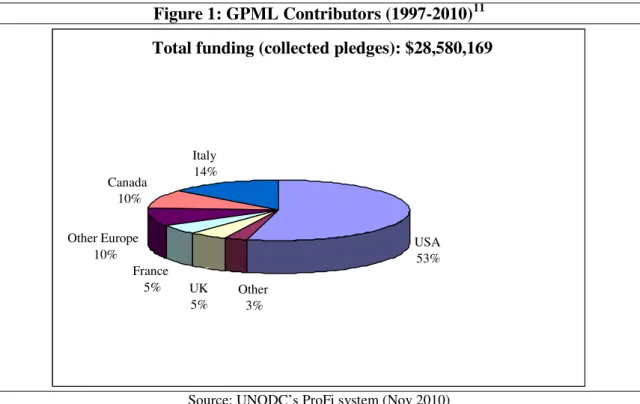
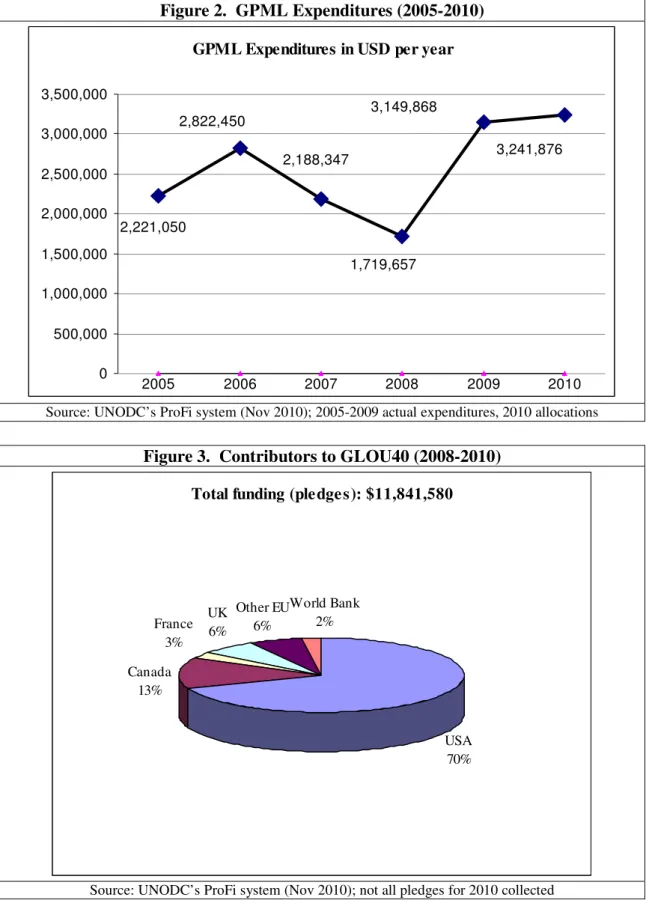
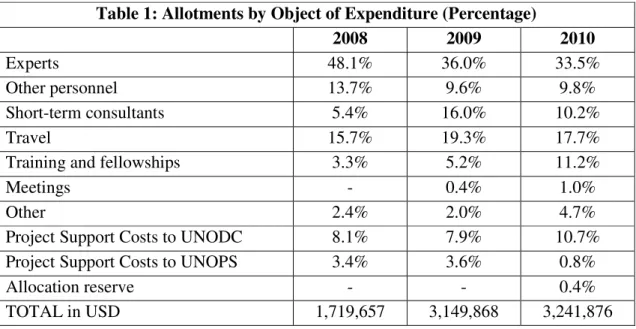
For the evaluation review period (June 2004-June 2010), GPML’s financial management was recorded under project GLOB079 (1997-2009) and GLOU40 (2008-2010). Voluntary resources account for more of 90% of GPML’s annual budget7, with the United States as its main donor. Currently only one post is funded from the regular budget of the United Nations. Since the programme’s inception in 1997, extra-budgetary sources totalled rounded USD 28.588 million and were provided by a large number of contributors, as shown in Figure 1. While the amounts of resources spent per year have mostly been within the USD 2 – 3.25 million range, sometimes with considerable fluctuation (2008-2009)9, the Programme has become more dependent on a smaller number of donors in recent years (see Figures 1-3). Since 2008 the programme succeeded in attracting smaller pledges from new donors. These pledges, however, were usually very hard earmarked.
5 There are UNODC offices in Senegal, Viet Nam, Kenya and Colombia, where mentors/ advisors were based in 2010,
but no UNODC offices in Namibia or on the Pacific Islands.
6
About 60% of face to face training is provided by long-term mentors/ advisors, about 30% by HQ staff and about 10% by long-term consultants.
7
In addition to one regular budget position, the programme had an average regular budget contribution of about USD 50,000 per year (rounded 65,000 in 2010) for e.g. consultants, Expert Group Meetings, printing.
8 For 2010 not all pledges have been collected yet. 9
The USA requested GPML to take over the administration and management of the Pacific Anti-Money Laundering Programme (PALP) in September 2008 and pledged an additional US$ 1,5 million for this purpose, which resulted in significantly higher funding levels in 2009.
It is important to note that UNODC collects project (or programme) support costs (PSC) of 13% on special purpose fund expenditures (extra-budgetary, voluntary contributions), which are not part of GPML’s operational budget. PSC income does not feed back into the programme directly, but goes to UNODC centrally to cover indirect costs related to administrative support functions at headquarters (e.g. Human Resources Management Service, finance personnel) and project management functions in the field offices.10 In those cases where UNOPS was the implementing agency for e.g. recruitment or procurement services, PSC income was shared with UNOPS (see table 1).
Figure 1: GPML Contributors (1997-2010)11
Source: UNODC’s ProFi system (Nov 2010)
10
PSC income is distributed between the Division for Operation (DO) and the Division for Management (DM) based on the formula presented in the budget (2/3 for DO, 1/3 for DM) and spent in accordance with the budget.
11
‘Other’ includes The World Bank, Antigua and Barbuda, Public Donations and the Asian Development Bank Total funding (collected pledges): $28,580,169
France 5% Other Europe 10% Italy 14% Canada 10% Other 3% UK 5% USA 53%
Figure 2. GPML Expenditures (2005-2010) GPML Expenditures in USD per year
3,241,876 2,221,050 2,822,450 3,149,868 2,188,347 1,719,657 2010 2009 2008 2007 2006 2005 0 500,000 1,000,000 1,500,000 2,000,000 2,500,000 3,000,000 3,500,000
Source: UNODC’s ProFi system (Nov 2010); 2005-2009 actual expenditures, 2010 allocations Figure 3. Contributors to GLOU40 (2008-2010)
Total funding (pledges): $11,841,580
USA 70% World Bank 2% Other EU 6% UK 6% France 3% Canada 13% Source: UNODC’s ProFi system (Nov 2010); not all pledges for 2010 collected
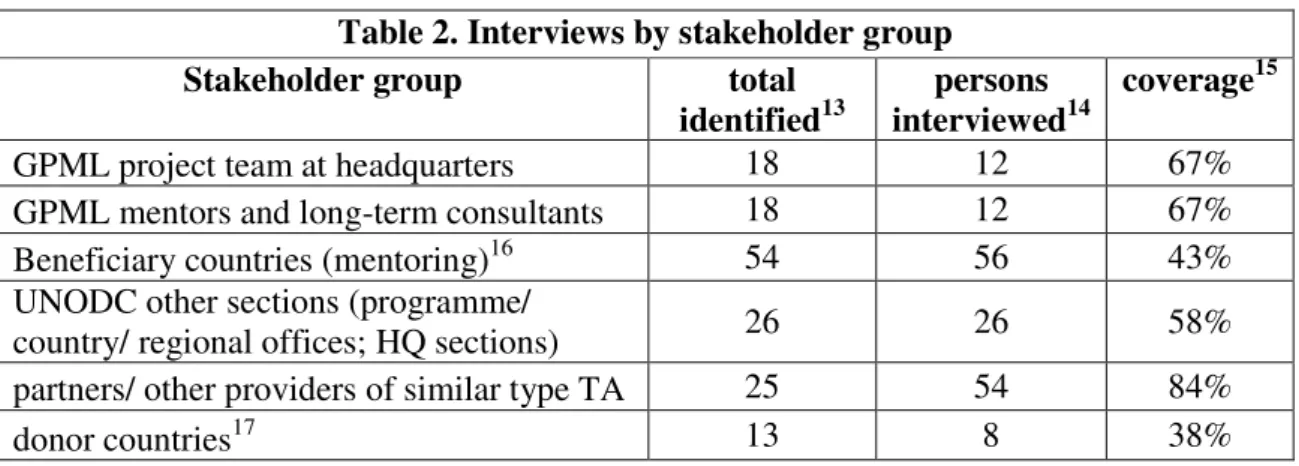
In terms of objects of expenditure, as can be seen from Table 1, GPML spent the largest percentage of its extra-budgetary funding on international experts and consultants, followed by travel and training (including fellowships).
Table 1: Allotments by Object of Expenditure (Percentage)
2008 2009 2010
Experts 48.1% 36.0% 33.5%
Other personnel 13.7% 9.6% 9.8%
Short-term consultants 5.4% 16.0% 10.2%
Travel 15.7% 19.3% 17.7%
Training and fellowships 3.3% 5.2% 11.2%
Meetings - 0.4% 1.0%
Other 2.4% 2.0% 4.7%
Project Support Costs to UNODC 8.1% 7.9% 10.7%
Project Support Costs to UNOPS 3.4% 3.6% 0.8%
Allocation reserve - - 0.4%
D. Methodology
The evaluation criteria used12 are relevance, effectiveness, efficiency, impact, and sustainability. In accordance with the Terms of Reference (TOR) for the evaluation (Annex C), lessons learned were identified and ‘partnerships’ added as an additional aspect to be analyzed in detail. The corresponding evaluation questions identified in the evaluation TOR served as a basis for data collection and the development of evaluation tools like the questionnaires for qualitative interviews and the beneficiary survey.
Relevance relates to UNODC’s mandate, but also to the needs of the recipients, while effectiveness is concerned with the relationship between outputs and outcomes, which was the main focus of the evaluation. Limitations related to the measurement of objectives and outcomes, as defined in the logical framework of the project document, are detailed in the following limitations section of this report. Efficiency, the relationship between inputs and outputs, was judged, to the extent possible, in terms of findings on effectiveness. Impact, which refers to the long-term achievements of GPML, but typically needs longer-term (and often lagged) data that are acquired by beneficiaries of the programme rather than by the programme itself, was determined based on 2004 baselines, if available, progress reporting and information on the activities of other technical assistance providers in a country. Attributions of stakeholders were considered to some extent, but triangulated with other sources. The sustainability related questions focused on the AML/CFT structure in Member States and on whether or not self-sufficiency and ownership have been promoted by the programme. Some questions also related to the programme’s own sustainability, which is very much related to its funding structure. Even though sustainability is essentially a process variable, it can be measured based on an analysis of how the programme has delivered its outcomes, its relationship with donors, funding levels, and how it has been placed in wider strategies of the organization and embedded in the organizational structure.
A first step of the evaluation was to translate the objectives and outcomes in the project document into a logical framework (or ‘logframe’) that could be measured and therefore evaluated. This involved connecting the outputs and activities of the project to the outcomes that were expected to result, and organizing these in terms of the objectives that were expected to have been achieved by 2012. The revised logframe for the evaluation (see Annex K) is based on existing objectives and outcomes, which were converted into end-states that could be observed. The three objectives correspond to the three levels at which GPML works: the level of international policy and information exchange; national action; and coordination among different international actors.
The GPML project document states that its overall objective is “to assist States in building effective legal, regulatory and law enforcement capacity in compliance with the provisions of UN instruments and other anti-money laundering/countering the financing of terrorism (AML/CFT) international standards.” As drafted, this is an activity rather than an end-state and thus difficult to measure. Similarly, the programme outcomes, except for number two, are hard to measure, in spite of the indicators defined for them in
12
the logical framework matrix (Annex B of the project document). The outcomes as defined in the project document are
• An awareness of the negative economic and social impact of money-laundering and the financing of terrorism amongst the following key stakeholders: Legislative bodies, criminal justice officials (FIU personnel, law enforcement agencies and their personnel), supervisory and regulatory authorities, officials of anti-corruption entities, and the private sector.
• Knowledge and expertise to combat money-laundering and the financing of terrorism effectively applied by legislative bodies, criminal justice officials (FIU personnel, law enforcement agencies and their personnel), officials of anti-corruption entities, supervisory and regulatory authorities and the private sector. • Enhanced AML/CFT coordination and cooperation among Member States,
international organizations and AML/CFT regional bodies.
According to the section on the scope of the evaluation in the evaluation’s terms of reference the focus of the evaluation was intended to be on the following:
• to consider how GPML contributes to fostering awareness, global commitment and action to combat money-laundering and the financing of terrorism in coordination with different stakeholders including governments, the international community, the international financial institutions (International Monetary Fund and World Bank), the Financial Action Task Force (FATF) and FATF–Style Regional Bodies (FSRBs);
• to consider how effectively GPML supports structures for AML/CFT policies and institutional frameworks; and
• to consider how efficiently GPML promotes enhanced AML/CFT coordination and cooperation among Member States, international organizations and AML/CFT regional bodies;
• to determine the significance of the anti-money laundering / countering the financing of terrorism in the UN agenda and how GPML fulfills this mandate. Based on the logical framework, data were acquired from three broad sources: records and documents (See Annex J List of reference documents), interviews with a wide range of stakeholders (Annex H), and a sample survey of persons trained or mentored (Annex G). The record and documentation review focussed first on the connection between policy proposals made by GPML and the extent to which these were reflected in documents adopted by the intergovernmental bodies to which they were sent. Secondly, the records review focused on the use of documents and other information made available electronically through the UNODC/ GPML website IMOLIN and the AMLID database, including especially downloads.
Interviews were undertaken over a four-month period with a wide sample of persons from beneficiary institutions, partner organizations, donors and UNODC staff, including GPML advisors and mentors based in the regions. The missions included an initial mission to UNODC headquarters in Austria and participation in international meetings held during the period of the evaluation, including the APG, ARINSA and the FATF
plenary meetings, where relevant participants were interviewed and the meetings observed. Some missions to specific countries were undertaken by the evaluation team, to Vietnam, South Africa, Namibia, Kenya and Kazakhstan, in order to interview beneficiaries, counterparts and partners in the countries, UNODC staff in field offices and GPML mentors. Country visits also included Canada, the United States and the Netherlands in order to reach donors and international partners. The selection of meetings and countries visited was based on the level and types of activities in a region/country, with some limitations related to the timing of the evaluation and the meeting schedules of FSRBs, as well as to resources for travel (see section E. Limitations of the evaluation). Interviews via Skype were arranged in order to also reach stakeholders in regions/ countries not visited. Interviews with staff of partner organizations were conducted in. During the mission to Vienna, Austria, interviews with a selection of UNODC staff in Vienna were carried out, including the GPML programme team as well as staff of other relevant sections of UNODC, who are knowledgeable about the project and have cooperation experiences. The interviews also covered mentors and long-term consultants in the field, former GPML staff, advisors and mentors, beneficiaries and counterparts from 23 countries, and staff of 25 different partner organizations, as well as representatives of donor countries. Overall, 162 persons were interviewed across all relevant stakeholder groups. The mission schedule and full list of interviewees can be found in Annex H.
The distribution of interviews by stakeholder group is shown in Table 2. Table 2. Interviews by stakeholder group
Stakeholder group total
identified13
persons interviewed14
coverage15
GPML project team at headquarters 18 12 67%
GPML mentors and long-term consultants 18 12 67%
Beneficiary countries (mentoring)16 54 56 43%
UNODC other sections (programme/
country/ regional offices; HQ sections) 26 26 58%
partners/ other providers of similar type TA 25 54 84%
donor countries17 13 8 38%
Finally, an effort was made to obtain data on the use of training and mentoring services by those who participated. Based on information supplied by GPML, a list of 987 individuals was obtained and a stratified random sample of 100 was drawn on the basis of participant geographic location and type of training provided, and the individuals were
13 Relevant AML/CFT stakeholders with exposure to GPML were identified by GPML and the evaluation team. Each
UNODC section/office or partner organization counted once for total.
14 Actual number of persons interviewed: more than one interviewee per country, partner organization or UNODC
office/ section; six interviewees interviewed in two capacities (for two stakeholder groups);
15
Only one representative per country, UNODC section/office or partner organization considered in order to determine coverage.
16
GPML activities took place in and benefitted 103 countries. The survey covered beneficiaries of mentoring and training participants (details in the following section).
17
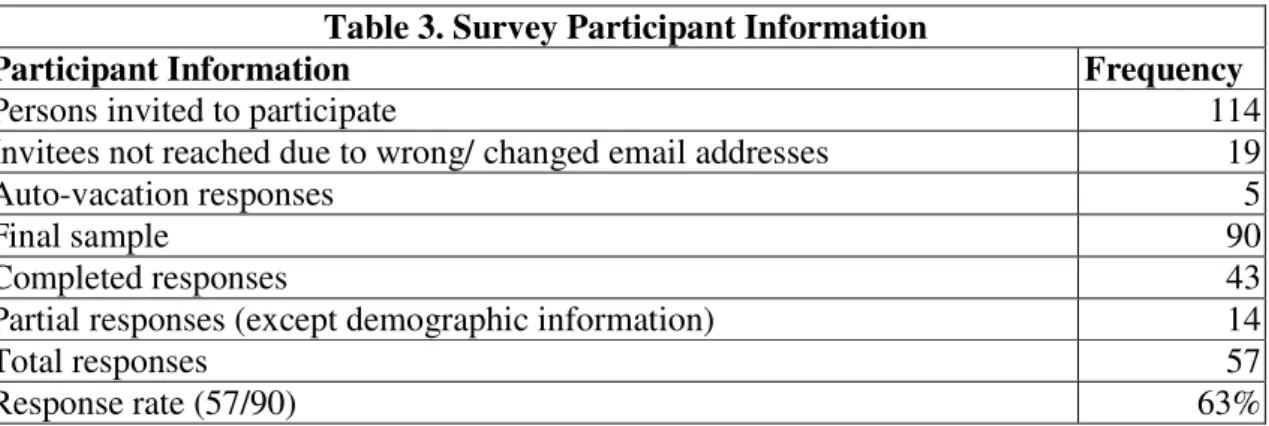
asked to fill in an on-line questionnaire. About twenty percent of the respondents in the initial sample could not be reached, due to out-of date email addresses. A replacement sample of 19 participants was drawn using the same methodology. About 63 percent of invitees responded to the survey. Of the participants who chose to disclose their demographic information (75%), 60% were male. At 16%, southern and eastern Africa had the maximum number of respondents. The response was slightly lower in the French and Spanish speaking regions, however all other regions were represented in fair proportion.
Table 3 below summarizes participant information.
Table 3. Survey Participant Information
Participant Information Frequency
Persons invited to participate 114
Invitees not reached due to wrong/ changed email addresses 19
Auto-vacation responses 5
Final sample 90
Completed responses 43
Partial responses (except demographic information) 14
Total responses 57
Response rate (57/90) 63%
In analyzing the findings, the evaluation also took into account the recommendations made in the evaluation of GPML undertaken in 2004.
E. Limitations of the evaluation
One limitation of the evaluation related to the logical framework. Since most of the focus areas, outputs and outcomes were based on the project objectives, they contained immeasurable terms (enhance, awareness) or were expressed as activities (promotes, fosters, supports) and for the purposes of the evaluation needed to be interpreted so that they could be measured. This was addressed in the creation of a logical framework, based on the original logical framework, which was updated for this evaluation (Annex K). Resource and timing related limitations, which did not allow for country case studies in all regions and participation in all FSRB meetings (e.g. no country case studies in Latin America, Caribbean or Pacific region), were addressed through Skype and phone interviews, extensive desk review and the beneficiary survey.
The very high number of interviews across all relevant stakeholder groups and the triangulation of sources and tools helped to compensate for the survey related limitations, like the underrepresentation of CBT center users, which were not specifically added to the total population for the sample, and the fact that it was an online survey in English language.
IV. MAJOR FINDINGS
A. Relevance of the programme
Anti-money laundering is a central component in addressing crime and corruption of all kinds by reducing the monetary return. UNODC is the guardian of three UN conventions, which are all linked to AML, the Convention Against Illicit Traffic in Narcotic Drugs and Psychotropic Substances, the Convention Against Transnational Organized Crime (UNTOC) and the Convention against Corruption (UNCAC). In addition, the International Convention for the Suppression of the Financing of Terrorism (Terrorism Financing Convention) provides the basis for GPML’s mandate to fight terrorism through countering the financing of terrorism. GPML’s work is thus closely linked to all four conventions and relevant to UNODC’s mandate.
The evaluation found that stakeholders interviewed unanimously considered GPML to be relevant to the global campaign to stop money laundering and terrorist financing. Most stakeholders also believed that a programme of this nature is best managed from the organization’s headquarters. Given that the global anti-money laundering measures are only as strong as the weakest link in the chain, centralized planning, monitoring and quality control must be seen as a necessity.
Stakeholders also recognized that GPML had clear competitive advantages in certain areas of money laundering control. GPML’s mentoring programme and knowledge and competence in enforcement issues were widely recognized as the mechanisms that made substantial contributions to improving AML regimes worldwide. However, various partner organizations and some donors and beneficiaries suggested that GPML’s result delivery could be improved further if its technical assistance had a sharper focus on enforcement, while international financial institutions focused their energies on assistance with legislation drafting.
Country beneficiaries/counterparts indicated an ongoing need in their countries for technical and practical AML/CFT support, which is provided by GPML. By now there is AML/CFT legislation in place in most countries, though sometimes as a dormant law, which needs a catalyst to move things forward in governments where there is either little political will to push AML/CFT legislation forward, or simply not enough funds available to set up the necessary infrastructure (e.g. trained financial investigators, IT system) and guarantee the effective implementation and compliance mechanisms needed. The needs identified by these countries particularly ask for more support from UNODC/GPML for practical training related to the role of the FIU personnel of financial investigators, including IT training.18
In addition, many countries that have successfully established an FIU are now at a stage where significant investments are needed to provide or improve the relevant IT infrastructure. In this respect the evaluation found that the joint promotion of the goAML
18
One example mentioned: To follow the money trail investigators need to be able to retrieve data that has been deleted on purpose to obfuscate the evidence. If there is not enough IT local knowledge available, outsourcing is mostly a too costly alternative, with the result that this important investigative work is not done.
software, developed by UNODC’s Information Technology Service (ITS), with GPML contributions, is very timely and relevant.
B. Attainment of the programme objectives, outcomes and outputs
The evaluation looked at the extent to which the three specific objectives set out in the current project document have been achieved by GPML, including the outputs and outcomes intended to lead to the achievement of these objectives.
In addition, GPML was included in the UNODC Strategic Framework for the Period 2008-2011 under two expected results related to money laundering:
1.2.2. Strengthened capacity of Member States to establish comprehensive and effective regimes against money-laundering and financing of terrorism in accordance with the relevant General Assembly resolutions
1.2.3. Strengthened capacity of Member States to establish comprehensive and effective regimes against money-laundering related to organized crime, drug trafficking and corruption
If “strengthened capacity” means that countries assisted by UNODC have established legal regimes and improved their law enforcement, these two results have been achieved through a combination of the mentor system, other training and the information systems described below.
Specific Objective 1: Legislative bodies, criminal justice officials (FIU personnel, law enforcement agencies and their personnel, anticorruption agencies officials), supervisory and regulatory authorities and the private sector aware of the negative economic and social impact of money-laundering and the financing of terrorism
As drafted, the programme logframe suggests that the main objective is to increase awareness. The data assembled for this evaluation, however, shows that in fact the objective is to increase the extent to which legislative bodies and national officials deal with money laundering through policy documents, national legislation and law enforcement procedures. In this sense, as will be noted, GPML has had considerable success in achieving the objective.
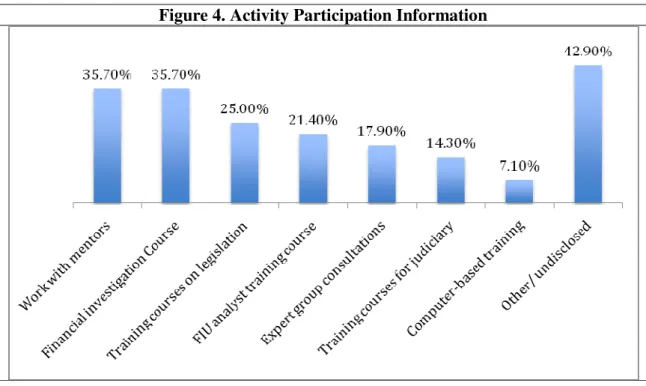
The achievement of the objective is based on the actual usage of provided information and services, The survey suggested that there were not just a wide variety of GPML activities in which beneficiaries had participated, but also that a majority of them had participated in more than one activity (Figure 4).
The survey asked, “which of the products and services provided by GPML are you familiar with and used.” As Figure 5 and Table 6 show, beneficiaries had used and found services such as country-specific technical assistance and mentoring to be very useful for them, but they had low awareness —and consequently use— of products such as publications and other resources available on the GPML website. Publications and CBT appear to be the least known and used products, even though it has to be considered that CBT center users were not particularly targeted in the survey and the regions with the highest number of CBT centers were not adequately represented in the survey sample. However, interviews with beneficiaries confirmed a limited awareness of publications, CBT and even the IMOLIN website as a resource. Both survey and interviews indicated a very high awareness of goAML, e.g. as a result of presentations at FSRB meetings and at the Egmont Group, though very few had actually used the software yet.
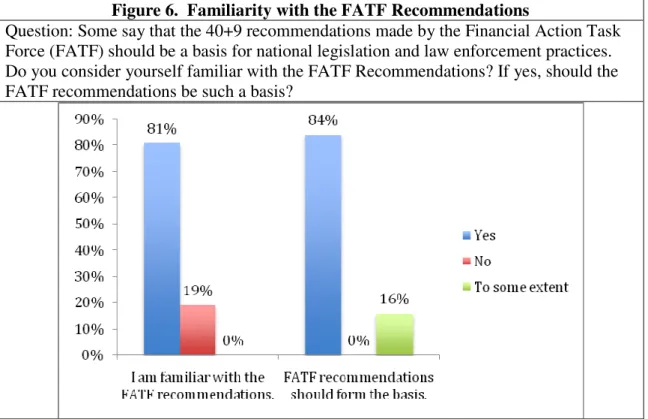
As noted in Figure 6, respondents were familiar with the FATF recommendations that form the basis of international standards for anti-money laundering and are included in both mentoring and training activities of GPML. It should be noted that there is also a consensus that they should be the main standards.
Figure 5. Familiarity with Products and Services
Table 6. Familiarity with GPML Products and Services Not aware Aware but not used Used but not found helpful Used and found helpful Used and found very helpful
Mentoring and advice 36% 23% 0% 14% 27%
Mutual Legal Assistance (MLA) Tool
32% 46% 5% 0% 18%
Model laws and provisions 36% 18% 5% 14% 27%
GPML website: International Money Laundering Information Network (IMoLIN) 27% 27% 9% 18% 18% Anti-Money Laundering International Database (AMLID) 32% 50% 0% 14% 5% Computer-based Training modules (CBT) 55% 27% 5% 5% 9%
Country specific technical assistance
32% 23% 0% 9% 36%
goAML 41% 55% 0% 5% 0%
Figure 6. Familiarity with the FATF Recommendations
Question: Some say that the 40+9 recommendations made by the Financial Action Task Force (FATF) should be a basis for national legislation and law enforcement practices. Do you consider yourself familiar with the FATF Recommendations? If yes, should the FATF recommendations be such a basis?
1.1 CND adopts resolutions taking into account reports
The Commission on Narcotic Drugs dealt with anti-money laundering at all of its sessions between 2005-2010, with the exception of 2006. In most years there was a Secretary-General’s report on money-laundering, until 2010, when there was no report included in the documentation before the Commission according to its report (E/CN. 7/2010/18) There was clear evidence that, when a report was presented, it was taken into account. The clearest case was the Report of the meeting of the open-ended intergovernmental expert working group on countering money-laundering and promoting judicial cooperation, held in Vienna from 30 June to 1 July 2008 (UNODC/CND/2008/WG.2/3). The working group was given a Secretariat note (UNODC/CND/2008/WG.2/2), drafted by GPML, that made recommendations. A comparison of the recommendations proposed and those adopted by the working group shows that of 35 recommendations adopted, 20 were the same or similar to those proposed by the Secretariat. Only four of the Secretariat recommendations were not included in those adopted.
In contrast, the Commission on Crime Prevention and Criminal Justice did not take up money laundering during its sessions from 2005-2010 and there were no reports on the subject presented by the Secretariat. Although money laundering was mentioned by delegations in the debates of the Commission, there is, therefore, no evidence that GPML influenced that intergovernmental body.
However, GPML did organize the preparation of a paper, issued in the name of the UNODC Secretariat, on international cooperation to address money laundering based on
relevant United Nations and other instruments (A/CONF.213/8) for the Twelfth Crime Congress in Salvador, Brazil in April 2010. The paper contained nineteen recommendations, of which only four were included in the conclusions and recommendations adopted by the Congress. At the Congress, the item on money laundering was combined with the item on Practical approaches to strengthening international cooperation in fighting crime-related problems and this may have made it difficult to have a detailed discussion of the AML proposals.
One recommendation adopted referred to asset confiscation, which was not included in the Secretariat report, and stated:
“Asset confiscation and recovery should become an integral part of the strategy to combat money-laundering and other profit-motivated crime. States should have the ability and capacity to trace, freeze and confiscate proceeds of crime and afford the widest range of cooperation possible. States should consider taking the necessary measures to allow for the confiscation of assets without a prior criminal conviction, in accordance with the principles of their national legal system.” This suggests that in the context of crime prevention, asset confiscation is an important element used to combat money laundering, a position argued by GPML in other documents. This was subsequently endorsed in General Assembly resolution 65/230 (see below.)
1.2 Increase in the number of persons using the CBT
While the number of CBT centres is known (see below), there are no data on the number of users. The survey asked the respondents to indicate if they had used the CBT. As mentioned in Figure 5, a large majority of the respondents were either not aware of CBT (55%), had not used it (27%) or had not found it helpful (5%). Only 14% percent found it useful. These results parallel the findings in the interviews, where a majority of persons indicated their complete lack of awareness and the remainder the fact that they had received the modules, but had not used them yet. Within this general trend of limited awareness, some regions showed more awareness than others, related to where CBT centers had been established and were operational. Since its first pilot in Fiji in 2004, the Asia Pacific region was a focus region for CBT, which was also reflected in the beneficiary interviews to some extent. Some countries institutionalized the training e.g. made it mandatory for new staff members. However, the overall awareness across regions and use of CBT continues to be rather limited.
Increased number of CBT centres
Over the period, the number of countries in which Computer-Based Training (CBT) centres with AML/CFT training modules were set up increased from 4 to 46, with sometimes more than one center per country. The establishment of centers sometimes included the provision of hardware and was usually accompanied by an introductory training. As can be seen from Table 4, the largest number of countries with newly-established centers were in Africa, and the greatest increase was in 2006. Since then, the pace of increase has clearly slackened as voluntary contributions for the CBT programme
have decreased. Most of the CBT centers (68 percent of 41 centres whose location was reported to the evaluation) were located with police institutions, with another 15 percent placed within Financial Intelligence Units.
Year Established
Africa Asia and Pacific Caribbean Eastern Europe Latin America Grand Total 2002 3 3 2004 1 1 2005 5 4 9 2006 5 10 4 19 2007 8 1 9 2008 3 1 4 2009 1 1 Grand Total 18 12 10 1 5 46
1.3 IMoLIN (and AMLID) used by intended users
An expected outcome under Specific Objective 1 is “IMoLIN used by intended users”. IMoLin is the International Money-Laundering Information Network website, maintained by UNODC as part of the GPML. This outcome is measured by the volume of use of the website as measured by downloads.
Complete download statistics for IMoLIN are available for the period 2005-2008. In 2009, UNODC’s ITS changed the content management system (CMS) used for monitoring use and records page visits and unique visitors rather than downloads. Due to that change and lack of comparability, the 2009-2010 figures have not been used in the analysis.
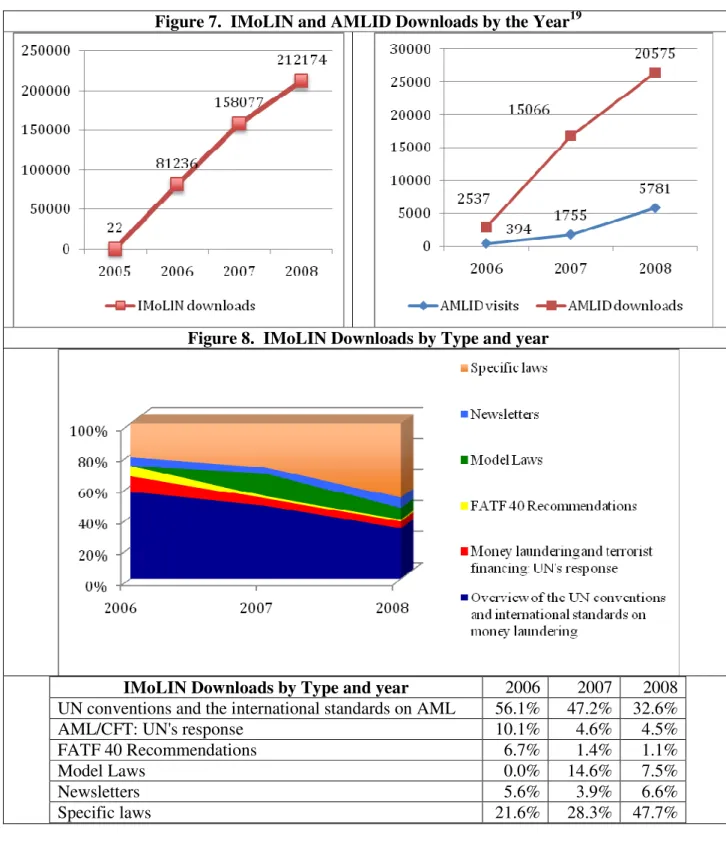
The IMoLIN website was first opened in 1998 and user statistics were first available in late 2005. That year there were a total of 22 downloads recorded by the CMS of ITS. As the GPML continued its use and development of IMoLIN, the number of downloads increased. Figure 4 shows the change over time.
Of perhaps more interest than the sheer growth is the importance of downloads of specific information from individual countries. In 2006, the largest downloads were of the full set of international conventions on money laundering. In 2007, there were large numbers of downloads of the model legislation, in all languages. By 2008, the main downloads were of individual laws and regulations that were being consulted. Figure 8 shows the result.
Figure 7. IMoLIN and AMLID Downloads by the Year19
Figure 8. IMoLIN Downloads by Type and year
IMoLIN Downloads by Type and year 2006 2007 2008
UN conventions and the international standards on AML 56.1% 47.2% 32.6%
AML/CFT: UN's response 10.1% 4.6% 4.5%
FATF 40 Recommendations 6.7% 1.4% 1.1%
Model Laws 0.0% 14.6% 7.5%
Newsletters 5.6% 3.9% 6.6%
Specific laws 21.6% 28.3% 47.7%
19 The downloads presented in the chart are based on the 20 top downloads for each year, as provided by ITS on the