© 2017. Mallanagouda Patil & Rajashekhar C. Biradar. This is a research/review paper, distributed under the terms of the Creative Commons Attribution-Noncommercial 3.0 Unported License http://creativecommons.org/licenses/by-nc/3.0/), permitting all non-commercial use, distribution, and reproduction inany medium, provided the original work is properly cited.
Energy Efficient Weighted Clustering Algorithm in Wireless
Sensor Networks
By Mallanagouda Patil & Rajashekhar C. Biradar
Reva University
Abstract-
With the advancement in communication and internet technologies, recently there have
been many research efforts in the area of Wireless Sensor Networks (WSNs) to conserve energy.
Clustering mechanisms have been applied to WSNs to enhance the network performance while
reducing the necessary energy consumption. The goal of Weighted Clustering Algorithm (WCA) is to
determine the cluster heads dynamically based on a combined weight metric that includes one or
more parameters such as node degree, distances with respect to a nodes neighbors, node speed
and the time spent as a cluster head. In this work, we have proposed a refined and improved version
of WCA known as Energy Efficient Weighted Clustering Algorithm (EEWCA) to prolong the network
lifetime by reducing energy consumption. EEWCA is designed and simulated with additional
constraint on energy for the selection of cluster heads. Both the WCA and EEWCA schemes have
been simulated using MATLAB. The proposed EEWCA behaves better than WCA for longer system
lifetime.
Keywords:
WSN; MANETS; energy efficiency; cluster.
GJCST-E Classification:
I.4.8, C.2.1
EnergyEfficientWeightedClusteringAlgorithminWirelessSensorNetworks
Strictly as per the compliance and regulations of:
Global Journal of Computer Science and Technology:
ENetwork, Web & Security
Type: Double Blind Peer Reviewed International Research Journal Publisher: Global Journals Inc. (USA)
Online ISSN: 0975-4172& Print ISSN: 0975-4350 Volume 17 Issue 2 Version 1.0 Year 2017
Energy Efficient Weighted Clustering Algorithm
in Wireless Sensor Networks
Mallanagouda Patilα & Rajashekhar C. Biradarσ
With the advancement in communication and internet technologies, recently there have been many research efforts in the area of Wireless Sensor Networks (WSNs) to conserve energy. Clustering mechanisms have been applied to WSNs to enhance the network performance while reducing the necessary energy consumption. The goal of Weighted Clustering Algorithm (WCA) is to determine the cluster heads dynamically based ona combined weight metric that includes one or more parameters such as node degree, distances with respectto a nodes neighbors, node speed and the time spent as a cluster head. In this work, we have proposed a refined and improved version of WCA known as Energy Efficient Weighted Clustering Algorithm (EEWCA) to prolong the network lifetime by reducing energy consumption. EEWCA is designed and simulated with additional constraint on energy for the selection of cluster heads. Both the WCA and EEWCA schemes havebeen simulated using MATLAB. The proposed EEWCA behaves better than WCA for longer system lifetime. The proposed work is simulated and performance is tested for number of clusters and average execution time. Simulation results show that the EEWCA outperforms WCA in terms of both the number of clusters formedand the execution time.
Keywords:WSN; MANETS; energy efficiency; cluster.
I.
I
ntroductionith the popularity of cell phones and smart devices, computing devices have become
cheaper, mobile and more distributed in daily
life. Wireless Sensor Network (WSN) is a collection of
sensor nodes organized into a co-operative network to
accomplish a common task. Each sensor node consists
of a processing capability, multiple types of memory
(program, data or flash memories), RF transceiver, and
a power source. In addition, the nodes accommodate
sensors and actuators [1]. WSNs have been widely
considered as one of the most important technologies
for the twenty first century [2]. Enabled by recent advances in microelectronic mechanical systems (MEMS) and wireless communication technologies, tiny, cheap and smart sensors deployed in a physical area
and networked through wireless links and the Internet;
provide unprecedented opportunities for a variety of
civilian and military applications, for example,
environmental monitoring, battle field surveillance and
industry processcontrol [3]. After the initial deployment,
sensor nodes communicate and self organize into an
appropriate network often with multihop connections
among sensor nodes. In most cases, it is very difficult
and even impossibleto change or recharge batteries for
the sensor nodes. Distinguished from traditional wireless
communication networks, WSNs have unique
characteristics for example, denser level of node
deployment, higher unreliability of sensor nodes, and
severe energy, computation, and storage constraints [4]
that present many new challenges inthe applications of
WSNs. In the past decade, WSNs have received
tremendous attention from both academia and industry
all over the world. It is envisioned that in the near future
WSNs will be widely used in various civilian and military
fields, and revolutionize the way we live, work and
interact with the physical world [5]. The next section
describes unique characterstics of WSNs.
Equipped with sensors, embedded microprocessors and radio transceivers, the sensor
nodes have not only sensing capability but also data
processing and communication capabilities [6].
Compared with traditional wireless communication
networks such as cellular systems and MANETs, WSNs
have unique characteristics and constraints that are
listed below [7]. Sensor nodes are usually densely
deployed in the field of interest. Thus, the data sensed
by multiple sensor nodes has a certain level of
redundancy [8]. Sensor nodes are usually deployed in
harsh or hostile environments and the network operation is autonomous. As a result, the network undergoes frequent topology change and it is prone to physical
damages or failures [3].The following section briefs the
hierarchical structure and clustering in WSNs.
a) Hierarchical structure and clustering in Wireless Sensor Networks
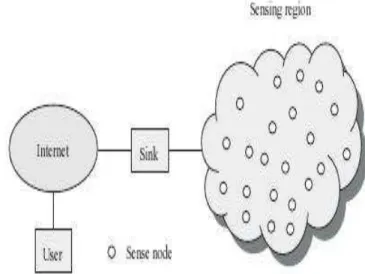
In a hierarchical network shown in figure 1, sensor nodes can be organized into clusters, where the
cluster members send their data to the cluster heads
that serve as relays for transmitting data to the sink. The
collaboration among sensor nodes is very important in
WSNs for two reasons: 1. Data collected from multiple
sensor nodes can offer valuable inference about the
system under study. 2. The collaboration among sensor
nodes can provide trade-offs between communication
cost and computation energy. Since it is likely that the
data acquired from one sensor node are highly
correlated with the data from its neighbors, data
aggregation can reduce the redundant information
W
Global Journal of Computer Science and Technology Volume XVII Issue II Version I
55 Year 2017 ( ) E
Authorα:Dept. of CSE, BNM IT, Bangalore-560070, India. e-mail: [email protected]
Authorσ:School of ECE, Reva Univ, Bangalore-560064, India. e-mail: [email protected]
Abstract-energy consumed for transferringone bit of data can be used to perform a large number of arithmetic operations
in a sensor processor [9]. When the base station is far
away, there are significant advantages in using local
data aggregation instead of direct communication.
Clustering aggregates nodes into groups and facilitates
consumption. The primary idea in clustering is to group nodes around a cluster head responsible for state maintenance and inter-cluster connectivity.
A node with lower energy can be used to perform the sensing task and send the sensed data to
its cluster head at short distance, while a node with
Figure 1:General Architecture of WSN
from its cluster members and transmit the processed data to sink. This process cannot only reduce the
energy consumption for communication, but also
balance traffic load and improve scalability when the
network sizegrows. Moreover, data aggregation can be
performed at cluster heads to reduce the amount of
data transmitted to the sink and improve the energy
efficiency of the network [10]. The major problem with
clustering is how to select the cluster heads and
organize the clusters [11]. Even routing mechanisms
have been applied to sensor networks with hierarchical
structures to enhance the network performance while
reducing the necessary energyconsumption [12]. In this
context, there are many clustering strategies proposed
in the literature. Next section highlights some of the
important works carried out in this domain.
II.
R
elatedW
orksIn Highest Connectivity Cluster Algorithm [13], the node with the highest connectivity (connected to the
most number of nodes) is elected clusterhead, but in
the case of a tie, the node with the lowest ID prevails.
Mobility Based Metric for Clustering [14] proposes a
local mobility metric such that mobile nodes with low
speed relative to their neighbors have the chance to
become clusterheads. By calculating the variance of a
mobile node’s speed relative to each of its neighbors,
the aggregate local speed of a mobile node is
estimated. A low variance value indicates that this
mobile node is relatively less mobile to its neighbors.
Consequently, mobile nodes withlow variance values in
their neighborhoods are chosen as clusterhead. Thus, a
selected clusterhead can normally promise the low
mobility with respect to its member nodes. However, if
mobile nodes move randomly the performance may
reduce. Clustering for energy conservation [15] assumes two node as master and slave. A slave node must be connected to one master node only and there is no direct connection between slave nodes. Each
master node can establish a cluster based on
connections to slave nodes. The drawback of this
scheme are paging process before each round of
communication consumes a large amount of energy.
Global Journal of Computer Science and Technology Volume XVII Issue II Version I
56 Year 2017 ( ) E
WSNs may not be optimal in terms of energy
Master node election is not adaptive and the method of selecting the master node is not specified. In vote based
clustering algorithm [16], researchers consider
neighbor’s number and remaining battery time of each mobile node. The basic concept is the Hello message, which is transmitted in the shared channel. Making use of node location and power information, this work proposes voting concept which is weighted sum of number of valid neighbors. The next section highlights the contribution of our work.
a) Our Contributions
The goal of Weighted Clustering Algorithm (WCA) [17] is to determine the cluster heads dynamically in Mobile Adhoc Networks (MANETs). The Cluster heads are selected based on a combined transmitted in the network. It is well known fact that the
practical deployment and operation of WSNs. Traditional higher energy can be selected as a cluster head to
process the data (i.e. flat) routing and data dissemination protocols for
weight metric that includes one or more parameters such as node degree, distances with respect to a nodes neighbours, node speed, and the time spent as a Energy Efficient Weighted Clustering Algorithm in Wireless Sensor Networks
cluster head. Wireless sensor networks are however little
different from traditional wirelessnetworks due to energy
constraints. Besides in WSNs, prolonging network
lifetime is an important issue. WCA cannot be applied
directly to wireless sensor networks as it does not
consider the energy constraint prevalent in WSNs. To
have an improvement over WCA, we have proposed”
Energy Efficient Weighted Clustering Algorithm
(EEWCA)” that enhances network lifetime by reducing energy consumption. In EEWCA, we have considered an additional constraint on energy over WCA for the selection of cluster heads and to form clusters in WSNs.
Both the WCA and EEWCA algorithms have been
simulated using MATLAB. The proposed EEWCA
behaves better than WCA in WSNS for longer system
lifetime. The proposed work is simulated and
performance is tested for the reduced number of
clusters and reduced average execution time. The
simulation results show that the EEWCA outperforms
WCA in terms of number of clusters and execution time.
The next part of this work describes thesteps involved in
WCA and EEWCA.
The following subsections explain both the WAC and EEWCA algorithms in detail.
a) Weighted Clustering Algorithm
The Weighted Clustering Algorithm (WCA) proposed for selecting cluster heads in MANETs, is
based on a combined weight metric that includes the
node degree, distances with respect to a nodes
neighbors, node speed, and the time spent as a cluster
head [17]. Each node broadcasts its weight value to all
other nodes. A node ischosen to be a clusterhead if its
weight is the minimum among its neighbors; otherwise,
it joins a neighboring cluster. Nodes in MANET can be
modelled as a set of nodes and links,represented by a
graph G = (V,E), where V is the set of nodes and E is
the set of links. In MANETs, the transmission radii of all
the nodes are assumed to be the same [17]. The
equation 1 is used to calculate the effective combined
weight(Wv) of a node v as a clusterhead.
Wv = w1dv+w2Dv+w3Mv+w4Tv (1)
where v is the serial number (ID) of a mobile node, dv is the degree difference of node v, Dv is the sum of the distances between v and its neighbors, Mv is the average speed of node v, Tv is the cumulative time in whichnode v has acted as cluster head, and Wi is the weighted coefficient for the i-th factor. The degree of a
node v is the number of nodes within the transmission
radius of v excluding itself. The dv is the difference
between the degree of a node v and a predefined
degree M of an ideal node in a cluster. Wv is used to
determine the goodness of a node as a cluster head.
Lower the Wv value, better are the chances of node v to become cluster head.
• Input: A set of sensor nodes, each with the same
transmission radius Rv, Individual cumulative time
Tv and mobility speed Mv, the predefined ideal
node number M in a cluster and the four coefficients w1 to w4.
• Output: A set of clusters with cluster heads and its
members.
Algorithm 1 Weighted Clustering Algorithm 1: Begin
2: for Eachsensor node do
3: Find the neighbors N(v) by using the equation 4: end for
5: Calculate the degree dv of node v as the number of the neighbors of v that fall within its transmission radius Rv, not including itself
6: Compute the degree difference for each node v by using the equation
7: Compute the sum Dv of the distances between node v and all its neighbors by using the equation
N
(
v
) =
v
′|
distance
(
v
,
v
′)
≤
Rv
(2)
δ
v
=
|
dv
−
M
|
(3)
Dv
=
∑
v′∈N(v)
distance
(
v
,
v
′)
(4)
Global Journal of Computer Science and Technology Volume XVII Issue II Version I
57 Year 2017 ( ) E
8: Compute the running average of the speed for every node till current time T by using the following formula.
This gives the measure of mobility and is denoted by Mv
9: Assume an appropriate value of cumulative time Tv for each sensor node. Cumulative time is the time in
Mv
=
1
/
T
∑
p
((
Xt
−
Xt
−1) + (
Y
t−
Y
t−1))
(5)
which node v has acted as a cluster head. A larger Tv value with node v implies that it has spent more resources (for example energy).
10: Calculate the combined effective weight, Wv by using the equation 11: Select the node with a minimum Wv as the cluster head.
12: Eliminate the chosen cluster head and its neighbors (cluster members) from theset of original sensor nodes.
13: Repeat Steps 1 to 12 for the remaining nodes not yet selected as a cluster head or until each node is assigned to a cluster.
14: All the mobile nodes are grouped into several clusters and each cluster has its own cluster head. 15: End
Although the WCA based on weighted coefficients, performs better than the earlier algorithms
proposed in the domain of MANETs, it cannot be
straight away used for WSN applications. In this work,
the WCA is modified such that it can be used in WSNs
with their specific energy constraint considered. The
next part of our work describes the proposed EEWCA
which is an improved version of WCA that takes care of
energyconstraints in WSNs.
IV.
E
nergyE
fficientW
eightedC
lusteringA
lgorithmThe WCA algorithm was designed to select cluster heads dynamically in MANETs. It is not so
appropriate to directly apply the WCA algorithm to
WSNs since it does not take care of energy contraints
and the transmission rate into consideration. In the real
world, the assumption of homogeneous sensors may
not be practical because sensing applications may
require heterogeneous sensors in terms of their sensing
and communication capabilities in order to enhance
network reliability and extend network lifetime. Also,
even if the sensors are equipped with identical
hardware, they may not always have the same
communication and sensing models. In fact, at the
manufacturing stage, there is no guarantee that two
sensors using thesame platform have exactly the same
physical properties. Heterogeneous nodes in WSNs can
bring the benefits of reduced response time and
increased life time. The proposed EEWCA has been
worked out for heterogeneous WSNs to form clusters
with the energy constraints being considered. In this
algorithm, energy factor is added into the evaluation
formula such that the nodes chosen as cluster heads
may have a better behavior in heterogeneous sensor
networks than those without this additional factor.
Equation 7 is used to calculate the effective combined
weight(Wv) of a node v as a cluster head.
where Wv is used to determine the likliness of a node as
a cluster head. The lower the Wv value is, the better v
acts as a cluster head. v is the serial number (ID) of a
mobile node, dv isthe degree differenceof node v, Dv is
the sum of the distances between v and all its
neighbors, Mv is the running average of the speed of
node v, Tv is the cumulative time in which node v acted
as a cluster head, wi is the weightedcoefficient for the
i-th factor and Cv is a characteristic factor of each node
and is defined by the followingequation 8
Where rv the transmission rate and Ev is the initial energy of node v. After a fixed interval of time, the proposed algorithm is then re-run again to find new cluster heads for the purpose of getting a longer system lifetime. The detailed procedure for the EEWCA is described as follows.
− Input: A set of sensor nodes, each with the same
transmission radius Rv, individual cumulative time Tv, mobility speed Mv, transmission rate rv, the initial energy Ev, the predefined ideal node number M in a cluster and the five weighted coefficients w1 to w5.
− Output: A set of clusters with cluster heads and its
members. Algorithm 2 Energy Efficient Weighted Clustering Algorithm
1: Begin
2: for Each sensor node do
3: Find the neighbors N(v) by using the equation
W v
=
w
1
δ
v
+
w
2
Dv
+
w
3
Mv
+
w
4
T v
(6)
Global Journal of Computer Science and Technology Volume XVII Issue II Version I
58 Year 2017 ( ) E
N
(
v
) =
v
′|
distance
(
v
,
v
′)
≤
Rv
(9)
W v
=
w
1
δ
v
+
w
2
Dv
+
w
3
Mv
+
w
4
T v
+
W
5
Cv
(7)
Cv
=
rv
/
Ev
(8)
4: end for5: Calculate the degree dv of node v as the number of the neighbors of v that fall within its transmission radius Rv, excluding itself.
6: Compute the degree difference for each node v by using the equation
7: Compute the sum Dv of the distances between node v and all its neighbors by using the equation
8: Compute the running average of the speed for every node till current time T by using the following formula. This gives the measure of mobility and is denoted by Mv
9: Assume an appropriate value of cumulative time Tv for each sensor node. Cumulative time is the time inwhich
node v has acted as a cluster head. A larger Tvvalue with node v implies that it has spent moreresources (for
xample energy).
10: Compute the characteristic factor Cv of every node by using the equation 11: Calculate the combined effective weight, Wv by using the equation 12: Select the node with a minimum Wv as the cluster head.
13: Eliminate the chosen cluster head and its neighbors (cluster members) from the set of original sensor nodes. 14: Repeat Steps 1 to 13 for the remaining nodes not yet selected as a cluster head or until each node is assigned to a cluster.
15: All the mobile nodes are grouped into several clusters and each cluster has its own cluster head. 16: End
V.
S
imulationP
arametersBoth WCA and EEWCA have been simulated in
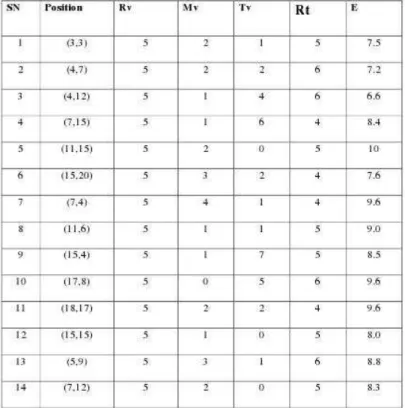
MATLAB. There are totally fourteen mobile sensornodes
loaded with their initial simulation parameters (or factors) as shown in figure 2. Where SN
Figure 2: Input Parameteres for Simulation
δ
v
=
|
dv
−
M
|
(10)
Dv
=
∑
v′∈N(v)distance
(
v
,
v
′)
(11)
Mv
=
1
/
T
∑
p
((
Xt
−
Xt
−1) + (
Yt
−
Yt
−1))
(12)
Cv
=
rv
/
Ev
(13)
W v
=
w
1
δ
v
+
w
2
Dv
+
w
3
Mv
+
w
4
T v
+
w
5
Cv
(14)
Global Journal of Computer Science and Technology Volume XVII Issue II Version I
59 Year 2017 ( ) E
represents the serial number of a sensor node, Position is the coordinate position(X,Y) of a sensor node, Rv represents the transmission radius of node v, Mv is the running average speed of node v, Tv represents the cumulative time, Rt is the transmission rate of node v and Ev represents the initial power on node v. The ideal degree of a node, M is set at 3 that means a cluster head can ideally handle 3 sensor nodes. The five coefficient values are set as follows: w1=0.5, w2=0.1, w3=0.05, w4=0.05 and w5=0.3 where the sum of these weights is equal to 1. For comparison, the same simualtion parameters are run with WCA. The result analysis is done in the next part along with the effect of
number of inputparameters and the execution time on
the number of clusters generated.
VI.
R
esultsA
nalysisThere are two main parameters that have been
used to evaluate the performance of EEWCA and WCA.
These parameters are the number of input sensor nodes
and execution time as described in the following
sections.
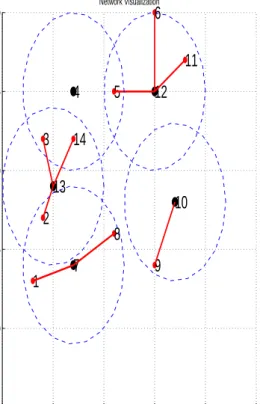
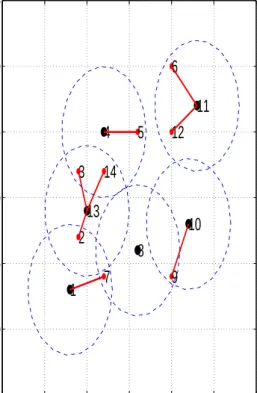
∗ Number of nodes: When the simulation example
(with 14 sensor nodes as input) is run with both EEWCA and WCA, the EEWCA performs better than
WCA with less number of clusters formedas shown
in the figure 3 as compared to figure 4
Thus EEWCA reduces the number of transmissions between the cluster heads and the base
station. This reduces energy consumed in transmission
of messages, thus prolonging the life time of a sensor
network. The EEWCA and WCA are simulated with
different number of input sensornodes and the number
of output clusters are noted down as shown in 5 and 6 respectively.
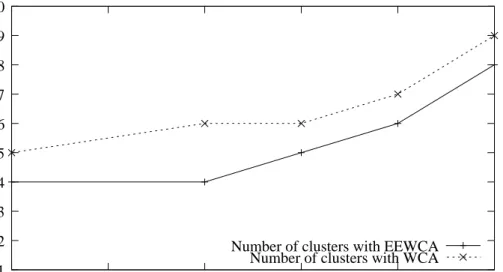
The graph 7 is drawn to compare the performance of both these algorithms with respect to
the number of input sensor nodes against number of
clusters formed. The graphs show that EEWCA forms
less number of clusters compared to WCA for the same number of input sensor nodes.
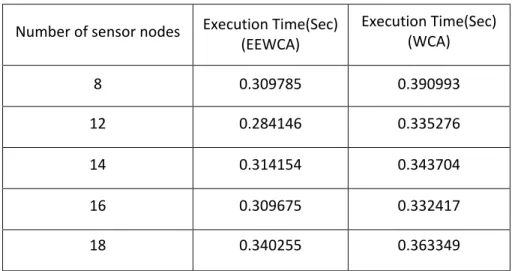
∗ Execution time: While EEWCA and WCA are
simulated for different number of input sensor nodes, the execution time in each of the cases is noted down. The following graph is drawn to plot execution times against number of inputs to compare the performance of both these algorithms. It is found that the average execution time of
EEWCA is better compared to WCA. The execution
0 5 10 15 20 25 −5 0 5 10 15 20 Network Visualization Xpos Ypos
1
2
3
4
5
6
7
8
9
10
11
12
13
14
Global Journal of Computer Science and Technology Volume XVII Issue II Version I
60 Year 2017 ( ) E
Figure 3:Clusters formed after simulating EEWCA
times of both these algorithms for different number of input sensor nodes are listed in the figure 8.
VII.
C
onclusionIn WSNs, power usage is an important factor for network lifetime. The proposed EEWCA is an improved Energy Efficient Weighted Clustering Algorithm in Wireless Sensor Networks
Figure 4: Clusters formed after simulating WCA
Figure 5: Inputs and corresponding outputs of EEWCA
−5 0 5 10 15 20 25 −5 0 5 10 15 20 25
1
2
3
4
5
6
7
8
9
10
11
12
13
14
Global Journal of Computer Science and Technology Volume XVII Issue II Version I
61 Year 2017 ( ) E
consumption for selection of cluster heads in mobile wireless sensor networks. The characteristics of sensor nodes including the power energy and the transmission rate are considered in the proposed algorithm. Experimental results have shown that the proposed algorithm behaves better than WCA on wireless sensor
networks for long system lifetime. The proposed algorithm reduces the number of
clustering algorithm based on the weighted clustering algorithm with a constraint of energy
Number of sensor nodes (Input) Number of clusters (Output) 8 4 12 4 14 5 16 6 18 8
Figure 6:Inputs and corresponding outputs of EEWCA
Figure 7:Performance of EEWCA and WCA
clusters compared to WCA for the same number of input
sensor nodes. The average execution timeof EEWCA is
better than that of WCA when simulation runs are carried
for different number inputsensor nodes.
R
eferencesR
éférencesR
eferencias1. W. Heinzelman, A. Chandrakasan, H. Balakrishnan,
Energy-efficient communication protocolfor wireless
sensor networks, in: Proceeding of the Hawaii
International Conference System Sciences, Hawaii,
January 2000
2. ”21 ideas for the 21st century”, Business Week,
Aug. 30 1999, pp. 78-167.
3. C. Y. Chong and S. P. Kumar, ”Sensor networks:
Evolution, Opportunities, and Challenges,IEEE, vol.
91, no. 8, Aug. 2003, pp. 1247-1256. 1 2 3 4 5 6 7 8 9 10 8 10 12 14 16 18 Number of Clusters
Number of Sensor Nodes
Number of Sensor Nodes Vs. Number of Clusters
Number of clusters with EEWCA Number of clusters with WCA
Global Journal of Computer Science and Technology Volume XVII Issue II Version I
62 Year 2017 ( ) E
4. I. F. Akyildiz, Y. Sankarasubramaniam, and E. Cayirci, ”A survey on sensor networks”, IEEE Communications Magazine, vol. 40, no. 8, Aug. 2002, pp. 102-114.
5. D. Estrin, D. Culler, K. Pister, and G. Sukhatme, ”Connecting the physical world with pervasive networks”, IEEE Pervasive Computing, 2002, pp. 59-69.
6. ”WIRELESS SENSOR NETWORKS, A Networking Perspective”, Jun Zheng and Abbas Jamalipour, IEEE publications, 2009.
7. F. Zhao, L. Guibas, ”Wireless Sensor Networks: An
Information Processing Approach”, Morgan
Kaufmann Publishers, San Francisco, CA, 2014. 8. I. F. Akyildiz, W.Su, Y. Sankarasubramaniam and E.
Cayirci, ”A survey on sensor networks”, IEEE Energy Efficient Weighted Clustering Algorithm in Wireless Sensor Networks
Number of sensor nodes (Input) Number of clusters (Output) 8 5 12 6 14 6 16 7 18 9
Communications Magazine, vol. 40, no. 8, Aug. 2002, pp. 102-114.
9. G. Pottie andW. Kaiser, ”Wireless integrated sensor
networks (WINS)”, Communications of theACM, vol.
43, no. 5, 2000, pp. 51-58.
10. V. Mhatre and C. Rosenberg,”Design guidelines for
wireless sensor networks: Communication, clustering and aggregation”, Ad Hoc Networks, vol. 2, no. 1, Jan. 2004, pp. 45-63.
11. R. Rajagopalan and P. Varshney, ”Data aggregation
techniques in sensor networks: A survey”, IEEE
Communications and Surveys and Tutorials, vol. 8, no. 4, 4th Quarter 2006, pp. 48-63.
12. Mallanagouda Patil, R C Biradar, ”A survey on
routing protocols in Wireless Sensor Networks”,
IEEE, 2012, pp. 98-103.
13. Chen, Nocetti, Gonzalez, Stojmenovic, ”Connectivity
based k-hop clustering in wireless networks”,
Proceedings of the 35th Annual Hawaii International
Conference on System Sciences,2002.
14. Basu, Khan, ”A Mobility Based Metric for Clustering
in Mobile Adhoc Networks”, IEEE, 2001, pp.
413-418.
15. Ryu, Song, Cho, ”New Clustering Schemes for
Energy Conservation in two tiered Mobile Adhoc
Networks”, IEEE, vo1. 3, 2001, pp. 862-866.
16. Li, Zhang, Wang, ”Vote Based Clustering Algorithm
in Mobile Adhoc Networks”, International Conference on Networking Technologies, 2004.
17. M. Chatterjee, S. K. Das, and D. Turgut, ”WCA: a
weighted clustering algorithm for mobile ad hoc
networks, Cluster Computing”, vol. 5, no. 2, 2002, pp.193-204.
Figure 8: Comparison of execution times of EEWCA and WCA
Global Journal of Computer Science and Technology Volume XVII Issue II Version I
63 Year 2017 ( ) E
Number of sensor nodes Execution Time(Sec) (EEWCA) Execution Time(Sec) (WCA) 8 0.309785 0.390993 12 0.284146 0.335276 14 0.314154 0.343704 16 0.309675 0.332417 18 0.340255 0.363349