Volume 4, Number 2, November 2019 | 111
Influence of Principals’ Collaborative Practices on Students’
Performance in Secondary Schools in Murang’a and Kirinyaga
Counties, Kenya
Irungu, Cecilia1; Josphat Kagema, 1; Michael Gachahi, 1.
1 School of Education and Social Sciences, Karatina University, Kenya. Corresponding author: Irungu Cecilia: [email protected]
Accepted: May, 10 2019 reviewed: August 5, 2019 Published: November, 20 2019
Abstract : Despite the fact that Kenyan children have more opportunities to attend school, there still remains large gaps in learning outcomes. This stagnation in learning is confirmed by results of national examinations including Kenya Certificate of Secondary Education (KCSE). According to KCSE examinations results analysis, performance in secondary schools in different parts of Kenya is still below expectations and this trend is worrying. The number of students in Murang’a and Kirinyaga Counties who have continuously scored grade D+ and below every year have consistently remained high compared to those attaining university minimum admission grade of C+ and above. This low performance has persisted despite most schools having adequate and well trained teachers as well as adequate facilities. This study examined the influence of principals’ collaborative practices on students’ performance in Murang’a and Kirinyaga Counties, Kenya. The study involved a sample of 205 principals and 367 teachers selected from 436 secondary schools in the two counties. The researchers used validated questionnaires and interview schedules to collect data from teachers and principals respectively. Data was analysed using both descriptive and inferential statistics. The study established that principals’ promotion of collaborative practices was higher in Kirinyaga than in Murang’a County. It was noted that secondary schools in Kirinyaga County post better results in KCSE than those in Murang’a County and the study concluded that collaborative practices enhanced academic performance. This study recommended that principals should promote collaborative practices in their schools. This can be done through engaging stakeholders in networking and linkages that promote collaboration and can lead to better academic performance.
Keywords: Principals, leadership, collaborative practices,learners’ performance. INTRODUCTION
Education is an essential ingredient for the development of any society and is seen as a pathway to raising political and social awareness as well as upholding the level of manpower 1. According to Yara and Otieno2, education is a fundamental human right. The pivot to sustainable development, peace, and stability within and among countries is the provision of quality education to their citizens
1 B N Onyara, “School Based Factors Influencing Students’ Academic Performance at Kenya Certificate of Secondary Education in Teso South District,” n.d.
2 P O Yara and K O Otieno, “Teaching and Learning Resources and Academic Performance in Mathematics in Secondary Schools in Bondo District of Kenya,” Asian social Science 6, no. 12 (n.d.).
Volume 4, Number 2, November 2019 | 112 (Oguntuase, Awe, & Ajayi, 2013). Quality education is meant for development of the country as well as individual’s wellbeing. Education has a transformative value and among other functions, it increases productivity and enhances lives of the people3. The Kenyan education sector has continued to experience paradigms of change. This change has also happened in the whole world at large as the determining global landscape on education is the essence for quality learning. In Kenya, the Kenya vision 2030 envisages to offer globally competitive quality education, training and research to the citizens4.It is the role of schools to transmit and perpetuate sustenance of society. In the Kenyan secondary schools’ context, the principal as the leader has the responsibility of providing the instructional foundation to the learners. In order for the principal to provide instructional foundation, the principal requires support from all stakeholders in the education sector. They all need to collaborate so that learners’ performance is enhanced and education goals are achieved.
DeWitt 5 argues that collaboration develops when entities recognize that none can succeed without the others. Each has special expertise or unique capabilities that the others need and their relationship is characterized by trust, norms of give-and-take, shared responsibilities, consensus-building and conflict resolution mechanisms. Collaboration is shared power, authority, shared information and decision-making systems. According to DeWitt6, collaborative leadership in schools includes the purposeful actions taken by leaders to enhance the instruction of teachers. This leadership builds deep relationships with all stakeholders through understanding self- effectiveness and also builds collective efficiency to deepen the act of togetherness in learning. Alternatively, Hurley (2011) defines collaborative leadership as the process of engaging collective intelligence to deliver results across organizational boundaries when ordinary mechanisms of control are absent. Hurley further ascertains that to lead collaboratively is to lead through conversation. Collaborative leaders take personal responsibility for communicating effectively and consciously use focused, intentional conversation to achieve key ends.
According to Bono and Ilies7, research has shown that enthusiastic, stimulating and passionately fascinating manifestations of charisma create positive moods in the workers. The positive mood reduces emotion-related occurrences of burnout and stress at the workplace. Promotion of a collaborative school culture discussed in this classification are concerned with creating good working conditions. The conditions in most cases will ensure that teachers make the most of their motivations and commitments.According to Lezotte8 strong instructional leaders are proactive and seek help in building team leadership and a culture that is conducive to learning and professional growth.Recent research advances more reciprocal and inclusive models of instructional leadership. Inclusive leadership is that within which principals share authority with designees and act as
3 UNESCO, “Guidelines for Inclusion: Ensuring Access to Education for All,” United Nations Educational, Scientific and Cultural Organization (2005).
4 Yara and Otieno, “Teaching and Learning Resources and Academic Performance in Mathematics in Secondary Schools in Bondo District of Kenya.”
5 P M DeWitt, School Climate: Leading With Collective Efficacy (Thousand Oaks, CA: Corwin, n.d.). 6 Ibid.
7 J E Bono and R Ilies, “Charisma, Positive Emotions and Mood Contagion,” The Leadership Quarterly 17, no. 4 (n.d.): 317–334.
8 Lawrence W Lezotte and Beverly A Bancroft, “Growing Use of the Effective Schools Model for School Improvement.,” Educational Leadership 42, no. 6 (1985): 23–27.
Volume 4, Number 2, November 2019 | 113 instructional coaches9 to the classroom teachers themselves10. Empowering principals encourage collaborative inquiry rather than rely upon more conventional, principal-centered supervisory practices11. When shared instructional leadership is practiced, teachers will in most cases become more committed and involved which will motivate them to innovate. Co-operation with teachers will work towards better performance as teachers will feel that they own the process and the outcomes of better performance.
Statement of the Problem
Students’ academic performance in the national examinations continues to be a major concern of education stakeholders in Kenya. This is because academic performance determines a student’s life after the secondary education. Results obtained from the Ministry of Education offices in the counties of Kirinyaga and Murang’a indicate that the number of students who have continuously scored mean grade D+ and below every year have consistently remained high. In comparison, the number of students attaining university entry grades of C+ and above has however remained consistently low. In the Kenyan context, grade C+ is the minimum university entry qualification. Table 1 shows KCSE results analysis in both counties for the years 2014 to 2017. Table 1 Murang’a and Kirinyaga Counties’ KCSE Results Analysis (2014-2017).
County Grade A to C+ 2014 2015 2016 2017 Murang’a 25.61 % 28.09 % 29.52 % 15.64 % Kirinyaga 33.35 % 33.79 % 32.70 % 18.62 % Grade D+ to E 2014 2015 2016 2017 Murang’a 52.43 % 47.53 % 45.74 % 66.43 % Kirinyaga 43.63 % 40.31 % 38.41 % 58.64 %
(Source: Murang’a and Kirinyaga Counties Education Offices, 2018)
The results in Table 1 show that though performance in the two counties have continuously remained low, the percentage of students attaining minimum university qualification of C+ and above is higher in Kirinyaga County than in Murang’a County. The results also show that the performance in Kirinyaga County was better than in Murang’a County. In Kenya, students attaining grades D+ and below fail to secure opportunities to pursue competitive courses in institutions of higher learning and this jeopardizes chances of jobs placement in future. Principals and other
9 R Halverson and C Thomas, “The Roles and Practices of Student Services Staff as Data-Driven Instructional Leaders,” in Instructional Teachers’ Leadership Roles: Using Research to Inform and Reform. Melinda Mangin and Sara Stoelinga, ed. eds. (New York: Teachers College Press, n.d.), 163–182.
10 H M Marks and S M Printy, “Principal Leadership and School Performance: An Integration of Transformational and Instructional Leadership,” Educational Administration Quarterly 39, no. 3 (n.d.): 370 – 397.
11 Richard Halverson et al., “The New Instructional Leadership: Creating Data-Driven Instructional Systems in School,” Journal of School Leadership 17, no. 2 (2007): 159–194.
Volume 4, Number 2, November 2019 | 114 instructional leaders are under pressure to improve the grades that the students attain at KCSE. In order to enhance academic performance, school principals have to employ practices that will lead to better academic performance. It is against this background that the researchers sought to establish the influence of principals’ promotion of collaborative practices on learners’ performance in Murang’a and Kirinyaga Counties, Kenya.
Purpose of the Study
The purpose of the study was to establish the influence of principals’ promotion of collaborative practices on learners’ performance in Murang’a and Kirinyaga Counties, Kenya. Objective of the Study
The study was guided by the following specific objective:- To establish the influence of principals’ promotion of collaborative practices on learners’ performance in Murang’a and Kirinyaga Counties, Kenya.
Null Hypothesis
The study tested the following null hypothesis;
H0: There is no statistically significant relationship between principals’ promotion of collaborative practices and learners’ performance in KCSE in Murang’a and Kirinyaga Counties, Kenya.
LITERATURE REVIEW
This study aimed at establishing the influence of principals’ promotion of collaborative practices on learners’ performance in Murang’a and Kirinyaga Counties. In this section, literature on principals’ promotion of collaborative practices and learners’ performance as captured in the study’s variables was discussed. The relationship between collaborative practices and learners’ academic achievement is also outlined.
Printy 12( in a recent review of research published since 2000 sought to explain the various ways leaders influence the quality of instruction in schools in the United States of America. Qualitative and quantitative findings across these studies suggest that principals influence student learning as they work with and through teachers. Thus, Printy suggested future research will extend our understanding of this important instructional leadership dynamic to the degree it probes the relationship of leadership to teaching as well as moving beyond general leadership characteristics to focus on the specific tasks of the role. Ultimately, as Robinson, Lloyd and Rowe13 concluded, “If we are to learn more about how leadership supports teachers in improving student outcomes, we need to measure how leaders attempt to influence the teaching practices that matter…[that is] how teachers make a difference to students”.Robinson et al14 supported the views of Duke and Canady
12 S M Printy, “Principals’ Influence on Instructional Quality: Insights from US,” Schools Article in School Leadership and Management 30, no. 2 (n.d.): 111–126.
13 V M J Robinson, C Lloyd, and K J Rowe, “The Impact of Leadership on Student Outcomes: An Analysis of the Differential Effects of Leadership Types,” Education Administration Quarterly 44 (n.d.): 635–674.
14 37–41. http://doi.org/10.1037/a0022390 Tuma, J. M., & Pratt, J. M. (1982). Clinical child psychology practice and training: A survey. \ldots of Clinical Child & Adolescent Psychology, 137(August 2012) et al., “Youth Mentoring across Professional Settings: A Pedagogic Approach to Social Exclusion,” Doctor of Education School of Education University of Derby (2012): 1–210, http://derby.openrepository.com/derby/handle/10545/272012.
Volume 4, Number 2, November 2019 | 115
15 who argued that it is possible to create a school learning climate in which academic performance is highly valued by students. A good school climate leads to promotion of a collaborative school culture. When multiple and visible opportunities for rewarding students and recognizing their academic achievement and improvement is carried out, then a climate of success is shaped. These rewards may not necessarily be costly but students should have opportunities to be recognized for their achievement both within the classroom and also as part of the school as a whole.
Based on their investigation, Watson, Partington, Gray and Mack 16 argued that students’ academic achievement in Aboriginal and minority communities, in Western Australia depended on focused principalship. A focused principal is the one who harnesses school community values and also involves instructors and learners successfully. In the same vein, Leithwood, Louis, Anderson and Wahlstrom17 argued that the greatest contribution of principals to the performance of their teachers and students is their ability to create meaningful and collaborative cultures in their schools. They emphasized that principals should be able to redesign their school organization through collaborative cultures and structures. Collaboration should be done within and outside the school so as to build productive relations with parents and the community. When collaborative structures are established, effectiveness of the school is strengthened and this leads to improvement in the learners’ achievement.
In Norway, the successful school leader was described by Møller, Eggen, Fuglestad, Langfeldt, Presthus and Skrøvset 18 as the one who exemplified collaboration and team efforts in promoting a learning-centered approach in teaching. Further, Hoog, Johansson and Olofsson 19 described how principals’ efforts in building teacher teams and in developing in students’ a sense of social values helped in promoting learning and achievement in Sweden. Decisions are arrived at jointly by clarifying, listening, reflecting, presenting, problem solving, negotiating and standardizing. This is possible when teachers and principals have similar levels of expertise, involvement and concern with problems in the school20. The Principal as the instructional leader is expected to identify problems, share with the teachers and allow them to come up with solutions to the problems as a team. When this happens, the teachers can own the solutions and be ready to implement them and to support the Principal in eradicating the identified problems.
Hoog et al 21further stated that collaboration between the teachers and the principal is very crucial and both parties are expected to share and own the plan as well as proposed solutions. These situations come in handy in most instances when the principal is not an expert in a certain area or has little or no knowledge about the issue at hand. Those knowledgeable in the team or have the expertise that is required expresses their opinions but everyone is involved in the decision making process. This can be very instrumental in the learners’ overall achievement. A head-teacher who is an effective leader should bring about team spirit and cooperation among teachers for achievement
15 D L Duke and L Canady, School Policy (New York: McGraw Hill, n.d.).
16 P Watson et al., Aboriginal Students and Numeracy (Perth, WA: Aboriginal Education and Training Council, n.d.). 17 R P Corcoran, “Preparing Principals to Improve Student Achievement,” Child and Youth Care Forum 46, no. 5 (2017): 769–781, https://www.scopus.com/inward/record.uri?eid=2-s2.0-85017663795&doi=10.1007%2Fs10566-017-9399-9&partnerID=40&md5=7a30bb261012e888b268c48a52a1e03f.
18 J Møller et al., “Successful School Leadership: The Norwegian Case,” Journal of Educational Administration 43, no. 6 (n.d.): 584–594.
19 J Hoog, O Johansson, and A Olofsson, “Successful Principalship: The Swedish Case,” Journal of Educational Administration 43, no. 6 (n.d.): 595–606.
20 Ibid. 21 Ibid.
Volume 4, Number 2, November 2019 | 116 of agreed objectives. While supporting this Bakhda 22 states that a discrete head-teacher will employ team-work as a working strategy. The head-teacher will set up committees and smaller groups of members of staff to investigate new ideas or strategies. After studying their proposals and suggestions, the head-teacher will use the larger teams to make the final decisions. The extent to which teachers participate in decisions about school policies and issues and the autonomy that teachers have in the classroom have an important effect on learners’ achievement.
The fundamental goal of professional communities is for teachers to collaborate. Couto 23 reminds us that it does not seem probable that high levels of success in student achievement can happen by teachers working alone. Couto states that it is a widely accepted sociological tenet that complex tasks require strong lateral relationships. Although there are schools that have not invested in this idea as evidenced by the lack of structures in place to support collaboration, it does not mean that changes cannot occur. This will however take persistence and hard work 24.For academically successful schools to be realized, it is the responsibility of the school principal to work together and cooperate with their teaching staff so as to effectively manage and run the instructional programme. Instructional leaders are hands-on and are able to learn on time everything that goes on in the classrooms. They are therefore able to develop the capacities of their teachers through encouraging them to continue making use of their strengths and also reduce their weak points25. Effective instructional leaders spend more time and energy focusing on curriculum implementation and knowledge development as well as instruction and assessment. By doing this, they perform their duties better as they are able to go beyond the traditional roles played by school administrators 26.
UNESCO’s 27 review of Botswana’s Basic Education system revealed that students’ academic performance was dismal when compared with other international students of comparable standards. The students used in the comparison were of high and middle income countries and of the same age group and below. The dismal performance was also evident in the way the students performed in the public examinations at the different levels of primary, junior and senior secondary schools in Botswana. Learners in all levels had posted a continued decline in performance at the national examinations28. This consistent decline could be partly attributed to outdated teaching methods that the teachers were using in the classrooms and practices such as lack of co-operation. The report also indicated that the problem is compounded by lack of training. Teachers were even expected to implement the new curriculum without any training concerning the curriculum. They therefore found themselves handicapped and not in a position to implement the curriculum properly. Moswela and Mphale further ascertain that the observations have repercussions on the worth of the teachers.
22 S Bakhda, Management and Evaluation of Schools (London: Oxford University Press, n.d.). 23 R A Couto, Reflections on Leadership. Lanham, Md (Plymouth: University Press of America, n.d.).
24 Tuma, J. M., & Pratt, J. M. (1982). Clinical child psychology practice and training: A survey. \ldots of Clinical Child & Adolescent Psychology, 137(August 2012) et al., “Youth Mentoring across Professional Settings: A Pedagogic Approach to Social Exclusion.”
25 J P Spillane and A Zuberi, “Designing and Piloting a Leadership Daily Practice: Using Logs to Study the Practice of Leadership,” Educational Administration Quarterly 45, no. 3 (n.d.): 375–423.
26 L C Jita, “Instructional Leadership for the Improvement of Science and Mathematics in South Africa,” Procodia–Social and Behavioral Sciences 9, no. 2 (n.d.): 851–854.
27 I D S ISSC, “UNESCO (2016) World Social Science Report 2016, Challenging Inequalities: Pathways to a Just World” (UNESCO Publishing, Paris, 2016).
28 B Moswela and L K Mphale, “Barriers to Clinical Supervision Practices in Botswana Schools in The,” Journal of Education and Training Studies 3, no. 6 (n.d.).
Volume 4, Number 2, November 2019 | 117 There is thus the need to train the instructors for excellence or quality teaching and learning in the classrooms. These specific training needs of the teachers can be identified through effective clinical classroom supervision. When clinical instructional supervision is carried out, guidance will be offered to the concerned teachers. Guidance will assist the teachers in improvement of their instructional delivery to the learners at the classroom level 29. Improvement in instructional delivery by teachers can however be realized if the principals are assisted or provided with the knowledge on good instructional management practices. Such management practices include collaborative practices. When principals are properly equipped, they are able to perform the role of instructional leaders of fellow teachers at the school level. With the importance of practice of collaborative practices on learners’ performance in Kenya and in response to the concern expressed by previous researchers on this matter, the present research will address the gap by investigating the practice of collaborative practices and how they influence learners’ performance.
LITERATURE REVIEW
The study was guided by the Model for Instructional Leadership developed by Weber30. The model was found suitable for the study because it expounded on instructional leadership practices which include collaborative practices that are responsible for improved learners’ achievement in schools. Weber’s Model identified five crucial domains of instructional leadership: defining the school’s mission, managing curriculum and instruction, fostering a positive learning climate, observing and improving instruction and assessing the instructional programme. According to Weber 31, the school’s mission is a dynamic process of cooperation and reflective thinking to create a mission that is clear and honest. The school staff, students and parents should be bound by the school mission to a common vision. The principal as the instructional leader offers the stakeholders with opportunities to discuss values and expectations for their school. Together they work to create a shared mission for the school.
The establishment of trusting and respectful relationships between the principal and the teachers is an initial step towards observing and improving instruction. Weber32 proposed that observations are opportunities for professional interactions. These interactions provide professional development opportunities for both the observer and one being observed. In other words, a reciprocal relationship develops where both people involved gain valuable information for professional growth. Hallinger 33 in support of Weber ascertains that promoting a positive school-learning climate includes protecting instructional time, maintaining high visibility and providing ways of motivating both the teachers and the learners.
According to Hallinger and Murphy 34, principals can influence students and teachers attitudes through enhancing collaboration. The attitude of teachers and students can be influenced through
29 Ibid.
30 Tuma, J. M., & Pratt, J. M. (1982). Clinical child psychology practice and training: A survey. \ldots of Clinical Child & Adolescent Psychology, 137(August 2012) et al., “Youth Mentoring across Professional Settings: A Pedagogic Approach to Social Exclusion.”
31 J Weber, “Leading the Instructional Program,” in School Leadership. Handbook for Excellence in Student Learning, ed. SmithS and Piele P, 4th ed. (California: Corwin Press, n.d.).
32 Ibid.
33 Corcoran, “Preparing Principals to Improve Student Achievement.”
34 Tuma, J. M., & Pratt, J. M. (1982). Clinical child psychology practice and training: A survey. \ldots of Clinical Child & Adolescent Psychology, 137(August 2012) et al., “Youth Mentoring across Professional Settings: A Pedagogic Approach to Social Exclusion.”
Volume 4, Number 2, November 2019 | 118 the establishment of a reward structure that reinforces better academic performance and productive effort. The rewarding process can be done through the use of clear-cut standards which are stated in detail that embody the school’s expectations. Principals will therefore play an active role in the development of teamwork among teachers and other stakeholders. In return, equipped and motivated teachers are able to work towards better academic performance in the school.
METHOD
This study employed the descriptive survey research design35. The study was undertaken in Murang’a and Kirinyaga Counties which are in the Central region of Kenya. These two counties were selected for the purpose of this study because they had varied types of schools which included National, Extra-County, County and Sub-county schools. The researchers employed multistage sampling technique comprising of: stratified sampling, purposive sampling and simple random sampling techniques. From a target population of 436 principals and 8,049 teachers, a sample of 205 principals and 367 teachers were selected. The samples were selected proportionally depending on the target population of each county. Murang’a County was apportioned 123 schools which translated to 60% of the sample as it had a higher population as compared to Kirinyaga County which was apportioned the other 82 schools.
The study used validated questionnaires and interview schedules to collect both quantitative and qualitative data. The questionnaires consisted of open ended and closed questions as well as a five item Likert scale36. The interview schedules consisted of open ended and closed questions. The researchers conducted face-to-face interviews with the 205 principals and administered questionnaires to the 367 teachers. Data was analysed using both descriptive and inferential statistics. RESULTS AND DISCUSSIONS
The purpose of the study was to establish the influence of principals’ collaborative practices on learners’ achievement in Murang’a and Kirinyaga Counties, Kenya. The researcher was able to interview all the principals thus obtaining a return rate of a 100% for the interview schedule. Majority of the targeted teachers responded resulting in a return rate of 98.09% for the teachers’ questionnaires. Results and discussions were based on the stated objective and hypotheses of the study.
The researchers conducted data analysis with regard to the roles performed by the principals that are necessary in ensuring that the learners’ performance is enhanced. A Likert Scale to measure how principals performed their roles was developed. The Likert Scale had five (5) items and respondents were to tick one response for each item. The response was selected from either Strongly Disagree (1), Disagree (2), Undecided (3), Agree (4) and Strongly Agree (5). The mean score for each statement was computed and used to measure the rating of the role of the principal in promoting collaborative practices on a scale ranging from one (1) to a maximum of five (5). Mean scores between 1.0 and 2.4 were rated as low, mean scores between 2.5 and 3.4 were rated as moderate while mean scores between 3.5 and 5.0 were rated as high. The findings of the data analysis are as analysed in Table 2.
35 W Creswell John, “Penelitian Kualitatif Dan Desain Riset, Memilih Diantara Lima Pendekatan,” Yogyakarta: Pustaka Pelajar (2014).
36 A G Mugenda, Social Science Research, Theory and Principles (Nairobi: Applied Research & Training Services (Arts Press, n.d.).
Volume 4, Number 2, November 2019 | 119 Table 2 Principals’ Roles on Promotion of Collaborative Practices According to Teachers.
Roles Performed by the
Principal County Frequency SD D U A SA 𝐱̅ sd
1 Creates a common vision, effective teams and engender commitment Murang’a Kirinyaga 197 137 11 0 40 11 24 15 90 82 32 29 3.47 3.94 1.15 .80 2 Engages teachers in
networking and linkages that promote collaboration Murang’a Kirinyaga 197 135 12 2 40 14 28 30 89 70 28 19 3.41 3.67 1.14 .90 3 Involves teachers in the
decision making process
Murang’a Kirinyaga 196 135 22 2 35 10 32 16 78 73 29 34 3.29 3.94 1.24 .90 4 Puts various mechanisms in place to ensure a harmonious working relationship Murang’a Kirinyaga 196 135 15 4 36 5 19 5 92 88 34 33 3.48 4.04 1.20 .84 5 Enhances collaborative approaches in the departments Murang’a Kirinyaga 197 135 20 7 25 7 29 8 88 93 35 20 3.47 3.83 1.21 .93 Aggregate Score Murang’a Kirinyaga 197 136 3.47 3.93 .996 .620 Source: Researchers (2018).
Results in Table 2 show that most teachers agreed or strongly agreed that the principals in both counties played the role of influencing collaborative practices in their respective schools. On creation of a common vision, effective teams and engendering commitment, Kirinyaga County was rated high at x̅ = 3.94 while Murang’a County was rated moderate at x̅ = 3.47. On whether principals engaged teachers in networking and linkages that promote collaborative practices, Kirinyaga County was rated high at x̅ = 3.67 while Murang’a County was rated moderate at x̅ = 3.41. Regarding involvement of teachers in decision making processes, the study revealed that in Kirinyaga, the rating was high at x̅ = 3.94 while in Murang’a County, the rating was moderate at x̅ = 3.29. Onputting up
Volume 4, Number 2, November 2019 | 120 various mechanisms in place to ensure a harmonious working relationship amongst all the stakeholders in their schools,the study revealed that the rating was high in Kirinyaga county (x̅ = 4.04) and moderate in Murang’a county (x̅ = 3.48). Finally, regarding whether principals enhanced collaborative approaches in the various departments in the school, the study showed that in Kirinyaga, the rating was high (x̅ = 3.83) and moderate in Murang’a (x̅ = 3.47). These results show that principals in both counties performed the role of influencing collaborative practices in their schools with the view of improving learners’ achievement. Further scrutiny of the results however show Kirinyaga County had higher ratings on collaborative practices than Murang’a County. These results show that principals in Kirinyaga County embraced collaboration practices more than principals in Murang’a County. It was also observed that secondary schools in Kirinyaga County attained better results in KCSE than schools in Murang’a County as shown in Table 1. This points to a possible relationship between collaborative practices and students’ academic performance.
The findings of this study agreed with the results of an investigation carried out by Watson, Partington, Gray and Mack37. In the study, Watson et al argued that students’ academic achievement in Aboriginal and minority communities in Western Australia depended on focused principalship. A focused principal is the one who harnesses school community values and also involves teachers and students effectively. In agreement with Leithwood, Louis, Anderson and Wahlstrom38, Watson et al 39argued that the greatest contribution of principals to the performance of their teachers and students is their ability to create meaningful and collaborative cultures in their schools. They however emphasized that principals should be able to redesign their school organization through collaborative cultures and structures. Creation of collaborative structures should be done both internally and externally in the institutions. Such structures enhance effective connections with guardians and the surrounding community. Collaborative cultures and structures also ensure that effectiveness of the school is strengthened and this leads to improvement in the learners’ achievement.
With regard to the benefits of involving teachers in decision making processes, one principal remarked as follows during the interview process; “Once involved, the teachers own the decisions and therefore work positively towards their achievement. The teachers also readily implement the school policies and therefore curriculum implementation is unhampered leading to better performance.” Collaboration allows the teacher and the principal to share ownership of the plan and proposed solutions. Shared ownership is helpful in areas where the principal is not an expert or have little or no experience. Through collaboration, the most informed individual expresses their knowledge but everyone participates in the decision making process which can be very instrumental in the learners’ overall achievement. While supporting the importance of collaboration in schools, the findings of the study agree with Bakhda40 who states that a discrete head-teacher will employ team-work as a working strategy. The school leader sets up committees and smaller groups of members of staff to investigate new techniques or ideas. After studying their proposals and suggestions, the leader uses the larger teams to make a final decision. The extent to which teachers participate in decisions about school policies and issues and the autonomy that teachers have in the classroom have an important effect on learners achievement.
37 Watson et al., Aboriginal Students and Numeracy.
38 K Leithwood et al., How Leadership Influences Student Learning (New York: The Wallace Foundation, n.d.). 39 Tuma, J. M., & Pratt, J. M. (1982). Clinical child psychology practice and training: A survey. \ldots of Clinical Child & Adolescent Psychology, 137(August 2012) et al., “Youth Mentoring across Professional Settings: A Pedagogic Approach to Social Exclusion.”
Volume 4, Number 2, November 2019 | 121 With regard to whether principals had put up various mechanisms in place to ensure a harmonious working relationship amongst all the stakeholders in their institutions, most of the teachers involved in the study 247 (73.95%) either agreed or strongly agreed. This was confirmed by one principal involved in the study who remarked as follows; “I offer servant leadership and also encourage regular departmental, student council and class meetings. I’m also in the frontline in solving personal problems that arise between the teaching and the non-teaching staff without any bias or favourism.” When a principal handles all stakeholders equally and without any bias, all members are able to respect each other and can easily collaborate and work as a team.
Relationship Between Principals’ Promotion of Collaborative Practices and Learners’ Performance.
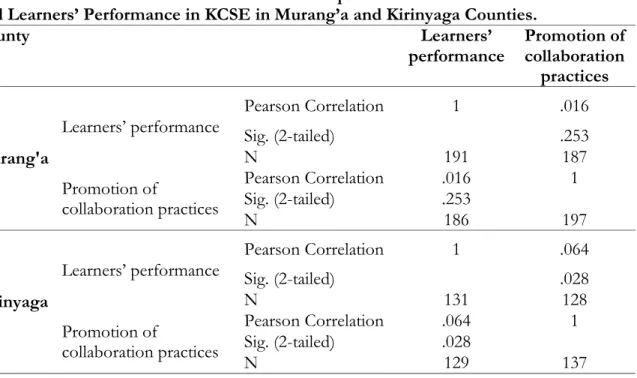
The study tested one null hypothesis in line with the study objective which was to establish the influence of principals’ promotion of collaborative practices on learners’ performance in KCSE in Murang’a and Kirinyaga Counties, Kenya. The hypothesis stated that there is no statistically significant relationship between principals’ promotion of collaborative practices and learners’ performance in KCSE in Murang’a and Kirinyaga Counties, Kenya. Pearson correlation analysis was done to show the relationship between principals’ promotion of collaborative practices and learners’ performance in KCSE in the two counties. Results of this analysis are presented in Table 3.
Table 3: Pearson Correlation Results for Principals' Promotion of Collaborative Practices and Learners’ Performance in KCSE in Murang’a and Kirinyaga Counties.
County Learners’ performance Promotion of collaboration practices Murang'a Learners’ performance Pearson Correlation 1 .016 Sig. (2-tailed) .253 N 191 187 Promotion of collaboration practices Pearson Correlation .016 1 Sig. (2-tailed) .253 N 186 197 Kirinyaga Learners’ performance Pearson Correlation 1 .064 Sig. (2-tailed) .028 N 131 128 Promotion of collaboration practices Pearson Correlation .064 1 Sig. (2-tailed) .028 N 129 137
Analysis in Table 3 shows the results of Pearson correlation analysis of the relationship between principals’ promotion of collaborative practices and learners’ performance for Murang’a and Kirinyaga Counties. This analysis showed that there was a weak, positive correlation between the two variables (r =.016, n = 186, p =.253) in Murang’a county and similarly, there was a weak, positive correlation between the two variables (r =.064, n = 129, p =.028) in Kirinyaga county. Data analysis established that the level of significance was .253 for Murang’a County and .028 for Kirinyaga County as shown in Table 3. Results obtained from the Pearson correlation analysis indicated that the relationship observed was statistically significant in Kirinyaga County and not
Volume 4, Number 2, November 2019 | 122 statistically significant in Murang’a County. The null hypothesis was rejected for Kirinyaga County showing that there was a statistically significant relationship between principals’ promotion of collaborative practices and learners’ performance in the county. These results indicated that principals in Kirinyaga County enhanced collaborative practices in their schools and in return acquired better academic performance. The null hypothesis was however not rejected for Murang’a County showing that there was no statistically significant relationship between principals’ promotion of collaborative practices and learners’ performance.
The results were in agreement with the descriptive analysis which pointed out that there existed differences in promotion of collaborative practices in Kirinyaga and Murang’a counties as indicated by the aggregate mean scores of x̅ = 3.93 in Kirinyaga County which was rated high and x̅ = 3.47 in Murang’a County which was rated moderate. The results indicating that principals’ promotion of collaborative practices was not the same in the two counties are also reflected in the differences in academic performance at KCSE in Kirinyaga and Murang’a Counties. Although performance has continuously remained dismal in both counties over the years, Kirinyaga County has performed relatively better compared to Murang’a County (Table 1). The higher ratings in Kirinyaga County in principals’ promotion of collaborative practices may be associated with the positive academic performance in the county. It was thus concluded that a positive relationship existed between principals' promotion of collaborative practices and learners’ performance.
The results were in agreement with the findings by Hattie (2009). Hattie emphasized more on the roles played by responsible teachers and students than that of the principal, in improving teaching and learning and obtaining good learning outcomes. In Hattie’s meta-analysis on academic achievement, the study findings mentioned the significance of the instructional role of the principal through management of teachers and students. Hattie’s emphasis was on teachers and students, who know their tasks and collaborate with the principal in the improvement of teaching and learning. Hattie identified the respective roles of effective principals, teachers and students but maintained emphasis on teacher effects, teacher-student relationships and responsibilities as catalysts of change that boost the efforts of the principal in improving teaching and learning and sustaining achievement. Principals have a responsibility of redesigning their school organization through collaborative cultures and structures. This should be done internally and externally in the institutions and encourage beneficial connections with parents and the community. When this is done, it ensures that effectiveness of the school is strengthened and this leads to improvement in the learners’ achievement.
CONCLUSION
The results of the study have indicated that principals’ promotion of collaborative practices in their respective schools in both counties was not the same. The study revealed that promotion of collaborative practices was higher in Kirinyaga County than in Murang’a County. Incidentally, secondary schools in Kirinyaga County posted higher results than those in Murang’a County. It was therefore concluded that collaborative practices enhance students’ performance. Schools which embrace collaborative practices are likely to post better results than those which do not.
RECOMMENDATIONS
The study recommended that principals should involve teachers and other stakeholders in decision making processes in the schools. When teachers are involved, they own the decisions and support their implementation and this may translate to better results. Principals should also put in
Volume 4, Number 2, November 2019 | 123 place mechanisms that enhance harmonious working relationships in the schools. This can be done through engaging teachers in networking and linkages that promote collaborative practices.
REFERENCES
Bakhda, S. Management and Evaluation of Schools. London: Oxford University Press, n.d.
Bono, J E, and R Ilies. “Charisma, Positive Emotions and Mood Contagion.” The Leadership Quarterly 17, no. 4 (n.d.): 317–334.
Corcoran, R P. “Preparing Principals to Improve Student Achievement.” Child and Youth Care Forum 46, no. 5 (2017): 769–781. https://www.scopus.com/inward/record.uri?eid=2-s2.0-
85017663795&doi=10.1007%2Fs10566-017-9399-9&partnerID=40&md5=7a30bb261012e888b268c48a52a1e03f.
Couto, R A. Reflections on Leadership. Lanham, Md. Plymouth: University Press of America, n.d. DeWitt, P M. School Climate: Leading With Collective Efficacy. Thousand Oaks, CA: Corwin, n.d. Duke, D L, and L Canady. School Policy. New York: McGraw Hill, n.d.
Halverson, R, and C Thomas. “The Roles and Practices of Student Services Staff as Data-Driven Instructional Leaders.” In Instructional Teachers’ Leadership Roles: Using Research to Inform and Reform. Melinda Mangin and Sara Stoelinga, edited by eds., 163–182. New York: Teachers College Press, n.d.
Halverson, Richard, Jeffrey Grigg, Reid Prichett, and Chris Thomas. “The New Instructional Leadership: Creating Data-Driven Instructional Systems in School.” Journal of School Leadership 17, no. 2 (2007): 159– 194.
Hoog, J, O Johansson, and A Olofsson. “Successful Principalship: The Swedish Case.” Journal of Educational Administration 43, no. 6 (n.d.): 595–606.
ISSC, I D S. “UNESCO (2016) World Social Science Report 2016, Challenging Inequalities: Pathways to a Just World.” UNESCO Publishing, Paris, 2016.
Jita, L C. “Instructional Leadership for the Improvement of Science and Mathematics in South Africa.” Procodia–Social and Behavioral Sciences 9, no. 2 (n.d.): 851–854.
John, W Creswell. “Penelitian Kualitatif Dan Desain Riset, Memilih Diantara Lima Pendekatan.” Yogyakarta: Pustaka Pelajar (2014).
Leithwood, K, K Louis, S Anderson, and K Wahlstrom. How Leadership Influences Student Learning. New York: The Wallace Foundation, n.d.
Lezotte, Lawrence W, and Beverly A Bancroft. “Growing Use of the Effective Schools Model for School Improvement.” Educational Leadership 42, no. 6 (1985): 23–27.
Marks, H M, and S M Printy. “Principal Leadership and School Performance: An Integration of Transformational and Instructional Leadership.” Educational Administration Quarterly 39, no. 3 (n.d.): 370 – 397.
Møller, J, A Eggen, O L Fuglestad, G Langfeldt, A M Presthus, and S Skrøvset. “Successful School Leadership: The Norwegian Case.” Journal of Educational Administration 43, no. 6 (n.d.): 584–594. Moswela, B, and L K Mphale. “Barriers to Clinical Supervision Practices in Botswana Schools in The.” Journal
of Education and Training Studies 3, no. 6 (n.d.).
Mugenda, A G. Social Science Research, Theory and Principles. Nairobi: Applied Research & Training Services (Arts Press, n.d.
Onyara, B N. “School Based Factors Influencing Students’ Academic Performance at Kenya Certificate of Secondary Education in Teso South District,” n.d.
Printy, S M. “Principals’ Influence on Instructional Quality: Insights from US.” Schools Article in School Leadership and Management 30, no. 2 (n.d.): 111–126.
Robinson, V M J, C Lloyd, and K J Rowe. “The Impact of Leadership on Student Outcomes: An Analysis of the Differential Effects of Leadership Types.” Education Administration Quarterly 44 (n.d.): 635–674. Spillane, J P, and A Zuberi. “Designing and Piloting a Leadership Daily Practice: Using Logs to Study the
Volume 4, Number 2, November 2019 | 124
Practice of Leadership.” Educational Administration Quarterly 45, no. 3 (n.d.): 375–423.
Tuma, J. M., & Pratt, J. M. (1982). Clinical child psychology practice and training: A survey. \ldots of Clinical Child & Adolescent Psychology, 137(August 2012), 37–41. http://doi.org/10.1037/a0022390, 120– 130. Gobry, F. (1999). {T}his is a title. {M}y Journal, 1, S. E. (1980). The Age of Reform 1250-1550. … and Religious History of Late Medieval and Reform …. Retrieved from http://scholar.google.com/scholar?hl=en&btnG=Search&q=intitle:THE+AGE+OF+REFORM+1 250-1550#2%5Cnhttp://scholar.google.com/scholar?hl=en&btnG=Se Osment, 525–534. http://doi.org/10.1037/0022-0663.100.3.525 Caprara, G., & Fida, R. (2008). Longitudinal analysis of the role of perceived self-efficacy for self-regulated learning in academic continuance and achievement. … of Educational …, 100(3), logic and mathematics in the twentieth century. … Philosophy. London and New York: Routledge. http://doi.org/10.4324/9780203029473 Shanker, S. (2003). Philosophy of science, J. (1998). Routledge History of Philosophy III. … Philosophy. London and New York: Routledge. http://doi.org/10.4324/9780203062272 Marenbon, 88–96. http://doi.org/10.1037//0033-3204.39.1.88 Pole, N., & Ablon, J. (2002). Ideal control mastery technique correlates with change in a single case. … Theory, Research, Practice …, 39(1), et al. “Youth Mentoring across Professional Settings: A Pedagogic Approach to Social Exclusion.” Doctor of Education
School of Education University of Derby (2012): 1–210.
http://derby.openrepository.com/derby/handle/10545/272012.
UNESCO. “Guidelines for Inclusion: Ensuring Access to Education for All.” United Nations Educational, Scientific and Cultural Organization (2005).
Watson, P, G Partington, J Gray, and L Mack. Aboriginal Students and Numeracy. Perth, WA: Aboriginal Education and Training Council, n.d.
Weber, J. “Leading the Instructional Program.” In School Leadership. Handbook for Excellence in Student Learning, edited by SmithS and Piele P. 4th ed. California: Corwin Press, n.d.
Yara, P O, and K O Otieno. “Teaching and Learning Resources and Academic Performance in Mathematics in Secondary Schools in Bondo District of Kenya.” Asian social Science 6, no. 12 (n.d.).