The Role of Immersive Virtual Reality in Individual Learning
Henrik KamplingUniversity of Siegen [email protected]
Abstract
New technologies create opportunities to improve education and, in this way, the individual learning. Due to their certain characteristics, such as immersion (i.e. the total engagement to a specific activity while other attentional demands are ignored), immersive Virtual Reality (VR) systems have the potential to increase the individual learning performance. Modern VR-head mounted displays (e.g. Oculus Rift) and provided controllers allow a new kind of interaction within a virtual environment. Against this background, the construct cognitive absorption (CA) within a learning context emerged. CA consists of five sub-constructs: temporal dissociation, curiosity, enjoyment, control, and immersion. Both, learning and CA, have already been brought together but not within a context of immersive VR. Hence, this study examines learning and its conditions within an immersive VR context by a Grounded Theory approach with 21 qualitative interviews. Implications for theory and design are derived.
1. Introduction
New technologies create new opportunities to improve education, and in this way, the individual learning. Here, digital technologies, formats, and materials enhance digital learning outcome through massive open online courses, blended learning, flipped classroom, or collaborative tools through social media [13]. Advantages are, for example, the cancellation of time or place restrictions, which means that the student or trainee has the opportunity to participate a class from the desk at home or on their way to work. However, the main goal of digitally supported learning environments or technologies is to improve the individual learning outcome. For instance, personally self-regulated and social self-regulated learning strategies [44] as well as learning environments [11] can improve the individual or organizational learning outcome or the learning performance.
Virtual reality has gained popularity through Oculus Rift (development kit) which came to the market in 2016. Nowadays, there are a couple of virtual reality head-mounted displays (HMD), such as HTC Vive or Playstation VR. A characteristic of such glasses, i.e. immersion, arises from the head-mounted display and a restriction of what a user can see [3]. Immersion is an individual’s total engagement to a particular interaction or task while all other attentional demands are ignored [1]. Within an immersive VR, a user is completely surrounded by an enclosing virtual space [24] whereby this user is beamed to the virtual environment in which they can interact or perform certain tasks with their entire body. In comparison to non-immersive VR, immersive VR offers the opportunity of creating a learning environment, in which a learner is not distracted or disturbed from outside attentional demands [23]. Another advantage of the emerging VR-HMDs is the provided controllers to interact within the virtual space. These controllers allow to interact, to create, or to manipulate objects. As a consequence, the use of VR-HMD and provided controllers make it possible to be more active and in a deeper fashion. These characteristics of immersive VR enhance the opportunities of learning by not only focusing on declarative knowledge, i.e. theoretical knowledge, but to impart skills of how to do something [23]. For instance, a study of non-immersive VR has examined effects of high and low VR conditions and its effects on consumer learning [38].
In Information Systems (IS) many learning theories explain how, why, and in which way the individual learning can be improved. Against the background of immersive VR, the Flow Theory [7] and a further development, i.e. Cognitive Absorption (CA) [2], include constructs, such as focused immersion, which are relevant for learning. CA and Flow are describing an individual’s mental state of absorption, a loss of self-consciousness, a transformation of time, a sense of being in control, and a feeling of engagement and immersion, including high concentration [7]. For instance, Flow, CA and its sub-constructs, namely focused immersion, temporal dissociation, heightened enjoyment, curiosity, and control, show, as described, important properties for learning. A couple of studies Proceedings of the 51st Hawaii International Conference on System Sciences|2018
URI: http://hdl.handle.net/10125/50060 ISBN: 978-0-9981331-1-9
have already examined CA and the Flow Theory within individual or organizational learning context. For instance, Agarwal and Karahanna [1] have shown that CA is an essential construct for explaining e-learning performance. Furthermore, it was found that Flow significantly impacts the use of e-learning software and academic performance [31, 32] as well as the acceptance of e-learning tools in vocational training [6]. CA, for instance, influences cognitive and affective involvement of a learner in mobile training scenarios [29] as well as learner’s satisfaction, performance, and perceived understanding of the learning content [28].
Although, there are already theoretical approaches explaining CA and individual learning, none of them are examining immersive VR-HMD technologies in combination with CA and its meaning for individual learning outcome. For instance, how to increase CA to improve the individual learning. Hence, the goal of the study at hand is to investigate elements of immersive VR, the meaning of CA’s sub-constructs in case of immersive VR, and how these affect individual learning. Consequently, the study is guided by the following research question:
RQ: How can individual learning and its conditions be defined in case of immersive VR technologies? Against the background of the explorative nature of this study, a Grounded Theory approach is used to analyze semi-structured interviews. The literature on VR, CA, and individual learning is reviewed to get an overview about the topic. Next, a semi-structured interview guide was developed whereby all interviewees were able to use a HTC Vive VR-HMD to get first-hand experience with the technology. Afterwards, the findings of the interviews are presented, discussed, and implications for theory and design are derived.
2. Individual Learning, Flow, Cognitive
Absorption, and Virtual Reality in IS
Flow and Cognitive Absorption. Learning theories and learning related-studies gained much attention in the field of IS. As introduced above, certain characteristics of Flow Theory and CA, such as immersion, suggest further investigation in case of immersive VR. Flow is an individual’s mental state of absorption, a feeling of being in control, a sense of being engaged and immersed while highly concentrated, a loss of self-consciousness, and a feeling of transformed time [7]. In addition, Agarwal et al. [2] use this definition of Flow to introduce the construct Cognitive Absorption (CA). On the one hand, in literature CA is referred to an uni-dimensional
central component [27] and, on the other hand, to a multi-dimensional construct (for instance, [45]). Both have in common that an individual’s Flow experience forms behavior and attitudes when using an information technology. In addition, a key component of Flow and CA is intrinsic motivation [45]. In contrast to extrinsic motivation, which deals with the expectation for greater rewards or other instrumental outcomes, intrinsic motivation is an individual’s inner incentive to behave for themselves [7]. For example, people expect satisfaction and pleasure from an activity. A couple of studies have already shown that Flow and absorption are holistic experiences with information systems and that both are important explanatory variables for human behavior (e.g. [1]). For instance, Agarwal and Karahanna define CA as a multi-dimensional construct including five sub-dimensions whereby CA refers to a “state of deep involvement with software” [1:673].
As suggest by Agarwal and Karahanna [1], temporal dissociation is an individual’s inability of recognizing how much time has been spent while engaged in a specific task or activity. Second, control is the perception of being responsible and being in charge while performing a task or an activity. Third, heightened enjoyment is an individual’s experience of satisfaction and pleasure from an activity or interaction. Fourth, curiosity is an individual’s extent of being aroused to a certain activity or interaction. At least, focused immersion is an individual’s state of being engaged or concentrated to a particular task or activity while other attentional demands are ignored.
Flow, CA, and its sub-dimensions have been investigated in many IS and learning related studies. For example, an educational and practical approach examines the impact of Flow and interaction behavior of nurses on e-learning acceptance [6]. The focus of the study lies on interaction factors, such as learner-system, instructor-learner, and learner-learner, on intrinsic (for instance, Flow) as well as extrinsic motivators (for instance, perceived usefulness and ease of use) to explain the behavior of a nurse, who is using an e-learning system for educational purposes. Another work investigates Flow in relation to an e-learning environment and in the context of higher education [31]. In their study, the authors analyze interactivity processes, imagery, and spatial presence in an e-learning environment affecting Flow and intrinsic motivation to investigate user’s continuance behavior.
Recent studies which focus on CA and learning examine, for instance, social presence and interest as antecedents of CA [20]. Here, CA is a mediator which influences learner satisfaction. In a collaborative environment, Magni et al. [22] investigate the impact of group learning behavior as moderator of CA and
individual learning in an organizational setting. A current study in a virtual environment, here a virtual world, examines CA and learning in collaborative tasks, whereby the effect of CA on perceived learning, learner satisfaction, and task participation is analyzed [11]. Moreover, the study of Reychav and Wu [28] focuses its work on a mobile training scenario. Here, CA and perceived learning are investigated, showing the result that CA significantly impacts the deep involvement of users. Another approach studies group learning behavior through text and video, and in addition, how peer learning and CA affect learning outcomes, such as learner satisfaction, perceived understanding, and performance [29].
In IS and IS related fields, CA has been investigated for use intentions or acceptance of learning systems. In case of hedonic systems, besides CA, classical Technology Acceptance Model (TAM) constructs, such as perceived usefulness and perceived ease of use, are included into a theoretical model to explain use intentions [21]. Additional research which also includes TAM constructs, but in the context of mixed-motivation systems (i.e. a systems comprising of utilitarian and hedonic components), investigates usefulness, ease of use, cognitive absorption as well as Flow and their effect on user’s use intentions of a learning environment [32, 33, 43]. Another approach is made by Roca et al. [30]. They analyze additional constructs, such as perceived quality, perceived usability, perceived control, confirmation, and subjective norm, that affect acceptance and learner satisfaction. Flow has also been examined as an uni-dimensional construct which explains, besides acceptance and satisfaction, the perceived hedonic and utilitarian value of a learning system while the Flow is explained through telepresence [12].
Virtual Reality. Virtual Reality (VR) technologies are emerging more and more since Oculus Rift was available on the market [10]. VR systems are computer-generated, interactive, and three-dimensional environments in which people become immersed [46]. Moreover, implemented VR applications in such a virtual environment depend on the degree of immersion [24] whereby VR is distinguished into immersive and non-immersive VR. The latter one refers to desktop computers and laptops. The first one, immersive VR, is determined by user’s who are using complex interface technologies, such as HMDs, and who are totally surrounded by an enclosing virtual environment. Actually the use of VR-HMD are related to single user experiences [34] and are limited to single user sessions of 30 minutes [26]. Recent research examines virtual low and high conditions while shopping online (the kind of product experience) [38]. Their results suggest that users of the high VR
condition learn more about the provided products (i.e. knowledge and attitude) than in the low condition. A similar study analyzes product presentation format and task complexity within a virtual product experience and a consumer’s product understanding [15]. Immersive VR, moreover, and the use of HMD as well as the provided controller allow users to be active within the virtual space. For instance, they can interact, create, and manipulate objects [16, 23]. The virtual space enables higher precision as well as a higher degree of visualization of objects and processes which otherwise is not possible to depict in the real world. Furthermore, the kind of precision and visualization allow to intense the focused experience which, in turn, can enhance the learning experience [23].
Virtual Worlds. In comparison to VR, research on Virtual Worlds (VW) gained more attention. A VW is defined as virtual reality with a multi-user domain/dungeon rendered on personal computers where real people can meet and interact, i.e. a shared environment [34]. A review on virtual environments focusing on VW examines theories as well as concepts, and presents insights on embodiment and presence related to avatars [34]. Avatars are central to the use of VW, notably if an avatar is edited and illustrated as oneself [37]. If an avatar is similar to its user, the user perceives the avatar more positive because of dual-congruity perspective, such as self-dual-congruity and functional congruity [37]. Recent studies on avatars examines virtual team collaboration with, on the one hand, avatars and, on the other hand, with people and virtual agents [8]. Moreover, another empirical work investigates the VW Second Life and focuses on embodied identities in the virtual world as well as in the real world [35]. Results suggest that an individual symbiotically unites their digital (avatar) and their physical embodiments to become a cyborg (i.e. people are extended by technology [5]) whereby both identities are entangled by technology [14]. Kim and Zhang have also examined avatar-based three-dimensional worlds and CA to explain user satisfaction and loyalty to the VW [17]. Here, they focus on antecedents such as the sense of presence and belonging.
In summary, it can be assumed that CA and its sub-constructs are essential for individual learning using an immersive VR system, particularly against the background of the underlying characteristics such as interaction, creation, and manipulation of objects as well as the single-user experience in an enclosed virtual space. In contrast, virtual environments, notably VW and non-immersive VR, gained much attention in the field of IS but there is little known about what immersive VR means in the context of individual learning and its conditions to increase learning
performance. This missing theoretical approach can be assumed as a research gap which the study at hand wants to address.
3. Research Design
Methodology. Given the relative novelty of immersive VR technologies (notably, HMD), it is not surprising that no solid theoretical base exists, which focuses the phenomenon of immersive VR learning systems. Taking this into account, the study at hand was conducted with initially achieving a comprehension of this phenomenon. Therefore, a deductive approach cannot be used to examine this context because there is a lack of reliable body of existing theory to inform extensive a priori theorizing [25, 42].
Against this background of the explorative nature, this study follows an inductive Grounded Theory approach [36, 40, 41] to explore and examine the specific conditions of an immersive VR learning system. Grounded Theory is a suitable method for theory building [36]. For instance, Grounded Theory can be characterized along six dimensions [4]: a) development of theory for describing and analyzing the phenomenon of interest; b) continuous data comparisons against different viewpoints by constant growing analytical and theoretical aspects; c) a step-by-step coding of data across multiple steps as emerging theory develops; d) along upcoming differentiating dimensions the theoretical sampling of data; e) the handling of prejudices that prevent relying on any certain theory as a starting point; f) “an inextricable link between data collection and analysis that incorporates further sampling as part of ongoing analysis and theorizing” [10:710].
Data Gathering. Current VR-HMD, such as HTC Vive, Oculus Rift, or Playstation VR, are not new but mostly unknown (no first-hand experience) to user, and hence, the interviews were conducted during a conference where a virtual reality system was presented. Each individual who participated was guided to an enclosed room to ensure a quiet and controlled environment without external distractions. Only people who used the VR system, so people with first-hand experience, were interviewed to guarantee that each interviewee is able to answer questions regarding the VR system. All participants were able to use a self-developed VR environment (created with the Unreal Engine 4). A semi-structured interview guideline was used which has the aim to reveal conditions, constructs, and design options of an immersive VR system. The explorative nature arises due to the fact that immersive VR systems and their certain characteristics are sparsely investigated, and
hence, 21 interviews with potential future users from different backgrounds and demographics (age and gender) were conducted (in average 10 minutes). Ten female and eleven male persons participated at the interview who have an average age of 33 years. Within our interview group five educators and teachers, ten students and pupils, one computer scientists, one engineer, one nurse, one research associate, and two managers participated. Their educational background differs from high school graduation, bachelor and master degrees as well as state examination.
Before the interviews started the literature on VR, learning, and related topics were reviewed in case of getting initial insights and have a first conceptualization of the topic. Next, these insights were used for the development of the semi-structured interview guideline to ensure to get in-depth insights to the subject of VR, learning, and related topics. The focus of the interview guideline lies on questions regarding specific conditions of immersive VR and the meaning of individual learning within this context.
Two major challenges emerged before and during the interviews. First, VR technologies are well-known because of the media and a current hype. In contrast, many people do not have first-hand experience. Consequently, an immersive VR system was provided, i.e. a HTC Vive, which each participant was able to use for first-hand experiences. Within the provided self-developed system, each participant was confronted with a scenario where the user was able to move in a virtual room. Here, the user had to take a key to open a door, walking through the door, and to follow instructions in order to hand over a parcel. The second challenge was the conduction of the interviews during the above mentioned conference. Here, a separated room, enclosed and quiet, was provided for the conduction of each interview.
Data Analysis. The used Grounded Theory approach [36, 40] started with an open coding scheme of the interview transcripts. The open coding scheme was done by two researchers. In a step-by-step process, both researcher coded independently, afterwards the codes were matched to come to a joint result. In a next step, axial coding was done to cluster the codes. Then, within the selective coding step, it was searched for similarities and relations between identified constructs. At least, all findings were matched with the literature (theoretical integration) and implications for theory could be derived. Within the next section suitable quotations are chosen to illustrate the findings.
4. Findings
Use Case Learning with immersive VR. Overall, many interviewees conform that an immersive VR and
the provided controller to interact within a virtual space can be used for a learning context. For instance, it is useful for cases as demonstrating or to make situations perceptible.
“Such a system would be useful for training or coaching purposes or to demonstrate something. Just imagine you can really experience situations and make them perceptible.” (Interviewee 1, educator)
“Within a virtual environment you are able to develop and create everything. You could experience and learn something about an atom and interact with it which would be impossible in real life. […] There is also the opportunity to depict procedures and
sequences and to walk them virtually through.”
(Interviewee 4, computer scientist)
A focus of many interview answers refers to the learning of skills and processes such as how something works and functions.
“I could imagine using it for work such as trainings. You would be able to learn the maintenance of machines. An example would be the learning of the adjustment of the rational speed.” (Interviewee 5, engineer)
“I can imagine to model a business process such as telescoping, to choose functions, or to change the order. There would be the opportunity to walk them through and to attach figures from the manufacturing environment.” (Interviewee 7, research associate)
Immersion is manifold in case of a virtual environment. Findings of the qualitative study at hand suggest that immersion has different predictors that positively influence the construct. In addition, the interviews show a deeper understanding of the construct itself. For instance, an immersive virtual environment is interpreted as real because a user dives deep into the space.
“It is really real. You know it is computer generated, also optical, but you behave like in real life. You have a real feeling of something such throwing objects. […] My view was completely within the three-dimensional virtual space, in 360°, and I forgot the instructor. I haven’t realized the real world anymore.” (Interviewee 20, student)
“At the beginning I still perceived the real world. After I started concentrating on certain objects, I haven’t noticed the outside world anymore. I was really deep involved.” (Interviewee 10, teacher)
“I really had the feeling of being in another room and place. […] I can imagine that really everything can be simulated to illustrate the real world in a virtual environment.” (Interviewee 6, teacher)
As a sub-construct of CA, curiosity is an important condition for intrinsic motivation. In case it refers to
the technology itself and to the contents presented within the VR space.
“It was really surprising of how to move and in which direction I was able to move within the presented virtual space.” (Interviewee 19, student)
“Using the system is really exciting. I am still curious about the technology itself.” (Interviewee 15, nurse)
“I could just turn around and I could see in every direction. There I was just able to experience and to test everything. That was really interesting and exciting.” (Interviewee 13, student)
Moreover, curiosity can be a predictor to positively influence the immersion of a VR system.
“I haven’t perceived the real world anymore, and hence, I could concentrate on certain aspects where I was really curious about all the things I was able to try out in the virtual environment.” (Interviewee 19, student)
In addition to curiosity, (heightened) enjoyment emerged as a predictor for affecting the immersion while using a VR system. In case of immersive VR, enjoyment refers to the virtual space itself and to technology of how to dive into.
“That was just a really nice experience.”
(Interviewee 15, nurse)
“Really impressive, something new, and very
realistic programmed and developed. It was real fun to use it and I am impressed that it was so good.” (Interviewee 17, student)
“It was so realistic and because of this it made more fun, so I was more involved.” (Interviewee 21, student)
Almost all interviewees mentioned the important aspect of the kind of interaction and sense of being in control within the virtual environment. Here, the people focus on the creation and manipulation of objects within virtual space. They were able to throw or grab virtual objects, and so, to interact with them.
“It was a nice experience to see that I am able to grab and carry the parcel. Just to move it and there was also a sense of weight of the parcel. It was a real feeling of success. […] The same was true for being able to open the door in the virtual room because there was this haptic feedback through the controller.” (Interviewee 2, manager)
Here, the idea of feeling embodied arises. People were able to use their real arms and hands to interact within the virtual reality, so they sensed themselves (the virtual body). They got a feedback like in the real world. For instance, within the VR people could see that they carry the parcel or other objects, and additionally, they got a haptic feedback from the controller they hold. This, in turn, increases the immersion within the virtual space.
“To me, if I lift something and it feels realistic then it feels good. […] Interacting with something just feels real.” (Interviewee 3, student)
“I was in another world and it felt very realistic that I have to bend down to grab a pocket and something else which dropped down on the virtual floor.” (Interviewee 11, student)
Although, some interviewees mentioned that interacting und being in control will help to increase learning performance. For instance, it could help to develop certain skills.
“I could imagine how to learn to drive in a virtual environment. That’s because I think you will learn best if you are active. Being active about what are you doing.” (Interviewee 11, student)
Besides the CA constructs, almost all interviewees state the feeling of presence within the virtual environment and how this could be increased. Here, presence refers to idea of sensing oneself within a virtual environment. In addition, within the VR presence seems to positively influence the immersion.
“You were able to realize yourself within the virtual reality. Where are you going to and you have seen the controller and, in this way, you know where your hands were.” (Interviewee 8, educator)
“A real hand or your own fingers would be more realistic and it would become blurred the blockade between the real and the virtual world. […] A glove that represents your hand and would allow moving fingers within the virtual room would help to interact but also to be more in the virtual environment.” (Interviewee 18, student)
“Shortly after I realized the battery of the one controller was empty, it felt like I would have just one arm. […] Very helpful to strengthen the feeling of being in there (the VR was meant) is to depict real hands within the environment. Just like a camera which takes a video as Microsoft Kinect is providing it.” (Interviewee 14, manager)
Another interesting aspect mentioned by a couple of interviewees was the idea of extending a single user VR experience to a virtual world. Here, people would like to interact or to have conversations with other real life people and that this could be helpful in a learning context, as, for example, peer learning.
“In my view, it is a drawback to be alone within the virtual environment. I would plead for others being in the virtual room with whom I can interact because I
could do whatever I want and no one cares.”
(Interviewee 14, manager)
“If you want to study more complicated contents, it will be better to a have a partner in the virtual environment for conversations and discussions. They could help and support you.” (Interviewee 13, student)
“It could be helpful to have someone else in the virtual environment because you could work and interact together.” (Interviewee 16, student)
Embodiment and Presence in the literature.
Against the background of people mentioned aspects of presence and embodiment, the literature was searched to get a better comprehension of the constructs. A recent review on embodiment and presence shows an in-depth understanding in virtual environments, particularly in virtual worlds focusing on non-immersive environments [34].
Embodiment is a feeling or sense of control in a virtual environment. If an individual is embodied, they are in control of a virtual body [9, 35]. They would be able to control gestures, such as fingers, arms, and the body, as well as facial expressions. In this way, embodiment in a virtual environment would mostly be sensed as a real body.
Presence refers to a feeling of being in a virtual environment and is described by a psychological state in which an individual does not notice or does not experience the virtual space [18]. Moreover, Schultze summarizes telepresence, also known as presence, to an “illusion of being in a distant place, that is, being there” [34:438]. If presence refers to being there then social presence refers to the idea of having an illusion of access to others like being with [34]. Social presence can be described through knowing another person whether in the real world or a virtual environment. Here, it relates to their personality or their intentions.
5. Discussion
Research on VR within a learning context mainly focuses on non-immersive systems or on examinations on VW. Here, the topic of investigation is the acceptance of such learning systems, collaboration behavior within a VW, group learning behavior and the impact on individual learning, a sense of oneself through the use of avatars, or a continuance use intention of an avatar. The study at hand assumes that an immersive VR environment could enhance the individual learning, notably against the background of the characteristics an immersive system consists of. The provision of head-mounted displays enables an enclosed single user experience while the controllers allow interactions and manipulations of objects within the virtual space. By answering the research question “How can individual learning and its conditions be defined in case of immersive VR technologies?” the study at hand contributes to the literature by presenting theoretical as well as design implications for the
potential use of an immersive VR system for individual learning.
Findings of the explorative approach and the match with the literature suggest that individual learning within immersive VR is manifold. Individual learning within such an environment refers to a development of skills instead of studying declarative knowledge, i.e. theoretical knowledge. A learner can interact, create, or manipulate objects within the environment. Hence, theoretical knowledge can be transformed to the level of doing something, i.e. the development of skills for a certain task or the learning of specific processes and procedures. In addition, such VR environments are experienced as realistic whereby a learner can transfer knowledge from, here a virtual scenario, to the real world. Consequently, a learner could identify themselves like in a practical training phase in which, typically, an instructor shows certain processes and the learner is repeating the stuff on their own.
Due to the specific characteristics of an immersive VR system, immersion reveals as a central construct. Immersion allows a user to concentrate on certain aspects such as interactions with objects or performing tasks while other attentional demands are ignored. Hence, through a HMD a learner can ignore distractions or other disturbances. In addition, immersion is profiting from a realistic scenario, so people do not feel like in a gaming scenario.
An immersive VR system enables a user to move and interact (almost) like in the real world. A current drawback is the absence of depicted hands within the virtual scenario and the (until now) unknown controllers. In contrast, an advantage is the movement where people get the feeling they would be in the real world. If they look around, everywhere around them (360°), a virtual environment is presented and if they bend down to grab something it feels like a real world behavior. Consequently, a more realistic scenario leads to a higher immersion.
The CA sub-constructs enjoyment and curiosity are twofold. Both, on the one hand, refer to a feeling of pleasure and happiness and inquisitiveness while using a VR system, i.e. the scenario by what is presented within the setting. On the other hand, both are related to the technology itself. Hence, it refers to the usage of the VR-HMD for diving into the VR and the controllers for interacting and manipulating objects. The latter concerns to technology affinity while the interest to the scenario focuses more on the (learning) setting. Therefore, curiosity as well as enjoyment positively influence immersion, and additionally, the individual learning outcome (such as learner satisfaction).
Against the background that people are becoming more and more familiar with the use of the VR system,
particularly how to use the controllers to interact, create, or manipulate objects within the virtual space, their behavior becomes normal. The sense of being in control increases due to the fact that the user is able to behave like in the real world, and hence, there is positive relationship between control and immersion.
Another interesting and emerging aspect is the user’s sense of embodiment and presence within the VR environment. As suggested in the literature, people are identifying themselves more and more if they are sensing themselves within a virtual space (e.g. [34, 35]). Here, through the kind of interaction, the feeling of oneself by moving and looking around, and the control of the virtual body with direct feedback, people are sensing them embodied and less notice or experience that they are in a virtual environment. As a consequence, the use of immersive VR systems feels realistic, so the immersion is positively affected by both, embodiment and presence.
In contrast to the other emerging CA sub-constructs, temporal dissociation was not an upcoming aspect. Again, temporal dissociation is the inability of a user to recognize how much time have been spent while they are engaged to a specific task or activity. Due to the fact the interviews were held during a conference, may be the participants were too excited to mention aspects of temporal dissociation. In addition, a self-developed system was presented which is restricted within the virtual space. It does not achieve the professional extent of a professional developer with many gamification elements and hours of gaming time. As described above, a short showcase was presented with certain aspects in which the people were able to experience a virtual environment. As a consequence, temporal dissociation was not a mentioned aspect.
Some of the findings are already examined in the literature but within another context. Here, the multi-dimensional construct CA is not only investigated as second-order construct, but as a first-order construct. For instance, Tan et al. examine three models where focused immersion and temporal dissociation are moderators to explain satisfaction and use intentions of smartphone uses [39]. In another work, Lee et al. focus their work on online wait time of websites and future use intentions [19]. They investigate focused immersion, temporal dissociation, and heightened enjoyment as antecedents of perceived waiting time. One example with a learning environment focuses on CA in mobile training [28]. They examine the different dimensions of CA to a state of deep involvement for learning and find out that CA plays a significant role. Within a hedonic motivation system, CA has been split and been examined as first-order constructs [21]. Results reveal that curiosity, enjoyment, and control
are antecedents of immersion and are positively related.
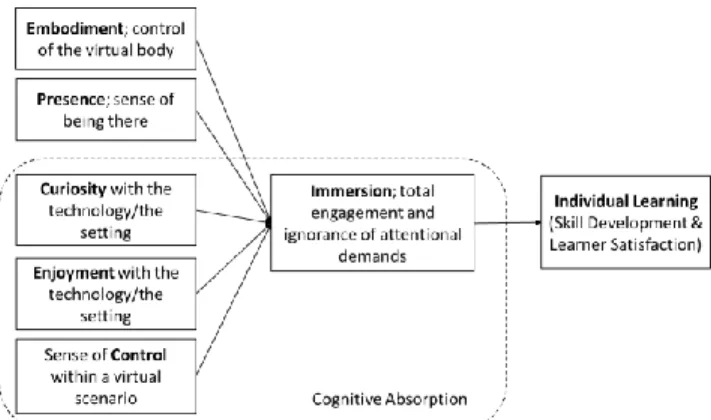
As the findings of the study at hand suggest, within the context of an immersive VR system for individual learning, curiosity, enjoyment, and control (as sub-constructs of CA) as well as embodiment and presence are positively related to immersion. Hence, a chain of effects is illustrated in Fig. 1.
Figure 1. Chain of effects identified in this study
6. Implications for Theory and Design
The study at hand contributes by several implications for theory and design of an immersive VR system for individual learning. First, due to the explorative nature of this qualitative study, the meaning of individual learning through the use of an immersive VR system has been examined. As the findings suggest, virtual reality technologies have the potential to improve learning. Declarative knowledge can be transferred to the development of skills like in practical training phases. Within a virtual environment a user has the possibility to learn procedures or processes by doing. Through different self-regulated learning strategies [44], user can enhance their individual learning outcome which can be done within an immersive VR.Second, the study at hand reveals theoretical insights to CA sub-constructs such as immersion, control, curiosity, and enjoyment as well as, mostly recently used in the context of VW, embodiment and presence. Immersion is the total engagement to a specific task or activity [1, 21] and within a VR setting it refers to a feeling of a realistic scenario. If it is more realistic, people will be more immersed. In addition, immersion is positively related to the sense of control, such as how to interact and manipulate objects within the VR setting. Embodiment, as suggested in the literature, is the sense of controlling the virtual body [34, 35] which arises by the use of the controllers and HMD. Here, a user can move and look around like in the real world and can control the virtual body such as
gestures or facial expressions [9]. Moreover, presence is the feeling of being there [8, 16, 37] which increases the perception of oneself of being in a real world scenario which, in turn, positively influences the immersion.
Implications for the design of an immersive VR system suggest, on the one hand, strengthening of the feeling of embodiment and presence positively influence the immersion towards the system and, on the other hand, providing more artificial or a human avatar will positively affect the sense of social presence. For instance, if within the virtual setting the depiction of controllers is replaced by artificial but human looking hands to interact, create, or manipulate objects, the sense of being there and the control of the virtual body as one-self’s body, hence the subjective experience, will rise which, in turn, affects the immersion. Another idea would be to use connected gloves to interact within the VR. This would also increase the feeling of a real world because people could act like in the real world by grabbing. Moreover, the feeling of being with by having access to others can increase the immersion towards the system. By providing other artificial avatars to interact with or by including other people, a VW can be created instead of a single user experience. Such a VW will be perceived as more realistic [35, 37], which, in turn, can have a positive effect on social self-regulated learning strategies as peer learning to improve learning [22, 44].
7. Limitations and Future Research
The study at hand has several limitations. First, even if all interviewees got first-hand experience, mostly all of them had no pre-experience with immersive VR technologies. Hence, excitement and curiosity towards the technology could lead to an overemphasizing of positive attitudes. Second, in case of providing a pure immersive VR learning system, the findings could be broadening, notably against the background of how to design for learning like didactical concepts. Third, the interviews were conducted during a conference. Even if a separated room was provided, the environment is less controlled in comparison to, for instance, a VR lab. Therefore, the use of an immersive VR system in front of an audience could weaken or distort the VR experience.
Against the background of the limitations, future research should empirically examine the theoretical model of immersive VR for individual learning. Here, a laboratory experiment can reveal cause-effect relationships while design options, within a design theory of how to design an immersive VR system, can be tested.
Acknowledgements. This article was supported by project ELISE by a grant of the German Federal Ministry of Education and Research (BMBF) (No. 16SV7512). Further, the author would like to thank Dr. Ulrich Bretschneider for his support (coding) and constructive feedback.
8. References
[1] Agarwal, R. and Karahanna, E. Time Flies When You’re Having Fun: Cognitive Absorption and Beliefs About
Information Technology Usage. MIS Quarterly 24, 4 (2000),
665–694.
[2] Agarwal, R., Sambamurthy, V., and Stair, R.M. Cognitive Absorption and the Adoption of New Information
Technologies. Academy of Management Proceedings 1997, 1
(1997), 293–297.
[3] Biocca, F. The Cyborg’s Dilemma: Progressive
Embodiment in Virtual Environments. Journal of
Computer-Mediated Communication 3, 2 (1997), 1–18.
[4] Birks, D.F., Fernandez, W., Levina, N., and Nasirin, S. Grounded Theory Method in Information Systems Research:
Its Nature, Diversity and Opportunities. European Journal of
Information Systems 22, 1 (2013), 1–8.
[5] Borer, M.I. The Cyborgian Self: Toward a Critical Social
Theory of Cyberspace. Reconstruction: Studies in
Contemporary Culture 3, 2 (2002).
[6] Cheng, Y.-M. Exploring the Roles of Interaction and
Flow in Explaining Nurses’ E-Learning Acceptance. Nurse
Education Today 33, 1 (2013), 73–80.
[7] Csikszentmihalyi, M. Play and Intrinsic Rewards. In Flow
and the Psychology of Discovery and Invention.
HarperCollinsPublishers, 1996, 135–153.
[8] Davis, A., Murphy, J., Owens, D., Khazanchi, D., and Zigurs, I. Avatars, People, and Virtual Worlds: Foundations
for Research in Metaverses. Journal of the Association for
Information Systems 10, 2 (2009).
[9] Donath, J., Karahalios, K., and Viégas, F. Visualizing
Conversation. Journal of Computer-Mediated
Communication 4, 4 (1999), 1–17.
[10] Gleasure, R. and Feller, J. A Rift in the Ground: Theorizing the Evolution of Anchor Values in Crowdfunding
Communities through the Oculus Rift Case Study. Journal of
the Association for Information Systems 17, 10 (2016).
[11] Goel, L., Johnson, N.A., Junglas, I., and Ives, B. How Cues of What can be done in a Virtual World Influence
Learning: An Affordance Perspective. Information &
Management 50, 5 (2013), 197–206.
[12] Guo, Z., Xiao, L., Van Toorn, C., Lai, Y., and Seo, C. Promoting Online Learners’ Continuance Intention: An
Integrated Flow Framework. Information & Management 53,
2 (2016), 279–295.
[13] Hiltz, S.R. and Turoff, M. Education Goes Digital: The Evolution of Online Learning and the Revolution in Higher
Education. Communications of the ACM 48, 10 (2005), 59–
64.
[14] Introna, L.D. Towards a Post-Human Intra-Actional
Account of Sociomaterial Agency (and Morality). In Moral
Agency and Technical Artefacts. NIAS, Hague, The
Netherlands, 2007, 31–53.
[15] Jiang, Z. (Jack) and Benbasat, I. The Effects of Presentation Formats and Task Complexity on Online
Consumers’ Product Understanding. MIS Q. 31, 3 (2007),
475–475.
[16] Khalifa, M. and Shen, N. System Design Effects on Social Presence and Telepresence in Virtual Communities.
Twenty-fifth International Conference on Information
Systems, (2004).
[17] Kim, D.J. and Zhang, D. The Effects of Sense of Presence, Sense of Belonging, and Cognitive Absorption on Satisfaction and User Loyalty toward an Immersive 3D
Virtual World. In Exploring the Grand Challenges for Next
Generation E-Business. WEB 2009. Lecture Notes in
Business Information Processing, Springer, Berlin, Heidelberg, 2010, 30–43.
[18] Lee, K.M. Presence, Explicated. Communication Theory
14, 1 (2004), 27–50.
[19] Lee, Y., Chen, A.N.K., and Ilie, V. Can Online Wait Be Managed? The Effect of Filler Interfaces and Presentation
Modes on Perceived Waiting Time Online. MIS Quarterly
36, 2 (2012), 365–394.
[20] Leong, P. Role of Social Presence and Cognitive
Absorption in Online Learning Environments. Distance
Education 32, 1 (2011), 5–28.
[21] Lowry, P.B., Gaskin, J.E., Twyman, N.W., Hammer, B., and Roberts, T.L. Taking “Fun and Games” Seriously: Proposing the Hedonic-Motivation System Adoption Model
(HMSAM). Journal of the Association for Information
Systems 14, 11 (2013), 617–671.
[22] Magni, M., Paolino, C., Cappetta, R., and Proserpio, L. Diving Too Deep: How Cognitive Absorption and Group
Learning Behavior Affect Individual Learning. Academy of
Management Learning & Education 12, 1 (2013), 51–69.
[23] Martín-Gutiérrez, J., Mora, C.E., Añorbe-Díaz, B., and González-Marrero, A. Virtual Technologies Trends in
Education. EURASIA Journal of Mathematics, Science and
Technology Education 13, 1 (2017).
[24] Mills, S. and Noyes, J. Virutal Reality: An Overview of
User-related Design Issues. Interacting with Computers, 11
(1999), 375–286.
[25] Myers, M. Qualitative Research in Information Systems.
Management Information Systems Quarterly 21, 2 (1997).
[26] Nilsson, A., Axelsson, A.-S., Heldal, I., and Schroeder, R. The Long-term Uses of Shared Virtual Environments: An
Exploratory Study. In R.S.B. MSc, ed., The Social Life of
Avatars. Springer London, 2002, 112–126.
[27] Novak, T.P., Hoffman, D.L., and Yung, Y.-F. Measuring the Customer Experience in Online
Environments: A Structural Modeling Approach. Marketing
Science 19, 1 (2000), 22–42.
[28] Reychav, I. and Wu, D. Are Your Users Actively Involved? A Cognitive Absorption Perspective in Mobile
Training. Computers in Human Behavior 44, (2015), 335–
346.
[29] Reychav, I. and Wu, D. Mobile Collaborative Learning: The Role of Individual Learning in Groups Through Text and
Video Content Delivery in Tablets. Computers in Human
Behavior 50, (2015), 520–534.
[30] Roca, J.C., Chiu, C.-M., and Martínez, F.J. Understanding E-Learning Continuance Intention: An Extension of the Technology Acceptance Model.
International Journal of Human-Computer Studies 64, 8
(2006), 683–696.
[31] Rodríguez-Ardura, I. and Meseguer-Artola, A. E-Learning Continuance: The Impact of Interactivity and the
Mediating Role of Imagery, Presence and Flow. Information
& Management 53, 4 (2016), 504–516.
[32] Rodríguez-Ardura, I. and Meseguer-Artola, A. What Leads People to Keep on E-Learning? An Empirical Analysis of Users’ Experiences and Their Effects on Continuance
Intention. Interactive Learning Environments 24, 6 (2016),
1030–1053.
[33] Saadé, R. and Bahli, B. The Impact of Cognitive Absorption on Perceived Usefulness and Perceived Ease of Use in On-line Learning: An Extension of the Technology
Acceptance Model. Information & Management 42, 2 (2005),
317–327.
[34] Schultze, U. Embodiment and Presence in Virtual
Worlds: A Review. Journal of Information Technology 25, 4
(2010), 434–449.
[35] Schultze, U. Performing Embodied Identity in Virtual
Worlds. European Journal of Information Systems 23, 1
(2014), 84–95.
[36] Strauss, A. and Corbin, J.M. Basics of qualitative
Research: Grounded Theory Procedures and Techniques.
Sage Publications, Thousand Oaks; CA, 1990.
[37] Suh, K.-S., Kim, H., and Suh, E.K. What if Your Avatar Looks Like You? Dual Congruity Perspectives for Avatar
Use. MIS Q. 35, 3 (2011), 711–730.
[38] Suh, K.-S. and Lee, Y.E. The Effects of Virtual Reality
on Consumer Learning: An Empirical Investigation. MIS
Quarterly 29, 4 (2005), 673–697.
[39] Tan, W.-K., Lee, P.-W., and Hsu, C.-W. Investigation of Temporal Dissociation and Focused Immersion as
Moderators of Satisfaction–Continuance Intention
Relationship: Smartphone as an Example. Telematics and
Informatics 32, 4 (2015), 745–754.
[40] Urquhart, C. and Fernandez, W. Using grounded theory method in information systems: the researcher as blank slate
and other myths. Journal of Information Technology 28, 3
(2013), 224–236.
[41] Urquhart, C., Lehmann, H., and Myers, M.D. Putting the ‘Theory’ Back Into Grounded Theory: Guidelines for Grounded Theory Studies in Information Systems.
Information Systems Journal 20, 4 (2010), 357–381.
[42] Venkatesh, V., Brown, S., and Bala, H. Bridging the Qualitative–Quantitative Divide: Guidelines for Conducting Mixed Methods Research in Information Systems.
Management Information Systems Quarterly 37, 1 (2013),
21–54.
[43] Visinescu, L.L., Sidorova, A., Jones, M.C., and Prybutok, V.R. The Influence of Website Dimensionality on Customer Experiences, Perceptions and Behavioral Intentions: An Exploration of 2D vs. 3D Web Design.
Information & Management 52, 1 (2015), 1–17.
[44] Wan, Z., Compeau, D., and Haggerty, N. The Effects of Self-Regulated Learning Processes on E-Learning Outcomes
in Organizational Settings. Journal of Management
Information Systems 29, 1 (2012), 307–340.
[45] Webster, J., Trevino, L.K., and Ryan, L. The
Dimensionality and Correlates of Flow in Human-Computer
Interactions. Computers in Human Behavior 9, 4 (1993),
411–426.
[46] Wexelblat, A., ed. Virtual Reality Applications and
Explorations. Academic Press Professional, Inc., San Diego,