FINANCING REGIONAL DEVELOPMENT THROUGH
DEVELOPMENT BANKS
*Branko Matić1, Hrvoje Serdarušić2 1
Full Professor, Faculty of Economics in Osijek, Croatia, [email protected] 2
Teaching Assistant, Faculty of Economics in Osijek, Croatia, [email protected]
________________________________________________________________
Abstract
A combination of various sources of financing is a necessary prerequisite to finance any development as well as regional development. Sources of financing can be monitored and evaluated from the aspects of suitability (cost aspect), availability and abundance. Ultimate users of funds give advantage to financial sources whose availability and abundance is at the maximum level, and costs are at their minimum. For the most part, development bank funds meet the above mentioned requirements, since the main function of these banks is to finance certain activities under special (more favourable) conditions. The significance, justification and evaluation of this form of financial resources in the regional development segment are becoming more and more prominent.
The subject of this paper is the amount and conditions of development bank loans in the area of Osijek-Baranja and Vukovar-Srijem Counties.
JEL classification: E51, G32, O16, O19, O23
Keywords: financing, regional development, development banks, sources of financing
________________________________________________________________
1. Introduction
Every country, region, company, as well as individuals, face the problem of financing their needs. Traditional credit institutions are often not interested in financing certain projects and providing financial support to specific activities. There are multiple reasons for that, among which there is a long financing period for these activities, lower income from interests, long turnover periods, increased loan repayment risks and inadequate collateral.
Countries try to overcome this specific problem and satisfy the need for financing by establishing specialized credit and development institutions whose
*
The presented results are the outcome of the projects Bank System in the Financing of Polycentric Development (No. 010-0102290-1284) conducted with the support of the Ministry of Science, Education and Sports of the Republic of Croatia
mission is to provide financing and to encourage development of certain segments and sectors of economy in this way.
2. Characteristics of Development Banking
Some specific needs, including various infrastructure projects of great value and special activities, like agriculture and related activities, often require special terms of financing. As business credit institutions are not interested in providing finances for this segment of economy due to specific conditions of financing these activities, financial support is partially taken over by states through specialized credit and development institutions. This form of financing is present to a varying extent in all countries of the world as well as in various associations of countries (unions). Main sources of financing of these institutions are funds from the state budget, then funds provided by long-term debt in country and abroad, and funds raised by issuing an emission of debt securities.
Compared to business banks, credit and development institutions have different sources of financing and very often they are beneficiaries of permanent government privileges†, which helps them in providing better terms of financing. As a rule, their activity has a development impact on certain branches of economy, regions and countries.
Development banks have one of the following ownership models: - State owned only,‡
- Owned by several countries,§ - Owned by individual regions.
2.1. Croatian Development Bank
The newly acquired independence of the Republic of Croatia and the need and necessity of overcoming the situation at that time, transition, war and occupation of some of the territory, lead the Republic of Croatia to realize the need and advantages of having a development bank as one of the instruments of development activities. So in 1992, at the beginning of the sovereignty,
†
Free from income taxes, not liable to bankruptcy proceedings or liquidation, country(ies) guarantee for all of their obligations. These banks have no obligation of calculating, maintaining and allocating required reserves.
‡
The operational area of this type of a development bank is mostly defined by state borders of a certain country(ies), because the state is at the same time the only founder and owner. In the Republic of Croatia this function is obtained by Croatian Bank for Development and Reconstruction (HBOR).
§
Croatian credit bank for reconstruction** (HKBO) was founded, which soon after, in 1995, changed its name in Hrvatska banka za obnovu i razvitak†† (HBOR) – Croatian Bank for Reconstruction and Development. This credit institution today acts as a development and exporting bank‡‡ of the Republic of Croatia and provides support through§§:
1. Financing of reconstruction and development of Croatian economy, 2. Financing of infrastructure,
3. Encouraging exports,
4. Providing support to development of small and medium entrepreneurship,
5. Encouraging environmental protection, and
6. Insurance of exports of Croatian goods and services against non-market risks.
HBOR implements its main activities by providing financing through***: 1. Approving loans and other placements
2. Issuing bank and other guarantees
3. Concluding insurance and reinsurance contracts
4. Making investments in equity and debt instruments and 5. Performing other financial work and services.
Unlike the previous period in which it had offices only in Zagreb, HBOR expanded its activity by opening five regional offices††† throughout the Republic of Croatia. Organization structure of the bank in form of branch offices facilitates collection of information as well as communication and availability of the “products” to potential clients.
2.2. Multilateral development banks –goals and ways of financing
Globalization and problems in uneven development of certain countries-association members or regions within certain countries impose the need and necessary activities in order to overcome such situation. Multilateral development banks have a relatively successful performance in that direction.
**
Official Gazette 33/1992, 76/1993 108/1995, 8/1996 ††
Amended Act on the Croatian Credit Bank for Reconstruction, Official Gazette 108/1995 Art. 1.
‡‡
Act on Croatian Bank for Development and Reconstruction, Official Gazette 138/2006, Art.2. §§
Act on Croatian Bank for Development and Reconstruction, Official Gazette 138/2006,
čl.10.t.2
***
Act on Croatian Bank for Development and Reconstruction, Official Gazette 138/2006,
čl.10.t.2
†††
Regional office for Slavonia and Baranja, Regional office for Dalmatia, Regional office for Istria, Regional office for Lika, Regional office for Primorje and Gorski kotar
The major multilateral development and bank institutions are‡‡‡: 1. International Bank for Reconstruction and Development (IBRD), 2. International Finance Corporation (IFC),
3. Inter-American Development Bank, 4. Asian Development Bank,
5. African Development Bank,
6. Council of Europe Development Bank (CEB), 7. Nordic Investment Bank,
8. Caribbean Development Bank,
9. European Bank for Reconstruction and Development (EBRD), 10. European Investment Bank (EIB),
11. European Investment Fund (EIF),
12. Multilateral Investment Guarantee Agency, 13. International Finance Facility for Immunisation, 14. Islamic Development Bank,
15. Inter-American Investment Corporation, 16. Black Sea Trade and Development Bank and 17. Central American Bank for Economic Integration.
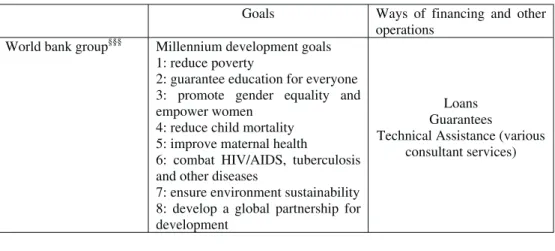
Comparing the role and significance of multilateral development banks in financing of regional development, it is possible to observe the same or similar goals and reasons for incorporation and directions and ways in which they act (Table 1).
Table 2: Goals, ways of financing and other business operations of multilateral development banks active in the Republic of Croatia
Goals Ways of financing and other operations
World bank group§§§ Millennium development goals 1: reduce poverty
2: guarantee education for everyone 3: promote gender equality and empower women
4: reduce child mortality 5: improve maternal health
6: combat HIV/AIDS, tuberculosis and other diseases
7: ensure environment sustainability 8: develop a global partnership for development
Loans Guarantees
Technical Assistance (various consultant services)
‡‡‡
Decision about adequacy of the guarantee capital of loan institutions Art.2.t.5 OG 1/2009 §§§
The Group consists of: International Bank for Reconstruction and Development, International Development Agency
European Bank for Reconstruction and Development (EBRD)
Depending on the strategy for a certain country Loans Investments in equity Guarantees European Investment Bank (EIB)
Contribution to more balanced development of the Community by ensuring economic and social cohesion of member countries
Loans
Technical Assistance (various expert consultant services)
Guarantees Venture capital funds European Investment
Fund (EIF)
Assistance in development of small and medium entrepreneurship in Europe
Loans Guarantees Venture capital funds Council of Europe
Development Bank (CEB)
Assistance in overcoming social inequalities and difficulties
Assistance in revitalization of economy in disadvantaged regions
Loans Guarantees Trust account Interest rebate
Business policy of multilateral development banks is highly harmonized with the development guidelines and strategies of countries/unions, regional development guidelines and strategies at the local level.
3. Credit placements of multilateral credit and development banks in the Republic of Croatia
In addition to providing loans, multilateral development banks also have a significant role in the technical assistance segment and guarantee-related business operations, but the dominant activity is credit placement.
Direct credit placements of multilateral development banks in the Republic of Croatia in the period since becoming a member of these institutions until today has amounted to: €5.673 million.
According to the placement structure, the most important creditors are**** IBRD with €2.164 million of approved funds, EBRD with €2.247 million, and
EIB/EIF with €1.303 million of approved funds.
International Bank for Development and reconstruction (IBRD), as one of more important international credit and development institutions in the Republic of Croatia, financed 46 large development projects worth €1.847 billion in the
period from 1994, when the Republic of Croatia became a member of, until
****
All amounts are denominated in €
2008. The projects were mostly related to investment and improvement of infrastructure, improvement of state administration work and harmonization with European legislation, then to the fields of de-mining and environmental protection. A trend of activity growth of this credit and development institution can be observed in the Republic of Croatia (Chart 1).
Out of the total amount of funds that this institution invested in the Republic of Croatia, €50,8 million of credit funds were directly invested in two projects in
the area of Osijek-Baranja and Vukovar-Srijem counties (Eastern Slavonia, Baranja and Western Srijem Reconstruction Project, €50 million, and Kopački
rit Wetlands Management Project).
European Bank for Reconstruction and Development (EBRD) has been financially active in the area of the Republic of Croatia since 1994. It has invested€2.247 million, €75 million of which have been directly invested in the
area of Osijek-Baranja and Vukovar-Srijem counties.
European Investment Bank (EIB) and European Investment Fund (EIF) are specialized credit and development institutions of European Union that have the status of multilateral development banks. Their main goal is to encourage integration, even development, economic and social cooperation among the countries – EU members and provide assistance in financing small and medium entrepreneurship at the state, regional and local level. The Republic of Croatia has been a member of these institutions†††† since 1997. Activity and significance of these institutions in the Republic of Croatia can be observed from the data about the amount of their placements, which was €1.303 million in the period from 1997 to 2007 (Chart 1).
Council of Europe Development Bank is a credit and development institution, and the Republic of Croatia has been present in it as a member since 1997. Its activity is primarily socially oriented and its assistance is directed to overcoming inequality and difficulties and providing assistance to disadvantaged economies in the region. This credit and development institution has been active in the Republic of Croatia since 1998. It invested the total of
€276 million of credit funds until 2007 (Chart 1).
†††† The Republic of Croatia is a member of the European Investment Fund through Croatian Bank for Reconstruction and Development, and it will become a member of the European Investment Bank after joining the EU, since the membership in this bank is reserved for EU members only.
Chart 1: Amounts of credit placements of multilateral development banks in the Republic of Croatia in € mil
Source: Annual reports and statistical data of IBRD, EBRD, CEB, EIB/EIF
For placements of multilateral development banks it is typical that they are not separately monitored by regions (no geographic differentiation), and in some banks also by activities. Certain standards of their activities can be observed, and these are:
1. Credit placements intended for development are mostly invested through
national development banks, and rarely directly to the client/company, 2. Most of finances are allocated through loans,
3. Interest rates are mostly fixed
4. Purpose-specific spending of approved credit placements is strictly controlled and monitored.
4. Credit activity of HBOR in the area of Osijek-Baranja and Vukovar-Srijem counties
The time period included in the analysis of trends in credit placements of HBOR in Osijek-Baranja and Vukovar-Srijem counties is 5 years, i.e. includes the period from 2004 to 2008.
In the last few years of the analyzed period a trend of growth of credit placements of HBOR as well as its more significant participation in financing development in the area of Osijek-Baranja and Vukovar-Srijem counties can be observed (Table 2).
Table 3: Credit activity of HBOR in the area of Osijek-Baranja and Vukovar-Srijem counties
OSIJEK-BARANJA COUNTY
2004 2005 2006 2007 2008 Credit programme € approved € approved € approved € approved € approved Programme of crediting reconstruction
and development of business entities 1.267.728 7.081.836 17.408.137 45.167.528 11.511.672 Exports credit 5.893.341 8.613.148 12.290.298 16.178.908 18.262.045 Programme of reconstruction and
development in the Republic of
Croatia 1.040.276 121.621 498.855 1.228.048 852.090 Small and medium entrepreneurship
credit programme 1.919.461 4.732.296 6.769.968 10.221.808 13.276.597 TOTAL 10.120.806 20.548.901 36.967.258 72.796.292 43.902.404
VUKOVAR-SRIJEM COUNTY
2004 2005 2006 2007 2008 Credit programme € approved € approved € approved € approved € approved Programme of crediting reconstruction
and development of business entities 271.330 7.076.024 7.394.434 23.254.994 22.182.616 Exports credit 1.867.742 7.226.857 7.749.461 1.068.413 13.039.681 Programme of reconstruction and
development in the Republic of
Croatia 5.555.702 270.269 0 1.156.810 0 Small and medium entrepreneurship
credit programme 1.283.219 2.947.257 7.993.966 6.672.908 8.696.900 TOTAL 8.977.993 17.520.407 23.137.861 32.153.125 43.919.197
Source: Internal data of HBOR
The average amount of credit placement of HBOR in Osijek-Baranja county has ranged from €389 thousand in 2004 to €887 thousand in 2007. The average
amount of credit in 2008 was about €418 thousand.
The average amount of credit placement of HBOR inVukovar-Srijem county is somewhat different. The lowest amount was recorded in 2007, when the average amount was about €518 thousand. There were no significant
oscillations n the observed period and the amount ranged between €518 to 700 thousand. In 2008, the last year of the observed period, it amounted to €665
thousand (Table 3).
Table 4: Average amounts of credit placements
The average amount of loan 2004 2005 2006 2007 2008 OSIJEK-BARANJA COUNTY 389.262 428.102 626.564 887.760 418.118 VUKOVAR-SRIJEM COUNTY 690.615 700.816 593.278 518.599 665.442
It is possible to connect the increase in financial activity of the Croatian Bank for Reconstruction and Development to the change in its business philosophy, i.e. opening of a network of regional offices.
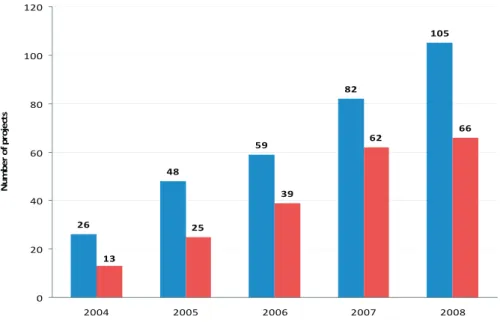
A trend of growth of the number of projects/loans can be observed in the observed period, going from 26 in Osijek-Baranja county and 13 in Vukovar-Srijem county at the beginning, to 105 projects/loans in Osijek-Baranja county and 66 projects/loans in Vukovar-Srijem county in 2008, which makes an increase of 304% in Osijek-Baranja county and 408% in Vukovar-Srijem county (Chart 2, Table 4).
Chart 2: The number of projects financed by HBOR
! "# ! $%" " &# $& Ϭ ϮϬ ϰϬ ϲϬ ϴϬ ϭϬϬ ϭϮϬ ϮϬϬϰ ϮϬϬϱ ϮϬϬϲ ϮϬϬϳ ϮϬϬϴ EƵ ŵ ďĞ ƌŽ ĨƉ ƌŽ ũĞ Đƚ Ɛ KƐŝũĞŬͲĂƌĂŶũĂĐŽƵŶƚLJ sƵŬŽǀĂƌͲ^ƌŝũĞŵĐŽƵŶƚLJ
Source: Internal data of HBOR
Table 5: Trends in the number of loans in indices
2004 2005 2006 2007 2008
OSIJEK-BARANJA COUNTY 100 185 227 315 404
VUKOVAR-SRIJEM COUNTY 100 192 300 477 508
Source : Internal data of HBOR, calculation of the author
From the structure of credit placements by credit programmes in both of the counties in the period from 2004 to 2008, a significant reduction of credit placements can be observed for the reconstruction and development of infrastructure programme as well as a more significant credit activity in reconstruction and development of business entities loan programmes, small and medium entrepreneurship loan programme and loans for export, with
significant decrease of this programme in 2007 in Vukovar-Srijem county (Charts 3 and 4).
Chart 3: Structure of loan programmes for Osijek-Baranja county
Ϭй ϭϬй ϮϬй ϯϬй ϰϬй ϱϬй ϲϬй ϳϬй ϴϬй ϵϬй ϭϬϬй ϮϬϬϰ ϮϬϬϱ ϮϬϬϲ ϮϬϬϳ ϮϬϬϴ ^ŵĂůůĂŶĚŵĞĚŝƵŵ ĞŶƚƌĞƉƌĞŶĞƵƌƐŚŝƉůŽĂŶ ƉƌŽŐƌĂŵŵĞ ZĞĐŽŶƐƚƌƵĐƚŝŽŶĂŶĚĚĞǀĞůŽƉŵĞŶƚ ŽĨŝŶĨƌĂƐƚƌƵĐƚƵƌĞƉƌŽŐƌĂŵŵĞŝŶ ƚŚĞZĞƉƵďůŝĐŽĨƌŽĂƚŝĂ >ŽĂŶƐĨŽƌĞdžƉŽƌƚƐ ZĞĐŽŶƐƚƌƵĐƚŝŽŶĂŶĚĚĞǀĞůŽƉŵĞŶƚ ŽĨďƵƐŝŶĞƐƐĞŶƚŝƚŝĞƐůŽĂŶ ƉƌŽŐƌĂŵŵĞ
Source: Internal data of HBOR
Chart 4: Structure of loan programmes for Vukovar-Srijem county
Ϭй ϭϬй ϮϬй ϯϬй ϰϬй ϱϬй ϲϬй ϳϬй ϴϬй ϵϬй ϭϬϬй ϮϬϬϰ ϮϬϬϱ ϮϬϬϲ ϮϬϬϳ ϮϬϬϴ ^ŵĂůůĂŶĚŵĞĚŝƵŵ ĞŶƚƌĞƉƌĞŶĞƵƌƐŚŝƉůŽĂŶ ƉƌŽŐƌĂŵŵĞ ZĞĐŽŶƐƚƌƵĐƚŝŽŶĂŶĚĚĞǀĞůŽƉŵĞŶƚ ŽĨŝŶĨƌĂƐƚƌƵĐƚƵƌĞƉƌŽŐƌĂŵŵĞŝŶ ƚŚĞZĞƉƵďůŝĐŽĨƌŽĂƚŝĂ >ŽĂŶƐĨŽƌĞdžƉŽƌƚƐ ZĞĐŽŶƐƚƌƵĐƚŝŽŶĂŶĚĚĞǀĞůŽƉŵĞŶƚ ŽĨďƵƐŝŶĞƐƐĞŶƚŝƚŝĞƐůŽĂŶ ƉƌŽŐƌĂŵŵĞ
Source: Internal data of HBOR 4. Conclusion
Financing as a key factor in sustainable regional development requires specific forms, ways and combinations of various sources of financing. Such circumstances resulted in the establishment of credit and development
institutions, which to a greater extent take the lead in financing regional development, especially in developing countries. Therefore, financing through credit and development institutions is becoming more popular, largely due to the fact that these institutions promote common interests and use other government benefits at the same time.
REFERENCES
1. Dokument europske banke za obnovu i razvoj Strategija za Republiku Hrvatsku, odobrena na sjednici Upravnog odbora od 14. svibnja 2007
2. Annualy Report EBRD-a od 1991 do 2008.
3. Matic, B. & Serdarusic, H. (2008) Models of Including Financially Inactive Population into the Financial System, Interdisciplinary Management Research, Faculty of Economics in Osijek, Croatia, vol. 4, pages 296-309 4. Markovic, B. & Matic, B. (2006) The Process of Transition and the Capital
Market in the Republic of Croatia, Interdisciplinary Management Research, Faculty of Economics in Osijek, Croatia, vol. 2, pages 343-348
5. Lamza – Maronic,M & Glavas, J & Bošnjak S (2008) Contribution to the Development of the Urban Management Model, Interdisciplinary Management Research, Faculty of Economics in Osijek, Croatia, vol. 4, pages 526-541
6. Barkovic, I.(2007) Gender Pay Gap in the European Union Labor Market, Interdisciplinary Management Research, Faculty of Economics in Osijek, Croatia, vol. 3, pages 92-99
7. Zakon o Hrvatskoj kreditnoj banci za obnovu, Narodne novine 33/1992, 76/1993 108/1995, 8/1996
8. Zakon o Hrvatskoj banci za obnovu i razvitak, Narodne novine 138/2006 9. Odluka o adekvatnosti jamstvenog kapitala kreditnih institucija, Narodne
novine 1/2009
10. Barkovic, D. (2007) Mehrfachkriterien-Fuzzy Lineares Programmieren, Interdisciplinary Management Research, Faculty of Economics in Osijek, Croatia, vol. 3, pages 219-241
11. Statute European Investment Bank, ISBN 92-861-0558-4
12. COMMISSION DIRECTIVE 2007/18/EC of 27 March 2007 amending Directive 2006/48/EC of the European Parliament and of the Council as regards the exclusion or inclusion of certain institutions from its scope of application and the treatment of exposures to multilateral development banks OJ L 87/2007od 28.03.2007 13.www.hbor.hr 14.www.worldbank.org 15.www.ebrd.com 16.www.eib.com 17.www.coebank.org 759