HAL Id: hal-01064785
https://hal-sciencespo.archives-ouvertes.fr/hal-01064785
Preprint submitted on 17 Sep 2014HAL is a multi-disciplinary open access archive for the deposit and dissemination of sci-entific research documents, whether they are pub-lished or not. The documents may come from teaching and research institutions in France or
L’archive ouverte pluridisciplinaire HAL, est destinée au dépôt et à la diffusion de documents scientifiques de niveau recherche, publiés ou non, émanant des établissements d’enseignement et de recherche français ou étrangers, des laboratoires
Precautionary Saving and Consumption Smoothing
Across Time and Possibilities
Miles Kimball, Philippe Weil
To cite this version:
Miles Kimball, Philippe Weil. Precautionary Saving and Consumption Smoothing Across Time and Possibilities. 1992. �hal-01064785�
NBER WORKING PAPER SERIES
PRECAUTIONARY SAVING AND CONSUMPTION SMOOTHING ACROSS TIME
AND POSSIBILITIES
Miles Kimball
Philippe Weil
Working Paper 3976
http://www.nber.org/papers/w3976
NATIONAL BUREAU OF ECONOMIC RESEARCH
1050 Massachusetts Avenue
Cambridge, MA 02138
January 1992
We gratefully acknowledge support from the National Science Foundation. Part of this research was
funded by National Institute of Aging Grants P01-AG10179 and 5 P01 AG026571-03. Our research
assistant, Thomas Bishop, caught many small errors and made excellent suggestions for tightening
up the text. We thank an anonymous referee for useful comments and suggestions. The views expressed
herein are those of the author(s) and do not necessarily reflect the views of the National Bureau of
Economic Research.
© 1992 by Miles Kimball and Philippe Weil. All rights reserved. Short sections of text, not to exceed
two paragraphs, may be quoted without explicit permission provided that full credit, including © notice,
Precautionary Saving and Consumption Smoothing Across Time and Possibilities
Miles Kimball and Philippe Weil
NBER Working Paper No. 3976
January 1992, Revised July 2008
JEL No. E21,D11
ABSTRACT
This paper examines how aversion to risk and aversion to intertemporal substitution determine the
strength of the precautionary saving motive in a two-period model with Selden/Kreps-Porteus preferences.
For small risks, we derive a measure of the strength of the precautionary saving motive which generalizes
the concept of "prudence" introduced by Kimball (1990b). For large risks, we show that decreasing
absolute risk aversion guarantees that the precautionary saving motive is stronger than risk aversion,
regardless of the elasticity of intertemporal substitution. Holding risk preferences fixed, the extent
to which the precautionary saving motive is stronger than risk aversion increases with the elasticity
of intertemporal substitution. We derive sufficient conditions for a change in risk preferences alone
to increase the strength of the precautionary saving motive and for the strength of the precautionary
saving motive to decline with wealth. Within the class of constant elasticity of intertemporal substitution,
constant-relative risk aversion utility functions, these conditions are also necessary.
Miles Kimball
Department of Economics
University of Michigan
Ann Arbor, MI 48109-1220
and NBER
Philippe Weil
Director, Universite Libre de Bruxelles
ECARES
50, Avenue Roosevelt CP 114
B-1050 Brussels BELGIUM
and NBER
1
Introduction
Because it does not distinguish between aversion to risk and aversion to intertemporal sub-stitution, the traditional theory of precautionary saving based on intertemporal expected utility maximization is a framework within which one cannot ask questions that are funda-mental to the understanding of consumption in the face of labor income risk. For instance, how does the strength of the precautionary saving motive vary as the elasticity of intertem-poral substitution changes, holding risk aversion constant? Or, how does the strength of the precautionary saving motive vary as risk aversion changes, holding the elasticity of intertemporal substitution constant?
Moreover, one might wonder whether some of the results from an intertemporal ex-pected utility framework continue to hold once one distinguishes between aversion to risk and resistance to intertemporal substitution. For instance, does decreasing absolute risk aversion imply that the precautionary saving motive is stronger than risk aversion regard-less of the elasticity of intertemporal substitution? And under what conditions does the precautionary saving motive decline with wealth?
To make sense of these questions, and to gain a better grasp on the channels through which precautionary saving may affect the economy,1 we adopt a representation of pref-erences based on the Selden and Kreps-Porteus axiomatization, which separates attitudes towards risk and attitudes towards intertemporal substitution.2
The existing literature on the theory of precautionary saving under Selden/ Kreps-Porteus preferences is not very extensive. Barsky (1986) addresses some of the aspects of this theory in relation to rate-of-return risks in a two-period setup, Weil (1993) analyzes a parametric infinite-horizon model with mixed isoelastic/constant absolute risk aversion 1There has been a considerable resurgence of interest in precautionary saving in the last twenty-two years. For some early papers in this period, see for instance Barsky, Mankiw, and Zeldes (1986), Skinner (1988), Kimball and Mankiw (1989), Zeldes (1989), Caballero (1990), Kimball (1990b), and Weil (1993). The subse-quent citation patterns of these early papers indicate continuing interest in precautionary saving.
2See, for instance, Selden (1978), Selden (1979), Kreps and Porteus (1978), Hall (1988), Epstein and Zin (1989), Farmer (1990), Weil (1990), and Hansen, Sargent, and Tallarini (1999).
preferences (which do not allow one to look at the consequences of decreasing absolute risk aversion), but there has not been as yet any systematic treatment of precautionary saving under Selden/Kreps-Porteus preferences.
Under intertemporal expected utility maximization, the strength of the precautionary saving motive is not an independent quantity, but is linked to other aspects of risk pref-erences. In that case, the absolute prudence −v′′′/v′′ of a von-Neumann Morgenstern second-period utility functionv measures the strength of the precautionary saving motive (see Kimball (1990b)]), and there is an identity linking prudence to risk aversion under additively time- and state-separable utility:
− v ′′′(x) v′′(x) =a(x)− a′(x) a(x), (1.1) where a(x) =−v ′′(x) v′(x) (1.2)
is the Arrow-Pratt measure of absolute risk aversion. Similarly, the coefficient of relative prudence−x v′′′(x)/v′′(x)satisfies − x v ′′′(x) v′′(x) =γ(x) +ǫ(x), (1.3) where γ(x) =−x v ′′(x) v′(x) = x a(x) (1.4)
is relative risk aversion, and
ǫ(x) =−x a ′(x)
a(x) (1.5)
is the elasticity of absolute risk tolerance,3which approximates the wealth elasticity of risky investment.
Selden/Kreps-Porteus framework that allows for risk preferences and intertemporal sub-stitution to be varied independently from each other—between the strength of the precau-tionary saving motive, risk aversion, and intertemporal substitution.
In Section 2, we set up the model. In Section 3 we derive a local measure of the precautionary saving motive for small risks. Section 4deals with large risks: it performs various comparative statics experiments to provide answers to the questions we asked in our first two paragraphs. The conclusion discusses the implications of our main results.
2
Setup
This section describes our basic model, and characterizes optimal consumption and saving decisions.
2.1
The model
We use essentially the same two-period model of the consumption-saving decision as in Kimball (1990b), except for departing from the assumption of intertemporal expected util-ity maximization.4 We assume that the agent can freely borrow and lend at a fixed risk-free rate, and that the constraint that an agent cannot borrow against more than the minimum value of human wealth is not binding at the end of the first period. Since the interest rate is exogenously given, all magnitudes can be represented in present-value terms— so that, without loss of generality, the real risk-free rate can be assumed to be zero. We also assume that labor supply is inelastic, so that labor income can be treated like manna from heaven. Finally, we assume that preferences are additively time-separable.
4Because there is enough to be said about the two-period case, we leave comprehensive treatment of the multi-period case to future research. ? follows up our research by studying the multi-period case computa-tionally. The results derived by Weil (1993) and van der Ploeg (1993) for particular multi-period parametric versions of Kreps-Porteus preferences suggest that the two-period results of this paper have natural general-izations to multi-period settings. In the case of intertemporal expected utility maximization, Kimball (1990a) extends two-period results about precautionary saving effects decreasing with wealth to multi-period settings. As in that paper, characterization of the multiperiod case must rely on the tools developed in the two-period case. In addition, the two-period model highlights what cannot possibly be proven for the multiperiod case.
The preferences of our agent can be represented in two equivalent ways. First, there is the Selden ordinal certainty equivalence representation,
u(c1) +U(v−1(Ev(˜c2))) =u(c1) +U(M(˜c2)),
wherec1andc2 are first- and second-period consumption,uis the first-period utility func-tion,U is the period utility function for the certainty equivalent of random second-period consumption (computed according to the atemporal von Neumann-Morgenstern utility function v),5 E is an expectation conditional on all information available during the first period, andM is the certainty equivalent operator associated withv:
M(˜c2) =v−1(Ev(˜c2)).
According to this representation, the utility our consumer derives from the consumption lottery (c1, ˜c2) is the sum of the felicity provided by c1 and the felicity provided by the certainty equivalent M(˜c2) of ˜c2. Obviously, v plays no role, and M is an identity, under certainty. These functions thus capture pure risk preferences.
Second, there is the Kreps-Porteus representation,
u(c1) +φ(Ev(˜c2)),
where nonlinearity of the functionφindicates departure from intertemporal expected util-ity maximization. This formulation expresses total utilutil-ity as the nonlinear aggregate of current felicity and expected future felicity.6
These two representations are equivalent as long as v is a continuous, monotonically increasing function, so that M(˜c2) is well defined wheneverEv(˜c2) is well defined. The
5SinceUis a general function, any time discounting can be embedded in the functional form ofU. 6Thus, when we refer in this paper to the Kreps-Porteus representation or to Kreps-Porteus preferences, we point to thespecific form of the aggregator functionbetween current and future consumption proposed by Kreps and Porteus (1978) in their multi-period axiomatization.
link between the two representations is that
φ(ν) =U(v−1(ν)). (2.1)
Thus, as can be seen by straightforward differentiation,φis concave if−U′′/U′≥ −v′′/v′, whileφ is convex if−U′′/U′ ≤ −v′′/v′. We will mainly use the Selden representation— which is more intuitive—but, when more convenient mathematically, we use the Kreps-Porteus representation.
2.2
Optimal consumption and saving
Our consumer solves the following problem:
max
x u(w−x) +U(M(x+˜y)), (2.2)
where w is the sum of initial wealth, first-period income, and the mean of second-period income,x is “saving” out of this whole sum, and ˜y is the deviation of second-period income from its mean.
The first-order condition for the optimal level of saving x is
u′(w−x) =U′(M(x+˜y))M′(x+˜y), (2.3)
where M′is defined by
M′(x+˜y) = ∂
∂xM(x+˜y). (2.4)
To guarantee that the solution to (2.3) is uniquely determined, we would like the marginal utility of saving,
U′(M(x+˜y))M′(x+˜y),
to be a decreasing function of x.7 In the main body of the paper, we will simply assume 7Throughout the paper, verbal characterizations of gradients (increasing, decreasing) or inequalities
that this condition holds; it is equivalent to the reasonable assumption that first-period consumption is a normal good. Appendix A gives a deeper treatment, proving that the marginal utility of saving is decreasing under plausible restrictions on preferences.
Equation (2.3) and the assumption of a decreasing marginal utility of saving imply that the uncertainty represented by ˜y will cause additional saving if
U′(M(x+˜y))M′(x+˜y)>U′(x), (2.5)
that is, if the risk ˜y raises the marginal utility of saving.
As in Kimball (1990b), we can study the strength of precautionary saving effects by looking at the size of the precautionary premiumθ∗needed to compensate for the effect of the risk ˜y on the marginal utility of saving. The precautionary premiumθ∗is the solution to the equation
U′(M(x+θ∗+˜y))M′(x+θ∗+˜y) =U′(x), (2.6) or equivalently, using the Kreps-Porteus representation of preferences, the solution to the equation
φ′[Ev(x+θ∗+˜y)]Ev′(x+θ∗+˜y) =φ′[v(x)]v′(x). (2.7) To be more specific, θ∗ is thecompensating Kreps-Porteus precautionary premium. It gen-eralizes the compensating von Neumann-Morgenstern precautionary premium ψ∗ that is defined8 as the solution to
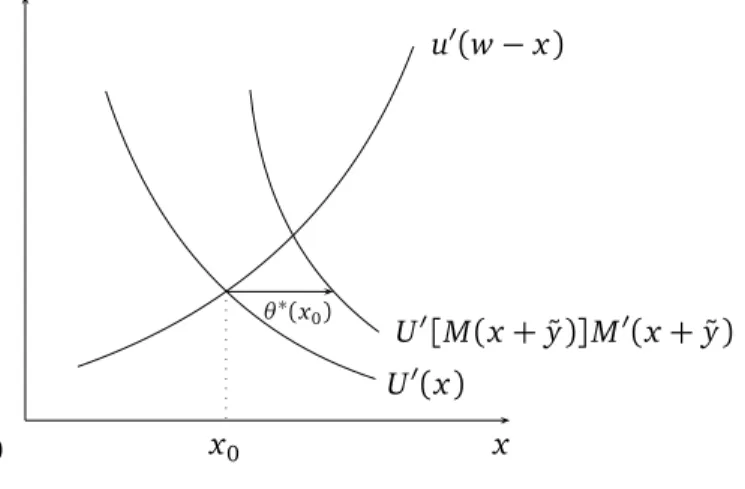
Ev′(x+ψ∗+˜y) =v′(x). (2.8) As illustrated in Figure1, the Kreps-Porteus precautionary premiumθ∗, which obviously depends (among other things) on x, measures at each point the rightward shift of the marginal utility of saving curve due to the risk ˜y. It enables us to isolate the effect of uncertainty from the other (purely intertemporal) factors that determine optimal savings (greater than, smaller than) should be understood as weak inequalities except where we emphasize strictness.
x 0 x0 θ∗(x 0) u′(w−x) U′[M(x+˜y)]M′(x+˜y) U′(x)
Figure 1: Precautionary saving
under certainty.
Also, as shown in Kimball (1990b), Appendix B, the compensating precautionary pre-miumθ∗is the rightward shift of the consumption function due to ˜y. The closely related equivalent precautionary premium9θ gives the leftward shift of the consumption function due to eliminating the risk ˜y. Hence, the extra consumption due to eliminating ˜y, or equiv-alently the reduced consumption and increased saving due to the presence of ˜y is equal to
Rw
w−θc
′(ω, 0)dω, wherec′(w, 0)is the marginal propensity to consume out of wealth in the
absence of uncertainty. If the marginal propensity to consume is constant in the absence of uncertainty, the increment to saving from ˜y will be directly proportional to the size of the equivalent precautionary premium.
9Theequivalent Kreps-Porteus precautionary premiumis the solution to the equationU′[
M(x+˜y)]M′(x+
˜
y) =U′[x−θ(x)]according to the Selden representation of preferences, or toφ′[Ev(x+˜y)]Ev′(x+˜y) =
φ′[
v(x−θ)]v′(x−θ)according to the Kreps-Porteus representation. Kimball (1990b), Appendix A shows that comparative statics of the compensating precautionary premium carry over to the equivalent precautionary premium.
3
Small risks: a local measure of the strength of the
precaution-ary saving motive
In appendixB, we prove that, for a small risk ˜y with mean zero and varianceσ2,
θ∗(x) =a(x)[1+s(x)ǫ(x)]σ 2 2 +o(σ 2), (3.1) where s(x) = −U ′(x) x U′′(x) (3.2)
denotes the elasticity of intertemporal substitution for the second period utility function
U(x),10o(σ2)collects terms going to zero faster thanσ2,a(x)is the absolute risk aversion of v defined in (1.2), andǫ(x)denotes the elasticity of absolute risk tolerance defined in (1.5).
Therefore, the local counterpartfor Kreps-Porteus preferencesto the concept of absolute prudence defined for intertemporal expected utility preferences by Kimball (1990b) is
a(x)[1+s(x)ǫ(x)].
Similarly, the local counterpart for Kreps-Porteus preferences to relative prudence is
P(x) =γ(x)[1+s(x)ǫ(x)], (3.3)
where γ(x) = x a(x) is relative risk aversion as above. Therefore, in the more general framework of Kreps-Porteus preferences, the strength of the precautionary saving motive is determined both by attitudes towards riskandattitudes towards intertemporal substitution.
Three important special cases should be noted:
10In our definition, the elasticity of intertemporal substitutions(x)is therefore the elasticity of the ratio of consumption between periods to the gross real interest rateholding first-period consumption constant.
• For intertemporal expected utility maximization, s(x) = 1/γ(x), so that P(x) =
γ(x) +ǫ(x)—which is the expression given in (1.3).
• For constant relative risk aversion,γ(x) =γandǫ(x) =1, so thatP(x) =γ[1+s(x)].
• For constant relative risk aversionγ(x) = γ, and constant (but in general distinct) elasticity of intertemporal substitution11s(x) =s, andP(x) =γ[1+s].
From (3.3), the local condition forpositiveprecautionary saving is simply
ǫ(x)≥ − 1
s(x), (3.4)
or, by calculating ǫ(x) from (1.5) and moving one piece to the right-hand side of the equation:
−x v′′′(x)
v′′(x) ≥γ(x)−ρ(x), (3.5)
where
ρ(x) =1/s(x)
denotes theresistance to intertemporal substitution. The right-hand side of (3.5) is zero un-der intertemporal expected utility maximization, in which case (3.5) reduces to the familiar conditionv′′′(x)≥0.
Intriguingly, equation (3.5) shows that when one departs from intertemporal expected utility maximization, quadratic risk preferences do not in general lead to the absence of precautionary saving effects that goes under the name of “certainty equivalence.”
Though the local measure P(x) cannot be used directly to establish global results, equation (3.1) does suggests several principles which are valid globally, as the next section shows. First, if one holds the outer intertemporal utility functionU fixed, a change in risk preferences v which raises both risk aversion and its rate of decline tends to strengthen the precautionary saving motive. Second, decreasing absolute risk aversion (which implies
ǫ(x)≥0) guarantees that the precautionary saving motive is stronger than risk aversion.
Third, if one holds risk preferences constant, raising the elasticity of intertemporal substitu-tions(x)and lowering the resistance to intertemporal substitutionρ(x) =1/s(x), widens the gap between the strength of the precautionary saving motive and risk aversion. In par-ticular, when absolute risk aversion is decreasing, lowering the resistance to intertemporal substitution from the intertemporal utility maximizing level, so thatρ(x)falls belowγ(x), makes the precautionary saving motive stronger than it is under intertemporal expected utility maximization. Conversely, a resistance to intertemporal substitution ρ(x) greater than relative risk aversionγ(x)makes the precautionary saving motive weaker than under intertemporal expected utility maximization.12
4
Large risks
4.1
Precautionary saving and decreasing absolute risk aversion
In the case of intertemporal expected utility maximization, Drèze and Modigliani (1972) prove that decreasing absolute risk aversion leads to a precautionary saving motive stronger than risk aversion. Kimball (1997) shows that there is a fundamental economic logic behind this result: decreasing absolute risk aversion means that greater saving makes it more desirable to take on a compensated risk. But the other side of such a complementarity between saving and a compensated risk is that a compensated risk makes saving more attractive.
This argument follows not from any model-specific features but rather from the logic of complementarity itself. To understand this claim, consider an arbitrary, concave indirect utility function of saving and the presence or absence of a compensated risk:J(x,λ), where 12There are several further minor but interesting propositions suggested by (3.1) which are valid globally. First,constant absolute risk aversionimplies thatε=0, so that the precautionary saving motive and risk aver-sion are of exactly equal strength, regardless of intertemporal substitution. Second, two easy sets of sufficient conditions for a positive precautionary saving motive that are valid globally are (a) decreasing absolute risk aversion or (b)v′′′(·)≥0 andρ(x)≥γ(x).
x is saving and λ is 1 in the presence of the compensated risk ˜y +π∗ and zero in its absence.13 The definition of a compensated risk insures that
J(x, 1)−J(x, 0) =0,
i.e., that the consumer is indifferent to the presence or absence of the risk ˜y+π∗.
In the most fundamental sense (i.e., independently of any particular model), the prop-erty of decreasing absolute risk aversion means that a risk to which an agent is indifferent at one level of saved wealth will become desirable at a slightly higher level of saved wealth. Thus,
∂
∂x[J(x, 1)−J(x, 0)] =Jx(x, 1)−Jx(x, 0)≥0
if absolute risk aversion is decreasing. But this implies that if the first-order condition for optimal saving is satisfied in the absence of the compensated risk—i.e., ifJx(x, 0) =0, then
Jx(x, 1)≥0,
implying that a compensated risk makes the agent want to save more. In other words, the risk premium needed to compensate the agent for the risk he or she is bearing does not eliminate the total effect of the (compensated) risk on saving. This is what we mean when we say that the precautionary saving motive is stronger than risk aversion.14
We now examine more formally how this general logic manifests itself in the specific framework we are studying.
13In the Kreps-Porteus model, for instance,J(x,λ) =u(w−x) +U[M(x+λ(˜y+π∗))]. See equation (4.1)
below for a precise definition of the compensating risk premiumπ∗.
14Note that while a nonnegative precautionary saving motive is equivalent to supermodularity between sav-ing and mean zero risks,U(M(x+δ+ε˜) +U(M(x))−U(M(x+δ))−U(M(x+ε˜))≥0, whereδ >0 and Eε˜=0, the line of reasoning connecting decreasing absolute risk aversion and a precautionary saving motive stronger than risk aversion uses the more subtle symmetry of a single-crossing property in two arguments that both have a zero marginal effect on the objective function at a joint crossing point. Supermodularity between saving and ˜y+π∗typically does not hold, since ˜y+π∗is likely to be strictly desirable at high levels ofxand
4.1.1 Intertemporal expected utility maximization: a reminder
Under intertemporal expected utility maximization, decreasing absolute risk aversion im-plies that ifπ∗is the compensatingriskpremium for ˜y, which satisfies
Ev(x+π∗+˜y) =v(x), (4.1)
then
Ev(x+δ+π∗+˜y)≥v(x+δ) (4.2) for anyδ≥0.15 Equation (4.1) and inequality (4.2) together imply that the derivative of the left-hand side of (4.2) atδ =0 must be greater than the derivative of the right-hand side of (4.2) atδ=0:
Ev′(x+π∗+y˜)≥v′(x). (4.3) Equation (2.8) defining the compensating von Neumann-Morgenstern precautionary pre-miumψ∗ differs from (4.3) only by having ψ∗ in place of π∗ and by holding with equal-ity. Therefore, since v′ is a decreasing function, ψ∗ ≥ π∗. In words, (4.3) says that a risk compensated by π∗, so that the agent is indifferent to the combinationπ∗+ ˜y, still raises expected marginal utility. Therefore, the von Neumann-Morgenstern precautionary premium ψ∗— which brings expected marginal utility back down to what it was under certainty—must be greater thanπ∗.
4.1.2 Kreps-Porteus preferences
The same economic logic applies to the Kreps-Porteus case. Any property that ensures that extra saving makes compensated risks more attractive guarantees that extra compensated risk makes saving more desirable. Formally, decreasing absolute risk aversion guarantees
15In other words, the risk premiumπ∗that compensates for the effect of the risk ˜
yon utility when wealth is xmore than compensates for the effect of risk ˜ywhen wealth isx+δ.
that M′(·)≥1, since differentiating the identity
M(x+π∗(x) + ˜y)≡x (4.4)
yields
(1+π∗′(x))M′(x+π∗(x) +˜y) =1. (4.5) Decreasing absolute risk aversion implies thatπ∗′(x)≤0. (Monotonicity of v implies that 1+π∗′(x)≥0.) Thus,
U′(M(x+π∗+˜y))M′(x+π∗+˜y) =U′(x)M′(x+π∗+˜y)≥U′(x), (4.6)
where the equality on the left follows from (4.4),16and the inequality on the right follows fromM′(·)≥1. Combined with the assumption of a decreasing marginal utility of saving, (4.6) impliesθ∗≥π∗. We have thus proved:
Proposition 1 Assuming a decreasing marginal utility of saving, if risk preferences v exhibit decreasing absolute risk aversion, then the Kreps-Porteus precautionary premium is always greater than the risk premium (θ∗≥π∗).
Remark.By reversing the direction of the appropriate inequalities above, one can see that globallyincreasingabsolute risk aversion guarantees thatθ∗≤π∗, just as globally decreas-ingabsolute risk aversion guarantees thatθ∗≥π∗.If absolute risk aversion is constant, both inequalities must hold, implying thatθ∗(x)≡π∗(x)≡constant,17 regardless of the form of the intertemporal utility function U.
16Note that the risk premiumπ∗is the same as it would be under intertemporal expected utility
maximiza-tion.
17Weil (1993) exploits the fact thatθ∗(x)≡π∗(x)under constant absolute risk aversion to solve a
4.1.3 Patent increases in risk
Proposition 1 can be extended to patent increases in risk, which, as defined by Kimball (1993), are increases in risk for which the risk premium increases with risk aversion, at least when a utility function with decreasing absolute risk aversion is involved. The set of patent increases in risk includes increases in the scale of a risk coupled with any change of location, and the addition of any independent risk, but does not include all mean-preserving spreads.18
The compensating risk premium Π∗(x)for thedifferencebetween two risks ˜Y and ˜y is defined by
Ev(x+ Π∗(x) +Y˜) =Ev(x+˜y), (4.7) or equivalently, by
M(x+ Π∗(x) +Y˜) =M(x+˜y). (4.8) If ˜Y is a patently greater risk than ˜y, then decreasing absolute risk aversion guarantees that Π∗(x)is a decreasing function of x. (Given decreasing absolute risk aversion, reducing x
increases risk aversion and therefore increasesΠ∗ by the definition of a patently greater risk.) Differentiating equation (4.8) with respect to x, one finds that
M′(x+˜y) = [1+ Π∗′(x)]M′(x+ Π∗(x) +Y˜)
≤ M′(x+ Π∗(x) +Y˜), (4.9)
where the inequality on the second line follows fromΠ∗′(x)≤0. In combination, equations 18As noted in Kimball (1993), “. . . the results of Pratt (1988) make it clear that ˜X is patently more risky than ˜xif ˜X can be obtained from ˜xby adding to ˜xa random variable ˜νthat is positively related to ˜x in the sense of having a distribution conditional on ˜xwhich improves according to third-order stochastic dominance for higher realizations of ˜x. This sufficient condition for patently greater risk includes as polar special cases ˜ν perfectly correlated with ˜x—which makes the movement from ˜xto ˜X a simple change of location and increase in scale—and ˜νstatistically independent of ˜x.”
(4.8) and (4.9) imply that
U′(M(x+ Π∗(x) +Y˜))M′(x+ Π∗(x) +Y˜)≥U′(M(x+˜y))M′(x+˜y). (4.10)
Defining the compensating Kreps-Porteus precautionary premiumΘ∗(x)for the difference between the two risks ˜Y and ˜y by
U′(M(x+ Θ∗(x) +Y˜))M′(x+ Θ∗(x) +Y˜) =U′(M(x+ ˜y))M′(x+˜y), (4.11)
a decreasing marginal utility of saving implies thatΘ∗(x)≥Π∗(x).
Proposition 2 (extension of Proposition1) Assuming a decreasing marginal utility of sav-ing, if risk preferences v exhibits decreasing absolute risk aversion and Y is patently riskier˜ than ˜y, then the Kreps-Porteus precautionary premium for the difference betweenY and˜ ˜y is always greater than the risk premium for the difference betweenY and˜ ˜y—i.e.,Θ∗≥Π∗.
Proof: See above.
4.2
Comparative statics
We now examine how the strength of the precautionary saving motive is affected by changes in intertemporal substitution, risk aversion, and wealth.
4.2.1 Intertemporal substitution
Before analyzing the effect of intertemporal substitution on the size of the precautionary premium in general, it is instructive to examine how departures from intertemporal ex-pected utility maximization affect the precautionary premium:
Proposition 3 Assuming a decreasing marginal utility of saving for the Kreps-Porteus utility function u(c1) +φ(Ev(˜c2)), if the von Neumann-Morgenstern precautionary premium ψ∗ is
greater than the risk premium π∗ (as it will be if absolute risk aversion is decreasing), then the Kreps-Porteus precautionary premium θ∗ ≤ ψ∗ when the function φ(·) is concave, but
θ∗≥ψ∗whenφ(·)is convex. Ifψ∗≤π∗(as it will be if absolute risk aversion is increasing), thenθ∗≥ψ∗whenφ(·)is concave, butθ∗≤ψ∗whenφ(·)is convex.
Proof: Assume first thatψ∗≥π∗
andφ(·)is concave. Then
φ′( Ev(x+ψ∗+˜ y))Ev′(x+ψ∗+˜ y) = φ′( Ev(x+ψ∗+˜ y))v′(x) ≤ φ′( v(x))v′(x). (4.12)
The equality on the first line follows from the definition ofψ∗
, and the inequality on the second line follows fromψ∗ ≥π∗, the monotonicity ofv and the concavity ofφ(·), which makesφ′(·) a decreasing function.
Together with a decreasing marginal utility of saving, (4.12) implies that
θ∗≤ψ∗
. (4.13)
Either the convexity ofφ(·)or the inequalityψ∗≤π∗would reverse the direction of the inequalities in both
(4.12) and (4.13), while convexity ofφ(·)andψ∗ ≤π∗ together leave the direction of the inequalities
un-changed.
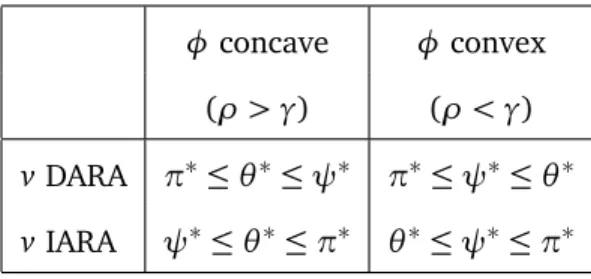
The results of Proposition3are summarized in Table1.19
φconcave φconvex
(ρ > γ) (ρ < γ)
vDARA π∗≤θ∗≤ψ∗ π∗≤ψ∗≤θ∗
vIARA ψ∗≤θ∗≤π∗ θ∗≤ψ∗≤π∗ Table 1: Summary of Proposition3
Concavity ofφbrings the Kreps-Porteus precautionary premiumθ∗closer than the von Neumann-Morgenstern precautionary premium ψ∗ to the risk premiumπ∗. Convexity of φ pushesθ∗further than ψ∗ fromπ∗. For example, for quadratic utility—which exhibits
IARA and for whichψ∗=0— the precautionary premiumθ∗is positive ifφis concave and negative ifφis convex.
Since concavity of φ is equivalent to the elasticity of intertemporal substitution s(x) below relative risk tolerance 1/γ(x), and convexity ofφ is equivalent to the elasticity of intertemporal substitution s(x) above relative risk tolerance 1/γ(x), one can see that the pattern is one of greater intertemporal substitution increasing the distance between the risk premiumπ∗and the Kreps-Porteus precautionary premiumθ∗.
Proposition 4indicates that, holding risk preferences fixed, higher intertemporal sub-stitution (or equivalently, a lower resistance to intertemporal subsub-stitution) leads quite gen-erally to a Kreps-Porteus precautionary premium that is further from the risk premium:
Proposition 4 If, for two Kreps-Porteus utility functions ui(c1)+Ui(M(˜c2)), i=1, 2, with the same risk preferences,
(a) the optimal amount of saving under certainty is the same,
(b) the marginal utility of saving is decreasing for both utility functions, and
(c) U2has greater resistance to intertemporal substitution than U1—that is, −U
′′ 2(x) U′ 2(x) ≥ −U ′′ 1(x) U′ 1(x) for all x,
then |θ2∗−π∗| ≤ |θ1∗−π∗|, whereθi is the Kreps-Porteus precautionary premium for utility
function i andπ∗is the risk premium for both utility functions. Also, θ2∗−π∗ and θ1∗−π∗
have the same sign. Proof: See AppendixC.
The conditions of the proof apply, for instance, when
ui(c1) +Ui(M(˜c2)) = c1−ρi 1 1−ρi +[M(˜c2)] 1−ρi 1−ρi
withρi>0, i.e., when the elasticity of intertemporal substitution is constant, and the sub-jective discount rate equals the interest rate (which we have assumed to be zero). In that case, the optimal amount of saving under certainty does not depend onρi, as there is
per-fect consumption smoothing (condition a of proposition4). Mild conditions onM, spelled out in Appendix A, guarantee that the marginal utility of saving is decreasing (condition b of proposition 4). The utility function U2 displays greater resistance to intertemporal substitution thanU1 ifρ2> ρ1 (condition c).
Remark. Using the machinery for the proof of Proposition 4, Appendix C also provides graphical intuition for why intertemporal substitution, risk aversion and the rate of decline of risk aversion matter in the way they do for the strength of the precautionary saving motive.
4.2.2 Risk aversion
Next, we examine how the strength of the precautionary saving motive is affected by changes in risk aversion.
Given two inner interpossibility functions v1andv2, define
Mi(x+˜y) =vi−1(Evi(x+˜y)) (4.14)
fori=1, 2, and defineθ1∗andθ2∗by appropriately subscripted versions of (2.6). Then one can state the following lemma:
Lemma 1 Assuming a decreasing marginal utility of saving and a concave intertemporal util-ity function U that is held fixed when risk preferences are altered, if
U′(M2(ξ+˜y))M2′(ξ+˜y)≥U
′(M
1(ξ+˜y))M1′(ξ+˜y)
Proof: Lettingξ=x+θ∗ 1(x), U′(M2(x+θ ∗ 1(x) +˜y))M ′ 2(x+θ ∗ 1(x) +˜y) ≥U′(M1(x+θ ∗ 1(x) +˜y))M ′ 1(x+θ ∗ 1(x) +˜y) =U′(x). (4.15)
Thus, the Kreps-Porteus precautionary premiumθ∗
1for the first set of risk preferences is insufficient under the second set of risk preferences to bring the marginal utility of saving back down toU′(x). By the assumption of
a decreasing marginal utility of saving, this means thatθ∗
2must be greater thanθ
∗
1to bring the marginal utility of saving all the way back down toU′(x).
This lemma has an obvious corollary:
Corollary 1 Assuming a decreasing marginal utility of saving and a concave outer intertem-poral utility function U that is held fixed when risk preferences are altered, if M2(ξ+ ˜y) ≤
M1(ξ+˜y)and M2′(ξ+˜y)≥M1′(ξ+˜y)atξ=x+θ1∗(x), thenθ2∗(x)≥θ1∗(x).
The corollary is less helpful than one might hope because it is not easy to find suitable conditions to guarantee thatM2′≥M1′. To see why it is not easy, consider the case of a two-point risk and two different interpossibility functions that both go from infinite positive risk aversion at zero, to zero risk aversion at infinity. Then, at zero, both certainty equivalents will converge to the lower outcome of the two-point risk, while at infinity, both certainty equivalents will converge to the mean value of the two-point risk. Since the certainty equivalents start and end at the same values, unless M2andM1 are identical functions the difference in their slope, M2′−M1′, must change sign at least once, so one cannot always have M2′ ≥ M1′. There is, though, at least one case in which it is easy to establish that
M2′ ≥ M1′: when v1 has increasing (or constant) absolute risk aversion, so that M1′ ≤ 1, whilev2 has decreasing (or constant) absolute risk aversion, so thatM2′ ≥1. This result is equivalent to Proposition3and Table1.
elasticity of intertemporal substitution, constant relative risk aversion (CEIS-CRRA) class. The next proposition focuses on the effect of risk aversion on the strength of the pre-cautionary saving motive. Within the CEIS-CRRA class, it takes care of the case where the resistance to intertemporal substitution (the reciprocal of the elasticity of intertemporal substitution) is greater than risk aversion.
Proposition 5 Suppose two Kreps-Porteus utility functions share the same intertemporal func-tion U but have different inner interpossibility funcfunc-tions v1 and v2. If
(a) the resistance to intertemporal substitution is greater than the risk aversion of v1(that is,
U is an increasing, concave transformation of v1),
(b) v2 is globally more risk averse than v1 (that is, −v2′′(x)/v
′ 2(x) ≥ −v ′′ 1(x)/v ′ 1(x) for all x),
(c) v2is globally more prudent than v1 (that is,−v2′′′(x)/v
′′ 2(x)≥ −v ′′′ 1 (x)/v ′′ 1(x)for all x),
(d) v2has decreasing absolute risk aversion, and
(e) both Kreps-Porteus utility functions have a decreasing marginal utility of saving,
then the Kreps-Porteus precautionary premium given v2 is greater than the Kreps-Porteus pre-cautionary premium given v1.
Proof: See AppendixD.
Within the CEIS-CRRA class, all the conditions of Proposition5are satisfied whenv2is more risk averse thanv1andU also has greater curvature thanv1.
A second proposition about the effect of greater risk aversion on the strength of the precautionary saving motive takes care of the case within the CEIS-CRRA class where the elasticity of intertemporal substitution is less than one:
(a) the resistance to intertemporal substitution is greater than 1 (that is, U(x)is an increas-ing, concave transformation of ln(x)),
(b) v2 is globally more risk averse than v1(that is,−v2′′(c)/v
′ 2(c)≥ −v ′′ 1(c)/v ′ 1(c)for all c),
(c) v1has constant or increasing relative risk aversion
(d) v2has constant or decreasing relative risk aversion, and
(e) both Kreps-Porteus utility functions have a decreasing marginal utility of saving,
then the Kreps-Porteus precautionary premium given v2 is greater than the Kreps-Porteus
pre-cautionary premium given v1. Proof: See AppendixE.
Within the CEIS-CRRA class, all the conditions of Proposition 6 are satisfied when v2 is more risk averse than v1 and the elasticity of intertemporal substitution is less than or equal to one.
Empirically, there is strong evidence that the elasticity of intertemporal substitution is no larger than one, so this proposition takes care of all the empirically relevant cases within the CEIS-CRRA class.20
In Proposition 6, as in Proposition 5, an assumption is needed that insures that the absolute risk aversion of v2 decreases fast enough relative to the absolute risk aversion of v1. In Proposition 5, the assumption of greater prudence for v2 plays that role. In Proposition 6, the assumption that v2 has constant or decreasing relative risk aversion, whilev1 has constant or increasing relative risk aversion plays that role.
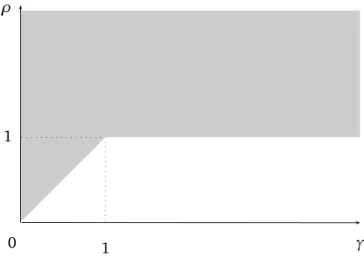
Together, Propositions5and6guarantee that if a CEIS-CRRA utility function has values ofγandρin the shaded region of Figure2, while the second function has parameter values directly to the right (whether or not in the shaded region), the precautionary premium will be greater for the second utility function.
γ ρ
0 1
1
Figure 2: Risk aversion and precautionary saving: CEIS-CRRA case
4.2.3 Limitations on what can be proven about the effect of risk aversion on the
strength of the precautionary saving motive
It is reasonable to wonder if stronger results are possible. In particular, what about those utility functions within the CEIS-CRRA class not addressed by Propositions5and6? Propo-sition 7 says that there are no corresponding results when raising risk aversion starting from any CEIS-CRRA utility function in the interior of the unshaded region of Figure2.
Proposition 7 For every Kreps-Porteus utility function u(c1) +[E(˜c2)1−γ] 1−ρ
1−γ
1−ρ withγ6= 1and
ρ ∈ (0, min{γ, 1}), and (when γ = 1) for every Kreps-Porteus utility function u(c1) + e(1−ρ)[Eln(˜c2)]
1−ρ withρ ∈(0, 1), there are two-point risks for which local increases in γ reduce
the size of the precautionary premiumθ∗.
Proof: See AppendixF.
4.2.4 Wealth
Kimball (1990a,b) shows that a precautionary premium that declines with wealth implies that labor income risk raises the marginal propensity to consume out of wealth at a given
level of first-period consumption. As can be seen from studying Figure 1, this connection between a decreasing precautionary premium and the marginal propensity to consume holds for Kreps-Porteus preferences as well. In the two-period case with intertemporal ex-pected utility maximization, decreasing absolute prudence is necessary and sufficient for a decreasing precautionary premium. Section3points to a necessary condition for a decreas-ing precautionary premium that is sufficient only for small risks: d
d xa(x)[1+s(x)ε(x)]≤0.
This subsection identifies conditions for a decreasing precautionary premium that are suf-ficient both for both small and large risks.
Given a decreasing marginal utility of saving, defineQ(w˜)by the identity
U′(Q(w˜))≡U′(M(w˜))M′(w˜). (4.16)
Then
Q(x+θ∗(x) +˜y)≡x, and
[1+θ∗′(x)]Q′(x+θ∗(x) +˜y) =1.
As a consequence, the precautionary premium is decreasing in x if and only ifQ′(w˜)≥1 with ˜w=x+θ∗(x, ˜y) + ˜y.
Differentiation of (4.16) yields
U′′(Q(w˜))Q′(w˜) =U′′(M(w˜))[M′(w˜)]2+U′(M(w˜))M′′(w˜).
Changing signs and dividing by the square of (4.16), we find
− U ′′(Q) [U′(Q)]2 Q′= − U ′′(M) [U′(M)]2 + 1 U′(M) − M ′′ [M′]2 , (4.17)
with the argument ˜w suppressed for clarity.
AppendixAshows, following Hardy, Littlewood, and Polya (1952, pp. 85-88), that con-cave absolute risk tolerance of v is sufficient to guarantee that the certainty equivalent function M is concave. Since CRRA, exponential and quadratic utility—with or without a shifted origin—yield linear absolute risk tolerance, weakly concave absolute risk toler-ance holds for an important set of inner interpossibility functionsv. This result makes the following proposition very useful:
Proposition 8 Given the Kreps-Porteus utility function u(c1) +U(v−1(Ev(˜c2)))with U and v increasing and concave, if
(a) absolute risk aversion is decreasing,
(b) the certainty-equivalent function M for the inner interpossibility function v is concave, and
(c) − U′′(x)
[U′(x)]2 is (weakly) increasing,
then the precautionary premium is decreasing in wealth.
Proof: First, as shown in AppendixA, if bothM(w˜)andU(x)are increasing and concave, then the marginal utility of saving is decreasing. Second, decreasing absolute risk aversion guarantees not only thatM′≥1, but
also, by (4.16), thatQ(w˜)≤M(w˜). Since− U′′(x)
[U′(x)]2 is increasing, − U ′′(Q) [U′(Q)]2≤ − U′′(M) [U′(M)]2. Therefore, − U ′′(Q) [U′(Q)]2 ≤ − U ′′(M) [U′(M)]2 + 1 U′(M) − M ′′ [M′]2 , implying by (4.17) thatQ′≥1.
Remark. If the elasticity of intertemporal substitution is constant, condition (c), which requires − U′′(x)
intertem-poral substitutionsless than or equal to 1. More generally, this condition is equivalent to
s′(x)≤ 1−s(x)
x , wheres(x) =− U′(x)
x U′′(x).
For the effect of greater risk aversion on the precautionary premium, Section 4.2.2 provides results that cover the CEIS-CRRA case not only for ρ ≥ 1, but also for ρ ≥ γ. We can do the same for the effect of wealth on the precautionary premium. Proposition9 shows that if the precautionary premium is decreasing for a utility function at any point in Figure2, the precautionary premium will also be decreasing at any utility function directly above it on Figure 2, up to the point where ρ = 1. Proposition 10 combines this result with the fact that the precautionary premium is decreasing for the CRRA intertemporal expected utility case ρ = γ to demonstrate that within the CEIS-CRRA class, ρ ≥ γ is enough to guarantee a decreasing precautionary premium, even ifρ <1.
Proposition 9 Suppose two Kreps-Porteus utility functions share the same inner interpossibil-ity function v but have different increasing, concave intertemporal functions U1 and U2 and associated precautionary certainty equivalence functions Q1(w˜)and Q2(w˜). If
(a) v has decreasing absolute risk aversion,
(b) Q′1(w˜)≥1so that the precautionary premium for the first utility function is decreasing,
(c) −U
′′
2(x)
U2′(x) ≥ −
U1′′(x)
U1′(x), or equivalently U2has a greater resistance to intertemporal substitution
than U1, (d) 2U ′′ 2(x) U2′(x)− U2′′′(x) U2′′(x) ≤2 U1′′(x) U1′(x) − U1′′′(x) U1′′(x), and (e) either2U ′′ 1(x) U′ 1(x) − U ′′′ 1 (x) U′′ 1(x) or2U ′′ 2(x) U′ 2(x) − U ′′′ 2 (x) U′′ 2(x) is a decreasing function,
then Q′2(w˜)≥1, so that the precautionary premium for the second utility function is decreasing at the corresponding point.
Remark. When the elasticity of intertemporal substitutionsand its reciprocalρ are con-stant, condition (c) boils down to ρ2
x ≥
ρ1
x , condition (d) boils down to
1−ρ2
x ≤
1−ρ1
x ,
and condition (e) boils down to 1−ρi
x being a decreasing function for one of the functions,
which is guaranteed if eitherρi≤1. Thus, for the CEIS-CRRA utility functions, Proposition
9applies in exactly the region where Proposition8cannot be used.
The foregoing proposition has an obvious corollary. Set U1(x) = v(x) and denote
U2(x) =U(x):
Proposition 10 (corollary to Proposition9) Suppose a Kreps-Porteus utility function satis-fies the conditions
(a) the inner interpossibility function v is increasing, concave, has decreasing absolute risk aversion and decreasing absolute prudence,
(b) −U′′(x) U′(x) ≥ − v′′(x) v′(x), or equivalentlyρ(x)≥γ(x), (c) 2UU′′′((xx))− U′′′(x) U′′(x) ≤2 v′′(x) v′(x)− v′′′(x) v′′(x), and (d) either2vv′′′((xx))− v′′′(x) v′′(x) or2 U′′(x) U′(x) − U′′′(x) U′′(x) is a decreasing function,
then the precautionary premiumθ∗(x)is decreasing.
The condition thatv has decreasing absolute prudence is needed to guarantee thatQ′1≥1 withU1=v.
Within the CEIS-CRRA class, the conditions of Proposition10are all guaranteed when 1> ρ > γ. Propositions8and10taken together thus establish that the precautionary pre-mium is decreasing for large risks for any set of parameters in the shaded region of Figure 2. This is the same region in which greater risk aversion increases the size of the precau-tionary premium. Conversely, Proposition 11 demonstrates that one cannot guarantee a decreasing precautionary premium for any of the utility functions in the interior of the un-shaded region in Figure2. Thus, the utility functions in the unshaded region—those with
a resistance to intertemporal substitution below oneandbelow relative risk aversion—are badly behaved in relation to both the effect of risk aversion and the effect of wealth on the strength of the precautionary saving motive:
Proposition 11 For every Kreps-Porteus utility function u(c1) + [E(˜c 1−γ
2 )] 1−ρ
1−γ
1−ρ with γ 6= 1
and ρ ∈ (0, min{γ, 1}), and (whenγ = 1) for every Kreps-Porteus utility function u(c1) + e(1−ρ)[Eln(˜c2)]
1−ρ withρ∈(0, 1), there are two-point risks for which increases in wealth raisethe
size of the precautionary premiumθ∗. Proof: See AppendixH.
5
Conclusion
We have made considerable progress in understanding the determinants of the strength of the precautionary saving motive under Kreps-Porteus preferences in the two-period case. Perhaps one of the more surprising results is that greater risk aversion tends to increase the strength of the precautionary saving motive, while greater resistance to intertemporal substitution reduces the strength of the precautionary saving motive in the typical case of decreasing absolute risk aversion. Thus, distinguishing between risk aversion and the resistance to intertemporal substitution is very important in discussing the determinants of the strength of the precautionary saving motive, since these two parameters—which are forced to be equal under intertemporal expected utility maximization—have opposite effects when allowed to vary separately.
Our results also bear on judgments about the likely empirical magnitude of the precau-tionary saving motive. Remember that we show in Section3that, for preferences exhibiting a constant elasticity of intertemporal substitution and constant relative risk aversion, the local measure (in relative terms) of the strength of the precautionary saving motive is
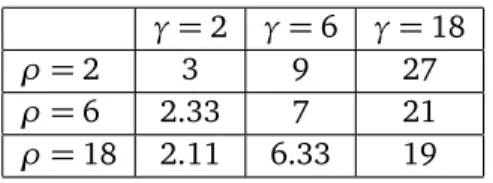
γ=2 γ=6 γ=18
ρ=2 3 9 27
ρ=6 2.33 7 21
ρ=18 2.11 6.33 19
Table 2: The local coefficient of relative prudence P = γ(1+ρ−1) for isoelastic Kreps-Porteus preferences
whereγis the coefficient of relative risk aversion,sis the elasticity of intertemporal substi-tution, andρ=1/sis the resistance to intertemporal substitution.
To give some idea of what this formula means in practice, Table 2shows the implied value of the coefficient of relative prudence,P, forγandρboth ranging over the three rep-resentative “low,” “medium,” and “high” values 2, 6 and 18. The words “low,” “medium,” and “high,” are in quotation marks because the values of bothγ andρ and what values would count as “low,” “medium” and “high,” in relation to the data are hugely contro-versial. For instance, economist A might find γ = 2 intuitively reasonable, while being convinced by consumption Euler equation evidence like that of Hall (1988) that the elas-ticity of intertemporal substitutions is very small, withsabout .055 and thusρ=18. By contrast, economist B might find the valueρ=2, and the higher implieds=.5, intuitively more reasonable in relation to what is needed to explain business cycles, but might be con-vinced by the evidence behind the equity premium puzzle that relative risk aversion should be at leastγ=18.
If they do not know how to relax the von Neumann-Morgenstern restriction ρ = γ, these economists with quite divergent views and data about risk aversion and intertempo-ral substitution might be compelled to compromise on some intermediate valueρ=γ=6 (taken here for computational simplicity to be the geometric mean of 2 and 18 for bothγ andρ). This would lead them to agree on a precautionary saving motive strength given by the relative prudence of 7. This agreement is artificial as, freed by Kreps-Porteus pref-erences from the restrictionρ=γ, economists A and B would strongly disagree about the strength of the precautionary saving motive. Economist A would expect a very strong
pre-cautionary saving motive withP =27, while Economist B would expect a much weaker precautionary saving motive withP =2.11. In addition, they also would differ widely on the implied magnitude of the equilibrium equity premium and real interest rate implied by their model.21
The dramatic quantitative differences illustrated in this example underline the impor-tance of refining the empirical evidence for the magnitude of risk aversion, and of obtain-ing distinct estimates of the resistance to intertemporal substitution.22 Kreps-Porteus pref-erences provide the conceptual foundation of this further empirical research program. In turn, understanding the precautionary saving effects of Kreps-Porteus preferences is central to a sound theoretical and empirical understanding of consumption and saving behavior.
21See, for instance, the computations in?.
22One of the key practical implications of distinguishing between risk aversion and the resistance to in-tertemporal substitution is that, without the restriction that they be equal, there is only half as much empirical evidence on the value of each as one might otherwise think.
Appendix A
Conditions guaranteeing a decreasing marginal
utility of saving
Almost every proof in the preceding sections relies in some way on the assumption of a de-creasing marginal utility of saving. If that assumption fails, the marginal utility of saving
U′(M(x+˜y))M′(x+˜y)can intersect first-period marginal utilityu′(w−x)more than once when
the first-period utility functionuis close to being linear. Regardless of the shape of the first-period utility function, an increasing marginal utility of saving results in a negative first-period marginal propensity to consume out of wealth, as illustrated in Figure3. In Figure3, the first-period marginal
x 0 x1 u′(w1−x) u′(w2−x) x2 U′[M(x+¯y)]M′(x+¯y)
Figure 3: A marginal utility of saving increasing on one interval
utility of consumptionu′rises as wealth rises fromw1tow2, indicating that first-period consumption falls.
In order to assess how restrictive this assumption is, we now derive conditions sufficient to guarantee that the marginal utility of saving will be decreasing.
The simplest sufficient condition for a decreasing marginal utility of saving is concavity ofφ
andv—or equivalently,ρ≥γ >0.
to intertemporal substitution is greater than risk aversion, which in turn is positive—then the marginal utility of saving is decreasing.
Proof: Concavity of both v andφguarantees that both factors of the Kreps-Porteus representation of the marginal utility of saving,φ′(Ev(x+˜y))Ev′(x+˜y), decrease asxincreases.
Alternatively, concavity of both the outer intertemporal functionUand of the certainty equiva-lent functionMis enough to guarantee a decreasing marginal utility of saving:
Proposition 13 If both the outer intertemporal utility function U and the certainty equivalent function
M(x+˜y)are increasing and concave in x, then the marginal utility of saving is decreasing.
Proof: Concavity of bothUandMguarantees that both factors of the Selden representation of the marginal utility of saving,U′(M(x+˜y))M′(x+˜y), decrease asxincreases.
This result becomes very useful in conjunction with Proposition 14 below (adapted from Hardy, Littlewood, and Polya’s classic bookInequalities) that the certainty equivalent functionM is always concave for risk preference function functionvwith concave absolute risk tolerance, which includes anyvin the hyperbolic absolute risk aversion class, including quadratic, exponential, linear, and constant relative risk aversion utility functions, which all have linear absolute risk tolerance.23
Proposition 14 If v′(x)> 0, v′′(x)< 0, and−v′(x)
v′′(x) is a concave function of x, then M(ξ+ ˜y) =
v−1(Ev(ξ+˜y))is a concave function ofξ.
Proof: As noted above, this proof is adapted from Hardy, Littlewood, and Polya (1952). Writeξ+˜y= w˜. Differentiating the identity
23Utility functions in the hyperbolic absolute risk aversion class are those that can be expressed in the form
v(x) = γ 1−γ § x−b γ 1−γ −1 ª
together with the logarithmic limit asγ→1 and the exponential limit asγ→ ∞ with b
γ→ −a. As pointed out by an anonymous referee, outside of the constant relative risk aversion class, an
increasing concave utility function must either have a subsistence level of consumption or strictly increasing relative risk aversion above a certain level in order to have globally concave absolute risk tolerance. We do not view either a subsistence level of consumption or some level of increasing relative risk aversion as inherently unreasonable, but it is good to be aware of this constraint. Supposet(x) =1/a(x)is well defined and strictly positive on the strictly positive reals. If t′(x∗)<0 for some x∗, then concavet(·)would force
t(x)<0 for large enough x. Also, t′(x)≤ t(x)/x is necessary in order to rule out t(x)<0 for small x.
t′(x)≤t(x)/xis equivalent to (weakly) increasing relative risk aversion. Furthermore, concavet(·)implies
that ift′(x∗)<t(x∗)/x∗for anyx∗, thent′(x)<t(x)/x<