Zhang, Huaxiang and Li, Yun and Yin, Yilong and Zhang, Jun (2017) A
maximal clique based multiobjective evolutionary algorithm for
overlapping community detection. IEEE Transactions on Evolutionary
Computation, 21 (3). pp. 363-377. ISSN 1089-778X ,
http://dx.doi.org/10.1109/TEVC.2016.2605501
This version is available at https://strathprints.strath.ac.uk/65262/
Strathprints is designed to allow users to access the research output of the University of Strathclyde. Unless otherwise explicitly stated on the manuscript, Copyright © and Moral Rights for the papers on this site are retained by the individual authors and/or other copyright owners. Please check the manuscript for details of any other licences that may have been applied. You may not engage in further distribution of the material for any profitmaking activities or any commercial gain. You may freely distribute both the url (https://strathprints.strath.ac.uk/) and the content of this paper for research or private study, educational, or not-for-profit purposes without prior permission or charge.
Any correspondence concerning this service should be sent to the Strathprints administrator:
The Strathprints institutional repository (https://strathprints.strath.ac.uk) is a digital archive of University of Strathclyde research outputs. It has been developed to disseminate open access research outputs, expose data about those outputs, and enable the
A Maximal Clique Based Multiobjective
Evolutionary Algorithm for Overlapping
Community Detection
Xuyun Wen,
Student Member, IEEE
, Wei-Neng Chen,
Member, IEEE
, Ying Lin,
Member, IEEE
, Tianlong Gu,
Huaxiang Zhang, Yun Li,
Member, IEEE
, Yilong Yin, and Jun Zhang,
Senior Member, IEEE
Abstract—Detecting community structure has become one
important technique for studying complex networks. Although many community detection algorithms have been proposed, most of them focus on separated communities, where each node can belong to only one community. However, in many real-world networks, communities are often overlapped with each other. Developing overlapping community detection algorithms thus becomes necessary. Along this avenue, this paper pro-poses a maximal clique based multiobjective evolutionary algorithm (MOEA) for overlapping community detection. In this algorithm, a new representation scheme based on the intro-duced clique graph is presented. Since the maximal-clique graph is defined by using a set of maximal maximal-cliques of original graph as nodes and two maximal cliques are allowed to share the same nodes of the original graph, over-lap is an intrinsic property of the maximal-clique graph. Attributing to this property, the new representation scheme allows MOEAs to handle the overlapping community detection problem in a way similar to that of the separated com-munity detection, such that the optimization problems are simplified. As a result, the proposed algorithm could detect overlapping community structure with higher partition accuracy and lower computational cost when compared with the existing ones. The experiments on both synthetic and real-world net-works validate the effectiveness and efficiency of the proposed algorithm.
Manuscript received February 24, 2016; revised June 30, 2016; accepted August 19, 2016. Date of publication September 1, 2016; date of current version May 25, 2017. This work was supported by the National Natural Science Foundation of China under Grant 61622206, Grant 61332002, Grant U1201258, and Grant 61309003. (Corresponding authors: Wei-Neng Chen; Jun Zhang.)
X. Wen is with the School of Computer Science and Engineering, South China University of Technology, Guangzhou 510006, China, and also with the Sun Yat-sen University, Guangzhou 510006, China.
W.-N. Chen and J. Zhang are with the School of Computer Science and Engineering, South China University of Technology, Guangzhou 510006, China (e-mail:[email protected];[email protected]).
Y. Lin is with the Department of Psychology, Sun Yat-sen University, Guangzhou 510006, China.
T. Gu is with the School of Computer Science and Engineering, Guilin University of Electronic Technology, Guilin 541004, China.
H. Zhang is with the School of Information Science and Engineering, Shandong Normal University, Jinan 250014, China.
Y. Li is with the School of Computer Science and Network Security, Dongguan University of Technology, Dongguan 523808, China.
Y. Yin is with Shandong University, Jinan 250100, China.
This paper has supplementary downloadable multimedia material available athttp://ieeexplore.ieee.orgprovided by the authors.
Color versions of one or more of the figures in this paper are available online athttp://ieeexplore.ieee.org.
Digital Object Identifier 10.1109/TEVC.2016.2605501
Index Terms—Clique-based representation, maximal-clique
graph, multiobjective evolutionary algorithm (MOEA), overlapping community detection.
I. INTRODUCTION
R
ECENT years have witnessed many researches that modeled real-world systems in nature and society as networks to capture the intricate properties of these complex systems, where objects are represented as nodes and the interactions among the objects are represented as edges [1]–[5]. Uncovering the community structure of com-plex networks is helpful for understanding comcom-plex sys-tems. Researches on analyzing community structure thus gained growing attention during the past decades [6]–[9]. Traditionally, much of the focus within community detec-tion is on the separated communities, where each node can belong to only one community [6], [7], [10], [11]. However, in many real-world networks, communities are often over-lapped with each other [12]–[15]. For example, people in social networks always belong to several groups, simulta-neously, such as family, friends and colleagues. For this reason, recent studies have paid much attention to overlapping community detection and developed various algorithms from different perspectives, including clique percolation [12], link partitioning [13], local expansion and optimization [16], [17], and label propagation [18].The community detection problem can be formulated as an optimization problem [7], and such a problem is always NP-hard [19]. Therefore, some researchers introduced evolu-tionary algorithms (EAs) into this field and developed several promising methods [9], [20], [21]. In addition, it is widely accepted that a community should have dense intraconnections and sparse interconnections, implying that two conflicting objectives should be optimized simultaneously in commu-nity detection, i.e., maximizing internal links and minimiz-ing external links [6], [22], [23]. Therefore, the community detection problem can also be modeled as a multiobjec-tive optimization problem (MOP). Along this line, several multiobjective EAs (MOEAs) [19], [24]–[28] have been pro-posed. However, most of them focused on separated com-munity detection and failed to detect overlapping comcom-munity structures.
1089-778X c2016 IEEE. Translations and content mining are permitted for academic research only. Personal use is also permitted, but republication/ redistribution requires IEEE permission. Seehttp://www.ieee.org/publications_standards/publications/rights/index.htmlfor more information.
In fact, one obstacle for applying MOEAs to overlapping community detection is the representation scheme of the individual. The existing representation approaches can be broadly divided into two major classes, i.e., prototype-based approaches [28] and node-prototype-based approaches [24]–[27]. In the prototype-based approaches [28], each gene of an individual represents the information of one community, e.g., the coordinates of the community center. Though suitable for overlapping community detection, this representation scheme has some shortcomings and limitations, such as tending to capture round-shaped community, requiring to set the num-ber of communities in advance, and increasing the difficulty in designing evolutionary operators. Furthermore, when adopt-ing prototype-based approaches as the representation scheme, the community detection is generally converted to a data clus-tering problem, which is based on the network information such as spectrum [28]. During this transformation, some valid network information may be lost [28].
Unlike the prototype-based representation, genes of an individual in the node-based approaches correspond to the community information of the nodes in the network [24]–[27]. Under this scheme, there are two types of approaches: 1) direct and 2) indirect. For the direct node-based approach [24]–[27], each gene is an integer representing the community infor-mation of the corresponding node, such as the label of the community this node belongs to [27] or the label of a node that belongs to the same community with this node [24]–[26]. However, since this representation scheme can only ensure every node to be assigned to one community, it is not suitable for overlapping community detection. For the indirect node-based approach [27], each gene of an individual is a random integer within the number of nodes of the network and thus a decoder is needed to transform them to the corresponding community information. In the decoding process, each node is allowed to belong to multiple communities, such that this representation approach can be used for overlapping commu-nity detection. However, the introduction of the decoder in the evolution process brings in two main drawbacks. First, since the fitness computation is directly related to the decoder, the decoding method has a significant influence on partition accuracy. Second, the decoding process is executed for each individual in each generation, leading to a high computational complexity of the algorithm.
To address the aforementioned issues of representation schemes, this paper introduces the maximal-clique graph, which uses a set of maximal cliques as nodes and links among maximal cliques as edges. Then based on the maximal-clique graph, a clique-based representation scheme is proposed, where each gene of the individual represents the commu-nity label of the corresponding maximal clique. Since two maximal cliques are allowed to share the same nodes of the original graph, overlap is an intrinsic property of the nodes of the maximal-clique graph, which exactly character-izes the overlapping communities. Attributing to this property, the new representation scheme allows MOEAs to handle the overlapping community detection problem in a way similar to that of the separated community detection, which not only simplifies the optimization problems, but also overcomes some
limitations of the existing representation schemes. Compared with the prototype-based representation, the clique-based approach is not restricted by community shapes and requires no prior knowledge on the community structure. Compared with the indirect node-based representation, the clique-based approach does not need to decode individuals in the evolution process, which largely lowers the computational cost of the algorithm.
Afterwards, the clique-based representation scheme and the corresponding evolutionary operators are coupled with the framework of MOEA, constituting a maximal clique based MOEA (MCMOEA), for overlapping community detection. The experiments on synthetic networks and real-world net-works validate that MCMOEA is effective and efficient. Comparisons with other five representative algorithms show that MCMOEA is competitive and promising.
The rest of this paper is organized as follows. Section II briefly describes the community detection problem, and introduces the objective functions and the framework of MOEA used in this paper. Section III gives a detailed descrip-tion of the proposed maximal-clique graph. In Secdescrip-tion IV, the details of MCMOEA are presented. In Section V, the per-formance of MCMOEA is evaluated on both synthetic and real-world networks and the comparisons are made between MCMOEA and other five representative methods. Finally, the conclusion is given in Section VI.
II. BACKGROUND
This section introduces the necessary background knowledge for understanding the proposed MCMOEA. First, the definition of network community used in this paper is clarified. Then the multiobjective model of the community detection problem is given. In the end, the framework of MOEA used in this paper is briefly reviewed.
A. Definition of Network Community
A network can be modeled as a graph G = (V,E), where V = {v1,v2, . . . ,vN} is the set of nodes,
E = {(vi,vj)|vi,vj ∈ V andi =j} is the set of links, called edges, andN is the number of nodes. Generally, a community
in a network is regarded as a group that has dense intra-links and sparse inter-links. To make the definition more clear, Radicchiet al.[10] gave a quantitative description of the
net-work community based on the node degree. LetA=[Aij]N×N be the adjacent matrix ofG. For an unweighted graph,Aij =1, if (vi,vj) ∈ E; otherwise, Aij =0. Suppose S is a subgraph of G, and then for any node vi ∈S, the internal and external degrees of nodevican be denoted askinS(vi)=vi,vj∈SAijand
koutS (vi)=vi∈S,vj∈/SAij, respectively. ThenS is a community in a strong sense if
∀vi∈S,kinS(vi) >kSout(vi). (1) In other words, every node in a strong community has more intraconnections than interconnections. In contrast, S is a community in a weak sense if
vi∈S kinS(vi) > vi∈S kSout(vi). (2)
That is, the sum of internal degrees of nodes in a weak com-munity is larger than that of external degrees. Considering the former community definition is too strict, the latter one is adopted in this paper [27].
B. Community Detection Problem
The community detection problem can be modeled as an MOP with two objectives [19], [24]–[28]. One objective is to maximize the link density among nodes in the same commu-nity (intra-link density), while the other is to minimize the link density among nodes in different communities (inter-link den-sity). A number of different criteria have been proposed for measuring intra-link and inter-link densities [19], [25], [26]. In this paper, the kernel k-means (KKM) [29] and ratio
cut (RC) [26] are, respectively, adopted for measuring these
two densities. Given a graphGand a partitionCwitht
com-munities, let Vp ⊆ V be the set of nodes in a community
p(p = 1,2, . . . ,t) and Vp = V −Vp be the set of nodes that are not in p. The KKM and the RC values of C can be calculated as KKM=2(N−t)− t p=1 L Vp,Vp Vp (3) RC= t p=1 LVp,Vp Vp (4) where L(Vp,Vp) = vi,vj∈VpAij and L(Vp,Vp) =
vi∈Vp,vj∈VpAij are the sum of internal and external link strengths of nodes in Vp, respectively, and “| · |” denotes the size of a set. Through (3) and (4), we can see that a smallKKM
value indicates that the communities inChave high intra-link densities, while a small RC value indicates that the commu-nities in C have low inter-link densities. Therefore, through using (3) and (4) as the objectives, the community detection problem can be formulized as an MOP that seeks minimization on both objectives.
C. MOEA/D
The main focus of this paper is to propose a new representation scheme for MOEAs to solve the overlapping community problems and address the limitations of the existing approaches. Therefore, based on the proposed rep-resentation scheme, different MOEAs could be adopted to implement MCMOEA, such as MOEA based on decom-position (MOEA/D) [30], non-dominated sorting genetic algorithm II (NSGA-II) [31], strength Pareto EA II [32], and MOEA with double-level archives (MOEA_DLA) [33]. However, to facilitate illustration, one of the most widely used MOEAs with relatively low computational complexity, i.e., MOEA/D [19], [26], [27], is chosen as the representa-tive in the following section for illustrating the structure of MCMOEA. The implementation details of MCMOEA with the frameworks of other MOEAs are provided in Section V-D. Therefore, in this section, only the procedure of MOEA/D is reviewed.
As a decomposition-based method, MOEA/D [30] decom-poses an MOP into several scalar optimization subproblems
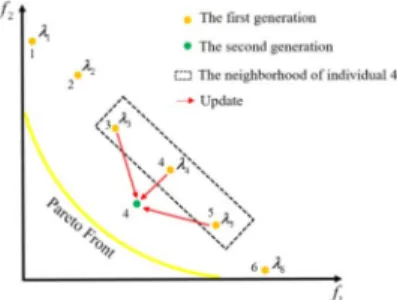
Fig. 1. Simple illustration of MOEA/D.
and optimizes them simultaneously. Each individual in the population of MOEA/D is associated with a subproblem and assigned ann-dimensional weight vectorλ=(λ1, λ2, . . . , λn), where n is the number of objective functions. Based on the distance between the weight vectors, the neighborhood rela-tionships among subproblems are determined. Considering the fact that neighboring subproblems should have similar optimal solutions, each individual is optimized using only the information of its neighbors.
Fig. 1 exemplifies the idea of MOEA/D using an MOP with two objectives. In Fig. 1, the yellow curve represents the Pareto front (PF). Dots in different colors represent indi-viduals in different generations and red arrows indicate the evolutionary direction. The population evolution in MOEA/D consists of three steps. First, six individuals, each of which is associated with a subproblem, are initialized and assigned different weight vectors λ1,λ2, . . . ,λ6. Second, the neigh-borhood of each subproblem is determined according to the distance between the weight vectors. For example, suppos-ing that the neighborhood size is 3, individuals 3 and 5 are selected as the neighbors of individual 4. Third, each individual is optimized based on the information of its neigh-bors, e.g., individual 4 is updated based on individuals 3–5. For more detailed descriptions of MOEA/D, please refer to [30].
III. MAXIMAL-CLIQUEGRAPH
In this section, the definition and the construction method of the maximal-clique graph are introduced. As the basic unit of the maximal-clique graph, the concept of the maximal clique is given at first. Given a graph, a clique is a complete subgraph in which every two nodes are adjacent [34].k-clique means the
size of the clique is k. A maximal clique is a special clique
which cannot be extended by adding any other nodes [34]. Take Fig. 2 as an example. Nodes v5,v6, and v7 compose a
3-clique, but it is not a maximal clique as it can be extended to a 4-clique by adding nodev8.
A recent study revealed that a community is typically composed of several cliques which share many common nodes [12]. Therefore, as one type of cliques, maximal cliques can be viewed as the essential unit of a community. Additionally, a node or an edge in a graph may belong to multiple maximal cliques. For example in Fig. 2, node v3 is
shared by maximal cliques①,②, and③, and the edge between
v5 and v6 is shared by maximal cliques ③ and ④. Using
Fig. 2. Examples of maximal cliques. Nodes v1, v2, and v3 constitute
maximal clique ①; nodes v3, v4, and v5 constitute maximal clique ②; nodesv3,v5, andv6 constitute maximal clique③; nodesv5,v6,v7, andv8
constitute maximal clique④.
revelation of the overlapping structure. In order to detect communities from the perspective of maximal cliques, this paper proposes to convert the original graph G = (V,E)
into a maximal-clique graph Gc = (Vc,Ec), where Vc = {vc1,vc2, . . . ,vcM} is named as clique nodes and Ec = {(vcm,vcn)|vcm,vcn ∈ Vc and m = n}is named as clique edges
or clique links, respectively. The conversion method contains
three steps: 1) determining the clique nodes; 2) measuring the link strength between clique nodes; and 3) determining the clique edges based on the distribution of link strength. Detailed implementation of these three steps is described in the following parts and the corresponding flowchart is presented in Fig. S1 in the supplementary material.
A. Determining Clique Nodes of Maximal-Clique Graph
Determining clique nodes is the first step to build a maximal-clique graph. In this paper, a set of maximal cliques in the original graph G are adopted as clique nodes of the
corresponding maximal-clique graph Gc. Since each maximal
clique is one of the largest cliques the nodes in G belong
to, this paper transforms the determination process of clique nodes into finding all the largest clique(s) that each node inG
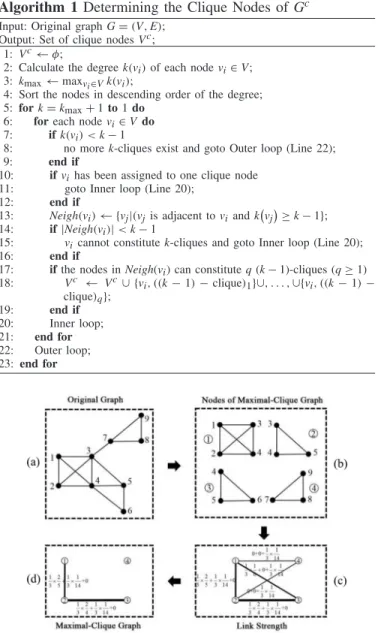
belongs to, and designs the corresponding method as shown in Algorithm 1.
In Algorithm1, the clique nodes are determined in descend-ing order accorddescend-ing to their clique sizes. Since the nodes with higher degrees are more likely to constitute larger maximal cliques, the determination process first calculates the degree of each node in Gand sorts the nodes in descending order of their degrees (lines 2–4). Suppose that the number of nodes ofGisN and the largest node degree iskmax, then the size of
cliques in Gis not larger than (kmax+1). Withkdescending
from (kmax+1) to 1, the determination process searches for the
k-clique(s) of each node. As every two nodes in a clique are
adjacent, the degrees of all nodes in a k-clique must be larger than (k−1). Additionally, since only the largest clique(s) for each node are interested, the searching process stops seek-ing smaller cliques for a node if it has been assigned to the larger ones. Therefore, the determination process only searches for k-clique(s) of a node when the following three conditions are satisfied: 1) the node degree is not smaller than (k−1) (lines 7–9); 2) the node has not been assigned to any cliques (lines 10–12); and 3) at least (k−1) adjacent nodes have a degree no smaller than (k−1) (lines 13–16). If all these conditions are satisfied, the determination process transforms the problem of finding all thek-clique(s) that contain this node
to that of searching for the (k−1)-clique(s) constituted by
Algorithm 1 Determining the Clique Nodes ofGc
Input: Original graphG=(V,E); Output: Set of clique nodesVc;
1: Vc←φ;
2: Calculate the degreek(vi)of each nodevi∈V;
3: kmax←maxvi∈Vk(vi);
4: Sort the nodes in descending order of the degree; 5: fork=kmax+1to1do
6: foreach nodevi∈Vdo
7: ifk(vi) <k−1
8: no morek-cliques exist and goto Outer loop (Line 22);
9: end if
10: ifvihas been assigned to one clique node 11: goto Inner loop (Line 20);
12: end if
13: Neigh(vi)← {vj|(vjis adjacent toviandk
vj
≥k−1}; 14: if|Neigh(vi)|<k−1
15: vicannot constitutek-cliques and goto Inner loop (Line 20);
16: end if
17: ifthe nodes inNeigh(vi) can constituteq(k−1)-cliques (q≥1)
18: Vc ← Vc∪ {vi, ((k−1)−clique)1}∪, . . . ,∪{vi, ((k−1)− clique)q}; 19: end if 20: Inner loop; 21: end for 22: Outer loop; 23: end for
Fig. 3. Illustration of constructing the maximal-clique graphGcfrom the original graph G. (a) Original graph G contains 9 nodes and 14 edges. (b) Clique nodes ofGccontains one 4-clique and three 3-cliques. (c) Link strength between different clique nodes is calculated and given beside each line. (d)wthris set to the averaged link strength of the graph in (c) and the final maximal-clique graph is determined.
its neighbors (line 17). Then all the discoveredk-cliques are added to the set of clique nodes (lines 18 and 19).
Figs.3(a) and (b) exemplify the above determination process of clique nodes. Fig. 3(a) shows the original graph with 9 nodes and 14 edges. The corresponding clique nodes are given in Fig.3(b), including one 4-clique and three 3-cliques. As can be seen, each node of the original graph is assigned to at least one clique node (i.e., maximal clique) of the cor-responding maximal-clique graph. For example, nodesv7,v8,
andv9belong to clique nodevc4, while nodesv4andv5belong
to both clique nodesvc2 andvc3.
B. Measuring Link Strength Between Cliques Nodes
Basic observations on a graph indicate that the link strength between two cliques depends on the ratios of
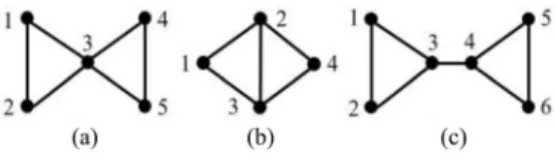
Fig. 4. Examples of (a) overlapping nodes, (b) overlapping edges, and (c) joint edges.
overlapping nodes, overlapping edges, and joint edges. Given two cliques, an overlapping node is a common node of both cliques, an overlapping edge is a common edge of both cliques, and a joint edge is an edge that connects a node in one clique with a node in the other. Taking two 3-cliques as an example in Fig. 4, node v3 in Fig. 4(a) is an overlapping
node, the edge between nodes v2 and v3 in Fig. 4(b) is an
overlapping edge, and the edge between nodes v3 and v4 in
Fig.4(c) is a joint edge. Since each clique node in a maximal-clique graph is a maximal-clique, the link strength between two maximal-clique nodes can be evaluated in the same way as evaluating the link strength between two cliques. Given two clique nodesvcmand vcn(m=n), the ratios of overlapping nodes, overlapping edges,
and joint edges are calculated as
ℓonvcm,v c n = N vcm vcn Nvc m +Nvc n −Nvc m vc n (5) ℓoevcm,vcn = vi,vj∈(vcm∩vcn)Aij vi,vj∈VAij (6) ℓjevcm,vcn = vi∈(vcm−vcn),vj∈(vcn−vcm)Aij vi,vj∈VAij (7) where N(vcm)and N(vcn) return the number of original nodes
in clique nodesvcmandvcn, respectively, andN(vcm∩vcn)returns
the number of original nodes in the intersection between clique nodesvcmandvcn.Ais the adjacent matrix of the original graph
and Aij = 1, if (vi,vj) ∈ E; otherwise, Aij = 0. Based on ℓon, ℓoe, and ℓje, the link strengthL(vcm,vcn) between vcm and
vcncan be defined as a weighted sum of these three components
Lvcm,vcn=αℓonvcm,vcn +βℓoevcm,vcn +γ ℓjevcm,vcn (8) where α, β, γ ∈ [0, 1] are the weights that control the impact
of overlapping nodes, overlapping edges, and joint edges on the link strength, respectively. Note that α+β +γ =1. In
this paper, for simplicity, all the weights are set to 1/3, namely, we consider that these three parts have equal contributions to the link strength between two clique nodes. Explicitly, we can derive that L(vcm,vcn)is within [0, 1), and only if there are no overlapping nodes, overlapping edges, and joint edges between
vcm andvcn,L(vcm,vcn)=0.
In Fig. 3(c), the nonzero link strength between the clique nodes in Fig. 3(b) is given. Taking the link between clique nodes vc1 and vc2 as an example, there are two overlapping nodes and one overlapping edge, but no joint edges. The total number of original nodes in clique nodes vc1
andvc2is 5. The number of original edges inGis 14. Hence,
ℓon = 2/5, ℓoe = 1/14, and ℓje = 0, and the link strength
betweenvc1 andvc2 isL(vc1,v2c)=1/3(2/5+1/14+0).
C. Determining Clique Edges of Maximal-Clique Graph
According to the previous two steps, the clique nodes and the link strength between them are obtained. Some links are strong, while the others are weak or even close to zero. If all the links with nonzero strength are admitted as clique edges, the following two problems may occur when detect-ing communities. First, the computational cost increases due to the large number of clique edges. Second, noise usually exists in a complex system, and thus weak links can interrupt the detection of community structure. In order to avoid the above problems, a threshold wthr is operated on the clique
edges to counteract the influence of noise and lower the complexity. A link is admitted as a clique edge only if its strength is beyondwthr. The setting ofwthr will be discussed
in Section V-B.
After determining clique edges, the original graphGis con-verted into a maximal-clique graph Gc. The link strength is considered as the weight of the corresponding edge. Take Fig. 3(d) as an example. With wthr set as the average link
strength, only two links in Fig. 3(c) are admitted as clique edges, resulting in a maximal-clique graph with four clique nodes and two clique edges.
IV. MCMOEA
This section details the implementation of the proposed MCMOEA, including the representation scheme, evolutionary operators, and the overall procedure.
A. Representation Scheme
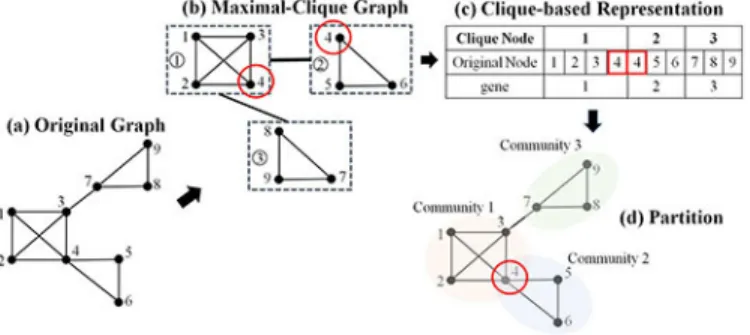
How to represent solutions in EAs has a great influence on the design of evolutionary operators and the algorithmic efficiency. As stated in Section I, the existing representation schemes, either prototype-based or node-based, have certain limitations when applied to the overlapping community detec-tion. To address these limitations, this paper proposes a new representation approach based on the introduced maximal-clique graph, namely, maximal-clique-based representation. In the proposed representation, each gene of an individual is an inte-ger that represents the community label of the corresponding clique node of the maximal-clique graph. Thus, every clique node can only be assigned to a unique community, which is similar to the separate community detection. However, as the maximal-clique graph has the property that clique nodes are allowed to share the same original nodes, the overlapping nodes shared by different clique nodes can actually be assigned to multiple communities. Taking Fig. 5 as an example, node
v4 is shared by both clique nodes vc1 and vc2 [Fig. 5(b)].
Since vc1 is assigned to community “1” and vc2 is assigned to community “2” [Fig. 5(c)], node v4 belongs to both
com-munities “1” and “2” [Fig. 5(d)]. The detailed population initialization is described as follows.
LetIi=(gi1,gi2, . . . ,giM)be theith individual in the pop-ulation of MCMOEA, where gij is the jth gene of Ii(j = 1,2, . . . ,M,i=1,2, . . . ,PS,Mis the number of clique nodes of the maximal-clique graph andPSis the size of population). The initialization ofIiis conducted by using a local algorithm in [16] to form a locally optimal partition of clique nodes.
Fig. 5. Example for the clique-based representation. (a) Original graphG. (b) Corresponding maximal-clique graph Gcis constructed based onGand each node inGis allowed to be assigned to multiple clique nodes ofGc, e.g., nodev4belongs to both clique nodesvc1 andvc2. (c) Proposed clique-based representation is adopted to assign each clique node an integer to represent the community label this node belongs to. For example, the community label of clique nodevc1is 1, indicating thatvc1belongs to community “1.” (d) Partition of the original graphGis directly determined based on the individual.
In detail, the algorithm builds the partitionCas follows. First,
the M clique nodes are randomly permuted and C is
initial-ized as an empty set. Then, following the permutation order, each unassigned clique node vcm is assigned to the first com-munity whose cohesiveness can be improved by includingvcm. If vcm cannot improve the cohesiveness of any existing com-munities, a new community that only contains vcm is added toC. Considering that the maximal-clique graph is a weighted graph, the cohesiveness of a community c is measured as in [17]
F(c)= Win(c)
Win(c)+Wout(c) (9)
where Win(c) and Wout(c) are the total weights of internal
edges and external edges of c, respectively. Based on the obtained partition C, the individual Ii can be initialized by setting each gene gim as the community label of vcm inC.
The proposed clique-based representation scheme has three features. First, instead of using the original nodes, the pro-posed approach uses clique nodes (i.e., maximal cliques) as the basic unit of the representation. Since overlap is an intrin-sic property of clique nodes in the maximal-clique graph, clique-based representation enables MOEAs to handle the overlapping community detection problem in a way similar to that of the separated community detection. Second, the clique-based representation does not require decoding individ-uals in the population evolution process, which largely lowers the computational complexity of MOEAs for overlapping community detection when compared with the indirect node-based approach. Third, the clique-node-based representation scheme has no limitations on the shape of communities and needs no prior community information, making it superior to the prototype-based representation scheme.
B. Evolutionary Operators
Evolutionary operators, including crossover and mutation, are the most important components of EAs, which significantly influence the population diversity and the convergence speed. Hence, it is crucial to select appropriate evolutionary operators
for the algorithm. In this paper, to fit the proposed clique-based representation scheme, we adopt the one-way crossover operator [9] and design a new mutation operator based on the maximal-clique graph.
1) Crossover: In many classic EAs, the crossover operator
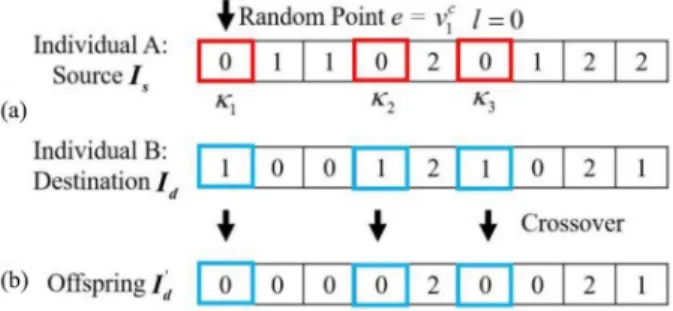
generates offspring by randomly exchanging genes of two parental individuals [24], [35]. However, such an idea of the crossover is not suitable for the proposed clique-based rep-resentation since community labels in different individuals are not compatible. Take the two individuals A and B in Fig.6(a) as an example. According to the clique-based repre-sentation scheme, both individuals indicate that clique nodes
vc1,vc4, andvc6belong to the same community, but the
commu-nity label is “0” in individual A but “1” in individual B. In this case, randomly exchanging genes between the two indi-viduals can easily break the promising community structure formed by vc1, vc4, and vc6. Therefore, this paper employs the one-way crossover operator introduced in [9]. The one-way crossover randomly selects two parental individuals from the population, with one set as the source (denoted as Is), and the other set as the destination (denoted asId). Then a clique node is randomly selected as the crossover seede. Letlbe the community label of einIs and κ be the set of clique nodes inIs that have the same community label asl. An offspring
I′d is generated by modifying Id so that all the clique nodes inκ are relabeled asl. By doing so, the offspring can merge the community structures of both parents. Using the two indi-viduals in Fig. 6(a) as parents, Fig. 6(b) shows an example of offspring generation utilizing the above one-way crossover, given thatvc1is selected as the crossover seed (i.e.,e=vc1and
l=0). For each individual, the crossover operator is executed with a predefined possibilitypc.
2) Mutation: A new mutation operator is proposed in this
paper to fit the clique-based representation. The essential idea is to improve the communities with low cohesiveness by including clique nodes that have strong connections with them. In detail, for each individualIiin the population, the mutation operator first calculates the cohesiveness of each community in Ii according to (9). Then an M-dimensional vector ri is generated, in which each element rij is a random number uniformly distributed in [0, 1].rij is compared with the cohe-siveness of the communitycgij that the clique nodev
c
j belongs to. If rij is larger than F(cgij), a clique node v
c
k adjacent to
vcj is randomly selected through the roulette wheel selection. The larger the weight on the clique edge (vcj,vck), the higher the probability thatvck will be selected. The mutation operator then changes the community label of vcj (i.e., gij) to that of
vck (i.e., gik). By doing so, each community in Ii, especially the one with low cohesiveness, is given a chance to adjust its structure, which leads to a possible improvement in the overall fitness.
C. Overall Procedure of MCMOEA
Following the framework of MOEA/D [30], MCMOEA is implemented using the clique-based representation scheme and the evolutionary operators described above. As MOEA/D, MCMOEA needs to decompose the problem of overlapping
Fig. 6. Simple illustration of the one-way crossover operator. (a) Parental individuals. (b) Offspring.
community detection into several scalar optimization sub-problems. Considering that the shape of PF is unknown and the weighted sum approach only works well for concave PF, Tchebycheff approach [27] is used in MCMOEA for decomposition. Let λ1,λ2, . . . ,λPS be a set of evenly spread weight vectors, where λi = (λi
1, λi2) (λi1, λi2 ∈ [0,1], and λi1+λi2=1) andPSis the size of population (i.e., the number of subproblems). Based on the maximal-clique graph and two objective functions defined in (3) and (4), a subproblem can be formulated as minimize gtex|λi,z∗ =max λi1KKM(x)−z∗1 , λi2 RC(x)−z∗2 (10)
wherexis a solution to the problem,z∗=(z∗
1,z∗2)is the
refer-ence point, i.e., the best values found so far for the KKMand RC, respectively, and i = 1,2, . . . ,PS. MCMOEA
approxi-mates the PF by minimizing thePSscalar subproblems defined
above using a population withPSindividuals.
As shown in Algorithm 2, MCMOEA contains three steps: 1) construction of the maximal-clique graph; 2) initialization; and 3) population evolution. In the first step, the maximal-clique graphGcis constructed from the original graphGusing the method introduced in Section III. In the second step, the population with PSindividuals is initialized according to the clique-based representation scheme proposed in Section IV-A.
PSweight vectorsλ1,λ2, . . . ,λPSare assigned to thePS indi-viduals I1,I2, . . . ,IPS, respectively. Then, the neighborhood
B(i) of each weight vector is determined by Euclidean distance.
The reference pointz∗is initialized by theKKMandRCvalues ofI1and the set of non-dominated solutions,NS, is initialized
as an empty set. In the third step, the population is evolved through the evolution operators described in Section IV-B. A new individual z is generated by performing crossover and/or mutation on each existing individual Ii. After evalu-ating zwith the two objective functions (i.e.,KKM andRC), the reference point, the neighborhood ofIi, and the set of NS
are updated accordingly.
The computational complexity of MCMOEA can also be analyzed from the above three steps. Suppose that there are
N nodes in the original graph G, M clique nodes in the corresponding maximal-clique graph Gc, and the maximum node degree in G is kmax. In the first step, the
computa-tional complexities of determining the clique nodes, mea-suring the link strength, and determining the clique edges
Algorithm 2 MCMOEA
Input:
G=(V,E): the original graph;
genmax: the maximum number of generations; PS:the size of population;
λ1,λ2, . . . ,λPS: a uniform spread ofPSweight vectors; T:the size of the neighborhood of each weight vector;
Output:
NS:the set of non-dominated solutions.
1. Construction of the Maximal-clique GraphGc:
1) Determine the set of clique nodesVc;
2) Measure the link strength between clique nodes;
3) Determine the set of clique edgesEcbased on the link strength. 2. Initialization:
4) Initialize the populationP= {I1,I2, . . . ,IPS}, where each individual Ii=(gi1,gi2,gi3, . . . ,giM)represents the current solution to thei-th subproblem;
5) Initialize the neighborhood of each weight vector. For each i =
1,2, . . . ,PS, setB(i) = {i1,i2, . . . ,iT}, whereλi1,λi2, . . . ,λiT are
theTclosest weight vectors toλiin the Euclidean space;
6) Initializez∗as(KKM(I1),RC(I1)); 7) InitializeNSas an empty set. 3. Population Evolution : 8) forg=1togenmax
9) fori=1toPS
10) Generate a random numberrifromU(0,1);
11) ifri<pc
12) Randomly choose another individual from B(i) and generate an offspring x by conducting the one-way crossover on this individual andIi;
13) else
14) SetxasIi;
15) end if
16) Generate anM-dimensional random vectorrifromUM(0,1); 17) forj=1toM
18) ifrij>F(cgij)
19) Generate a new individualzby mutatingx;
20) end if
21) end for
22) ifKKM(z) <z∗1, setz∗1 asKKM(z); 23) ifRC(z) <z∗2, setz∗2 asRC(z); 24) foreach individualIj∈B(i)
25) ifgte(Ij|λi,z∗) >gte(z|λi,z∗), replaceIjwithz;
26) end for
27) Remove fromNSall the solutions that are dominated byz; 28) AddztoNSif no solutions inNScan dominatez;
29) end for
30)end for
U(0,1): the normalized uniform distribution.
are O(N×k3max),O(M2), and O(M), respectively. Hence, the
computational complexity of the first step is O(max{N ×
k3max,M2}). In the second step, the computational complexity is bounded by the operation of population initialization which takes O(M2×PS). In the third step, the time complexity of crossover and mutation operators is related to M and can be realized in linear time, namely,O(M). The other operations can be finished in constant time. Therefore, the time complexity of the third step is bounded byO(M×PS×genmax) (PSis the size of population andgenmaxis the maximum number of
gen-erations). To sum up, the overall computational complexity of MCMOEA isO(max{N×kmax3 ,M2×PS,M×PS×genmax}). It should be noted thatM is usually smaller than or equal toN.
V. EXPERIMENTS ANDDISCUSSION
In this section, a series of experiments are designed based on synthetic and real-world networks to validate the performance
TABLE I
PARAMETERSETTINGS OFSYNTHETICNETWORKS
thr
of the proposed MCMOEA. First, the generation model of synthetic networks and evaluation indexes in use are intro-duced. Second, the influences of the parameter wthr,
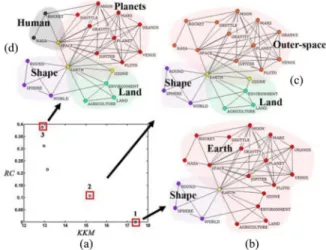
evalua-tion indexes and MOEA frameworks on the performance of MCMOEA are experimentally tested. Third, the performance of MCMOEA is evaluated on synthetic networks with differ-ent characteristics and compared with other five represdiffer-entative algorithms. Finally, MCMOEA is applied to four real-world networks and the benefit of using a multiobjective framework to detect overlapping communities is illustrated.
In all experiments, the parameters of MCMOEA are set as follows. PS and genmax are set as 100 and 50, respectively [27]. The crossover probability is set as a rela-tively high value, 0.7, to increase the population diversity [27]. The neighborhood size T is set as 20 according to the sug-gestion of MOEA/D [30]. All the experiments are carried out on computers with Intel Core i5-3470 (3.20 GHz) CPU, 16 GB RAM, and Ubuntu 12.04 LTS 64-bit operating system.
A. Synthetic Networks and Evaluation Indexes
In this paper, the Lancichinetti–Fortunato–Radicchi (LFR) model [36] is adopted to produce synthetic networks. A synthetic network under LFR can be described as LFR(N,k,kmax, τ1, τ2,cmin,cmax, µ,On,Om). N is the num-ber of nodes. kandkmaxare the average node degree and the
maximum node degree, respectively. τ1 and τ2 are the
expo-nents of the power law distributions that the node degrees and the community sizes, respectively follow. cmin and cmax
are the minimum and the maximum size of each community.
µ ∈ [0,1] is a mixing parameter that controls the average
ratio of the external links to the total links of each node. If
µ =0, all the edges in the network are intraconnections. If
µ=1, all the edges are interconnections. Therefore, a larger
µ indicates a more ambiguous community structure.On and
Om are two parameters specially defined for controlling the overlapping rate of communities in the network. On is the number of overlapping nodes, evaluating overlapping density among communities. Similar toµ, the higher the value ofOn, the more ambiguous the community structure is.Om, namely, overlapping membership, is the number of communities to which each overlapping node belongs. The difficulty of the detection problem increases with the rise ofOm.
Once the above parameters are determined, a synthetic network can be generated from the LFR model using the method in [36]. In this paper, the settings of LFR parame-ters follow the suggestions in [27] and [37]. k, kmax,τ1, and τ2 are fixed at 20, 50, 2, and 1, respectively.N is set at three
levels: 1000, 5000, and 10000. (cmin,cmax) is set as (20, 50),
(30, 70), and (40, 100) at different levels ofN, respectively,
since the community size generally slightly increases with the scale of the network.µvaries from 0.1 to 0.5,Onvaries from 0.1N to 0.5N, and Om varies from 2 to 8. In each experi-ment, a set of networks with different settings of N, µ, On, and Om is considered, which is summarized in Table I. The effectiveness and efficiency of MCMOEA can thus be studied at different levels of network scale, community ambiguity, and overlapping rate.
As a multiobjective algorithm, MCMOEA yields a set of non-dominated solutions, none of which is superior to the other on both objectives ofKKMandRC. In order to facilitate comparison with algorithms that treat overlapping community detection as a single-objective problem, an evaluation index is needed to select one solution from the set of non-dominated solutions. In this paper, the generalized normalized mutual information (gNMI) [16] and the modularity (Qov) [38] are
adopted as the evaluation criteria. The first index, gNMI, eval-uates the similarity between the true partition and the detected one, which is only suitable when the true community struc-ture is already known. The second index, Qov, measures the difference between the fraction of edges within the given com-munities and the expected fraction if edges are distributed at random. Obviously,Qovcan be used without knowing the true community structure. Therefore, gNMI can only be used in the experiments on synthetic networks, whileQov can be used on both synthetic and real-world networks. Both gNMI andQov range from 0 to 1. The higher values of the gNMI and Qov are, the better the quality of a solution will be.
B. Investigation of the Parameter wthr
As stated in Section III-C,wthris a threshold of link strength
for determining clique edges of the maximal-clique graph. Only links with strength beyond wthr will be admitted as
clique edges. The setting ofwthrthus has a direct control over
yet significant influence on the algorithmic performance since MCMOEA operates on the maximal-clique graph. To study the effect of wthr and find its appropriate setting, the
per-formance of MCMOEA using different wthr is compared on
eight synthetic networks. For detailed settings of the synthetic networks, please refer to part 1 of Table I. On each net-work, MCMOEA is tested with wthrrising from 0 to 30wavg,
where wavg is the average link strength of clique nodes in the
maximal-clique graph. For each value of wthr, MCMOEA is
run for 30 independent times and the average gNMI value is reported for comparison. Fig. S2 in the supplementary material, plots the average gNMI as a function ofwthr/wavg.
From Fig. S2 in the supplementary material, it can be observed that in most cases the MCMOEA with extreme wthr
values performs the worst, e.g., wthr = 0 or wthr =30wavg.
This observation is not surprising. Ifwthris too small, a large
number of links between clique nodes are kept as clique edges, which interferes community detection as the noise between communities increases. On the opposite, ifwthris too
large, most links between clique nodes are filtered out, which causes possible loss of useful information for revealing the actual community structure. Besides the above observation, it is also noticed that the curves in Fig. S2 in the supple-mentary material, have consistent shapes. That is, the average gNMI value rises from wthr = 0, reaches the top at about
wthr = wavg, remains steady for a small interval, and then
drops until wthr = 30wavg. Such a phenomena suggests that
wthr =wavg is a generally good setting no matter what kind
of network it is. Hence, the wthr is always set to wavg in the
following experiments.
Comparing the curves in Fig. S2 in the supplementary mate-rial, it can also be summarized that the decreasing trend after the turning point becomes less steep asµ,On, orOmincreases. As stated in Section V-A, larger values of µ, On, and Om indicate a more ambiguous community structure and a higher overlapping rate. In this case, a largerwthris preferred for
fil-tering out more links so that the community structure becomes clearer.
C. Investigation of gNMI and Qov
Since gNMI andQovare both evaluation indexes suitable for synthetic networks, an experiment is designed here to inves-tigate the differences between the partitions chosen by gNMI andQov. To make a comprehensive test,µ,On, andOm are all set to different levels, which are {0.1, 0.3, 0.5}, {0.1N,0.3N, 0.5N}, and {2, 4, 6, 8}, respectively. N is set to 1000. The detailed parameter settings of the synthetic networks are listed in part 2 of Table I. On each network, MCMOEA is run for 30 independent times. For each run, the best gNMI value and the correspondingQov (gNMI_Qov) value, as well as the best
Qovvalue and the corresponding gNMI (Qov_gNMI) value are recorded. The average results of each index over 30 runs are reported in Fig. S3 and Table SI in the supplementary material. From Fig. S3 in the supplementary material, it can be observed that the difference between the best gNMI andQov_gNMI, or between the best Qov and gNMI_Qov is slight, indicating the solutions chosen by gNMI and Qovare similar.
Additionally, to make a further comparison, this paper also examines the cumulative distributions of community sizes of partitions chosen by gNMI and Qov and compares them with the known ground truth. The results are presented in Figs. S4–S6 in the supplementary material. As can be seen, compared toQov, the cumulative distribution curves of gNMI are closer to those of the true partitions on almost all net-works, implying that gNMI may be slightly more suitable as the evaluation index for synthetic networks. Therefore, in the following experiments, gNMI is used as the crite-rion on synthetic networks and Qov is used on real-world networks.
D. Comparisons of MCMOEAs Based on Different MOEAs
As stated in Section II-C, different kinds of MOEAs are applicable for the proposed MCMOEA [39]–[43]. Therefore, in this section, except MOEA/D, other state-of-the-art MOEAs are adopted to implement MCMOEA for investigating the per-formance of MCMOEA based on different MOEAs. Among the existing MOEAs, NSGA-II [31] is a classical domination-based MOEA, which has been widely used in many fields and shown excellent performance. MOEA_DLA [33] is a new MOEA, which achieves a competitive performance by tak-ing advantages of both MOEA/D and NSGA-II. Therefore, this paper chooses NSGA-II and MOEA_DLA as the rep-resentatives of MOEAs to implement MCMOEA and com-pares their performance with MOEA/D-based MCMOEA. The implementation details of MCMOEA using NSGA-II and MOEA_DLA as the MOEA frameworks are, respectively, provided in Algorithms S1 and S2 in the supplementary material.
The parameter settings of the synthetic networks are listed in part 3.1 of Table I. To make a comprehensive compar-ison, µ, On, and Om are all set to different levels, which are {0.1, 0.3, 0.5}, {0.1N, 0.3N, 0.5N}, and {2, 4, 6, 8}, respectively, and N is set to 1000. For the sake of fair-ness, parameters of the three MCMOEAs are set to the same values, i.e., PS = 100, genmax = 50, and pc = 0.7. On each network, each MCMOEA is run for 30 indepen-dent times and the average gNMI is reported in Table SII in the supplementary material. Additionally, the computa-tional speed of three MCMOEAs is also compared on several networks with different scales. The corresponding network information is listed in part 3.2 of Table I. The compari-son results are reported in Table SIII in the supplementary material.
From Tables SII and SIII (in the supplementary material), we can see that, MOEA_DLA-based MCMOEA shows the best performance on partition accuracy, and MOEA/D-based MCMOEA consumes the least computational time. Overall, it can be observed that the differences among these three MCMOEAs on both partition quality and computational speed are slight. Therefore, in the following experiments, the one with the least time, i.e., MOEA/D-based MCMOEA is used as the representative to further validate the performance of MCMOEA.
E. Experiments on Synthetic Networks
In this section, based on the synthetic networks, two exper-iments are designed to test the effectiveness and efficiency of MCMOEA. The first experiment makes a comprehensive anal-ysis of how MCMOEA performs on networks with different properties, including community ambiguity (µ), overlapping rate (OnandOm), and network scale (N). The second experi-ment compares the performance of MCMOEA with other five representative algorithms.
1) Performance of MCMOEA on Synthetic Networks: To
well observe how the performance of MCMOEA varies on networks with the change of eitherµ,On,Om, orNseparately, the method of controlling variables is adopted here. That is to say, when investigating one parameter, the other ones are held constant. Therefore, this experiment is divided into four parts. 1) Verifying the performance of MCMOEA on networks
with differentµand constantOn,Om, andN.
2) Verifying the performance of MCMOEA on networks with differentOnand constantµ,Om, andN.
3) Verifying the performance of MCMOEA on networks with differentOm and constantµ,On, andN.
4) Verifying the performance of MCMOEA on networks with differentN and constantµ,On, andOm.
In each part, to give a comprehensive result, the fixed parame-ters exceptNare all set to two values, which are the minimum and maximum of their feasible ranges, respectively. As forN, considering the computational cost, it is always set to 1000 in the first three parts. The detailed parameters setting of the synthetic networks is presented in part 4 of TableI. For each network, 30 independent runs of MCMOEA are conducted and the average gNMI is used as result.
First, the performance of MCMOEA on networks with dif-ferent µ is investigated. On, Om, and N are set to {0.1N, 0.5N}, {2, 8}, and 1000, respectively. Through increasing
µ from 0.1 to 0.5 with the step of 0.1, the performance
of MCMOEA is evaluated on each network and the results are shown in Fig. S7 in the supplementary material. As can be seen, all curves in Fig. S7 in the supplementary material, present similar tendency that the performance of MCMOEA naturally decreases with the increase ofµ, because a higher value of µ indicates a more ambiguous community structure.
Second, the performance of MCMOEA on networks with different On is evaluated. µ, Om, and N are set to {0.1, 0.5}, {2, 8}, and 1000, respectively. The performance of MCMOEA is displayed in Fig. S8 in the supplementary material with On increasing from 0.1N to 0.5N with the step of 0.1N. Obviously, we can see that with On increasing, MCMOEA performs worse and worse. This is not surprising because a largerOn implies a higher overlapping density, and such a high overlapping density usually blurs the boundary of the communities and increases the challenge to the community detection.
Third, the performance of MCMOEA on networks with different Om is tested. µ, On and N are set to {0.1, 0.5}, {0.1N, 0.5N}, and 1000, respectively. Om varies from 2 to 8 with the interval 1. The results are presented in Fig. S9 in the supplementary material. As can be seen, the
performance of MCMOEA decreases with the increase ofOm. The fundamental reason is that, with the increase of Om, it becomes harder and harder to successfully detect all the com-munities that each overlapping node belongs to, resulting in a lower partition accuracy.
Finally, we evaluate how the performance of MCMOEA changes on networks with the increase of
N. µ, On, and Om are set to {0.1, 0.5}, {0.1N, 0.5N}, and {2, 8}, respectively. N increases from 1000 to 5000 and 10000. The results are shown in Fig. S10 in the supple-mentary material. As can be seen, when µ, On, and Om are all small, MCMOEA shows similar performance on networks with different N, such as µ = 0.1, On = 0.1N, and Om = 2. However, when the value of µ [observing Figs. S10(a)–(d) in the supplementary material, separately] becomes large, the performance of MCMOEA decreases with the increase of N. The similar conclusions can also be obtained on On [comparing Fig. S10(a) with (c) or Fig. S10(b) with (d) in the supplementary material] and Om [comparing Fig. S10(a) with (b) or Fig. S10(c) with (d) in the supplementary material]. The fundamental reason of these phenomena lies in insufficient population diversity for the large scale networks. As we know, a largerN usually means a longer length of the individual and more communities. Meanwhile, with the increase ofµ(OnorOm), the number of communities also increases. However, for the same population size and evolutionary generation of MCMOEA, the increases of the individual length and the number of communities inevitably result in a decrease of population diversity, leading to a decrease in the quality of the final solutions.
In conclusion, we can obtain that MCMOEA works well on synthetic networks with different combinations ofµ,On,Om, andN. For example, in Fig. S7 in the supplementary material, when On,Om, andN are set to 0.1N, 2, and 1000, the value of gNMI is always larger than 0.85, even whenµincreases to 0.5. In Fig. S8 in the supplementary material, when µ=0.1,
Om = 2, and N = 1000, the value of gNMI is larger than 0.8 even increasing On to 0.5N. Likewise, as can be seen in Fig. S9 in the supplementary material, the value of gNMI is also larger than 0.8 even Om increases to 8 with µ = 0.1,
On=0.1N, andN=1000. Additionally, even though all the parameters are set to the maximum of their feasible ranges, i.e.,µ=0.5,On=0.5N,Om=8, andN=10000, the value of gNMI is still larger than 0.5 as shown in Fig. S10 in the supplementary material.
2) Comparisons With Other Representative Algorithms:
In this section, the performance of MCMOEA is com-pared with other five algorithms: 1) clique percolation method (CPM) [12]; 2) link clustering [13]; 3) speaker-listener-based information propagation algorithm (SLPA) [18]; 4) MOEA based on the signed similarity for detecting communities from social networks (MEAs_SN) [27]; and 5) improved multiobjective quantum-behaved particle swarm optimization (IMOQPSO) [28]. The five algorithms are selected for comparison as they are either state-of-the-art methods for overlapping community detection or relevant to MCMOEA in some sense. In detail, CPM [12] first introduced the conception of the clique into the field of
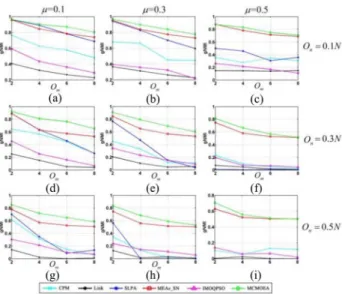
Fig. 7. Comparison results of gNMI values between MCMOEA and other five representative algorithms. (a) µ=0.1,On =0.1N,Om = {2,4,6,8}, andN=1000. (b)µ=0.3,On=0.1N,Om= {2,4,6,8}, andN=1000. (c) µ=0.5,On =0.1N,Om = {2,4,6,8}, andN =1000. (d)µ= 0.1, On = 0.3N,Om = {2,4,6,8}, and N = 1000. (e)µ =0.3,On = 0.3N, Om= {2,4,6,8}, andN=1000. (f)µ=0.5,On=0.3N,Om= {2,4,6,8}, andN=1000. (g)µ=0.1,On=0.5N,Om= {2,4,6,8}, andN=1000. (h) µ=0.3,On = 0.5N,Om = {2,4,6,8}, andN = 1000. (i)µ= 0.5, On=0.5N,Om= {2,4,6,8}, andN=1000.
community detection. Link clustering [13] is featured by using links instead of nodes to discover community structures. As for SLPA [18], a previous review [37] claimed that it is a competitive method for overlapping community detection. MEAs_SN [27] and IMOQPSO [28], [44]–[47] are two
rep-resentatives of MOEAs applicable to overlapping community detection. For each algorithm in comparison, the code is pro-vided by its authors. CPM, link clustering, and SLPA are implemented with C++, MEAs_SN with C, and IMOQPSO with MATLAB. The tunable parameters of each algorithm are set as the suggestion of the corresponding paper.
The parameter settings of the synthetic networks used in this section are listed in part 5.1 of TableI. In this experiment, the networks are all with 1000 nodes.µ,On, andOmare set to {0.1, 0.3, 0.5}, {0.1N, 0.3N, 0.5N}, and {2, 4, 6, 8}, respec-tively, which are the minimum, the median and the maximum of their feasible ranges, to represent the networks with different properties. Hence, these algorithms are compared on totally 3×3×4 = 36 networks with different levels of
community ambiguity and overlapping rate. By doing so, it is expected that the comparison can be comprehensive and thor-ough. For the sake of fairness, on each network, the algorithms with adjustable control parameters (i.e., CPM, link clustering, and SLPA) report their best results among different parameter settings, and the results of nondeterministic algorithms (i.e., SLPA, MEAs_SN, IMOQPSO, and MCMOEA) are averaged over 30 independent runs. The comparison results of gNMI among these algorithms are presented in Fig. 7 and Table SIV in the supplementary material. Additionally, in order to provide insight into the behaviors of different algorithms, this paper also examines the cumulative distri-bution of community sizes of each algorithm and compares
it with the known ground truth on each network. The results are shown in Figs. S11–S13 in the supplementary material.
From Fig. 7, three observations can be obtained. First, as expected, the performance of all the algorithms decreases as either of the three network parameters (µ, On, or Om) increases. Second, MCMOEA and MEAs_SN substantially outperform CPM, link clustering, and IMOQPSO on all the total 36 networks. Comparing with SLPA, MCMOEA and MEAs_SN achieve similar performance whenµ,On, and Om are all small. However, with either of the three parameters (µ,On, orOm) increases, the performance of SLPA decreases dramatically and becomes much worse than MCMOEA and MEAs_SN. Third, when compared MCMOEA with
MEAs_SN, MCMOEA performs better than, or at least as well
as MEAs_SN on all networks. Moreover, MCMOEA is more
robust to the variations of On andOm. Take the first column of Fig.7as an example [i.e., Figs.7(a), (d), and (g)]. Withµ
andOm fixed andOn rising from 0.1Nto 0.5N, the change of gNMI for MCMOEA is smaller than that of MEAs_SN. Take Fig. 7(d) as another example. With µ and On fixed and Om rising from 2 to 8, the performance of MCMOEA degrades more gently than that of MEAs_SN. From Figs. S11–S13 in the supplementary material, it can be observed that when µ,
On, andOmare all small, the cumulative distributions of com-munity sizes of CPM, SLPA, MEAs_SN, and MCMOEA are similar and close to the true community size structures. With the increase of eitherµ,On, orOm, all curves gradually devi-ate from the known ground truth. However, compared to other algorithms, the curves of MCMOEA are closer to those of the true partitions on almost all networks.
Although MCMOEA shows great superiority in gNMI to other algorithms, recent studies [48]–[50] pointed out that gNMI may have the selection bias problem that tends to choose solutions with more communities. That is to say, a par-tition with a higher number of communities is more likely to obtain a larger gNMI value. To avoid this possible unfairness caused by gNMI, another evaluation index, called scaled nor-malized mutual information (FNMI) [49], is also adopted to evaluate the performance of all algorithms in comparison. As an adjustment of gNMI, FNMI [49] can overcome the defect of gNMI to some extent by punishing partitions that have a number of communities either too higher or too lower than the true number. Similar to gNMI, FNMI is in the range of [0, 1] and a larger FNMI represents a better partition. The com-parison results of FNMI among all algorithms are presented in Fig. S14 and Table SV in the supplementary material. From Fig. S14 in the supplementary material, it can be observed that the comparison results of FNMI are roughly similar to those of gNMI. For example, the performance of CPM, link cluster-ing and IMOQPSO are much worse than those of MCMOEA and MEAs_SN on all networks. SLPA has the similar perfor-mance to MCMOEA and MEAs_SN whenµ,On, andOmare all small. However, with the increase of eitherµ,On, orOm, its performance dramatically decreases and becomes much worse than MCMOEA and MEAs_SN. The only difference lies in the relationship between the performance of MEAs_SN and MCMOEA. When measured by gNMI, MCMOEA performs better than, or at least similar to MEAs_SN on almost all